2012 Snap Lake Mine
Contents
1
Introduction from our CEO
3
Employment Report
13
Human Resources and Training
19
Scholarships
21
Health and Wellness
24
Social Investment and Culture
31
Tony Guthrie Chief Executive Officer, Mining, Canada
“Operating a diamond mine in the North is about more than just diamonds. It is about the relationships that are forged between our employees and the people who live close to our projects.”
These opening words from our 2006 Snap Lake Mine Socio-Economic Report remain as true today as they did then. Unchanged is De Beers’ commitment to working with the Government of the NWT, Aboriginal governments, communities and residents to maximize the benefits that flow from our operation. We recognize that communities close by continue to be eager for jobs and business opportunities and their passion for protecting the land and water is unwavering.
In 2012, we recovered 870,000 carats from 918,000 tonnes of ore, production built upon the pillars of safety and environmental protection.
I am proud to report that at the end of 2012, employees at the Snap Lake Mine had worked 1.3 million hours without a Lost Time Injury.
Throughout the year, we invested significant resources, both personnel and financial, to successfully manage water. We worked hard to reinforce an open, transparent relationship with communities and regulators. We will build upon this success through 2013 and over the life of the mine.
The purpose of this report is to demonstrate how we are doing in terms of meeting commitments made in the Snap Lake Mine socio-economic agreement with the Government of the Northwest Territories:
• The number of NWT residents employed at Snap Lake is at an all-time high;
• The mine workforce included 21 trainees;
• Women working at the Snap Lake Mine fill a diverse range of occupations;
• 69% of the goods and services purchased for the mine in 2012 came from NWT companies and joint ventures;
• We celebrated the 10th anniversary of our Books in Homes program in 2012 and published a book of NWT writing with NorthWords NWT; • 15 NWT students received scholarships under our new NWT
scholarship program; and,
• Corporate Social Investment in education and training, sponsorships and cultural support surpassed $3.3 million.
“ Operating a diamond mine
in the North is about more
than just diamonds. It is about
the relationships that are forged
between our employees and
the people who live close to
our projects.”
There continue to be challenges. The lack of skilled NWT residents needed to fill jobs at Snap Lake has not changed. We cannot address this gap alone and we remain a committed partner with the NWT Mine Training Society and other agencies. Global realities drive the critical business decisions needed to make Snap Lake a long-term success. Together, we will understand how devolution and resource revenue sharing can bring new benefits to the NWT.
As we move through 2013, we remain focused on strengthening relationships. We will accomplish this by being honest and transparent, willing partners to do what we can to support community aspirations.
We hope that as you read this report, you will get to know us better, to join us in celebrating our success, and understand how the Snap Lake Mine is providing real and lasting social and economic value to the North
About the Snap Lake Mine
The Snap Lake Mine opened in 2008 and is located 220 km northeast of Yellowknife. It is De Beers’ first mine outside of Africa. A completely underground operation, diamonds are recovered from a kimberlite dyke, or sheet, that averages 2.5 metres-3 metres in thickness and declines down beneath Snap Lake at approximately 12 degrees.
In Canada, we also operate the Victor Mine in the James Bay lowlands of Northern Ontario. We are also the 51% joint venture partner with Mountain Province Diamonds in the proposed Gahcho Kué Project, 280 km northeast of Yellowknife.
De Beers is committed to sustainable development in local communities. The Snap Lake Mine has signed four Impact Benefit Agreements (IBA) including:
• Yellowknives Dene First Nation (November 2005); • Tlicho Government (March 2006);
• North Slave Métis Alliance (August 2006); and, • Lutsel K’e and Kache Dene First Nation (April 2007).
This report is designed to fulfill reporting requirements as outlined in the Socio-Economic Monitoring Agreement signed between De Beers and the Government of the Northwest Territories in 2004. It includes a section on 2012 employment, recruitment initiatives, training, procurement, health and wellness initiatives, social investment and our support for cultural initiatives.
Snap Lake Mine Quick Facts
Capital cost $975M
Mine life 20+ years
Mine-site area 500 ha
Tonnes processed in 2012 918,000 Carats recovered in 2012 870,000 Production workforce 757 PY (2012) Northern workforce 275 PY (2012) Investment to date (December 2012) $1.9B NWT spend to date (December 2012) $1.3B Aboriginal spend to date (December 2012) $768M Social investment in 2012 $3.3M
A bolter operator installs bolts and screens to secure a section of the underground mine.
The workforce made up of De Beers and contractors at the Snap Lake Mine grew for the third year in a row in 2012. An additional 79 person- years worked brought the year’s overall employment to 757. This steady growth in employment over the past three years comes as a direct result of bringing production at the mine up to its capacity after the setback that occurred in 2009 as a result of the world economic recession.
With the Snap Lake Mine’s workforce growing, we are inching closer and closer to our original target to employ 300 NWT residents full time. In 2012, there were 275 person-years of employment filled by NWT residents, which is a slight increase from the previous year and is the largest NWT resident workforce we have ever had working at the mine site since we began operations.
Finding, training, and retaining NWT resident employees remains a challenge. This is illustrated by the results of our 2012 hiring campaign. Over the course of 2012, we held competitions for 93 full-time
permanent jobs within De Beers’ workforce at the Snap Lake Mine. These competitions attracted 3,907 applications. Applicants residing in the NWT represented only 28 percent of the total. However, 46 percent of the jobs were filled by NWT residents. These results reflect well on the use of hiring priorities.
Number of person-years of employment
Non-NWT Residents NWT Residents
1,200 1,000 800 600 400 200 0 2005 2006 2007 2008 2009 2010 2011 2012
Annual Employment at the
Snap Lake Mine
(construction phase 2005 to 2007; operations phase 2008 to 2012)
2012 De Beers Canada’s Snap Lake
Job Vacancies & Recruitment Results
number
of Applications ResultsHiring
NWT Aboriginal Residents 514 13% 23 25% Other NWT Residents 598 15% 20 21%
Total nWT Residents 1,112 28% 43 46%
Non-NWT Residents 2,795 72% 50 54%
Total Received/Hired 3,907 100% 93 100%
(based on 93 De Beers Canada job opportunities)
2012 Number of Applicants for De Beers
Canada Full -Time Positions
2012 Number of New Hires for De Beers
Canada Full -Time Positions
Southern Residents 72% NWT Residents 28% Southern Residents 54% NWT Residents 46% • Aboriginal 13% • Other 15% • Aboriginal 25% • Other 21%
Employment Report
Pat Decque, a Mine Operations Senior Supervisor, checks in with workers during a visit underground.
Hiring NWT residents is our top priority, and we are working to grow the number of NWT residents who are employed at the Snap Lake Mine. For that to happen, the labour supply will have to improve, especially the supply of labour with the skills to compete for semi-skilled and skilled jobs at the mine. It is in these two job categories that most of the mine site employment can be found.
It is not helping matters that the territory lost 900 residents through out-migration over the 12 month period from July 2011 to July 2012. By the final quarter of last year, the NWT’s population was the lowest it had been since early 2007 at 43,313, having declined for five consecutive quarters.
The reality for the NWT and its labour supply is that labour shortages in the mining sector exist throughout Canada and around the world. The 2009 survey of mine workers conducted by the NWT Bureau of Statistics on behalf of the Government of the Northwest Territories and the three NWT diamond mines revealed the high cost of living and distance from family and friends are important factors that influence a person’s residency decision. These factors have not changed since the survey was conducted and are not likely to change in the near future. Nevertheless, we remain committed to finding and developing new labour from within the NWT and are confident employment targets will be realized over the life of the Snap Lake Mine.1
1 See Section 3.4.2 in the Snap Lake Socio-Economic Agreement. Achieving this 60 percent target is subject to the availability of persons in the priority groups with the required skills, training and experience.
NWT Population
(quarterly, 2005 to 2012) 42,400 42,600 42,800 43,000 43,200 43,400 43,600 43,800 44,000 44,200 Number of residents 44,400 Q 1 20 05 Q 2 20 05 Q 3 20 05 Q 4 20 05 Q1 2 00 6 Q 2 2 00 6 Q 3 2 00 6 Q4 2 006 Q1 2 00 7 Q 2 2 007 Q 3 2 007 Q 4 2 007 Q1 2 00 8 Q 2 2 00 8 Q 3 2 00 8 Q 4 2 00 8 Q1 2 00 9 Q 2 2 00 9 Q 3 2 00 9 Q 4 2 00 9 Q 1 2 010 Q 2 2 010 Q 3 2 010 Q 4 2 010 Q 1 2 011 Q 2 2 011 Q 3 2 011 Q 4 2 011 Q 1 2 012 Q 2 2 012 Q 3 2 012 Q 4 2 012Trudy Beaulieu drives a haul truck underground at the Snap Lake Mine.
Employment by Hiring Priority
Table 1 presents employment in person-years2 by hiring priority for the
Snap Lake Mine from 2005 to 2012. The first three years, 2005 to 2007, represents the employment numbers during the mine’s construction phase. A total of 2,200 person-years of direct employment were created during this phase. The mine went into production in 2008, with total employment for the year equal to 728 person-years. By the end of that year, however, the world was falling into a severe recession that resulted in workforce reductions and a suspension of operations for six weeks in 2009. The year ended with an average monthly workforce 300 person-years below the previous year. By mid to late 2009, the world’s economy was inching out of its recession and a period of cautious growth began. The world economy remained fragile in 2012, with several European countries in deep recession and the United States’ economy growing slowly.
At pace with the rebuilding world economy, we have been bringing the Mine’s production up to capacity. For 2012, employment totalled 757 person-years, which is an increase of 79 over last year and represents the highest operational workforce since the mine was commissioned in 2008. The year also saw the highest number of NWT Aboriginal resident employees equal to 149 person-years—20 percent of the overall workforce. It is also noteworthy that De Beers and our Snap Lake contractors employed 275 NWT resident labour (Aboriginal and non-Aboriginal) which is the most ever and is just 25 shy of our commitment to employ 300 NWT residents at the Snap Lake Mine.3
The continued need to go outside the territory to find new employees remains disappointing. Individuals residing outside the NWT filled 50 of the 93 full-time jobs that became available at De Beers Canada for the Snap Lake Mine in 2012. This is an area that will continue to receive attention. We regularly attend recruitment fairs and trade shows throughout the territory to promote employment at the mine and advertise all Snap Lake Mine job openings through NWT media and in communities.
Scoop operator Hank Pankratz has worked at the Snap Lake Mine for several years.
2 In 2012, it was expected that over a full year, an employee would work 13 cycles of 14 days with a day equalling a 12 hour shift. This represents 2,184 hours per year or an average of 182 hours per month. Therefore,
estimating number of jobs in terms of person years requires summing the total number of hours worked by all employees and dividing that number by 2,184.
3 An employment target of 300 person-years for NWT residents was established for the Snap Lake Diamond Mine during its environmental assessment, which was 60% of the 500 full-time equivalent jobs predicted
for the operations phase of the mine. De Beers continues to grow NWT resident involvement.
2005 2006 2007 2008 2009 2010 2011 2012 Total Average Person-years NWT Aboriginal 39 93 126 139 92 123 145 149 906 113 Other NWT residents 56 130 143 135 71 106 104 126 871 109 Subtotal nWT Residents 95 223 269 274 163 229 249 275 1,777 222 Non-NWT 137 614 875 454 269 406 429 482 3,666 458 Grand Total 231 838 1,144 728 431 635 678 757 5,443 680 Percent of total NWT Aboriginal 17% 11% 11% 19% 21% 19% 21% 20% 17% 17% Other NWT residents 24% 16% 13% 19% 16% 17% 15% 17% 16% 17% Subtotal nWT Residents 41% 27% 24% 38% 38% 36% 37% 36% 33% 35% Non-NWT 59% 73% 76% 62% 62% 64% 63% 64% 67% 65% Grand Total 100% 100% 100% 100% 100% 100% 100% 100% 100% 100%
Note: Those that did not self identify in the survey are recorded as non-Aboriginal. NWT Aboriginal employees who were identified as residing outside the NWT are recorded as Non-NWT Aboriginal Residents in this table. Figures may not add up due to rounding error.
Table 2 provides information on the employment record of De Beers and our contractors for 2012. Our employees provided 466 person-years of labour to the Snap Lake Mine, 34 percent of which came from NWT residents. NWT Aboriginal labour provided 82 person-years of the employment, while other NWT residents contributed 79 person-years of labour. Another 45 person-person-years of employment came from Aboriginal labour residing outside the territory.4 In all cases, these
figures represent increases from 2011, however, the contribution of each group relative to the overall workforce is essentially unchanged from last year.
Snap Lake Mine contractors provided 291 person-years of labour to the Project—an increase of 33 over last year. NWT residents supplied 40 percent of this labour. De Beers’ contractors employ a higher percentage of NWT Aboriginal labour than NWT non-Aboriginal labour.
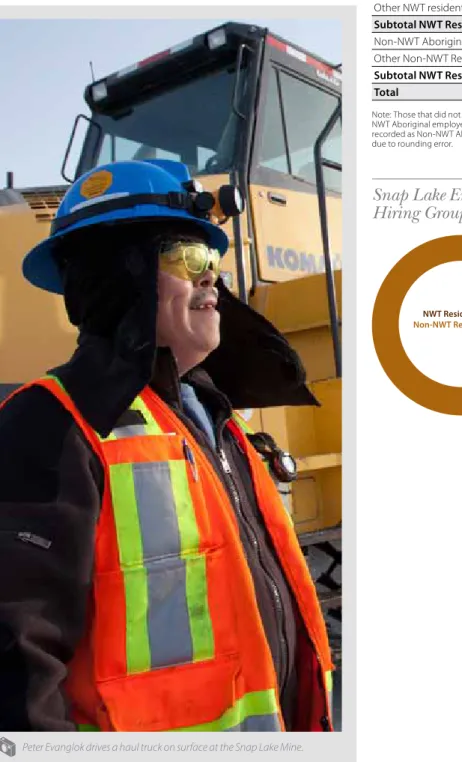
Peter Evanglok drives a haul truck on surface at the Snap Lake Mine.
4 The Employment Statistical Information (ESI) Form used for the Snap Lake Mine results in data that require some explanation and interpretation. Aboriginal employees can record their status in one of three
categories within the survey: Impact Benefit Agreement (IBA) Group, NWT Aboriginal or Other Aboriginal. An Aboriginal person who is a member of the North Slave Métis Alliance, Yellowknives Dene First Nation, Lutsel K’e and Kache Dene First Nation or Tlicho Nation can identify themselves as representatives of their IBA group, regardless of where they live. “NWT Aboriginal” is defined in the survey as Any Indian, Inuit or Métis individual who originated in the NWT or is a descendant of an Aboriginal person originating in the NWT. De Beers assumes that this will capture every employee who represents any other Aboriginal group in the NWT regardless of their residency. Finally, De Beers assumes that “Other Aboriginal” captures all other Aboriginal people. It is important to note that someone who identifies himself or herself as part of an IBA group or another NWT Aboriginal group might not reside in the NWT. Also, a number of individuals choose not to self-identify themselves by their heritage or location. These individuals are recorded as non-Aboriginal, non-NWT residents.
Note: Those that did not self identify in the survey are recorded as non-Aboriginal. NWT Aboriginal employees who were identified as residing outside the NWT are recorded as Non-NWT Aboriginal Residents in this table. Figures may not add up due to rounding error.
Table 2: Employment by Hiring
Priority, 2012
De Beers contractor Total
Person-years
NWT Aboriginal 81.8 67.3 149.1 Other NWT residents 78.6 47.8 126.4
Subtotal nWT Residents 160.4 115.1 275.5
Non-NWT Aboriginal 44.6 14.3 59.0 Other Non-NWT Residents 260.8 161.9 422.7
Subtotal non-nWT Residents 305.4 176.2 481.7 Total 465.8 291.3 757.1 Percent of total NWT Aboriginal 18% 23% 20% Other NWT residents 17% 16% 17% Subtotal nWT Residents 34% 40% 36% Non-NWT Aboriginal 10% 5% 8% Other Non-NWT Residents 56% 56% 56%
Subtotal nWT Residents 66% 60% 64%
Total 100% 100% 100%
Snap Lake Employment by Priority
Hiring Group (De Beers and contractors)
NWT Residents 36%
Employment by Hiring Priority and Job classification
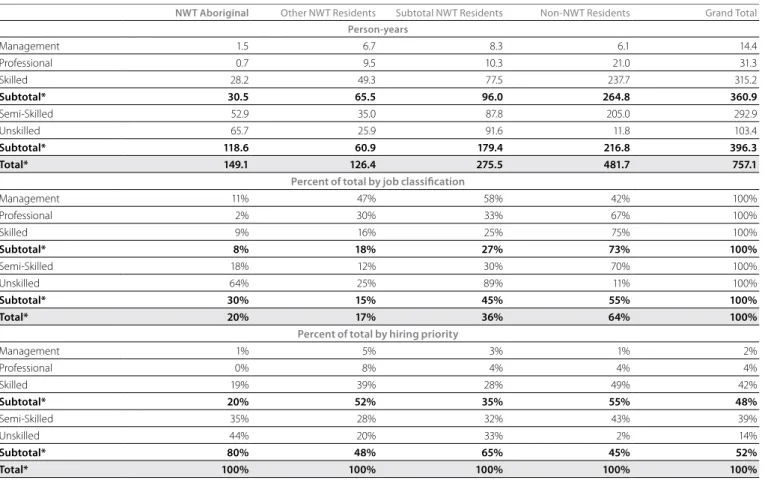
Tables 3a and 3b contain employment results by hiring priority and job classification. These results highlight the skills gap that exists in the NWT and its labour supply. The largest percentage of NWT resident labour is employed in unskilled jobs, filling 89 percent of the 103 available positions. A far greater number of jobs at the mine (81%) are classified as semi-skilled and skilled jobs, 293 and 315 respectively. These positions require additional education and/or work experience. NWT residents fill 30 percent of the semi-skilled jobs and 25 percent of the skilled jobs. In the case of professional jobs, such as the mine engineers and geologists, NWT residents fill 10 of the 31 jobs. In 2012, 58 percent of the mine’s management staff were NWT residents.
Table 3b reorganizes the data to highlight the number of Aboriginal employees working at the Snap Lake Mine. The table presents some interesting results. First, the number of Aboriginal employees who reside outside the NWT is growing faster than the number of Aboriginal employees who reside in the NWT. It is also interesting to see that almost all of the Aboriginal employees who reside outside the NWT are working in semi-skilled or skilled positions.
nWT Aboriginal Other NWT Residents Subtotal NWT Residents Non-NWT Residents Grand Total
Person-years Management 1.5 6.7 8.3 6.1 14.4 Professional 0.7 9.5 10.3 21.0 31.3 Skilled 28.2 49.3 77.5 237.7 315.2 Subtotal* 30.5 65.5 96.0 264.8 360.9 Semi-Skilled 52.9 35.0 87.8 205.0 292.9 Unskilled 65.7 25.9 91.6 11.8 103.4 Subtotal* 118.6 60.9 179.4 216.8 396.3 Total* 149.1 126.4 275.5 481.7 757.1
Percent of total by job classification
Management 11% 47% 58% 42% 100% Professional 2% 30% 33% 67% 100% Skilled 9% 16% 25% 75% 100% Subtotal* 8% 18% 27% 73% 100% Semi-Skilled 18% 12% 30% 70% 100% Unskilled 64% 25% 89% 11% 100% Subtotal* 30% 15% 45% 55% 100% Total* 20% 17% 36% 64% 100%
Percent of total by hiring priority
Management 1% 5% 3% 1% 2% Professional 0% 8% 4% 4% 4% Skilled 19% 39% 28% 49% 42% Subtotal* 20% 52% 35% 55% 48% Semi-Skilled 35% 28% 32% 43% 39% Unskilled 44% 20% 33% 2% 14% Subtotal* 80% 48% 65% 45% 52% Total* 100% 100% 100% 100% 100%
Table 3(a): Employment by Hiring Priority and Job Classification, 2012
Note: Those that did not self identify in the survey are recorded as non-Aboriginal. NWT Aboriginal employees who were identified as residing outside the NWT are recorded as Non-NWT Aboriginal Residents in this table.
* Figures may not add up due to rounding error.
nWT Aboriginal Non-NWT Aboriginal Total Aboriginal Other NWT Residents Other Non-NWT Residents Grand Total Person-years Management 1.5 0.3 1.8 6.7 5.8 14.4 Professional 0.7 0.4 1.1 9.5 20.7 31.3 Skilled 28.2 21.2 49.4 49.3 216.5 315.2 Subtotal* 30.5 21.9 52.4 65.5 243.0 360.9 Semi-Skilled 52.9 24.6 77.4 35.0 180.5 292.9 Unskilled 65.7 0.3 66.0 25.9 11.5 103.4 Subtotal* 118.6 24.9 143.4 60.9 192.0 396.3 Total* 149.1 46.7 195.8 126.4 434.9 757.1
Percent of total by job classification
Management 11% 2% 13% 47% 40% 100% Professional 2% 1% 4% 30% 66% 100% Skilled 9% 7% 16% 16% 69% 100% Subtotal* 8% 6% 15% 18% 67% 100% Semi-Skilled 18% 8% 26% 12% 62% 100% Unskilled 64% 0% 64% 25% 11% 100% Subtotal* 30% 6% 36% 15% 48% 100% Total* 20% 6% 26% 17% 57% 100%
Percent of total by hiring priority
Management 1% 1% 1% 5% 1% 2% Professional 0% 1% 1% 8% 5% 4% Skilled 19% 45% 25% 39% 50% 42% Subtotal* 20% 47% 27% 52% 56% 48% Semi-Skilled 35% 53% 40% 28% 41% 39% Unskilled 44% 1% 34% 20% 3% 14% Subtotal* 80% 53% 73% 48% 44% 52% Total* 100% 100% 100% 100% 100% 100%
Table 3(b): Employment by Hiring Priority and Job Classification, 2012
Note: Those that did not self identify in the survey are recorded as non-Aboriginal. NWT Aboriginal employees who were identified as residing outside the NWT are recorded as Non-NWT Aboriginal Residents in this table.
* Figures may not add up due to rounding error.
Non-NWT Residents NWT Residents
300 350 250 200 150 100 50 0 M an age me nt Profe ss ion al Sk ill ed Se m i-Sk ill ed Uns ki lle d
Snap Lake Employment by Job
Classification and Hiring Priority
(residency)Number of
FTE
Employment by nWT community
The employment data by NWT community is presented in Table 4. This table reflects the NWT communities where our employees and contractors, who are NWT residents, are choosing to live. These statistics are recorded as the number of person-years of employment as of December 31, 2012. Snap Lake Socio-Economic Agreement
establishes priority groups within the NWT, which guides De Beers’ hiring practices.5
In an effort to increase the number of NWT resident employees, we have expanded the number of NWT community pick-up points to include Fort Smith, Fort Simpson, Norman Wells, and Inuvik.6 In
addition, we provide a travel allowance to employees living in any other NWT community to assist them with travel costs to our pick-up points. Despite these efforts, attracting and retaining labour from outside the North and South Slave regions of the NWT has been a challenge. Residents of the Sahtu, Gwich’in, and Inuvialuit regions combined to register a total of 10 person-years of employment in 2012.
Overall, 15 communities were represented in the workforce. Most of these workers resided in Yellowknife, accounting for 68 percent of NWT workforce with 187 person-years of employment. The Town of Hay River contributed 36 person-years (13%), while Behchoko added another 18 person-years (7%) of employment to the Project.
Darryl Chocolate is an Operator Trainee in the process plant at the Snap Lake Mine.
Table 4: Employment by NWT
Community
Person Years Employment% of NWT Aklavik 0 0% Behchoko 18 7% Colville Lake 0 0% Deline 5 2% Enterprise 1 0%Fort Good Hope 2 1%
Fort Liard 0 0% Fort McPherson 1 0% Fort Providence 5 2% Fort Resolution 1 1% Fort Simpson 0 0% Fort Smith 7 3% Gamètì 3 1% Hay River 36 13% Inuvik 0 0%
Jean Marie River 0 0%
Kakisa 0 0% Lutsel K'e 0 0% Nahanni Butte 0 0% Norman Wells 1 0% Paulatuk 0 0% Sachs Harbour 0 0% Trout Lake 0 0% Tsiigehtchic 0 0% Tuktoyaktuk 0 0% Tulita 1 0% Ulukhaktok 0 0% Wekweètì 2 1% Whatì 4 1% Wrigley 0 0% Yellowknife (incl. Dettah/ Ndilo) 187 68% Total nWT* 275 100%
5 See Section 3.2 in the Snap Lake Socio-Economic Agreement.
6 De Beers continues to pick up employees in all Tlicho communities, Yellowknife (including Ndilo and Dettah), Lutsel K’e, and Hay River.
new Hires by Residency
Table 5 presents the number of new hires by residency separated between employees of De Beers and our contractors. The data in this table is not in person-years, but rather number of individuals hired. 7
Over the course of 2012, 169 employees were hired to work at the Snap Lake Mine; 51 of whom were long-time residents (having resided in the NWT for more than 6 months) and 7 of whom were recent arrivals (having lived in the NWT for less than 6 months). The majority of new employees, 111, live outside the territory.
Employment by Gender and Job classification
We support and encourage the participation of women in all aspects of work related to the Snap Lake Mine and encourage similar
commitments from contractors.9 Table 6 and Table 7 provide evidence
of our record in this area. Men dominate the overall workforce at 86 percent, virtually unchanged from one year ago. There were 109
Mine contractors were much more active in hiring new employees.8
The total number of new hires by contractors was 309. Similar to De Beers, a majority (63%) of these new employees were hired from outside the territory. Of the 113 new hires that do live in the NWT, 75 are long-time residents.
Tli Cho Logistics was the most active employer of all contractors. It hired 99 people throughout the year, 70 of whom reside in the NWT. Bouwa Whee Catering hired 40 new people in 2012, 37 of whom are NWT residents. As noted on page 3, 93 of the new hires for De Beers were into permanent, full-time jobs. The balance reflects temporary or seasonal work contract hires.
women employed at the Snap Lake Mine in 2012, representing 14 percent of the workforce. Women are most represented in unskilled positions filling 42 percent of jobs in that category. Women are least represented skilled positions at seven percent. Women provided the mine with 28.4 person-years of employment in jobs classified as management, professional, or skilled.
7 The figures representing hiring will appear inflated or would otherwise suggest excessive turn-over. This is not the case, however. It is not uncommon for someone to accept several short-term positions with
different contractors throughout the year. Depending on the duration of their work term, which could be as short as two weeks (a single work rotation), it is possible for the same person to be entered into the system as a new hire multiple times each year. The system also counts the movement of an individual from one job to another between contractors and De Beers as a new hire.
8 Bearing in mind the issue with over reporting.
9 See Section 4.10 in the Snap Lake Socio-Economic Agreement.
Table 5: New Hires by Residency
> 6 months < 6 months nWT non-nWT Total
number of new Employees
De Beers Canada Inc. 51 7 58 111 169
Contractors 75 38 113 196 309
Total 126 45 171 307 478
Percent of Total
De Beers Canada Inc. 30% 4% 34% 66% 100%
Contractors 24% 12% 37% 63% 100%
Total 26% 9% 36% 64% 100%
men Women Total
Person-years Percent Person-years Percent Person-years Percent
Management 12.8 89% 1.5 11% 14.4 100% Professional 26.9 86% 4.4 14% 31.3 100% Skilled 292.4 93% 22.5 7% 314.9 100% Subtotal* 332.1 92% 28.4 8% 360.6 100% Semi-Skilled 255.7 87% 36.9 13% 292.6 100% Unskilled 59.3 58% 43.5 42% 102.8 100% Subtotal* 315.0 80% 80.4 20% 395.4 100% Grand Total* 647.1 86% 108.9 14% 756.0 100%
Table 6: Employment by Job Classification and Gender
Table 7: Employment by Job
Classification for Women
Person-years Percent Management 1.5 1% Professional 4.4 4% Skilled 22.5 21% Subtotal* 28.4 26% Semi-Skilled 36.9 34% Unskilled 43.5 40% Subtotal* 80.4 74% Grand Total* 108.9 100%
* Note: Figures may not add up due to rounding error.
* Note: Figures may not add up due to rounding error.
Distribution of Women by
Job Classification
Unskilled 40% Semi-Skilled 34% Skilled 21% Professional 4% Management 1%When it comes to building a mining workforce, women are a relatively untapped potential source of skilled employees. We recognize this and are committed to encouraging women to consider mining careers.
In 2012, 109 full-time jobs were held by women at the Snap Lake Mine, the highest number since we started operations in 2008. While this is good news, women continue to be most represented in unskilled positions at the mine. Our aim
in promoting opportunities for women at the mine is focussed on encouraging women to consider opportunities in the skilled, professional and management positions.
We have done this in a number of ways. For example, we targeted 50% of our new NWT Post-Secondary Scholarships to support educational advancement of qualified female applicants and eight of the 15 scholarships in 2012 were awarded to women in the study areas of Commerce, Human Resources, Mining Engineering, Aquatic Resources, Accounting, Earth and Ocean Sciences, Science and Engineering. We have also
worked with Skills Canada to provide female role models to those considering careers in the trades through both financial support of Skills Canada in the NWT and by providing female role models in the Power-Up Youth Conferences. We have also promoted opportunities for jobs as part of our annual visits to schools during our Books in Homes Program, ensuring female role models are actively participating
We have women miners, apprentices, process plant operators, human resources professionals, senior managers and more. In this section we profile just a few of the women who work at Snap Lake.
Women in Mining
“Adventure” isn’t usually the word that comes to mind when most people think of geology. But that’s exactly how Aaliya sees it.
She discovered the field halfway through university and fell in love with the lifestyle that came with it.
“I see the mine as a mini-adventure,” she says. “I commute on a plane and get to work in a remote area before going back home at the end of the week.” She loves not knowing what each day will bring. She could be in the office, underground or outdoors, working on a range of projects. “This is definitely for me,” she says. “I can’t ever go back to a Monday to Friday job.”
Aaliya Adam
Yellowknife, NT Mine Geologist
They say that landing a job is about who you know. When you’re from a small community, it helps that you already know everyone in town.
Three years ago, the coordinator at the learning centre in Wekweètì called Calinda out of the blue to let her know that the Mine Training Society was offering an underground mining course in the community. Calinda signed up and in just a few months she was working underground at Snap Lake. She has a messy job: keeping fluids like fuel and oil topped up in the heavy equipment. But she loves it.
“It’s been an amazing learning experience over the past three years,” she says. “And it helps that everyone I work with is so nice, outgoing and fun to be around.”
Calinda Football
Wekweètì, NT Field Truck Operator
Deanna hadn’t planned to become a mechanical engineer. But a summer job helped her find her calling.
While on a break from the University of Saskatchewan she took a job at a pulp and paper mill. Among the noise and the equipment, she discovered she enjoyed the mechanical side of science and math.
After finishing her degree, she was attracted to the adventure of working in the North and working in a mine posed unique challenges she was ready to embrace.
Keeping everything running smoothly can be especially tough. As Deanna notes, “Crushing rock tends to be a little hard on equipment.”
Deanna Astill
Whitecourt, AB Maintenance Engineer
Some people take a while to find what they want to do in life. Others know from the start.
Growing up in a family where caring for the environment was important, and loving the outdoors, Guylaine was drawn to the environmental sciences. And being a lifelong northerner, she was exposed to mining all her life and knew she wanted to work in the industry.
She applied for a summer job at De Beers while on a break from university. More than three years later, she’s still at Snap Lake and loving it. She’s even finishing her degree while working at the mine.
“It’s great working here - weather permitting,” she says with a chuckle. “I work outside a lot, so it can get cold.
“It’s a lifestyle that requires adaptation, but I love the job, the accommodations and the people.”
Guylaine Gueguen
Yellowknife, NT Environmental Technician
Recruiting and Retaining nWT Talent
With strong competition for a small skilled labour pool, we’ve had to find unique approaches to develop northern workers. We talk one-on-one with potential employees, bring students to site so that they can see what mining is like, and work hard to make the Snap Lake Mine as attractive as possible. Competitive pay and benefits, a safe work environment as well as our commitment to communities close by and to minimizing our impact on the environment are important selling points in attracting and retaining skilled workers. Job satisfaction, along with training and development opportunities and, for some, opportunities for advancement are key elements for retention.
career Fairs and Events
Career fairs and related events have proven good opportunities to speak with potential employees directly. They provide an opportunity for our staff to talk about our mine and the opportunities there, as well as about our bigger group of companies and the opportunities these present.
Last year we worked with the Lutsel K’e Dene First Nation and the Yellowknives Dene First Nation to plan our participation in their community career fairs. We also attended Skills Canada competitions in Fort Smith and Yellowknife, promoting the job opportunities and skills required for jobs at our Canadian operations. Our Books in Homes
events in nine NWT communities were also used as opportunities to promote careers and the education and skills required for the various jobs available at our mines.
opportunities for Students
Some northerners have already decided on a career in mining. Showing them that a career with De Beers is an excellent choice means we have to show them what we have to offer. In 2012 we updated our career opportunities booklet so that students considering their own futures could see the breadth and depth of jobs available at our Canadian mines and what skills and education these jobs require.
We work with Aurora College and the Mine Training Society to bring students in mining-related training courses to Snap Lake. In 2012 students enrolled in the Mineral Processing Operator Training Program (MPOT) at Aurora College were hosted at the Snap Lake Mine for an overview of the opportunities at the mine. The mine site visit allowed them to meet other northerners who have come through the same training and who have advanced in their careers with us.
We also offer summer job opportunities to students to help them build their experience. Last summer, for example, two Aurora College Business Administration students worked in our Yellowknife office, learning office procedures and putting some of their training to the test. Coaching and performance feedback from our supervisors in the Yellowknife office contributed to the growth of these young students.
Human Resources and Training
Nicole Harris, Sr. Human Resources Coordinator, sits with youth attending a career fair in Lutsel K’e
Strategic Job Postings
It’s hard to find workers if those workers don’t know where the jobs are. We make sure that all of our job postings are highly visible throughout the North. All opportunities are published in NWT News/North and posted online at jobsnorth.ca and on the De Beers Canada website. Our job opportunities are also provided to community career centres and regional employment offices. In 2012, our careers web page received 140,000 unique visitors, representing over one-third of the total traffic on our website.
In some of the smaller NWT communities, internet access and speed can be limited, so we don’t just rely on our website. All job listings are sent to Aboriginal governments, community organizations, and community learning centres. To encourage applicants from our top hiring priorities, we send job ads directly to Impact Benefit Agreement coordinators for posting and circulation in their communities.
Training and incentives
At De Beers, we are promoting as many opportunities as possible for northerners who want to work or train with us. We believe in building capacity so that we get qualified, dedicated employees and the NWT has a trained workforce ready for the future. That’s why we provide training and incentives for northerners to learn and work at Snap Lake.
We start with northern-focused apprenticeships and training programs in mining-related trades. We offer training and professional development to all of our employees so they can continue to improve their skills throughout their careers. You can read more about our training initiatives on page 15 of this report.
In addition, we offer an attractive NWT allowance for all employees who are NWT residents. This helps offset some of the higher cost of living in the NWT. For employees hired from outside the NWT this NWT residency allowance is a tool we use to help them consider making the NWT their home. We believe that having local employees is an important way of contributing to the local economy and to building community.
challenges
Although we use creative ways to recruit and retain NWT residents, we still face challenges with filling as many jobs with NWT residents as we’d like. The Snap Lake Mine was the third diamond mine to start production in the NWT, and while there is unemployment in a number of NWT communities, a small population from which to draw on with limited skills often means we often have only a small number of qualified NWT applicants for our job opportunities. Where there are skilled workers in the NWT, we face stiff competition in hiring them as other mining companies, including southern companies are also looking north to recruit trained mine workers. In 2012, a number of companies were in the NWT recruiting skilled workers for jobs outside of the NWT. Even though we face these challenges,
we understand that building the employment skills for NWT residents is a key to the long-term success of NWT communities. That’s why we continue to recruit, train and develop NWT residents for available career opportunities with us.
Mining Great Skills
Training ProgramsTraining is an important investment we make at De Beers. It’s how we create our next generation of employees, it helps us ensure the safety of our workforce and it helps us grow the skills of our workforce. Twenty-five training courses are offered regularly at Snap Lake and additional courses are hosted when required. More than 1,000 employees took training of some kind in 2012, adding up to nearly 25,000 hours, or almost 11.5 work years. Perhaps more importantly, we offer NWT residents a chance to learn mining trades from the ground up, through apprenticeships, and training programs for underground mining and other skilled trades.
Training for NWT residents means increased capacity for local communities close to Snap Lake. This, in turn, creates better economic potential for the future as NWT residents are even better prepared to take on a wider variety of jobs.
Just as well-qualified workers make for a stronger NWT, a well-qualified local workforce also makes us a stronger company. Having a great pool of northern talent means that we can more easily fill the roles that we have available.
Training nWT Residents
We made available 12 training opportunities in 2012 for NWT residents in Millwright Apprentice (x3), Summer Student positions (x3), Process Plant Operators Trainee (x5), and Maintenance Helper, promoting these opportunities through the De Beers Canada careers web page, News/North newspaper, jobsnorth.ca, and community contacts. In all, 109 applications were received for the Millwright Apprentice positions, including 33 from the NWT. All three apprenticeships were awarded to NWT Aboriginal residents.
Our partnerships with the Mine Training Society, Aurora College, the Government of the NWT, contractors and communities are important in promoting the training opportunities, attracting new trainees and helping them succeed in meeting the requirements for training positions and ultimately placement at the mine.
Travis Guild, an apprentice at the Snap Lake Mine, works with a judge at Skills Canada NWT Territorial Competition in Yellowknife.
Seven apprentices were working for De Beers at the Snap Lake Mine in 2012, all on track to become journeypersons. Two apprentices are female, including a millwright apprentice and an electrician
apprentice. There were also nine trades trainees and five underground mining trainees from the NWT. Since the mine opened, 39 northerners have graduated from these programs. Most of them have become full-time De Beers employees.
To help apprentices succeed, De Beers has a very competitive package that includes providing financial support for travel to their destination school, housing, and tuition while the apprentices are attending classes. While they are attending school, apprentices also remain on the De Beers payroll.
Site-based contractors also employ apprentices and trainees, although these are not included in this report.
Learning centre
Snap Lake’s learning centre is a resource for all employees. Most of the site’s classroom-based learning happens there. All new employees start their training at the centre, spending 3– 5 days there for
orientation to ensure they can work safely and that site and job specific procedures are understood.
The learning centre is also a resource for employees who wish to learn on their own time. It has a large number of computers and is building a library of books and videos so employees can brush up on their literacy skills, look up building and electrical codes, or even learn more about engineering.
The annual training budget for Snap Lake also includes funds to support employee professional development. This fund enables employees to enrol in professional development programs that can be either taken as web-based programs or off-site programs. A total of 27 employees were pursuing professional development opportunities with the company’s financial support in 2012. Of these, 20 are NWT Resident employees.
We also offer our own program, called Facets of Leadership, aimed at improving the safety and leadership skills of De Beers and contractor managers and supervisors (see page 17).
While we sometimes face challenges, we are committed to making our employees the best and brightest they can be, whether they’re current employees or NWT residents training to be our workers of the future.
Much of the training at the Snap Lake Mine Learning Centre is done on computer.
Training Life of mine Training commitment Actual 2012 Trainees cumulative Trainees to Date cumulative Program Graduates
Trades 10 9 24 16
Apprenticeship 10 7 23 5
Underground 20 5 34 18
ToTAL 40 21 81 39
Building capacity in communities is about more than just job training. There are a huge number of other skills that can help individuals and communities—whether on the land, on the job or in everyday life.
The Lutsel K’e Dene First Nation offers plenty of training in such skills every year. In 2012, De Beers contributed $15,000 to co-sponsor classes on first aid, firearms safety, and boat and water safety.
Proper safety skills help communities stay strong and healthy. We make safety a top priority at our mines, so we’re proud to support community-based safety training as well.
“ I wouldn’t be able
to do this without
De Beers,” he says.
“Their support
package for
apprentices is one
of the best. If I was
trying to do it on
my own, there’s
no way I’d be going
back to school.”
When he was nine years old, Austin helped his dad take the good parts from two old SUVs and make them into one working vehicle. That’s when he caught the bug.
“I didn’t know what I was doing at the time,” he says, “but I liked the end result: being able to cruise around town with my dad in a big Suburban.”
Being a mechanic seems to be in his blood. He has already trained to be a journeyperson heavy equipment technician at the Snap Lake Mine, his father is a mechanic, and his brother is a 3rd year heavy equipment technician apprentice. With the help and encouragement of his father, he learned that he could walk into a career development centre, write his trade entrance exam on the spot and see if he would qualify. He did and he qualified for his first apprenticeship. Now, nearly three years after finishing his first one, he’s going back for more.
Austin’s progression as an apprentice at Snap Lake was with three different companies, including De Beers. He’s been with De Beers as a journeyperson since 2010. But recently, he’s become an apprentice again to switch from heavy equipment to passenger vehicles, gaining new skills.
“Last year they needed someone in an automotive role. I guess they liked my work and they asked me.” That good work has shown itself in other places, too. In 2010, Austin won a gold medal in the NWT Skills Canada competition for apprentices. Life as an apprentice was a little easier the first time around. He didn’t have many responsibilities, so he could go to school and be away from home as long as he wanted. Now he’s a dad with a three-year-old daughter to take care of. “I find the work/home balance pretty easy for now. When I go home for two weeks, my daughter has nothing but my time. When I go back to school, though, I’ll have to set up child care and be away from her.”
He won’t be completely away from family, though. His brother is due to go back to school around the same time, and they would like to go together.
Luckily, he won’t have as much schooling this time around. Because he is already a licensed heavy equipment technician, he has been given credit for the first two years of his automotive apprenticeship. That means that he will only have to go back to school for two sessions of technical training.
“I wouldn’t be able to do this without De Beers,” he says. “Their support package for apprentices is one of the best. If I was trying to do it on my own, there’s no way I’d be going back to school.” “You know, overall, working at the mine has been great,” he says. “I really love the fact that I can go home for two weeks and my daughter gets my full attention. She is young enough I can take her travelling or camping and not have to worry about getting back in time for work or school the next day.”
“I guess I’ve just been fortunate.”
Austin Larocque Hay River, NT,
Automotive Technician Apprentice
Learning the Trade
The Facets of Leadership Program
De Beers puts safety first. When managers and supervisors at the Snap Lake Mine identified the importance of growing its leaders—increasing their leadership in safety and generally just building better leaders overall—an action plan was put in place.
We developed a series of two-day courses covering areas like health and safety, team building, communication and conflict resolution.
The program, called Facets of Leadership: Living up to Diamonds, is spread out over a year. This accommodates shift rotations and lets people use what they have learned before taking the next course.
To help the managers and supervisors who take the course remember what they have learned, “cheat sheet” cards and a reference website were developed.
Seventy-five managers and supervisors from the Snap Lake Mine, including 29 NWT residents, took Facets of Leadership
courses in 2012 and the program is continuing in 2013. This is proof that we are committed to building stronger leaders every day.
Building Better Leaders
Yellowknives Dene First Nation Food
Safety Training
At De Beers, providing training opportunities for northerners can go beyond our Snap Lake Mine employees.
Food safety is a growing concern everywhere. So when you’re responsible for keeping hundreds of workers healthy and well-fed, like Bouwa Whee Catering is at Snap Lake, food safety training is a must.
In December, we co-sponsored a Food Safety Level 1 course for Yellowknives Dene members at the Aurora College Community Learning Centre in Ndilo. Twenty community members completed the training and received their certificates.
Bouwa Whee is a Yellowknives Dene-owned company. However, it is just one of many employment options open to community members who have food safety training.
More than Numbers
increasing Financial Literacy in the nWT
For people whose traditions haven’t involved a wage economy, money management can be as foreign as caribou hunting might be to a person who has never spent time on the land.
We recognize the importance of financial literacy in building strong communities and capable employees. In 2011 we introduced Your Money Matters, an online course that teaches the basics of money management. It was available at the Snap Lake Mine, and at Aurora College community learning centres in Behchoko, Whatì, Wekweètì, Gamètì, Lutsel K’e and in Ndilo/Dettah.
In 2012, the program was accessed 215 times.
While Your Money Matters was well-received, it will be replaced by Financial Literacy, a program developed by the GNWT’s Department of Education, Culture and Employment in cooperation with De Beers and other mining companies.
2012 Your Money Matters Users
Site Logins
Snap Lake Mine 32
Lutsel K’e 4 Whatì 56 Ndilo/Dettah 15 Wekweètì 6 Gamètì 55 Behchoko 27
De Beers office – Yellowknife 20
Total 215
Your Money Matters is an online program. The table shows the number of times the program was accessed from each community/location.
Investing in Education
De Beers Scholarship ProgramsPost-secondary education is expensive for any student, but for students in the NWT, who must leave home and the support of family close by in order to attend school, every little bit of financial help makes a measurable difference.
Since 2006, we have provided scholarships to NWT students through our Impact Benefit Agreements, however in 2012 we expanded our scholarship program, providing more opportunities to NWT students.
To train the next generation of northern mining leaders, we introduced NWT Post-Secondary Scholarships, a territory-wide program open to all NWT residents enrolled or accepted to a post-secondary institution in one of the following courses of study:
• Mining Engineering • Geology
• Finance and Accounting (Commerce) • Human Resources (Commerce) • Occupational Health and Safety • Environmental Sciences
• Metallurgy and Chemical Engineering • Mechanical and Electrical Engineering
This new program is designed to attract more NWT residents to professional roles at De Beers in the professions where we have had the most difficulty finding skills in the NWT. This program reflects our commitment to find new ways to increase the involvement of NWT Residents in our workforce.
The scholarships are worth $2,000 each, adding up to $30,000 a year. With our existing programs, our scholarship fund is now $50,000 annually. Since 2006, we have invested $180,000 in financial support for NWT students. We are also looking to expand the program in 2013.
“Our new scholarship program is aimed at building NWT capacity and future leaders,” says Cathie Bolstad, Director of External and Corporate Affairs. “We had many excellent applicants and while we couldn’t select every applicant for a scholarship, the process of reviewing the applications enabled us to see what NWT students are studying, where they are in their programs and it gave us an opportunity to promote the mine and the opportunities it can present to NWT students who would like to consider a career with us.”
Scholarships
Aimee Gauthier, a mining engineering student at Queens University, received a new De Beers Post-Secondary Scholarship.
IBA Scholarships
Since 2006, we have funded scholarships for NWT students through our Impact Benefit Agreements for the Snap Lake Mine. Each year, approximately $20,000 in scholarships are awarded to students through IBA agreements to help them fund their education. In some cases, communities have provided scholarships to encourage the completion of Grade 12 or its equivalent for mature students. To date, IBA Scholarships awarded by the Snap Lake Mine total $150,000. In 2012, the following individuals were recipients of scholarships from De Beers through Impact Benefit Agreements.
2012 Yellowknives Dene First nation Scholarship Recipients
Laurie-Ann Lines Wesley Lines Roseanna Sangris Jessie Mackenzie David Staples Ashley Chapple-Sangris Eileen Liske Cindy Allen Mary T. Black Kirsten Sangris Lila Lines Brandon Etsemba-Sangris Bobbie-Jo Black Eric Tsetta Jonathan Goulet Stacey Sundberg Garrett Tsetta
2012 north Slave métis Alliance Scholarship Recipients
Stefany Bulmer Deborah-Ann Clunie Thomsen D’Hont Lauren Mercredi Chloe Smith In 2013, we will add tertiary scholarships to our program creating links
for permanent employment to financial sponsorship of students in key study areas. Cathie is proof that northern tertiary scholarship programs work. In the early 1990’s she completed two university degrees with the help of another northern company that she was employed with at that time. Today she remains in the North, with a successful career and as an active community contributor.
2012 nWT Scholarship Recipients
Agamani Chakrabarty – Bachelor of Commerce (Finance) Pamela Norwegian – Business Administration (Human Resources) Aimee Gauthier – Bachelor of Science (Mining Engineering) Michael Canam – Chemical Engineering
Lindsay Vician – Science (Aquatic Resources) Melanie Joan Desjarlais – Business (Accounting) Tyler Bell – Engineering
Keelan Mooney – Chemical Engineering Wesley Lines – Engineering
Aaron G. Doan – Earth Science
Kaitlyn Menard – Earth and Ocean Sciences Alexander Hunt – Engineering
Nicole Labine – Science Ashley Mulders - Engineering Jordan Bryan – Geology, Engineering
We invest in our employees in many ways. While most of our investments help build skills and ensure safe work, helping our employees maintain good health is also important.
Our focus on health and wellness at Snap Lake in 2012 included offering heart-smart meal options, providing mandatory drug and alcohol training for employees and other initiatives such as those that are highlighted below.
Fitness centre
We have three fitness rooms at the Snap Lake mine site: a weight room with free weights, machines and contact equipment like heavy bags; a cardio room with equipment like stationary bikes and treadmills; and a room where people can do pilates and yoga. Some of the equipment that was originally installed when the accommodations facility opened in late 2010 was used more than we expected and it was starting to show. So, being enthusiastic about our employees’ dedication to personal fitness, we spent $25,000 upgrading our exercise equipment in 2012. In addition, with the advent of spring, and the desire for our employees to enjoy the outdoors, we promoted use of a safe seasonal hiking trail along the shore of Snap Lake and we held a number of weekend softball games during the summer. During the winter, a large warehouse was put to use for indoor floor hockey games.
medical initiatives
All Snap Lake employees need to complete a medical exam before beginning work at the mine. These exams ensure that employees are fit to perform their duties and avoid injuries. They also help our employees become aware of any underlying conditions that can cause problems later in life. If they are aware, then they can get the help they need for those conditions or concerns.
We also offer flu shots on site, and while these are optional for employees, nearly 100 employees took advantage of this service.
We believe that healthy employees are happier employees. Investing in their health—whether through a fitness centre, medical initiatives or workplace safety—is just one way that we try to create the best employees in the North.
Health and Wellness
at Snap Lake Mine
Hay River Charity Golf Classic
Since 2007, we have sponsored the annual De Beers Charity Classic Golf Tournament in Hay River, helping to raise money for the local Hospital Foundation, while also providing some support to Hay River Junior Golf. We contribute to the success of this charity fundraiser by organizing the tournament and covering the costs so all entry fees and contributing sponsorships from our business partners go directly to charity.
The tournament raised more than $60,000 last year, and over its five year life has contributed $200,000. Most of that money goes to the Hospital Foundation for things like new equipment, such as the medication dispensing system purchased in 2012.
It’s equipment like this that has helped Hay River’s HH Williams Memorial Hospital earn Exemplary Status from Accreditation Canada—its highest honour—in 2012. It’s the only hospital in the North to earn the designation. In order to achieve Exemplary Status it needed the new medication dispensing system, which was purchased with proceeds from our charity golf tournament.
“De Beers has played a huge part in helping us get this equipment,” says Heather Coakwell, Chair of the Hay River Hospital Foundation. “Without them we wouldn’t be close to reaching our fundraising goals.”
In 2012, we also sponsored Rocking the Caribbean raffle,
which raised $50,000 for the Stanton Territorial Hospital Foundation, going toward a new chemotherapy/IV treatment suite at Stanton Territorial Hospital.
Supporting NWT Community Wellness
Substance abuse can take a toll on any community, but it’s been especially serious in the North. It’s an issue that some northerners believe is at the centre of many of the NWT’s social issues. The issue is considered so important that the territorial government struck the Minister’s Forum on Addictions and Community Wellness, to make recommendations on how the government can address addictions issues following a series of community meetings to be held in 2013.
As part of our commitment to community wellness, we are proud to support activities that lead to better community living, like raising awareness of drug and alcohol abuse and options for treatment. Last year, we contributed funds to health and community wellness initiatives initiated by communities, including support of National Addictions Awareness Week activities in Behchoko and in Lutsel K’e.
In Behchoko, we provided funds for the community to hold a series of workshops. The goal of the workshops was to teach people how alcohol and drugs negatively affect the mind, body, and spirit. Funding was also used to support evening activities, like youth hand games and a family barbecue.
“Alcohol abuse is a destructive influence,” says Tony Rabesca, language, culture and communications director for the Tlicho Government. “It’s important to have events that bring people together to support one another.”
In Lutsel K’e, we donated funds to support events and activities like the sobriety walk to raise awareness about addictions. Other activities in the community helped inform people about available services. One event was an open house luncheon to share information about the addictions treatment program. According to Hanna Catholique, community co-ordinator at the Lutsel K’e Health Centre, our donation helped to make the week a success.
“Addictions affect us all,” says Hanna, who helped organize events and activities throughout the week. “Having a week to put a spotlight on the issue and addressing it as a community is important.”
Social Investment and Culture
Supporting Healthy, Vibrant
Communities
Social investment
Investing isn’t only about business. When companies like De Beers invest in the social fabric of communities close to our operations, it helps us all live richer, fuller lives. We’ve made a commitment to strengthen NWT socially, not just economically, and we stand by that commitment.
Social investment means supporting those initiatives and organizations that make our communities great by strengthening things like education, health and culture.
Last year, we invested $3.37 million in social initiatives in the Northwest Territories. Most of this focused on education, training and youth. The rest was spent on health, the environment, community development, arts and culture, small business development, sports and other areas (see graph below). In 2012, we were proud to support 90 different activities and community partners such as:
• Hay River Hospital Foundation • Jean Wetrade Gamètì School • Tree of Peace Friendship Centre • Skills Canada NWT
• NorthWords NWT • NWT SPCA
• Behchoko Handgames Committee • Aboriginal Sports Circle
• Mine Training Society
2012 Corporate Social Investment
Health: 1.59% Education and Youth (Literacy): 83.73% Environment: 7.41%
Arts, Culture and Heritage: 2.04%
Small Business Development/ General Community Development: 4.63% Sports/Other: 0.60% 0% 20% 40% 60% 80% 100%
Our focus on education, training and youth is about building capacity in the NWT. Developing literacy, financial skills and job skills all help create the workers of today and tomorrow. De Beers benefits from skilled workers for our mine, and northerners benefit because they develop skills that will help them succeed in jobs today and in the future.
Because investment in building employment skills is challenged without strong, healthy, vibrant communities in which to live, we invest in communities too. Contributing to health and wellness, arts and culture initiatives that are the priorities for communities for example, helps nurture community culture that makes the North unique.
De Beers knows that strong communities are an important ingredient in successfully operating in the North. They also play an important role in our ability to retain the skilled northern workforce that we have developed. Northern communities, and the people who live there, play an important role in how we do business. That’s why we want to leave a legacy. We want to leave communities better off after us, than before us.
Snap Lake Recycling Program
Every few months, crates of recyclables that are collected at Snap Lake Mine are sent to Yellowknife. De Beers donates the bottle recycling funds to local organizations. During 2012 more than $6,000 was raised for three groups: the Polar Bear Swim Club, the NWT SPCA and the Aurora Fiddle Society. Our recycling program also helped support a De Beers employee’s participation in the Relay for Life, a fundraising event of the Canadian Cancer Society.
Rae-Edzo Friendship Centre Youth
Hockey Clinics
Since the Sportsplex in Behchoko closed several years ago, youth in the community have not had the chance to participate in organized hockey programs. But in 2012, the Rae-Edzo Friendship Centre, in partnership with NWT Hockey, organized nine skating and hockey skill sessions at the Yellowknife Multiplex for Tlicho and North Slave area youth. De Beers provided funds to help these youth increase their skills, improve their fitness and make new friends.
Yellowknives Dene First Nation Lateral
Violence Presentations
Throughout the years, Aboriginal people have been affected by changes in lifestyle. When the social programs in their communities were not prepared for these changes, lateral violence could be one of the results.
Lateral violence happens when violence or other damaging behaviours are directed at one’s own people. This can come from unresolved feelings of frustration, anger or helplessness that arise from change. These actions can harm communities, and the underlying issues must be dealt with in positive ways.
In the fall of 2012, the Yellowknives Dene First Nation held community presentations to bring awareness of lateral violence to its members and encourage positive change. We contributed funds to help this important wellness initiative to happen.
Investing in Culture
The NWT has a rich cultural heritage. Today, many Aboriginal northerners still speak their language, practice traditional ways and keep close ties to the land.
We are proud to honour and uphold northern culture as part of our commitment to social investment.
At the Snap Lake Mine, we have a culture centre where non-Aboriginal employees can learn about Aboriginal culture and build a cultural understanding. Last year we held scrapbooking and carving workshops there, among other classes.
We also support initiatives throughout the territory. Much of our financial support for arts, culture and history in the NWT was spent supporting Aboriginal cultural activities such as hand games tournaments and annual gatherings and assemblies.
Promoting northern culture and heritage and supporting activities that celebrate culture, history and tradition is important. It strengthens community bonds, builds bridges across generations and upholds values that are important to communities. We think that’s an investment worth making and are proud to contribute.
A youth drums during a Christmas season hand games tournament held in Dettah by the Yellowknives Dene First Nation.
De Beers Inspired Ice - NWT Ice Carving
Championship
After a long cold winter, a spring festival plays an important role in bringing people in the community together outside to enjoy the sunshine and each other. In Yellowknife, a new festival was born in 2012 and the cornerstone activity of the festival was made possible with our financial contribution and in-kind support. The De Beers Inspired Ice - NWT Ice Carving Championship was created as part of the inaugural Long John Jamboree in Yellowknife. We donated staff time to help Jamboree organizers get the event off the ground and provided a solid financial contribution to the festival enabling them to establish their first carving event as one that was internationally sanctioned. Seven teams took part: six from the NWT and one from Indiana.
The ice carvings were the delight of the community, and they provided something for everyone to come out and enjoy. We share a dream with the festival organizers who hope to build this event into an internationally acclaimed event so that more people can
experience the culture of the North.
Hand Games Tournaments in Behchoko
Hand games are an important part of Dene culture. Not only are they a long-held tradition that provides fun, friendly competition, but they also serve as a way to bring communities and generations together. They are a way for one generation to pass on traditional culture to the next, as adults teach youth how to play.
Last winter, the community of Behchoko hosted both a major youth tournament and the Canadian Aboriginal Hand Games Championship for men with our help. Sixteen youth teams and 40 adult teams came from all over the NWT to celebrate a part of their culture, and to meet new friends as the community opened its doors to visitors.
North Slave Métis Alliance Heritage
Research Project
We provided funds to the North Slave Métis Alliance for its Indigenous North Slave Métis Community Heritage Project. Through this project, historical records are being reviewed and used to document and define the Indigenous Métis community in the Great Slave Lake area of the NWT.
Randy Sibbeston, of Fort Simpson, works on his sculpture at the first annual De Beers Inspired Ice – NWT Ice Carving Championship.
Stephan and Mike Koch, from Indiana, pose with their winning piece from the first annual De Beers Inspired Ice – NWT Ice Carving Championship.
Nicole Harris, Sr. Human Resources Coordinator, reads to youth during a Books in Homes visit to Lutsel K’e Dene School.