Mathematical and Software Engineering, Vol. 1, No. 1 (2015), 6-11 Varεpsilon Ltd, http://varepsilon.com
Inverse Iterative Methods for Solving
Nonlinear Equations
Gyurhan Nedzhibov
Faculty of Mathematics and Informatics, Shumen University, Bulgaria
Abstract
In his work we present an approach for obtaining new iterative methods for solving nonlinear equations. This approach can be applicable to arbitrary iterative process which is linearly or quadratically convergent. Analysis of convergence of the new methods demonstrates that the new method preserve the convergence conditions of primitive functions. Numerical examples are given to illustrate the efficiency and performance of presented methods.
Subject Codes (PACS): 02.60.Cb
Keywords: Nonlinear equations; Iterative methods; Order of convergence;
Newton method.
1 Introduction
The problem of solving nonlinear equations is one of the classical problems which arise in several branches of pure and applied mathematics. Including the fact that solution formulas do not in general exist, the finding new and efficient numerical algorithms for solving nonlinear equations always has been an attractive problem. In recent years, several numerical methods have been developed and analyzed
under certain conditions. These methods have been constructed using different
techniques such as Taylor series, quadrature formulas, acceleration techniques, decomposition method, and etc. (see, [1-9] and references therein).
follows. In Section 2 we consider some preliminary results and the new method. Analysis of convergence is provided in Section 3. Several sample iterative methods and numerical examples are explored in Section 4.
2 Main Results
Let us consider the nonlinear equation
(1.1)
f
(
x
)
=
0
,
where
f
:
U
⊂
R
→
R
is a scalar function andU
is an open interval. Inthis work, we consider iterative methods for finding a simple root
α
off
and assume that
f
is aC
2 function in a neighborhood ofα
.An iterative scheme for solving the equation (1.1), generally takes the form
(1.2)
x
k+1=
ϕ
(
x
k),
fork
≥
0
,where
ϕ
(x
)
is a fixed function andx
0∈
U
is a given initial value ofα
. When studying the iterative methods, one of the most important aspects to consider is the convergence, and the order of convergence, respectively.Theorem 4 (Traub [1, Theorem 2.2]) Let
ϕ
be an iterative function such thatϕ
and its derivativesϕ
′
,
ϕ
′′
,
…
,
ϕ
(p)are continuous in the neighborhood of aroot
α
of a given functionf
. Thenϕ
defines an iterative method of order p if and only if
ϕ
(
α
)
=
α
,
ϕ
'
(
α
)
=
…
=
ϕ
(p−1)(
α
)
=
0
,
ϕ
(p)(
α
)
≠
0
.Without loss of generality we assume that function
ϕ
in (1.2) has the form(1.3)
ϕ
(
x
)
=
x
−
g
(
x
)
,where
g
(
x
)
=
g
(
x
,
f
,
f
′
,
…
)
.Investigations in this work are inspired by our previous results in [6,7], where we suggest the Inverse Newton method
(1.4)
)
(
21
k k
k k
x
u
x
x
x
+
=
+ , where
( )
)
(
'
)
(
k k k
x
f
x
f
x
u
=
.which is a modification of the well known Newton iterative function
Iterative function (1.4) is obtained as consequence of companion matrix method and similarity transformations between some companion matrices.
The purpose of this paper is to generalize the approach presented in [7].
Let us consider an arbitrary, linearly or quadratically convergent iterative function
(1.6)
x
k+1=
x
k−
g
(
x
k),
fork
≥
0
,then we call Inverse iterative function of (1.6) the following function
(1.7)
,
)
(
2 1
k k
k k
x
g
x
x
x
+
=
+ for
k
≥
0
.Further we will show that iterative process (1.7) preserves the conditions of process (1.6) for nonzero roots. The following local convergence theorem is valid.
Theorem 1.2 Let
α
∈
U
,
α
≠
0
be a simple root of a sufficiently differentiablefunction
f
:
U
⊂
R
→
R
for an open intervalU
. Then if forx
0 sufficientlyclose to
α
the iterative function (1.6) generates convergent sequence with order of convergence not higher than two, the iterative function (1.7) also generates convergent sequence with the same order of convergence.Proof: According to Theorem 1.1 for the function (1-3)-(1.6) are fulfilled
(1.8)
ϕ
(
α
)
=
α
, i.e.g
(
α
)
=
0
andϕ
′
(
α
)
=
1
−
g
′
(
α
)
. Then (i) in the case of linear convergence of (1.6), the error equation is fulfilled(1.9)
ε
n+1=
ϕ
′
(
α
).
ε
n+
O
(
ε
n2)
=
(
1
−
g
′
(
α
)).
ε
n+
O
(
ε
n2)
, whereε
n=
x
n−
α
andϕ
'
(
α
)
=
1
−
g
′
(
α
)
<
1
;(ii) in the case of quadratic convergence of (1.6), the following error equation is fulfilled
(1.10)
.
(
)
2
)
(
)
(
.
2
)
(
2 3 2 31 n n n n
n
O
g
O
ε
α
ε
ε
ε
α
ϕ
ε
+=
′′
+
=
−
′′
+
.Let denote the function
)
(
)
(
2
x
g
x
x
x
+
=
φ
from the expression (1.7). It is not difficult to verifythat
φ
(
α
)
=
α
and(1.11) 2
2
))
(
(
))
(
1
(
)
(
2
)
(
x
g
x
x
g
x
x
g
x
x
x
n+
′
+
−
+
=
′
Then from (1.8) and (1.11) it follows that
(1.12)
φ
′
(
α
)
=
1
−
g
′
(
α
)
=
ϕ
′
(
α
)
.Equations (1.9), (1.10) and (1.12) implies that the iterative process defined by (1.7) will have the same order of convergence as the process (1.6). Theorem is proved.
3 Sample iterative methods and numerical results
In this we will consider some examples of well known iterative methods and their inverse version according approach (1.6)-(1.7).
3.1 Newton modification method
(3.1)
)
(
)
(
0 1x
f
x
f
x
x
k kk+
=
−
′
,which is linearly convergent and the corresponding inverse method is
(3.2)
)
(
)
(
)
(
0 0 2 1 k k k kx
f
x
f
x
x
f
x
x
+
′
′
=
+ .3.2 Consider the following quadratically convergent iterative function
(3.3)
))
(
(
)
(
)
(
2 1 k k k k k kx
f
x
f
x
f
x
f
x
x
−
−
−
=
+ ,and the inverse method function
(3.4)
)
(
)))
(
(
)
(
(
)))
(
(
)
(
(
2 2 1 k k k k k k k k k kx
f
x
f
x
f
x
f
x
x
f
x
f
x
f
x
x
+
−
−
−
−
=
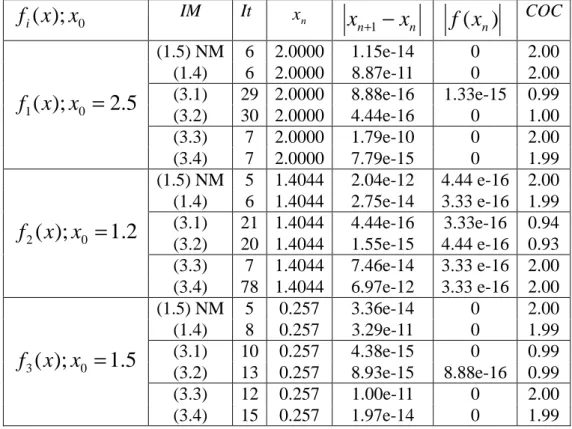
+ .Further we present some results of numerical experiments to illustrate the performance of the considered inverse iterative methods. We compare the Newton method (1.5) with the inverse method (1.4), Modified Newton methods (3.1) and (3.2), and the method s(3.3) and (3.4). We use the following stopping criteria
(i)
x
n+1−
x
n<
ε
,(ii)
f
(
x
n)
<
ε
.We have used the fixed stopping criterion ε =10−15.When the stopping criterion is satisfied,
x
n+1 is taken as the exact rootα
computed.We have denoted:
x
0 - initial approx. It - the number of iterations to approximateaproximations ,
f
(
x
n)
the absolute value of f atx
n, and COC- thecomputational order of convergence computed using the formula
) /(
) (
ln
) /(
) (
ln
2 1 1
1 1
− − −
− +
− −
− −
=
n n n n
n n n n
x x x x
x x x x
COC .
We consider the following nonlinear equations as test problems. These equations can be found in many other papers on the subject, see for example [3,8,9].
1)
f
1(
x
)
=
(
x
−
1
)
3−
1
;2)
f
2(
x
)
=
sin
2(
x
)
−
x
2+
1
;3)
f
3(
x
)
=
x
2−
e
x−
3
x
+
2
;The experimental results are included in the following Table 1:
Table 1. Experimental results.
Acknowledgements
This work is partially supported by Shumen University under Grant No. RD-08-265/10.03.2015.
References
[1] J. F.Traub, Iterative methods for the Solution of Equations, Prentice
0
);
(
x
x
f
i IM It xnn n
x
x
+1−
f
(
x
n)
COC
(1.5) NM 6 2.0000 1.15e-14 0 2.00
(1.4) 6 2.0000 8.87e-11 0 2.00
(3.1) 29 2.0000 8.88e-16 1.33e-15 0.99
(3.2) 30 2.0000 4.44e-16 0 1.00
(3.3) 7 2.0000 1.79e-10 0 2.00
5
.
2
);
(
01
x
x
=
f
(3.4) 7 2.0000 7.79e-15 0 1.99
(1.5) NM 5 1.4044 2.04e-12 4.44 e-16 2.00 (1.4) 6 1.4044 2.75e-14 3.33 e-16 1.99 (3.1) 21 1.4044 4.44e-16 3.33e-16 0.94 (3.2) 20 1.4044 1.55e-15 4.44 e-16 0.93 (3.3) 7 1.4044 7.46e-14 3.33 e-16 2.00
2
.
1
);
(
02
x
x
=
f
(3.4) 78 1.4044 6.97e-12 3.33 e-16 2.00
(1.5) NM 5 0.257 3.36e-14 0 2.00
(1.4) 8 0.257 3.29e-11 0 1.99
(3.1) 10 0.257 4.38e-15 0 0.99
(3.2) 13 0.257 8.93e-15 8.88e-16 0.99
(3.3) 12 0.257 1.00e-11 0 2.00
5
.
1
);
(
03
x
x
=
f
[2] G.H.Nedzhibov, V.I.Hasanov, M.G.Petkov, On Some Families of Multi-point Iterative methods for Solving Nonlinear Equations, Numer. Algor., 42, (2006), 127-136.
[3] S. Weerakoon and T. G. I. Fernando, “A variant of Newton’s method with accelerated third-order convergence,” Applied Mathematics Letters, vol. 13, no. 8, pp. 87–93, 2000.
[4] G.H. Nedzhibov, An acceleration of iterative methods for solving nonlinear equations, Applied Mathematics and Computation, Sep2005, Vol. 168, Issue 1, 320–332 (2004).
[5] M.A.Noor, K.I. Noor, E. Al-Said and M. Waseem, Some new iterative methods for nonlinear equations, Math. Prob. Eng. (2010), Article ID, 98943: 12.
[6] G.H.Nedzhibov, Similarity transformations between some companion matrices, Application of Mathematics in Engineering and Economics (AMEE14), AIP Conf. Proc., 1631, pp. 375-382, (2014).
[7] G.H.Nedzhibov, On two modifications of Weierstrass-Dochev iterative method for solving polynomial equations, MATHTECH 2014, Proceedings of the international conference, Volume 1, pp. 84-90, (2014).
[8] C. Chun, Construction of Newton-like iteration methods for solving nonlinear equations, Numerical Mathematics 104, (2006), 297-315.
[9] M. Aslam Noor and K. Inayat Noor, “Some iterative schemes for nonlinear equations,” Applied Mathematics and Computation, vol. 183, no. 2, pp.774–779, 2006.