www.thelancet.com Vol 390 November 4, 2017 2063
Bictegravir, emtricitabine, and tenofovir alafenamide versus
dolutegravir, abacavir, and lamivudine for initial treatment of
HIV-1 infection (GS-US-380-1489): a double-blind, multicentre,
phase 3, randomised controlled non-inferiority trial
Joel Gallant, Adriano Lazzarin, Anthony Mills, Chloe Orkin, Daniel Podzamczer, Pablo Tebas, Pierre-Marie Girard, Indira Brar, Eric S Daar, David Wohl, Jürgen Rockstroh, Xuelian Wei, Joseph Custodio, Kirsten White, Hal Martin, Andrew Cheng, Erin Quirk
Summary
Background Integrase strand transfer inhibitors (INSTIs) are recommended components of initial antiretroviral therapy with two nucleoside reverse transcriptase inhibitors. Bictegravir is a novel, potent INSTI with a high in-vitro barrier to resistance and low potential as a perpetrator or victim of clinically relevant drug–drug interactions. We aimed to assess the efficacy and safety of bictegravir coformulated with emtricitabine and tenofovir alafenamide as a fixed-dose combination versus coformulated dolutegravir, abacavir, and lamivudine.
Methods We did this double-blind, multicentre, active-controlled, randomised controlled non-inferiority trial at 122 outpatient centres in nine countries in Europe, Latin America, and North America. We enrolled HIV-1 infected adults (aged ≥18 years) who were previously untreated (HIV-1 RNA ≥500 copies per mL); HLA-B*5701-negative; had no hepatitis B virus infection; screening genotypes showing sensitivity to emtricitabine, tenofovir, lamivudine, and abacavir; and an estimated glomerular filtration rate of 50 mL/min or more. Participants were randomly assigned (1:1), via a computer-generated allocation sequence (block size of four), to receive coformulated bictegravir 50 mg, emtricitabine 200 mg, and tenofovir alafenamide 25 mg or coformulated dolutegravir 50 mg, abacavir 600 mg, and lamivudine 300 mg, with matching placebo, once daily for 144 weeks. Randomisation was stratified by HIV-1 RNA (≤100 000 copies per mL, >100 000 to ≤400 000 copies per mL, or >400 000 copies per mL), CD4 count (<50 cells per μL, 50–199 cells per μL, or ≥200 cells per μL), and region (USA or ex-USA). Investigators, participants, and study staff giving treatment, assessing outcomes, and collecting data were masked to group assignment. The primary endpoint was the proportion of participants with plasma HIV-1 RNA less than 50 copies per mL at week 48, as defined by the US Food and Drug Administration snapshot algorithm, with a prespecified non-inferiority margin of –12%. All participants who received one dose of study drug were included in primary efficacy and safety analyses. This trial is registered with ClinicalTrials.gov, number NCT02607930.
Findings Between Nov 13, 2015, and July 14, 2016, we randomly assigned 631 participants to receive coformulated bictegravir, emtricitabine, and tenofovir alafenamide (n=316) or coformulated dolutegravir, abacavir, and lamivudine (n=315), of whom 314 and 315 patients, respectively, received at least one dose of study drug. At week 48, HIV-1 RNA less than 50 copies per mL was achieved in 92·4% of patients (n=290 of 314) in the bictegravir, emtricitabine, and tenofovir alafenamide group and 93·0% of patients (n=293 of 315) in the dolutegravir, abacavir, and lamivudine group (difference –0·6%, 95·002% CI –4·8 to 3·6; p=0·78), demonstrating non-inferiority of bictegravir, emtricitabine, and tenofovir alafenamide to dolutegravir, abacavir, and lamivudine. No individual developed treatment-emergent resistance to any study drug. Incidence and severity of adverse events was mostly similar between groups except for nausea, which occurred less frequently in patients given bictegravir, emtricitabine, and tenofovir alafenamide than in those given dolutegravir, abacavir, and lamivudine (10% [n=32] vs 23% [n=72]; p<0·0001). Adverse events related to study drug were less common with bictegravir, emtricitabine, and tenofovir alafenamide than with dolutegravir, abacavir, and lamivudine (26% [n=82] vs 40% [n=127]), the difference being driven by a higher incidence of drug-related nausea in the dolutegravir, abacavir, and lamivudine group (5% [n=17] vs 17% [n=55]; p<0·0001).
Interpretation At 48 weeks, coformulated bictegravir, emtricitabine, and tenofovir alafenamide achieved virological suppression in 92% of previously untreated adults and was non-inferior to coformulated dolutegravir, abacavir, and lamivudine, with no treatment-emergent resistance. Bictegravir, emtricitabine, and tenofovir alafenamide was safe and well tolerated with better gastrointestinal tolerability than dolutegravir, abacavir, and lamivudine. Because coformulated bictegravir, emtricitabine, and tenofovir alafenamide does not require HLA B*5701 testing and provides guideline-recommended treatment for individuals co-infected with HIV and hepatitis B, this regimen might lend itself to rapid or same-day initiation of therapy in the clinical setting.
Funding Gilead Sciences.
Lancet 2017; 390: 2063–72 Published Online
August 31, 2017 http://dx.doi.org/10.1016/ S0140-6736(17)32299-7 See Comment page 2019
Southwest CARE Center, Santa Fe, NM, USA
(J Gallant MD); IRCCS Ospedale San Raffaele SrL, Milan, Italy
(Prof A Lazzarin MD); Southern California Men’s Medical Group, Los Angeles, CA, USA
(A Mills MD); Grahame Hayton Unit, Royal London Hospital, London, UK (C Orkin MD); Hospital Universitari de Bellvitge, Barcelona, Spain
(D Podzamczer MD); University of Pennsylvania, Philadelphia, PA, USA (P Tebas MD); Hôpital Saint Antoine, Paris, France
(Prof P-M Girard MD); Henry Ford Hospital, Detroit, MI, USA
(I Brar MD); Los Angeles Biomedical Research Institute at Harbor–UCLA Medical Center, Torrance, CA, USA
(E S Daar MD); University of North Carolina at Chapel Hill, Chapel Hill, NC, USA
(D Wohl MD); University Hospital Bonn, Bonn, Germany
(Prof J Rockstroh MD); and Gilead Sciences, Foster City, CA, USA (X Wei PhD, J Custodio PhD, K White PhD, H Martin MD, A Cheng MD, E Quirk MD) Correspondence to: Dr Hal Martin, Gilead Sciences, Foster City, CA 94404, USA
Introduction
Integrase strand transfer inhibitor (INSTI)-containing regimens are widely recommended for the treatment of HIV-1 infection, and in many settings have become the standard of care for initial therapy in combination with
two nucleoside reverse transcriptase inhibitors (NRTIs).1–3
Three INSTIs are currently approved: raltegravir, elvite-gravir, and dolutegravir. No coformulations of raltegravir with NRTIs are commercially available, and patients receiving the twice-daily or once-daily formulations have to take two pills per day, not including the NRTI com ponent. Elvitegravir is available in two once-daily, single-tablet coformulations, but requires boosting by the CYP3A4 inhibitor and pharmacokinetic enhancer,
cobic istat, resulting in the potential for drug–drug
interactions with medications primarily metabolised by CYP3A4. Elvite gravir is restricted to patients with an estimated glomerular filtration rate (eGFR) of more than 30 mL/min. Raltegravir and elvitegravir have overlapping resistance profiles. Dolutegravir is a once-daily, unboosted INSTI with a higher barrier to resistance than raltegravir or elvitegravir, and is available as a single drug or
coformulated with abacavir and lamivudine. Abacavir is associated with risk of hypersensitivity reaction, requires pretreatment HLA-B*5701 testing, has no activity against hepatitis B virus, and has been associated with an
increased risk of cardiovascular events.3–10 No underlying
pathophysiological mechanism has been defined for this possible association. Coformulations that include abacavir and lamivudine are indicated only for patients with an eGFR of more than 50 mL/min. Although CNS adverse effects, including depression, anxiety, and insomnia, might be a class effect of INSTIs, some evidence suggests that these events occur more frequently with dolutegravir in clinical practice than reported in
clinical trials.11–13 Hypersensitivity reactions have also
been reported with dolutegravir.14
Bictegravir (formerly GS-9883) is a novel, potent, once-daily, unboosted INSTI with a high in-vitro barrier to resistance and in-vitro activity against most INSTI-resistant variants, including several variants that have
reduced susceptibility to dolutegravir.15,16 Findings from
clinical studies show that bictegravir has a half-life of roughly 18 h, can be given with or without food,
Research in context
Evidence before this study
We searched PubMed between Jan 1, 1997, and June 5, 2017, for randomised clinical trials of dolutegravir and bictegravir (GS-9883) in patients with HIV-1, with title or abstract search terms of “dolutegravir” or “bictegravir” or “randomised” or “randomized”. Searches were limited to articles published in English. Our search yielded two articles for bictegravir or GS-9883: one article summarising results of a short-term monotherapy and pharmacokinetic study and the other summarising results from a phase 2 study comparing bictegravir with dolutegravir, each given with the
recommended nucleoside reverse transcriptase inhibitor (NRTI) combination of emtricitabine and tenofovir alafenamide in treatment-naive adults with HIV infection. Both treatments showed high efficacy and were well tolerated up to 48 weeks. The search also yielded 25 articles for dolutegravir. We removed 22 of these articles because they were short-term monotherapy or pharmacokinetic studies or systemic reviews or
meta-analyses, and selected the three remaining articles for further review. These studies showed non-inferiority of regimens containing dolutegravir to those containing raltegravir, and superiority of regimens containing dolutegravir to those containing darunavir plus ritonavir, atazanavir plus ritonavir, or efavirenz. Findings also showed antiviral activity of dolutegravir in integrase strand transfer inhibitor (INSTI)-resistant populations. Treatment with dolutegravir was well tolerated.
Added value of this study
INSTIs are recommended as first-line antiretroviral therapy in combination with two NRTIs. Bictegravir is a novel, potent INSTI with high in-vitro activity against most INSTI-resistant
viruses and low potential to perpetrate drug–drug interactions, although it can be a victim of potent CYP3A4 inducers. Bictegravir has been coformulated with emtricitabine and tenofovir alafenamide as a fixed-dose combination. This NRTI backbone is recognised for its potency and safety advantages, particularly with respect to bone and renal measures as compared with emtricitabine and tenofovir disoproxil fumarate. It does not require pretreatment HLA-B*5701 testing, trigger hypersensitivity reactions, or have any known association with cardiovascular events as reported with abacavir and lamivudine. Moreover, HIV guidelines recommend tenofovir alafenamide or tenofovir disoproxil fumarate as components of regimens for treatment of individuals co-infected with HIV and hepatitis B virus. This is the first phase 3 clinical trial comparing the fixed-dose combination of bictegravir, emtricitabine, and tenofovir alafenamide with coformulated dolutegravir, abacavir, and lamivudine.
Implications of all the available evidence
is eliminated by hepatic metabolism with similar contri-butions of CYP3A4 and UGT1A1, and has low potential for clinically meaningful drug–drug interactions, but can be
affected by drugs that are potent inducers of CYP3A4.16
Bictegravir, at doses ranging from 5 mg to 100 mg daily in HIV-infected adults, showed rapid, dose-dependent declines in HIV-1 RNA after 10 days of monotherapy in a phase 1b placebo-controlled study evaluating its short-term
antiviral potency.17 Bictegravir was well tolerated, and
displayed rapid absorption and a half-life supportive of once-daily therapy.
In a phase 2 trial comparing bictegravir with dolute-gravir, both in combination with emtricitabine and tenofovir alafenamide, both regimens were well tolerated with no clinically significant toxic effects or tolerability differences, and 48 week efficacy was high and similar
between groups.18 We did the GS-US-380-1489 study to
compare the efficacy and safety of coformulated bicte-gravir, emtricitabine, and tenofovir alafenamide with coformulated dolutegravir, abacavir, and lamivudine in HIV-1-infected, previously untreated adults.
Methods
Study design and participants
We did this double-blind, multicentre, active-controlled, phase 3, randomised controlled non-inferiority trial at 122 outpatient centres in nine countries in Europe (Belgium, France, Germany, Italy, Spain, and the UK), Latin America (Dominican Republic), and North America (Canada and the USA). Study investigators enrolled HIV-1-infected adults (aged ≥18 years) who were previously untreated and had plasma HIV-1 RNA concentrations of 500 copies per mL or more, no hepatitis B virus infection, were HLA-B*5701-negative, had an eGFR of 50 mL/min or more (Cockcroft–Gault equation), and had no documented resistance to emtricitabine, tenofovir, abacavir, or lamivudine. This study was done in accordance with the Declaration of Helsinki and was approved by central or site-specific review boards or ethics committees. All participants gave written informed consent.
Randomisation and masking
Participants were randomly assigned (1:1), via a computer-generated allocation sequence (block size of four) created by Bracket (San Francisco, CA, USA), to receive once-daily fixed-dose combinations of either bictegravir 50 mg, emtricitabine 200 mg, and tenofovir alafenamide 25 mg or dolutegravir 50 mg, abacavir 600 mg, and lamivudine 300 mg, with matching placebo. Randomisation was
stratified by HIV-1 RNA (≤100 000 copies per mL,
>100 000 to ≤400 000 copies per mL, or >400 000 copies per mL), CD4 count (<50 cells per μL, 50–199 cells per μL, or ≥200 cells per μL), and region (USA or ex-USA). Investigators, participants, and study staff giving treat-ment, assessing outcomes, and collecting data were masked to group assignment. Study investigators deter-mined eligibility, obtained a participant number, and
received automated treatment assignment on the basis of a randomisation sequence.
Procedures
Both regimens were given without regard to food. Post-baseline study visits were done at weeks 4, 8, 12, 24, 36, and 48, after which participants will continue masked treatment with visits every 12 weeks until week 144. Laboratory tests included haematological analysis, serum chemistry tests, fasting lipid measures, CD4 cell counts, measures of renal function (eGFR, urine albumin to creatinine ratio, retinol binding protein to creatinine ratio, β2-microglobulin to creatinine ratio; Covance Laboratories, Indianapolis, IN, USA), and measurement of HIV-1 RNA (Roche TaqMan 2.0; Roche Diagnostics, Rotkreuz, Switzerland). Protocol-defined resistance testing consisted of genotyping and phenotyping of integrase, protease, and reverse transcriptase (Monogram Biosciences, South San Francisco, CA, USA) for any participant who had an HIV-1 RNA of at least 50 copies per mL with a confirmed HIV-1 RNA of at least 200 copies per mL or who had an HIV-1 RNA of at least 200 copies per mL at week 48 or at the last visit on study drug.
We did dual energy X-ray absorptiometry scans for hip and spine lumbar bone mineral density before drug administration at baseline, week 24, and week 48. A centralised centre masked to group assignment read all scans (BioClinica, Newtown, PA, USA). Safety was assessed by physical examinations, laboratory tests, 12-lead electrocardiogram, concomitant drugs, and recording of adverse events, which were coded with the Medical Dictionary for Regulatory Activities (version 19.1). Relatedness of adverse events to study drugs was indicated by the investigator in a binary manner (yes or no). The pharmacokinetics of bictegravir, emtricitabine, and teno-fovir alafenamide were assessed through an intensive pharmacokinetic substudy done on a non-randomised subset of participants. A trough pharmacokinetic blood sample was obtained at the week 4 or 8 visit 20–28 h after the last dose of bictegravir, emtricitabine, and tenofovir alafenamide, and post-dose pharmacokinetic blood samples were obtained at 0·5, 1, 1·5, 2, 3, 4, 6, 8, and 24 h post dose after an observed dose at the clinic. Plasma concentrations of bictegravir, emtricitabine, and tenofovir alafenamide were determined by use of fully validated high-performance liquid chromatography–tandem mass spectroscopy bioanalytical methods.
Outcomes
The primary outcome was the proportion of participants with plasma HIV-1 RNA less than 50 copies per mL at week 48, as defined by the US Food and Drug
Administration (FDA) snapshot algorithm.19 Additional
participants with plasma HIV-1 RNA less than 50 copies per mL at week 48 after imputation of missing-as-failure and missing-as-excluded values; participants with HIV-1 RNA less than 20 copies per mL at week 48 by the snapshot algorithm; and change in HIV-1 RNA and CD4 cell count from baseline to week 48.
Other prespecified secondary outcomes included per-centage changes from baseline in hip and lumbar spine bone mineral density at week 48, change from baseline in serum creatinine and eGFR at week 48, and percentage changes from baseline in urine retinol binding protein to creatinine ratio, urine β2-microglobulin to creatinine ratio, and urine albumin to creatinine ratio at week 48.
Statistical analysis
We analysed the primary endpoint in the full analysis set (all participants who were randomly assigned and had received at least one dose of the study drug, regardless of whether they returned for post-baseline assessments) after enrolled participants had completed their week 48 study visit or had prematurely discontinued the study drug. We assessed the primary assessment of non-inferiority with a conventional 95% CI approach for the difference in virological response rates (bicte gravir, emtricitabine, and tenofovir alafenamide minus dolutegravir, abacavir,
and lamivudine) with a prespecified non-inferiority mar-gin of –12%, based on published US FDA regulatory
guidance.20
With an assumed response rate of 91% at week 48 for both treatment groups, a sample size of 600 participants would achieve at least 95% power to detect non-inferiority at a one-sided α of 0·025. Two planned interim analyses by the independent data monitoring committee were done after roughly the first 50% of enrolled participants had completed their week 12 study visit or had prematurely discontinued study drugs, and again when all subjects completed their week 24 study visit or had prematurely discontinued study drugs. Both analyses concluded that efficacy and safety findings warranted continuation of the trial. An α penalty of 0·00001 was applied for each planned interim analysis. Therefore, the significance level for the two-sided non-inferiority test at week 48 was 0·04998, corresponding to a 95·002% CI. We constructed the baseline stratum-weighted difference in the response rate and its 95·002% CI based on Mantel–Haenszel proportion adjusted by baseline HIV-1 RNA (≤100 000 or >100 000 copies per mL) and region (USA or ex-USA).
In the FDA snapshot analysis, participants were classified according to three outcomes: (1) HIV-1 RNA less than 50 copies per mL at week 48 (between days 295 and 378, inclusive); (2) HIV-1 RNA of 50 copies per mL or more, including participants with HIV-1 RNA of 50 copies per mL or more at week 48, participants who discontinued study drug before week 48 because of low efficacy, or participants who discontinued study drug because of reasons other than low efficacy, adverse event, and death before week 48 with last available HIV-1 RNA of 50 copies per mL or more; and (3) no virological data in the week 48 window, including participants who discontinued study drug before week 48 because of adverse events or death; participants who discontinued study drug because of reasons other than low efficacy, adverse event, and death before week 48 with last available HIV-1 RNA less than 50 copies per mL; and participants who were still on study drug with missing HIV-1 RNA data at week 48. The difference in response rates and p value of the snapshot analysis were calculated based on the dichotomised response: HIV-1 RNA less than 50 copies per mL at week 48 versus HIV-1 RNA of 50 copies per mL or more and no virological data at week 48.
Subgroup analyses of the primary endpoint were done based on age, sex, race, baseline HIV-1 RNA, baseline CD4 cell count, geographical region, and adherence to study drug. Adherence was computed as number of pills taken divided by number of pills prescribed, whereby the number of pills taken was the number of pills dispensed minus the number of pills returned. We also analysed the primary efficacy endpoint in the per-protocol analysis set, which excluded participants in the full analysis set who did not have an HIV-1 RNA value in the week 48 Figure 1: Trial profile
B/F/TAF=bictegravir, emtricitabine, and tenofovir alafenamide. DTG/ABC/3TC=dolutegravir, abacavir, and lamivudine.
739 individuals screened
631 randomly assigned
89 did not meet eligibility criteria
19 met eligibility criteria but not randomly assigned 8 lost to follow-up 6 withdrew consent 2 at investigator’s discretion 1 adverse event 1 outside visit window 1 other
315 assigned to receive DTG/ABC/3TC
315 treated
299 continued on treatment 16 discontinued
4 had an adverse event 1 had non-compliance with
study drugs 5 at participant’s decision 6 lost to follow-up 316 assigned to receive B/F/TAF
314 treated 2 never treated
295 continued on treatment
19 discontinued 1 had a pregnancy 3 at investigator’s discretion 1 had non-compliance with
analysis window and those who had low adherence (ie, adherence ≤2·5th percentile). Additionally, the week 48 efficacy endpoint was analysed with a HIV-1 RNA cutoff of less than 20 copies per mL by snapshot analysis, and the proportion of participants with plasma HIV-1 RNA less than 50 copies per mL at week 48 was analysed with imputation of failure and missing-as-excluded values.
Change from baseline in log10 HIV-1 RNA and CD4 cell
count at week 48 was summarised by treatment group with descriptive statistics based on the full analysis set.
Differences in changes from baseline in log10 HIV-1 RNA
and CD4 cell count between treatment groups were constructed with an ANOVA model, including treatment group, baseline HIV-1 RNA stratum (≤100 000 copies per mL vs >100 000 copies per mL), and region as fixed covariates.
We summarised baseline characteristics with des-criptive statistics for the safety analysis set, which included all randomly assigned participants who received at least one dose of study drug. Safety data are described in summary form, with use of all data collected from after study drug was first given to the data cutoo date or up to 30 days after the last dose of study drug, if the participant discontinued treatment. For categorical data, we calculated p values with the Cochran–Mantel– Haenszel test (the general association statistic was used for nominal data and the row mean scores differ statistic for ordinal data) for treatment comparison. We used two-sided Wilcoxon rank-sum testing for continuous data. To minimise the effect o f m ultiple c omparison, statistical comparisons of the incidence of adverse events between the two treatment groups were made with Fisher’s exact test for adverse events occurring with more than a 5% difference in incidence between groups. For bone mineral density, differences i n p ercentage changes from baseline between treatment groups, and their 95% CIs and p values, were constructed with ANOVA, including treatment group as a fixed effect in the model.
We did analyses with SAS (version 9.4). Pharmacokinetic measures were calculated by application of a non-linear model with standard non-compartmental analysis (WinNonlin version 6.4). This trial is registered with ClinicalTrials.gov, number NCT02607930.
Role of the funding source
The funder of the study had a role in study design, data collection, data analysis, data interpretation, and writing of the report. The corresponding author (HM) had full access to all the data in the study. JG, HM, EQ, and AC had final r esponsibility f or t he d ecision t o s ubmit f or publication.
Results
Between Nov 13, 2015, and July 14, 2016, we randomly assigned 631 patients to receive bictegravir, emtricitabine,
and tenofovir alafenamide (n=316) or dolutegravir, abacavir, and lamivudine (n=315), of whom 314 and 315 patients, respectively, received at least one dose of study drug (figure 1). Demographics and baseline characteristics were similar between groups (table 1).
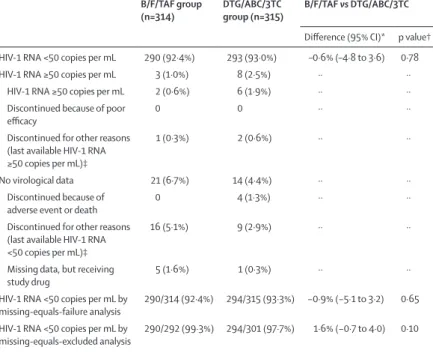
Bictegravir, emtricitabine, and tenofovir alafenamide was non-inferior to dolutegravir, abacavir, and lamivudine for the primary outcome of proportion of partici pants with plasma HIV-1 RNA less than 50 copies per mL at week 48 (92·4% [n=290] vs 93·0% [n=293]; difference −0·6%, 95·002% CI −4·8 to 3·6; p=0·78; table 2). Between-group efficacy did not differ significantly among the various subgroups (appendix p 1).
B/F/TAF group
(n=314) DTG/ABC/3TC group (n=315) Age (years) 31 (18–71) 32 (18–68) Sex
Female 29 (9%) 33 (10%)
Male 285 (91%) 282 (90%)
Race
White 180 (57%) 179 (57%)
Black 114 (36%) 112 (36%)
Asian 6 (2%) 10 (3%)
American Indian or
Alaska Native 2 (1%) 4 (1%) Native Hawaiian or
Pacific Islander 1 (<1%) 2 (1%)
Other 9 (3%) 8 (3%)
Not permitted 2 (1%) 0
Hispanic or Latino 72 (23%) 65 (21%) HIV disease status
Asymptomatic 286 (91%) 286 (91%) Symptomatic 16 (5%) 14 (4%)
AIDS 12 (4%) 15 (5%)
HIV risk factor
Heterosexual sex 61 (19%) 62 (20%) Homosexual sex 251 (80%) 250 (79%) Intravenous drug use 5 (2%) 4 (1%) HIV-1 RNA (log10 copies
per mL) 4·42 (4·03–4·87) 4·51 (4·04–4·87) HIV-1 RNA >100 000
copies per mL 53 (17%) 50 (16%) CD4 count (cells per μL) 443 (299–590) 450 (324–608)
<50 7 (2%) 10 (3%)
≥50 to <200 29 (9%) 22 (7%) ≥200 to <350 69 (22%) 58 (18%) ≥350 to <500 87 (28%) 91 (29%)
≥500 122 (39%) 134 (43%)
Creatinine clearance
(mL/min)* 125·9 (107·7–146·3) 123·0 (107·0–144·3) Body-mass index (kg/m²) 25·1 (22·4–28·7) 24·9 (22·5–29·1)
Data are median (IQR [range for age]) or n (%). B/F/TAF=bictegravir, emtricitabine, and tenofovir alafenamide. DTG/ABC/3TC=dolutegravir, abacavir, and lamivudine. *Estimated with the Cockcroft–Gault equation.
Table 1: Baseline demographic and clinical characteristics
The proportion of participants with HIV-1 RNA less than 20 copies per mL at week 48 was 87·6% (n=275) in the bictegravir, emtricitabine, and tenofovir alafenamide group and 87·3% (n=275) in the dolutegravir, abacavir, and lam-ivudine group (difference 0·4%, 95% CI –4·8 to 5·6; p=0·87).
The proportion of participants with HIV-1 RNA less than 50 copies per mL was high in both groups in the per-protocol analysis (99·3% [n=287 of 289] in the bictegravir, emtricitabine, and tenofovir alafenamide group vs 98·6% [n=289 of 293] in the dolutegravir, abacavir, and lamivudine group; difference 0·7%, 95·002% CI –1·4 to 2·8; p=0·43). Results of the missing-as-failure and missing-as-excluded analyses were consistent with those of the primary analysis (table 2). HIV-1 RNA concentrations decreased in each treatment group, with the fastest decreases from baseline observed in the first 4 weeks after initiation of study drugs (appendix p 5). In missing-as-excluded analysis, the proportion of participants with HIV-1 RNA less than 50 copies per mL was 77·4% (n=243 of 314) in the bictegravir, emtricitabine, and tenofovir alafenamide group and 75·9% (n=236 of 311) in the dolutegravir, abacavir, and lamivudine group at week 4 and 91·7% (n=286 of 312) and 91·6% (n=284 of 310), respectively, at week 8 (figure 2). Mean changes in
log10 HIV-1 RNA from baseline to week 48 were –3·11 log10
copies per mL (SD 0·660) in the bictegravir, emtricitabine,
and tenofovir alafenamide group and –3·08 log10 copies
per mL (0·719) in the dolutegravir, abacavir, and lamivudine group (p=0·65). CD4 cell count increased in each treatment group, with mean changes from base-line to week 48 (observed data, on-treatment values) of 233 cells per μL (SD 185·2) in the bictegravir, emtricitabine, and tenofovir alafenamide group and 229 cells per μL (188·8) in the dolutegravir, abacavir, and lamivudine group (p=0·81).
We did resistance analysis of five participants with protocol-defined criteria for resistance testing (n=1 in the bictegravir, emtricitabine, and tenofovir alafenamide group and n=4 in the dolutegravir, abacavir, and lamivu-dine group). No treatment-emergent resistance devel-oped to any component of either treatment regimen (data not shown).
An intensive pharmacokinetic substudy was done in a subset of the study participants (n=17) in the bictegravir, emtricitabine, and tenofovir alafenamide group. Plasma concentrations of bictegravir, emtricitabine, and tenofovir alafenamide were assessed and the pharmacokinetic measures determined. The mean trough concentration
(Ctau) of bictegravir was 2310 ng per mL (percentage
coefficient of variation [%CV] 41; appendix p 2), which is more than 14-times greater than the protein-adjusted 95% effective concentration (162 ng per mL) against wild type HIV-1 virus. Exposures of emtricitabine (mean area under the plasma concentration–time curve during the dosing
interval [AUCtau] 10 900 ng/mL per h [%CV 30]) and
tenofovir alafenamide (206 ng/mL per h [51]) were consistent with historical data for these approved drugs in
HIV-infected individuals (appendix p 2).21,22
Both treatments were well tolerated, with most adverse events reported as mild or moderate in severity. Nausea was reported less frequently in participants in the bictegravir, emtricitabine, tenofovir alafenamide group than in those in the dolutegravir, abacavir, and lamivudine group (p<0·0001; table 3). Adverse events leading to study drug discontinuation were uncommon and occurred in four (1%) participants in the dolutegravir, abacavir, and
B/F/TAF group
(n=314) DTG/ABC/3TC group (n=315) B/F/TAF vs DTG/ABC/3TC Difference (95% CI)* p value† HIV-1 RNA <50 copies per mL 290 (92·4%) 293 (93·0%) –0·6% (–4·8 to 3·6) 0·78 HIV-1 RNA ≥50 copies per mL 3 (1·0%) 8 (2·5%) ·· ··
HIV-1 RNA ≥50 copies per mL 2 (0·6%) 6 (1·9%) ·· ·· Discontinued because of poor
efficacy 0 0 ·· ··
Discontinued for other reasons (last available HIV-1 RNA ≥50 copies per mL)‡
1 (0·3%) 2 (0·6%) ·· ··
No virological data 21 (6·7%) 14 (4·4%) ·· ·· Discontinued because of
adverse event or death 0 4 (1·3%) ·· ··
Discontinued for other reasons (last available HIV-1 RNA <50 copies per mL)‡
16 (5·1%) 9 (2·9%) ·· ··
Missing data, but receiving
study drug 5 (1·6%) 1 (0·3%) ·· ··
HIV-1 RNA <50 copies per mL by
missing-equals-failure analysis 290/314 (92·4%) 294/315 (93·3%) −0·9% (−5·1 to 3·2) 0·65 HIV-1 RNA <50 copies per mL by
missing-equals-excluded analysis 290/292 (99·3%) 294/301 (97·7%) 1·6% (−0·7 to 4·0) 0·10
Data are n (%) or n/N (%), unless otherwise specified. B/F/TAF=bictegravir, emtricitabine, and tenofovir alafenamide. DTG/ABC/3TC=dolutegravir, abacavir, and lamivudine. * Difference (95·002% CI for snapshot analysis, 95% CI for missing-equals-failure and missing-equals-excluded analyses) based on Mantel–Haenszel proportions adjusted by baseline HIV-1 RNA (≤100 000 vs >100 000 copies per mL) and region (USA vs ex-USA). †p value based on the Cochran–Mantel–Haenszel test, stratified by baseline HIV-1 RNA (≤100 000 vs >100 000 copies per mL) and region (USA vs ex-USA). ‡Other reasons include participants who discontinued study drug at the investigator’s discretion, withdrawal at the decision of the participant, loss to follow-up, non-compliance with study drug, protocol violation, pregnancy, and study termination by the sponsor.
Table 2: Virological outcomes at week 48
Figure 2: Proportion of participants with HIV-1 RNA less than 50 copies per mL Missing-as-excluded analysis. Error bars represent 95% CIs. B/F/TAF=bictegravir, emtricitabine, and tenofovir alafenamide. DTG/ABC/3TC=dolutegravir, abacavir, and lamivudine.
0 4 8 12 24 36 48
0 20 40 60 80 100
Proportion
of participants (%)
Time (weeks)
B/F/TAF DTG/ABC/3TC
97·7%
lamivudine group due to nausea and generalised rash (n=1), thrombocytopenia (n=1), chronic pancreatitis and steatorrhoea (n=1), and depression (n=1), all of which were deemed by the investigator to be related to study drugs (table 3). Participants in the bictegravir, emtricitabine, and tenofovir alafenamide group had fewer drug-related adverse events than did those in the dolutegravir, abacavir, and lamivudine group (table 3); events were primarily mild or moderate in severity. The difference between groups was driven mainly by drug-related nausea (5% [n=17] vs 17% [n=55]; p<0·0001). Overall, CNS and psychiatric adverse events were equally distributed between treatment groups (data not shown). Insomnia was reported in 4% of participants in the bictegravir, emtricitabine, and tenofovir alafenamide group and 6% of those in the dolutegravir, abacavir, and lamivudine group (table 3). No patients died during the study. Two women, one in each group, had confirmed pregnancies. The participant in the bictegravir, emtricitabine, and tenofovir alafenamide group discontinued study drug at the time pregnancy was confirmed and subsequently delivered a healthy full-term infant. The pregnancy in the dolutegravir, abacavir, and lamivudine group was terminated with an elective abortion and study drug was continued. 46 (15%) participants in each group had a grade 3 or 4 laboratory abnormality; incidence and types of abnormalities were similar between groups (appendix p 3).
We recorded small changes from baseline in hip and lumbar spine bone mineral density that were similar between patients in the bictegravir, emtricitabine, and tenofovir alafenamide and dolutegravir, abacavir, and lamivudine groups: mean percentage changes at week 48 were –0·78% (SD 2·22) versus –1·02% (2·31) at the hip (least-squares mean difference 0·238%, 95% CI –0·151 to 0·626; p=0·23) and –0·83% (3·19) versus –0·60% (3·10) at the lumbar spine (–0·235, –0·766 to 0·297; p=0·39; figure 3).
No cases of proximal tubulopathy or Fanconi syndrome were reported in either group and no participant dis-continued because of a renal adverse event. Increases from baseline in median serum creatinine and decreases in eGFR were noted at week 48 for both groups (table 4). At 48 weeks, percentage changes in quantitative pro-teinuria (total urinary albumin to urine creatinine ratio) and tubular proteinuria (retinol binding protein and β2-microglobulin to urine creatinine ratios) were similar and did not differ significantly between groups (table 4).
Changes from baseline in fasting lipid measures were generally similar between groups at week 48 (appendix p 4). There was a small (–0·1), statistically significant (p=0·0130) difference in the total cholesterol to HDL ratio between groups (appendix). The proportion of patients initiating lipid-modifying drugs during the study did not differ significantly between the bictegravir, emtricitabine, and tenofovir alafenamide group and the dolutegravir, abacavir, and lamivudine group (2·5% [n=8 of 314] vs 2·9% [n=9 of 315]; p=1·00).
Discussion
Our findings show that efficacy of the fixed-dose combination of bictegravir, emtricitabine, and tenofovir alafenamide was high, and non-inferior to that of the approved fixed-dose combination of dolutegravir, abacavir, and lamivudine, with no differences between treatment groups in efficacy among subgroups. Viral suppression by per-protocol analysis was 99% in both treatment groups. No treatment-emergent resistance developed to the components of either regimen.
Both regimens were well tolerated; adverse events leading to study discontinuation were noted in no participants in the bictegravir, emtricitabine, and tenofovir alafenamide group and 1% of participants in the dolutegravir, abacavir, and lamivudine group. However, dolutegravir, abacavir, and lamivudine was associated with more adverse events in total than bictegravir, emtricitabine, and tenofovir alafenamide, primarily driven by nausea. Overall, neuropsychiatric and sleep disorder events were similar between groups. Changes from baseline in bone mineral density and serum creatinine and eGFR were similar between treatment groups. No patients had proximal tubulopathy or discontinuations for renal adverse events in either group, and changes in overall proteinuria and tubular proteinuria were similar. Changes in fasting lipid
B/F/TAF group
(n=314) DTG/ABC/3TC group (n=315) Any adverse event 265 (84%) 283 (90%) Grade 3 or 4 adverse event 23 (7%) 24 (8%) Serious adverse event 19 (6%) 25 (8%) Drug-related adverse event 82 (26%) 127 (40%) Drug-related serious adverse event 1 (<1%) 1 (<1%) Any adverse event leading to study
drug discontinuation 0 4 (1%)* Adverse events occurring with ≥5% incidence in either group
Nausea 32 (10%) 72 (23%)
Diarrhoea 40 (13%) 41 (13%)
Headache 36 (11%) 43 (14%)
Upper respiratory tract infection 20 (6%) 34 (11%) Nasopharyngitis 23 (7%) 29 (9%)
Fatigue 19 (6%) 27 (9%)
Syphilis 12 (4%) 25 (8%)
Insomnia 14 (4%) 20 (6%)
Arthralgia 11 (4%) 19 (6%)
Vomiting 12 (4%) 17 (5%)
Cough 20 (6%) 8 (3%)
Bronchitis 10 (3%) 16 (5%)
Abdominal pain 9 (3%) 16 (5%)
Data are n (%). B/F/TAF=bictegravir, emtricitabine, and tenofovir alafenamide. DTG/ABC/3TC=dolutegravir, abacavir, and lamivudine. *Chronic pancreatitis and steatorrhoea (n=1), nausea and generalised rash (n=1), depression (n=1), and thrombocytopenia (n=1).
concentrations were generally similar between groups and not deemed clinically relevant, and there were no differences in initiation of lipid-lowering drugs.
Findings from this study suggest that bictegravir and dolutegravir have similar advantages. Both are potent,
with high inhibitory quotients;23,24 are highly efficacious
when combined with two NRTIs; can be taken once a day, with or without food and in the absence of pharma-cokinetic enhancement; and are coformulated with NRTIs in dose combinations. However, the fixed-dose combination of bictegravir, emtricitabine, and tenofovir alafenamide might have advantages over the combination of dolutegravir, lamivudine, and abacavir. Both dolutegravir and abacavir are associated with hypersensitivity reactions. Initiation of treatment with dolutegravir, abacavir, and lamivudine must be delayed
pending HLA B*5701 testing and determination of co-infection with hepatitis B virus. Furthermore, tenofovir alafenamide is active against hepatitis B virus and is approved for treatment of hepatitis B as a single drug. HIV treatment guidelines recommend tenofovir alafenamide or tenofovir disoproxil fumarate as components of regimens for treatment of people
co-infected with HIV and hepatitis B virus.1–3 Because use of
coformulated bictegravir, emtricitabine, and tenofovir alafenamide does not require HLA B*5701 testing and provides guideline-recommended treatment for individuals with HIV and hepatitis B co-infection, this combination might lend itself to rapid or same-day initiation of treatment in the clinical setting. Some, but not all, studies have shown an association between abacavir use and an increased risk of myocardial infarction, although a pathophysiological underlying
mechanism has not been defined.3–10 Additionally,
coformulated bictegravir, emtricitabine, and tenofovir alafenamide can be given to individuals with an eGFR of 30 mL/min or more, whereas use of dolutegravir, abacavir, and lamivudine is limited to those with an eGFR of more than 50 mL/min. We recorded more nausea adverse events in the dolutegravir, abacavir, and lamivudine group. This observation is most likely to be attributable to differences in gastrointestinal tolerability between tenofovir alafenamide and abacavir, since gastrointestinal tolerability was similar in the phase 2 and 3 trials comparing bictegravir with dolutegravir when both were combined with emtricitabine and
tenofovir alafenamide.18,25 Furthermore, findings from
the ACTG 5202 study indicated a greater incidence of nausea with the abacavir and lamivudine NRTI backbone than with emtricitabine and tenofovir disoproxil
fumarate.26
There is growing evidence that the resistance barrier of dolutegravir is higher than that of raltegravir and elvitegravir. To date, only two cases of possible emergent INSTI resistance have been reported in patients taking
dolutegravir as part of an initial regimen.27,28 Thus far, no
INSTI resistance has emerged in any patient treated with either bictegravir or dolutegravir within combination
regimens in clinical trials.18,25,29 Although assessment of
the resistance barrier of a drug cannot be determined by clinical trials alone, the lack of observed resistance in clinical trials, and the finding of in-vitro activity of
bictegravir against some dolutegravir-resistant isolates,30
suggests that bictegravir might have a similarly high barrier.
Our study has several limitations. The trial was powered for the primary efficacy endpoint after 48 weeks of treatment. Thus, adverse events, such as CNS events recorded in patients treated with dolutegravir, might become apparent after longer durations of use or in broader patient populations. Other limitations include a small proportion of study participants with advanced HIV disease, and a small proportion of female participants. Figure 3: Mean percentage change from baseline in hip and lumbar spine bone mineral density
As determined by dual energy X-ray absorptiometry scan. Error bars represent 95% CIs. B/F/TAF=bictegravir, emtricitabine, and tenofovir alafenamide. DTG/ABC/3TC=dolutegravir, abacavir, and lamivudine. *B/F/TAF versus DTG/ABC/3TC at week 48 by ANOVA.
B/F/TAF DTG/ABC/3TC
Number of patients B/F/TAF group DTG/ABC/3TC group
0
304 299
24
284 287
48
267 274 Time (weeks) –3
–2 –1 1 0 2
0
300 297
24
278 285
48
257 270 Time (weeks)
Spine Hip
3
Mean percentage change
(%) –0·78%
–1·02%
–0·83%
–0·60%
p=0·23* p=0·39*
B/F/TAF group
(n=314) DTG/ABC/3TC group (n=315) p value* Serum creatinine (mg/dL)
Baseline 0·90 (0·80 to 1·00) 0·91 (0·81 to 0·99) 0·92 Change at week 48 0·11 (0·03 to 0·17) 0·11 (0·03 to 0·18) 0·78 eGFR (mL/min)†
Baseline 125·9 (107·7 to 146·3) 123·0 (107·0 to 144·3) 0·76 Change at week 48 –10·5 (19·5 to 0·2) –10·8 (–21·6 to –2·4) 0·20 Urine albumin to creatinine ratio (mg/g)
Baseline 5·5 (3·7 to 9·2) 5·4 (3·7 to 9·1) 0·72 Percentage change at week 48 0·6% (–32·0 to 48·9) 6·2% (–23·6 to 57·7) 0·11 Urine β2-microglobulin to creatinine ratio (μg/g)
Baseline 108·1 (71·7 to 184·4) 109·8 (77·6 to 191·8) 0·92 Percentage change at week 48 –23·0% (–57·2 to 19·8) –18·1% (–54·2 to 17·4) 0·40 Urine retinol binding protein to creatinine ratio (μg/g)
Baseline 81·0 (58·3 to 122·4) 83·7 (59·8 to 120·4) 0·55 Percentage change at week 48 13·6% (–20·9 to 63·6) 19·9% (–16·0 to 58·9) 0·34
Data are median (IQR), unless otherwise specified. B/F/TAF=bictegravir, emtricitabine, and tenofovir alafenamide. DTG/ABC/3TC=dolutegravir, abacavir, and lamivudine. eGFR=estimated glomerular filtration rate. *p values for B/F/TAF versus DTG/ABC/3TC from two-sided Wilcoxon rank-sum tests. †Calculated with the Cockcroft–Gault formula.
In summary, the fixed-dose combination of bictegravir, emtricitabine, and tenofovir alafenamide has high antiretroviral efficacy and is non-inferior to the combination of dolutegravir, abacavir, and lamivudine, with no emergence of drug resistance and no apparent disadvantage in terms of adverse events or toxic effects, including renal, bone, and metabolic measures. Bictegravir, emtricitabine, and tenofovir alafenamide had better gastrointestinal tolerability, with less nausea, than dolutegravir, abacavir, and lamivudine, presumably because of differences between tenofovir alafenamide and abacavir. The fixed-dose combination of bictegravir, emtricitabine, and tenofovir alafenamide is a promising regimen for the initial treatment of HIV infection.
Contributors
JG, AL, AM, CO, DP, PT, P-MG, IB, ESD, DW, and JR enrolled participants, analysed data and independently interpreted the results, and edited and approved the report. HM, EQ, and AC designed the study. XW analysed the data, which were reviewed and interpreted by JC, KW, HM, EQ, and AC. JG and AC wrote the first draft. All authors were involved in the development of the primary manuscript; interpretation of data; and provided edits, read, and approved the final version. Declaration of interests
JG has received grants or research support from AbbVie, Bristol-Myers Squibb (BMS), Gilead, Janssen Therapeutics, Merck & Co, Sangamo Biosciences, and ViiV Healthcare–GlaxoSmithKline; and honoraria or consultancy fees from BMS, Gilead, Merck & Co, Theratechnologies, and ViiV Healthcare–GlaxoSmithKline. AL has received honoraria for advisory board participation from BMS, Gilead, ViiV Healthcare, Merck Sharp & Dohme, AbbVie, and Janssen-Cilag, and speaker fees for conference and meeting talks from BMS, Gilead, ViiV Healthcare, Merck Sharp & Dohme, Janssen-Cilag, and Mylan. AM has received grants and personal fees from Gilead; grants from ViiV Healthcare and Merck; and grants from Sangamo, Medrio, and Eisai. CO has received research grants, personal fees, and non-financial support for lectureships and serving on advisory boards from Gilead, Merck Sharp & Dohme, BMS, ViiV Healthcare, and Janssen. DP has received research grants and honoraria for advisories or conferences from ViiV Healthcare, BMS, Abbvie, Gilead, Janssen, and Merck. PT has received consultancy fees from Merck, institutional research grants for Gilead trials, and has served on an adjudication committee for GlaxoSmithKline. P-MG has received grants from BMS and Janssen, personal fees from BMS, and financial fees from Gilead and ViiV Healthcare for participation on international advisory boards. IB has received grants and financial support from Gilead Sciences and Tobotec, and grants from GSK. ESD has received research support from Gilead, Merck, and ViiV Healthcare, and has acted as a consultant or advisor for BMS, Gilead, Janssen, Merck, Teva, Theratechnology, and ViiV Healthcare. DW has served on advisory boards for Gilead and Janssen, and has received research grants to the University of North Carolina from Gilead. JR has received personal fees from Abbott, Hexal, Merck, Gilead, AbbVie, BMS, and ViiV Healthcare. XW, JC, KW, HM, AC, and EQ are employees of Gilead and hold stock interest in the company.
Acknowledgments
This study was funded by Gilead Sciences. We thank the
GS-US-380-1489 principal investigators and their staff (appendix pp 6–9); the patients who participated in this trial, their families, and the Gilead study staff; and Anna Kido (Gilead) for providing editorial assistance. Parts of this study were presented at the 9th International Aids Society (IAS) Conference on HIV Science; Palais des Congrès, Paris, France; July 23–26, 2017.
References
1 Gunthard HF, Saag MS, Benson CA, et al. Antiretroviral Drugs for treatment and prevention of HIV infection in adults: 2016 recommendations of the International Antiviral Society–USA panel. JAMA 2016; 316: 191–210.
2 Panel on Antiretroviral Guidelines for Adults and Adolescents. Guidelines for the use of antiretroviral agents in HIV-1-infected adults and adolescents. 2016. http://www.aidsinfo.nih.gov/ ContentFiles/AdultandAdolescentGL.pdf (accessed June 16, 2017). 3 European AIDS Clinical Society. Guidelines. Version 8.0.
October 2015. http://www.eacsociety.org/files/guidelines_8_0-english_web.pdf (accessed June 16, 2017).
4 Cahn P, Kaplan R, Sax P, et al, for the ONCEMRK Study Group. Raltegravir (RAL) 1200 mg once daily (QD) is non-inferior to RAL 400 mg twice daily (BID), in combination with tenofovir/ emtricitabine, in treatment-naïve HIV-1-infected subjects: week 48 results. AIDS 2016; Durban, South Africa; July 18–22, 2016. FRAB0103LB (abstr).
5 D:A:D Study Group. Use of nucleoside reverse transcriptase inhibitors and risk of myocardial infarction in HIV-infected patients enrolled in the D:A:D study: a multi-cohort collaboration. Lancet 2008; 371: 1417–26.
6 Worm SW, Sabin C, Weber R, et al. Risk of myocardial infarction in patients with HIV infection exposed to specific individual antiretroviral drugs from the 3 major drug classes: the data collection on adverse events of anti-HIV drugs (D:A:D) study. J Infect Dis 2010; 201: 318–30.
7 Young J, Xiao Y, Moodie EE, et al. Effect of cumulating exposure to abacavir on the risk of cardiovascular disease events in patients from the Swiss HIV Cohort Study. J Acquir Immune Defic Syndr 2015; 69: 413–21.
8 Friis-Møller N, Thiébaut R, Reiss P, et al. Predicting the risk of cardiovascular disease in HIV-infected patients: the data collection on adverse effects of anti-HIV drugs study.
Eur J Cardiovasc Prev Rehabil 2010; 17: 491–501.
9 Marcus JL, Neugebauer RS, Leyden WA, et al. Use of abacavir and risk of cardiovascular disease among HIV-infected individuals. J Acquir Immune Defic Syndr 2016; 71: 413–19.
10 Sabin CA, Reiss P, RyomL, et al; D:A:D Study Group. Is there continued evidence for an association between abacavir usage and myocardial infarction risk in individuals with HIV? A cohort collaboration. BMC Med 2016; 14: 61.
11 de Boer MG, van den Ber GE, van Holten N, et al. Intolerance of dolutegravir-containing combination antiretroviral therapy regimens in real-life clinical practice. AIDS 2016; 30: 2831–34. 12 Hoffmann C, Welz T, Sabranski M, et al. Higher rates of
neuropsychiatric events leading to dolutegravir discontinuation in women and older patients. HIV Med 2017; 18: 56–63.
13 Fettiplace A, Stainsby C, Winston A, et al. Psychiatric symptoms in patients receiving dolutegravir. J Acquir Defic Syndr 2017; 74: 423–31. 14 ViiV Healthcare–GlaxoSmithKline. Tivicay (dolutegravir).
Highlights of prescribing information. June, 2016. https://www. gsksource.com/gskprm/htdocs/documents/TIVICAY-PI-PIL.PDF (accessed July 27, 2016).
15 Lazerwith SE, Cai R, Chen X, et al. Discovery of GS-9883, an HIV-1 integrase strand transfer inhibitor (INSTI) with improved pharmacokinetics and in vitro resistance profile. ASM Microbe; Boston, MA, USA; June 16–20, 2016. 414 (abstr).
16 Zhang H, Custodio J, Wei X, et al. Clinical pharmacology of the HIV intregrase strand transfer inhibitor bictegravir. Conference on Retroviruses and Opportunistic Infections; Seattle, WA, USA; Feb 13–16, 2017. 40 (abstr). http://www.croiconference.org/sessions/ clinical-pharmacology-hiv-integrase-strand-transfer-inhibitor-bictegravir (accessed June 15, 2017).
17 Gallant JE, Thompson M, DeJesus E, et al. Antiviral activity, safety, and pharmacokinetics of bictegravir as 10-day monotherapy in HIV-1-infected adults. J Acquir Immune Defic Syndr 2017; 75: 61–66. 18 Sax PE, DeJesus E, Crofoot G, et al. Bictegravir versus dolutegravir,
each with emtricitabine and tenofovir alafenamide, for initial treatment of HIV-1 infection: a randomised, double-blind, phase 2 trial. Lancet HIV 2017; 4: e154–60.
19 Smith F, Hammerstorm T, Soon G, et al. A meta-analysis to assess the FDA DAVP’s TLOVR algorithm in HIV submissions. Drug Inf J 2011; 45: 291–300.
21 Gilead Sciences. Viread (tenofovir disoproxil fumarate). Highlights of prescribing information. February, 2016. http://www.gilead. com/~/media/files/pdfs/medicines/hiv/viread/viread_pi.pdf?la=en (accessed June 15, 2017).
22 Gilead Sciences. Genvoya (elvitegravir, cobicistat, emtricitabine, and tenofovir alafenamide). Highlights of prescribing information. September, 2016. http://services.gileadhiv.com/genvoya/pdf/ prescribing_info (accessed June 15, 2017).
23 Zhang H, West S, Vu A, et al. A study evaluating the pharmacokinetics, safety, and tolerability of the bictegravir/ emtricitabine/tenofovir alafenamide (B/F/TAF) single tablet regimen (STR) in Japanese subjects. 9th International Aids Society (IAS) Conference on HIV Science; Palais des Congrès, Paris, France; July 23–26, 2017. MOPEB0332 (abstr).
24 Min S, Sloan L, DeJesus E, et al. Antiviral activity, safety, and pharmacokinetics/pharmacodynamics of dolutegravir as 10-day monotherapy in HIV-1-infected adults. AIDS 2011; 25: 1737–45. 25 Sax PE, Pozniak A, Arribas J, et al. Phase 3 randomized, controlled
clinical trial of bictegravir coformulated with FTC/TAF in a fixed-dose combination (B/F/TAF) vs dolutegravir (DTG) + F/TAF in treatment-naïve HIV-1 positive adults: week 48 results. 9th International Aids Society (IAS) Conference on HIV Science; Palais des Congrès, Paris, France; July 23–26, 2017. A-854-0106-05793 (abstr).
26 Sax PE, Tierney C, Collier AC, Daar ES, Mollan K, Budhathoki C, et al. Abacavir/lamivudine versus tenofovir/emtricitabine as part of combination regimens for initial treatment of HIV: final results. J Infect Dis 2011; 204: 1191–201.
27 Fulcher JA, Du Y, Sun R, Landovitz RJ. Emergence of integrase resistance mutations during initial therapy with TDF/FTC/DTG. Conference on Retroviruses and Opportunistic Infections; Seattle, WA, USA; Feb 13–16, 2017. 500LB (abstr).
28 Lepik KJ, Harrigan PR, Yip B, et al. Emergent drug resistance with integrase strand transfer inhibitor-based regimens. AIDS 2017;
31: 1425–34.
29 Junjun J, Xu X, Guo W, et al. Dolutegravir (DTG, S/GSK1349572) combined with other ARTs is superior to RAL- or EFV-based regimens for treatment of HIV-1 infection: a meta-analysis of randomized controlled trials. AIDS Res Ther 2016; 13: 30. 30 Tsiang M, Jones GS, Goldsmith J, et al. Antiviral activity of
bictegravir (GS-9883), a novel potent HIV-1 integrase strand transfer inhibitor with an improved resistance profile.