Jharna Ghosh IJSRE Volume 06 Issue 05 May 2018 Page 7950 Volume||6||Issue||05||May-2018||Pages-7950-7957||ISSN(e):2321-7545 Website: http://jsae.in
Index Copernicus Value- 76.10 DOI: http://dx.doi.org/10.18535/ijsre/v6i5.06
A Study To Find The Effect of Spirometry Exercise in Controlling Pain Among CABG
Patients During Ambulation in A Selected Hospital, WB
Author Jharna Ghosh
INC,WBUHS ABSTRACT-
Analgesics are not always effective in eliminating post-operative Pain .There are so many Non- Pharmacological interventions which can be done by the nurse researcher to recover patients from pain and help in early ambulation as well as improve quality of life.
The investigator conducted, ‘A study to find the effect of spirometry exercise in controlling pain among post CABG patients during ambulation in a selected hospital, Kolkata , West Bengal .’
The objective of the study: To assess the level of pain among post CABG patients practicing spirometry exercise during ambulation, To find the effect of spirometry exercise in terms of reduction of pain during ambulation and to find the association between pain score and selected variables.
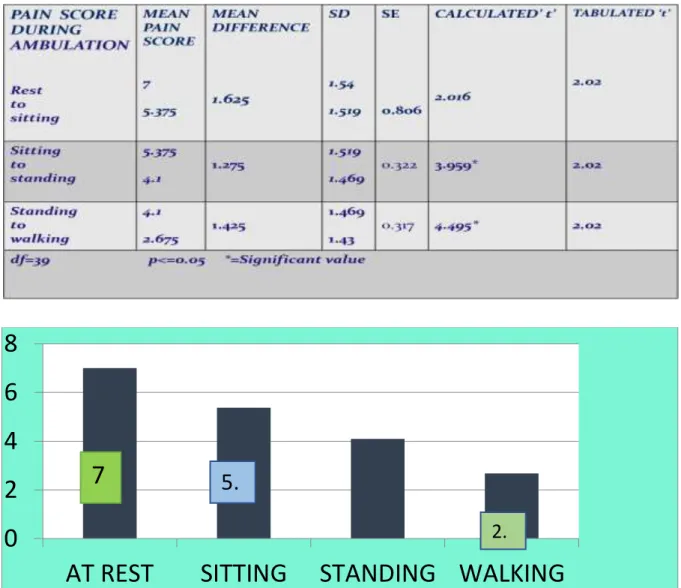
The investigator adopted purposive research sampling technique with time-series research design. The total sample size was 40. Here the investigator used two tools for data collection – selected variables and universal pain scale (simple descriptive numerical pain scale) to assess pain score. The data were analyzed using both descriptive and inferential statistics. Investigator found that the mean pain score is reduced gradually after practising spirometry exercise during different stages of ambulation (rest to sitting, sitting to standing and after walking around the bed). The findings of the study revealed that the ‘t’ value was not significant during 1st stage of ambulation i.e.at rest to sitting (2.016) but was significant at sitting to standing (3.959) and after walking (4.495) at 0.05 level of significance. Therefore, effectiveness of spirometry exercise in controlling pain during ambulation is established. Study also revealed that there was association of pain-score with selected variables. The findings of the study can be implicated on nursing education, administration, practice and in further research.
INTRODUCTION
CAD is now a days a global burden . It is due to atherosclerotic blockage in the blood vessels. As a result sufficient blood can not reach to esteemed area of heart which leads to heart attack.
According to WHO an estimated 17.5 million people died from CVD in 2012 ,representing 31% 0f all deaths.OF these deaths an estimated 7.4 million were due to coronary artery disease and 6.7 million were due to stroke.
Jharna Ghosh IJSRE Volume 06 Issue 05 May 2018 Page 7951
Peric V (2012) conducted a study on to evalute the changes in quality in life after CABG among 243 consequtive patients.
Analysis showed that changes in quality of life is improved in post CABG patients in the relation to physical mobility.
Need of The Study- Analgesics are not always effective In eliminating post operative Pain .There are so many Non- Pharmacological interventions which can be done by the nurse researcher to recover patients from pain and help In early ambulation as well as improve quality of life.
Jamunabai,Priyalatha(2010)conducted an experimental study to assess the effectiveness of vibration foot massage therapy on controlling pain among 60 post CABG patients . Result shows that there is decrease of pain intensity from mean score 7.27to 1.17 in experimental group as compared to control group whose mean pain score ranged from 6.97 to 5.07. Therefore foot massage therapy can be used as an efffective non-pharmacological pain control measure.
Purpose of Study- To determine the effectiveness of spirometry exercise in controlling pain during ambulation which will help in early discharge, fast recovery and back to normal life.
Problem Statement- A study to find the effect of spirometry exercise in controlling pain among post CABG patients during ambulation in a selected hospital, Kolkata , West Bengal.
OBJECTIVES
To assess the level of pain among post CABG patients practicing spirometry exercise during ambulation.
To find the effect of spirometry exercise in terms of reduction of pain during ambulation.
To find the association between pain score and selected variables.
VARIABLES Dependent Variables: Pain score Independent Variables: Spirometry Exercise Demografic Variables:
Age , Sex , Education , Occupation Illness Variables:
Type of CABG , Site of graft , number of graft , number of post operative days , number of wounds , number of invasive lines , number of chest drains.
Hypotheses
All the hypotheses are tested at 0.05 level of significance…
The mean post test pain score of CABG patients practicing spirometry exercise during ambulation is significantly lower than pre test pain score.
There is significant association between pain score and selected variables.
RESEARCH METHODOLOGY
Research Approach : Quasi experimental research approach Research Design : Quasi experimental time series design Research Design:
O1 X M1 O2 X M2 O3 X M3 O4 (10Minute)
Jharna Ghosh IJSRE Volume 06 Issue 05 May 2018 Page 7952
O(n)=O1(30Sec)……O2(30Sec)…….O3(30Sec)……… O4(30Sec)
(m n = 1Min X 4)=4Min X=Intervention
M=Ambulation Sec=Second Min=Minute
Population : Patients who had undergone CABG surgery. Sample: 2rd and 3rd post CABG patients.
Sampling Technique : Convenience non probability sampling technique. Sample Size: 40
Setting: B.M.Birla Heart Esearch Centre Tools And Techniques
DATA COLLECTION STEPS Sit in fowler position.
Be relax and concentrate for breathing exercise through spirometer.
Hold spirometer at chest level with mouth piece hold by 2 lips in such a way that there is no leakage of air. Inhale through spirometer by slow deep breath with visual feedback to uplift 3 balls by counting 1,2,3 with visuaL feedback.
Jharna Ghosh IJSRE Volume 06 Issue 05 May 2018 Page 7953
ANALYSIS OF DATA
17.50
%
32.50
%
50%
30-45 Yrs
46-60 Yrs
61-75 Yrs
Jharna Ghosh IJSRE Volume 06 Issue 05 May 2018 Page 7954
TABLE-2 DISTRIBUTION OF ILLNESS VARIABLES n=40
SL.NO VARIABLES FREQUENCY PERCENTAGE(%)
1 TYPE OF CABG
On pump Off pump 10 30 25 75
2 SITE OF GRAFT
Sephanus Radial Thorasic 38 -25 95 -62.5
3 NO.OF GRAFT
One Two Three 8 20 12 20 50 30
4 NO.OF CHEST DRAIN One Two Three 32 7 1 80 17.5 2.5 5 6. 7.
NO.OF POST OP DAY 2ndpod
3rdpod
NO OF INVASIVE LINE CVP
Jharna Ghosh IJSRE Volume 06 Issue 05 May 2018 Page 7955
Table 3: Effectiveness of Intervention During Ambulation N=40
Fig:6 Distribution of mean pain score during ambulation
Table 3: Chi Square Between Pain Score And Demographic Variables N=40
0
2
4
6
8
AT REST
SITTING
STANDING WALKING
7
5.
Jharna Ghosh IJSRE Volume 06 Issue 05 May 2018 Page 7956
Table 4: Chisquare Value Between Pain Score And Illness Variable Among Experimental Group
N=40
Jharna Ghosh IJSRE Volume 06 Issue 05 May 2018 Page 7957
MAJOR FINDINGS 1. Sample Charecteristics
majority age group belongs to 61-75yrs(50%) majority are male(82.5%)
majority of coronary artery bypass grafting surgery performed in off pump(88%) majority education is graduate(52.5%)
majority occupation is service(57.5%)
majority samles are 2nd post-operative day(80%) majority of graft are sephanus (95%)
majority of subjects have 2 chest drain(82.5%)
number of invasive line is equally distributed in cvp and peripheral line 2. Effectiveness Of Spirometry Exercise
The Mean Pain Score Is 7 At Rest , 5.37 At Sitting ,4.1 At Standing And 2.67 After Walking With Practicing Spirometry Exercise. So Data Highlights That The Mean Pain Scores Are Gragually Decreasing With Practicing Spirometry Exercise Which Is Significant By ‘t’Value For df(39) At 0.05 Level Of Significance.So research hypothesis is accepted and null hypothesis is rejected.
3. Findings Related To Association Between Pain Score And Selected Variables:
The chi square test was computed in order to determine the test of sinificance of association between pain score and selected variables.Test showed there was no significant association between pain score as tabulated chi square value is less than calculated chi squre value.so null hypothesis is accepted and research hypothesis is rejected.
CONCLUSION