THREE BLACK WOMEN JOURNALISTS IN THE STRUGGLE FOR CIVIL RIGHTS
Fatimah S. Salleh
A dissertation submitted to the faculty of the University of North Carolina at Chapel Hill in partial fulfillment of the requirements for the degree of Doctor of Philosophy
in the School of Journalism and Mass Communication
Chapel Hill 2012
ABSTRACT
FATIMAH S. SALLEH: Empowered Women Resist: Three Black Women Journalists in the Struggle for Civil Rights (Under the Direction of Dr. Jane D. Brown and Dr. Donald Shaw)
The Civil Rights Movement, 1947-1968, was a time of great change and resistance for African Americans. The black press played a crucial role as African-American journalists conveyed the hopes and frustrations of their people and rallied citizens to fight for their rights. Although previously understudied, a number of the most powerful writers of the era were black female journalists. This dissertation examines the lives and work of journalists and journalism educators Lucile Bluford, Francis Murphy, and Dorothy Gilliam, based on analysis of their writing and oral histories recorded as part of the Washington Press Club’s Oral History Project. Black feminist, alternative, and ethnic media theories are used to understand these women’s lives and work.
Frances L. Murphy’s reign as the owner and editor of the long standing
Although the life story of each woman is unique, the similarities of their focus and approach were striking. All three women fought throughout their lives for racial parity. They fought for school segregation despite their positive experiences with black schooling. Their voices championed voting rights and health care in the black community, and they
When people ask, “how did you do it?” I know it was the grace of God. Without divine help, this would not have been possible. I could definitely see His love through my wonderful support system. Here is the village that helped raise me:
Dr. Jane Brown who stuck by me through my teary breakdowns, two childbirths, and my “nursing brain” writing. I have been so fortunate to call her my chair, my teacher, mentor and best of all, my friend. She has taught me how to be a humane academic and I hope one day I can do for someone what she has so graciously done for me through these years.
My husband, Eric Sorensen, who never let me quit. On so many occasions, I would talk through my dissertation and he would tirelessly listen to all my ideas. He always made me feel like my ideas were valued and powerful. I don’t think he will ever know how much he helped build my academic confidence. I would not want to go through this journey with anyone else.
My mom has been there through it all. She is my heroine, my anchor.
My children, Micah, Xavier, Ronin, and Zora always make me realize what is truly important. I will have no greater honor in this life than being their mother.
My sister, Najah, is a ray of light. She comes into my life and makes me happier, stronger, and better.
Chapter
I. INTRODUCTION AND BACKGROUND...1
A Neglected Area of History ...3
Lucile Bluford of the Call...7
Francis Murphy: A Newspaper Scion ...10
Dorothy Gilliam: A Newspaper Pioneer...13
II. ORAL HISTORY METHODOLOGY...15
Oral History as a Method……….16
Analysis of the Transcripts and Newspaper Articles………...20
Chapter Overview...22
III. THE HISTORICAL LEGACY OF BLACK WOMEN’S SURVIVAL AND RESISTANCE ...24
Slave Survival Amid A Cultural Castration ...25
Slave Women’s Harsher Plight...26
Slave Survival as Resistance ...27
Surviving Reconstruction and Jim Crow...28
Emerging Resistant Strategies in Reconstruction and Jim Crow ...31
The Black Church’s Role in Resistance and Journalism...32
The Black Press in the Civil Rights Movement ...37
The Black Press and Black Journalists ...40
Alternative Media Theory and Ethnic Media Theory...41
Resistant Eras and Revolutionary Journalists...45
Slavery and Journalism...45
Maria W. Stewart (1803-1879)...46
Mary Ann Shadd Cary (1823-1893)...46
Journalism in the Jim Crow Era ...48
Mary Church Terrell (1863-1954) ...49
Charlotta A. Bass (1874-1969)...51
Black Feminist Standpoint Theory ...54
Black Women and Mainstream Feminism ...55
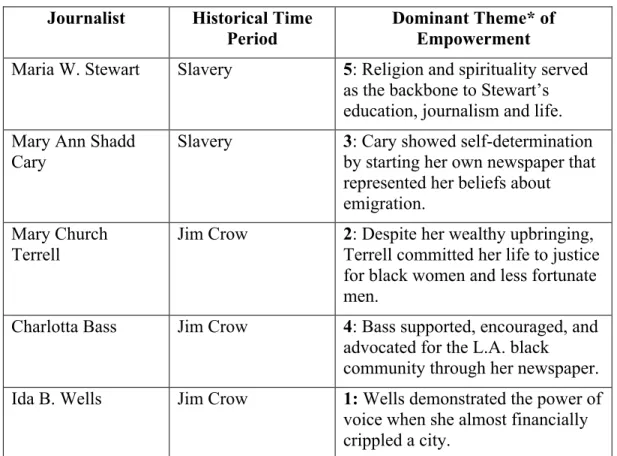
The Five Themes of Black Women’s Empowerment and Resistance...58
Journalism History and Application of Black Feminist Theory...65
IV. BLACK FEMINIST THEORY IN THE LIVES OF BLUFORD, MURPHY, AND GILLIAM...71
Lucile Bluford (1911-2003)...72
Francis Murphy (1922-2007)...83
Dorothy B. Gilliam (1936- ) ...94
V. BLACK INK...110
The Voice of Lucile Bluford in the Call...111
Francis Murphy’s Voice in the Afro...136
VI. ECHOES OF THE PAST HEARD IN THE PRESENT...149
Black Male Mentors ...150
Acknowledging Those Who Went Before...152
The Value of Black Schooling...154
Black Feminist Theory: Themes of Empowerment and Resistance...157
Importance of Self-Redefinition...157
Self-Development...158
Alternative and Ethnic Media Theories...159
APPENDIX ...162
BIBLIOGRAPHY ...174
Chapter 1:
Introduction and Background
“One had better die fighting against injustice than die like a dog or a rat in a trap.” --Ida B. Wells 1
At age 16, Ida B. Wells, the oldest of eight children, was orphaned when both her parents died of yellow fever. Wells took on the responsibility of supporting and raising her seven siblings. She worked as a teacher and started to wear her hair in a bun to look older. The hairstyle remained her signature “do” the rest of her life. At 22, Ida B. Wells bit the hand of a train conductor who tried to forcibly remove her from the ladies car because she was black. It took three men to physically drag her from the train car. Wells sued the Chesapeake and Ohio Railroad and won in the circuit court, receiving $500 in damages. Three years later the Tennessee Supreme Court reversed the decision.
The train incident propelled Wells into her journalism career. The local Memphis papers asked her to write the personal account.2 Her articles describing the experience
1 Stephanie Tolliver, "Women in History: Living Vignettes of Notable Women from U.S. History, Lakewood,
Ohio Public Library, http://www.lkwdpl.org/wihohio/barn-ida.htm (accessed May 12, 2008).
2Ida B. Wells, “A Darky Damsel Obtains a Verdict for Damages against Chesapeake and Ohio Railroad,”
and the lawsuit led to subsequent writing opportunities. In 1889, she purchased a third of the interest in a newspaper for blacks called Free Speech and Headlight, originally called the
Memphis Free Speech.3 The success of the paper, due in part to Wells’ relentless campaign
to increase subscriptions, allowed Wells to pursue writing as a full-time career.4
At the pinnacle of her militant muckraking career in 1892, Wells wrote about three black males who were brutally murdered for owning a local grocery store that financially jeopardized a nearby white-owned market. Enraged, Wells wrote against the lynching and embarked on convincing the local, black townspeople to leave the city in protest.5 Her
readers responded with their feet and hundreds relocated, financially debilitating the city. After galvanizing the exodus, Wells, now a marked woman in the South, wrote in exile. The threats only increased her advocacy writing, however, especially for stronger anti-lynching policies and laws, for integrated schools in Chicago, women’s suffrage, and for the
establishment of the NAACP.6
Thus, one woman managed to take part in crippling a Southern town, preventing segregated schools in Chicago, and in the establishment of an important national
organization. Arguably the best known black female journalist, Ida B. Wells is not the only black woman whose story is of journalistic trial, tenacity, and triumph, however. The stories
3 Alfred M. Duster, ed., Crusade for Justice: The Autobiography of Ida B. Wells (Chicago: The University of
Chicago Press, 1970), 35-37.
4 Lee D. Baker, Living Our Stories, Telling Our Truths: Autobiographies and the Making of African American
Intellectual Tradition (Oxford: Oxford University Press, 1996),
http://www.duke.edu/~idbaker/classes/AAIH/caaih/ibwells/ibwbkgrd.html (accessed October 8, 2007).
5 Alfred M. Duster, ed., Crusade for Justice: The Autobiography of Ida B. Wells (Chicago: The University of
Chicago Press, 1970), 52.
6 Rodger Streitmatter, Raising her Voice: African-American Women Journalists Who Changed History
of a number of Wells’ successors who also contributed to changing the racist and sexist social climates in which they lived remain to be told.
Wells’ life serves as a launching block for this research project that focuses on the journalistic careers of three African-American women journalists who lived and wrote during the Civil Rights Movement and whose lives and accomplishments deserve documentation and analysis.
A Neglected Area of History
Historians can write a history of anything or anyone but the key is the historian must decide that thing, event, person or group is worthy of investigation and apparently no one had ever thought Black women . . . were worth studying. -Darlene Clark Hine7
The focus in this project is on black women because their achievements have not been documented as thoroughly as their male counterparts even though black women were
disproportionately more involved in the early years of the Civil Rights Movement.8 One example--in 1944, 14 years before the much-noted Greensboro sit-ins,9 Pauli Murray, the granddaughter of a slave and the great granddaughter of a slave owner, staged a sit-in with fellow Howard University students at the segregated cafeteria, Thompson’s. She and her fellow students sat all day, reading textbooks and poetry until they were finally served hours later. Thus, approximately 50 black students, mostly women, had successfully planned,
7 PBS, "Shattering the Silences: Minority Professors Break into the Ivory Tower," Gail Pellett Productions,
http://www.pbs.org/shattering/shattering2.html (accessed May 12, 2008, 2008).
8 Darlene Clark Hine and Kathleen Thompson, A Shining Thread of Hope (New York: Broadway Books, 1998)
267, 268.
9 On February 1, 1960, four male African American students from North Carolina A & T sat at a segregated
executed and desegregated the local establishment. Fourteen years later, black male students in the highly hailed Greensboro, N.C., would stage a sit in at Woolworth’s using these same non-violent tactics but attract much more publicity than the women had.10
Because black women activists have been given short shrift in the chronicles of the Civil Rights Movement, this project examines the Civil Rights Movement from the lens of black women. Part of augmenting current historical dialogue to include more about black women is the important task of unearthing and understanding their stories of strength and survival. Even Rosa Parks, historically known as the “First Lady of the Civil Rights Movement” because she refused to give up her bus seat to a white patron, has not been accurately depicted. According to Lynne Olson, author of Freedom’s Daughters, “Parks was far more than the image that Martin Luther King, among others, had crafted for her--a
seamstress too tired to move, who had been less a free agent than a vessel of the forces of history…In fact, she had been a committed civil rights activist since the 1940s, a staunch member of the NAACP with a history of rebellion against casual cruelties of white bus drivers.”11
By excavating and examining the lives of black women journalists, this research offers an expanded look into the Civil Rights Movement. This project focuses on the ways in which some black women made the most of their resources, such as journalism, in their fight for equality. Throughout black history, journalism has often served as a tool for resistance. As the formation of organizations strengthened the reach of black women’s resistance and activism, historian Darlene Clark Hine wrote that “not sufficiently noted among black
10 Lynne Olson, Freedom’s Daughters: The Unsung Heroes of the Civil Rights Movement from 1830-1970
(New York: Simon and Schuster, 2001), 13.
women’s tools was the press.” In her encyclopedia of Black Women in America, Hine pays homage to the work of black women journalists of the Jim Crow era and their efforts to spotlight and abolish the injustices of the time: “They wrote. They edited. They were owners and operators. They made public policy and every aspect of Jim Crow a daily fare. They gave voice to rights and wrongs. They tore into stereotypes in battling against the abysmal place of both the Negro and the women.”12
African-American women journalists remain overlooked and understudied in
historical research, however, as journalism historian Rodger Streitmatter noted in the preface of his book, Raising Her Voice: African American Women Journalists Who Changed History. Streitmatter said he just happened across the autobiography of Alice Dunnigan, the first black woman to cover the White House, when he was working on another topic. Sparked by this resource, Streitmatter pursued the notion of writing about African-American women journalists and their contributions to news history. He found there was much to be done. “When I referred to the standard history of American journalism, I found a description of the career of only one black woman, Ida B. Wellswhose life was compressed into seven lines. Nor were histories of the African-American press of much help. When I looked at that standard in the field, I found that the descriptions of women of both the nineteenth and twentieth centuries were limited to a dozen pages.”13
More than a decade after Streitmatter’s research on 11 influential black female journalists, the research on African-American women journalists is still sparse.14 As historian
12 Darlene Clark Hine, "Black Women in America," in Jim Crow, 36 (Oxford: Oxford University Press, 2005). 13 Streitmatter, Raising her Voice, 1-2.
14 Streitmatter researched these women from the Antebellum Period: Maria W. Stewart, Mary Ann Shadd Cary;
Jinx Coleman Broussard noted in 2004: “Black women journalists have remained virtually invisible in the literature about the history of the black press, the feminist, and the
mainstream press. The historical experiences of the female journalists have received little attention and, likewise, neither have their issues been addressed.”15 In her book, Giving a Voice to the Voiceless: Four Pioneering Black Journalists, Broussard provides biographies of three other black women journalists (Mary Church Terrell, Alice Dunbar-Nelson, and Amy Jacques Garvey) and their overlooked contributions to journalism. Despite the historical contributions of Streitmatter and Broussard, who together profiled 14 black women
journalists, many others remain overlooked and understudied, especially those who wrote during the Civil Rights era.
This research focuses on three black women journalists who wrote during the Civil Rights era -- Lucile Bluford, Francis Murphy, and Dorothy Gilliam. These women have not been extensively written about before. This research analyzes in-depth interviews
conducted16 with Bluford, Murphy and Gilliam and their newspaper writings to better
understand their lives and work.
Meet the Journalists: Lucile Bluford, Francis Murphy, and Dorothy Gilliam
Lucile Bluford of The Call
On June 13, 2003, Lucile Bluford died at age 91 having dedicated more than 70 years of her life to journalism. Almost all of her career was spent with the Kansas City Call, a
Beasley, Marvel Cooke; and from the Civil Rights era: Charlotta A. Bass, Alice Allison Dunnigan, Ethel L. Payne and Charlayne Hunter-Gault.
15 Jinx Coleman Broussard, Giving A Voice to the Voiceless: Four Pioneering Black Women Journalists (New
York: Routledge, 2004), 2.
16 Washington Press Club, “Women in Journalism Oral History Project of the Washington Press Club,”
black press weekly. During her extensive career, Bluford challenged racial and gender barriers both inside and outside the newsroom.
Bluford was born on July 1, 1911 in Salisbury, North Carolina, to John Henry Bluford Sr. and Viola Harris Bluford. When Lucile was four, her mother died. Three years later her father remarried and relocated the family to Kansas City, Missouri. Young Lucile refused to move and chose to stay and be raised by her grandmother. Upon her
grandmother’s death, Bluford, 10, moved to Kansas City to live with her father, stepmother and two brothers. This move proved a lasting one as she spent the rest of her life working, advocating and protesting in Kansas City. So influential was Bluford’s life work in the area that ultimately she was referred to as the “conscience of Kansas City.”17
In North Carolina, the young Bluford cultivated her love of reading. In Missouri she groomed her love of writing. At the behest of her high school English teacher, Trussie
Smothers, Bluford started writing for the school’s yearbook and newspaper. Graduating from Lincoln High School with honors in 1928, she went on to pursue a journalism degree at Kansas University (now the University of Kansas). As only the second African-American woman to graduate in journalism at Kansas University, Bluford lauded her predecessor, Marie Ross, who paved the way for her.18
In the summers during college, Bluford interned at the Kansas City Call, where she worked and was mentored under famed journalists Chester A. Franklin and Roy Wilkins.19
17 Pam Johnson, “The Unforgettable Miss Bluford,” Poynter, February 23, 2004,
http://www.poynter.org/how-tos/leadership-management/what-great-bosses-know/21161/the-unforgettable-miss-bluford/ (accessed March 16, 2011).
18 Lucile Bluford, interview by Fern Ingersoll, Women in Journalism (May 13, 1989).
19 NAACP, s.v. “NAACP History: Roy Wilkins,” http://www.naacp.org/pages/naacp-history-Roy-Wilkins
Recognizing Bluford’s talent and dedication, Franklin, editor and publisher of the Call, offered her a full-time reporting job when she finished school. Bluford instead chose a brief stint at two other black press papers, The Word and the Kansas City American, but returned to the Call in 1933, where her career flourished.
Early on at the Call, Bluford worked as a police beat reporter and photographer. When managing editor Roy Wilkins left the paper in 1937, Bluford, only four years out of college, was promoted to fill his position at age 26. Bluford continued to work her way up the Call’s managerial ladder; during Chester Franklin’s last years with the paper, Bluford helped write his editorials. Upon Franklin’s death in 1955, she took over as publisher and part owner of the Call, where she stayed for 40 more years.
Chester A. Franklin, Bluford’s Boss, Mentor and Friend. Chester A. Franklin was known for his “free of gossip and tabloid sensation” journalistic standards. Even today the
Call recognizes and adheres to Franklin’s original ideals and states on the paper’s website: “[F]rom the Call’s inception, news policy has been constructive, presenting the achievements and worthwhile happenings among the African-American community, rather than crime or other stereotypical aspects of the news.”20
Franklin learned the business from his father, George F. Franklin, who had been publisher of the Star in Denver, Colorado. As his father’s health declined, the younger Franklin, 17, along with his mother, Carla Franklin, took over the family’s newspaper.
Daily and became editor of St. Paul Appeal, an African-American newspaper. After he graduated he became the editor of the Kansas City Call.In 1950, Wilkins, along with A. Philip Randolph, founder of the Brotherhood of Sleeping Car Porters, and Arnold Aronson, a leader of the National Jewish Community Relations Advisory Council, founded the Leadership Conference on Civil Rights (LCCR). LCCR has become the premier civil rights coalition, and has coordinated the national legislative campaign on behalf of every major civil rights law since 1957.”
20 Donna Stewart, “About the Call,” The Call, Kansas City Call Newspaper Anniversary Issues from 1938,
Shortly after his father’s death, Franklin moved to Kansas City because of the larger black population. Franklin and his mother produced the first four-page edition of the Kansas City Call on May 6, 1919. “Mother Franklin,” as she was affectionately called, worked by selling subscriptions and delivering newspapers. Franklin, shunned by the local printers union, learned to run his own linotype machine.
Francis Murphy: A Newspaper Scion
Frances L. Murphy, knew what it was like growing up in a “family focused on a newspaper.”21 Both Murphy’s grandfather and father were editors and publishers of the premiere black newspaper, the Baltimore Afro-American, nicknamed the Afro. Newspaper grooming started early in the Murphy household, and by the age of five Francis quietly sat through newspaper board meetings. By age 30, she was the first woman publisher and editor of the newspaper.22
Born on October 8, 1922, the year of her grandfather’s death, Francis was the youngest of the five Murphy girls. The Murphy parents had high expectations for their five daughters. Francis’ father, Carl Murphy, had earned a Master’s degree from Harvard University and her mother, Vashti Turley Murphy, co-founded the black sorority, Delta Sigma Theta, Inc. Francis was expected to excel in school as well as participate in the family’s newspaper business. In living up to her family’s high standards, Murphy did well in school (valedictorian of her junior class) and took an active part in the newspaper throughout her childhood, adolescence and adult life.
She graduated from Baltimore’s Douglass High School in 1940 and received her Bachelor’s degree in Journalism at the University of Wisconsin in 1944. After her graduation she worked at the Afro as a full time reporter. Twelve years later in 1955, she has
successfully worked her way up from beat reporter to magazine editor and picture editor to branch/city editor of the Baltimore Afro-American.
21 Francis L. Murphy, interview by Fern Ingersoll, Women In Journalism, (October 25, 1991), 3.
22 James Wright, "Frances Murphy II, A Black Media Institution, Passes at 85," Washington Afro-American,
Murphy earned her second bachelor’s in Education at Coppin State Teacher’s College in 1958. As a newly single mother of two children, she took a self-imposed hiatus from the
Afro and went to teach in Baltimore’s public school system, where she could keep the same hours as her children. While teaching full time, Murphy earned a master’s degree in
education at Johns Hopkins University. She was one of the first African Americans to graduate from the school that had previously rejected her father’s admission on grounds of race.
After earning the master’s, Murphy began teaching at Morgan State, an historically black college. For much of the rest of her career, Murphy juggled her love of teaching and her obligations to the Afro. In the last 40 years of her life she was either teaching or working in the newsroom and often both.
Much like Bluford, Murphy’s life cannot be fully understood without a brief
discussion of the newspaper that grounded her life and work. The Baltimore Afro-American
was the result of the desire of the Murphy family to have their voices and those of their community represented in the press. Historian Hayward Farrar’s personal account of the
Afro-American lauded the paper’s contributions to black life:
The paper was one of the first things I learned to read. I learned things about the black community I could not have found elsewhere. For me the Afro-American was a window into the world of black Baltimore. It provided visibility for a people rendered invisible by centuries of racial oppression. Indeed, it influenced and changed the world it described to others.23
The first four-column issue of the Afro-American was published on August 13, 1892. Off to a tenuous start, the Afro-American had two different owners and declared bankruptcy in its first four years of circulation. The paper, heading in a downward
spiral, was auctioned in 1897. Francis’ grandfather, John L. Murphy Sr., the foreman and manager for the paper, witnessed the numerous setbacks of the paper. In an effort to resuscitate the paper, Murphy Sr. borrowed money from his wife and bought the paper for $200. His leadership resurrected the Afro-American and turned it into a family franchise that flourished.
The financial risks taken by both of Francis’ grandparents helped establish a history of Murphy’s entrepreneurship and resilience. Murphy Sr., the son of slaves and born into slavery, gained his freedom by fighting in the Civil War. While working in a series of varied blue-collar jobs, John Murphy tried to gain entrance to the newspaper business but prior to his ownership of the Afro had failed at two local newspaper ventures. His third and final attempt, the purchase of the Afro, proved a lasting success that he characterized as the “one thing I didn’t fail in.”24 Prior to his death, John asked his son, Carl, to take over management of the newspaper. Francis reminisced about her grandfather and his progressive nature:
My grandfather was a fair man as far as women were concerned. He left the stock of the Afro-American newspapers in equal shares to women as well as men. Every single person, every one of his ten children, got an equal share of the four hundred shares of stock that were outstanding at the time. That was interesting to me, that here’s a man dying back in 1922, who is determined that the women in his family, as well as the men [have equal shares]. He didn’t pick out the oldest son but he gave it to everyone.25
Carl Murphy, Francis’ father, held a Bachelor’s degree from Howard University and a Master’s degree in German Studies from Harvard University. Of his nine
siblings, Carl initially had the least to do with the newspaper business—mostly
sporadic articles from his studies abroad in Germany. With failing health and an urge to solidify his business, John Murphy Sr. requested that Carl return home from Germany. Carl quickly reunited with his family and upon his father’s death was unanimously chosen to head the Afro.
A wise choice, Carl guided the paper into an era of social advocacy and increased circulation. When Francis began her leadership of the paper in 1970, she made sure to maintain the high standards established by her grandfather and father.
Dorothy Gilliam: A Newspaper Pioneer
Dorothy Gilliam started her journalism career at age 15 working as a typist for the
Louisville Defender, a black press paper. By age 17, she was named the society editor for paper. The following ten years of Gilliam’s career were spent working for the black press as she covered a wide swath of topics from fashion to pivotal Civil Rights protests.
Simultaneously she pursued her education and attended four colleges before she earned her Master’s degree in journalism from Columbia University in 1961. She then joined the
Washington Post as a full-time reporter, making her the first African-American woman reporter there. During her more than 30 years with the Post, she worked as a beat reporter, assistant editor and a columnist. In addition to her day job as a journalist, Gilliam also authored a biography on Paul Robeson, served as president of NABJ (National Association of Black Journalists) and spearheaded a project designed to help high schools develop journalism programs.26
26 Lincoln University, “Lincoln University Dream Recipient: Washington DC Chapter—Hall of Fame and
Distinguished Alumni Members,”
Born on November 24, 1939, Gilliam is the youngest and the sole surviving journalist in this study. Her father, Adee Butler, was an A.M.E minister and her mother, Jessie Mae Butler, was a domestic worker. Early in her adolescence, Gilliam’s father died, leaving her mother with the responsibility of raising five of their eight surviving children. Gilliam remembers eating to hide the grief of her father’s death and excelling in school as a way of proving herself.
Her oral history interview with the Washington Press Club was not completed. In the words of her interviewer, Donita Moorhus, “Demands on Dorothy's time increased
significantly after her election as president of the National Association of Black Journalists. With her heavy travel and speaking schedule, we were unable to schedule a final interview session to discuss in detail Dorothy's activities, the environment at the Washington Post, and the tumultuous events in Washington, D.C., during the 1980s.”27 Fortunately, I was able to
conduct a phone interview with Gilliam that allowed us to pursue the areas not fully covered by Morrhus.
27 Washington Press Club Foundation. “Dorothy Gilliam Introduction.”
Chapter 2:
Oral History Methodology
“Oral history is not necessarily an instrument for change; it depends upon the spirit in which it is used. Nevertheless, oral history certainly can be a means for transforming both the content and purpose of history.”--Paul Thompson28
In-depth interviews with each of the three black women journalists focused on in this project are in the archives of the Washington Press Club, as part of their extensive oral history project, Women in Journalism. The Women in Journalism project began in 1986 and includes interviews with more than 50 female journalists who made “significant
contributions to society through journalism since the 1920s.”29 Eight of those interviewed are
African-American. The women who were interviewed worked in three historical periods: (1) prior to 1942, (2) between the beginning of World War II and the passage of the Civil Rights Act of 1964, and (3) after 1964.30
28 Thompson, Paul. The Voice of the Past: Oral History (Oxford: Oxford University Press, 1978), 3.
29 Washington Press Club Foundation, " Women in Journalism Oral History Project of the Washington Press
Club," http://wpcf.org/oralhistory/ohhome.html (accessed May 15, 2008, 2008).
This dissertation focuses on three black women print journalists who began their careers in the second period.31 These three women were chosen because they were African-American newspaper journalists working during the Civil Rights Movement and had not been extensively studied by Streitmatter, Broussard, or other journalism historians. Murphy, Gilliam, and Bluford were also chosen because of their different career trajectories. Frances L. Murphy’s reign as the owner and editor of the long standing Afro-American newspaper creates a distinct look at black-centered advocacy writing during the Civil Rights era. In contrast, Dorothy Gilliam migrated from the black press to the noted mainstream paper, the
Washington Post, and became its first black female editor. Lucile Bluford battled for racial equity in the ranks of journalism education and contested the University of Missouri’s segregated admittance policies.32
Fern Ingersoll conducted a total of twelve interviews, six each, with Murphy and Bluford. Ingersoll, an experienced oral historian with nearly 50 years of interviewing experience, previously headed numerous oral history projects and interviewed three women journalists for the Press Club project.33 Ingersoll’s interview with Bluford produced a
190-page transcript. Murphy was interviewed on six occasions in 1991 and 1992, producing more than 130 pages of online transcription.
31 The other five black women journalists included in the Press Club’s project were: Marvel Cooke, Charlayne
Hunter-Gault, Ethel Payne, Carolee Simspon, and Belva Davis. Cooke, Hunter-Gault and Payne are included in Streitmatter’s research. Simpson and Davis worked in television and radio.
32 The Foundation provided online access to Murphy and Gilliam’s interviews. Bluford’s interviews can be
found at 30 university repositories including Wilson Library at UNC-Chapel Hill.
33 Washington Press Club, "WPCF Oral History Project: Women in Journalism, Interviewer Bios," Washington
Donita Moorhus interviewed Dorothy Gilliam six times during late 1992 and
throughout 1993 to accumulate approximately 130 pages of transcripts. Donita Moorhus is an oral historian and writer; her previous interview experience was with the U.S. Army Corps of Engineers.
In the interviews the women were routinely asked the same opening questions. The interviewers asked about early life and childhood, education, journalism beginnings and subsequent career choices. After the initial questioning, the interviews followed the woman’s responses to the questions about her journalism career.
Oral History as a Method
Oral histories can aid in uncovering the stories of the past. Oral historian and author of Ophelia and Me, Martha Goodson, noted that her oral history research with former slaves sparked her interest in what was being omitted from history texts.34 In concordance, oral
historians Sherna Gluck and Daphe Patai advocate oral history because it often acts as an historical equalizer by offering a counter narrative to the more traditional chronicles of American history. They contend that oral history affords the disenfranchised a chance to tell their side of the story and shed new light on how events transpired. In their book, Women’s Words, Gluck and Patai detail the importance of oral history in preserving women’s
experiences and suggest that history is incomplete if it fails to offer different angles/perspectives to any given story.35
34 Martha Graham Goodson, “Ophelia and me: Tribute to an Early Narrative Researcher,” in Oral Narrative
Research with Black Women, ed. K. Vaz (Thousand Oaks, CA: Sage Publications, 1997), 7-23.
35 Sherna Berger Gluck and Daphne Patai, eds. Women’s Words: The Feminist Practice of Oral History (New
It is also important to acknowledge the potential biases of oral accounts. According to oral history scholar Michael Frisch, the human memory has inherent limitations. In his book,
A Shared Authority: Essays on the Craft and Meaning of Oral History and Public History, Frisch encourages oral historians to be mindful of the drawbacks. One potential problem of oral history accounts is the tendency of the individual who is recounting her life to categorize events and then retell them as though they happened in succession.36 Interviewees may have
a tendency to impose a narrative structure on their lives in an attempt to understand their lives in hindsight. People link events in a way that makes their experience seem more coherent and thematically organized than it actually was. It is not that these experiences did not occur or provide any less validity to an account, but the sequencing may be distorted or inaccurate. In addition, oral historians should recognize that incidents and experiences could be more or less emphasized based on the person’s perception of what is valued in the present.
Bearing the limitations of this method in mind, this research attempts to convey the most accurate historical analysis of these three black women journalists possible based on their own stories and other historical documents. Documents and written records were used jointly with the interviews to provide a methodologically collaborative approach. Each journalist’s writings were analyzed to create a more detailed picture of the journalists’ perspectives. Many of their newspaper articles were accessible in the newspaper archives at UNC-Chapel Hill and Duke University libraries. For further support, secondary sources such as biographies, journal articles, and books describing the time period were used to develop a historical context.
36 Micheal Frish, A Shared Authority: Essays on the Craft and Meaning of Oral and Public History (Albany:
By combining these resources, this project focuses on understanding how Murphy, Gilliam, and Bluford empowered themselves for resistance during the Civil Rights era.
Reflexivity: My Part of This History
Reflexivity is an important part of oral history analysis because it allows the
researcher and/or interviewer to address their personal influence on the research and analysis. Oral historian, Valerie Yow, has written about the importance of reflexivity in oral history methodology. Yow argues that “the motives for doing the project, feelings about the narrator, interviewer’s reaction to the narrator’s testimony, and intrusion of the interviewer’s
assumptions and of the interviewer’s self-schema”37 impact the interpretation and practice of
oral histories. By detailing my own feelings and motives behind this research, I acknowledge that these factors can and do contribute to how I conducted and analyzed these interviews.
In 2001 I started my first reporting job at The Syracuse (NY) Post-Standard. I was first assigned to the city desk to work under Mike Grogan, a well-respected editor. The newsroom housed more than 200 reporters and staff. On my first day I was given a brief tour, introduced to my cubicle mate and promptly given my first assignment. I was nervous and even though I had graduated with a degree in newspaper journalism, I didn’t know where to begin.
I looked around the newsroom looking for a possible ally and mentor. In truth, I was searching for anyone who could offer advice because I was too embarrassed to ask my editor. I looked to my left and found my cubicle colleague deeply engaged in a project, so, I looked around the newsroom and spotted another African-American female journalist to whom I
37 Valerie Yow, “ ‘Do I Like Them Much?’: Effets of the Oral History Interview and Vice Versa,” The Oral
introduced myself. She smiled and welcomed me to the paper. I was grateful and relieved when she offered to be of assistance.
In those beginning months at the Post Standard, this woman’s friendship proved invaluable. When I came to her crying after my first harsh edit, she told me of her own brush with brutal editing. She informed me about my editor; he was hard but fair. She taught me how to look at my stories from different angles. She encouraged me. She took me to lunch on occasion and often came by to check on me. Several weeks later, I met the only other black female journalist at the paper and she, too, took me under her wing. When a local merchant mistreated me, she warned me not to frequent that establishment because they had a history of racism.
I relied on these two women. By befriending and guiding me they warded off feelings of inadequacy, loneliness, and isolation. In the years following this initial journalism
experience, I wondered how other black women journalists have dealt with predominantly white, male dominated newsrooms. I wanted to know how they survived in what I saw as an isolating profession.
I found my answers through these women’s stories. This project helped me make sense of my days at the Post-Standard and helped me see that I am not alone in trying to answer the myriad of questions I face as a woman of color. It was humbling yet invigorating to find answers while illuminating these remarkable women’s contributions to an important period in the lives of all African Americans.
One of the wonderful aspects of oral history research is that the researcher is encouraged to connect with the participants and to use their experiences to inform and influence their project.38 With this perspective in mind, I did not try to maintain a distance
when reading the women’s transcripts. My goal was just the opposite. As I wanted to fully understand these women’s experiences I let their life stories envelope me and draw me closer to them as women and journalists. I felt that I needed to try to understand and empathize with these women as much as possible to accurately tell their life stories. Thus, my goal was to decrease the distance between my story and theirs.
Analysis of the Interview Transcripts and Newspaper Articles
I initially read each transcript like a novel. To do that, I printed off the interviews for each woman and had them bound as one book. Each had a cover with the woman’s picture and dates of all the interviews. On my first read, I refrained from taking notes and just tried to get a good feel for each woman and her life. On the second read I started to highlight significant quotes and experiences. By the third read I began to more precisely code the transcripts. I used initials to signify the five empowerment concepts (described in more detail
38 Carolyn Ellis and Arthur P. Bochner, “Autoethnography, Personal Narrative, Reflexivity: Researcher as
in Chapter Three): SD= Self Determination; SDF= Self Definition; V= Voice; CC=Connection to Community; SRV= Spiritual Regeneration and Rejuvenation.
In the margins were also included insights, questions, and observations that were not fully answered by Black Feminist Theory.
On subsequent readings, I used a spiral binder to chronologically map out each woman’s life. As I reread the interviews, I transferred my marginal notes in the interviews to the notebook. I created another code for my notebook notes. First, I wrote down the page number, then the observed empowerment trait and a brief description of the quote or experience. For example, in Francis Murphy’s interview I liked how she talked about her father, so I made note of it in the spiral binder. The note read:
3-SDF: learned lessons from her father [QQ]. 3= page number; SDF= self-definition trait; A brief description; [QQ]= Quotable Quote.
opportunity to interview Dorothy Gilliam. I also noticed that connection to community and voice were less evident in the oral histories. That puzzled me because I knew these women had exhibited those forms of empowerment but they were not easily recognized in the interviews. I soon saw, however, that the characteristics were clearly visible in the women’s written works (columns and editorials).
As I read through the years of the women’s writings, I took note of the 10 to 15 topics that appeared most frequently. I then narrowed those topics to the top five and coded those with colored tabs. I could then count which were the most frequent topics and organized the chapters with the frequency of themes in mind.
Chapter Overview
The findings from this analysis strategy are presented in two parts: (1) the lives of the women as seen through the lens of black feminist theory, and (2) the issues and ideas the women focused on in their writing from the perspective of alternative and ethnic media theory.
Chapter Three, The Historical Legacy of Black Women’s Survival and Resistance,
consists of an overview of the history of black American women’s survival tactics, black press history, alternative and ethnic media theories, resistant women journalists, and black feminist theory.
Chapter Five, Black Ink, is an examination of how the newspaper articles written by Bluford, Murphy, and Gilliam display the characteristics/functions suggested by alternative and ethnic media theories.
The Historical Legacy of Black Women’s Survival and Resistance
“History, despite its wrenching pain, cannot be unlived, but if faced with courage, need not be lived again.” --Maya Angelou
The history of American black women is one of survival that contains valuable stories of resistance and empowerment. These stories are crucial to understanding the lives of black women then and now. To better understand the women in this research project, a discussion of how the study of the past shapes present knowledge is necessary. The history of black women in America shows how race and gender have been muted, contorted, forged and reborn. In the words of historian Darlene Clark Hine, “…the history of black women in America possesses elements shared by people of all colors and national origins, especially those who have experienced marginalization, exploitation, and oppression.”39
A long history of oppression and the survival tactics employed by black women in their efforts to survive can be traced across centuries. The struggles and the triumphs of Bluford, Murphy, and Gilliam are a part of a rich history of defiance and tenacity. It is impossible to discuss their lives without acknowledging and paying tribute to their ancestors.
39 Darlene Clark Hine, "Preface," in Black Women In American, ed. Darlene Clark Hine, (Oxford
Slave Survival Amid A Cultural Castration (1661-1863)
In 1619, the first African female slave, “Angela,” arrived on American soil.40 In the following two centuries thousands of Black women were deracinated from their homelands and forced into lives of servitude. The social, physical, and emotional
manacles of slavery were designed to degrade and destroy. As slaves, black women were subjected to a system designed to obliterate their traditional roles and worth as women. In their book, A Shining Thread of Hope, historians Darlene Cark Hine and Kathleen
Thompson further explain the effects of slavery on black women: “In both the African cultures from which black women came and the American culture into which they were transplanted, a woman’s identity was bound up in and even defined by their familial roles. Her sense of self depended on fulfilling those roles, and many of the early enslaved black women were robbed of the opportunity to do so.”41
In surviving slavery, black women forged their lives as mothers, wives, daughters and sisters despite the oppressive slave regime. Slavery, in one aspect, symbolically castrated its slaves with the goal to advance the dominant ideology that both black men and black women were simply chattel, androgynous personal property. Under centuries of this shared subjugation, black female and male slaves lived under a system that did not distinguish between the two genders when doling out castigation and workload. Political activist and philosopher Angela Davis articulates the results of the slave system’s attempt at gender neutrality:
40 Darlene Clark Hine, “Slavery,” in Black Women In America, ed. Dorothy Clark Hine, 132 (Oxford:
Oxford University Press).
41 Darlene Clark Hine and Kathleen Thompson, A Shining Thread of Hope (Broadway, New York:
Black women were equal to their men in the oppression they suffered; (during slavery) they were their men’s social equals within the slave community; they resisted slavery with a passion equal to their men’s. This was one of the greatest ironies of the slave system, for in subjecting women to the most ruthless
exploitation conceivable, exploitation which knew no sex distinctions, the groundwork was created not only for Black women to assert their equality through their social situations, but also to express it through their acts of resistance.42
A Slave Women’s Harsher Plight
Thus, while the slave system aimed to crush the spirit of both male and female blacks by de-gendering their lives, it inadvertently catalyzed a unisexual resolve to resist. In the words of Harriet Jacobs, an escaped slave, “Slavery is terrible for men; but it is far more terrible for women. Superadded (sic) to the burden common to all, they have wrongs, and suffering, and mortifications peculiarly their own.”43 Davis also notes that black slaves, both male and female, were subject to a system built on equal opportunity at exploitation, black women had to endure additional violence and sexual abuse: “the punishment afflicted on women exceeded in intensity the punishment suffered by their men, for women were not only whipped and mutilated, they were also raped.”44
Historian Evelyn Higgenbotham adds, “Black Women experienced the
vicissitudes of slavery through gendered lives and thus differently from slave men. They bore and nursed children and performed domestic duties--all on top of doing fieldwork.”45
Slave women also disproportionately suffered from the hardships of marriage and motherhood within the slave system. The mandated separation of mothers and wives
42 Angela Davis, Women, Race, and Class (New York, New York: Random House, 1983), 24. 43 Jacobs, Harriet, Incidents in the Life of a Slave Girl Written by Herself, 2 (Stilwell, Kansas:
Digireads.com Publishing, 2005).
44 Angela Davis, Women, Race, and Class. 24.
45 Evelyn Higginbotham, "The Metalanguage of Race and Gender," in We Specialize in the Wholly
from their husbands and children is what Hine called “the most heart wrenching problem adult slave women faced.”46 Hine calls this forced separation “a kind of sacrifice, like no
other” that “defined slavery for slave women.”47 So great was this burden, that many female runaways were in fact fleeing to their estranged families in an effort to be with them or include them in their efforts to escape.48
Slave Survival as Resistance
Slavery thus created a paradigm specific to black women; their experience, a byproduct of both racial and gender oppression, established an explicit black women’s standpoint apart from male slaves. The atrocities of slavery gave rise to resistance. The hardships of slavery on black women fostered distinctive forms of resistance. Black feminist theorist Patricia Collins contends that for black women, “survival was a form of resistance.”49 In their efforts to survive and resist, black female slaves “ran away, refused to maintain certain work quotas, talked back to authority figures, stole food, met secretly with other slaves, plotted against masters, and brought whites physical harm.”50 In one account, Celia, a 19-year-old Missouri slave, failed for five years to thwart her master’s attempts to rape her. In her final refusal and while already pregnant with his child, she
46 Darlene Clark Hine, Slavery, Vol. 3, in Black Women In America, ed. Dorothy Clark Hine, 148 (Oxford:
Oxford University Press).
47 Ibid. 48 Ibid.
49 Patricia Hill Collins, Black Feminist Thought: Knowledge, Consciousness, and the Politics of
Empowerment, ed. 10th Anniversary Edition, 201 (New York: Routledge, 2000).
killed him, dismembered his body and burned it in a fireplace. She stood trial for his murder in 1855 and was sentenced to hang. She was hanged only a few days later.51
While Celia’s act may seem like a drastic example of resistance, there was nothing small about the resistance of slave women, for every offense against the system was punishable. “Hundreds, perhaps thousands, of slave women were sold because of such acts of resistance. Many more received corporal punishment on a daily basis.”52 Despite the threats of physical castigation and removal, slave women continued to resist. In slave records, slave women were accused of: malingering, stealing, mistreating the master’s children, aiding and abetting runaways, poisoning, and writing illegal passes. 53
Surviving Reconstruction and Jim Crow, 1863-1950s
The Emancipation Proclamation of 1863 and the end of the Civil War in 1865 did little to “free” slaves as America’s politics conspired to usher in a modified version of Black slavery. With the death of President Abraham Lincoln in 1865, former
vice-president Andrew Johnson, a Southern slaveholder, began his term as vice-president. Showing his true loyalties, Johnson advocated for former Confederates to regain political control of the South. In so doing, President Johnson endorsed the ideals of slavery by allowing racist policies to survive in local and state governments. While former Confederate politicians may have conceded to their loss of the war, they were not reconciled to the loss of their slaves and unwilling to relinquish the placement of blacks as second-class citizens. Hine wrote, “Loath to forfeit their white supremacy, whites instituted the
51 Melton A. McLaurin, Celia, A Slave (New York: Avon Books, 1993). 52 Darlene Clark Hine, “Slavery,” 146.
systematic abridgement of black rights through fraud, terror, intimidation, and the perversion of the electoral, and judicial system.”54
Unfortunately, with President Johnson at the helm, the federal government did not answer the cries of its newest citizens. The period known as Reconstruction, 1865-1877, did little to reconstruct the lives of black Americans. And for black women, “that meant they would continue to suffer much of the same vilification and abuse endured while enslaved.”55 Hine, however, believes that being unheard and unseen by the government taught black women “a valuable lesson about self-determination” because they learned to persevere despite the apparent setbacks and obstacles.56
While Reconstruction served to reestablish the presiding racist ideology toward blacks, the subsequent Jim Crow era, 1861-1950, cemented injustice by supporting the policing of blacks through the violent practices of lynching in efforts to keep “blacks in line” and compliant.57 According to historian William Chafe, “the so-called Jim Crow era, was in fact, a combination of de facto second-class citizenship and racial
separation.”58 In direct response to the travesties of lynching plaguing their community, coupled with the government’s apathy, black men and women continued to reinvent, hone and adjust their resistance strategies.
54 Darlene Clark Hine, "Jim Crow” in Black Women in America, 32 (Oxford: Oxford University Press,
2005).
55 Hine, “Jim Crow,” 32. 56 Ibid.
57 The Jim Crow period is named after a 1830s minstrel song and dance show. The catchy song, “Weel
about and turn about and do jis so,Eb'ry time I weel about I jump Jim Crow" quickly became associated with blacks and their simultaneous accommodated yet ostracized societal placement.
58 Raymond Gavins, Robert Korstad, William H. Chafe, ed., Remembering Jim Crow: African Americans
Emerging Resistant Strategies in Reconstruction and Jim Crow
While slavery prohibited the formal organization of blacks, emancipation did give blacks the ability to publicly organize. Black women mobilized to create formal
organizations. Organizations such as the National Association of Colored Women (NACW), established in 1896, labored diligently to address the injustices of Jim Crow. Established and managed primarily by black professional women, the organization
initially focused on desegregation and black women’s self-development. The NACW was a testament to the tenacity of its founders and members, because a majority of black women were not allowed much, if any, professional mobility outside of farm and field or domestic service.59 Female dominated professions at that time were limited to teaching, nursing, social work, and librarianship.60
While the rise of black professional organizations and employment aided in severing the unjust tentacles of Jim Crow, black churches were also important vehicles for resistance and activism. In Righteous Discontent, Evelyn Higginbotham argues that black women’s participation in their churches had the biggest impact on the fight for equality during the Jim Crow period: “[B]lack women were crucial to broadening the public arm of the church and making it the most powerful institution of racial self-help in the African-American community. During these years, (1880-1920), the church served as the most effective vehicle by which men and women alike, pushed down by racism and
poverty, regrouped and rallied against emotional and physical defeat.”61 Through their churches, black women fought for voting rights, anti-lynching legislation, the
abolishment of segregation laws, educational opportunities and addressed issues of gender discrimination in the black community.62
The Black Church’s Role in Resistance and Journalism
Since its inception in the early days of slavery, the church “constituted the backbone of the black community.”63 In Righteous Discontent, Evelyn Brooks
Higginbotham argues the historical importance the black church because “it provided a spiritual cohesiveness that permitted its people to absorb, interpret, and practice the Christian faith--to make it their own.”64 While white slave owners manipulated the contents of Christianity to endorse and excuse slavery, black slaves interpreted Christianity to favor their standpoint, a “remarkable display of resistant triumph for enslaved blacks.”65
From its embryonic stages, the black church subversively espoused insurgent tenets oppositional to the dominant Christian theology of their enslavers. Famed
abolitionist and ex-slave Frederick Douglass explained how white Americans corrupted Christianity for their own benefit. In 1845, he wrote, “I mean strictly to apply to the
61 Evelyn Brooks Higginbotham, "Righteous Discontent: The Women's Movement in the Black Baptist
Church, 1880-1920," 1 (Cambridge, Massachusetts: Harvard University Press, 1993).
62 Higginbotham, Righteous Discontent, 1. 63 Ibid., 5.
64 Ibid.
65 David M. Goldenberg, The Curse of Ham: Race and Slavery in Early Judaism, Christianity, and Islam
slaveholding religion of this land, and with no possible reference to Christianity proper; for between the Christianity of this land, and the Christianity of Christ, I recognize the widest possible difference…Indeed, I can see no reason, but the most deceitful one, for calling the religion of this land Christianity. I look upon it as the climax of all misnomers, the boldest of all frauds, and the grossest of all libels.”66
In reinterpreting and preaching a pro-black Christian dogma, black Americans boldly carved out a confluence of religion and resistance. As Higginbotham put it: “In the decades following Reconstruction, the church’s autonomy and financial strength made it the most logical institution for the pursuit of racial self-help. It functioned not only as a house of worship but as an agency of social control, forum of discussion and debate, promoter of education and economic cooperation, and arena for the development and assertion of leadership.”67
The black church laid vital groundwork for the making of civil rights activists. Within the church, black women expanded their personal power and exerted their equality. Black women, throughout the previous centuries, toiled and revolted alongside their men, in the fields and in the churches. They too, along with their men, bore the weight of injustice and refused to be relegated to silence, inactivity, or blind consent even in matters of religion. As Hine notes, “It is irrelevant that some of the churches opposed their political actions. They had also been disagreeing with the preacher, in the name of
66Narrative of the Life of Frederick Douglass, An American Slave, 1st American edition, published by
Massachusetts Anti-Slave Society in Boston, 1845.
God, for a very long time. Inside the church or out, black women carried more than their share of the load and felt entitled to make up their own minds.”68
Black women writers recognized the power of religion and were not opposed to brandishing Biblical prose in pursuit of their racial and gender initiatives. In constructing their written and spoken words of reform, black women often wove their arguments around the ecclesiastical canon. Most black women journalists started their writing careers by working for black church publications, arguably one of the precursors to the black press. The abolitionist journalist Maria W. Stewart built her entire anti-slavery campaign on the Bible, comparing the United States to the wicked Babylon.69 In her signature piece, “A Woman’s Mission,” Ida B. Wells advocated for the equality of women, by referencing the stories of Eve and the Virgin Mary.70 The synergy between black women writers and the church proved a formidable partnership.
Civil Rights Era: The Culmination of Lessons Learned from Slavery, Reconstruction and
Jim Crow
The collective lessons of resistance drawn from slavery, Reconstruction and Jim Crow would come to serve black women well in the years of the Civil Rights Movement. In historical hindsight, the tactics black women had accumulated through centuries of oppression were all masterfully wielded in the Civil Rights Movement. From slavery black women learned discretion and survival. As Hine asserts, “black women in the
68 Darlene Clark Hine and Kathleen Thompson, Shining Thread of Hope (Broadway, NY: Random House,
2005), 268.
69 Rodger Streitmatter, Raising her Voice, 18.
1930s and 1960s knew how to organize, were accustomed to working together, and felt a strong kinship with members of the community beyond their immediate families. The church and community work in which they have been involved for two centuries--and especially in the 60 years before the Civil Right Movement--made them ideal political activists.”71
What remains understudied is the power black women wielded as journalists. Darlene Clark Hine wrote, “not sufficiently noted among black women’s tools were the press.” Black women capitalized on the power of the press to strengthen the reach of their resistance and activism. In the encyclopedia of Black Women in America, Hine pays homage to the work of black women journalists and their efforts in spotlighting and abolishing the injustices of Jim Crow. “They wrote. They edited. They were owners and operators. They made public policy and every aspect of Jim Crow a daily fare. They gave voice to rights and wrongs. They tore into stereotypes in battling against the abysmal place of both the Negro and the women.”72
Black Press History
The establishment of the black press played an integral role in voicing the concerns of a muted people while simultaneously offering black reporters an entry into newspaper journalism. The black press began with a meeting of black leaders in the home of M. Boston Crummell in 1827. They decided to publish a weekly newspaper for free blacks. According to press historians Armistead Pride and Clint Wilson II, the paper would “be a strictly Negro newspaper. It would be the Negro speaking; it would be
71 Hine, Shining Thread of Hope, 267,-268.
72 Darlene Clark Hine, "Black Women in America," in Jim Crow, (Oxford: Oxford University Press,
directed to the Negro’s problems. Unlike abolitionist newspapers run by whites with Black assistance, it would be Negro owned and Negro controlled.”73
In 1827, the first newspaper, Freedom’s Journal, gave way to hundreds of Negro newspapers aspiring to develop, enhance, and dictate their own news forum. The first editors of Freedom’s Journal, Samuel Cornish and John Russworm, stated their intentions: “We wish to plead our own cause. Too long have others spoken for us. Too long have we been misrepresented in things that concern us dearly.”74
More than a century after its inception, the black press remained the premiere place where a significant number of African-American reporters gained their start in the newspaper world. Renowned African-American journalist Clarence Page describes his attempt at entering the newspaper arena in the 1960s:
When I decided as a high school student that I wanted to be a journalist, the black press offered me something else: a possible career safety net. Unlike my young white friends, I had to prepare myself for the possibility that the same white newspapermen who were eager to have me sell and deliver newspapers in my hometown would not, because of my complexion, hire me to report for those same newspapers. No matter, I assured my worried parents; if the white
newspapers wouldn’t let me compete, maybe the “colored papers” would give me a chance—as they had Langston Hughes, Louis Lomax, Ida B. Wells, W.E.B. DuBois, and my other black journalistic role models. I held high hopes.75
Page’s sentiments were similar to the experiences of the black women journalists featured in this research. Each of the African-American women journalists writing in the Civil Rights era gained her first break in black press newspapers—a few would never
73 Armistead S. Pride and Clint C. Wilson II, A History of the Black Press (Washington D.C.: Howard
University Press, 1997), 9.
74 Pamela Newkirk, Within the Veil: Black Journalists, White Media (New York: New York University
Press, 2000), 36.
75 Patrick Washburn, The African American Newspaper: Voices of Freedom (Evanston: Northwestern
leave. For more than 100 years, black newspapers held the monopoly for representing their own.
Although readership was hard to maintain because of enslavement and low rates of literacy, the initiation of the Freedom’s Journal paved the way for some 38 more black newspapers before the end of the Civil War in 1865, on average one new black paper a year until emancipation.76 The black press continued to serve the black community post
emancipation and, according to black press historian Patrick Washburn:
For the remainder of the century, some things about the black press would remain unchanged. Black journalists would continue to write about many of the same themes, and although slavery was gone, lynching would replace it as the new evil that drew the ire of the black press. As for the number of black newspapers, they escalated sharply, but their life expectancy remained short in many cases for lack of circulation, advertising, and money.77
In the first half of the 20th Century, the increase in literacy rates and household incomes coupled with the neglect in coverage of black communities in the mainstream press helped stabilize black newspapers. As Washburn writes: “Black newspapers were a necessity if blacks wanted to read about themselves, because white newspapers continued to largely ignore them unless a story involved a criminal activity.”78
Between World War 1 (1914-1918) and World War II (1939-1945) the influence of the black press grew stronger, with an estimated readership of more than one half million. Black newspapers continued to speak and fight for the rights of America’s disenfranchised black population:79 “With the ravages of Jim Crow firmly entrenched as
76 Carter R. Bryan, “Negro Journalism in America before Emancipation,” Journalism Monographs 12
(September 1969): 3-9.
77 Washburn, The African American Newspaper, 37. 78 Ibid., 83.
a fact of life at the beginning of the 20th century, Black Americans relied on their own press to chronicle the effects of segregation and racial discrimination and to provide leadership in the struggle to overcome them.”80
The Black Press’ Role and Reactions to the Civil Rights Movement
In 1945, black soldiers returning from World War II came home from fighting racism internationally to confronting it domestically. Historians differ on when the Civil Rights Movement actually started or which event should be seen as the catalyst.
Journalists Gene Roberts and Hank Klibanoff suggest that a series of events, not any one in particular set the stage for the fight for black rights. Roberts’ and Klibanoff’s book,
The Race Beat: The Press, The Civil Rights Struggle, and the Awakening of a Nation, meticulously details the events that led to the mainstream press’s realization of the race problem in America. Roberts and Klibanoff argue that racism in America had always been addressed in the black press but it was not until the same racial issues bled into the white press could the civil rights movement develop a national agenda with a collective focus. Roberts and Klibanoff suggest that a series of stories that broke the racial news divide should be seen as the national “white” press awakening to the black struggle. They propose that the movement started as early as 1947 when Jackie Robinson integrated Major League Baseball because “he had become the first running story that the white press joined the black press in covering.”81
Taking Roberts’ and Klibanoff’s suggestions into account, I will set 1947 as the start date of the Civil Rights Movement at least in the news media. Roberts and Klibanoff