TECHNICAL UNIVERSITY OF CLUJ-NAPOCA
ACTA TECHNICA NAPOCENSIS
Series: Applied Mathematics, Mechanics, and Engineering Vol. 61, Issue III, September, 2018
USING IMAGE PROCESSING TO AUTHENTICATE
ARTWORK
Daniela POPESCU, Vasile TOMPA, Dan HURGOIU, Călin NEAMŢU, Ciprian FIREA, Diana DRAGOMIR, Zsolt BUNA
Abstract: The traditional approach used for painted artwork studies is based on scholar’s observations
regarding subtle differences in detail and brushing features. Given the empirical methods involved, in some cases interpretation may be biased by a series of aspects like personal experience, visual acuity or individual color perception. The drawbacks of this technique are aggravated by the lack of sufficient qualified personnel. The paper describes the preliminary steps needed for “ID-Art” platform development, an integrated solution with the goal of providing complementary scientific knowledge and mathematical arguments necessary for 2D artifacts investigation or other painted artwork authentication efforts.
Key words: Painted artwork, image acquisition and processing, machine vision.
1. INTRODUCTION
The traditional approach used for painted artwork studies is based on scholar’s observations regarding subtle differences in detail and brushing features.[1] Given the empirical methods involved, in some cases interpretation may be biased by a series of aspects like personal experience, visual acuity or individual color perception.[2] The drawbacks of this technique are aggravated by the lack of sufficient qualified personnel. According to the Romanian national cultural heritage experts’ registry, there are only seven certified researchers with competences for medieval painted artwork expertise, a very work intensive and time consuming process. [3, 4]
On the other hand, the integration of digital cameras and various image processing concepts in the structure of new generation Coordinate Measurement Machines is one of the greatest arguments for supporting the importance of pixel analysis, which physical dimensions were reduced to less than one micrometer in the last five years. [5, 6]
This paper describes the preliminary steps needed for “ID-Art” platform development, an
integrated solution with the goal of providing complementary scientific knowledge and mathematical arguments necessary for 2D artwork authentication efforts.
1.1. Main objectives
The project’s main objectives are:
• Development of a specific methodology for data and image acquisition, management and processing, dedicated for 2D artwork artifacts; • Adaptation and integration of existing hardware and software instruments to provide maximum efficiency for the automated feature recognition;
• Definition, implementation and optimization of a dedicated database, which would assist the academic communities in their future studies and research work.
2. IMAGE AND DATA ACQUISITION
2.1 Scene considerations
processes, primarily by generating inconsistencies concerning captured pixel values. [7]
Fig. 1. Relative sun position and its effect regarding pixel data for images acquired in an extended timespan [8]
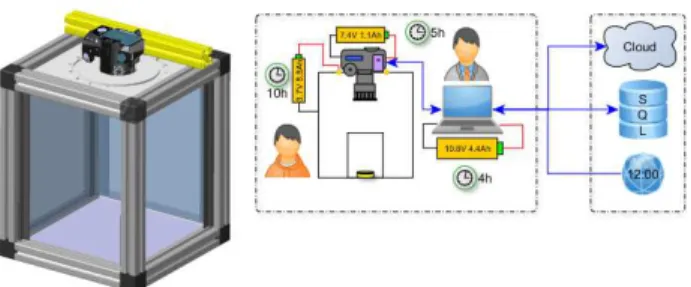
For relatively small and movable artifacts a special enclosure with dedicated lighting system can be used, but on large areas this procedure cannot be used. (Figure 2)
Fig. 2. IMAQ enclosure with integrated ring shaped illumination system
In order to limit the occurrence and amplitude of uncertainties related to extracted data necessary for image processing and feature extraction algorithms, the main causes were identified and addressed by using the well-known Ishikawa’s QA instrument. [9].
Fig. 3. Fishbone diagram regarding the uncertainties related to image analysis process [10]
2.2. Image acquisition
The image acquisition procedure involves six distinct steps, illustrated by the following diagram:
Fig. 4. IMAQ procedure (main steps):
a. The initial preparation requires a series of verifications like compatibility settings, available storage and battery levels, RTC synchronisation etc.
b. CAM + DAQ parameters configuration refers to image capture settings (resolution, exposure, format, sharpness etc.) and associated data attributes (like sampling rate and numeric precision);
c. Optical calibration is necessary for maintaining a constant pixel to mm ratio, which should be identical for all the items included in the database;
d. Ambient conditions monitoring and/or control is important to assure a viable dataset for each captured image. If rigorous control cannot always be provided, by precise monitoring the errors can be compensated later in the process; [11]
e. IMAQ control should be performed by visual control for each captured image, preferably on a large sized external display. Also, the trigger action must be performed externally, to avoid camera movement which could translate in exposure problems (like motion blur); [12] f. The image storage, transfer and backup are dependent on camera architecture and connectivity, but for newer models the synchronisation can be achieved in an automatic manner.
2.3. Data acquisition and logging
Fourier-transform infrared spectroscopy (FTIR) and X-ray fluorescence (XRF) spectrometry, data can be manually inserted at a later date by including sample extraction location, relative to the 2D image (X, Y coordinates). [13, 14].
Fig. 5. Modules interconnectivity and dataflow diagram
The architecture illustrated above presents the main components, communication and dataflow configured for Real Time Data Acquisition (RT-DAQ). Primary functions currently included are: • Ambient light control and temperature monitoring;
• Giga-Pan system camera orientation reporting (Pan-Tilt-Zoom parameters) ;
• GPS location (provided by internal/external receiver);
• Detached EXIF info (via command line utility).
3. THE SOFTWARE ARCHITECTURE
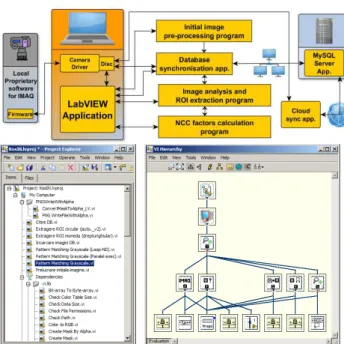
As illustrated by Figure 6, the National Instruments Vision Development Module (LabVIEW Application) has a central role, assuring most of the operations utilized for image storage, transfer, processing and analysis [15].
3.1 Modified NCC algorithm
The authors developed a modified NCC-based algorithm designed to improve correlation coefficients for the case of various shaped objects. The standard function was altered in such a way that it will not take into account null-declared values (pixels outside the user defined region of interest).
Fig. 6. Software architecture and main ID-Art platform functions
This step was extremely necessary as there are numerous cases of painted features with edge irregularities which can generate abrupt and unpredictable changes regarding the pixel’s intensities, their exclusion being a key element to reduce measurement uncertainties and to assure a coherent recognition process. [7] The LabVIEW program components (front panel and diagram) are presented by Figure 7:
Fig. 7. Modified algorithm exemplified for circular ROI extraction and NCC-based template matching
For religious iconography, the most prevalent circular item is the nimbus (or halo), a disk of light that surrounds a person in art which have been used by many religions to indicate holy or sacred figures.[16] In our case, the algorithm adaptation process needs three distinct actions: • Detection and validation, based on “IMAQ Find circular edge” and “IMAQ Find circles” VI Functions, coupled with particle detection and measurement operations; [17]
• Template extraction, where only the relevant data is kept and each pixel located outside this region, the value is set to 0 (grayscale) or 0,0,0 (RGB);
• Template processing and matching, a step that concludes with the calculation of matching scores (resulted pattern matching NCC coefficients) for every possible combination.
4. CASE STUDY
For initial tests, we applied basic geometric transformations (horizontal flip/mirror) to the previously extracted template (Figure 8). The main reason for this operation derives from frequent symmetry utilization that is especially true for paintings included in the church’s main stage, the iconostasis. [18].
A B C
Fig. 8. A) Reference template; B) Template with circular ROI isolated; C) Mirrored version of B.
Another positive effect of non-halo intersecting region exclusion was the improvement of resulted correlation factors when comparing figures with slight differences regarding their appearance.
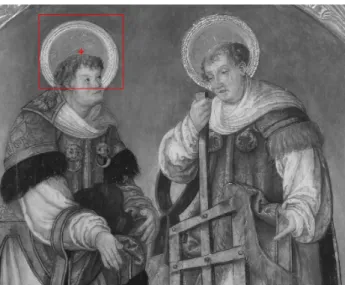
As shown by figures 9 and 10, the exclusion of background data, chin/beard zone, neck and upper body garnish, resulted in significant improvement of generated matching scores.
Fig. 9. The source painting used for template extraction (converted to grayscale, for NCC test purposes)
Fig. 10. Symmetrical circular ROI template matching (improved matching score = 679)
5. CONCLUSIONAND FUTURE WORK
The currently provided images (captured in a non-controlled environment) may be useful for human interpretation, but the variability of pixel values and inconsistent shooting perspectives have undesired effects difficult or even impossible to overcome. So, it is imperative to re-acquire the images using the procedure described in this paper. For unmanageable aspects, information provided by additional sensors should allow for both real-time and post-acquisition error compensation.
As for the purposed circular ROI based NCC algorithm, the next step regarding this direction should be the separation of the holy figure’s head from the annulus shaped halo. This would allow a greatly increased number of extracted templates and as a result, more pattern matching test combinations.
6. ACKNOWLEDGMENTS
The work presented in this paper is supported by a grant of the Romanian Ministry of Research and Innovation, CCCDI - UEFISCDI, project number PN-III-P1-1.2-PCCDI-2017-0812/53PC CDI, within PNCDI III.
7. REFERENCES
[1] T. Hurtut. (2010, 13.06.2018). 2D artistic images analysis, a content-based survey. Available: https://hal.archives-ouvertes.fr/hal-00459401v1
[2] ***. (2015, 13.06.2018). Facts About Color
Blindness. Available:
https://nei.nih.gov/health/color_blindness/fa cts_about
[3] ***. Experts' Registry with competence in Romanian National Heritage evaluation
[Online]. Available:
http://www.cimec.ro/scripts/RegistruExperti/ PatrimoniulMobil/sel.asp?nr=1&NrSel=0&L ang=RO
[4] M. Franke and M. Mennella. (2017, 31.05.2017). Culture - Fact Sheets on the
European Union. Available:
http://www.europarl.europa.eu/atyourservice /en/displayFtu.html?ftuId=FTU_5.13.1.html [5] T. Hirayama, "The evolution of CMOS image
sensors " presented at the Solid-State Circuits Conference (A-SSCC), 2013 IEEE Asian Singapore, 2013.
[6] S. Isono, T. Satake, T. Hyakushima, K. Taki, R. Sakaida, S. Kishimura, et al., "A 0.9 µm Pixel Size Image Sensor Realized by Introducing Organic Photoconductive Film into the BEOL Process " presented at the 2013 IEEE International Interconnect Technology Conference (IITC) Kyoto, 2013. [7] V. Tompa, "Contributions regarding digital image acquisition, processing and analysis
used for the recognition and classification of coin type ancient artifacts," PhD Thesis, Faculty of Machine Building, Design Engineering and Robotics Dept., Technical University, Cluj-Napoca, 2017.
[8] V. Agafonkin. (2009, 31.05.2017). SunCalc for Muzeul National de Istorie a Romaniei, Old Town, Bucharest, Romania (Based on Astronomy Answers formulae). Available: http://suncalc.net/#/44.4314,26.0979,18/200 9.10.06/13:43
[9] Ş. Bodi, M. Dragomir, D. Banyai, and D. Dragomir, "Process Improvements Using Simulation Software and Quality Tools," Applied Mechanics and Materials, vol. 808, pp. 376-381, 2015.
[10] J.-A. Beraldin, F. Blais, S. F. El-Hakim, L. Cournoyer, and M. Picard, "Traceable 3D Imaging Metrology: Evaluation of 3D Digitizing Techniques in a Dedicated Metrology Laboratory," presented at the Optical 3D Measurement Techniques, Zurich, 2007.
[11] C. Demant, B. Streicher-Abel, and C. Garnica, Industrial Image Processing: Visual Quality Control in Manufacturing, 2nd Edition: Springer Berlin Heidelberg, 2013. [12] Y. Xu and F. Yu, "Research on the Image
Acquisition and Camera Control of Machine Vision Camera Based on LabVIEW," presented at the 5th International Conference on Intelligent Human-Machine Systems and Cybernetics (IHMSC), Hangzhou, 2013. [13] C. Marutoiu, S. P. Grapini, A. Baciu, M.
Miclaus, V. C. Marutoiu, S. Dreve, et al., "Scientic Investigations of a 16th Century Stall Belonging to the Evangelic Church in Bistriţa, Bistriţa-Năsăud County, Romania," Journal of Spectroscopy, 2013.
[14] K. Janssens, J. Dik, M. Cotte, and J. Susini, "Photon-Based Techniques for Nondestructive Subsurface Analysis of Painted Cultural Heritage Artifacts," Accounts of chemical research, vol. 43, pp. 814-825, 2010.
[16] ***. (2018, 13.05.2018). Halo (religious
iconography). Available:
https://en.wikipedia.org/wiki/Halo_(religiou s_iconography)
[17] B. Plötzened. (2017, 31.05.2017). NI Vision - Image Processing with LabVIEW. Available:
http://forums.ni.com/ni/attachments/ni/200/4 8550/1/patternmatching.pdf
[18] B. Constantinescu, "Romanian Architectural Wooden Cultural Heritage – The Present Status - A Survey," presented at the Wood science for conservation of cultural heritage, Braga, 2008.
UTILIZAREA PROCESARII IMAGINILOR PENTRU VERIFICAREA AUTENTIFICITATII ARTISTICE
Rezumat: Abordarea tradițională utilizată pentru studiile de artă pictată se bazează pe observațiile privind diferențele subtile în detaliu și caracteristicile de periere. Având în vedere metodele empirice implicate, în unele cazuri interpretarea poate fi influențată de o serie de aspecte, cum ar fi experiența personală, acuitatea vizuală sau percepția individuală a culorilor. Dezavantajele acestei tehnici sunt agravate de lipsa personalului calificat suficient. Lucrarea descrie pașii preliminari necesari dezvoltării platformei "ID-Art", o soluție integrată cu scopul de a furniza cunoștințe științifice complementare și argumente matematice necesare investigării artefactelor 2D sau a altor eforturi de autentificare a operelor de artă pictate.
Daniela POPESCU, Department of Design Engineering and Robotics, Technical University of Cluj-Napoca, Romania, daniela.popescu @muri.utcluj.ro
Vasile TOMPA, Department of Design Engineering and Robotics, Technical University of Cluj-Napoca, Romania, [email protected]
Dan HURGOIU, Department of Design Engineering and Robotics, Technical University of Cluj-Napoca, Romania, [email protected]
Călin NEAMŢU, Department of Design Engineering and Robotics, Technical University of Cluj-Napoca, Romania, [email protected]
Ciprian FIREA, The Romanian Academy, Institute of Archaeology and Art History, Cluj-Napoca, Romania, [email protected]
Diana DRAGOMIR, Department of Design Engineering and Robotics, Technical University of Cluj-Napoca, Romania, [email protected]