ORIGINAL ARTICLE
Engineering alternative isobutanol
production platforms
Carmen Felpeto‑Santero
1, Antonia Rojas
2, Marta Tortajada
2, Beatriz Galán
1, Daniel Ramón
2and José L García
1*Abstract
A synthetic inducible operon (IbPSO) expressing alsS, ilvC, ilvD and kivD genes encoding a pathway capable to transform pyruvate into 2‑isobutyraldehyde has been designed and two recombinant plasmids named pIZIbPSO and p424IbPSO were constructed. The IbPSO containing plasmids can generate in a single transformation event new recombinant isobutanol producer strains and are useful for testing as suitable hosts wild type bacteria in different culture media. In this way we found that Shimwellia blattae (p424IbPSO) was able to produce in flasks up to 6 g l−1 of isobutanol using glucose as carbon source. Moreover, for the first time, we have demonstrated that isobutanol can be produced from sucrose using Escherichia coli W (ATCC9367) transformed with pIZIbPSO. These robust recombinant strains were also able to produce isobutanol from a raw carbon source like hydrolysed lignocellulosic biomass. Keywords: Isobutanol, Sucrose, Synthetic operon, E. coli, S. blattae
© 2015 Felpeto‑Santero et al. This article is distributed under the terms of the Creative Commons Attribution 4.0 International License (http://creativecommons.org/licenses/by/4.0/), which permits unrestricted use, distribution, and reproduction in any medium, provided you give appropriate credit to the original author(s) and the source, provide a link to the Creative Commons license, and indicate if changes were made.
Introduction
The growing concerns on climate change have increased the interest in producing new fuels from renewable sources. Although ethanol provides the first model for biofuel commercialization, different efforts have been made to develop new processes for producing novel advanced biofuels such as C3–C5 alcohols containing higher energy density than ethanol. These alcohols are compatible with the current fuel infrastructures since they are less hygroscopic than ethanol. Two examples of these alcohols are 1-butanol and isobutanol that can be blended with gasoline and also can be used for gasoline replacement, as they perform well in conventional gaso-line engines. Taking advantage of the increasing genomic information and the rapidly evolving techniques and tools of metabolic engineering, considerable progress has been made toward developing recombinant microbial strains for the production of these new fuels.
Depending on their metabolic capabilities, hetero-trophic microorganisms produce central metabolites such as pyruvate and acetyl-CoA using different external
carbon and energy sources including sugar, glycerol, sol-uble and insolsol-uble polysaccharides, alginates, proteins and other organic compounds. Biosynthetic pathways for producing higher alcohols elongate and reduce these cen-tral metabolites into more electron rich compounds, like higher carbon acyl-CoAs and 2-keto acids. However, only few microorganisms are capable to naturally produce isobutanol in low amounts.
Nowadays it is possible to generate precursors for higher chain alcohol production exploiting the amino acid biosynthesis pathways (Atsumi et al. 2008; Chen et al. 2011; Huo et al. 2011; Kondo et al. 2012; Brat et al.
2012). These pathways produce amino acids through 2-keto acid precursors, which can be used as substrates for the Ehrlich biosynthetic pathway to alcohols that con-sists of two steps, i.e., a decarboxylation of a 2-keto acid to the corresponding aldehyde by a 2-keto acid decar-boxylase, followed by a reduction of the aldehyde by an alcohol dehydrogenase. Using this strategy, a non-natu-ral isobutanol biosynthetic pathway has been created by combining genes from different organisms. In this way isobutanol production has been achieved in several engi-neered microorganisms (for a summary see Akita et al.
2014) like Escherichia coli (Atsumi et al. 2008; McEwen and Atsumi 2011; Akita et al. 2014), Corynebacterium glutamicum (Blombach et al. 2011), Bacillus subtillis (Li
Open Access
*Correspondence: [email protected]
1 Department of Environmental Biology, Centro de Investigaciones Biológicas, CSIC, Madrid, Spain
et al. 2011), Saccharomyces cerevisae (Chen et al. 2011; Kondo et al. 2012; Lee et al. 2012), Clostridium cellulo-lyticum (Higashide et al. 2011), Synechococcus elongatus
(Atsumi et al. 2009; Lan and Liao 2013), Pseudomonas
sp (Lang et al. 2014) and Ralstonia euthropha (Lu et al.
2012; Li et al. 2012).
Although the synthesis of isobutanol using the keto acid pathway has opened the possibility for its indus-trial production, the non-native engineered pathways may interfere with the cell metabolism by competing for essential precursors for growth or maintenance. There-fore, to create new fine-tuned pathways that can be perfectly integrated to be compatible with the host cel-lular metabolism is highly desirable. In this sense, oper-ons have been naturally created to tightly control many pathways and therefore, it appears that assembling the non-natural pathways into well controlled and designed synthetic operons could render some benefits.
In this work we have explored the possibility of con-structing a new chemically synthetic operon to transfer the capacity to produce isobutanol to different bacteria, allowing the possibility to test in a simple way many dif-ferent host organisms as putative isobutanol producers and to regulate it in an integrated manner. Moreover, this approach provides the proof of concept and the opportu-nity to easily incorporate novel properties to the process (e.g., the use of different raw materials as carbon sources) depending on the strains used as hosts.
Materials and methods
Bacterial strains, plasmids, growth media and transformation
The bacterial strains and plasmids used in this study are listed in Table 1. E. coli and Shimwellia blattae strains were cultured in solid LB medium at 37°C. Antibiotics were used if indicated at the following concentrations: gentamicin (10 µg ml−1), streptomycin (50 µg ml−1) and
ampicillin (100 µg ml−1). E. coli and S. blattae recombi-nant strains were cultured in M9 minimal liquid media containing a mixture of trace elements (nitrilotriacetic acid 1.5 mg l−1, MgSO
4·7H2O 3 mg l−1, ZnSO4·7H2O 0.18 mg l−1, CuSO
4·5H2O 0.01 mg l−1, MnSO4·2H2O 0.5 mg l−1, NaCl 1 mg l−1, FeSO
4·7H2O 0.1 mg l−1, CoSO4·7H2O 0.18 mg l−1, NaSeO3·5H2O 0.3 mg l−1, KAl(SO4)2·12H2O 0.02 mg l−1, H3BO3 0.01 mg l−1, Na2MoO·2H2O 0.01 mg l−1, NiCl2·6H2O 0.025 mg l−1) according to Atsumi et al. (2010). This medium was always supplemented with yeast extract (5 g l−1). The sugar carbon sources used in isobutanol production experiments were: glucose (20 g l−1), xylose (20 g l−1), sucrose (20 g l−1), or liquid lignocellulosic hydrolysate (wheat straw partially degraded after treatment with acid and elevated temperatures) being its main compo-nents: Glucose (59.16 g l−1), xylose (27.2 g l−1), arabinose (3.04 g l−1), galactose (1.42 g l−1), cellobiose (1.04 g l−1), manose (0.55 g l−1), acetic acid (3.73 g l−1), formic acid (0.14 g l−1), hydroxymethylfurfural (0.39 g l−1), Furfural (0.77 g l−1), 4-hydroxybenzoic acid (0.009 g l−1), vanillin (0.029 g l−1), syringaldehyde (0.016 g l−1), cumaric acid (0.11 g l−1), and feluric acid (0.15 g l−1) (provided by Biopolis S.L.). The hydrolysate was included in the mini-mal medium at different concentrations as indicated in volume percentages (% vol/vol, i.e., ml of liquid hydro-lysate in 100 ml of total culture medium). The hydrohydro-lysate cannot be used without dilution as a culture medium since it is toxic for the bacteria tested in this study when used at concentrations higher than 50% (vol/vol). Antibi-otics were used for plasmid maintenance at the following concentrations: Gentamicin (10 µg ml−1) or streptomycin (50 µg ml−1). Cells were cultured overnight in LB (10 ml) in 100 ml flasks at 37°C in an orbital shaker at 250 rpm. Cells were inoculated at 0.05 OD600nm in produc-tion media (10 ml) in 100 ml screw flasks at 37°C in an orbital shaker at 250 rpm during 2.5–3 h, until reaching
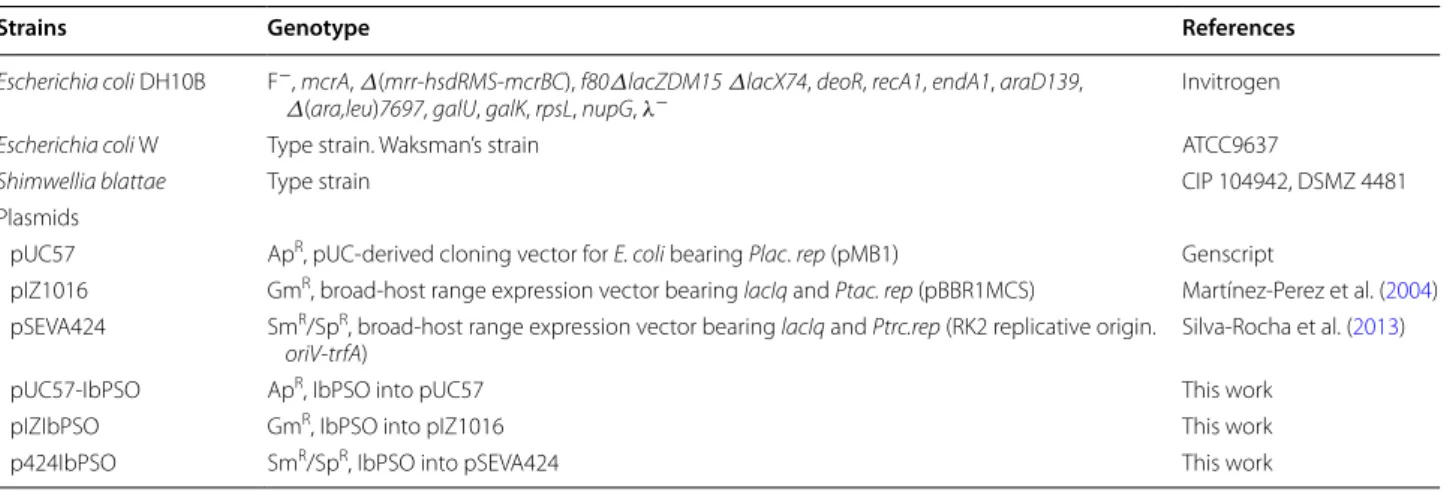
Table 1 Bacterial strains and plasmids used in this study
Strains Genotype References
Escherichia coli DH10B F−, mcrA, Δ(mrr‑hsdRMS‑mcrBC), f80ΔlacZDM15ΔlacX74, deoR, recA1, endA1, araD139, Δ(ara,leu)7697, galU, galK, rpsL, nupG, λ−
Invitrogen
Escherichia coli W Type strain. Waksman’s strain ATCC9637
Shimwellia blattae Type strain CIP 104942, DSMZ 4481
Plasmids
pUC57 ApR, pUC‑derived cloning vector for E. coli bearing Plac. rep (pMB1) Genscript
pIZ1016 GmR, broad‑host range expression vector bearing lacIq and Ptac. rep (pBBR1MCS) Martínez‑Perez et al. (2004)
pSEVA424 SmR/SpR, broad‑host range expression vector bearing lacIq and Ptrc.rep (RK2 replicative origin.
oriV‑trfA) Silva‑Rocha et al. (2013) pUC57‑IbPSO ApR, IbPSO into pUC57 This work
pIZIbPSO GmR, IbPSO into pIZ1016 This work
an OD600nm of 0.5. Then, cultures were induced by add-ing 1 mM IPTG and grown at 30°C in an orbital shaker at 200 rpm during 48 h. This culture process has been performed either in shake flask or in 96-microwell plates. Culture growth was monitored with a Shimadzu UV-260 spectrophotometer in shaking screw flasks. For the cul-tivation in 96-microwell plates, aliquots (0.2 ml) were distributed in the microwells. The plates were incubated at same temperature for 48 h, with 20 s of heavy orbital shaking every 15 min using a Multiskan Ascent Incubator (Thermo Scientific, Waltham, MA, USA) that monitors optical density at 630 nm every 60 min. Transformation
of bacterial strains was performed by electroporation as previously described (Díaz et al. 1994).
Construction of the synthetic operon
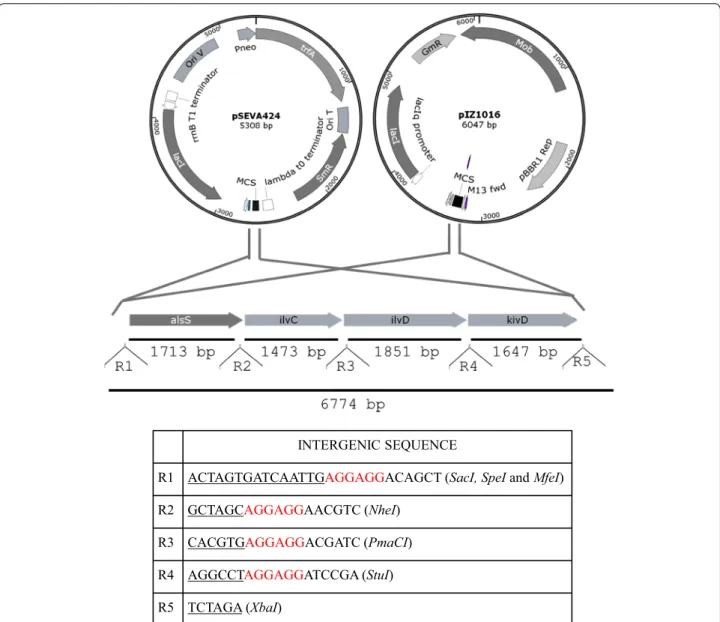
The synthetic operon (Figure 1) (GenBank accession No. KP739244), named IbPSO, was designed to express the following genes: alsS (acetolactate synthase) from B. sub-tilis, ilvC (acetohydroxy acid isomeroreductase) from E. coli, ilvD (dihydroxy-acid dehydratase) from E. coli and
kivD (2-ketoacid decarboxylase) from Lactococcus lac-tis. To achieve optimal translation of the mRNA a con-sensus Shine Dalgarno sequence (AGGAGG) was added
INTERGENIC SEQUENCE
R1 ACTAGTGATCAATTGAGGAGGACAGCT (SacI, SpeIandMfeI)
R2 GCTAGCAGGAGGAACGTC (NheI)
R3 CACGTGAGGAGGACGATC (PmaCI)
R4 AGGCCTAGGAGGATCCGA (StuI)
R5 TCTAGA (XbaI)
upstream each gene at 6 bp from the respective start codons. Restriction enzyme sites were added upstream each gene to facilitate different cloning options. Codon usage was adapted to Gram negative bacteria using the Optimizer program (Puigbó et al. 2007, 2008) at Univer-sitat Rovira i Virgili server ( http://genomes.urv.es/OPTI-MIZER/). IbPSO operon was chemically synthesized at ATG:biosynthetics GmbH and was initially cloned into pUC57 generating the plasmid pUC57-IbPSO. Plasmid pUC57-IbPSO was digested with SpeI-XbaI or SacI-XbaI to release the fragment containing the IbPSO operon that was further subcloned into the pIZ1016 (under the con-trol of the Ptac promoter) and pSEVA424 (under the con-trol of Ptrc promoter) vectors, respectively (Figure 1).
HPLC analysis
For quantification of isobutanol 80 µl of culture superna-tants were precipitated by the addition of 10 µl of both 0.1 M Ba(OH)2 and 0.1 M ZnSO4, and after removing the precipitate by centrifugation at 12,000g for 5 min, super-natants were analyzed by HPLC using a Gilson HPLC system equipped with a refraction index detector and an Aminex HPX-87H column (300 × 7.8 mm, hydrogen form, 9 µm particle size, 8% cross linkage). The column was eluted isocratically at a flow rate of 0.6 ml min−1 of 5 mM H2SO4. The analysis was performed using Beck-man Coulter’s 32 Karat Software 8.0.
Isobutanol and norvaline tolerance test
To test isobutanol tolerance bacterial strains were inoc-ulated at an OD600nm of 0.01 in M9 liquid medium sup-plemented with trace elements as described above, yeast extract (5 g l−1), glucose (36 g l−1) and isobutanol (0–10 g l−1). Growth was determined at 24 h by deter-mining the O.D at 600 nm. Norvaline tolerance was tested according to Smith and Liao (2011).
Results
Construction of IbPSO operon
Atsumi et al. (2008, 2010) had designed a non-natural isobutanol production pathway consisting of five enzy-matic steps from pyruvate (Figure 2). This pathway com-bines the alsS, ilvC, kivD, and ADH2 genes that were independently cloned from B. subtilis, E. coli, L. lactis
and S. cerevisiae, respectively and expressed in several transcription units harbored in at least two compatible plasmids (Atsumi et al. 2008, 2010). The use of two plas-mids and different transcription units make this system complex to handle and thus, based on this work we have explored the possibility of designing a new single syn-thetic isobutanol operon (IbPSO) (see “Materials and methods”) to facilitate the cloning and manipulation of this non-natural pathway.
To improve the design of the gene arrangement and reduce its complexity, we have introduced three novel-ties; (i) the genes were de novo chemically synthesized using a programmed codon use optimal for different bacteria; (ii) the genes were cloned together creating a single transcription unit under the control of a gle regulated promoter that can be harbored by a sin-gle broad-host-range plasmid or transposon; and (iii) the gene encoding the alcohol dehydrogenase (ADH2) responsible for the last biochemical step (the transfor-mation of 2-isobutyraldehyde to isobutanol) has not been included in the IbPSO operon because as dem-onstrated by Atsumi et al. (2010) many bacteria pos-sess Adh enzymes that can supply this activity and its inclusion in the operon does not provide additional advantages.
As a proof of concept we have constructed two broad-host range plasmids, pIZIbPSO and p424IbPSO, har-bouring the IbPSO operon using E. coli DH10B (K12
PYRUVATE
2-ACETOLACTATE
2,3-diHYDROXY-ISOVALERATE
2-KETOISOVALERATE
AlsS
IlvC
IlvD
2x
ISOBUTYRALDEHYDE
ISOBUTANOL
Kdc
CO
2NADPH
NADP
+CO
2H
2O
NADH
NAD
+Adh
strain) and E. coli CC118 (K12 strain) as hosts, respec-tively. Plasmid p424IbPSO derives from the synthetic pSEVA424 plasmid, and therefore the new construction has the novelty of being one of the few complete chemi-cally synthetic plasmids used for metabolic engineering so far.
The plasmids were stably maintained in these strains and we confirmed that E. coli DH10B (pIZIbPSO) and
E. coli CC118 (p424IbPSO) produced 0.9 and 1.4 g l−1 of isobutanol, respectively, using glucose as carbon source. These strains only produced isobutanol in the presence of IPTG confirming that the expression of the operon is under the control of the LacI regulator, as expected. These results demonstrated that the new IbPSO synthetic operon was fully functional in E. coli.
The plasmids extracted from these bacteria were fur-ther used to create ofur-ther isobutanol producers with a single transformation event. Because both plasmids have two different broad-host range replication origins and two different antibiotic resistance markers they can be used to transform a large variety of hosts.
Isobutanol overproduction in recombinant strains expressing IbPSO operon
To test the feasibility of producing isobutanol using the IbPSO operon different strains of Escherichia, Pseu-domonas, Shimwellia and Klebsiella were transformed with plasmids pIZIbPSO or p424IbPSO depending of the strains and the possibility of using their antibiotic mark-ers (data not shown). Remarkably, although we were able to obtain antibiotic resistant recombinants in all cases, the plasmids were partially deleted in several hosts. Obvi-ously, only the transformants keeping intact plasmids were able to produce isobutanol in different amounts ranging from milligrams to grams per litter using glu-cose as carbon source. These results demonstrated that the stability of the plasmids and the isobutanol produc-tion were strongly dependent on the host strain. The rea-sons why the IbPSO containing plasmids were deleted in some strains or why some strains produced more isobu-tanol than others have not been investigated because the objective was to obtain a battery of isobutanol producers to select the best producing bacteria.
The two best isobutanol producers were E. coli W (ATCC9637) (pIZIbPSO) and S. blattae (p424IbPSO) that were selected for further analyses. The so called “Waksman’s strain” or “W strain”, E. coli W (ATCC9637) is a fast-growing industrial strain and the only safe (GRAS) strain that can grow using sucrose as sole carbon and energy source. In addition, this strain is able to pro-duce high amounts of l-valine (Park et al. 2011). On the other hand, S. blattae is a non-pathogenic strain that has
been used to produce high amounts of 1,3-propanediol (Heinrich et al. 2013).
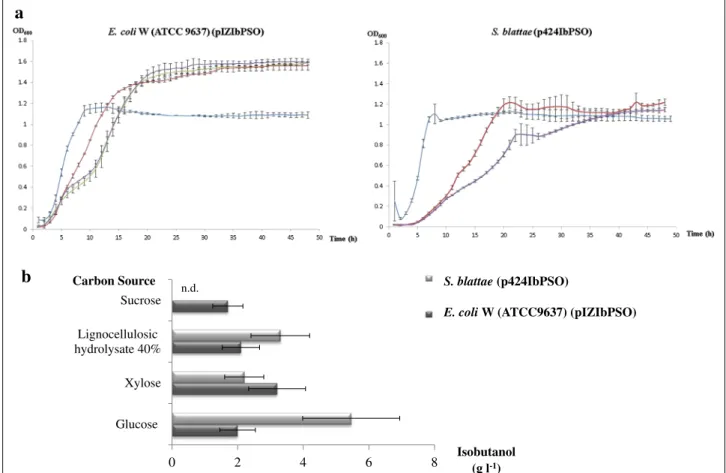
Figure 3a shows the growth curves of the two strains in the different compounds used as carbon sources to measure the isobutanol production. The best isobutanol producer was S. blattae (p424IbPSO) (6 g l−1) when the microorganism was cultured on glucose, but isobutanol production was also high (>2 g l−1) when this strain was cultured in the presence of lignocellulosic hydrolysate or xylose. The strain E. coli W (ATCC 9637) (pIZIbPSO) produced up to 3 g l−1 in the presence of xylose and 2 g l−1 when glucose or lignocellulosic hydrolysate were metabolized, but more important this strain also pro-duced 1.7 g l−1 of isobutanol with sucrose as carbon source. This is the first time that isobutanol has been pro-duced from sucrose. The yields of the transformations are shown in Table 2.
The results demonstrate the potential of the IbPSO strategy, as significant isobutanol productions were achieved even without a comprehensive optimization of the strains and of the operation conditions.
Testing strain tolerance to isobutanol and norvaline
To investigate whether the higher productions observed in E. coli W and S. blattae correlate with their tolerance to isobutanol and/or their overproduction of branched amino acids we tested their resistance to isobutanol and to norvaline, respectively.
Isobutanol is known to be toxic to microbial cells (Brynildsen and Liao 2009) and this feature can be a major restriction to improve productivity. To check isob-utanol tolerance the host strains were cultured in liquid medium in the presence of increasing concentration of isobutanol. Figure 4 shows that E. coli W (ATCC 9637) was tolerant to isobutanol up to 7.5 g l−1. However, E.
coli DH10B (K12 strain) and S. blattae were less toler-ant. None of the tested strains were tolerant to more than 10 g l−1 of isobutanol.
Taking into account that norvaline resistance is a prop-erty that is related with an improved ability for overpro-ducing branched amino acids in bacteria and that was used for increasing the isobutanol production in E. coli
(Smith and Liao 2011) we have observed that the better producers E. coli W (ATCC 9637) and S. blattae are able to grow up to 10 mg l−1 of norvaline in contrast with E.
Therefore, resistance to norvaline can be a selective trait to identify the best potential isobutanol producers.
Discussion
The pioneering work of Liao and co-workers demon-strated that it was possible to transform glucose into isobutanol using engineered microorganisms (Atsumi et al. 2008; Atsumi and Liao 2008; Connor and Liao 2009; Gronenberg et al. 2013). To achieve this objective the producer organism must first convert the carbon source
to central metabolic intermediates, which are then trans-formed into isobutanol through engineered pathways. When using non-conventional resources strain engineer-ing efforts must address problems in both resource uti-lization and isobutanol synthesis. Therefore, it would be possible to construct the feedstock utilization pathways into an organism that already produces isobutanol, or construct the isobutanol production pathways into a host organism capable of metabolizing the desired resource. The choice of the strategies depends on the complexity of the two types of pathways and difficulties in express-ing the enzymes involved (Atsumi et al. 2008; Atsumi and Liao 2008; Connor and Liao 2009; Gronenberg et al.
2013).
With the sole exception of plasmid pJL26 used to pro-duced isobutanol in Ralstonia eutropha (Lu et al. 2012) the existing engineered isobutanol production path-ways have been constructed using the native genes obtained from different organisms and these genes have been cloned in pairs or individually in different plas-mids. Obviously, this strategy presents several problems:
Table 2 Isobutanol production yields (g/g) with the car-bon sources tested
a 24 g l−1 glucose and 12 g l−1 xylose.
E. coli W S. blattae
Yisobutanol/glucose 0.095 0.196
Yisobutanol/xylose 0.160 0.123
Ya
isobutanol/lignocellulosic hydrolysate 0.067 0.102
Yisobutanol/sucrose 0.204 n.d.
a
b
0 2 4 6 8
Glucose Xylose Lignocellulosic hydrolysate 40%
Sucrose
Isobutanol (g l-1)
Carbon Source S. blattae (p424IbPSO)
E. coli W (ATCC9637) (pIZIbPSO)
n.d.
Figure 3 Growth curves and isobutanol production by E. coli W (ATCC 9637) (pIZIbPSO) and S. blattae (p424IbPSO). a Growth curves in different carbon sources. Glucose (20 g l−1) (red), xylose (20 g l−1) (purple), 20% lignocellulosic hydrolysate (20 ml liquid hydrolysate/100 ml medium) (blue)
and sucrose (20 g l−1) (green). b Isobutanol production of the recombinant strains at 48 h in the presence of different carbon sources. S. blattae does
(i) the codon use of the genes were not adapted to the host organism; (ii) the genes are expressed in different plasmids which requires the use of several antibiotics and hampers their stability; (iii) the requirement of two or more plasmids complicates their transference to alterna-tive hosts; and (iv) the genes are constructed in different operons making more difficult its regulation.
In order to circumvent these problems we have engi-neered a completely synthetic pathway in a single operon. The new tools of synthetic biology allowed us not only to optimize the codon usage of the genes but also their transcriptional and translational issues. The genes were placed in the operon according to their metabolic order in the pathway, as occurs on many natural operons. In this way, the complete operon can be uniformly con-trolled and inserted in a broad range plasmid that can be tested in many different bacteria having diverse meta-bolic properties.
As a proof of concept we have inserted the new IbPSO operon in two different broad-host range expression vec-tors, pIZ1016 and pSEVA424, under the control of Ptac
and Ptrc promoters, respectively. Therefore, these plas-mids allow testing isobutanol production in many differ-ent bacteria. Taking into account that pSEVA424 is also a synthetic plasmid, the construction p424IbPSO is a com-pletely synthetic product.
It is worth to mention that based on the results of Atsumi et al. (2010) we have excluded from the operon the gene encoding for an alcohol dehydrogenase since they have demonstrated that E. coli and other bacteria already contain encoded in their chromosomes wide-substrate-range dehydrogenases (e.g., YqhD or AdhA in
E. coli) that can efficiently perform the last enzymatic step, i.e., isobutyraldehyde reduction, even better than ADH2 from S. cerevisiae currently used in previous con-structions. Moreover, the chromosome expression of these enzymes appears to saturate the enzyme require-ments for isobutanol production (Atsumi et al. 2010).
The best isobutanol producer strains constructed so far must be equipped with different mutations in order to achieve a high isobutanol yield, because the recom-binants based on the transformation of wild type strains accumulate other intermediates and produce very low isobutanol yields (Atsumi et al. 2008; Atsumi and Liao
2008; Connor and Liao 2009; Gronenberg et al. 2013). One of the best producer strains is E. coli JCL206, a multiple mutant strain (ΔadhE, ΔfrdBC, Δfnr, ΔldhA, Δpta, ΔpflB) derived from E. coli K12 strain BW25113,
bearing two plasmids, pSA65 and pSA69, that produces about 7 g l−1 of isobutanol in flasks (Atsumi et al. 2008,
2010) when cultured in similar conditions to that used in this work. This suggests that the recombinant E. coli W (ATCC 9637) and S. blattae strains are good candidates to be improved as isobutanol producers. In this sense it is important to mention that E. coli JCL206 (pSA65, pSA69) can produce up to 22 g l−1 when cultured in higher con-centrations of glucose and longer times (Atsumi et al.
2008) or even higher (about 50 g l−1) in bioreactors with in situ product removal (Baez et al. 2011). In this sense, it is very difficult to compare the isobutanol productions described in the literature because when the recombinant bacteria are cultured in flasks, the alcohol is partially evaporated during the fermentation process. Then, to reduce the isobutanol evaporation, flasks must be sealed causing microaerophilic fermentation conditions that do not favour the bacterial growth and are difficult to con-trol and reproduce.
Whether, our recombinant strains of E. coli W (ATCC 9637) and S. blattae can be improved to reach the high isobutanol productions using similar operation condi-tions that those described for the best producer strains is under study. Moreover, the construction of specific mutants of these new hosts to reduce by-products might still open the possibility of obtaining even best producer strains as demonstrated for other microor-ganisms (Atsumi et al. 2008; Atsumi and Liao 2008; Connor and Liao 2009; Gronenberg et al. 2013). Never-theless, it is interesting to notice that during isobutanol productions we have not observed in our recombinant
0.00 2.00 4.00
E. coli DH10B E. coli W
S.blattae E. coli DH10B
E. coli W S.blattae E. coli DH10B
E. coli W S.blattae E. coli DH10B
E. coli W S.blattae E. coli DH10B
E. coli W S.blattae E. coli DH10B
E. coli W S.blattae
0.00
2.50
5.00
7.50
10.0
0
12.5
0
OD600nm
Isobutanol (g l-1)
strains a significant accumulation in the culture medium of metabolites such as lactic and acetic acids that might reduce the production of isobutanol (data not shown).
On the other hand, the reasons why E. coli W (ATCC 9637) and S. blattae are more robust, produce more isobutanol, and support stably these plasmids better than others tested strains, remain unknown. The anal-ysis of their central and amino acid metabolism based on their genome information did not provide any spe-cific evidence of the existence of spespe-cific pathways that might contribute to their robustness. Nevertheless, we suggest that the finding that they are naturally resistant to high concentrations of norvaline might contribute positively.
To produce isobutanol cost effectively on an industrial scale, more economical carbon, nitrogen, and mineral sources should be tested to replace glucose. Sucrose is one of the main feedstock for industrial fermentations presenting several advantages over glucose, such as the fewer amounts of energy, water, and chemicals used for its production which lies in its lower price. Waste molas-ses from beet and sugar cane contain large amounts of sucrose and they have been used at industrial level as raw materials for different fermentation processes. However, most industrial E. coli strains are derived from the wild types that do not utilize sucrose. In this sense E. coli W (ATCC 9637) is able to metabolize sucrose by using the chromosomally encoded sucrose catabolism (csc) regu-lon. In this work we have demonstrated for the first time that E. coli W (ATCC 9637) (pIZIbPSO) can produce isobutanol from this important raw material. This robust strain appears to be an excellent platform for industrial uses due to its more rapid growth with much less by-product formation compared with E. coli K-12 strains as suggested by Park et al. (2011). On the other hand, the observation that S. blattae and E. coli W (ATCC 9637) grow well on the highly toxic crude lignocellulosic hydro-lysates (Figure 3a), has allowed us to produce isobutanol directly using these slurries as carbon sources even con-taining such toxic mixtures. Because these strains can consume glucose, xylose and arabinose that are the main sugar components of these hydrolysates, these bacteria appear to be ideal for developing an isobutanol produc-tion process based on the fermentaproduc-tion of such slurries.
Summarizing, the proof of concept provided in this work opens new avenues to investigate the production of isobutanol using the tools of synthetic biology in order to optimize the production pathways in a simple way and to investigate the utility and adaptability of alternative host strains having different metabolic capabilities to use alternative raw materials or able to work under extreme toxic conditions.
Authors’ contribution
CF‑S carried out molecular genetic studies and fermentation experiments and helped to draft the manuscript. AR carried out fermentation experiments and helped to draft the manuscript. MT and BG participated in the design of the study and helped to draft the manuscript. DR conceived the study and helped to draft the manuscript. JLG designed and coordinated the study and drafted the manuscript. All authors read and approved the final manuscript.
Author details
1 Department of Environmental Biology, Centro de Investigaciones Biológi‑ cas, CSIC, Madrid, Spain. 2 Biopolis S.L., Parc Científic Universitat de Valencia, Paterna, Spain.
Acknowledgements
We are deeply indebted to Prof. E. Santero (CABD‑CSIC/UPO, Seville, Spain) for providing pIZ1016 plasmid and Prof. V. de Lorenzo (CNB‑CSIC, Madrid, Spain) for providing pSEVA424 plasmid. We want to thank A. Valencia, F. de la Peña and Dr. V. Morales for technical support. This work was supported by grants from Biopolis S.L. and Spanish Ministry of Science and Innovation BIOSOS CEN20091040 (CENIT‑CDTI). We acknowledge support of the publication fee by the CSIC Open Access Publication Support Initiative through its Unit of Information Resources for Research (URICI).
Compliance with ethical guidelines
Competing interests
The authors declare that they have no competing interests.
Received: 13 May 2015 Accepted: 18 May 2015
References
Akita H, Nkashima N, Hoshino T (2014) Bacterial production of isobutanol without expensive reagents. Appl Microbiol Biotechnol. doi:10.1007/ s00253‑014‑6173‑x
Atsumi S, Liao JC (2008) Metabolic engineering for advanced biofuels produc‑ tion from Escherichia coli. Curr Opin Biotechnol 195:414–419
Atsumi S, Hanai T, Liao JC (2008) Non‑fermentative pathways for synthesis of branched‑chain higher alcohols as biofuels. Nature 451:86–89 Atsumi S, Higashide W, Liao JC (2009) Direct photosynthetic recycling of
carbon dioxide to isobutyraldehyde. Nat Biotechnol 27:1177–1180 Atsumi S, Wu TY, Eckl EM, Hawkins SD, Buelter T, Liao JC (2010) Engineering
the isobutanol biosynthetic pathway in Escherichia coli by comparison of three aldehyde reductase/alcohol dehydrogenase genes. Appl Microbiol Biotechnol 85:651–657
Baez A, Cho KM, Liao JC (2011) High‑flux isobutanol production using engi‑ neered Escherichia coli, a bioreactor study with in situ product removal. Appl Microbiol Biotechnol 90:1681–1690
Blombach B, Riester T, Wieschalka S, Ziert C, Youn JW, Wendisch VF et al (2011)
Corynebacterium glutamicum tailored for efficient isobutanol production. Appl Environ Microbiol 77:3300–3310
Brat D, Weber C, Lorenzen W, Bode H, Boles E (2012) Cytosolic re‑localization and optimization of valine synthesis and catabolism enables increased isobutanol production with the yeast Saccharomyces cerevisiae. Biotech‑ nol Biofuels 5:65
Brynildsen MP, Liao JC (2009) An integrated network approach identifies the isobutanol response network of Escherichia coli. Mol Syst Biol 5:277 Chen X, Nielsen KF, Borodina I, Kielland‑Brandt MC, Karhumaa K (2011)
Increased isobutanol production in Saccharomyces cerevisiae by overex‑ pression of genes in valine metabolism. Biotechnol Biofuels 4:21 Connor MR, Liao JC (2009) Microbial production of advanced transportation
fuels in non‑natural hosts. Curr Opin Biotechnol 20:307–315 Díaz E, Munthali M, de Lorenzo V, Timmis KN (1994) Universal barrier to
lateral spread of specific genes among microorganisms. Mol Microbiol 13:855–861
Heinrich D, Andreessen B, Madkour MH, Al‑Ghamdi MA, Shabbaj II, Stein‑ büchel A (2013) From waste to plastic, synthesis of poly3‑hydroxypropi‑ onate in Shimwellia blattae. Appl Environ Microbiol 79:3582–3589 Higashide W, Li Y, Yang Y, Liao JC (2011) Metabolic engineering of Clostridium
cellulolyticum for production of isobutanol from cellulose. Appl Environ Microbiol 77:2727–2733
Huo YX, Cho KM, Rivera JG, Monte E, Shen CR, Yan Y et al (2011) Conversion of proteins into biofuels by engineering nitrogen flux. Nat Biotechnol 29:346–351
Kondo T, Tezuka H, Ishii J, Matsuda F, Ogino C, Kondo A (2012) Genetic engineering to enhance the Ehrlich pathway and alter carbon flux for increased isobutanol production from glucose by Saccharomyces cerevi-siae. J Biotechnol 159:32–37
Lan EI, Liao JC (2013) Microbial synthesis of n‑butanol, isobutanol, and other higher alcohols from diverse resources. Bioresour Technol 135:339–349 Lang K, Zierow J, Buehler K, Schmid A (2014) Metabolic engineering of Pseu-domonas sp. strain VLB120 as platform biocatalyst for the production of isobutyric acid and other secondary metabolites. Microb Cell Fact 13:2 Lee WH, Seo SO, Bae YH, Nan H, Jin YS, Seo JH (2012) Isobutanol production in
engineered Saccharomyces cerevisiae by overexpression of 2‑ketoisovaler‑ ate decarboxylase and valine biosynthetic enzymes. Bioprocess Biosyst Eng 35:1467–1475
Li S, Wen J, Jia X (2011) Engineering Bacillus subtilis for isobutanol production by heterologous Ehrlich pathway construction and the biosynthetic 2‑ketoisovalerate precursor pathway overexpression. Appl Microbiol Biotechnol 91:577–589
Li H, Opgenorth PH, Wernick DG, Rogers S, Wu TY, Higashide W et al (2012) Integrated electromicrobial conversion of CO2 to higher alcohols. Science 335:1596
Lu J, Brigham CJ, Gai CS, Sinskey AJ (2012) Studies on the production of branched‑chain alcohols in engineered Ralstonia eutropha. Appl Micro‑ biol Biotechnol 96:283–297
Martínez‑Perez O, Moreno‑Ruiz E, Floriano B, Santero E (2004) Regulation of tetralin biodegradation and identification of genes essential for expres‑ sion of thn operons. J Bacteriol 186:6101–6109
McEwen JT, Atsumi S (2011) Alternative biofuel production in non‑natural hosts. Curr Opin Biotechnol 23:1–7
Park JH, Jang YS, Lee JW, Lee SY (2011) Escherichia coli W as a new platform strain for the enhanced production of l‑valine by systems metabolic engineering. Biotechnol Bioeng 108:1140–1147
Puigbó P, Guzmán E, Romeu A, Garcia‑Vallvé S (2007) OPTIMIZER, a web server for optimizing the codon usage of DNA sequences. Nucl Acids Res 35:W126–W131
Puigbó P, Romeu A, Garcia‑Vallvé S (2008) HEG‑DB, a database of predicted highly expressed genes in prokaryotic complete genomes under transla‑ tional selection. Nucl Acids Res 36:D524–D527
Silva‑Rocha R, Martínez‑García E, Calles B, Chavarría M, Arce‑Rodríguez A, de las Heras A et al (2013) The Standard Europea Vector Architecture SEVA, a coherent platform for the analysis and deployment of complex prokary‑ otic phenotypes. Nucl Acids Res 41D1:D666–D675