Introduction
Plans to improve the National Health Service (NHS) recognise that clinicians need excellent communication
systems today.1 Primary care teams that have taken advantage of information technology (IT) advances have demonstrated that it is possible to save time and improve patient care by 10–20%.2,3The NHS infor-mation technology strategy has recognised these
Refereed papers
A survey of computer use in Scottish
primary care: general practitioners are
no longer technophobic but other primary
care staff need better computer access
Libby Morris MB ChB
Chairman, Scottish Clinical Information Management in Primary Care (SCIMP), Royal College of General Practitioners (Scotland), Edinburgh, UK
Jo Dumville PhD
Administrator, Royal College of General Practitioners (Scotland), Edinburgh, UK
L Malcolm Campbell MD FRCGP
Senior Lecturer in General Practice, Glasgow University and Director of Quality Standards, Royal College of General Practitioners (Scotland), Edinburgh, UK
Frank Sullivan FRCGP
Professor of General Practice, Health Informatics Centre, University of Dundee, Dundee, UK
ABSTRACT
Objective To describe the use of computing systems by primary care staff in Scotland.
Participants Practice managers in Scotland on behalf of their practice teams.
Methods A survey of computer use in Scottish general practices was carried out by the Scottish Clinical Information Management in Primary Care (SCIMP) group in April 2001. Every practice was sent an electronic copy of a questionnaire using NHSnet. Practices that did not respond to the electronic version were sent a paper version of the questionnaire.
Main outcome measures Access to computers, use during consultations, links to laboratories, problems experienced by users.
Results A total of 308 practices (30%) replied to the electronic questionnaire and 346 practices (33%) to a paper version, giving an overall response rate of 63% (654 practices). A total of 296 (29%) of
practices could not receive the electronic version. It was reported that 94% of general practitioners and 74% of practice nurses frequently used a computer; 72% of practices used their computer for chronic disease management. There was great variability in links to laboratories for lab results (range 1–30% by region). Of responding practices, 16% had plans for a unified patient record, but access to a computer is still a major problem for community nurses. Satisfaction was expressed for all systems and many practices also use third-party programs.
Conclusions Most Scottish doctors make frequent use of computers for a variety of clinical and prac-tice management activities. Many other staff want to make greater use of computers, but are often unable to obtain access.
opportunities for more effective care and proposed a strategy designed to act as a framework for effective com-puting.1,4,5It is often difficult, however, for clinicians and policymakers to know to what extent the different components of the strategy are already in place. There are many reports that clinicians are afraid to use com-puter technology or perceive that they have inadequate training to make the best use of it.6,7In the past, failure to harness optimum technologies has led to unhelpful features of information systems being continued and other useful functionality being discarded prematurely.8 Despite the national strategy, computer use in primary care is unlikely to achieve its potential until this ‘evaluation paradox’ is addressed and clinicians see clear benefits to their patients, or themselves, from computer use. All practices in Scotland were linked electronically to the NHSnet in 1998, so it should be possible to implement much of the national strategy.9 The Scottish Programme for Improving Clinical Effectiveness in Primary Care (SPICE-PC) is part of the Royal College of General Practitioners’ (RCGP’s) quality initiatives programme.10The SPICE program identifies essential criteria of chronic disease manage-ment which are designed to act as reminders to the clinician during the consultation and make it easier to do the right thing. It is vital that data can be entered quickly and easily during the consultation, reminders be provided where needed and the data easily extracted by practices for their own use where required. The data, which is entered on practice databases, can be extracted by disc or sent by email to Aberdeen University where it is analysed by the Primary Care Clinical Informatics Unit (PCCIU) to produce reports for individual prac-tices or local health care co-operatives (LHCCs).11
The last national survey by the Department of Health was in 1993.12 The number of GPs and practice nurses currently using their computer in the con-sulting room for clinical management of patients is not currently known. Scottish Clinical Information Management in Primary Care (SCIMP) was set up in September 1999 by a group of Scottish general practitioners (GPs) in order to provide a central body to co-ordinate and standardise the management of clinical information in primary care.13The aims of the group were to publicise the benefits of a co-ordinated Scottish approach, encourage minimum datasets and common standards of clinical activity, facilitate audit, implement guidelines and demonstrate clinical effect-iveness. SCIMP undertook to carry out a survey to establish accurately how many GPs, practice nurses and other practice staff were making use of the tech-nology currently available, and to establish the problems they face.
Methods
A questionnaire was designed to ask relevant questions about the use of computers by doctors, nurses and administrative staff working in primary care. The questions were developed by content experts who were members of SCIMP. These included represent-atives of the RCGP, the Scottish General Practice Committee of the British Medical Association (BMA), Scottish Intercollegiate Guidelines Network (SIGN) guidelines and users of all five clinical systems cur-rently used in Scottish practices. A pilot version of the questionnaire was tested by sending it electronically to ten practices. The pilot version was intended to ensure that practices could open the electronic document, and either complete and return it or print it off and post it back. Two questions were found to be ambigu-ous and were removed, but all of the test practices received the electronic document successfully and were able to send it back by email.
An electronic version of the questionnaire was developed to automatically populate a database when it was returned. This was sent by email on NHSnet to every practice in Scotland (1036 in total) in April 2001 by the Information Services Division (ISD) of the NHS in Scotland, which holds a list of email addresses for every practice. The questionnaire was addressed to the practice manager or administrator, who was asked to reply on behalf of the whole practice.
Those practices that did not reply to the electronic questionnaire were sent a paper version, with an additional question asking why they had not returned the electronic version. All of the electronic responses were collated automatically by ISD. The remaining paper replies were added into the database manually.
Results
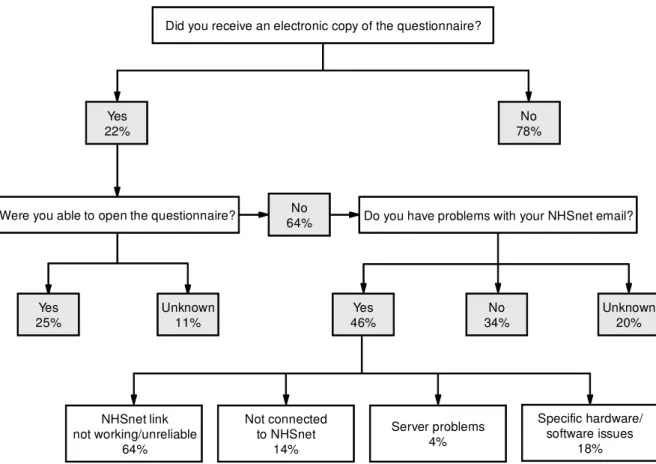
A total of 308 (30%) practices replied electronically, but 296 more questionnaires were returned to ISD as ‘undeliverable’. Of the 728 paper questionnaires sent, 346 further replies were received (Figure 1), giving a final total of 654 completed questionnaires (63% response rate). The figure describes the reasons for failure to respond to the initial electronic question-naire. The main reason for non-response was that the email containing the questionnaire was not received (78%). The reasons for this were problems with NHSnet and some local problems. Of the 22% who did receive the email, 64% were unable to open it. Forty-six percent of practices stated that they had problems with their NHSnet email, including 75 (64%) practices which stated that their NHSnet link was not working or unreliable, 17 (14%) which were not con-nected to NHSnet and 27 (18%) which had specific hardware/software issues (e.g. ‘can’t open attachments’, ‘can’t receive email from outside NHS’, ‘can’t print’, ‘router held together with sellotape’).
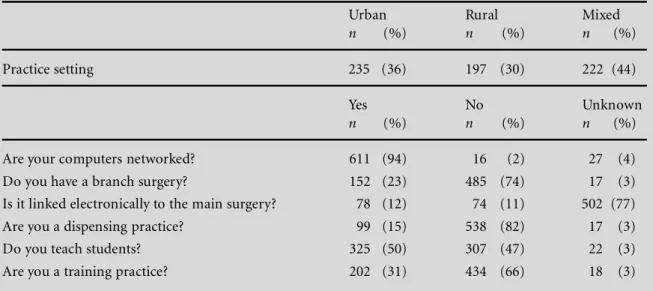
The characteristics of responding practices and their geographical locations are shown in Table 1. This shows a wide geographical spread, almost half of respondents were in teaching practices and a third in
training practices. Almost all practice systems were networked.
Respondents indicated that 94% of GPs used the computer, and only 4% of the total never switched their computer on at all. The usual reasons for not using one were technophobia and lack of motivation. The numbers using a computer for different activities are: in the consulting room 91%; acute prescribing 84%; repeat prescribing 83%; to record clinical information 63%; to record the whole consultation 26%; to use their own formularies 39%; to use area-based formularies 37%. Only 3% of practices claimed they were completely paperless. However, 79% of GPs had access to email from their con-sulting room, 63% frequently sent emails from the practice, 23% accessed journals and publications electronically and 27% accessed Scottish Health on the Web (SHOW) – the NHS in Scotland’s official website.
Table 2 shows the use of some more advanced features by practices. Only 7% of responding practices use email to access the website of their system support. One of the most consistent requests from practices for new developments in recent years has been for electronic links to hospital laboratories for test results. It has been top of the list of requests by General Practice Administration System for Scotland (GPASS)
Figure 1 Paper questionnaire responses describing why practices did not send an electronic reply
Did you receive an electronic copy of the questionnaire?
Yes 22%
Yes
25% Unknown11%
No 78%
Yes
46% 34%No Unknown20%
No 64% Were you able to open the questionnaire?
NHSnet link not working/unreliable
64%
Not connected to NHSnet
14%
Server problems 4%
Specific hardware/ software issues
users for the past three years. Despite this, only 16% of responding practices have direct electronic links with labs for results, and 31% record lab results on the computer. Five different clinical systems were in use with 78% of practices using GPASS. Most respondents reported general satisfaction with the system they used, though this varied from 48–80%, and 67% of practices were happy with the support provided by their local health board.
Table 3 describes the use of computers by com-munity nurses, the allied health professions (AHPs) and social work staff. Practice nurses are the only group where a majority have access to computers though a
majority of other community nurses, AHPs and social work staff would like to do so.
Discussion
This is a survey, completed by practice managers, reporting the activity and attitudes of practice teams. We know that they consulted with other staff when completing this, but have no information on the extent to which these responses accurately reflect
Table 1 Characteristics of responding practices according to location (n= 654)
Urban Rural Mixed
n (%) n (%) n (%)
Practice setting 235 (36) 197 (30) 222 (44)
Yes No Unknown
n (%) n (%) n (%)
Are your computers networked? 611 (94) 16 (2) 27 (4)
Do you have a branch surgery? 152 (23) 485 (74) 17 (3)
Is it linked electronically to the main surgery? 78 (12) 74 (11) 502 (77)
Are you a dispensing practice? 99 (15) 538 (82) 17 (3)
Do you teach students? 325 (50) 307 (47) 22 (3)
Are you a training practice? 202 (31) 434 (66) 18 (3)
Table 2 GP and wider practice use of computers (n= 654)
Yes No No answer
n (%) n (%) n (%)
Does the practice use the computer for chronic 473 (72) 147 (23) 34 (5) disease management?
Does your practice participate in the SPICE-PC 256 (39) 337 (51) 61 (10) program?
Does your practice participate in the SPICE-PC 172 (26) 357 (54) 125 (20) program at LHCC level?
How many GPs have access from their consulting 517 (79) 137 (21) n/a room PC to email?
Do they use:
EBNF 278 (42) 267 (41) 109 (17)
Mentor 88 (13) 372 (57) 194 (30)
Other clinical applications: TRAVAX, EMIMS,
the situation of their colleagues, though other studies have reported accurate representation of views.14The initial response rate to the electronic questionnaire was disappointing compared with studies elsewhere which have reported response rates of up to 75%.15This may have been partly due to incomplete or inaccurate addresses being used by the ISD: 308 practices replied electronically, but 296 more questionnaires were returned to the ISD as ‘undeliverable’. This is an im-portant consideration for the future of electronic communications between primary and secondary care. There are significant resource implications for main-taining and updating accurate databases of practice details at national and regional levels.
Paperless practices
The far lower prevalence of paperless practices in Scotland compared to England is a notable feature of the survey.16 This may be partly because 80% of Scottish practices use GPASS, which is predominantly an administrative system (although seven GPASS practices were nevertheless paperless), but mainly because Scotland moved to A4 notes 15 years ago. The resulting quality of notes is excellent, compared to England where many practices still employ Lloyd George envelopes.17 The impetus for becoming
paperless in England has thus been driven by factors other than choice of clinical system.
Electronic laboratory links
Some health board areas are well advanced in their development of electronic laboratory links, and the crucial factor determining whether or not electronic transmission of lab results occurs is not the clinical system used, but health board area. One of the aims of the Electronic Clinical Communications Implementa-tion (ECCI) programme is to solve the problems of linking different primary care systems and multiple lab systems.18A pilot phase is currently underway in the Highlands to find a solution and, if the results are positive, this important development will be imple-mented across Scotland in the near future. The require-ment is not simply for electronic lists to be sent to practices, but results to be sent electronically which can automatically populate the patient record.
Clinical governance
There are 65 LHCCs in Scotland, and only three of them share a single clinical system in use by all their practices. As more LHCCs set up their programme
Table 3 Use of computers by other members of the practice team
Frequently Occasionally Never Unknown
n (%) n (%) n (%) n (%)
Does the practice nurse use the computer? 487 (74) 71 (11) 36 (6) 60 (9) Does the community nurse use the computer? 126 (19) 237 (37) 236 (36) 55 (8) Does the health visitor use the computer? 132 (20) 238 (37) 227 (34) 57 (8)
Yes No Unknown
n (%) n (%) n (%)
Would any like to be linked in the future? 407 (63) 68 (10) 179 (27) Do they all have full read and write access to patient records? 404 (62) 177 (27) 73 (11) Do they have remote access to the system? 56 (8) 521 (80) 77 (12) Do they have access to telemedicine? 61 (9) 500 (77) 93 (14)
Frequently Occasionally Never Unknown
n (%) n (%) n (%) n (%)
General comments:
for audit and clinical governance, it becomes more important to standardise the recording of clinical information and minimise the extra effort required to collect this manually. The 2003 GP contract, with its increased emphasis on demonstrating the achievement of high-quality care, will also make increased demands on high-quality electronic data.19
Primary care team use of general
practice systems
Community and primary care nursing use of general practice information systems varies both across and within NHS board areas. Practice nurses, being em-ployed by general practices, have so far been the largest group of non-GP primary care team members to use GP systems. The use of GP systems by district nurses, health visitors and AHPs has mainly been negotiated with their employers, island health boards (HBs) and primary care trusts (PCTs). Although often practice attached, these groups of healthcare professions usu-ally have a remit for the health care of communities within a geographical area as well as the general practice population, some not being based within a general practice. The information needs of the island HBs and PCTs in terms of governance and service plan-ning are met by these groups using their computer or other paper-based systems. These systems also help community nurses and AHPs in direct patient care by supporting continuity of care, caseload planning and management. Community nurses and AHPs may use GP systems as well as other systems, dependent upon local protocols. Computer usage has also largely been dependent upon access to computers and networks, training and support.
In September 2000, the Scottish Executive Health Department (SEHD) invited proposals from island HBs and PCTs for investment in community nursing IT infrastructure. In response, £3.5 million was made available. An additional £1 million was also made avail-able for the upgrading of GP information manage-ment and technology infrastructure. As a result of this investment many community nurses and practice nurses now have access to GP systems, email and the Internet as well as training and support. The effect of this investment is currently being audited in order to identify gaps and make plans to meet this need. Integration of patient information into an electronic patient record is an objective of both local and national strategy. Work is underway to promote and further develop general practice system functionality for use by the wider primary care team and to enable virtual sharing of patient information across services and organisations. Recent surveys within island HBs and PCTs show that community nurses feel the electronic sharing of patient information in a secure way with
social care should be given the highest priority for development.20
This survey has demonstrated the widespread use of computers in Scottish primary care by GPs and practice nurses. Networked computers are available but not yet accessible to other members of the ex-tended primary care teams. More training and time during consultations will be needed if full imple-mentation of national policies is to be achieved.
ACKNOWLEDGEMENTS
We would like to thank the practices that generously responded to the questionnaire, the SEHD which funded the development of the questionnaire into an electronic version, members of the SCIMP panel and Kathy Dallest of the Community Nursing Network for commenting on computer use by nurses.
REFERENCES
1 Department of Health (2000) The NHS Plan: a plan for investment, a plan for reform. HMSO: London.www.nhs. uk/nationalplan/nhsplan.htm
2 Mitchell L and Sullivan F (2001) A descriptive feast but an evaluative famine: systematic review of published articles on primary care computing during 1980–97.
British Medical Journal 322: 279–322.
3 Feachem RGA, Sekhri NK and White KL (2002) Getting more for their dollar: a comparison of the NHS with California’s Kaiser Permanente.British Medical Journal
324: 135–43.
4 Burns F (1998) Information for Health. NHS Executive: Leeds.www.nhsia.nhs.uk/
5 Framework for information management & technology in the National Health Service in Scotland:Taking Action 1998–2002.www.show.scot.nhs.uk/takingaction/
6 Farmer J and Richardson A (1997) Information for trained nurses in remote areas: do electronically networked resources provide an answer? Health Libraries Review14: 97–103.
7 Tai SS, Nazareth I, Donegan C and Haines A (1999) Evaluation of general practice computer templates: lessons from a pilot randomised controlled trial.Methods of Information in Medicine38: 177–81.
8 Friedman CP and Wyatt JC (1997)Evaluation Methods in Medical Informatics. Springer: London.
9 Willmot M and Sullivan F (2000) The NHSnet in Scottish primary care: lessons for the future. British Medical Journal321: 878–81.
10 The SPICE-PC:www.ceppc.org/spice/index.shtml
11 PCCIU: www.abdn.ac.uk/general_practice/research/
itprcare.hti
12 Department of Health (1993) Computerisation in GP Practices 1993 Survey. NHS Management Executive: Leeds.
13 SCIMP:www.ceppc.org/scimp/index.shtml
15 Schleyer TK and Forrest JL (2000) Methods for the design and administration of web-based surveys.Journal of the American Medical Informatics Association 7: 416–25.
16 Waring N (2000) To what extent are practices ‘paperless’ and what are the constraints to them becoming more so?
British Journal of General Practice50: 46–7.
17 Gillies A (2000) Assessing and improving the quality of information for health evaluation and promotion.
Methods of Information in Medicine39: 208–12.
18 ECCI:www.show.scot.nhs.uk/ecci/ecci00.htm
19 New GP contract: www.bma.org.uk/ap.nsf/C ontent/_ Hub+GPC+contract
20 Information needs analysis for community nurses by Lothian PCT. ECHIP project. www.show.scot.nhs.uk/ sehd/publications
ADDRESS FOR CORRESPONDENCE
Dr L Morris RCGP Scotland 25 Queen Street Edinburgh EH2 1JX UK
Tel: +44 (0)131 260 6800 Fax: +44 (0)131 260 6836
Email: [email protected]