UDC 331.453:613.155:697.953:[519.6:004.94]
M. M. BILIAIEV
1*, S. G. TSYGANKOVA
2*1*Dep. «Hydraulics and Water Supply», Dnipropetrovsk National University of Railway Transport Named
after Academician V. Lazaryan, Lazaryan St., 2, Dnipropetrovsk, Ukraine, 49010, tel. +38 (056) 373 15 09, e-mail [email protected], ORCID 0000-0002-1531-7882
2*Dep. «Water Supply, Drainage and Hydraulic», Pridneprovsk State Academy of Civil Engineering and Architecture,
Chernyshevskyi St., 24-a, Dnipropetrovsk, Ukraine, 49600, tel. +38 (050) 697 92 18, e-mail [email protected], ORCID 0000-0002-9837-3109
COMPLEX OF NUMERICAL MODELS FOR COMPUTATION
OF AIR ION CONCENTRATION IN PREMISES
Purpose. Thearticle highlightsthe question aboutcreation the complex numerical models in order to calculate the ions concentration fields in premises of various purpose and in work areas. Developed complex should take into account the main physical factors influencing the formation of the concentration field of ions, that is, aerodynamics of air jets in the room, presence of furniture, equipment, placement of ventilation holes, ventilation mode, location of ionization sources, transfer of ions under the electric field effect, other factors, determining the intensity and shape of the field of concentration of ions. In addition, complex of numerical models has to ensure conducting of the express calculation of the ions concentration in the premises, allowing quick sorting of possible variants and ena-bling «enlarged» evaluation of air ions concentration in the premises. Methodology. The complex numerical models to calculate air ion regime in the premises is developed. CFD numerical model is based on the use of aerodynamics, electrostatics and mass transfer equations, and takes into account the effect of air flows caused by the ventilation operation, diffusion, electric field effects, as well as the interaction of different polarities ions with each other and with the dust particles. The proposed balance model for computation of air ion regime indoors allows operative cal-culating the ions concentration field considering pulsed operation of the ionizer. Findings. The calculated data are received, on the basis of which one can estimate the ions concentration anywhere in the premises with artificial air ionization. An example of calculating the negative ions concentration on the basis of the CFD numerical model in the premises with reengineering transformations is given. On the basis of the developed balance model the air ions concentration in the room volume was calculated. Originality. Results of the air ion regime computation in premise, which is based on numerical 2D CFD model and balance model, are presented. Practical value. A numerical CFD model and balance model for the computation of air ion regime allow calculating the ions concentration in the prem-ises in the conditions of artificial air ionization taking into account the main physical factors determining the forma-tion of ions concentraforma-tion fields.
Keywords: air ions regime; concentration field of air ions, artificial ionization; CFD model; balance model
Introduction
In recent years in field of labor protection con-siderable attention is paid to the observance of the appropriate qualitative air composition in premises, as evidenced by the increased number of publica-tions, both domestic and foreign scientists on this problem. Since to support air ion regime use often artificial ionization of the air, it is necessary calcu-late quickly the ions concentration anywhere in the premises. Thus it is necessary to take into account the geometric characteristics of the premises, placement therein of furniture and equipment, the presence dust sources, the aerodynamics of the air jets in the room, the interaction of different polari-ties ions with each other and with dust particles etc. In addition to the aforesaid, there is need to
develop methods for express calculation of the ions concentration in the premises, allowing quick sort-ing variants and enablsort-ing the «integrated» evalua-tion of the ions concentraevalua-tion in the premises.
Purpose
The purpose of this work is to develop complex of numerical models to calculate the ions concen-tration field at using artificial ionization of air to support air ion regime in the premises.
Methodology
In this paper, two numerical models to calculate the concentration of ions in the premises were pro-posed.
The first model. To calculate the ions concen-tration in the premises 2D CFD model, which is based on the mass transport, aerodynamics and electrostatics equations, is proposed. This model is developed taking into account physical factors that influence the formation of ions concentration field. Also at modeling the geometric characteristics of premises, placement of furniture and equipment, presence of dust emission sources, the interaction of different polarities ions with each other and with dust particles is taken into account. In view of the aforesaid at the modeling of ions dispersion proc-ess, transport equation will have the form [18]:
C (u bE)C (v bE)C
t x y
∂ +∂ + +∂ + =
∂ ∂ ∂
х y
C C
µ µ αCB
x x y y
⎛ ⎞
∂ ⎛ ∂ ⎞ ∂ ∂
= ⎜ ⎟+ ⎜ ⎟− −
∂ ⎝ ∂ ⎠ ∂ ⎝ ∂ ⎠
( ) (
) (
)
с с с
CD Q t δ x x δ y y ,
−β +
∑
− − (1)where C , B , D – is the concentration of negative and positive air ions and dust particles respec-tively; u , v , – velocity components of airflow in the room; µ = µ µ
(
x, y)
– diffusion coefficients; t – time; α –recombination rate of ions with different polarity; β – the recombination rate of ions with dust particles; QC i – the intensity of the negative ions emission at the appropriate points with the coordinates x yc, c; δ −(
x xi) (
δ y y− i)
– Dirac delta function; b – coefficient of ion mobility; E– electric field intensity.
Since air ions have a charge, they generate an electric field E, which is described by the follow-ing equation [18]:
0
y
x E e
E q
x y
∂ ∂
+ =
∂ ∂ ε , (2)
here ε0 – is the dielectric permittivity; qe – is the space charge density.
From equation (2) can go to the scalar poten-tial, taking into account such dependence
, x E x ∂φ = − ∂ . y E y ∂φ = −
∂ (3)
Then we get the Poisson equation of the follow-ing form [18], which we will be used to simulate the electric field:
2 2 2 2 0 e q x y
∂ φ ∂ φ
+ = −
ε
∂ ∂ , (4)
here qe= −eC x y
( )
, , C x y( )
, – is the concentra-tion of negative air ions; φ – scalar potential; e – elementary charge. On the basis of this equation is a performed simulation of the electric field.To describe the processes of positive ions and dust dispersion we will use the equation of transfer in the form [18]:
х
B uB vB B
t x y x x
∂ +∂ +∂ = ∂ ⎛µ ∂ ⎞+
⎜ ⎟ ∂ ∂ ∂ ∂ ⎝ ∂ ⎠ y B CB BD y y ⎛ ⎞ ∂ ∂
+ ⎜µ ⎟− α − β +
∂ ⎝ ∂ ⎠
( ) (
) (
)
,В В В
Q t x x y y
+
∑
δ − δ − (5)D uD vD
t x y
∂ ∂ ∂
+ + =
∂ ∂ ∂
х D y D
x x y y
⎛ ⎞
∂ ⎛ ∂ ⎞ ∂ ∂
= ⎜µ ⎟+ ⎜µ ⎟+
∂ ⎝ ∂ ⎠ ∂ ⎝ ∂ ⎠
( ) (
) (
)
.Di D D
Q t x x y y
+
∑
δ − δ − (6)Designation of the physical parameters in these equations is the same, which was given for the equation (1).
is a modeling equation
2 2
2 2 0
P P
x y
∂ ∂
+ =
∂ ∂ , (7)
where P – is velocity potential.
The components of the air environment veloc-ity vector are connected with the velocveloc-ity potential following dependencies
,
P u
x
∂ =
∂
P v
y
∂ =
∂ . (8)
Formulation of boundary conditions for the modeling equations is considered in [1, 15, 18].
For the numerical integration of the transfer equations [1, 12, 15, 18] is used the implicit alter-nately – triangular difference schemes, which has being implemented by the method of running ac-counts [1]. For the numerical solution of the Laplace equation and Poisson’s equation the Liebmann method is used. The calculation is per-formed on rectangular difference grid.
On the basis of the difference schemes was de-signed the software package (code) «ION-2». This package is built on a modular principle; each sub-program implements a specific numerical integra-tion of the modeling equaintegra-tion and implementing appropriate boundary conditions.
A feature of the modeled process is the pres-ence of furniture in the room, i.e., objects, influ-encing the formation of ion concentration field. To «reproduce» these and other objects in the numeri-cal model one uses a technology numeri-called «porosity technique», also called the method of marking [1]. The essence of this technology lies in the encoding of difference cells, which belong to such facilities, and the implementation of them in the appropriate boundary conditions.
The second model.For the deduction of express method of the ions concentration computation in the premises the following equation will be used:
( )
n
dn
q t np nA
dt = − α − β +
( ) ( )
( )
0 i
Q t Q t
n t n n
V V
+ − − λ (9)
( )
p
dp
q t np pA
dt = − α − β +
( ) ( )
( )
0 i
Q t Q t
p t p n
V V
+ − − λ (10)
here qn, qp are the generation rate of negative and positive ions in the room accordingly; n0, p0 are the negative and positive ion concentrations exter-nal to the room; α – is the recombination rate of ions with those of opposite polarity; β – is the rate of combination of ions with dust particles; A – is dust concentration; V – volume; Q – ventilation rate; λi – the electrostatic deposition of ions.
To describe the dust mass transport equation the equation of the form is used [14]:
( )
0( ) ( )
( )
A p
Q t Q t
dA
q t A t A n
dt = + V − V − λ (11)
here qA is the generation of particles in the space;
0
A isthe external particle concentration; λp – the electrostatic deposition of dust particles.
In contradistinction to the classical model Mayya Y. [14] in the equations (9) – (11) takes into account the dependence on time of negative and positive ions emission and dust emission in the premises and the time dependence of the air ex-change rate. The system of the given equations closes by setting the initial conditions of the form
(
0)
0A t= =A , n t
(
=0)
=n0, p t(
=0)
=p0.These conditions define the initial values of dust, negative and positive ions concentration, re-spectively, before the ionization of the air in the premises. It should be noted that the equations (9) – (11) define the concentration of negative and positive ions and dust are not in the room, but on the exit of it. This is defined by the condition that is the deduction of the balance ratios.
Parameter λi can be defined under equation:
(
)
0
i e c
b
q q eA
λ = +
ε (12)
e
q =en ep− (13)
here e – is the elementary charge.
The electrostatic deposition of dust λp can be defined under formula
p
p c i
i
D q D
λ = λ (14)
where Dp and Di are the dust and ion diffusion coefficients accordingly; qc – is the characteristic number of charges.
The characteristic number of charges can be found from the expression:
0 2
4 p
c
d kT q
e
πε
= ×
2 2
0 0
ln 1 ln 1
4 4
p p
d cpe t d cne t
kT kT
⎡ ⎡ ⎤ ⎡ ⎤⎤
⎢ ⎥
× ⎢ + ⎥− ⎢ + ⎥
ε ε
⎢ ⎢⎣ ⎥⎦ ⎢⎣ ⎥⎦⎥
⎣ ⎦
(15)
where k is the Boltzmann constant; T is the abso-lute temperature; c is the thermal speed of the ions ; dp is the dust particle diameter; t is the time.
However, following [14], the summands λp,
i
λ can be omitted.
The balance equation (9) – (11) is numerically solved by using Euler’s method.
For a numerical calculation of the equations (9) – (11) developed a program BALANCE-1 is real-ized in FORTRAN. For practical use of the pro-gram must be set: the premises volume; air ex-change rate; concentrations of negative and posi-tive ions and dust, which flows into the premises; the intensity of negative and positive ions emission and dust emission in the premises.
Findings
The first model. CFD numerical model was used to calculate the ions concentration field in the premises volume at the conditions of artificial air ionization by setting the ionizer indoors.
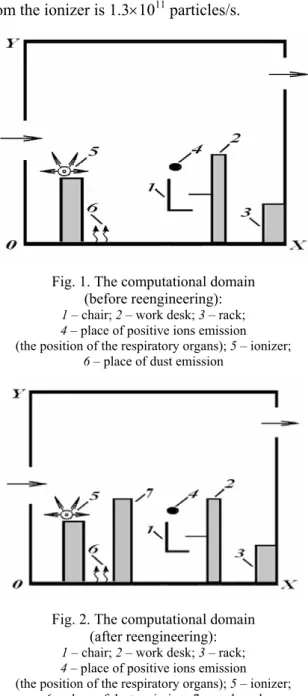
Sketch of the computational domain is shown in Fig. 1. It is the premises where the air flows en-ter through the ventilation system. The air exit from the room occurs through the outlet in the wall. The work area includes table and chair placed next. Placement of ionizer was shown in Fig. 1,
pos. 5. The intensity of the negative ions emission from the ionizer is 1.3×10¹¹ particles/s.
Fig. 1. The computational domain (before reengineering): 1 – chair; 2 – work desk; 3 – rack;
4 – place of positive ions emission (the position of the respiratory organs); 5 – ionizer;
6 – place of dust emission
Fig. 2. The computational domain (after reengineering): 1 – chair; 2 – work desk; 3 – rack;
4 – place of positive ions emission (the position of the respiratory organs); 5 – ionizer;
6 – place of dust emission; 7 – cupboard
The people are the source of positive ions emis-sion in the room. Therefore in the zone of their respiratory organs (Fig. 1, pos. 4) set point sources of positive ions emission intensity QB = 7×10
4
taken to equal µ = µ =x y kV (where k =0,1 – the parameter, V – the local velocity in the specific computational point and it is defined by solving the aerodynamic problem). Dust emission occurs in-door, QDi= 45×104 particles/s (dust emission posi-tion shown in Fig. 1 and Fig. 2 as a wavy line).
Sketch of the same premises where the rear-rangement of the furniture is made, was shown in Fig. 2.
Purpose of numerical modeling is definition of the negative ions concentration in the room and the area of the human respiratory system.
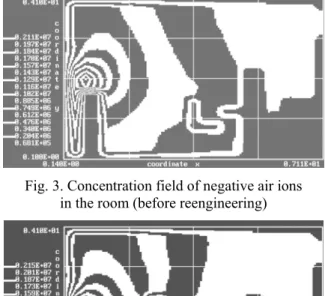
The results of numerical simulation in the fol-lowing figures are shown. On these figures the negative ions concentration field in the room was given.
Fig. 3. Concentration field of negative air ions in the room (before reengineering)
Fig. 4. Concentration field of negative air ions in the room (after reengineering)
As shown in Fig. 3 and Fig. 4, the negative ions concentration in the area of the employee respira-tory organs (the position over the chair) for the first variant is about 0.032×10¹² particles/m3, аnd after reengineering of the order 0.015×10¹²
parti-cles/m
3. That is, the concentration has decreased in 2 times, due to the influence of the installed equipment (Fig. 2, pos. 7) on the formation of air ions concentration field. For the solution of theproblem on the basis of the developed CFD model it took about 1 minute of computer time.
The second model. On the basis of the second model calculations were performed to evaluate negative ions concentration in the office premises with volume 62 m3. It should be noted that this «clean volume» of the premises without furniture and other objects. Indoor occurs emission of posi-tive ions in a quantity 22×103 particles/s. There is an air, which flows into the premises and contain dust in a quantity 6×10³ particles/m3; positive ions in a quantity 104 particles/m3, and negative ions in a quantity 2×10³ particles/m3. Ionizer works indoor. The computation is performed for the in-tensity of the negative ions emission from the ion-izer in a quantity 9×10⁷ particles/s (the first variant of emission) and 12×107 particles/s (the second variant of emission). As a result of calculation negative ions concentration was 0.029×10¹² parti-cles/m3 for the first variant of emission and 0.040×10¹² particles/m3 for the second variant of emission. Time of computation is about one sec-ond.
Originality and practical value
The complex of numerical models for computa-tion the air ions concentracomputa-tion in the premises was developed. 2D CFD model, which is based on the use of aerodynamics, electrostatics and mass trans-port equations, allows taking into account the basic physical factors determining the formation of air ions concentration fields in the premises and work areas. CFD model allows calculating air ions con-centration field in premises and working areas at artificial air ionization with taking into account the installed equipment, and given the location of ion-izers.
Developed balance model allows calculating quickly the air ions concentration in the premises at artificial air ionization. Also, this model allows take into account the impulse regime of ionizer operation.
Conclusions
de-veloped CFD model took about a minute of com-puter time. The numerical balance model allows calculating quickly the air ions concentration in the premises. Calculation using the balance model takes about one second of computer time.
LIST OF REFERENCES LINKS
1. Беляев, Н. Н. Защита зданий от проникно
-вения в них опасных веществ : монография /
Н. Н. Беляев, Е. Ю. Гунько, Н. В. Расточило. –
Днепропетровск : АкцентПП, 2014. – 136 с. 2. Беляев, Н. Н. Комплекс численных моделей
для расчета концентрации аэроионов в поме
-щениях / Н. Н. Беляев, С. Г. Цыганкова // Нау
-катапрогрестранспорту. – 2016. – № 1 (61). –
С. 30–38. doi:10.15802/stp2016/60947.
3. Беляев, Н. Н. Оценка аэроионного режи-
ма в рабочих зонах на базе CFD-модели /
Н. Н. Беляев, С. Г. Цыганкова // Зб. наук. пр.
НГУ. – Дніпропетровськ, 2015. – № 46. –
С. 168–173.
4. Беляев, Н. Н. Расчет аэроионного режима
впомещениииврабочейзоненабазечислен
-ноймодели / Н. Н. Беляев, С. Г. Цыганкова //
Зб. наук. пр. НГУ. – Дніпропетровськ, 2015. –
№ 47. – С. 137–143.
5. Визначення та прогнозування динаміки зміни аероіонного складу повітря виробничих
приміщень / В. А. Глива, В. І. Клапченко,
С. М. Пономаренко [та ін.] // Вісн. нац. техн.
ун–туУкраїни «Київський політехн. ін-т». Се
-рія: «Гірництво». – Київ, 2010. – Вип. 19. –
С. 161–168.
6. Деякі аспекти забезпечення нормативного аероіонного режиму робочого середовища приміщень спеціального призначення МНС України / І. О. Толкунов, В. В. Маринюк,
І. І. Попов, В. В. Пономар // Проблеминадзви
-чайнихситуацій : зб. наук. пр. / Нац. ун-тцив.
захисту України. – Харків, 2008. – № 8. –
С. 198–206.
7. Запорожець, О. І. Нормування аероіонного складу повітряробочих приміщень та основні напрями його вдосконалення / О. І. Запоро
-жець, В. А. Глива, О. В. Сидоров // Вісн. нац.
авіац. ун–ту. – 2011. – № 1. – С. 139–143. 8. Запорожець, О. І. Принципи моделювання
динаміки аероіонного складу повітря у при
-міщеннях / О. І. Запорожець, В. А. Глива,
О. В. Сидоров // Вісн. нац. авіац. ун–ту. – 2011. – № 2. – С. 120–124.
9. Левченко, Л. О. Тривимірне моделювання
просторових розподілів концентрацій аеро
-іонів у повітрі приміщень / Л. О. Левченко,
В. А. Глива, О. В. Сидоров // Управління роз
-витком складних систем : зб. наук. пр. / Київ.
нац. ун-тбуд-ваі архіт. – Київ, 2012. – № 1. –
С. 198–206.
10. Моделирование распределения концентрации ионов вблизи ионизатора / В. Е. Бахрушин,
М. А. Игнахина, Д. В. Вертинский, А. Ю. Ев
-сюков // Складнісистемитапроцеси. – 2002. –
№ 1. – С. 30–36.
11. Толкунов, І. О. Біполярнаіонізаціяповітряного середовища приміщень функціональних під
-розділів мобільногогоспіталюМНС / І. О. То
-лкунов // Проблеми надзвичайних ситуацій :
зб. наук. пр. / Нац. ун-тцив. захистуУкраїни. –
Харків, 2014. – Вип. 14. – С. 161–170.
12. Толкунов, І. О. Моделюванняпроцесівформу
-вання полів концентрації аероіонів у повіт
-ряному середовищі приміщень спеціального призначення МНС України / І. О. Толкунов,
І. І. Попов // Проблеминадзвичайнихситуацій
: зб. наук. пр. / Нац. ун-тцив. захистуУкраїни. – Харків, 2010. – Вип. 12. – С. 175–184.
13. Толкунов, И. А. Теоретическое исследование процессов переноса аэроионов в потоках воз
-духа в помещениях специального назначения МЧС Украины / И. А. Толкунов, И. И. По-
пов, В. В. Барбашин // Проблеминадзвичайних ситуацій : зб. наук. пр. / Нац. ун-т цив. за-
хисту України. – Харків, 2010. – Вип. 11. –
С. 137–145.
14. Aerosol removal by unipolar ionization in indoor environments / Y. S. Mayya, B. K. Sapra, A. Khan, F. Sunny // J. of Aerosol Science. – 2004. – Vol. 35. – P. 923–941. doi: 10.1016/j.jae-rosci.2004.03.001.
15. Air ion behavior in ventilated rooms / L. A. Flet-cher, C. J. Noakes, P. A. Sleigh [et al.] // Indoor and Built Environment. – 2008. – Vol. 17, № 2. – P. 173–182. doi: 10.1177/1420326x08089622. 16. Drexler, Р. Numerical modeling of accuracy of air
ion field measurement / P. Drexler, P. Fiala, K. Bartusek // J. of Electrical Engineering. – 2006. – Vol. 57, № 8/S – P. 62–65.
17. Murakami, S. Computational wind engineering / S. Murakami // J. of Wind Engineering and Indus-trial Aerodynamics. – 1990. – Vol. 36, pt. 1. – P. 517–538. doi:10.1016/0167-6105(90)90335-A. 18. Noakes, C. J. Modelling the air cleaning
mvent_07.pdf. – Title from the screen. – Accessed : 17.09.2015.
19. The impact of the air distribution method in venti-lated rooms on the aerosol particle dispersion and
removal: The experimental approach / A. Jureli-onis, L. Gagytė, T. Prasauskas [et al.] // Energy and Buildings. – 2015. – Vol. 86. – P. 305–313. doi: 10.1016/j.enbuild.2014.10.014.
М
.
М
.
Б
I
ЛЯЄВ
1*,
С
.
Г
.
ЦИГАНКОВА
2*1*Каф. «Гідравлікатаводопостачання», Дніпропетровськийнаціональнийуніверситетзалізничноготранспорту іменіакадемікаВ. Лазаряна, вул. Лазаряна, 2, Дніпропетровськ, Україна, 49010, тел. +38 (056) 373 15 09, ел. пошта [email protected], ORCID 0000-0002-1531-7882
2*Каф. «Водопостачання, водовідведеннятагідравліки», Придніпровськадержавнаакадеміябудівництватаархітектури, вул. Чернишевського, 24-а, Дніпропетровськ, Україна, 49600, тел. +38 (050) 697 92 18, ел. пошта [email protected], ORCID 0000-0002-9837-3109
КОМПЛЕКС
ЧИСЕЛЬНИХ
МОДЕЛЕЙ
ДЛЯ
РОЗРАХУНКУ
КОНЦЕНТРАЦІЇ
АЕРОІОНІВ
У
ПРИМІЩЕННЯХ
Мета.Встаттіповинно бутирозглянутоствореннякомплексучисельнихмоделейдлярозрахункукон
-центраційних полів аероіонів у приміщеннях різного призначення та в робочих зонах. Розроблений ком
-плексповиненвраховуватиосновніфізичніфактори, щовпливаютьнапроцесформуванняконцентраційно
-гополяаероіонів. Тобто: аеродинамікуповітряних струменів уприміщенні, наявністьмеблів, обладнання,
розміщення вентиляційних отворів, режиму вентиляції, розташування джерел іонізації, перенесення іонів піддією електричногополя, інші фактори, що визначаютьінтенсивністьта формуконцентраційногополя аероіонів. Крім того, комплекс чисельних моделей повинен забезпечити проведення експрес-розрахунку концентраціїаероіонівуприміщенні, якийдозволявбишвидкийперебірможливихваріантівтаможливість
«укрупненої» оцінкиконцентраціїаероіонівуприміщенні. Методика. Розробленокомплексчисельнихмо
-делейдлярозрахункуаероіонногорежимувприміщеннях. Чисельна CFD-модельзасновананазастосуванні рівняньаеродинаміки, електростатики і масопереносу та дозволяє враховувати впливпотоків повітря, ви
-кликанихроботоювентиляції, дифузії, впливелектричногополя, атакож взаємодіюіоніврізноїполярності один із одним та з частинками пилу. Запропонована балансова модель розрахунку аероіонного режиму
в приміщеннях дозволяє оперативно розраховувати концентраційне поле аероіонів із урахуванням імпульсного режиму роботи іонізаторів. Результати. Отриманорозрахункові дані, на основі яких можна оцінити концентраціюаероіонів убудь-якому місці приміщення зі штучноюіонізацією повітря. Наведено приклад розрахунку концентрації негативних іонів на базі чисельної CFD-моделі в приміщенні
з реінжиніринговими перетвореннями. На базі розробленої балансової моделі розрахована концентрація аероіоніввоб’єміприміщення. Науковановизна. Представленірезультатирозрахункуаероіонногорежиму вприміщеннінабазі чисельної 2D CFD-моделі та балансовоїмоделі. Практична значимість.Розроблені балансова та чисельні CFD-моделі для розрахунку аероіонного режиму дозволяють розраховувати концентраціюаероіонівуприміщенняхвумовахштучноїіонізаціїповітрязурахуваннямосновнихфізичних факторів, щовизначаютьформуванняконцентраційнихполіваероіонів.
Ключовіслова:аероіоннийрежим; концентраційнеполеаероіонів; штучнаіонізація; CFD-модель; балан
-совамодель
Н
.
Н
.
БЕЛЯЕВ
1*,
С
.
Г
.
ЦЫГАНКОВА
2*1*Каф. «Гидравликаиводоснабжение», Днепропетровскийнациональныйуниверситетжелезнодорожного
транспортаимениакадемикаВ. Лазаряна, ул. Лазаряна, 2, Днепропетровск, Украина, 49010, тел. +38 (056) 373 15 09, эл. почта [email protected], ORCID 0000-0002-1531-7882
2*Каф. «Водоснабжение, водоотведениеигидравлика», Приднепровскаягосударственнаяакадемиястроительства иархитектуры, ул. Чернышевского, 24-а, Днепропетровск, Украина, 49600, тел. +38 (050) 697 92 18,
КОМПЛЕКС
ЧИСЛЕННЫХ
МОДЕЛЕЙ
ДЛЯ
РАСЧЕТА
КОНЦЕНТРАЦИИ
АЭРОИОНОВ
В
ПОМЕЩЕНИЯХ
Цель. В статье должен быть рассмотрен вопрос создания комплекса численных моделей для расчета концентрационныхполейаэроионов в помещенияхразличного назначения иврабочих зонах. Разработан
-ныйкомплекс долженучитыватьосновныефизическиефакторы, влияющиенапроцессформированиякон
-центрационного поляаэроионов. Тоесть: аэродинамику воздушныхструй в помещении, наличие мебели,
оборудования, размещения вентиляционных отверстий, режима вентиляции, местоположения источников ионизации, переносаионовподдействиемэлектрическогополя, другихфакторов, определяющихинтенсив
-ностьиформуконцентрационногополяаэроионов. Крометого, комплексчисленныхмоделейдолженобес
-печитьпроведениеэкспресс-расчета концентрации аэроионовв помещении, позволяющего быстрыйпере
-борвозможных вариантов и дающего возможность «укрупненной» оценкиконцентрации аэроионов в по
-мещении. Методика.Разработанкомплексчисленныхмоделейдлярасчетааэроионногорежимавпомеще
-ниях. Численная CFD-модель основана на применении уравнений аэродинамики, электростатики,
массопереносаипозволяетучитыватьвлияниепотоковвоздуха, вызванныхработойвентиляции, диффузии,
воздействия электрического поля, а также взаимодействие ионов различной полярности друг с другом
и с частицами пыли. Предложенная балансовая модель расчета аэроионного режима в помещениях позволяет оперативно рассчитывать концентрационное поле аэроионов с учетом импульсного режима работы ионизаторов. Результаты. Получены расчетные данные, на основании которых можно оценить концентрациюаэроионоввлюбомместепомещениясискусственнойионизациейвоздуха. Приведенпример
расчета концентрации отрицательных ионов на базе численной CFD-модели в помещении
с реинжиниринговыми преобразованиями. На базе разработанной балансовой модели рассчитана концентрация аэроионов в объеме помещения. Научная новизна. Представлены результаты
расчета аэроионного режима в помещении на базе численной 2D CFD-модели и балансовой модели. Практическаязначимость.Разработанныебалансовая ичисленные CFD-моделидлярасчетааэроионного режима позволяют рассчитывать концентрацию аэроионов в помещениях в условиях искусственной
ионизации воздуха с учетом основных физических факторов, определяющих формирование
концентрационныхполейаэроионов.
Ключевые слова: аэроионный режим; концентрационное поле аероионов; искусственная ионизация;
CFD-модель; балансоваямодель
REFERENCES
1. Belyayev N.N., Gunko Ye.Yu., Rastochilo N.V. Zashchita zdaniy ot proniknoveniya v nikh opasnykh veshchestv [Protection of building from penetration of hazardous substances]. Dnipropetrovsk, Aktsent PP Publ., 2014. 136 p.
2. Belyayev N.N., Tsygankova S.G. Kompleks chislennykh modeley dlya rascheta kontsentratsii aeroionov v pomeshcheniyakh [Complex of numerical models for computation of air ion concentration in premises].
Nauka ta prohres transportu – Science and Transport Progress, 2016, no. 1 (61), pp. 30-38. doi:10.15802/stp2016/60947.
3. Belyayev N.N., Tsygankova S.G. Otsenka aeroionnogo rezhima v rabochikh zonakh na baze CFD modeli [Evaluation of air ion regime in work areas on the basis of CFD models]. Zbirnyk naukovykh prats Natsional-noho hirnychoho universytetu – Bulletin of the National Mining University, 2015, no. 46, pp. 168-173.
4. Belyayev N.N., Tsygankova S.G. Raschet aeroionnogo rezhima v pomeshchenii i v rabochey zone na baze chislennoy modeli [Calculation of air ion regime in the premises and work area on the basis of a numerical model]. Zbirnyk naukovykh prats Natsionalnoho hirnychoho universytetu – Bulletin of the National Mining University, 2015, no. 47, pp. 137-143.
5. Hlyva V.A., Klapchenko V.I., Ponomarenko S.M. et al. Vyznachennia ta prohnozuvannia dynamiky zminy aeroionnoho skladu povitria vyrobnychykh prymishchen [Determination and prediction of the ionic air compo-sition change dynamics in industrial premises]. Visnyk natsionalnoho tekhnichnoho universytetu Ukrainy «Kyivskyi politekhnichnyi instytut». Seriia «Hirnytstvo» [Bulletin of Ukrainian National Technical University «Kyiv Polytechnic Institute»], 2010, issue 19, pp. 161-168.
Ukrainian Ministry of Emergencies]. Problemy nadzvychainykh sytuatsii [Problems of Emergencies], 2008, is-sue 8, pp. 198-206.
7. Zaporozhets O.I., Hlyva V.A. Sydorov, O.V. Normuvannia aeroionnoho skladu povitria robochykh prymishchen ta osnovni napriamy yoho vdoskonalennia [The standardization of the ionic air composition in work premises and main directions of its improvement]. Visnyk natsionalnoho aviatsiinoho universytetu – Bul-letin of National Aviation University, 2011, no. 1, pp. 139-143.
8. Zaporozhets O.I., Hlyva V.A. Sydorov, O.V. Pryntsypy modeliuvannia dynamiky aeroionnoho skladu povitria u prymishchenniakh [The principles of modeling the ionic air composition in premises]. Visnyk natsionalnoho aviatsiinoho universytetu – Bulletin of National Aviation University, 2011, no. 2, pp. 120-124.
9. Levchenko L.O., Hlyva V.A. Sydorov, O.V. Tryvymirne modeliuvannia prostorovykh rozpodiliv kontsentratsii aeroioniv u povitri prymishchen [Three-dimensional modeling of spatial distributions for air ions concentrations in the air]. Upravlinnia rozvytkom skladnykh system – Managing the Development of Complex Systems, 2012, no. 1, pp. 198-206.
10. Bakhrushin V.Ye., Ignakhina M.A., Vertinskiy D.V., Yevsyukov A.Yu. Modelirovaniye raspredeleniya kontsentratsii ionov vblizi ionizatora [Simulation of distributing concentration of ions nearly ionizator].
Skladnі sistemy ta protsesy – Complex Systems and Processes, 2002, no. 1, pp. 30-36.
11. Tolkunov I.A. Bipoliarna ionizatsiia povitrianoho seredovyshcha prymishchen funktsionalnykh pidrozdiliv mobilnoho hospitaliu MNS [Bipolar ionization of air environment of functional units premises of the mobile hospital of the Ministry of Emergencies]. Problemy nadzvychainykh sytuatsii [Problems of Emergencies], 2014, issue 14, pp. 161-170.
12. Tolkunov I.O., Popov I.I. Modeliuvannia protsesiv formuvannia poliv kontsentratsii aeroioniv u povitrianomu seredovyshchi prymishchen spetsialnoho pryznachennia MNS Ukrainy [Simulation of the ions concentration fields formation in the air space of the special purpose premises of the Ukrainian Ministry of Emergencies].
Problemy nadzvychainykh sytuatsii [Problems of Emergencies], 2010, issue 12, pp. 175-184.
13. Tolkunov I.A., Popov I.I., Barbashin V.V. Teoreticheskoye issledovaniye protsessov perenosa aeroionov v potokakh vozdukha v pomeshcheniyakh spetsialnogo naznacheniya MChS Ukrainy [Theoretical study of the ions transport processes in the air flows in the special purpose premises of the Ukrainian Ministry of Emergen-cies]. Problemy nadzvychainykh sytuatsii [Problems of Emergencies], 2010, issue 11, pp. 137-145.
14. Mayya Y.S., Sapra B.K., Khan A., Sunny F. Aerosol removal by unipolar ionization in indoor environments.
Journal of Aerosol Science, 2004, vol. 35, pp. 923-941. doi: 10.1016/j.jaerosci.2004.03.001.
15. Fletcher L.A., Noakes C.J., Sleigh P.A. Air ion behavior in ventilated rooms. Indoor and Built Environment, 2008, vol. 17, no. 2, pp. 173-182. doi: 10.1177/1420326x08089622.
16. Drexler Р., Fiala P., Bartusek K. Numerical modeling of accuracy of air ion field measurement. Journal of Electrical Engineering, 2006, vol. 57, no. 8/S, pp. 62-65.
17. Murakami S. Computational wind engineering. Journal of Wind Engineering and Industrial Aerodynamics, 1990, vol. 36, part 1, pp. 517-538. doi:10.1016/0167-6105(90)90335-A.
18. Noakes C.J., Sleigt P.A, Beggs C. Modelling the air cleaning performance of negative air ionisers in ventilated room. Proc. of the 10th Intern. Conf. on Air Distribution in Rooms. Roomvert, 2007. Available at: http://eprints.whiterose.ac.uk/7700/1/Noakes_roomvent_07.pdf (Accessed 17 September 2015).
19. Jurelionis A., Gagytė L., Prasauskas T., Čiužas D., Krugly E., Šeduikytė L., Martuzevičius D. The impact of the air distribution method in ventilated rooms on the aerosol particle dispersion and removal: The experimen-tal approach. Energy and Buildings, 2015, vol. 86, pp. 305-313. doi: 10.1016/j.enbuild.2014.10.014.
Prof. V. M. Derevyanko, D. Sc. (Tech); Prof. V. B. Petrenko, D. Sc. (Tech) recommended this article to be published