Vassalos, Dracos and Boulougouris, Evangelos and Paterson, Donald
(2016) An alternative system for damage stability enhancement. In: 15th
International Ship Stability Workshop, 2016-06-13 - 2016-06-15,
Stockholm, Sweden. ,
This version is available at http://strathprints.strath.ac.uk/58447/
Strathprints is designed to allow users to access the research output of the University of Strathclyde. Unless otherwise explicitly stated on the manuscript, Copyright © and Moral Rights for the papers on this site are retained by the individual authors and/or other copyright owners. Please check the manuscript for details of any other licences that may have been applied. You may not engage in further distribution of the material for any profitmaking activities or any commercial gain. You may freely distribute both the url (http://strathprints.strath.ac.uk/) and the content of this paper for research or private study, educational, or not-for-profit purposes without prior permission or charge.
Any correspondence concerning this service should be sent to Strathprints administrator:
An alternative system for damage stability enhancement
Dracos Vassalos, University of Strathclyde, [email protected]Evangelos Boulougouris, University of Strathclyde, [email protected]
Donald Paterson, University of Strathclyde, [email protected]
ABSTRACT
There is an ongoing and continuous initiative to improve the survivability of passenger vessels and in the past increasing safety standards have generally been catered for through the use of design(passive) measures. However, this approach is becoming saturated and any such measures to improve damage stability severly erode ship earning potential and are being resisted by industry. In a change of direction, this paper aims to explore the use of operational(active) measures for damage stability enhancement in line with IMO Circular 1455 on equivalents. An alternative system for damage stability enhancement is intorduced that involves injecting highly expandable foam in the compartment(s) undergoing flooding during the initial post-accident flooding phase thus enhancing damage stability and survivability of RoPax vessels well beyond the design levels in the most cost-effective way currently available. This is a mind-set changing innovation that is likely to revolutionise design and operation of most ship types and RoPax, in particular. A case study has been performed on a large RoPax vessel with impressive results that will challenge the current established practice and open possibilities for novel and innovative design configurations.
Keywords: Damage Stability, Passenger Ship Safety, Risk Reduction
1.
INTRODUCTIONEvery time there is an accident with RoRo passenger ships, exposing their vulnerability to flooding, societal outcry follows and industry and
academia “buckle up”, delving for design
improvements to address the Achilles heel of this ship type, namely damage stability. However, any such improvements are targeting mainly newbuildings, which comprise a small minority of the existing fleet. Therefore, state-of-the-art knowledge on damage stability is all but wasted, scratching only the surface of the problem and leaving a high amount of ships with severe vulnerability, that is likely to lead to further (unacceptably high) loss of life
.
This problem is exacerbated still further, today more rapidly, as the pace of scientific and technological developments is unrelenting, raising understanding and capability to address damage stability improvements of newbuildings cost-effectively, in ways not previously considered. As a result, SOLAS is becoming progressively less relevant and unable to keep up with this pace of development. This has led to gaps and pitfalls, which not only undermine safety but inhibit progress.However, lack of retrospectively applied legislation (supported by what is commonly known as the Grandfather Clause) is not the only reason for damage stability problems with ships. Tradition should share the blame here. In the quest for damage stability improvement, design (passive) measures have traditionally been the only means to achieve it in a measurable/auditable way (SOLAS 2009, Ch. II-1). However, in principle, the consequences from inadequate damage stability can also be reduced by operational (active) measures, which may be very effective in minimising loss of life (the residual risk). There are two reasons for this. The first relates to the traditional understanding that operational measures safeguard against erosion of the design safety envelop (possible increase of residual risk over time). The second derives from lack of measurement and verification of the risk reduction potential of any active measures. In simple terms, what is needed is the means to account for risk reduction by operational means as well as measures that may be taken during emergencies. Such risk reduction may then be considered alongside risk reduction deriving from design measures. IMO Circular 1455 on Alternatives and Equivalents offers the means for this.
damage stability enhancement that involves injecting highly expandable foam in the compartment(s) undergoing flooding during the initial post-accident flooding phase thus enhancing damage stability and survivability of RoPax vessels well beyond the design levels in the most cost-effective way currently available.
2.
DAMAGE STABILITY RECOVERY SYSTEM (DSRS)Whilst the safety of RoPax is improving, the survivability in case of a serious incident such as hull breach due to collision or grounding, resulting in water ingress, is still relatively low, particularly with most of the existing ships.
Deriving from the foregoing, the following arguments may be put forward:
• Design (passive) measures are saturated. Hence, any such measures to improve damage stability severely erode the ship earning potential and are being resisted by industry.
• Traditionally, the industry is averse to operational (active) measures and it takes perseverance and nurturing to change this norm.
• Up until recently, there was no legislative instrument to assign credit for safety improvement by active means. Only recently IMO Circular 1455 opened the door to such innovation.
• Key industry stakeholders are keen to explore this route.
Inspired by these considerations and with support from Scottish Enterprise, the University of Strathclyde is involved with R&D of a system, patent pending, that can be fitted to new or retrofitted to existing RoPax in order to reduce the likelihood of capsize/sinking and further water ingress following a major incident / accident.
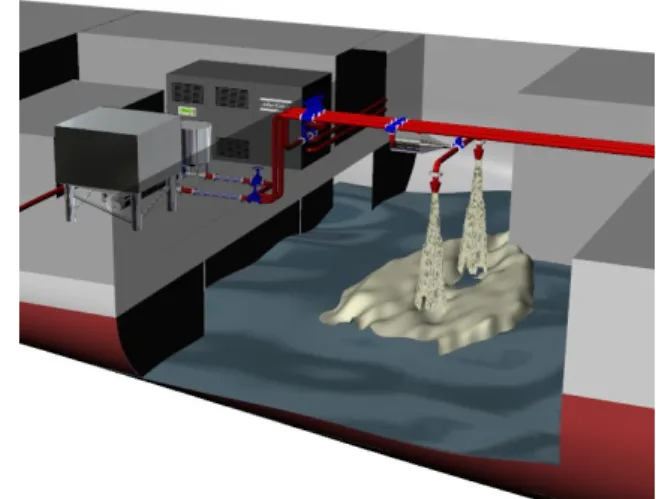
The working principle of the proposed system is simple: when a vessel is subjected to a critical damage, stability is recovered through the reduction of floodable volume within the vessel’s high risk compartment(s). This is achieved by rapidly distributing fast setting, high expansion foam to the protected compartment(s), regaining lost buoyancy whilst also eliminating free surface effects and
openings. Moreover, with water being constrained low in the ship, it actually increases damage stability (Lower KG).
The system itself consists of a fixed supply of both foam resin and hardener agents; each stored within an individual tank and connected to a piping network for distribution. The operation of the system starts when two distribution pumps supply a flow of filtered sea water into individual resin and hardener lines. Both streams are then dosed with concentrated resin and hardener agents, before they each pass through a static mixer in order to produce a homogeneous solution of each component.
Figure 1 - System Representation
The two lines are then fed to the protected compartment where they meet and enter a foam generator. Here both streams mix and compressed air is introduced into the system for the in situ production of foam. The foam is then passed in to a branched piping network within the vulnerable compartment where both port and starboard side branches allow the foam distribution to be directed depending on the damage side.
The whole process is monitored and controlled by a central system linked to vital components and sensors. The use of the system is under the full control of the crew, with a decision support system
available to help the ship’s master decide where
and when the system will act as well as inform all concerned of the ensuing actions.
The foam compound meets all the environmental and health criteria, it is not harmful to humans and its release does not pose any danger to the people onboard or the environment. Furthermore the foam is non-flammable and in this respect could reduce risk by other event sequences such as a fire ignited in collision. The residual clean-up post system discharge is also aided by a foam dissolving agent ensuring minimal business interruption.
3.
METHODOLOGYFor the purposes of this study a large ROPAX vessel, currently operating in European waters, has been investigated with a view to assess the effectiveness of the proposed Damaged Stability Recovery System (DSRS) as a risk reduction technology. A case study has been conducted on the vessel using the probabilistic approach to damage stability (SOLAS 2009) as a means of establishing the initial level of risk associated with the design. The effects of the DSRS have then been modelled and the vessel re-examined in order to assess the risk reduction afforded by the system.
DSRS Implementation & Modelling
In order to ascertain the impact of the proposed system on vessel safety, the overall risk level associated with the vessel had to first be identified. As the attained index A represents the safety level of the vessel, the overall risk, with regards to collision damage, could be calculated according to the simple formula below.
(1)
This provided a benchmark from which to gauge any improvement on the vessel’s safety afforded by the DSRS.
In order to ensure the system was applied in the most efficient manner it was reasoned that the compartment(s) protected by the system should be those which constituted the greatest risk. As such, a risk profile of the vessel was created in order to aid in the identification of design vulnerabilities. This then provided the foundation from which a risk influenced decision could be made with regards to the compartment(s) that should be protected by the system while also highlighting the circumstances under which this protection is necessary.
The results from the probabilistic damage stability assessment afforded a straightforward way of determining the vessel’s risk profile by firstly considering the local risk associate with each damage scenario, as calculated by (Eq. 2).
(2)
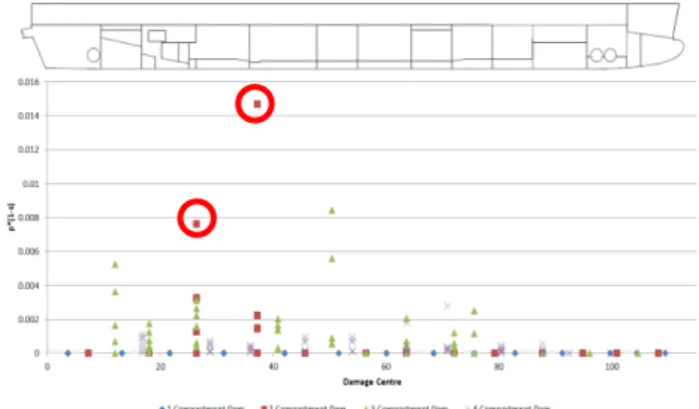
These local risk values could then be mapped across the vessel according to damage centre in order to form the example risk profile as shown in figure 3.
Figure 3: Example Risk Profile
In the above risk profile, risk is plotted on the vertical axis and the damage position along the horizontal. Differing lengths of damage, as measured by multiples of adjacent zones, are distinguished by marker type and colour. This enables the identification of both safety critical design spots and opportunities where safety could be improved most significantly and efficiently. Two cases in particular, circled in Fig. 3, are identified as large risk contributors. As such, it can be reasoned that the DSRS would be best applied in the protection of one if not both of the compartments which give rise to this risk.
the system could be applied in the most efficient and effective manner.
The analysis for the case study was conducted through modelling the vessel from the original GA and lines plans. Relevant stability documentation was used in order to ensure all unprotected and weather tight openings were taken into account. Loading condition information within the vessel’s stability booklet was used in conjunction with the damage stability GM limiting curves in order to select the SOLAS 2009 initial loading conditions.
The effects of the DSRS system were modeled through alterations to the permeability of the protected compartment(s) to account for the effect of the foam. The required volume of foam was taken as the minimum volume required to save the most demanding high risk damage scenario.
The scope of the investigation saw a one and two compartment approach to system application whereby the impact of the system was assessed when protecting the highest risk compartment and also the two highest risk compartments.
4.
CASE STUDY: LARGE ROPAXOverview
The vessel is a large ROPAX with a central cased ro-ro deck suitable for drive through operations. Further capacity is offered by a large lower hold spanning from compartments nine to fifteen. The vessel is also equipped with a hoistable car deck suitable for additional car storage. Accommodation for passengers is located within
the vessel’s superstructure with cabins available for
overnight journeys along with a range of public spaces including a shopping center, cinema, restaurants and bars.
The vessel was built in 1998 to a two-compartment subdivision standard according to
SOLAS 90’ along with Stockholm agreement
compliance with a significant wave height of 2.9m. Below the bulkhead deck the vessel is divided into a total of twenty water tight compartments and has pronounced B/5 subdivision spanning almost the entire length of the vessel and cross flooding ducts fitted to enable symmetrical flooding.
The vessel’s principal particulars and general
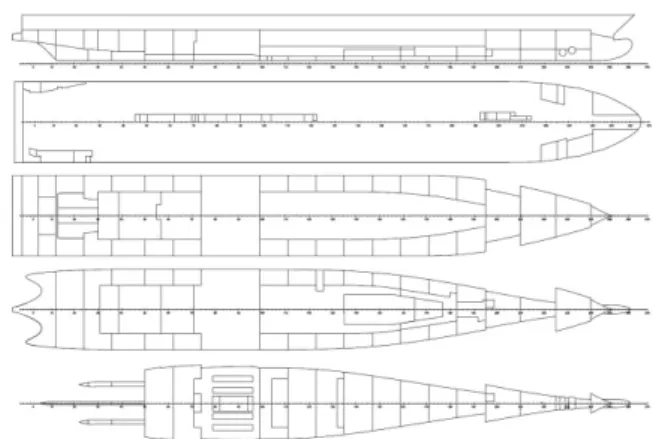
arrangement are provided in table 1 and figure 4.
Table 1: Principal Particulars
Figure 4: General Arrangement
Stability Assessment
In order to assess the damage stability performance of the vessel a total of 942 damage cases have been analysed under three loading conditions as outlined in table 2.
Table 2: Loading Conditions
Displacement (t) Draft(m) GM(m)
LC1 (dl) 19468 6.8 2.226
LC2 (dp) 17412 6.4 2.003
LC3 (ds) 15087 5.733 3.191
The results of the SOLAS 2009 damage stability assessment along with the required index value calculated for this vessel can be found in table 3 below. The risk profile derived for the vessel is also provided in figure 5.
Principle Particulars
Length o.a (m) 200.65
Length b.p (m) 185.4
Breadth (m) 25.8
Draught MLD. (m) 6.8
Displacement (t) 19468
Deadweight (t) 5830
Crew Number 200 persons
Table 3: SOLAS 2009 Results
As 0.79
Ap 0.80
Al 0.96
Attained index A 0.83 Required index R 0.795
Figure 5: Risk Profile
It is noted that the required subdivision index is fulfilled with a reasonable margin in this case. However, observation of the vessels risk profile reveals several vulnerabilities existing within the
vessel’s design. This risk is founded primarily by damages that penetrate beyond the B/5 longitudinal bulkhead of the lower hold. Damages involving this space were not covered by the regulations in place at the time although they do however present a
significant threat to the vessel’s safety.
Damage to the lower hold gives rise to large scale flooding leading to a significant reduction in
the vessel’s residual stability. Having been
identified as the largest risk contributor this space was selected for application of the system.
The volume of foam required in this case was defined as that required to mitigate the risk stemming from two compartment damages involving the lower hold, equating 2000m3 expanded volume. The damage stability performance was then re-assessed following a permeability change to the lower hold to account for the effects of the foam.
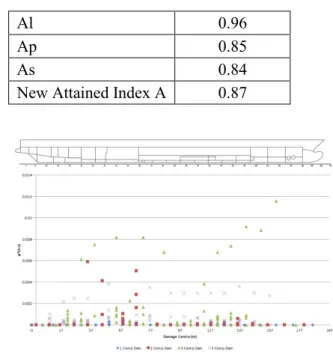
The new attained index values calculated in this case can be found in table 4 along with the updated risk profile of the vessel highlighted in figure 6.
Table 4: Re-calculated Index Values
Al 0.96
Ap 0.85
As 0.84
New Attained Index A 0.87
Figure 6: Updated Risk Profile
It is clear from the newly calculated results that the effects of the system have resulted in a substantial reduction of risk. This is evident in the eradication of the risk contribution made by one and two compartment damages involving the
vessel’s lower hold. The risk stemming from three
compartment damages to this space has also been mitigated, particularly in those damages located closer to amidships. Unfortunately there still exists a series of high risk three compartment damages towards the fore of the lower hold and mitigation of these risks would call for a larger volume of foam to be utilised. In total the system has resulted in a 157% risk reduction for a one compartment application.
Selection of the second compartment for system protection involved re-evaluation of the vessel’s
risk profile. Through doing so, the vessel’s main
engine room was identified as the largest of the remaining risk contributors. This particular space has a large volume coupled with a high permeability value leading to large scale flooding when damaged and serious diminishment of the
vessel’s residual stability.
As the one compartment system application required an already large volume of foam the decision was made to use a constant volume of available foam in the investigation of two compartment protection. As such, the volume of foam was shared between the two protected
simultaneously damaged. When either of the protected compartments was damaged independently the entire volume of foam was assumed to be used for the damaged compartment in question.
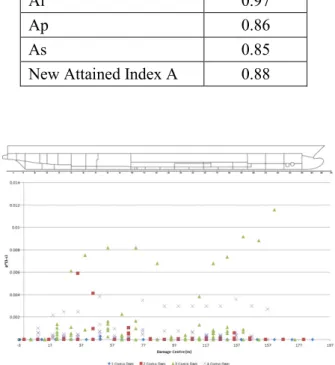
The damage stability results following this process are provided in table 5 and the vessel’s updated risk profile is provided in figure 7.
Table 5: Re-calculated Index Values
Al 0.97
Ap 0.86
As 0.85
New Attained Index A 0.88
Figure 7 : Updated Risk Profile
The results in this case show that the protection of two compartments has worked to mitigate the risk stemming from damages to the main engine room but failed to eradicate these risks. In total, there has been a relative 14% additional risk reduction afforded by this further protection. In order to generate a more meaningful reduction in risk, either a larger volume of foam would be required or the range of compartments served by the system would have to be increased. The system was however able to produce an overall risk reduction of 171%.
By combining expertise in ship damage stability and specialist knowledge in expanding foams, a non-intrusive cost effective solution to the damage stability problem of ROPAX vessels has been identified that does not interfere with the existing characteristics of the vessel, its functionality or business model, enabling the vessel to remain competitive while being above all safer.