KLE
The IP-based
KVM Link Extender
Anytime Anywhere
User Guide
Revision 1.4
About this manual
This User Guide is the complete reference to the KLE, its functional features and usage. The
Complete User Guide could be found only on the KLE Support CD-ROM disc. KLE documentation List
Quick Installation Guide Print-out / KLE support CD-ROM disc
User Guide KLE Support CD-ROM disc
How to generate your own set of Certificates KLE Support CD-ROM disc
FCC Statement
This equipment has been tested and found to comply with the regulations for a Class B digital device, pursuant to Part 15 of the FCC Rules. These limits are designed to provide reasonable protection against harmful interference when the equipment is operated in a commercial environment. This equipment generates, uses, and can radiate radio frequency energy and, if not installed and used in accordance with this User Guide, may cause harmful interference to radio communications. Operation of this equipment in a residential area is likely to cause harmful interference in which case, the user will be required to correct the interference at his/her own expense.
CE Statement
This is a Class B product in a domestic environment, this product may cause radio interference, in which case the user may be required to take adequate measures.
t t
TABLE OF CONTENTS
1 INTRODUCTION ... 1
1.1 PRIMARY FEATURES... 3
General features... 3
TCP/IP remote connec ion... 3
Thin-clien Viewer Program... 3
Hi-Speed PPP Connection... 3
Power ON-OFF Control Support... 4
Security... 4
User Management... 4
1.2 SYSTEM ARCHITECTURE... 5
1.3 KLEEXTERNAL VIEWS... 8
KLE Front View... 8
KLE Rear View... 8
KLE Power Socket... 9
2 KLE INSTALLATION ... 10
2.1 PHYSICAL CONNECTIONS... 10
2.2 CONFIGURE YOUR SERVERS FOR CONNECTIONS TO KLE... 11
2.3 MORE TIPS FOR SERVER DESKTOP CONFIGURATION... 13
2.4 CONFIGURE KLENETWORK SETTINGS... 15
2.5 CONFIGURE PORT BASE SETTING FOR KLE... 16
2.6 CONFIGURE YOUR FIREWALL/ROUTER FOR ACCESSING KLE ACROSS INTERNET... 18
2.7 INSTALL CERTIFICATES ON KLE... 19
3 MAKING A VIEWER CONNECTION ... 24
3.1 INSTALL WIN32VIEWER ON THE CLIENT COMPUTER... 24
3.2 INSTALL JAVA VIEWER ON THE CLIENT COMPUTER... 24
3.3 IMPORT CERTIFICATES TO KLE VIEWER ON THE CLIENT COMPUTER... 25
Import client certificate to Win32 Viewer... 26
Import the certificates for the Java-based KLE Viewer... 26
3.4 SPECIFY THE VIEWER CONNECTION OPTION BEFORE MAKING A CONNECTION... 26
ENCODING... 27
LOCAL CURSOR SHAPE... 27
MISC... 27
DISPLAY... 27
3.5 ESTABLISH THE VIEWER CONNECTION... 27
3.6 MOUSE CURSORS SYNCHRONIZATION... 29
3.7 SAVE THE CONNECTION OPTIONS... 30
3.8 WIN32VIEWER CHARACTERISTICS... 30
3.9 TITLE BAR INFORMATION... 34
3.10 THE SELECT COMPUTER BOX... 34
3.11 VIEWER QUICK MENU... 36
3.12 JAVA VIEWER CHARACTERISTICS... 40
3.13 COMMON VIDEO DISPLAY PROBLEM TROUBLESHOOTING... 40
4 KLE UNIT MANAGEMENT OVER A SECURE HTTPS BROWSER CONNECTION... 43
4.1 WEB-BASED MANAGEMENT INTERFACE... 43
4.2 DOWNLOAD –DOWNLOAD PROGRAMS FOR VIEWERS... 45
4.4 DATE &TIME –DATE,TIME,GLOBAL TIME ZONE SUPPORT AND NTP SERVER SYNCHRONIZATION49
4.5 VIDEO SERVER –MISCELLANEOUS SETTINGS FOR VIDEO SERVERS... 51
4.6 POWER CONTROL –MISCELLANEOUS SETTINGS FOR VIDEO SERVERS... 53
4.7 COMPUTERS –MISCELLANEOUS SETTINGS FOR VIDEO SERVERS... 54
4.8 SERVER LOG –LOGGING SERVER EVENTS... 56
4.9 VIDEO MODES –KEEPING,MODIFYING AND AUGMENTING YOUR VIDEO MODE DATA BASE... 57
4.10 ALARMS – E-MAIL NOTIFICATIONS AND SNMPLOGGING SUPPORT... 59
4.11 KVMS –KEEPING AND ADDING YOUR KVMDATA BASE... 63
4.12 LANTCP/IP–PORT AND IP SETTINGS... 67
4.13 WANPPP–PPPSERVER AND CLIENT... 69
4.14 USER STATUS –SHOW THE CURRENTLY CONNECTED USERS... 73
4.15 USER MANAGEMENT –MANAGE USER ACCOUNTS,RADIUS ACCOUNTING AND REMOTE AUTHENTICATIONS... 74
4.16 SECURITY –CERTIFICATES INSTALLATION,VIEWER ENCRYPTION AND PASSWORD POLICIES... 80
4.17 MAINTENANCE –FLASH IMAGE VERSION INFORMATION,SOFTWARE UPGRADE,CONFIGURATION BACKUP AND UPLOAD... 84
4.18 LOGOUT –LOG OUT THE WEB MANAGEMENT... 88
1 INTRODUCTION
The name of KLE is derived from an acronymic combination from it full name, KVM Link Extender, which well explains the functionality of this powerful machine in itself. Though lightweight in size and compact in form factor, KLE is nevertheless a heavy-weight in its
functional versatility, rock-solid robustness and formidable security. It supports full 1024-bit PKI authentication, 256-bit SSL data encryption, LDAP, RADIUS as well Active Directory
authentication and RADIUS accounting.
Dominant yet cost-effective solution for remote server management scenarios
With the ubiquity of the DSL/Cable technology and the bandwidth availability therewith, the IP-based KVM technology has emerged as a dominant player in the new landscape of remote servers management. Today, the IP-based KVM Extender has been regarded as a better and more cost-effective solution to address the critical issue of remote servers management, which could only be partially tackled in the past by expensive yet redundant software solutions or Enterprise Management System. And KLE is a robust and versatile solution to address the needs
of modern remote server management scenarios.
Total server control from BIOS level up anytime anywhere
KLE gives users total control from preboot stage such as the BIOS-level CMOS setting up to the
GUI applications and daily maintenance routines such as power cycling (power control unit required). And all these could be nicely done on your admin desk using an ordinary web-browser management interface and a thin-client software viewer. All you need for accessing your
computer is to login the KLE and download the viewer program and get yourself connected to a whole bunch of servers in seconds. A truly anytime anywhere access for the server administrator!
Versatile backup connection featuring a PPP Server or PPP Client
To provide the necessary redundancy of a second backup system while your network might no longer works in critical situation, KLE also allows an easy and convenient PPP connection over the dial-in modem phone line. It could serve as a PPP server to accept a peer computer to make PPP connection request over either a direct cable connection or a dial-in modem phone line. On the other hand, KLE could also serve as a PPP client to dial-in to your ISP or enterprise PPP server to connect to internet, making a truly anytime access for remote client anywhere on the Internet. Thus, the PPP server/client features in KLE allow users a second backup system, which offers a direct cable/modem dial-in access to your connected servers via PSTN while your
KLE – the KVM Link Extender
Edge of critical Advantage over other remote server management solution
The advantages of using KLE, as compared to the conventional software remote control solution
is that: The hardware-based remote control solution such as KLE is able to access the server regardless of the server states while software remote control solution is non-functional while the server is still in the POST or preboot stage or in a “blue screen of death”. KLE also offers power on/off alternatives if used with a remote power control unit.
Rock-solid stability and ultra-security yet with flexibility and convenience to use
The KLE distinguishes itself among its peer products not only in its rock-solid stability in durable performance, but also in its industry-standard security features such as full 1024-bit PKI
Authentication and 256-bit SSL data encryption. Together with 3 levels of viewer connection security levels in combination with 3 types of password policies and three categories of user privileges, all these make KLE a ultra-powerful IP Extender machine with ultra-flexibility for a customized balance between data safety and user convenience. On the other hand, the
robustness and the ease of maintenance of the embedded systems involve zero costs for the unit management and maintenance.
Global Time Zone and Timer Servers Support
To make KLE really comfortable with all the global time zones it will be deployed in, it is vital to provide a convenient Global Time Zone support since it will give a correct time stamp to all logging events, alert e-mail notifications and won’t leave server administrators in troubles with calculating the time differences he will inevitably encounter with servers in different time zones. Additionally, KLE also supports NTP time servers and keep its time always sync with the timer servers you specify. The KLE is even sophisticated enough to take care of the daylight saving time in each and every Time Zone/Region, thus saving troubles for updating time frame with daylight saving specifics every six months.
Upgrade and Configuration Backup is just a breeze
KLE is fully Web-enabled to allow software upgrade and configuration upload/backup over the Web Management Interface. All you need to do is to upload the files to KLE over Web interface and voila it’s freshly restarted and begins working with those latest update functionalities and features-all within minutes and can be performed across oceans-by a remote SUPERADMIN!
Advantages Galore
With KLE, the server administrator can access enterprise server room or data center on his own seat without toils and troubles of going anywhere from across the street to oversea. And
organizations can enjoy a uniquely centralized and very cost-effective control over its dispersed servers in different branch offices, even around the world, thus saving money for outsourcing costs.
1.1
Primary features
General features▪ Full-featured IP-based Remote Control Solution for server management
▪ Provides remote control for several servers when connected to a conventional KVM Switch
▪ Simultaneous access from multiple users
▪ No user limitation
▪ Facilitate centralized control
▪ Total control over the remote server from BIOS level up to GUI applications
▪ Remote Power On/Off support
▪ Total transparency of control
▪ Ultra-security using full 1024-bit PKI Authentication / 256-bit SSL encryption
▪ Work with LDAP / RADIUS / Active Directory Servers
▪ Ethernet 10/100 and serial PPP connections
TCP/IP remote connection
▪ Web Management Interface for all settings and upgrade/backup features
▪ Support Telnet session and FTP service (disabled by default for more security)
Thin-client Viewer Program
▪ Win-32 viewer and Java viewer for cross-platform compatibility
▪ Connection options configurable for optimized performance
▪ Shared, Non-Shared and View Only sessions
▪ Easy download and installation
▪ Multiple viewer instances can be run on a same client computer
▪ Automatic video optimization
Hi-Speed PPP Connection
▪ PPP Connection support over serial RS-232 interface up to 1 Mbps
▪ PPP server enabling for PPP connection across a pair of modems for secure or backup direct access
Video server
▪ Support up to 1600 x 1200 @ 60 Hz resolution
▪ 8/16-bit color
▪ 3 Video Quality settings
▪ 4 Video Compression schemes
▪ 8-bit color reduction
▪ Configurable database to set up new or unknown VGA modes
▪ Virtually compatible to any KVM Switch through simple configuration
Power ON-OFF Control Support
▪ Remote power ON-OFF control over serial interface
▪ Serial commands configurable to fit all serial power control devices
▪ Power ON-OFF privilege only for the SUPERADMIN users
Security
▪ 1024-bit Public key Authentication using certificates generated by an external CA
▪ 256-bit SSL Encryption for keyboard, mouse and video signal transmissions
▪ Remote authentication support for LDAP or RADIUS servers
▪ RADIUS accounting support
▪ 3 SSL security levels :
o No authentication – No encryption o Server Authentication – SSL encryption
o Server & Client authentication – SSL encryption
▪ 3 password policies : o No Password
o One global password for all users o One different password for each user
▪ Linux operating system offers robust virus resistance
Alarms and Notifications
▪ Alert e-mail notification and SNMP trap messages for critical server events such as No Video, Blue Screen and NumLock Test Failure
User Management
▪ User login either by querying the local user database or by connection to remote LDAP or RADIUS server
▪ 3 user privileges :
o SUPERADMIN – to access complete set of management features and user features, including Power ON-OFF remote servers
o ADMIN – partial set of management and all user features o USER – only user features
Global Time Zone Support
▪ Time support for all continents and major cities
▪ Time synchronization by connection to any NTP time servers
1.2
System Architecture
The KLE is based on an embedded Linux platform for computing power and rugged stability. The KLE employs a High speed Processor to ensure excellent video quality and fast keyboard / mouse response across the Internet, even when bandwidth availability is limited.
LAN/WAN Configurations
KLE connected to a single server
Power Control Configuration
KLE connected to a Remote Power Control Device
PPP connections
KLE as PPP client to dial-out to ISP for remote clients to access via internet
‘
1.3
KLE
External Views
KLE
Front View
KLE Front-panel
PS/2 Keyboard port
This is where you connect the PS/2 keyboard for local console. PS/2 Mouse port
This is where you connect the PS/2 mouse for local console. Console Management Port (RJ-12)
This is where you connect the serial console cable for advanced console management of KLE
unit via a serial terminal emulation utility such as Windows HyperTerminal. Status LEDs
The 10/100Mbps LED is lit as solid orange when the current digital link is running on 100Mbps speed.
The Link/Act LED gives off solid green light when a network link is established and flashes whenever network transmission are perceived on the digital port.
The Power LED indicates the Power On status when it is lit as solid green.
The Video LED indicates the normal functioning of video server when it is blinking. Restore-to-Default Button
The Res ore o-Default but on is a tiny recessed button located to the right of the LED indicators, and can only be accessed by prying down with a pointed needle tip. t -t t
To depress the recessed button for over 4 seconds, and upon release, it will restore KLE to factory default – the default IP settings and user account settings that come with factory default settings.
KLE Rear Panel
PC/KVM port (HDB-15, integrated with PS/2 Keyboard and mouse signals)
The PC port connector is where you should connect to either a single PS/2 computer or a single PS/2 KVM Switch, using the 3-in-1 slim KVM cables w/ an integrated HDB15 connector. However, if you are using USB-enabled computer or USB KVM Switch, you should additionally use a USB cable to connect to a USB port on your computer for keyboard/mouse connection.
Monitor Port (HDB-15)
This is where you should plug in the Monitor for your local console on KLE. USB port (USB Type B)
This USB port provides USB keyboard/mouse connections to a USB-enabled PC, or to a USB KVM Switch. Thus, if you are connecting any USB-enabled PC or USB KVM Switch, please use a USB cable to make the connection.
Ethernet Port (RJ-45)
The Ethernet port, or digital port, offers anytime anywhere access of KLE and subsequently the conventional KVM Switch(es) and servers/computers connected behind it to the remote login clients lover LAN/Internet.
Serial Control Port (RJ-12)
The serial control port allows you to connect to either an external modem or a power control unit or to a cascaded chain of power control units. When added with an external modem to its serial control port, KLE could serve either as a PPP server to allow direct cable connection or dial-in connection from its peer computers, or as a PPP client to dial-in to the ISP or an enterprise PPP server. Furthermore, through serial commands sent over its serial control port, KLE can perform remote power on/off and power cycling task via the (cascaded) power control module(s).
KLE
Power Socket
You should use the DC9V 2A Adapter provided within the package. Use of any other adapter will nullify the warranty.
2 KLE IN
S
TALLATION
2.1
Physical Connections
Step 1. Power on the KLE: Connect the KLE Power adapter and power on KLE.
Step 2. Set up a local console on KLE: If a local console (that is a physical keyboard, mouse
and monitor connected to the KLE) is required, connect the keyboard and mouse to the KLE local console ports (that is keyboard, mouse and monitor port specifically).
Step 3-a. Single Server Mode: If you need to connect to only one computer/server. Just
connect to the PC/KVM port directly to the PC, using the 3-in-1 Slim KVM combo cable and/or the USB cable that come with the KLE packing box.
Step 3-b. Multiple Server Mode: If you need to connect to multiple computers/servers, you
should use a KVM switch in between the KLE and your connected computers/servers. Just connect to the PC/KVM port o the console port of your KVM switch using the 3-in-1 Slim KVM combo cable and/or the USB cable (if it is a USB KVM switch) that come with the KLE packing box. And the KVM switch will in turn be connected to the multiple computers/servers.
KLE configuration – Multiple server mode
Now that you have set up your local console on KLE, you can now configure your connected servers just by using the ready access provided by KLE’s local console.
2.2
Configure Your Servers for Connections to
KLE
Mouse acceleration is not supported in KLE. Therefore, you must turn off mouse acceleration on all your connected servers.
Turn off mouse acceleration & “Snap to” option
Windows XP Platform
Access Control Panel Mouse. On the Mouse Properties tab, select the Pointer Options page : / 1. Adjust the pointer speed slide bar to the exact middle.
2. Uncheck the Enhance pointer precision option.
Click
OK.
Windows 2000 Platform
Access Control Panel Mouse. On the Mouse Properties tab, select the Pointer Options page : / 1. Adjust the pointer speed slide bar to the exact middle
2. Select the Acceleration as None
3. Uncheck the Move pointer to the default button in dialog box
Click OK.
Windows 98
Access Control Panel Mouse. On the Mouse Properties tab, select the Motion page. Under the Pointer Speed category: /
Click
OK.
The mouse setting page on different Windows platforms might be quite different, some gives mouse acceleration option and some don’t. If you see any mouse acceleration option, please uncheck it. If there is no mouse acceleration available on the setting page, you can adjust the mouse speed slide bar to either x1 or the slowest position (such as on Linux platforms). But sometimes, it requires a middle position on the speed slide bar to make mouse synchronization on the viewer side, for example, Windows XP requires a middle position on mouse speed. Anyway, the worst case is that you have to make some trial and error to make your mouse acceleration off and the speed as x 1 (could be at the slowest position or the middle position).
2.3
More Tips for Server Desktop Configuration
There are several aspects that have to be taken into consideration and maybe configured on your computers or servers for best performance:
(1) Resolution modes should refrain from too much peculiarity and better adopt ones that are within KLE’s standard support.
(2) Turn off the Menu special transition effects on your operating system (especially on Windows XP, if you are using any) such as fade for best video refreshing effect, especially when you are using Medium or Low Video Quality as your video filter setting on KLE.
(3) Adjust the server desktop backgrounds as containing preferably plain, solid colors with simple designs (only for improving video refreshing speed when bandwidth is critically limited. No need to do so when bandwidth is ample)
Configure Display Resolution on your Server
KLE supports most display modes up to 1600 x 1200. However, you might encounter some display problems when your display card is outputting an unusual display mode. These possible problems are either no video or abnormal display on viewer screen.
To simplify the display factor before connection to KLE, we suggest you use more standard display modes such as: 800 x 600 @ 60Hz/72Hz/75Hz, 1024 x 768 @ 60Hz/72Hz/75Hz, 1280 x 1024@60Hz, 1600 x 1200@60Hz, etc. For the suggested display modes, please refer to the following table.
640 x 400 640 x 480 800 x 600 1024 x 768 1152 x 864 1280 x 1024 1600 x 1200
56Hz
60Hz D D D D D D
61Hz 64Hz
70Hz D D D
72Hz D D
74Hz
75Hz D D D
76Hz D
78Hz D
84Hz
85Hz D D D D
100Hz D D D
Note: These are suggested display modes for server desktop connected KLE. However, the actual feasible display modes for as specific server desktop will be dependent on its display card. Some display modes listed here might not be feasible with some display card. Try to do some trials to determine the best display mode for your desktop on KLE viewer.
Disable special transition effects on the screen outputs of your connected servers
Go to Control Panel/ Display / Appearance / Effects. And then uncheck the option to disable transition effects such as Fade for the menus and tool tips. You should perform the same check on each of your connected servers.
On Windows platforms such as Windows 98, 2000, XP and 2003 Server, some transition effects might yield undesirable video refreshing artifacts, especially when you are using Medium or Low Video Quality as your video filter settings. To avoid undesirable artifacts from appearing on your screen, please turn off the special transition effects.
Choose plain and solid server desktop backgrounds for your connected servers.
To optimize the bandwidth efficiency and speed up video performance across bandwidth-limited environment, one should preferably adopt a server desktop which should be as plain as a color background with a solid and light-colored graphics. Complex patterns or color gradients should be avoided, if bandwidth is critical in your application, since they will create more bandwidth demands for their transmission across internet.
2.4
Configure KLE Network Settings
Step 1. Connect your KLE to the Ethernet LAN.
The factory default network settings for KLE are as follows: IP address: 192.168.1.200
Net mask: 255.255.255.0 Gateway: 192.168.1.254 DNS: 192.168.1.254
Step 2. Access KLE Web Browser Management interface by typing the following in the address bar of your browser window on a remote client:
https://192.168.1.200:5908
Step 3. Then a login prompt will ask you for the account name the password. Use the default account and password:
User Name: superuser Password: superu
Step 4. Go to the LAN TCP/IP page on the KLE Browser Management Interface and modify your IP settings. Refer to Sec ion t 4.12, LAN TCP/IP – Port and IP Settings.
Step 5. Apply the new setting by clicking Apply Settings. Step 6. Verify KLE’s network connection.
Connect to KLE by Web Management Interface using the new IP address.
Note that the IP address should be followed immediately by a colon and the port base +8 for port number,
https://<IP_address>:<PortBase+8>.
For example, if the IP address is 192.168.1.7 and the port base number is 5900, then you should enter
https://192.168.1.7:5908
Remember that it’s a secure SSL encrypted connection, so you should type “https” instead of the usual “http”. Otherwise, the connection will not be established.
2.5
Configure port base setting for
KLE
If you are satisfied with the default port base setting as 5900, you can skip this section.
The default port base for KLE connection is set at 5900. This means it will use port 5900 (port base) for viewer connection and port 5908 (port base + 8) for https web browser connection.
<Port base> – used for viewer connection
However, if you intend to use your own port base setting, just access the Web Management interface and configure the port base as follows:
For example, if you choose 5970 as your port base, then you have: 5970 – used for viewer connection
5978 – used for secure browser connection
Click Submit button and Apply Settings button to validate your new setting.
Now you have installed
KLE
within your Local Area Network environment, and can try
to establish a remote viewer connection…
2.6
Configure your firewall/router for accessing
KLE across internet
To allow access to the KLE behind corporate firewall/router, please configure the following settings on your firewall/router (not on your KLE):
Step 1. Configure a virtual server on your router: you should configure (or ask your net
admin to configure for you!) a virtual server as mapped to the KLE local IP address.
Step 2. Open a port range: (<port_base> ~ <port_base_+_9>) both inbound and outbound for the virtual server: you should open a port range according to what you have
configured as port base for KLE previously.
Taking previous example, if we configure KLE as having a port base of 5970, then we should open port range 5970~5979 ( that is, <port_base> ~ <port_base +9>) both for inbound and outbound, in which,
<port_base> = 5970 is the KLE viewer connection port
. . . . <port_base + 8> = 5978 is the browser SSL connection port <port_base + 9> = 5979 is for viewer internal communication, etc. For example:
Router internet IP ÅÆ virtual server (port range open) ÅÆ KLE local IP 61.232.134.120 ÅÆ virtual server (port 5970~5979 open) ÅÆ 192.168.1.7
Once you haved configure a virtual server with appropriate port range open (<port_base> ~
<port_base_+_9>), you can then try to access your KLE across internet by using in the public
IP address and designated port number. For example, in this case, we have
Browser access: https://
61.232.134.120:5978Viwer access: 61.232.134.120:5970
If you have domain name mapping to the public IP address, you can also use the domain
name, for example:
Browser access: https://
www.mycompany.com:5978 Viwer access: www.mycompany.com:5970Once you have changed the port base of your KLE, you should also modify the open port range on your router accordingly, if you want internet access to come across.
2.7
Install Certificates on KLE
You could use the default set of certificates (could be found on CD-ROM) to practice making some PKI-authenticated connections as long as your network safety is not jeopardized. We advise that it is better to do the practices within your Local Area Network, which is supposed to be well secured with adequate firewall and other due precautions against network intrusions. Or if you have already obtained a set of certificates with the file names and formats required by KLE, you can then use them for KLE viewer authentication. However, if you simply use the default set of certificates that comes with KLE, anybody who has a copy of the default certificates may establish a connection to your servers. . So we strongly recommend that you obtain your own certificates for KLE or go forth to generate them using software like XCA….. For certificate generation using XCA, please refer to How to Generate KLE Certificates using XCA (could be found on the KLE support CD-ROM).
First you have to have these certificates ready on your client computers for uploading to KLE via a Web browser. If you haven’t obtained your own KLE certificates, you can use the default set of certificates (could be found on the KLE support CD-ROM).
Certificates to be installed on KLE: (1) the root certificate (root.crt)
(2) the server certificate (server.crt), and (3) the server private key (serverkey.pem)
Step 1: Access KLE Web Management Interface and go to the Security page.
Step 2: Click the Browse Button and use the Choose File dialog box to browse to your certificate files ….
Step 3. Click UPLOAD button to upload the root certificate to KLE. After the uploading is completed, you can then see the prompt page for reboot.
Click Reboot and wait till KLE is booted up, then likewise try to import the server.crt and the serverkey pem. .
You don’t have to reboot each time when you finish uploading one certificate. You could do one complete reboot at the end when you finish uploading all of them. To return to the previous Security page for uploading another certificate without going to immediate reboot, you just click the Security page hyperlink on the left frame of the browser window.
2.8
Select a Security Level for Viewer Connection
Step 1. Go to the Security page on the KLE Web management interface and select a viewerconnection security level.
There are three security levels for choice: • Level 1: No encryption (No SSL)
• Level 2: 256-bit encryption, no user certificate required for user authentication
• Level 3: 256-bit encryption, user certificate required for authentication (PKI)
Security level 1 offers a non-secured connection, and hence should be used with caution when KLE is intended to be accessed through external network. For level 1, there’s virtually no encryption.
Security Level 2 offers a secured SSL connection that provides encryption for mouse, keyboard and video but uses no PKI-authentication.
Security Level 3 offers a secured SSL connection that provides encryption for mouse, keyboard and video, and uses 1024-bit PKI-authentication.
The choice of a security level to be implemented for the KLE viewer connection is of most importance, especially when your remote server connections requires a high security that can keep your servers safe from unauthorized entries and/or network sniffers.
Step 1-a. If you choose to implement PKI authentication feature on KLE viewer, you have to
select Level 3 viewer security connection on the Security page of your KLE browser interface.
Then Enter the server password.
Here you should enter the password that has encrypted the server private key in the server private key file, serverkey.pem. You should enter the correct server password here in order to make successful viewer connection with KLE in level 3 security setting. If you use the standard
set of certificates provided on the Support CD ROM disc, the password that encrypts the server private key is
serverpwd
However, if you use your own set of certificates, you should get the correct server password from the Certificate Authority that issues those certificates.
Step 2. Go to the Apply Setting page and hit the Apply Setting button to validate your selection.
2.9
Select a User Password Policy
Step 1. Select a User Password Policy.
KLE offers three types of password policies On the drop-down combo box, you can select your password policy for viewer connections:
No Password Global Password User Password
No Password – the viewer will prompt you for no password. Anyone who is with the viewer and passes the security level check of the viewer could well establish the connection.
Global Password – the viewer will prompt you for a global password, which is used by all who want to make viewer connections to KLE.
User Password – the viewer will prompt you with user-specific password. With this setting, each login user will be checked against his or her corresponding password before allowing viewer connection.
Global user password : If you adopt the Global Password Policy. Here you should enter the password that is used when the global user password setting is enabled as your active password policy.
Step 2. Go to the Apply Setting page and hit the Apply Setting button to validate your selection.
There are altogether nine ( 3 x 3) possible combinations of Viewer Security Levels + Password Policies that are available for a flexibility to adapt to your security needs. The administrator can choose an optimized combination of user password policy and the SSL / PKI Authentication according to his security/convenience concern.
User Password Policy
No password Global Password User-specific Password No SSL-No PKI N – N – N G – N – N U – N - N
SSL – No PKI N – S – N G – S – N U – S - N SSL / PKI
Authentication
SSL - PKI N – S – P G – S – P U – S - P G – Global Password U – User-specific Password
S – 256-bit SSL Encryption P – 1024-bit PKI Authentication N – Not available
Please note: Either Password Policy or Security Level (SSL/PKI authentication) settings should be used with due precaution: If you adopts No Password Policy and No SSL encryption/No SSL authentication, anyone with a viewer and knowledge of the access IP and port number of KLE can establish a remote connection
Now your KLE is ready for a PKI-authenticated plus SSL-encrypted viewer connection!
All you have to do is to distribute the followings to you remote connection client:
1. Certifidcates: (as you have obtained from your CA (Certification Authority). They are required only if you select level 3 viewer security)
root.crt
client_name.p12. (client_name is freely chosen)
2. Certificate password: (as you have obtained from your CA. It is required only if you select level 3 viewer security)
clientpwd (if you use the default set of certificate provided on KLE CD-ROM)
3. User account and password: (as you have specified in the User Management page. It is required only if you choose User Password Policy)
Superuser / superu Admin / 123456 User / 123456
(If you use the default user accounts/passwords)
4. Global Password: (as you have specified in the Security Page. It is required only if you use the Global Password Policy)
(You will be prompted when choosing it as your password policy on the Security Page.)
3 MAKING A VIEWER CONNECTION
The KLE provides a win32 viewer for Windows clients and a Java viewer for cross-platform on any major operating systems.
.
3.1
Install Win32 Viewer on the Client Computer
Go to the Download page to download the Win32 viewer, Kripview_install exe. Install the viewer program on the client computer that will connect to KLE. After installation, a desktop icon will be created on your client desktop.
3.2
Install Java Viewer on the client computer
Before you can use the java viewer, KViewer.jar, on any OS platform, you should first install the Java Runtime Environment, JRE 1.5.0 or higher, which is downloadable from
http://www.java.com.
To download Java Viewer, just go to the Download page of the Web Management interface.
After all, to run the small java program, you don’t have to actually save the Kviewer.jar to your local hard disk, since it is small (only 70 KB), you can choose to open it directly wile download is completed.
On some client platforms such as Linux, after you have installed the JRE on your client platform, you have to set the path information in order for the client system to know where the Java compiler program is.
3.3
Import certificates to
KLE
viewer on the client
computer
If you will be using only the non-PKI authenticated viewer connections to KLE (such as Level 1 – No encryption and No Authentication, and Level 2 – 256-bit SSL encryption and only server authentication by client), you are not obliged to use or import any certificates. If so you can skip this section and proceed to the next.
To make full PKI authenticated viewer connection with KLE, you need to import client certificates to the Win32 viewer and Java Viewer on the client computer.
The KLE is already preinstalled with a default set of certificates. You can use the default client certificates provided on CD ROM. However, it also allows you to use your own set of certificates.
Note that if you intend to use your own set of certificates instead of the default set of certificates, you should not only import the client certificates to the win32 viewer/java viewer on remote client computer, but you should also import the root certificate, server certificate and the server private key to the KLE. To import certificates to the KLE, please go to the Security page of the KLE Web Management to upload your own set of certificates. For details, please refer to Section 4.16, Security – Certificate Installation, Viewer Encryption and Password Policies.
Generally, the naming requirements of these certificates are as follows:
[Certificates and private key for KLE to authenticate viewer user logins] root.crt - KLE root certificate, mandatory file name
server.crt - KLE server certificate, mandatory file name serverkey.pem - KLE server private key, mandatory file name [Certificates for remote login users with viewer connections]
client_name1.p12 - client certificate, client name could vary client_name2.p12 - client certificate, client name could vary . . .
Specifically, we should import client certificate(s) in .p12 format, to the win32 viewer and Java Viewer on your client computer, using each of their own certificate import utilities.
First, you have to have your certificates ready, either on a removable media or you can copy them to your local disk on the client computer.
Note that if you copy certificates to your local hard disk, you might need to delete them from your local hard disk after finishing importation, so that others won’t have access to your certificate files. Although the personal client certificate (that is, the client_name1.p12) is password-protected, more caution is never to blame!
Note that the win32 viewer and the java viewer require separate certificate importation utility to get the job done.
Import client certificate to Win32 Viewer
Run the importation utility by accessing Start/Programs/PROSUM /KLE Viewer/Import Certificates. Click Root Certificate to import root certificate and then click Client Certificate to import client certificate.
Import the certificates for the Java-based
KLE
Viewer
Now you have imported certificates to the viewers on the client computer and are now ready for making a viewer connection of any security level setting ….
3.4
Specify the Viewer Connection Option before
Making a Connection
The viewer connection option interface provides you with several alternative options to use in combination for optimization of your viewer connection.
Connection details box
t
Click the Options button on the Connec ion Details dialog box.
Win32 Viewer Java Viewer
Setting connection options
Encoding
Slow Internet: Video quality is optimized for viewer connection with slower internet bandwidth Fast Internet: Video quality is optimized for viewer connection with better internet bandwidth LAN: High Video Quality for viewer connection over LAN
No Compression: Best Video Quality with no compression Local Cursor Shape
No cursor: local cursor invisible on KLE Viewer. Dot: dot shape for local cursor on KLE Viewer. Normal: arrow shape for local cursor on KLE Viewer. Misc
Shared Session: multiple users access same server desktop
View Only (inputs ignored): Keyboard and mouse inputs are ignored (not restricting keyboard and mouse access on other users).
Display
Res rict pixels to 8-bit (for slow networks): color reduction to 256 colors for slow connection t Scale x/y (server/viewer): Scale the display output on viewer (not affecting the actual transmission bandwidth)
3.5
Establish the viewer connection
Using Win32 KLE Viewer for Connection
Default IP address: 192.168.1.200
Login dialog box (Win32 Viewer)
At the password or private path phrase prompt, just enter the user name and password as required:
Default user & specific password: User: superuser
Password: superu
Or, if you are using the Global Password policy setting …
Default global password: 123456
Or, if you are using the Level 3 security setting that requires installation of certificates for PKI authentication (For details, please refer to section 3.3 Import certificates to KLE Viewer on the client Computer, and Section 4.16, Security –Certificates Installation, Viewer Encryption and Password Policies.)
,
Default private path phrase: clientpwd
After you have entered either the global password, user name and password, or private path phrase as its security and password policy require, a viewer connection will be established successfully.
Some Tips about Viewer Connection
If you want to specify the type of your viewer connection rather than using the default one, you can click the Options button and optimize your connection parameters. Please refer to previous section for details.
Note that you can simply type in the access IP of KLE server without specifying its port number only when the port number is default to 5900
IP_address [only if port number is default to 5900] 192.168.1.200
Of course, you can always type IP_address:port_number 192.168.1.200:5900
However, if the port setting on KLE is already changed to other port number, you have to specify its specific port number following the IP address. For example, if you want to connect to port 5910 on the KLE server, type, for example:
192.168.1.8:5910
To configure the port base number, please refer to Section, 4.12., LAN TCP/IP – Port and IP Settings.
Connection Performance Tuning
However, if you are using a dial-up modem line and experiencing slow keyboard mouse movement and response, you might check whether you are using the default LAN encoding scheme or even the No Compression scheme, which requires much more packet quantity in transmitting a video frame; or there is a network bottleneck somewhere in between KLE and your client desktop. For more details, please refer to Sec ion 3.13, Common Video Display Problem Troubleshooting. t
3.6
Mouse Cursors Synchronization
Normally, you will see both the local cursor and the remote cursor on the view area. You can specify the shape of the local cursor as seen within the Viewer Window either as a dot, an arrow or none (not showing any local cursor within the viewer area). Also if these two cursors become out of sync, all you need to do is to hit default the mouse synchronization hotkey (right) Ctrl – (right) Ctrl – Home to synchronize the two cursors.
Mouse cursors out of sync Mouse cursors in Sync Local/remote cursor resynchronization hotkey- RCtrl-RCtrl-Home
Note that, while operating your mouse, it is not necessary to wait till the remote cursor has actually caught up with the local one before you can click on the target in the view area. Actually, you can click the target just using the local cursor well before your remote cursor catches up the target!
3.7
Save the Connection Options
After you have optimized you connection options, you might want to save the connection options. Next time when you log in with the KLE viewer to KLE server, the viewer on that specific client computer will use the stored connection parameters as well as the password (but not the private path phrase, which is not saved since it is used by secured/PKI-authenticated connection) for connection with KLE.
To save connection options, click the KLE icon on the Viewer title bar to call forth the Viewer Quick Menu and select Save the connection options.
KLE Viewer Quick Menu (Win32 viewer)
3.8
Win32 Viewer Characteristics
Viewer Window with scroll bars (Win32 viewer)
The size of the KLE viewer window can be adjusted by dragging the border of the viewer windows.
Change the Viewer size to full screen mode
Note that only the win32 viewer supports full screen mode. The java viewer does not support full screen mode.
Click the KLE viewer icon on the title bar of the viewer window to evoke the Quick Menu. Select the Full Screen option on the Quick Menu
A message box will appear to remind you how to exit the full screen mode:
Full screen prompt – Ctrl – Esc to return to normal mode
To exit the full-screen mode, just hit Ctrl-Esc to bring up the local task bar. Right-click the viewer taskbar icon to bring up Quick Menu, then click to deselect the full screen mode to restore it to window mode.
Scale the Window Size of your viewer
Click the KLE viewer icon on the title bar of the viewer window to evoke the Quick Menu. Select Connection options on the Quick Menu
Scale the viewer window to ½ size
On the Connection Options dialog box, specify the preferred proportions of the viewer window, for example: ½, and then check the option. Click OK to scale the window to half size.
Centralize your remote servers control
If you have multiple KLE units installed in a distributed manner among your global branch offices, you can then simultaneously monitor different remote servers distributed over this IP KVM Link Extender infrastructure on a single client desktop.
Five Win32 viewers on a Windows client desktop (each showing one different remote server desktop)
Four Java Viewers on a Linux client desktop (each showing one different remote server desktop)
r f
3.9
Title Bar Information
ServerRoom_TPE: This is the name you specified for your Video Server.
Window XP P o essional: This is the name you specified for this connected computer
53 ms: This is the capture time that is used for capturing the video image
Shared: This is a shared session that allows other authorized user logins
OPTIMISING: This indicates that the KLE video server is optimizing the video capture from the server desktop.
Not shared: This indicates a non-shared session that blocks others from subsequent logins No Encryption: This indicates no encryption for signal transmission (Level 1)
256-bit encryption: The current viewer session is using 256-bit SSL connection (Level 2 and 3)
PKI Authentication: The current viewer session is PKI-authenticated (Level 3)
Connection Information shown on the Title
3.10
The Select Computer box
Win32 Viewer
The Select Computer box allows the user to perform intuitive Click-and-Switch operation without memorizing the varying port-switching hotkey commands of all kinds of KVM Switches possibly installed behind KLE. However, to use the click-and-swi ch feature provided by it, you must first configure the KVM switching hotkey commands for that KVM Switch model via the Web
Management Interface . Please refer to Section 4.11, KVMs – Keeping and adding your KVM Data Base
t
The Select Computer box shows always on top of your screen once the KLE Viewer connection is successfully made. On the box, you can see the computer icons together with the computer names you have already specified for each of them using the web management interface. Click-and-Switch
To switch to a computer, just click a computer icon on the box.
Note that those computer icons represents only the computer names you have already registered using KLE Web management interface, not indicating any status of its connection such as whether it is in powered-on or powered-off state.
Java viewer
To bring up the Select Computer Box, click the Viewer Computer List option on the Quick Menu. For the java viewer, the Select Computer Box will not appear by default.
Quick Menu (Java Viewer)
To switch to specific computer, just click any item on the listing …
3.11
Viewer Quick Menu
The Quick Menu of KLE’s Win32 Viewer can be evoked by clicking the program icon on the leftmost of the title bar, or right-clicking anywhere on the title bar.
For the Java Viewer, Just click the Menu options under the Title Bar to evoke the Quick Menu.
Select computer
Select the remote computer by a drop-down combo box
View Computer ICONs
Select Computer Box (Win32 viewer)
Adjust Screen
Fine-tune the screen area by pixel shifts.
Adjust Screen Box (Win32 viewer)
Connection options
Open the Connection Options dialog box
Connection Options dialog Box (Win32 viewer)
Connection info
Connection Info (Win32 viewer)
New connection
Make another new connection by the viewer. Save connection options
Save the connection options settings such as those connection parameters specified within the Connection Options Box and also the password within the registry of the client computer. By selecting this option, you can save your session password as well as other connection parameters in the registry of your client computer, so that next time when you log in the viewer for a new session, you will not be prompted for session password again. However the client path phrase required in the connection of Level 3 security (256-bit SSL encryption and PKI
Authentication) will not be saved and will be asked for every time when you login under Level 3 security setting.
Screen Refresh
Force updating of the viewer screen output Full Screen
Change the viewer screen to Full Screen mode (Only the Win32 Viewer supports this Full Screen option).
Send Ctrl-Alt-Del
Send a Log On (Log Off) key sequence to the remote end. Scanning
Start scanning through computers by issuing a programmable port switching commands with a delay time to a conventional KVM Switch behind KLE.
Computer Power Off
Send a Power Off serial port command to the remote power control unit (Only SUPERADMIN or ADMIN is allowed).
Computer Power On
Send a Power On serial port command to the remote power unit (Only SUPERADMIN or ADMIN is allowed)
Power-on/off options grayed-out (unavailable for User privilege)
Now you have got yourself well familiar with KLE viewer interface, so go ahead to use and enjoy the remote viewer connection!
3.12
Java Viewer Characteristics
You can perform likewise operations (except full screen) on java viewer. Although the java viewer has slightly different menu arrangement, you should find it as easy to operate on as the win32 viewer interface.
3.13
Common Video Display Problem
Troubleshooting
KLEvideo server supports most major display modes up to 1600 x 1200. However, some display problems will occurs, when either there is abnormal or unusual display output from your server or the display resolution is over the biggest support of 1600 x 1200, or the display vertical frequency is beyond the support range in that pixel dimension.
To yield best video results on the viewer screen display on remote login client, you should also refer to Section 2.2, Prepare your Computers for Connections to KLE, and Section, 2.3, More Tips for Server Desktop Configuration for more details about how to prepare your servers/computers before getting them connected to your KLE.
The followings are some common video display problems and their troubleshooting….
Q. There seems to be many artifacts or residuals not getting refreshed on the viewer screen. Is there any way to improve the video display quality on viewer screen?
A: The causes of these artifacts or residuals could be:
(1) The video filter currently active on KLE is either set at Medium Quality or Low Quality Level. These two video filter levels are for faster response than the High Quality Level as to increase the response speed over limited bandwidth condition. If your bandwidth allows or you need higher video quality instead of higher speed, just change the video filter from Low to Medium or even to
High to increase the video display quality on viewer screen on the remote login client. To raise the Video Filter Level, please go to the Video Server Page in KLE Web Management Interface, and select the filter as either Medium or High Quality according to your requirements. Note that High Quality video filter gives high quality always on the expense of video response speed on the viewer screen.
(2) The transitional effect of Windows XP is enabled. The transition effects of menu will cause refreshing problems in Low/Medium Video Filter settings. Thus, if you are using a Low/Medium Quality Level of video filter, either try to raise the video filter level to High Quality (at the expense of response speed) or just turn off the transitional effects of Windows XP. To turn off the
transitional effects of menu on Windows XP, please refer to Section 2.2, Prepare your Computers for Connections to KLE
Also note that KLE local console is not affected at all by the Video Filter settings or by the transitional effects on Windows XP.
Q. The KLE booting time has become unduly longer over several minutes. What’s wrong?
A. Please make sure that the external authentication, PPP server/client, time server as well as power control settings are correct. If you don’t use all these features or the authentication/time servers are not available, just try to disable them to save booting time since if you don’t have all these servers present, the KLE will try to look for them till timeout. That will waste KLE booting time considerably.
Q: Video response seems slower in limited bandwidth condition, are there ways to increase the response speed?
A: There are several ways to increase the response speed on the viewer screen:
(1) Under bandwidth limited condition, you should select a more economical encoding scheme such as Slow Internet or Fast Internet Encoding scheme instead of the LAN or No Compression encoding scheme from the viewer connection option menu. However, if the connection is made only within LAN with plenty connection bandwidth, LAN or No Compression encoding scheme should be (paradoxically) quicker than Internet scheme – since your client computer won’t dissipate extra computing power for decoding the more-compressed internet scheme.
(2) Use 8-bit color reduction (with only 256 colors instead of the 65K colors in 16-bit settings).
(3) You can enable Automatic Filter Adjustment (Web Management/Video Server page) for automatic video optimization according to different bandwidth condition.
(4) On the other hand, if you don’t want to use Automatic Filter Adjustment, you could always select either Medium Quality/Low Quality level for more speed as your Video Filter setting (Web Management/ Video Server Page). You could also do something to increase the response speed: use a server desktop of small resolution (such as 800 x 600) and use a solid plain color background for server desktop. (5) Finally, you should check also the networking environment to find if there is some bottleneck that can
be improved or eliminated for more bandwidth throughput.
Q. When connection is first made, the display on the viewer screen seems not centered correctly and there is black margin on the edge of the viewer screen. How could I eliminate the black strip?
A. The black strip is the offset that will be seen when the display on viewer screen is not centered corrected. Probably you have not enabled automatic centering option on KLE, so please check the followings:
(1) Go to the Video Server page on KLE Web Management Interface to check whether the Automatic Screen Alignment option is enabled. If it is not yet enabled, please check the option, click Submit
button and then go to Apply Settings page to click the Apply Settings button to restart KLE with new setting.
(2) When the viewer connection is made, select the Adjust Screen option on Viewer’s Quick Menu, and the Adjust Screen dialog box appears. On it, check whether you have Automatic Centering enabled. If it is not yet enabled, please check this option to enable it. If it is already checked, please
uncheck it and then wait for at least 15 seconds and then check the option again to force the video server to align (center) the display in the viewer screen.
Q: I can log in and make successful browser connection with KLE. However, I cannot make a valid viewer connection or the KLE does not respond to my viewer connection request. What can I do about it?
A: The KLE video server might not function properly. First, make sure your account have the SUPERADMIN privilege. If not, you should request one that has the SUPERADMIN privilege to do the troubleshooting job for you. Next, go to the Apply Settings Page on the Web Management Interface and then hit the Apply Settings button to restart KLE. Then wait for at least 10 more seconds for it to start completely. Try to make the viewer connection again to see if it is back to normal. Second, If the Apply settings button could not bring back the KLE video server to normal working condition, try to hit the Emergency Reboot button (could be found on the Maintenance Page of the Web Management Interface) for a complete start from ground level. An Emergency Reboot is a clean reboot, and it takes longer time for KLE system and video server to load, thus you have to wait at least a minute for the system to be up and running. Then try to make the viewer connection again to see if it is brought back to normal function again. A cold boot of KLE is always a last resort to bring the KLE back – just try to disconnect the power adapter form KLE and wait for sometime (30 seconds) before plugging in again for a cold start over.
4 KLE UNIT MANAGEMENT OVER A
SECURE HTTPS BROWSER
CONNECTION
KLE’s Web Management interface uses only password authentication to authenticate login user’s identity. After user identity is authenticated (that is, if you have typed in the right user name with a right password in the login prompt…), an SSL-secured browser connection using 256-bit cipher strength is established.
4.1
Web-based Management Interface
Type in the correct IP address and port number: https://<IP_address>:<port_number>
` https://61.222.144.195:5908
Remember that it’s a secure SSL encrypted connection, so you should type “https” instead of the usual “http”. Otherwise, the connection will not be established. The port number might vary according to its setting on the KLE server. By default, the browser connection uses port 5908. Both the user name and password are case-sensitive.
Three User Privileges – SUPERADMIN, ADMIN, USER
KLE offers three categories of user privileges for Web Management: SUPERADMIN, ADMIN and USER.
SUPERADMIN – Full access to Web Management features [and Power ON-OFF feature on viewer] ADMIN - Partial access to Web Management features [and Power ON-OFF feature on viewer] USER – Only minimal access to Web Management features (only the Download and the Logout pages)
Full access - SUPERADMIN Partial access - ADMIN Minimal Access (User privilege)
KLE Browser Management Access Privilege
Feature Page SUPERADMIN ADMIN USER
Download √ √ √
Viewers √ √ ×
Date & Time √ √ ×
Video Server √ √ ×
Power Control √ √ ×
Computers √ √ ×
Server Log √ √ ×
Video Modes √ √ ×
Alarms √ √ ×
KVMs √ √ ×
LAN TCP/IP √ × ×
WAN PPP √ × ×
User Status √ × ×
User Manag. √ × ×
Security √ × ×
Maintenance √ × ×
Logout √ √ √
4.2
Download – Download Programs for Viewers
KLE Viewer Download Page
The win32 viewer program supports all the current Windows platforms such as Windows 98/Me/NT/2000/XP/2003 Server, and the java viewer is truly cross-platform for all major Operating Systems including Windows, Linux, MacOS, etc. However, you should install Java Runtime Environment specific for your KLE client platform before using the Java Viewer. To get the Java Runtime Environment, please download from the Java website: http://www.java.com.
4.3
Viewer – Video Server Name & Keyboard Type
Settings
After any setting change, click the Submit button to save new setting to the KLE database, and then click Apply Setting to apply new settings to KLE immediately.
Viewer Related Settings
Server Name for Viewers
Enter the server name you choose and it will appear on the title bar of your KLE Viewer window. Keyboard Layout
Choose the keyboard layout for KLE according to the real keyboard you’ll be using on the remote login client. Choosing the correct keyboard layout for your keyboard is very important since some keycodes are represented by different key locations in different keyboard layout. And keyboard layout setting ensure you will have a matching keycode output as you have on the physical keyboard on client computer. The default keyboard layout is the US keyboard (US).
Largest Possible Screen
Select the largest workable resolution for your display device. 640 x 400
640 x 480 800 x 600 1024 x 768 1152 x 864 1280 x 1024 1600 x 1200
Hot keys
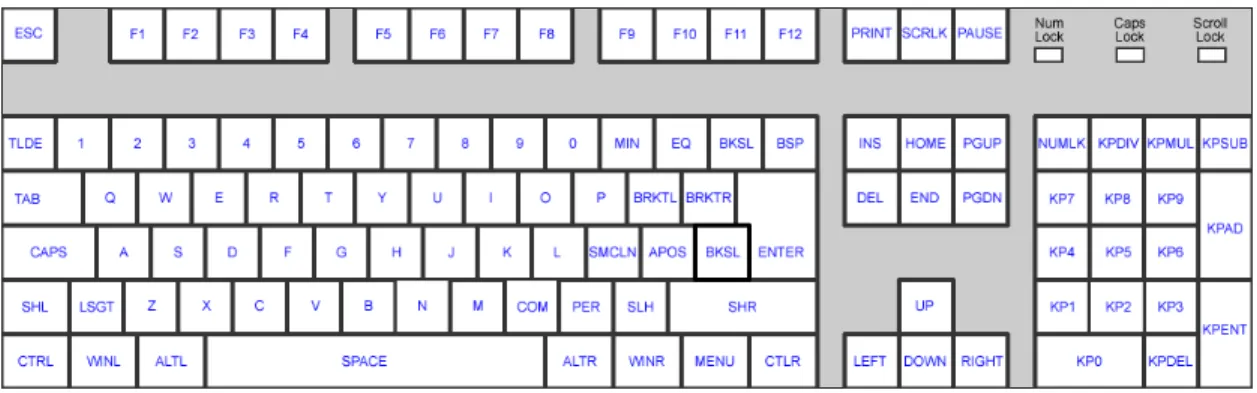
The Hot Keys as here specified are the key sequence that precedes the command string and they are to be directed not to your local client PC, nor to your remote server, but to KLE itself. The hot keys here are default to CTLR – CTLR, that is, two consecutive Right Control keys (Please note that this is the right control key (CTLR), NOT the left control key, CTRL). And the
Mouse-Resynchronize Hotkey is default to Home key (HOME). For example, to synchronize
the remote and the local mouse cursor, you have to hit CTLR – CTLR – Home. (To find out the key positions on a standard keyboard, please click the Keyboard drawing hyperlink for a detailed key mapping.)
Of course, you can also customize the mouse resynchronization hotkey for your own preference.
If you are using MacOS as your KLE client for connection, you might find that the default mouse resync hotkey – CTLR-CTLR-Home - does not work on Java viewer running on your MacOS. That is because the Right Control key on Mac keyboard sends out different keycode as the PC keyboard. If that is the case, you might consider to configure your mouse resync hotkey as, for example, CTLL- CTLL – S, so that you could sync mouse cursors from your Macintosh computer or notebook.
Enable Hot-Keys Transparent Mode for Double-Byte Languages
If the Windows system you are using is of the double-byte language version (such as Chinese Windows XP), no matter it is on your client computer or on the remote server accessible by Prima viewer, you can enable this option to make the language/input method switching hotkey (Alt-Shift/Ctrl-Shift, pressed together) operate more smoothly and interference-free with both client computer and remote server. Once this option is enabled, you can use separate key strokes (Alt Æ Shift/ Ctrl Æ Shift) to do the language/input method switching trick only on the remote server desktop without acting on the client computer system.
The double-byte language input method switching will pose special interference problem between the remote login client and the connected server desktop connected via Prima IP viewer program. The problem arises from the fact that, by Windows default, the Windows hotkey to switch among different input languages (such as English, Chinese, Japanese) is Alt-Shift (pressed together), and the hotkey to switch among different input methods (such as Phonetic, Changjie, etc for the Traditional Chinese input method) is Ctrl-Shift (pressed together). If a user needs to input mixed English and Chinese character strings, one has to switch constantly between different languages and even different input methods alternately with Alt-Shift and Ctrl-Shift.
However, these two Windows hotkey will act not only on the local system but also on the remote server. Thus, situations might arise that both local system and remote server will have the same double-byte input
local system (that is, on the remote login client). If you have constantly changed the input language or input method, you will be obliged to change the input method either on the local system or the remote server so that you can effectively input characters on the remote server.
The hotkey transparent mode for the double-byte language input enables the user to use the same sequence, Alt-Shift as well as Ctrl-Shift, albeit not pressed together, but pressed one after the other sequentially. Thus, when you pressed Alt then Shift (or Ctrl then Shift), it will not switch either language or input method on the local system, but will switch only on the remote server. In short, this mode will switch only the remote desktop through the Prima IP viewer, and not on the local system.
4.4
Date & Time – Date, Time, Global Time Zone
Support and NTP server synchronization
After any setting change, click the Submit button to save new setting to the KLE database, and then click Apply Setting to apply new settings to KLE immediately.
Current Date and Time
Enter the correct date and time here and click Set Current Date and Time button to set current system time on KLE.
Note that if you check the option to Automatical y Synchronize with an Internet Time Server (NTP), the time setting will be periodically synchronized to the time of NTP server specified on each restart of the KLE and every hour.