Relationships between the Objective Structured Clinical
Examination, Depression Cognitive Scale, Self-Efficacy, and
Problem Solving Strategies of Sophomore Nursing Students
Jee Hee Kim
1and Hee Jeong Kim*
1
Department of Emergency Medical Technology
Kangwon National University, 245-907, Samcheok-si, Gangwon-do, South Korea
*Department of Nursing, Namseoul University
331-707, 91 Daehak-ro, Seonghwan-eup, Seobuk-gu, Cheonan-si,
Chungcheongnam-do, South Korea
1
[email protected]
Corresponding Author: *[email protected]
Abstract
Practical nursing training includes the learning of knowledge, skills, and attitude that are applied in clinical situations. The Objective Structured Clinical Examination (OSCE) method is an effective tool for evaluating the clinical nursing skills of nursing students. Depression is an important stress factor that can reduce academic achievement. However, self-efficacy with respect to the ability to provide patient care is vital for nurses who may be required to initiate treatments. The clinical field also requires that nurses use problem solving strategies (PSS) effectively. In this study, we conducted a survey to examine the relationship between the OSCE, Depression Cognitive Scale (DCS), self-efficacy (SE) and PSS in sophomore nursing students. We collected data data from 90 sophomore students at Namseoul University The data were analyzed using a t-test, ANOVA test, Mann-Whitney, Kruskal-Wallis, and stepwised multiple regression using SPSS 18.0. The stepwise multiple regression analysis shows that DCS(p=<.001), SE(p=.014), and PSS(p=.004) had significant effects on OSCE performance. Lower depression (B=-.164), higher self-efficacy (B=.025), and higher PSS (B=.071) appeared to be related to higher OSCE performance. DCS explains 64.3% of the total variation in OSCE, DCS and SE explained 66.3%. of the total variation and the addition of PSS increased this to 69.1%. Finally, the hit ratio of DCS, SE, and Pss was 69.1%.
Keywords: depression, objective structured clinical examination, self-efficacy
1. Introduction
In order to respond effectively and actively to rapidly changing public health environments, the nurses should be trained in the latest advances and must possess excellent skills [1, 2]. Thus, it is essential to combine nursing theory with practical training in the nursing curriculum. Practical training includes the learning of knowledge, skills, and attitudes that can be applied in clinical situations. To ensure that nursing education involves nursing activities in real patient situations, the majority of practical nursing training occurs in the hospitals rather than classroom. However, errors in patient care are not permitted during practical hospital so nursing students tend to lose motivation and confidence if they cannot demonstrate adequate nursing performance activity with patients and are refused access to patients because of their poor skills [3, 4]. Simulation-based education was emerging as alternative solutions to address this problem. Simulation-based education was developed by faculty members at the University of Southern California in the 1960s and spread throughout North America, Europe, and Asia
[5]. The main advantage of educational simulation is that the student becomes an active participant rather than a passive observer by applying the concept of a standardized patient (SP) [6]. The Objective structured clinical evaluation (OSCE) uses a SP and it is an objective method that captures the interaction between students and patients. OSCE comprises history taking, physical assessment, nursing performance, and an evaluation by professors. OSCE has been introduced widely in nursing education during recent years [7]. The OSCE method is an effective tool for evaluating the clinical nursing skills of student nurses. OSCE addresses various learning objective and assesses their achievement. At the same time, the interaction with patients during nursing activities gives a realistic experience to nursing students, and memories of successful practices can be stored in students’ knowledge systems [8]. Thus, an appropriate evaluation of clinical performance is important for increasing clinical skills. Previous studies have shown that simulation-based learning using a SP improves the nursing skills [9], patient management ability [10], and self-efficacy (SE) of students [11]. However, depression was found to be the main mental health problem that affects nursing students. Clinical training is the most important part of the curriculum for nursing students because it allows them to engage in imagery and role play. However, clinical training is less useful if the students are experiencing depression and stress. A previous study showed that depression had a negative correlation with satisfaction during the clinical training [12]. Depression is very important stress factor that can reduce academic achievement [13]. Depression was reported to be an important factors that affects the nursing practice and academic achievement so it would be useful to investigate the relationship between depression and OSCE performance. SE is closely related to environmental factors, motivation and achievement [14]. The SE of nurses with respect to the ability to provide patient care is very important for nurses who may be required to initiate treatments. A student with low SE in various tasks may delay treatment initiation or avoid it altogether which may have adverse consequences for patients. The potentially adverse nursing performance effects of the SE of nurses means it is important to nurse educators to provide instruction that help students to estimate of their ability accurately [15]. However, the relationship between the SE and OSCE performance of nursing students is not fully understood. The clinical field also requires that nurses use problem solving strategies (PSS) effectively [16], because they will become the leading nurses of the future. Therefore, the present study conducted a survey to examine the relationship between the OSCE, and Depression Cognitive Scale (PSS), SE and PSS scores in sophomore nursing students. Additional basic data were also collected to help improve the clinical nursing skills of sophomore students.
2. Method
2.1. Design of the Research
This was a descriptive research that investigated the relationship between OSCE, DCS, SE, and PSS in sophomore nursing students.
2.2. Ethics
The study was approved by the Ethical Committee (Institutional Review Board) of Namseoul University.
2.3. Subjects
The study subjects were 90 sophomore nursing students at Namseoul University in Chungcheongnam-do. The students agreed to the purpose of the study and gave their informed consent to participate in the study.
2.4. Instruments
2.4.1. OSCE: A total of 15 items were specified for the OSCE used in this study, where
the maximum score was 10 points and ability to perform Foley catheterization was tested.
2.4.2. DCS: DCS was developed by Zausziewski and translated into Korean by Yeun,
Kwon, and Kim [17]. The DCS comprises eight items and the scores ranged from 0 to 40 points. A lower score indicated severe depression. Cronbach’s α was .93 in the original scale and .92 in the present study.
2.4.3. SE: SE scale was developed by Kim and Cha (1996) [18]. The SE questionnaire
comprises 24 items in three subcategories: confidence, self-control efficacy, and task difficulty. The possible scores ranged from a minimum of 24 points to a maximum of 120 points where higher scores indicated good SE. Cronbach’s α was .89 on the original scale and .74 in the present study.
2.4.4. PSS: PSS was developed from a checklist of mathematical PSS [19]. The PSS
questionnaire comprised 20 items in three subcategories: spontaneity, task commitment, and confidence where the scores ranged from 0 to 20. Higher scores indicated that students had good PSS. Cronbach’s α was .74 in the present study.
2.5. Data Collection
The data were collected between September 1 and September 30, 2012. The researchers explained the purpose of the study to the nursing students and obtained their informed consent. The students completed the questionnaire after performing Foley catheterization in the OSCE.
2.6. Data Analysis
This study was performed using data collected from 90 sophomore nursing students at Namseoul University. The data were analyzed using a t-test, ANOVA test, Mann-Whitney U test, the Kruskal Wallis test, and stepwise multiple regression with SPSS 18.0 software.
3. Results
3.1. General Characteristics
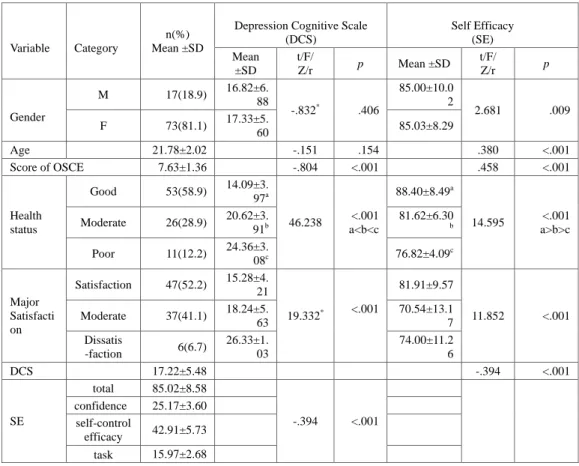
The demographic characteristics of the students are shown in Table 1.
The average age of the subjects was 21.07 years and 81% were female. The nurses reported their health status as: good 58.9%, moderate 28.9%, and poor 12.2%. Their satisfaction ratings were as follows: highly satisfied 52.2%, moderately satisfied 41.1%, and dissatisfied 6.7%. The mean scores and standard deviations in the evaluations were: OSCE=7.63±1.36, DCS=17.22±5.48; SE= 85.02±8.58; and PSS=12.54±3.56. The correlation analysis showed that OSCE had a significant negative relationship with DCS (p<.001) and positive relationships with SE (p<.001) and PSS (p<.001).
3.2. Relationships between the General Characteristics of Nurses and the DCS, SE, and PSS Results
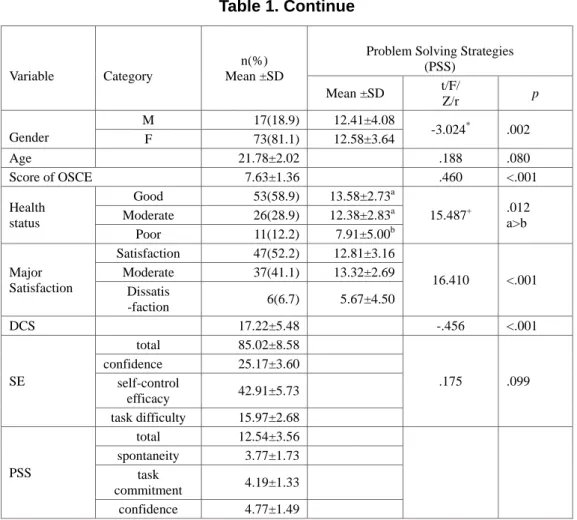
Table 1 shows the relationships between the OSCE, DCS, SE, and PSS results and the general characteristics of the subjects.
The DCS score had a significant relationship with good health status (24.36±3.08, p=<.001), whereas poor health status students had a depressive tendency and higher DCS
scores than did good health status students, according to a post hoc Duncan’s multiple range test. The mean SE score of students with a good health status was 88.40±8.49, which was significantly different from that of the students with a poor health status (76.82±4.09, p=<.001). The mean PSS score of the students with a good health status students was 13.58±2.73, which was significantly higher than that of the students with a poor health status (7.91±5.00, p=<.001), according to a post hoc Duncan’s multiple range test. The mean DCS score of students who reported that they were highly satisfied was 5.28±4.21, which was significantly lower than that of the dissatisfied students (26.33±1.03, p=<.001). The mean SE score of the highly satisfied students was 88.40±8.49, which was significantly higher than that of the dissatisfied students (76.82±4.09, p=<.001). The mean PSS score of the highly satisfied students was 12.81±3.16, which was significantly greater than that of the dissatisfied students (5.67±4.50, p=<.001).
3.3. Effects of DCS, SE, and PSS on OSCE Performance
There was no multicollinearity between the independent variables because the variance inflation factor was <10.
The stepwise multiple regression analysis showed that DCS (p=<.001), SE (p=.014), and PSS (p=.004) had significant effects on OSCE performance. Lower depression (B=-.164), higher SE (B=.025), and higher PSS (B=.071) scores correlated with higher OSCE performance. DCS explained 64.3% of the total variation in OSCE. DCS and SE explained 66.3% of the total variation and the addition of PSS increased this to 69.1%. Finally, the hit ratio of DCS, SE, and PSS was 69.1%.
4. Discussion
The present study investigated the effects of DCS, SE, and PSS on OSCE performance by evaluating the Foley catheterization skills of sophomore nursing students during basic nursing practice training, according to the OSCE performance evaluation guidelines. Each part of the evaluation had a significant relationship with the DCS, SE, and PSS scores, according to the health status and satisfaction results. The OSCE performance and DCS score had a significant negative relationship. The highly satisfied students tended to be motivated and had higher academic achievement, and they participated in clinical training actively, because they were less depressive. A previous study of medical school students suggested that high satisfaction correlated with better clinical skills in the OSCE and Clinical Performance Examination. Nursing students experience considerable stress and anxiety before clinical training, which can lead to maladjustment in some [13]. They may feel nervous while performing unfamiliar medical procedures [20]. Stress and anxiety were identified as predictors of performance in previous studies. Thus, it was expected that there would be a negative correlation between the OSCE performance and depression. In the present study, lower depression (B=-.164) appeared to be correlated with higher OSCE performance and the DCS score explained 64.3% of the total variation in OSCE. A previous study also suggested that depressive nursing students were likely to have lower clinical skills performance [14]. Therefore, it is necessary to implement a psychoeducational program for nursing students. The present study showed that SE had a significant effect on the OSCE performance. Evaluation of personal ability affect the choices people make in many situations. SE is the belief in one’s ability to take actions to manage a future situation [21]. This construct is of particular importance in practice disciplines such as nursing, where the acquisition of psychomotor skills is a critical component of student instruction because inaccurate SE assessment may lead to adverse patient outcomes [22, 23]. The SE and self-directed learning (SDL) are closely related, and it was reported that students with a higher SDL capacity performed better in learning
environments where they controlled the volume and style of SDL voluntarily [24]. A previous study of medical school students showed that SE was closely related to the OSCE performance and power of SE to explain the total variation in OSCE (66.3%) was similar to that determined in the present study. Thus, a higher SE is linked to better clinical performance. The SE of nursing students was the most important factor that affected their OSCE performance.
The PSS score had a positive relation with OSCE performance and it explained 69.1%of the variation (with DCS and SE). Nurses are confronted by many problems in hospitals and the correct identification of a patient problem means that it can be addressed appropriately [25]. The nursing process involves finding solutions and the PSS used in clinical practice have important roles in health care services. This study of the nursing process highlights the need for nurses with good PSS. The ability to apply PSS is a very important element of professional nursing practice. It is expected that professional nurses will be able to make effective decisions using PSS based on a strong knowledge base [16]. The importance of good PSS is supported by the results of the present study. The results showed that it is important to prepare and continuing education programs for PSS to enhance the clinical training performance of nursing students.
5. Conclusion
The results of this study show that we need to manage depression, SE, and PSS in students to increase their OSCE performance. These findings provide basic information that may help to improve OSCE performance. It is necessary to explore more efficient methods for increasing OSCE performance in broader areas of nursing education. It is also recommended that replicate studies should be conducted in this research area.
Table 1. Relationships between the General Characteristics of Nurses and the DCS, SE, and PSS
Variable Category
n(%) Mean ±SD
Depression Cognitive Scale (DCS) Self Efficacy (SE) Mean ±SD t/F/ Z/r p Mean ±SD t/F/ Z/r p Gender M 17(18.9) 16.82±6. 88 -.832* .406 85.00±10.0 2 2.681 .009 F 73(81.1) 17.33±5.60 85.03±8.29 Age 21.78±2.02 -.151 .154 .380 <.001 Score of OSCE 7.63±1.36 -.804 <.001 .458 <.001 Health status Good 53(58.9) 14.09±3. 97a 46.238 <.001 a<b<c 88.40±8.49a 14.595 <.001 a>b>c Moderate 26(28.9) 20.62±3. 91b 81.62±6.30 b Poor 11(12.2) 24.36±3.08c 76.82±4.09c Major Satisfacti on Satisfaction 47(52.2) 15.28±4. 21 19.332* <.001 81.91±9.57 11.852 <.001 Moderate 37(41.1) 18.24±5. 63 70.54±13.1 7 Dissatis -faction 6(6.7) 26.33±1. 03 74.00±11.2 6 DCS 17.22±5.48 -.394 <.001 SE total 85.02±8.58 -.394 <.001 confidence 25.17±3.60 self-control efficacy 42.91±5.73 task 15.97±2.68
difficulty PSS total 12.54±3.56 -.356 <.001 ..175 .991 spontaneity 3.77±1.73 task commitmen t 4.19±1.33 confidence 4.77±1.49
* Z value (Mann Whitney U test), ab: post hoc by Duncan’s multiple range test, + value (Kruskal Wallis test)
Table 1. Continue
Variable Category
n(%) Mean ±SD
Problem Solving Strategies (PSS) Mean ±SD t/F/ Z/r p Gender M 17(18.9) 12.41±4.08 -3.024* .002 F 73(81.1) 12.58±3.64 Age 21.78±2.02 .188 .080 Score of OSCE 7.63±1.36 .460 <.001 Health status Good 53(58.9) 13.58±2.73a 15.487+ .012 a>b Moderate 26(28.9) 12.38±2.83a Poor 11(12.2) 7.91±5.00b Major Satisfaction Satisfaction 47(52.2) 12.81±3.16 16.410 <.001 Moderate 37(41.1) 13.32±2.69 Dissatis -faction 6(6.7) 5.67±4.50 DCS 17.22±5.48 -.456 <.001 SE total 85.02±8.58 .175 .099 confidence 25.17±3.60 self-control efficacy 42.91±5.73 task difficulty 15.97±2.68 PSS total 12.54±3.56 spontaneity 3.77±1.73 task commitment 4.19±1.33 confidence 4.77±1.49
* Z value (Mann Whitney U test), ab: post hoc by Duncan’s multiple range test, + value (Kruskal Wallis test)
Table 2. Effects of DCS, SE, and PSS on OSCE Performance (n=80)
Step 1 Step 2 Step 3
B Β B β B β Constant 11.019 8.513 7.438 DCS -.164 -.672*** SE .025 .010*** PSS .071 .188*** R2(ᐃR2) .643 .663(.024) .691(.031) F 161.349 88.641 67.364 p <.001 <.001 <.001
References
[1] K. Bowles, “The relationship of critical-thinking skills and clinical judgment skills of baccalaureate nursing students”, Journal of Nursing Education, vol. 39, (2000), pp. 373-376.
[2] W. O. Oh, “Factors influencing self-directedness in learning of nursing students”, Journal of Korean Academic of Nursing, vol. 32, (2002), pp. 684-693.
[3] J. Y. Choi, K. S. Jang, S. H. Choi and M. S. Hong, “Validity and reliability of a clinical performance examination using standardized patients”, Journal of Korean Academy of Nursing, vol. 38, (2008), pp. 83-91.
[4] M. Y. Park and S. Y. Kim, “A qualitative study of nursing students’ first clinical experience”, Journal of Korean Academic Society of Nursing Education, vol. 6, no. 1, (2000), pp. 23-35.
[5] B. G. Lee, “Recent world trend in performance-based assessments and application of the standardized patient program in Korean medical situation”, Korean Journal of Medical Education, vol. 12, (2000), pp. 377-392.
[6] P. Wallace, “Coaching standardized patient: For use in the assessment of clinical competence”, Springer Publishers, New York, (2007).
[7] H. E. Rushforth, “OSCE: Review of literature and implications for nursing education”, Nurse Educ Today, (2006), pp. 1-10. http://dx.doi.org/10.1016/j.nedt.2006.08.009.
[8] M. S. Yoo, I. Y. Yoo, “Effects of OSCE Method on performance of clinical skills of students in fundamentals of nursing course”, Journal of Korean Academy of Nursing, vol. 33, no. 2, (2003), pp. 228-235.
[9] Y. J. Yi, N. Y. Lim, E. H. Lee, H. J. Han, J. H. Kim and H. M. Son, “Evaluation on the practicum using standardized patients for nursing assessment to articular disease”, Journal of Muscle and Joint Health, vol. 14, (2007), pp. 137-148.
[10] H. S. Randolph, C. C. Wendy, M. H. Yue, M. Rima and R. L. Baxter, “Simulation-based training is superior to problem based learning for the acquisition of clinical assessment and management skill”, Critical Care Medicine, vol. 34, (2006), pp. 151-157.
[11] R. Theroux and C. Pearce, “Graduate students’ experiences with standardized patients as adjuncts for teaching pelvic examinations”, Journal of American Academic Nurse Practice, vol. 18, (2006), pp. 429-435.http://dx.doi.org/10.1111/j.1745-7599.2006.00158.x
[12] H. J. Park and I. S. Jang, “Stress, Depression, Coping Style and Satisfaction of clinical practice in nursing students”, Journal of Academic Society Nursing Education, vol. 16, no. 1, (2010), pp. 14-23. [13] N. Shikai, M. Shono and T. Kitamura, “Effects of coping styles and stressful life events on depression
and anxiety in Japanese nursing students: a longitudinal study”, International Journal of Nursing Practice, vol. 15, no. 3, (2009), pp. 198-204,http://dx.doi.org/10.1111/j.1440-172X.2009.01745.x.
[14] Y. M. Lee, B. J. Ham, K. A. Lee, D. S. Ahn and M. K. Kim, “The relation of self efficacy with environmental factors personality and academic achievement in medical students”, The Korean Society Medical Education, vol. 18, no. 3, (2006), pp. 249-257, http://dx.doi.org/10.3946/kjme.2006.18.3.249. [15] G. S. Stump, J. Husman and S. K. Brem, “The Nursing Student Self-Efficacy Scale: Development Using
Item Response Theory”, Nursing Research, vol. 61, no. 3, (2012), pp. 149-158.
[16] T. Fusun, “The perceived problem-solving ability of nurse managers”, Journal of Nursing Management, vol. 14, no. 5, (2006), pp. 340-347, 10.1111/j.1365-2934.2006.00551.
[17] E. J. Yeun, Y. M. Kwon and J. A. Kim, “Psychometric Testing of the Depressive Cognition Scale in Korean adults”, Applied Nursing Research, vol. 25, no. 4, (2011), pp. 264-270. http://dx.doi.org/10.1016/j.apnr.2011.04.003.
[18] A. Y. Kim and J. E. Cha, “Measure of self- efficacy”, Korean Society for Industrial and organizational psychology Proceedings of the winter conference, (1996), pp. 51-64.
[19] F. K. Lester, “Mathematical problem solving in the elementary schools: Some educational and psychological considerations”, L. L. Hatfield & D. A. Bradbard (Eds.), Mathematical problem solving: Papers from a research workshop, “Columbus, OH: ERIC Information Analysis Center for Science, Mathematics and Environmental Education, (1978), pp. 55-87.
[20] M. J. Kim and H. H. H, “Randomized trial evaluating the aroma inhalation on physiological and subjective anxiety indicators of the nursing students experiencing the first intravenous injection”, International Journal of Bio-Science and Bio-Technology, vol. 2, no. 4, (2010), pp. 1-9.
[21] A. Bandura, “Self-Efficacy: The exercise of control”, New York, NY: Freeman, (1997).
[22] American Association of College of Nursing, Revision of essentials of baccalaureate education for professional nursing practice. Retrieved from http://www.aacn.nche.edu/ Education/pdf/BEdraft.pdf,
(2008).
[23] Y. Kim and O. G. Kwag, “Validation of a path model on clinical practice competency of the nursing students”, Journal of the Korea Academic-Industrial cooperation Society, vol. 13, no. 10, (2012), pp. 4572-458, http://dx.doi.org/ 10.5762/KAIS.2012.13.10.4572
[24] B. J. Zimmerman, “Self efficacy: an essential motive to learn”, Contemporary Educational Psychology, vol. 25, (2000), pp. 82-91,http://dx.doi.org/10.1006/ceps.1999.1016.
[25] J. Bransford, R. Sherwood, N. Vye and J. Rieser, “Teaching thinking and problem solving”, American Psychologist, vol. 41, (1986), pp. 1079-1089.
Authors
Jee Hee Kim, MD, PhD
1993.2 MD, PhD, Korea University Graduate School, Seoul, Korea
1989.8 Master, Korea University Graduate School, Seoul, Korea
1987.2 Korea University College of Medicine, Seoul, Korea
Hee Jeong Kim, RN PhD HHCANP
2010.2 PhD, Nursing, Chung Ang University Graduate School, Seoul, Korea
1995.2 MSN, Nursing, Chung Ang University Graduate School, Seoul, Korea
1986.2 BSN, Nursing, Chung Ang University, Dept. of Nursing, Seoul, Korea