TAXI CONSULTANT REPORT
OCTOBER 11, 2013
THE CITY OF BOSTONIN ASSOCIATION WITH: TAXI RESEARCH PARTNERS
BOSTON TAXI CONSUL TAN T
TABLE OF CONTENTS / TABLE OF FIGURES
Table of Contents
Page
Executive Summary ... 1
ES.1 Study Background and Purpose ... 1
ES.2 Approach and Methodology ... 1
ES.3 Study Findings ... 3
ES.4 Recommendations ... 20 1. Study Purpose, Approach, and Report Organization ... 1-1
1.1 Study Background and Purpose ... 1-1 1.2 Work Plan Summary ... 1-3 1.3 Report Organization ... 1-7 2. Taxi Regulation in Boston ... 2-1
2.1 Introduction ... 2-1 2.2 Boston Police Hackney Carriage Unit ... 2-1 2.3 Summary of Taxi Regulations ... 2-4 3. The Boston Taxi Industry and Transportation Network Companies ... 3-1 3.1 Introduction ... 3-1 3.2 Medallion Owners ... 3-5 3.3 Vehicle Types ... 3-6 3.4 Radio Associations ... 3-8 3.5 Taxi Drivers ... 3-12 3.6 Taxi Stands ... 3-13 3.7 Massport / Logan Airport ... 3-16 3.8 Other Institutional Customers ... 3-17 3.9 Transportation Network Companies ... 3-18 4. Taxi Ridership and Performance ... 4-1
4.1 Introduction ... 4-1 4.2 Taxi Ridership and Utilization ... 4-1 4.3 Taxi Availability ... 4-5 4.4 Summary ... 4-21 5. Driver Income ... 5-1
5.1 Introduction ... 5-1 5.2 Driver Income and Cost Modeling ... 5-2 5.3 Market growth ... 5-3 5.4 Scenario testing ... 5-4 6. Prominent Issues ... 6-1
6.1 Introduction ... 6-1 6.2 Customer-Oriented Issues ... 6-1 6.3 Taxi Drivers, Medallion Owners and Radio Association Issues ... 6-5 6.4 Hackney Unit’s Issues ... 6-9 7. Recommendations ... 7-1
7.1 Short-Term Recommendations ... 7-1 7.2 Long Term Recommendations ... 7-9 Appendix – Under Separate Cover
B T C
TABLE OF CONTENTS / TABLE OF FIGURES
Table of Figures
Page
Figure ES-1 Current and Predicted Income by Driver Group ... 5
Figure ES-2 Taxi Pick-Up Locations ... 6
Figure ES-3 Hourly Ridership ... 7
Figure ES-4 Taxi Utilization on Three Days ... 8
Figure ES-5 Hourly Utilization (July 13, 2013) ... 8
Figure ES-6 Dispatch Requests Served by Neighborhood ... 9
Figure ES-7 Dispatch Responsiveness in Boston Neighborhoods ... 10
Figure ES-8 Responsiveness by Time of Day ... 11
Figure ES-9 Average Passenger Wait Time at Taxi Stands ... 11
Figure ES-10 Logan Airport Taxi Trends ... 12 Figure 2-1 Boston Police Department Licensing Division Organization Chart ... 2-3 Figure 2-2 Taxi Related Fees ... 2-9 Figure 2-3 Taxi Related Fines ... 2-10 Figure 3-1 Boston Taxi Industry Elderly Program Coupon ... 3-2 Figure 3-2 Medallion Ownership (June 2013) ... 3-5 Figure 3-3 What is Done With Each Medallion? (June 2013) ... 3-5 Figure 3-4a Vehicle Type by No. of Medallions (June 2013) ... 3-6 Figure 3-4b Vehicle Type by No. of Medallions (June 2013) ... 3-6 Figure 3-5a Taxicabs by Model Year (as of June 2013) ... 3-7 Figure 3-5b Taxicabs by Model Year (as of June 2013) ... 3-7 Figure 3-6 Taxicabs by Radio Association ... 3-9 Figure 3-7 WAV Taxicabs by Radio Association ... 3-9 Figure 3-8 Known Taxi Stand Locations ... 3-15 Figure 3-9 Uber Fare Structure in Boston ... 3-21 Figure 4-1 Taxi Utilization on Three Days ... 4-2 Figure 4-2 Range of Utilization among Drivers ... 4-3 Figure 4-3 Hourly Utilization (July 13, 2013) ... 4-4 Figure 4-4 Dispatch Requests Served by Neighborhood ... 4-6 Figure 4-5 Dispatch Responsiveness in Boston Neighborhoods ... 4-8 Figure 4-6 Pick-up Location for Two Dispatch Associations ... 4-9 Figure 4-7 Responsiveness by Time of Day ... 4-10 Figure 4-8 Trend of Passenger Arrivals at Logan Airport ... 4-11 Figure 4-9 Logan Airport Taxi Trends ... 4-12 Figure 4-10 Taxi Wait Time and Entrances - Airport Waiting Pool ... 4-13 Figure 4-11 Taxi Pool Tweets ... 4-14 Figure 4-12 Count of Waiting Cabs – Airport Taxi Pool ... 4-15 Figure 4-13 Count of Waiting Cabs – Logan Airport Tweets ... 4-15 Figure 4-14 Taxi Stand Observations ... 4-16 Figure 4-15 Taxi Wait Times in Taxi Stands ... 4-17
BOSTON TAXI CONSUL TAN T
TABLE OF CONTENTS / TABLE OF FIGURES
Figure 4-16 Average Passenger Wait Time at Taxi Stands ... 4-19 Figure 4-17 BCEC Event Attendance and Number of Taxis per 1,000 Attendees ... 4-20 Figure 5-1 Baseline Driver Income ... 5-3 Figure 5-2 Current and Predicted Income by Driver Group ... 5-4 Figure 5-3 Effects of Scenario 1 (Enhanced Testing and Longer Service Lifetimes) ... 5-5 Figure 5-4 Effects of Scenario 2 (Nighttime Surcharge) ... 5-6 Figure 5-5 Driver Incomes Depending on Work Hours ... 5-6 Figure 7-1 Model Years of Current WAV Taxicabs ... 7-7
B
OSTONTAXI CONSULTANT REPORT
EXECUTIVE SUMMARY
ES.1 STUDY BACKGROUND AND PURPOSE
The City of Boston commissioned the Nelson\Nygaard consulting team to prepare this analysis of the City of Boston's taxi industry. The team was charged with undertaking a comprehensive review of the taxi system's operations and regulations; assess recent changes in the taxi and for-hire market, including for-for-hire vehicles through smartphone applications; and make
recommendations to improve the operations and regulations of the City's taxi system. The purpose of this analysis is to provide data and information to the City to make informed decisions regarding a number of changes to the industry and to understand how these changes would impact taxi drivers and customers. The study seeks to address the following issues and potential changes to the taxi industry:
Demand for and availability of taxis in all City neighborhoods, including minority neighborhoods, waterfront areas, and the City's Innovation District
Demand for and availability of taxis during the late evening hours Discriminatory practices
The relationship between radio associations, medallion owners, and drivers Treatment of taxi drivers
Oversight and enforcement of taxi regulations
ES.2 APPROACH AND METHODOLOGY
The team's approach includes a substantial quantitative data analysis effort as well as a qualitative, subjective analysis through stakeholder interviews and surveys. The data-based analysis needs to be balanced by an on-the-ground understanding of how taxis do and should
B T C
EXECUTIVE SUMMARY
serve Boston; therefore, these two types of data supplement each other and help to explain "the story behind the story" on different perspectives presented.
Stakeholder Interviews
The Nelson\Nygaard consulting team conducted in-person and/or telephone interviews with representatives of the Mayor’s Office, Boston Police Department Commissioner and Hackney Carriage Unit staff, Commission for Elder Affairs, Commission for Persons with Disabilities, Office of Neighborhood Services, Massport, MBTA Accessibility Office, Greater Boston
Convention and Visitors Bureau, Massachusetts Convention Center Authority, MASCO, Boston Onein3, radio associations, Steelworkers Union/Boston Taxi Drivers Association staff and executive board, Boston Taxi Advisory Group, new electronic hailing services companies1
(Hailo), several large and small medallion owners and managers, and shift drivers.
Service and Financial Data Analysis
Several raw data sources were compiled and summarized:
Hackney Carriage Unit medallion data that shows medallions by radio association,
medallion ownership, vehicle type and model year, etc.
Data on Wheelchair Accessible Vehicles (WAVs) supplied by the City of Boston’s
Disability Commissioner
Taxi trip data from credit card processing vendors (CMT and Verifone) from January
through August 2013, including pick-up and drop-off locations and times, mileage, fare/fees/tips, etc. (this includes all trips, not just the trips paid for by credit cards) Dispatch data from radio associations, as available (the only radio association that
supplied usable data was Boston Cab)
Driver survey results from a paper and online survey that sought service, income and
cost data, as well as driver perspectives on various issues
Taxi stand observations that documented wait times for both taxi drivers and
customers at various taxi stands around the city
Massport/Logan Airport taxi pool data that was analyzed to show taxi wait times
in the pool and passenger wait times at the curb
Massachusetts Convention Center Authority data that included sample event
attendance and number of taxi pick-ups/drop-offs and anecdotal comments from show attendees
Data was also requested from some Transportation Network Companies (companies that use computer-based and smartphone apps which allow customers to request a trip directly from drivers); however, none was supplied to the study team.
1 Uber opted to not participate in this study.
BOSTON TAXI CONSUL TAN T
EXECUTIVE SUMMARY
Policies and Handbooks
The team also reviewed in detail the Boston Police Department's Rule 403: Hackney Carriage Rules and Flat Rate Handbook (August 29, 2008) and subsequent published amendments and notices. Supplemental documents, such as lease agreements, Hackney Driver applications and forms, vehicle standards forms, medallion renewal application forms, and other related documents were also collected and reviewed.
ES.3 STUDY FINDINGS
Taxi Supply
There are 1825 taxis licensed in Boston. The method of licensing is called a medallion. The 1825 medallions are owned by
individuals or ownership groups. Only “medallioned" taxis, where a Boston medallion is affixed to the rear of the taxi, are permitted to pick-up a customer at a taxi stand in Boston, from a street hail, or at the taxi queue lines at the airport at each
terminal. In most cases, a Boston taxi medallion owner typically does one of the following:
Buys or leases a vehicle, affixes the medallion to the vehicle, and “shifts” the medallioned taxicab out, usually to two licensed taxi drivers respectively working a 12-hour day shift and a 12-hour night shift – 48% of the 1825 taxis.
Buys or leases a vehicle, affixes the medallion to the vehicle, and operates the vehicle him/herself; the medallion owner in this case is known as an owner operator – 25% of the 1825 taxis.
Lease the medallion to a vehicle owner, who affixes the medallion to his/her taxi and operates the taxi – 20% of the 1825 taxis.
Hires a manager to manage his/her medallions – either by shifting a medallioned taxicab or leasing the medallion to a vehicle owner -- 5% of the 1825 taxis.
Most of Boston’s taxis are environmentally-friendly “green” taxis; these green taxis, which are almost all hybrids, total 1287 or 70% of the fleet. The most common taxi vehicle overall is a Toyota Camry Hybrid (1036 or 57% of the fleet and 81% of the hybrid taxis).
One hundred (100) of the 1825 medallions are specifically designated as wheelchair accessible vehicles (WAVs). Of these, there are 59 retrofitted Toyota Siennas and 41 retrofitted Dodge Caravans. Three of the 59 Siennas are hybrid.
By City regulation, medallion owners must affiliate with a radio association. There are seven radio associations authorized by the City. The primary function (among many) that the radio associations provide is the dispatching of trips that are requested by customers through the radio associations. The largest of the radio associations is Metro Cab (527 taxis) followed by Boston Cab (473 taxis), City Cab / Top Cab (426 taxis), ITOA (303 taxis), 617-TAXI CAB (57),
B T C
EXECUTIVE SUMMARY
and Tunnel Taxi (4 taxis). (The affiliations of others are either unknown, are exempt from the affiliation requirements, or are in probate.)
Taxi Drivers and Income
Taxi drivers are licensed by the Hackney Unit, which is responsible for reviewing and processing new and renewal taxi driver applications and training taxi drivers. Hackney Unit staff reported that as of August 15, 2013, there were 6,347 active drivers (and 152 suspended drivers). This is not to say that all of these drivers are actively driving taxis. In three days sampled, there were between 2700 and 2950 drivers providing taxi service. There are likely additional drivers who are active and who are not included in this range; these might include part-time drivers who pick-up a Sunday shift and/or fill in for a regular driver when he/she is not driving. Drivers fall into the following categories:
Owner operators – These are drivers who own their medallion, own/lease the vehicle,
and operate the taxicab – Based on information from the Hackney Unit, there are 453 owner operators.
Leased medallion drivers – These are drivers who lease a medallion (from an owner
or manager), and provide and operate their own vehicle. Number of such drivers is
unknown.
Shift drivers – These are drivers who neither own or lease a medallion nor own a
vehicle; most shift drivers “rent” a medallioned taxicab over a weekly or 12-hour shift, paying the owner in cash for the rental. For weekly shifts, the drivers typically pay the shift rental fee upfront. For 12-hour shift drivers, the drivers typically pay for their shift rental fee after the shift is completed. Number of shift drivers is unknown, although most active drivers likely fall into this category.
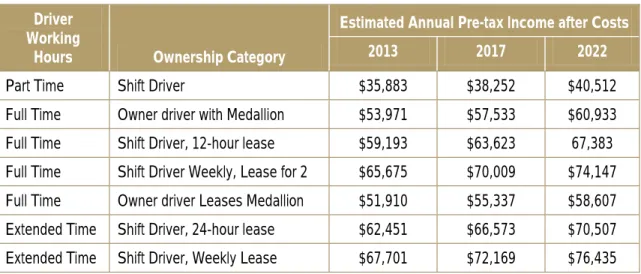
From the data analyzed, the average taxi carried 22 trips per day bringing $478 in revenue. On a typical day, each cab is driven by about 1.6 drivers, which means that an average driver takes in about $300 in revenue, before considering expenses. Net annual driver income can range from about $35,000 (part-time driver) to about $67,000 (shift driver, weekly lease) and averages about $60,000.
BOSTON TAXI CONSUL TAN T
EXECUTIVE SUMMARY
Figure ES-1 Current and Predicted Income by Driver GroupDriver Working
Hours Ownership Category
Estimated Annual Pre-tax Income after Costs
2013 2017 2022
Part Time Shift Driver $35,883 $38,252 $40,512
Full Time Owner driver with Medallion $53,971 $57,533 $60,933
Full Time Shift Driver, 12-hour lease $59,193 $63,623 67,383
Full Time Shift Driver Weekly, Lease for 2 $65,675 $70,009 $74,147
Full Time Owner driver Leases Medallion $51,910 $55,337 $58,607
Extended Time Shift Driver, 24-hour lease $62,451 $66,573 $70,507
Extended Time Shift Driver, Weekly Lease $67,701 $72,169 $76,435
Taxi Ridership, Availability and Utilization
Based on data gathered from the credit card processing vendors, the Hackney Unit estimated that taxis provided 14.6 million trips in 2012, or about 40,000 trips per day. Data available for this study confirms these estimates.
The spatial and temporal distribution of trips is shown below in Figures ES-2 through ES-5. Figure ES-2 shows the locations of every pick-up on January 9, 2013. Not surprisingly, most pick-ups are in Boston proper. A concentration of pick-ups is also at Massport/Logan Airport. Taxi pick-ups in the other neighborhoods of Boston are more sparse.
Figure ES-3 shows taxi trips per hour on three different days reflecting low ridership (29,470 trips), medium ridership (41,595 trips) and high ridership ( 48,373). The two weekday charts show a mismatch between supply and demand in the p.m. peak. The Saturday chart shows a mismatch between supply and demand from 10 p.m. through 2 a.m.
B T C
EXECUTIVE SUMMARY
BOSTON TAXI CONSUL TAN T
EXECUTIVE SUMMARY
Figure ES-3 Hourly RidershipWednesday, January 9, 2013 Thursday, April 11, 2013 Saturday, July 13, 2013 0 500 1,000 1,500 2,000 2,500
12A 1A 2A 3A 4A 5A 6A 7A 8A 9A 10A 11A 12P 1P 2P 3P 4P 5P 6P 7P 8P 9P 10P 11P
C a bs or T ri ps
Cabs in Service Total Cabs Trips in Each Hour January 9, 2013 (Wednesday) 29,470 trips 0 500 1,000 1,500 2,000 2,500 3,000 3,500 T ri ps or C a bs
Cabs in Service in Each Hour Total Cabs Trips in Each Hour April 11, 2013 (Thursday before Boston Marathon)
48,373 trips 0 500 1,000 1,500 2,000 2,500 3,000 3,500 4,000 12A 1A 2A 3A 4A 5A 6A 7A 8A 9A 10A11A12P 1P 2P 3P 4P 5P 6P 7P 8P 9P 10P11P T ri ps or C a bs
Cabs in Service Total Cabs Trips in Each Hour July 13, 2013 (Saturday)
41,595 trips
B T C
EXECUTIVE SUMMARY
Figure ES-4 shows utilization in terms of productivity, typically measured in trips per hour. As shown, productivity ranged from 1.4 trips per hour on the light weekday to 1.8 trips per hour on the heavy weekday. Above 1.5 trips per hour driven (i.e. 1.5 trips per hour per taxi) is considered a good level of productivity, at which there might begin to be a need for additional taxis to serve demand.
Figure ES-4 Taxi Utilization on Three Days Date/Day of
Week Drivers Cabs Driven Hours Occupied Hours Trips
Trips per Hour
Driven Pct. of Time Occupied
Hours per Driver January 9 (Wednesday) 2,746 1,768 21,053 5,254 29,453 1.4 25% 7.7 April 11 (Thursday) 2,927 1,778 25,584 9,452 47,006 1.8 37% 8.7 July 13 (Saturday) 2,702 1,732 22,032 7,386 41,432 1.9 34% 8.2
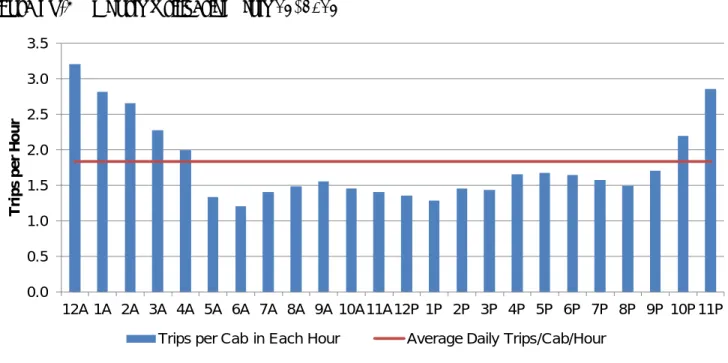
Figure ES-5 shows the hour by hour productivity for Saturday, June 13. Figure ES-5 Hourly Utilization (July 13, 2013)
0.0 0.5 1.0 1.5 2.0 2.5 3.0 3.5 12A 1A 2A 3A 4A 5A 6A 7A 8A 9A 10A11A12P 1P 2P 3P 4P 5P 6P 7P 8P 9P 10P11P T ri ps pe r H our
BOSTON TAXI CONSUL TAN T
EXECUTIVE SUMMARY
Taxi Responsiveness
Taxi availability is difficult to measure, and due to a lack of dispatch data provided by the radio associations and "holes" in the data from CMT and Verifone, we have measured taxi availability in the following ways: filled dispatch requests, responsiveness, and field observations. The most important key finding of determining taxi availability is that there is a lack of data collected, and thus Hackney should work with radio associations and credit card companies to collect more refined datasets.
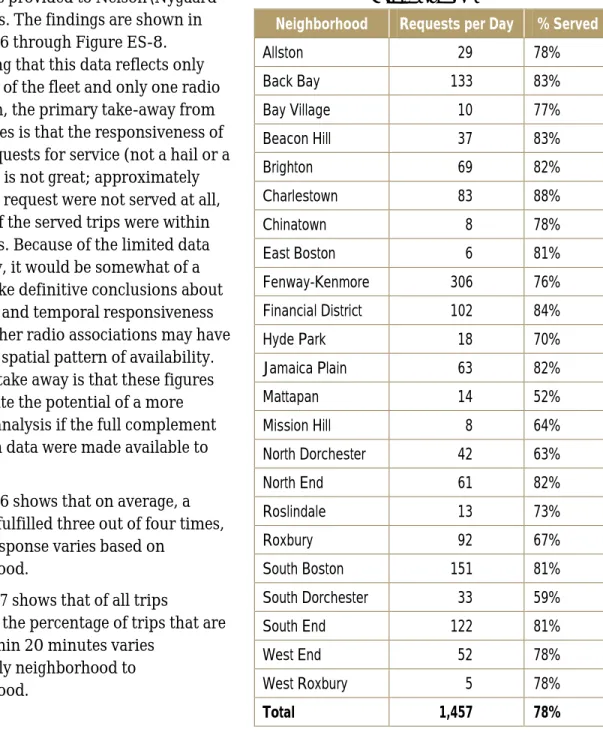
Data from one radio association’s dispatch system was provided to Nelson\Nygaard for analysis. The findings are shown in Figure ES-6 through Figure ES-8. Recognizing that this data reflects only about 25% of the fleet and only one radio association, the primary take-away from these figures is that the responsiveness of taxis to requests for service (not a hail or a taxi stand) is not great; approximately 22% of the request were not served at all, and 87% of the served trips were within 20 minutes. Because of the limited data availability, it would be somewhat of a leap to make definitive conclusions about the spatial and temporal responsiveness because other radio associations may have a different spatial pattern of availability. The other take away is that these figures demonstrate the potential of a more thorough analysis if the full complement of dispatch data were made available to the City.
Figure ES-6 shows that on average, a request is fulfilled three out of four times, but that response varies based on
neighborhood.
Figure ES-7 shows that of all trips
requested, the percentage of trips that are served within 20 minutes varies
significantly neighborhood to neighborhood.
Figure ES-6 Dispatch Requests Served by Neighborhood
Neighborhood Requests per Day % Served
Allston 29 78% Back Bay 133 83% Bay Village 10 77% Beacon Hill 37 83% Brighton 69 82% Charlestown 83 88% Chinatown 8 78% East Boston 6 81% Fenway-Kenmore 306 76% Financial District 102 84% Hyde Park 18 70% Jamaica Plain 63 82% Mattapan 14 52% Mission Hill 8 64% North Dorchester 42 63% North End 61 82% Roslindale 13 73% Roxbury 92 67% South Boston 151 81% South Dorchester 33 59% South End 122 81% West End 52 78% West Roxbury 5 78% Total 1,457 78%
B T C
EXECUTIVE SUMMARY
Figure ES-7 Dispatch Responsiveness in Boston Neighborhoods (Four weeks of data from one dispatch association)
Figure ES-8 shows that responsiveness not only varies spatially, but by time of day. Averaged over the whole city, responsiveness is between 70% and 90% from about 4 a.m. to 2 p.m. After 2 p.m., responsiveness declines continuously into the evening hours. In many areas of Boston, the chances of getting a taxi within 20 minutes are less than 50% between 6 p.m. and 3 a.m.
BOSTON TAXI CONSUL TAN T
EXECUTIVE SUMMARY
Figure ES-8 Responsiveness by Time of DayData from taxis stands and from Massport’s Logan Airport was also collected. As shown in Figure ES-9, the data from taxi stand observations indicate that wait times vary but average just under one minute; however, wait times in the late nights/early mornings are substantially longer.
Figure ES-9 Average Passenger Wait Time at Taxi Stands Location and Time Period
Average Wait Time (m:ss)
Back Bay Station 4:45 - 6:00 p.m. 0:31
Boylston St outside Hynes Convention & Prudential Ctr 12:01 - 2:30 a.m. 4:12
Park Plaza on St. James Ave 11:00 a.m. - 2:30 p.m. 0:00
Dorchester - Ashmont Station 3:15 - 6:10 p.m. 0:12
Downtown - Pearl St 11:00 a.m. - 1:35 p.m. 0:00
South Station on Atlantic Ave 2:30 - 3:10 p.m. 0:16
South Station on Atlantic Ave 2:45 - 4:35 p.m. 0:12
South Station on Atlantic Ave 3:00 - 7:00 p.m. 0:00
North End - Hanover St 5:00 - 6:00 p.m. 0:00
South Boston - East Broadway between L St and K St 12:00 - 1:35 p.m. 0:00
Average of All Wait Times of All Observations 0:53
0% 10% 20% 30% 40% 50% 60% 70% 80% 90% 100% 0 1 2 3 4 5 6 7 8 9 10 11 12 13 14 15 16 17 18 19 20 21 22 23
Hour of the Day
Weekdays Weekends
Percent of Requests Served within 20 Minutes
B T C
EXECUTIVE SUMMARY
The data from Massport in Figure ES-10 shows that the number of taxis entering the taxi pool has been growing at around 4% per year, comparing each month to the same month in the previous year. Not only has the number of taxis serving the airport increased, airport staff have been increasing their use of multiple loading, especially in 2013, reaching an average in June of two hours per day when multiple loading was in effect. In December 2012, Massport began reporting the average wait time for passengers when no cabs were available. From December 2102 through June 2013, the average wait time observed was 5 minutes when no cabs were available. During such time, Massport’s starters had to resort to multiple loadings. The worst case was on Thursday, March 7, when passengers had to wait an average of 31 minutes; on this day there was a three hour period when multiple loading was in effect.
Figure ES-10 Logan Airport Taxi Trends
SOURCE: Massport 0 20 40 60 80 100 120 140 0 1,000 2,000 3,000 4,000 5,000 6,000 7,000 J anuar y F eb ruar y M a rc h A p ri l M ay J une Jul y A ug us t S ep tem b er O c tobe r N o v em b er D ec em b er J anuar y F eb ruar y M ar c h A p ri l M ay J une Jul y A ug us t S ep tem b er O c tobe r N o v em b er D ec em b er J anuar y F eb ruar y M a rc h A p ri l M ay J une 2011 2012 2013 M in u te s T axi s E n ter in g p er D ay
Average taxis per day (lef t scale)
Average minutes of multiple loading per day (right scale)
BOSTON TAXI CONSUL TAN T
EXECUTIVE SUMMARY
Prominent Issues
A summary of prominent issues as identified by City officials, stakeholder organizations, radio associations, and taxi drivers (through the driver survey and focus groups) are identified below.
Issues for Taxi Customers and other Organizational Stakeholders
Poor performance in response to trip requests. When a customer requests a trip
via the telephone or a smartphone application through a radio association, only 78% of the requests are completed, and only 87% of the served trips are picked up within 20 minutes of the call, based on data from one dispatching system representing 25% of the fleet.
There is unmet demand during peak hours. Regardless of what neighborhood
needs service, many report that during rush hour, late nights on weekends, and during inclement weather, it is difficult to get a cab either via street hail or through the dispatch. Generally, this impact is on the ONEin3 population (more than one-third of Boston's population). This unmet demand for taxi service has partially been accommodated by transportation network companies (such as Uber) that have partnerships with taxi drivers and livery vehicle drivers. However, it is difficult to discern how large this potential market is. Some customers use TNCs such as Uber or Lyft, other customers, in particular the elderly, may not have other options.
Rates are either difficult to access, are not in Rule 403, or are confusing.
While base rates – but not all charges – are displayed on the passenger information monitor (PIM), some customers have difficulty finding the rates, and those that are able to find the rates may not realize they are displayed over multiple “pages.” Also, how you access that information is different depending on the PIM used. Thus, if there is a dispute at the end of the trip, it is not easy to support point because the supporting data is not easily accessible or not there. Additionally, there is specific confusion over (1) large vehicle charge of $6:00; (2) distinctions between Logan Airport and East Boston that affect an additional $2.75 charge ; and (3) the $2.25 Massport pool entry fee to
customers. Massport staff indicated a desire to have a flat rate structure to/from airport, as they have received complaints from out-of-towners. Staff reports that the first
question visitors in the taxi queue ask is “What will the fare be to (a specific location)?"
Insufficient, undersized, and unknown taxi stands. Taxi customers and taxi
drivers alike could benefit from additional and strategically located taxi stands that are better marked and better advertised.
Little assistance and public education/information. Visitors and local customers
alike have little guidance (except perhaps for taxifarefinder.com) as to the approximate fares between the Airport and popular locations. There is little information available to Boston residents and employees and no public education efforts. While rates are posted on the Hackney Unit's website and are available on the PIMs, there is no information
B T C
EXECUTIVE SUMMARY
available about rules and regulations regarding out-of-town pick-ups, TNCs, driver behavior, etc. that is available for public consumption.
WAVs are not compliant with City of Boston standards, are not regularly
inspected, and are not readily available. The City's Disability Commissioner
initiated a recent (June 2013) inspection of 98 WAVs per Hackney requirements and found that only one vehicle met the City’s WAV standards. Correct specifications are not being used to retrofit vans, and there have been no compliance inspections of WAVs prior to being put in service. The City’s Disability Commissioner also reported that persons requesting a WAV through radio associations have found it challenging and frustrating: even it a WAV is successfully dispatched, it may be unusable.
Driver training. Stakeholders have expressed mixed reviews on driver training; some
think that the system works well as is; others think the system needs a complete overhaul.
TNCs and livery vehicles are not regulated. TNCs (such as Uber) and livery service
operators (who are licensed by the Commonwealth and receive a Business Certificate from the City) do not have a regulatory body providing oversight. Some TNCs already comply with Hackney regulations regarding background checks, etc.; others do not. This poses several issues, in addition to those voiced above by drivers, medallion owners and the radio associations:
− Customer safety: Stakeholders are concerned that livery service drivers do not
have to undergo a standard criminal and driving record background check and include former taxi drivers who are no longer allowed to drive a taxicab because of violations.
− Pricing: Stakeholders voiced concerns of unfair practice that Hackney licensed taxis
may only charge customers the fare rates outlined in Rule 403, and unregulated services may charge customers a surcharge depending on the time of day/week, and some charge the drivers a certain percentage of the trip.
− Access: Stakeholders expressed that many seniors, persons with disabilities, low
income persons, and tourists do not own or have access to smartphones or the web, and therefore are unable to access these types of services.
Complaint management/response. On the Hackney Unit website, it states that staff
will respond to customer complaints within 10 business days. Some customers have reported that it often takes up to a month to be contacted. Also, the window of time to discuss a complaint – sometimes a specific two hour period on a specific day -- can be unreasonable.
Little outsourcing of Hackney functions. Many stakeholders reported that some
Hackney functions are ineffectively operated in-house by a uniformed officer and may be able to be handled more effectively by a contractor. Functions include license renewals, inspections, and training. Others suggest that having uniformed officers perform some of these functions is effective, as drivers respect and obey a uniformed officer.
BOSTON TAXI CONSUL TAN T
EXECUTIVE SUMMARY
No forum or process for stakeholder input. Many stakeholder organizations
voiced that they have been left out of the process of providing input to taxi issues and regulatory matters. There hasn’t really been a reliable and objective forum or any process to do this, and many suggested a desire to be on such a “task force” or “committee” if one is formed. Some stakeholder organizations stated that their interview held in the course of this study was the first time they had been asked to voice an opinion.
Not enough taxis serving Massport at peak times. Massport staff reported that at
peak times, there can be 100 or more customers waiting for a taxi at each terminal. They report that the worst time is Friday nights, when it’s raining, and on college graduation weekends when multiple loading – and the use of livery vehicles – is required. Massport staff reports that multiple loading periods can sometime last for hours (the most recent data from June 2013 shows that an average day has about two hours of multiple
loading).
Institutional users perceive there to be a lack of taxi availability. Users such as
BCEC and MASCO (representing hospitals and institutions in the Longwood Medical Area) are not provided service at the level of their need. User needs (and their respective institutional needs) are unlikely to be served by TNCs for operational, licensing, and perceived safety reasons, but they do not have a way to communicate effectively to the taxi industry. Individual arrangements and communication protocols have been established but not always achieve desired results.
Issues for Taxi Drivers, Medallion Owners and Radio Associations
Lease agreements cause disputes between medallion owners and lessees.
Medallion lease agreements are only for one to two years; however, lessees often purchase a vehicle that they expect will last up to six years. When a medallion owner does not renew a lease agreement, the lessee is "stuck" with an outfitted taxi but no medallion. In some cases, the medallion owner has helped to finance the vehicle. When the same medallion owner does not continue the lease, it forces the driver to sell his vehicle. Often, the medallion owner is the only option, but the offer is to buy the vehicle for a fraction of its worth. The driver may have to do this to continue being able to drive a taxi. Once the medallion owner buys the vehicle, he shifts it back to the driver.
No receipts for cash payments. Some shift drivers have indicated that they have
been unfairly charged for various circumstances from previous shifts and do not have an itemized receipt to support their argument. Rule 403 Section 6 mandates that medallion owners, managers, or lessees shall provide immediate receipts to drivers for all payments and transactions; in addition, Rule 403 Section 7 reads that radio associations shall provide an immediate receipt to medallion owners, managers, and lessees for all
payments and transactions. There is inconsistency on when receipts are issued and what information is included on the receipt. Some use them; some don't. A lack of a receipt makes it impossible for a driver or other to have proof of payment for various payments,
B T C
EXECUTIVE SUMMARY
resulting in "he-said/she-said" issues. (The Hackney Unit has been working on a universal receipt form.)
Dispatcher tipping. According to driver survey and interviews, tipping radio
dispatchers (e.g. to get a long trip) or tipping window dispatchers (e.g. for non-regular drivers to move to the head of the waiting line to get a taxi) does happen in some
instances. From the survey, 1.3% of the driver survey respondents mentioned this issue. This response suggests that tipping may not be a dominant feature of driver-dispatcher-owner interactions; still, it should nonetheless be watched out for and addressed where it happens.
Illegal pick-ups are not enforced. There are on-going illegal pick-ups in Boston by
livery vehicles, out-of-town taxis, and "gypsy" taxis (sedans or vans painted to look like a taxi or livery vehicle, but they are unlicensed) who “act” as taxicabs. Issues include: − Legal requested pick-ups via illegal street hails within the City of Boston
− Curbside pick-ups at or adjacent to taxi stands (vehicles often wait in between the taxi stand and building entrance/exit)
− Paint schemes, logos, decals, and company names that mimic Boston radio association schemes to attract customers
− Little to no enforcement at taxi stands, hotels, and on street to minimize illegal pick-ups
[Note: Data provided by the Hackney Unit indicate that over 300 citations in 2011, almost 400 citations in 2012 and over 500 citations in 2013 year-to-date were issued for such incidents; however, taxi drivers suggest that the incidence of illegal pick-ups is much more prevalent.]
Not enough taxi stands. Drivers also are in favor of additional taxi stands and would
like to some of the existing taxi stands expanded and better marked. Drivers also mentioned a desire to establish “temporary” taxi stands at Fenway Park.
Designated public rest rooms. Taxi drivers would like to see the City designate
specific public restrooms which they would be allowed to use.
New car premium fee is confusing and ineffective. Fees assessed to shift drivers
for new cars (defined as four model years old or less) are excessive and unnecessary since all vehicles are six years old or less, and as of June 2013, only about 13% are more than four years old.
Radio association dues are seen as inequitable; required affiliation seen as
unnecessary. Required affiliation with radio associations is required but mainly
functions as an (important) avenue for electronic trip level data collection – through their contracts with credit card processing vendors. There are many drivers who accept dispatch trip offerings, but many do not or accept very few, but still have to pay the weekly association dues. Some of the associations do not actively advertise, do not assist with disputes, and with the exception of dispatch, do not provide any meaningful
BOSTON TAXI CONSUL TAN T
EXECUTIVE SUMMARY
services to medallion owners or drivers. Some drivers are supportive of removing the requirement for radio association affiliation or keeping the requirement but changing to a “per trip” dispatch fee. If the latter, some drivers have also suggested that the long-term financial commitments that come with affiliation should be removed.
Excessive financial obligations. When a medallion owner signs on with a radio
association, a 10-year financial obligation to the associated credit card processing vendor would appear to become part of this affiliation contract, and there also appears to a fairly stiff penalty for a medallion owner disestablishing relations with the credit card vendor. In cases where a medallion owner sells his/her medallion and the buyer chooses not to associate with the same radio association, for example, the seller may owe the credit card vendor $1500 per year for the remaining years of the 10-year contract. We think this financial obligation applies to CMT and not to Verifone, but are not 100% certain. We also do not know whether the obligation would be applied to cases where the buyer affiliates with another radio association who has a relationship with CMT. More investigation into this issue is warranted.
5% to 6% fee (and other fees) for credit card transactions. Drivers would like to
see the percentage for credit card transaction processing fees reduced. Some drivers report that there is some inconsistency over what specific elements of the transaction amount are considered in this calculation, i.e., is the tip included? Are tolls included? Are additional fees such as the large vehicle charge included? Drivers also mentioned that the limitations and fees associated with accessing credit card trip reimbursement payment from designated ATMs and banks can be onerous, and that they would like direct control over choosing the banks to which credit card reimbursements would be deposited.
8% fee for voucher processing. Rule 403 permits radio associations to assess an 8%
fee to drivers who receive voucher payments from employees of organizations to which the association has distributed such vouchers. This seems excessive to drivers.
Paper-coupon program for seniors is cumbersome. The senior coupon program,
which subsidizes taxi rides for seniors, utilizes a paper coupon, which (1) is cumbersome to administer and use; (2) causes additional administrative labor for the City and for the radio associations which often wait a few months to get reimbursed for coupons
submitted to the City, and (3) is susceptible to fraud.
Logan Airport charges. Drivers would like to see a mechanism put in place where
they are credited for a $2.25 taxi pool fee and/or do not have to pay the $5.25 tunnel toll if they respectively return from the airport taxi pool or from the airport without a fare.
Advertising revenues do not go to the medallion owner or driver. Taxi
advertisements generally come in two ways: (1) the rooftop signage and (2) video
advertising on the PIMs. Neither medallion owners nor drivers receive any benefits from these revenues; the rooftop signage revenue goes to the radio dispatch association, noting that some radio dispatch associations do offer discounted weekly dispatch fees to
B T C
EXECUTIVE SUMMARY
medallion owners that advertise via rooftop signage. It is unclear who receives the video advertising revenue.
Competition from unregulated TNCs. Medallion owners, drivers and radio
associations all mentioned that Uber and other TNCs that partner with livery vehicle and other private for hire operators are “stealing” business from taxis while not having to undergo or abide by the same regulations as the taxi industry.
Specific Perceived Shortcomings of the Hackney Unit
− Inconsistency in enforcing Rule 403. Some rules are consistently enforced
(such as radio association membership) and others are not (such as receipts for payment and WAV standards). There are also rules that are not in Rule 403 that are enforced, including that a radio association must be located within the City of Boston.
− Lack of enforcement in protecting taxis. Medallion owners and drivers view
the BPD as focused on taxi driver violations, and that that effort is not in balance with the lack of effort put toward protecting taxis from out-of-town taxis,
bandit/gypsy taxis, and cruising livery vehicles acting as Boston taxis, i.e.,
responding to hails and picking up passengers in taxi stands in Boston. [See history of relevant citations discussed above.]
− Decision-making has little to no input from radio associations, medallion
owners, and drivers. Stakeholders report that many regulations are implemented
without seeking input from the industry and are mandated to be implemented "overnight", or on short time frames, yet no systems are established. This includes Rule 403, implementation of credit card payment technology, and the driver training program. There is no documented or followed procedure to get rules changed or updated.
− Inconsistency of Hackney leadership. The effectiveness of the Hackney Unit
with a “revolving door” of leadership (8 Captains/Lieutenants and 8 Sergeants since 1997) has been inconsistent. It is also difficult to discern who is in charge of what issues (i.e. Civilian Leadership or the Captain). Without a clear point of contact, questions/issues have gone unanswered. There are no identified
individuals/departments to address issues regarding associations, drivers, leases, the public, etc.
− Is the Hackney Unit the right entity to regulate the taxi industry? Some
drivers are supportive of the keeping taxi regulation under the auspices of the Hackney Unit. The United Steelworkers Union's Boston Taxi Driver Association, which represents several taxi drivers (we heard varying numbers) has suggested that the Hackney Unit is not be the right entity for taxi oversight (because of the issues above), and would prefer a civilian commission.
BOSTON TAXI CONSUL TAN T
EXECUTIVE SUMMARY
Issues from the Hackney Unit’s Perspective
Labor for Dispute Resolution. An overabundance of Hackney Unit staff labor is
spent resolving disputes between drivers and medallion owners, especially over lease agreements and payment due. The Hackney Unit has been brought into these
discussions because the City provides the lease agreement forms, and because there paper receipts for cash payments have been lacking in detail. See above.
Confusion over Definition of Maximum Vehicle Age. Rule 403 is not clear in
identifying what a "model year" is. According to Mark Cohen, the maximum age of the vehicle (i.e., no more than 6 years old) is based on of January 1 of the model year, regardless of the date of the purchase. This seems reasonable. However, Rule 403 does need to be updated with this definition.
Customer fees that are not in Rule 403. It is the drivers’ understanding that they
may pass along – and they do pass along -- the Massport/Logan Airport taxi pool fee of $2.25 to customers upon picking them up in from the of the terminals. This is not
specified in Rule 403. Moreover, Hackney Unit staff has stated that it has no control over whether this $2.25 fee is charged to the passenger or not. There is also a $6.00 customer fee that is charged to a customer who requests a large taxi. This is not specified in Rule 403, nor is a large taxi defined. The type of request is also not defined. For example, can a driver charge the $6.00 fee to a group of 4 passengers who hails a 5-passenger taxi?
East Boston vs. Logan Airport. Hackney Unit staff – and drivers and customers
alike-- are lacking clarity on the circumstances under which the $2.75 fee may be charged on a trip from Boston to Logan Airport. Indeed, this lack of clarity has resulted in complaints. Rule 403 states that the $2.75 fee can be charged on trips to the airport, and that it cannot be charged for trips from Boston to East Boston. Clarity is needed however on what exactly is considered the airport and what is in "East Boston." For example, are the Hilton Airport, the Hyatt Hotel, and the new rental car facility considered “airport” or “East Boston” locations?
Reporting of Data. Trip level data is accessible on line from the credit card processing
vendors for complaint/dispute resolution or to follow-up with an official incident. And there is some very high-level reporting conducted by a data analysis contracted by the Hackney Unit. However, there is an abundance of reporting that could be available and that could be used to perform many of the analyses from this study that is not being requested. The issue is a bit murky because there is no direct contractual relationship between the City and the credit card processing companies.
B T C
EXECUTIVE SUMMARY
ES.4 RECOMMENDATIONS
The table below summarizes identified Boston taxi industry issues and recommendations (explained in more detail in Chapters 6-7). Recommendations are offered for short-term implementation—within a one-year time-frame—and for long-term implementation. Long term recommendations require more time because of their complexity or are dependent on the results of the short-term recommendations.
Issue Short-Term Recommendation Long-Term Recommendation
Customer-Oriented Issues
Poor performance in response to trip requests Consider incentives for drivers to take dispatch calls Reports and data from radio associations
Funnel taxi fines to a new fund to test incentives
Centralization of radio dispatch functions
Unmet demand during peak hours Consider incentives for drivers to take dispatch calls
Implement an annual process to review meter rates and medallion supply
Consider peak period surcharges (Chapter 5 analysis shows that a $2 nighttime surcharge would increase annual driver income by about $3,000)
Funnel taxi fines to a new fund to test incentives
Centralization of radio dispatch functions
Confusion over extra charges ($2.25
Massport/Logan Airport Taxi pool charge; $2.75 charge from Boston to the airport; $6.00 “large vehicle” charge)
Explore alternatives for a flat fare from Logan Airport Redefine airport trips and non-airport trips in Rule 403 Add all charges to Rule 403, the Hackney website, backseat monitors, and the fare decal
Rates are either difficult to access or not displayed Make taxi rates more accessible to customers Information at airport
Public education campaign
Add all charges to Rule 403, the Hackney website, backseat monitors, and the fare decal
Insufficient, undersized, and unknown taxi stands Taxi stand expansion, improvements, and advertising Institute temporary taxi stands at Fenway events
BOSTON TAXI CONSUL TAN T
EXECUTIVE SUMMARY
Issue Short-Term Recommendation Long-Term Recommendation
Lack of visitor assistance and public
education/information Make taxi rates more accessible to customers Information at airport
Transfer lost and found item management to radio associations Public education campaign
Funnel taxi fines to a new fund to test incentives
One paint scheme
Flat fare(s) between Logan Airport and Boston proper
WAVs are not compliant and not readily available Outsource WAV inspections
Upgrade WAVs so they are compliant with City specs
Funnel taxi fines to a new fund to test incentives to replace non-compliant WAVs early and to replace non-accessible taxis with WAVs
Allow for extended vehicle usage
Driver training Outsource/upgrade taxi driver training
Funnel taxi fines to a new fund to test incentives Transportation Network Companies (TNCs) and
livery vehicles are unregulated Create a new license for transportation network companies Explore the creation of an independent taxi and livery department or commission Establish regulations for livery oversight if TNC licensing is not enough
Complaint management/response Upgrade reporting of complaints
Establish a taxi advisory committee (TAC) Little outsourcing of Hackney functions Outsource driver training
Outsource/upgrade taxi inspections (Chapter 5 analysis shows that longer service lifetimes of 1-2 years does not result in substantial income gain/loss)
Allow for extended vehicle usage for taxis that pass more rigorous inspections
No forum or process for stakeholder input Establish a Taxi Advisory Committee
Transfer dispute resolution functions to a city ombudsman and existing taxi appeals board
B T C
EXECUTIVE SUMMARY
Issue Short-Term Recommendation Long-Term Recommendation
Not enough taxis at peak times Consider incentives for drivers to take dispatch calls; funnel taxi fines to a new fund to test incentives
Consider a peak period fare surcharge (Chapter 5 analysis shows that a $2 nighttime surcharge would increase annual driver income by about $3,000)
Create a new license of transportation network companies
Centralization of radio dispatch functions
Institutional users have a persistent lack of taxi
availability Consider incentives for drivers to take dispatch calls; funnel taxi fines to a new fund to test incentives Upgrade WAVs
Create a new license of transportation network companies
Centralization of radio dispatch functions
Taxi Drivers, Medallion Owners, and Radio Associations
Lease agreement conflicts Transfer dispute resolution functions to a city ombudsman and taxi
appeals board Explore the creation of an independent taxi and livery
commission No receipts for cash payments Require printed driver receipts
Dispatcher tipping Education about driver rights Centralization of radio dispatch
functions Illegal pick-ups are not enforced Progressive fines or impoundment for illegal poaching
Taxi stand signs to include fine information Funnel taxi fines to a new fund to test incentives
Establish regulations for oversight of livery operators
Not enough taxi stands Taxi stand expansion, improvement, and advertising; TAC to identify locations for new taxi stands; temporary stands for Fenway events No designated public rest rooms Create a map or list of public rest rooms for drivers
New car premium is confusing and ineffective Reduce the new car premium in Rule 403 Radio association dues are seen as inequitable;
required affiliation seen as unnecessary Centralization of radio dispatch functions
Excessive financial obligations Consider requiring all medallion leases to be for the life of the vehicle Centralization of radio dispatch functions
BOSTON TAXI CONSUL TAN T
EXECUTIVE SUMMARY
Issue Short-Term Recommendation Long-Term Recommendation
5% to 6% fee (and other fees) for credit card
transactions Consider setting a cap on credit card processing fees or issuing an RFQ to pre-qualify credit card processing vendors. Drivers should have control over choosing ban accounts in which credit card trip reimbursement is deposited.
8% fee for voucher processing Eliminate processing fees for radio association vouchers
Paper-coupon program for seniors is cumbersome Automate the senior taxi coupon program and eliminate driver fees for coupon processing
Logan Airport charges Make taxi rates more accessible to customers and add all fees to
Rule 403 Explore alternatives for a flat fare from Logan Airport
Advertising revenues do not go to the medallion
owner or driver Needs further investigation
Competition from unregulated TNCs that partner
with livery operators Progressive fines or impounding for illegal poaching Create a new license for transportation network companies Explore the creation of an independent taxi and livery department or commission if short recommendations do not have desired results
Establish regulations for oversight of livery operators
Inconsistency in enforcing Rule 403/ Clarity of Rule
403/ Rule 403 is out of date Place a BPD Officer in Charge of the Hackney Unit Add a Lieutenant to the Hackney Unit Make clarifications to Rule 403
Establish a taxi advisory committee
Make taxi rates more accessible to customers and add fees to Rule 403
Explore the creation of an independent taxi and livery commission
Overhaul Rule 403 Lack of enforcement in protecting taxis Progressive fines or impoundment for illegal poaching
Establish a taxi advisory committee Better monitoring of complaints
Establish regulations for oversight of livery operators
Decision-making has little to no input from radio
associations, medallion owners, and drivers Establish a taxi advisory committee
B T C
EXECUTIVE SUMMARY
Issue Short-Term Recommendation Long-Term Recommendation
Inconsistency of Hackney leadership Place a BPD Officer in Charge of the Hackney Unit Add a Lieutenant to the Hackney Unit
Maintain leadership continuity Is the Hackney Unit the right entity to regulate the
taxi industry? Keep regulatory oversight with BPD–for now Explore the creation of an independent taxi and livery commission if Hackney Unit is unable to implement short-term recommendations
Issues from the Hackney Unit's Perspective
Labor for dispute resolution Transfer dispute resolution functions to a City Ombudsman and Taxi Appeals Board
Outsource support functions
Confusion over definition of maximum vehicle age Policy governing vehicle age should be clarified in Rule 403 based on January 1 of model year
Customer fees that are not in Rule 403 Add all charges to Rule 403, the Hackney website, backseat monitors, and the fare decal
East Boston vs. Logan Airport $2.75 charge and Logan Airport/East Boston distinction
Reporting of data Require reports and data from radio associations Alternative strategies based on
B
OSTONTAXI CONSULTANT REPORT
1.
STUDY PURPOSE, APPROACH, AND
REPORT ORGANIZATION
1.1 STUDY BACKGROUND AND PURPOSE
The general purpose of this study is to conduct a review of Boston’s taxi industry. In its Request for Proposals (RFP), the City identified the following topics to be examined, noting that, in part, the study and its objectives stemmed from local press coverage about taxi service in Boston.1:
Oversight and enforcement of taxi regulations
The financial relationship between the radio associations, medallion owners, and drivers The treatment of taxi drivers and discriminatory practices
The spatial and temporal demand for and availability of taxis in the City’s neighborhoods.
The relationship between the taxi industry, and new smartphone / internet-based services that are used to request taxi service and/or other for-hire (livery) services. In order to address these issues, the City in its RFP very appropriately requested a broad and “comprehensive review of the City of Boston’s taxi system, its operation, regulation, and oversight.” As these are all connected, the potential solutions could involve changes in:
The rules governing how medallion owners, radio associations, and drivers interact Rules governing the provision of service
Data provided to the City and how it used
How taxi service is monitored and the staff and tools needed to perform that function The number of medallions, the number of drivers, and the fundamental economics of taxi operation all have a major impact on all of the issues the City has raised. The rates of fare and
1 "Driven to the Edge," Parts 1-3, The Boston Globe Spotlight Team, 31 March 2013 - 02 April 2013; subsequent The Boston Globe articles in
Spring/Summer 2013.
B T C
1. STUDY PURPOSE, APPROACH & ORGANIZATION
lease rates that are controlled by the City, the demand for taxi service at the current rates of fare, and the City-established limit on the number of medallions all have a major impact on drivers’ ability to earn a living, their relationship with cab and medallion owners, opportunities for discrimination, and the kind of service customers can expect. For this reason, the study undertook an economic analysis of the current earnings potential of drivers and medallion owners, and also how potential regulatory and market changes would change these earnings. With press coverage focusing on the treatment of drivers, the City has an interest in ensuring that drivers are not mistreated, not only for humanitarian and social justice reasons, but also because the treatment of drivers has a direct bearing on the level and quality of service that is available to the public. If driving a taxi is not an attractive occupation, then the quality of service available to the public is likely to suffer.
Levels of taxi service likely differ from neighborhood to neighborhood in Boston. Differences may be especially pronounced compared to downtown. Perceptions of taxi availability probably vary to an even greater degree. As Boston continues to evolve and enliven, a number of changes will continue to affect the demand for taxi service:
Commercial growth outside the downtown, especially in the Seaport/Innovation District and Longwood Medical Area
Continued growth in hotel space throughout the city
Growing residential neighborhoods around the city with a significant population of young adults needing transportation options (35% of Bostonians are between the ages of 20-34 and 58% of these “ONEin3” Bostonians take public transportation, bike, or walk to work)2
Consistent need to provide access to all in a non-discriminatory fashion, especially where public transportation is unavailable, unreliable, or is outside service span
As noted above, the City also asked the consultant to “assess recent changes in the taxi and for-hire market, including recent growth of competing services such as for-for-hire vehicles,
technological advances, and smartphone applications.” Taxi drivers, taxi vehicle and medallion owners, and radio associations have long complained about competition from for-hire vehicles (i.e. livery vehicles), especially when such vehicles and companies do not operate under the same set of regulations. In some cases this competition is entirely legitimate, but in many cases non-taxi for-hire vehicles act in a way that is almost indistinguishable from taxicabs. In
particular, the advent of new app-based services blurs the line between taxis and other for-hire vehicles even more. For example, when a customer orders a livery vehicle using a smartphone app, this might be viewed as a form of pre-arrangement. But if a customer uses the same app or a similar one to order a taxicab with a smartphone app, that can be viewed as “electronic hailing.”
This raises issues regarding protecting taxi drivers and medallion owners from perceived unfair competition, and whether the City should protect the monopoly it has given them. Typically, it is
2 http://www.onein3boston.com/wp-content/uploads/2009/07/ONEin3DemographicBreakdown_12.12.12.pdf
BOSTON TAXI CONSUL TAN T
1. STUDY PURPOSE, APPROACH & ORGANIZATION
argued that taxi drivers and medallion owners have a right to expect the City to protect them from competition because taxis are mandated to provide a universal, equal-access service, available to everyone at all times, with City-imposed limits on fares, drivers and many other rules. However, it is unclear whether taxis in Boston are in fact providing universal service throughout the City at all times.
Issues have also been raised about public safety, as the background checks, driver training, and vehicle requirements and inspections that are required for taxi drivers and taxicabs are not required for livery vehicle drivers, and drivers of so-called ridesharing services.
Beyond the contentious issue of quasi-hailing of livery and other private for hire vehicles, the growth of hailing apps for traditional taxicabs potentially changes the economics of operating a taxicab, the relationship between radio associations and drivers, the strategies that drivers employ to find business, and the availability of taxicabs to the public.
Examination of all these issues required a substantial data gathering effort. This involved gathering data from credit card vendors, which collect fare and GPS information for all trips (and not just credit card trips), dispatch system data, data from Massport/Logan Airport and BCEC, and from observations at taxi stands and other key locations. The team also administered a taxi driver survey. All of this data was used to provide insight into taxi drivers’ costs and earnings, taxi availability and utilization, and how long customers have to wait to get a taxi. As part of the study, the consulting team also gathered more subjective information to understand the perspective of all parties on the above issues. This was done by interviewing representatives of the Mayor’s Office, Boston Police Department Commissioner and Hackney Carriage Unit staff, Commission for Elder Affairs, Commission for Persons with Disabilities, Office of Neighborhood Services, Massport, MBTA Accessibility Office, Greater Boston
Convention and Visitors Bureau, Massachusetts Convention Center Authority, MASCO, Boston Onein3, radio associations, Steelworkers Union/Boston Taxi Drivers Association staff and executive board, Boston Taxi Advisory Group, Hailo, several large and small medallion owners and managers, and shift drivers.
Lastly, the consulting team also weighs-in on the ways that the City of Boston has upgraded the taxi fleet to include green taxis (and new vehicles) and wheelchair accessible taxis.
1.2 WORK PLAN SUMMARY
Stakeholder interviews
In-person interviews were held with representatives from various stakeholder organizations and groups:
City of Boston officials
City of Boston Mayor’s Office staff
Boston Police Department’s Commissioner
Boston Police Department’s Hackney Carriage Unit staff
B T C
1. STUDY PURPOSE, APPROACH & ORGANIZATION
Hackney Carriage Unit Civilian Director (on administrative leave) City of Boston Commission for Elder Affairs
City of Boston Commission for Persons with Disabilities City of Boston Office of Neighborhood Services
Boston Onein3
Other Governmental Organizations
Massport
MBTA Accessibility Office Civic Organizations
Greater Boston Convention and Visitors Bureau
Massachusetts Convention Center Authority
Other Stakeholder Organizations / Customer Groups
MASCO (non-profit planning organization in Longwood Medical Area)
Taxi Industry Organizations / Representatives
Five of the seven authorized radio associations (representatives from ITOA and Tunnel Taxi opted not to participate in the study
Steelworkers Union/Boston Taxi Drivers Association staff and members of its executive board (two different meetings)
Boston Taxi Advisory Group
Representatives from large and small medallion owners
A group of 10 shift drivers, randomly chosen, at the Boston Cab garage Transportation Network Companies
Hailo
Uber (opted not to participate in the study)
Brief telephone interviews were also conducted with representatives of MART, the regional broker for the Massachusetts Department of Human Services’ Office of Transportation Services and with brokerage staff for the Veteran Affairs Medical Center’s transportation office in
Jamaica Plain. In both cases, the brokerage managers confirmed that they currently do not use any Boston-based taxis.
Our interviews with the Hackney Carriage Unit staff and Massport staff focused on gathering information about:
Duties, responsibilities, challenges and staffing levels
Any limitations of existing authorities under current laws and rules
What type of service data is readily available and ways to collect any additional needed data
BOSTON TAXI CONSUL TAN T
1. STUDY PURPOSE, APPROACH & ORGANIZATION
Interviews with radio association representatives, large and small medallion owners, and taxi driver representatives focused on gaining an understanding of functions and responsibilities, relationship between radio associations, medallion owners, and shift drivers, the number of taxis and drivers that associated with these organizations, the weekly fees paid for dispatch services, the lease fees and other fees paid by weekly and 12-hour shift drivers, the relationships with PIM/credit card processing vendors, and the use of dispatching software systems. Also discussed were perceptions of trends in the taxi business, relationships with the Hackney Carriage Unit, limitations of current City administration and oversight, suggestions for improvement, and what internal practices have been used to ensure fair treatment of drivers. Interviews with other City representatives focused on service quality and availability, including finding a cab on the street or at a cab stand, response time, vehicles, drivers, willingness to accept credit cards, and adherence to the established flat fare rules, and de facto patterns of discrimination.
While the notes from the interviews remain confidential, the information, perspectives and themes are all noted in different parts of this document.
Data Collection - service supply and demand, dispatch performance, financial data,
and driver issues
The consulting team’s approach to collecting service and financial data included the following:
Information on Medallions
The Hackney Carriage Unit provided the consulting team with a database of 1,825 medallions. Information for each medallion included owner type, number of medallions owned, radio dispatch affiliation, vehicle make, model and year. This database is provided in the Appendix. Additional information on WAVs (wheelchair accessible vehicles) was provided by the City’s Disabilities Commissioner who, as part of a joint effort with the Hackney Carriage Unit, undertook a compliance review of the 100 WAVs in the Boston taxi fleet.
Service Data
Creative Mobile Technologies (CMT) and Verifone are the two primary credit card processing vendors, which through contracts with the radio associations, provide in-vehicle equipment capable of recording trip data (e.g., can number, trip date, pick-up location and time, drop-off location and time, mileage, fare, fees, tips, etc.) on all trips, and not just the trips paid for by credit cards. Both CMT and Verifone have given the Hackney Carriage Unit permission to access this data. The Consulting Team utilized this access to collect seven months worth of trip data (January through July 2013). Samples from this data were used to analyze taxi availability, taxi productivity, spatial and temporal demand, and as input to the analysis of driver revenue and cost information.
B T C
1. STUDY PURPOSE, APPROACH & ORGANIZATION
Dispatch DataDispatch data was requested from the radio associations and their dispatch system vendors for four non-holiday weeks at various times of year. Three radio associations provided data, but only one data set was usable. This data applies only to trips order by phone or internet through the radio associations. It was used for analysis of response times in neighborhoods.
Driver Survey Data
In addition to collecting electronic service and dispatch data, the consulting team also sought to elicit service, revenue and cost data, as well as attitudinal perspectives, concerns and
suggestions, via a driver survey. The survey was designed with the assistance of the Hackney Carriage Unit staff. The survey was administered in various ways: consulting team staff and City of Boston interns administered the survey in key locations, including the Hackney Carriage Unit office, Massport/Logan Airport, various taxi stands, and other high-demand areas. Survey forms were also distributed in taxi garages and at the taxi inspection site, with directions to complete the survey and mail it back to the Hackney Carriage Unit or complete a survey line. The on-line survey was also advertised though radio association announcements and through the Carriage News. The survey return was less than expected, but did provide driver feedback on various issues. Because of the limited response, driver cost information was calibrated with similar data collected from previous and pertinent taxi studies, plus complemented by in-person focus groups with drivers.
Airport Taxi Holding Area
The Massport Taxi Pool at Logan Airport is the holding area for taxis waiting to be sent to terminals for passengers. This holding area can accommodate up to 400 taxicabs at any one time. Drivers receive a ticket when they enter the Taxi Pool, for which they are charged $2.25 by an EZ Pass system at the entrance. Massport provided electronic data for a week in December 2012 and a week in January 2013 with taxi entrance time, dispatch time, ticket number, amount charged, and which terminal the taxi was dispatched to. This data was then analyzed to show waiting time per day and per time of day. Massport also provided two years of daily totals of Taxi Pool tickets.
Massachusetts Convention Center Authority Data
The Massachusetts Convention Center Authority (MCCA) owns and oversees the operations of the Boston Convention & Exhibition Center (BCEC) and the John B. Hynes Veterans Memorial Convention Center, as well as other facilities. This data analysis focuses on taxi availability at BCEC, located at 415 Summer Street in Boston's Seaport District, where taxi issues are more prevalent. Data about taxi availability at BCEC was provided by MCCA, whose transportation agents manage a curbside taxi stand with capacity for 50 taxis on Summer Street. Usable data was provided for a sample of 2012 event attendance and taxi pick-ups and drop-offs during the events.