ASSESSINg MulTIlATERAl
ORgANISATION EFFECTIVENESS
EVAluATION STuDY 2008/3
from danida’s evaluation department - development cooperation, march 2008Assessing Multilateral Organisation Effectiveness
March 2008
Alison Scott, Simon Burall, Nick Highton and Karina Wong Overseas Development Institute www.odi.org.uk
Disclaimer: The views presented in this paper are those of the authors and do not necessarily represent the views of DANIDA
Acknowledgements: We would like to thank Marta Foresti and Simon Maxwell for their insightful comments during the writing of this paper, and Geoff Handley for responding so quickly to requests for information.
Acronyms
ADF African Development Fund AfDB African Development Bank
ARDE Annual Review of Development Effectiveness AROE Annual Report on Operations Evaluation AsDB Asian Development Bank
CIDA Canadian International Development Agency COMPAS Common Performance Assessment System DAC Development Assistance Committee (of OECD) DADA Duska-Anema Development Associates
DANIDA Danish International Development Agency DFID UK Department for International Development DRI Debt Relief International
EBRD European Bank for Reconstruction and Development
EC European Commission
EU European Union
FAO Food and Agriculture Organisation of the UN
GFATM Global Fund to fight AIDS, Tuberculosis and Malaria HIPC Heavily Indebted Poor Country
HR Human resources
HQ Headquarters
IADB Inter-American Development Bank ICRC International Committee of the Red Cross
IDA International Development Association (of World Bank) IEE Independent External Evaluation
IFAD International Fund for Agricultural Development
IFRC International Federation of Red Cross Red Crescent Societies ILO International Labour Organisation
JIU Joint Inspection Unit M&E Monitoring and Evaluation MDBs Multilateral Development Banks
MDES Multilateral Development Effectiveness Summaries MDGs Millennium Development Goals
MEFF Multilateral Effectiveness Financing Framework
MERA Multilateral Evaluation Relevance and Assessment system MfDR Managing for Development Results
MOPAN Multilateral Organisations Performance Assessment Network NGO Non-governmental Organisation
OCHA United Nations Office for the Coordination of Humanitarian Affairs ODA Official Development Assistance
ODI Overseas Development Institute
OECD Organisation for Economic Co-operation and Development
OHCHR United Nations Office of the High Commissioner for Human Rights PCR Project Completion Reports
PMF Performance Management Framework PRS Poverty Reduction Strategy
PRSP Poverty Reduction Strategy Paper RBM Results Based Management
RIDE Report on IFAD Development Effectiveness SPA Strategic Partnership for Africa
UN United Nations
UNAIDS Joint United Nations Programme on HIV/AIDS UNDP United Nations Development Programme
UNEG United Nations Evaluation Group
UNESCO United Nations Educational, Scientific and Cultural Organisation UNFPA United Nations Population Fund
UNHCR United Nations High Commissioner for Refugees UNICEF United Nations Children‟s Fund
UNIDO United Nations Industrial Development Organisation UNIFEM United Nations Development Fund for Women
WB World Bank
WFP World Food Programme
Contents
Acknowledgements ... i Acronyms ... ii Contents ... iv Executive Summary ... 1 1 Introduction ... 3 1.1 Background ... 31.2 Purpose and Scope of Paper ... 4
2 Identifying Approaches for Assessing Multilateral Effectiveness ... 6
2.1 Defining the Terms ... 6
2.2 Categorising the Assessment Approaches ... 9
2.3 Aspect of Effectiveness Examined ... 11
2.4 Types of Commissioning Agent ... 14
3 Mapping Different Approaches for Assessing Multilateral Effectiveness ... 15
3.1 Evaluations ... 15
3.2 Results Based Management Assessments ... 16
3.3 Assessments of Partnership Behaviour ... 19
3.4 Synthetic Approaches ... 23
4 What can the Different Approaches tell us About Effectiveness? ... 26
4.1 Methodological Issues ... 26
4.2 Assessing the Strengths and Limitations of the Different Approaches ... 29
4.3 Gaps ... 31
5 Ways Forward for Multilateral Effectiveness Assessments ... 33
5.1 Can we rely on the Multilaterals to Assess their own Effectiveness? ... 33
5.3 Improving the Bilateral Governance Role ... 37
5.4 Meeting the Needs of Partner Countries ... 38
5.5 Implication of Effectiveness Assessments for the Global Aid Architecture ... 39
6 Conclusion ... 40
Annex 1 - References ... 43
Annex 2 – Terms of Reference ... 46
Annex 3 – Comparing the Different Approaches to Assessing Multilateral Effectiveness... 48
Annex 4 – The Importance of Additional Partnership Behaviour Criteria for Partners ... 54
Executive Summary
Key Points
Individual approaches for assessing multilateral effectiveness only give a very partial picture of effectiveness; all are useful and have both strengths and limitations. Donors should continue to explore approaches that synthesise information from a range of sources.
Common standards for assessing effectiveness will need to be developed through international networks such as the Multilateral Organisations Performance Assessment Network (MOPAN) group
The current proliferation of bilateral assessments of effectiveness is inefficient. Ideally, bilaterals should use their role on the governing boards of multilaterals to improve multilateral reporting on effectiveness so that bilateral assessments become redundant. However, in the short run, bilateral assessments are likely to continue.
Bilaterals should clarify the rationale for conducting separate assessments of multilateral effectiveness for their internal decision-making processes and conduct these assessments collectively with other donors through networks such as MOPAN rather than separately.
In the context of the Paris Declaration, and the emphasis on ownership and mutual accountability, donors must consider ways to include partner countries more directly in current assessments and how better to meet their information needs.
Assessments of multilateral effectiveness provide information on only one part of the international aid system. Donors should consider ways of opening up broader discussions about the effectiveness of the system as whole.
The issue of the cost-effectiveness of bilateral aid budgets has become increasingly important over the past ten years or so. A key element in the debate has been the extent to which bilateral agencies should fund the activities of multilateral agencies, and which out of more than 230 that are currently operating to fund. In order to aid these decisions, donors have developed different methodologies for assessing the effectiveness of organisations within the system. In this paper we focus on approaches to assess multilateral effectiveness. We note that the term effectiveness has a number of different meanings and we provide some key definitions.
We develop a two dimensional framework to categorise the different assessment approaches. The first dimension focuses on the aspect of effectiveness that is assessed; the second dimension looks at the type of commissioning agency. Within this framework we identify the strengths and weaknesses of each approach as well as
more generally. We conclude that no single approach is able to provide a complete view of multilateral effectiveness, and that all provide important information, although there are gaps. There is a need to synthesise information on effectiveness from a range of sources.
We highlight a number of problems associated with the proliferation of assessments by bilateral donors. We conclude that, ideally, bilaterals should use their positions on the governing bodies of multilateral agencies to advocate improvements in multilateral reporting on effectiveness so that separate bilateral assessments would become unnecessary. We note that the International Fund for Agricultural Development‟s (IFAD) Report on IFAD‟s Development Effectiveness (RIDE) may be one model to build on.
In the short run though, and given the need for improvements in multilateral reporting, bilateral agencies are likely to continue to need separate assessments of multilateral effectiveness as an input to their internal decision-making. However, they should be more explicit in what those factors are and how they use the information. If bilaterals are to carry out their own assessments, they should do this collectively through international groupings such as the MOPAN group. In addition, such groupings should expand their remit to include the development of an international consensus on criteria and standards for the assessment of effectiveness.
Bilateral donors are not the only actors in the system making decisions about how, when and to what extent to engage with multilateral organisations. Partner governments also make decisions of this nature when they seek additional financing. Donors should consider how best to increase the involvement of partner governments and wider stakeholder groups in assessment methodologies as part of a move towards meeting their information needs more directly. These must focus on the effectiveness of both multilateral and bilateral agencies if partner governments are to make decisions about their engagement with the system as a whole.
Finally, the international context is changing. The system is becoming more complex and there are concerns that it is becoming less efficient as a result. Assessments of multilateral effectiveness only provide information about individual elements of the system and not about the effectiveness of the system as a whole. Donors must therefore consider ways in which the effectiveness debate can contribute to dialogue with other actors about improving the system as a whole.
1
Introduction
1.1 Background
Over the last decade, the international community has increasingly focused on issues of performance, effectiveness and results when assessing progress towards poverty reduction in the developing world. This focus has been accompanied by efforts amongst bilateral and multilateral agencies to measure, monitor and report on results. Major factors in promoting this agenda have been:
The espousal during the 1990s, of Results Based Management (RBM) by Western governments as part of the „modernising government‟ agenda, and the incorporation of these techniques into bilateral aid agencies;
The international adoption of an agreed framework for measuring progress towards development results, based on the Millennium Development Goals (MDGs); and
Increasing domestic pressures on bilateral governments to account for increases in their overseas development assistance (ODA) and support to the multilaterals.1
As financiers of the multilaterals, bilateral governments have increasingly pressurised the multilaterals to improve their performance, and to demonstrate this through better monitoring, evaluation and reporting. In response, the Multilateral Development Banks (MDBs) have developed results frameworks for concessional lending, and many United Nations (UN) agencies have developed results-oriented planning and reporting. 2
At the same time, bilateral agencies have increasingly sought their own independent assessments of multilateral effectiveness. Initially, most of these were done internally and consisted of surveys of their own staffs‟ perceptions of multilateral performance. With time, they became more systematic and rigorous, and expanded in scope to include a review of multilateral RBM systems. As these studies proliferated, the need for cooperation amongst bilaterals arose in order to pool findings and reduce transactions costs. The MOPAN was formed in 2002 and now has 11 bilateral donor members3. It has conducted joint annual surveys
of multilateral partnership behaviour since 2003.
1 Development Assistance Committee (DAC) projections are for ODA to increase to around $140bn by
2010 (see http://www.oecd.org/dataoecd/13/26/38341348.pdf)
2 The World Bank introduced results measurement frameworks in International Development Association
(IDA) rounds 13 and 14, the African Development Bank (AfDB) followed suit in African Development Fund (ADF) X round, United Nations Development Programme (UNDP) introduced a results oriented Multi-Year Funding Framework
3 Austria, Canada, Denmark, Finland, France, Ireland, The Netherlands, Norway, Sweden, Switzerland,
Other cooperative ventures also emerged amongst the multilaterals and more generally. In 2003, the MDBs formed a Working Group on Managing for Development Results (MfDR). It developed the Common Performance Assessment System (COMPAS) in 2005, which produces an annual report on the performance of the five MDBs. Following the adoption of international commitments towards harmonisation and alignment in Monterrey 2002, Rome 2003 and Paris 2005, the Organisation for Economic Co-operation and Development (OECD) Development Assistance Committee (DAC) has spearheaded a number of country surveys to monitor the rollout of the harmonisation and alignment agenda. A few non-governmental organisations (NGO), such as Debt Relief International (DRI), have also developed their own surveys of multilateral performance.
Not surprisingly, bilateral donors are now entering a period of reflection about the value of these assessments, reviewing the relative merits of the different approaches and seeking improved ways to pool and synthesise results.
1.2 Purpose and Scope of Paper
This paper has been commissioned as a contribution to the reflections of bilateral donors about the value of the various approaches to assessing multilateral effectiveness. We begin section 2 by defining some of the key terms and then propose a scheme for categorising the different assessment approaches. Section 3 briefly describes a number of the assessment approaches according to this categorisation. In section 4, we explore some key methodological issues. We then consider the strengths and weaknesses of the different types of approach before identifying a number of gaps that are not covered by any of the existing approaches. In section 5 we discuss ways forward for future assessments of multilateral effectiveness, including:
The relative merits of reliance on assessments by multilaterals as opposed to bilateral agencies;
The best way of fulfilling the multiple purposes that bilaterals have for effectiveness assessments;
How the needs of partner countries can be met by effectiveness assessments; and
The need for effectiveness assessments to inform discussion about reform of the aid system as a whole.
This paper provides a selective rather than comprehensive review of the approaches to assess multilateral effectiveness. In part this is because it only examines those approaches for which there is publicly available information on methodology and results. We examine approaches undertaken by two bilateral agencies, by multilateral agencies individually, by international groupings of bilateral and/ or multilateral agencies, and one by an NGO. We focus mainly on the implications for bilateral donors while carrying out this analysis, though, in the context of the Paris Declaration and the focus on country ownership, we also explore the implications for partner governments.
This paper was produced by reviewing the available literature and has not included any consultations with any of the agencies implementing the approaches. It is also important to note that the MOPAN group is currently discussing changing their methodology and the final shape of this new approach has yet to be agreed.
2
Identifying Approaches for Assessing Multilateral Effectiveness
2.1 Defining the Terms
Development agencies have developed a number of different ways of thinking about the term effectiveness as they try to assess their contribution to development goals. We focus below on the main ways that the term „effectiveness‟ is used. All of the different uses of the term take as their ultimate goal how well any intended results are achieved. As is clear below, these terms are interrelated and can be used in different ways in different contexts.
2.1.1 Effectiveness
At its simplest, „effectiveness‟ is the likelihood of achieving the intended objectives of an activity, policy or other intervention. The DAC defines effectiveness as, “the extent to which a development intervention has attained, or is expected to attain, its relevant objectives” (OECD/DAC, 2001, p5). The concept of „results‟ is integral to the discussion of effectiveness, but the term is very general and can be applied to a variety of effects at country level, and within the aid organisation. At country level, „results‟ can refer to outputs, outcomes, and impacts.4 The term
„output‟ normally refers to the products and services directly produced by a development project or programme (e.g. roads constructed, teachers trained). „Outcomes‟ are the results achieved beyond immediate project outputs (e.g. markets expanded, service delivery times reduced, literacy rates increased); they can be influenced by other factors external to the project and may extend beyond direct project beneficiaries. Outcomes vary in their timeframes and usually refer to short to medium-term results – also referred to as „intermediate outcomes‟ to distinguish from longer-term ones. The longer the timeframe, the wider the populations that may be affected and the more difficult it is to trace the causal connections between donor activity and results at this level. „Impacts‟ usually refer to long-term development results and sustainability at a more general societal level. These are the most difficult of all for the measurement of effectiveness and require special evaluation methodologies (see below 2.3.1). For this reason, most discussions of multilateral effectiveness at country level are confined to outputs and intermediate outcomes.5
The discussion of organisational effectiveness also includes results that are internal to the organisation, but which can have an effect on country level results, such as project design quality, speed of disbursement etc. (see 2.1.6).
4 „Results‟ are defined by the DAC as „the output, outcome or impact (intended or unintended, positive
and/or negative) of a development intervention.‟ (OECD/DAC, 2002)
5 Some RBM experts confine the discussion to outcomes only, while others – such as the present study -
2.1.2 Development effectiveness
Development effectiveness is the likelihood of achieving country-level development objectives. Since the UN Millennium Summit in 2000, the broad international consensus is that these objectives should be expressed in terms of the eight MDGs. However, these MDGs refer to mid- to long-term development results, which arise from the activities of a wide range of actors including the partner government, NGOs, businesses, and donor agencies. It is therefore difficult to attribute these results to the actions of specific agencies. The discussion of multilateral development effectiveness therefore normally refers to the outputs and intermediate outcomes that can be more closely linked to the activities of the organisations concerned.
2.1.3 Aid effectiveness
Aid effectiveness is the likelihood of aid (usually defined as financial flows) contributing to development. The term raises questions such as what country level results can be associated with a particular aid volume and different aid delivery modalities, and how allocation across countries, or sectors, for example, affects these results. There is a long literature, primarily using econometric techniques, that attempts to link aid to long-term development impacts.6
2.1.4 The Paris Declaration on Aid Effectiveness
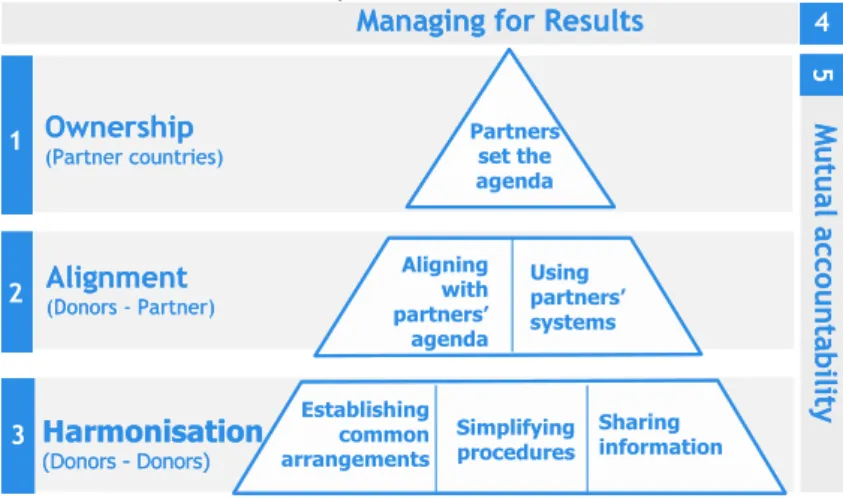
The international consensus on the importance of aid quality (as opposed to deliverables) is best captured by the Paris Declaration on Aid Effectiveness, which synthesises earlier thinking in this area (OECD/DAC, 2005). The Declaration is based on the premise that donor behaviour at the country-level can enhance the effectiveness of aid by improving their partner relationships and aid delivery processes. The Paris Declaration is built around five mutually reinforcing dimensions: ownership; alignment; harmonisation; managing for results; and mutual accountability (see Figure 1). The changes in behaviour implied by these dimensions are expected to improve the development effectiveness of the country-level system as a whole.
2.1.5 Organisational effectiveness
The term „organisational effectiveness‟ is usually deployed to contrast with „development effectiveness‟. It focuses on the direct results of an agency‟s interventions, for which it can be held accountable, in contrast with development outcomes, which are the effect of many agencies‟ interventions. The term organisational effectiveness usually focuses on the internal systems that are geared towards producing development outputs and outcomes.7 In this sense, it is
synonymous with results based management and managing for development results (see below). There are two main questions:
How well do organisations manage themselves internally in order to maximise their development outcomes? and
How well do organisations behave in relation to the Paris Declaration?
6 See for example Collier and Dollar, 2001
Figure 1: The Five Pillars of the Paris Declaration (OECD Working Party on Aid Effectiveness)
2.1.6 Results based management
RBM originated in the private sector, but was soon adopted by public sector organisations in western governments. RBM is also known as Performance Based Management. RBM is a management tool that applies a results focus to all internal business processes (e.g. planning, operations, budget, human resources, knowledge management), and all levels of the organisation (corporate management, divisions and departments, work units, individuals). As deployed by development agencies, RBM can be defined as a management strategy that aims to link internal performance to the achievement of development outcomes (OECD/DAC, 2000). RBM emphasises a learning culture and stresses the measurement of results through monitoring and evaluation.
2.1.7 Managing for Development Results
This refers to how well organisations are managing themselves internally through the application of RBM techniques in order to maximise their contribution to development outcomes. It is essentially an RBM approach, but focuses on the difference between managing for as opposed to by results. This is because, in contrast to private sector firms, it is much more difficult to attribute results directly to an individual agency‟s interventions. Early thinking on MfDR was developed in 2002 and led to the formation of the MDB MfDR Working Group. As part of the OECD/DAC Working Group on Aid Effectiveness, a Joint Venture on MfDR was formed between the DAC and the MDBs, which has set out some core principles, promoted MfDR at developing country level and produced a best practice Sourcebook on MfDR.8 This is the fourth dimension of
the Paris Declaration. MfDR may also be referred to as „organisational effectiveness‟ or „internal performance.‟
8 The MfDR principles are: focusing the dialogue on results at all phases of the development process;
aligning programming, monitoring, and evaluation with results; keeping measurement and reporting simple; managing for, not by, results; using results information for learning and decision-making (OECD/DAC, 2007a). Aligning with partners’ agenda Using partners’ systems Alignment (Donors - Partner) 2 Mutu al acc ountabili ty Ownership
(Partner countries) Partners set the
agenda 1 Harmonisation (Donors - Donors) Establishing common arrangements Simplifying procedures Sharing information 3
Managing for Results 4
5 Aligning with partners’ agenda Using partners’ systems Alignment (Donors - Partner) 2 Mutu al acc ountabili ty Ownership
(Partner countries) Partners set the
agenda 1 Harmonisation (Donors - Donors) Establishing common arrangements Simplifying procedures Sharing information 3
Managing for Results 4
2.1.8 Efficiency
The term effectiveness is often contrasted with that of efficiency. Efficiency focuses on the input-output relationship, as opposed to outputs and outcomes. High efficiency would be exemplified by the delivery of a large number of outputs (schools built, teachers trained) for given inputs. However, these outputs may not necessarily produce the desired outcomes, such as increased primary school enrolments or literacy rates because of, for example, faulty design (schools built in the wrong places, teachers given inappropriate training). Assessing efficiency can be an aspect of both RBM and MfDR approaches.
2.1.9 Relevance
The term relevance has three aspects:
Relevance to the partner country priorities (as expressed in Poverty Reduction Strategy Papers (PRSPs), for example);
Relevance to donor policies and strategies (e.g. gender, environment, human rights); and
Relevance to the mandate of the multilateral.
These three aspects may conflict. For example, a donor may give higher priority to some aspects (e.g. human rights) than a partner country, and a multilateral may be restricted by its mandate to addressing aspects considered less important by the bilateral donor.
2.1.8 Performance
This is usually considered to be a broader term than effectiveness and includes efficiency and behaviour. However, in practice, these terms are often used interchangeably.
2.2 Categorising the Assessment Approaches
We propose a two dimensional framework for categorising the different assessment approaches. 9 The first dimension is based on the aspect of
effectiveness examined; the second dimension highlights the commissioning agency
that undertakes the assessment. These two dimensions are important because they imply differences in the objectives, the types of information gathered, the methodologies used, and the conclusions that may be reached about multilateral effectiveness.
In terms of the aspect of effectiveness examined, there are the following:
Evaluations assess the development outcomes and impacts that are achieved at country level as a result of the multilateral‟s activities, policies or processes;
9 There are other ways of categorising multilateral effectiveness assessments. Meier looks at bilateral
approaches only and categorises them according to their degree of institutionalisation (Meier, 2007a); Obser, looking at both bilateral and multilateral approaches, categorises them by the purpose of the assessment approach (Obser, 2007).
Results based management assessments focus on the effectiveness of the multilateral‟s internal business processes, which are aimed at achieving development outcomes;
Assessments of partnership behaviour examine how multilaterals conduct their business with other development partners, especially at country level. Increasingly such assessments examine how well organisations are performing against the principles of the Paris Declaration;
Synthetic Approaches cover several of these aspects in order to make a more comprehensive assessment of effectiveness.
In terms of the commissioning agency, there are:
Multilaterals themselves, including their internal monitoring and evaluation (M&E) systems (such as portfolio reviews) and their independent evaluations;
Bilateral assessments, carried out by agencies separately;
International collaborations, amongst bilaterals or by bilateral and multilaterals together, including joint bilateral surveys (MOPAN), or bilateral/multilateral surveys (OECD/DAC and the Strategic Partnership for Africa (SPA)); and
NGOs, such as Debt Relief International.
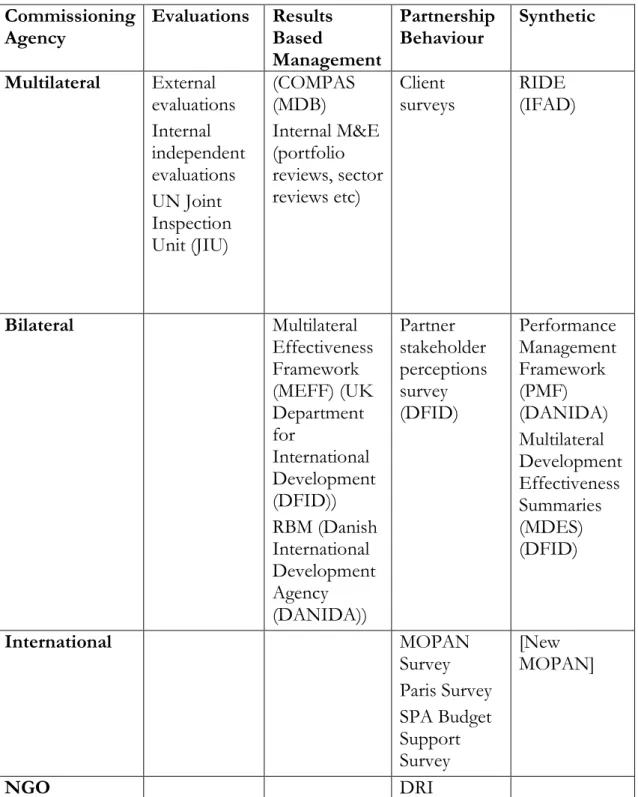
The approaches identified with this categorisation are presented in Table 1 below. A number of other bilateral approaches are not listed in this table, such as the Canadian Multilateral Evaluation Relevance Assessment (MERA) and the Dutch Multilateral Monitoring Survey because neither their methodologies nor their results are publicly available.10
Table 1: Framework for analysing approaches to assessing multilateral effectiveness
Commissioning
Agency Evaluations Results Based
Management Partnership Behaviour Synthetic Multilateral External evaluations Internal independent evaluations UN Joint Inspection Unit (JIU) (COMPAS (MDB) Internal M&E (portfolio reviews, sector reviews etc) Client
surveys RIDE (IFAD)
Bilateral Multilateral Effectiveness Framework (MEFF) (UK Department for International Development (DFID)) RBM (Danish International Development Agency (DANIDA)) Partner stakeholder perceptions survey (DFID) Performance Management Framework (PMF) (DANIDA) Multilateral Development Effectiveness Summaries (MDES) (DFID) International MOPAN Survey Paris Survey SPA Budget Support Survey [New MOPAN] NGO DRI
We now briefly describe the characteristics of each of the assessment approaches identified above. Further details are provided in Annex 2.
2.3 Aspect of Effectiveness Examined
2.3.1 Evaluations
Evaluation has been described as „the systematic and objective assessment of an on-going or completed project, programme or policy, its design, implementation and results‟ (OECD/DAC,
2002). Evaluations examine the different levels of the logframe: inputs, outputs, outcomes and impacts, but in most cases the emphasis is on outcomes and impact. Standard criteria include relevance, effectiveness, efficiency, impact and sustainability. Evaluations cover operational projects, country programmes, specific policies and/or corporate issues. Most evaluations, however, are focused on operational work and are usually carried out after the activity or intervention has taken place. Therefore they are able to judge the likely achievement of development outcomes better than other M&E processes.
Evaluations use a range of methodologies to enable triangulation between different sources of information. These include documentary reviews, primary data collection, and secondary literature reviews. Fieldwork is carried-out involving some or all of the following: site visits; key informant interviews, focus groups, workshops and mini-surveys. Beneficiaries will also be included. Evaluations therefore offer more breadth and depth than other assessment approaches.
Most large multilaterals have evaluation offices within their institutions. The majority of these have policies guiding evaluation practice at operational and policy levels and the quality of these policies is very high (Lloyd et al, 2007). In recent years, multilaterals have begun to focus on increasing the independence of their evaluation offices by reporting to their governing bodies rather than to management and this is now the case in all MDBs.11 Under the auspices of the
OECD/DAC, the MDB Evaluation Group and the UN Evaluation Group (UNEG), there has been considerable effort amongst bilaterals and multilaterals to achieve consistency of standards in evaluation work. Amongst the variety of assessments of multilateral effectiveness considered here, only evaluation work has such standards.
2.3.2 Results based management assessments
RBM approaches look at the way in which the multilateral internal operational and support systems are organised towards the achievement of development results, rather than the actual results produced. For example, if good project outcomes depend on good design quality and project supervision, then systems should be in place to monitor design and supervision. The principle source of data for RBM assessments is internal M&E reporting by the multilaterals. Most agencies have incorporated an RBM focus into their project portfolio monitoring and have now expanded these systems to include country programme monitoring. Data exist on such aspects as design, supervision, disbursement, and management of project risk. The adoption of an RBM approach is less commonly applied to support systems such as human resources (HR), budget and finance, communications etc. Only a few multilaterals have a comprehensive corporate system for monitoring a results focus throughout the organisation,12 for example through Key Performance
Indicators and a Balanced Scorecard.
11 For an overview of evaluation units in a range of agencies, as well as a discussion of some of the key
issues, see Foresti et al, 2007.
Bilateral assessments are limited in the degree to which they can independently assess the quality of multilateral RBM systems without incurring substantial transactions costs. They can ask whether the systems exist or not, but it is difficult to assess how well they are actually implemented without intensive research. They therefore have to rely on multilateral M&E reporting for this information.
2.3.3 Assessments of partnership behaviour
The assessments of the partnership behaviour of multilaterals aim to investigate the quality of aid, as manifested in their relations with partner governments and other aid agencies, particularly at country level. These assessments have focused primarily on the harmonisation and alignment agenda, particularly the criteria set out by the Paris Declaration. A number of the methodologies go beyond these criteria to look at other aspects of behaviour. The most developed is the DRI methodology, which assesses a series of criteria including donor policies as well as donor procedures (see section 3.3.6 for more detail). Other reports (e.g. DFID‟s Stakeholder Perceptions Survey), have confirmed the importance of these additional criteria for partner governments and wider stakeholders (see annex 3 for more detail).
The principle methodology in these assessments is surveys of perceived behaviour carried out through questionnaires or focus group discussions. Five of the six approaches identified here – the MOPAN survey, DFID‟s stakeholder perception survey, multilateral client surveys and the SPA budget support survey – use this methodology. 13
The DRI methodology differs in that it uses donors‟ own documents to score against its key indicators. It also examines partner governments‟ own aid policies and works with government officials to combine the two analyses.
Partnership behaviour surveys are particularly favoured by bilateral and international groupings because of their relatively low transactions costs, and as a way of monitoring commitments to the Paris harmonisation and alignment agenda. Client surveys by multilaterals have been rare until recently.
2.3.4 Synthetic approaches
In the past, the different types of assessments described above have been conducted in a piecemeal fashion, giving a fragmented and sometimes inconsistent picture of a multilateral‟s effectiveness. However, bilateral policy-makers need an overall „bottom line‟ conclusion on the organisation‟s effectiveness to facilitate their decision-making and accountability reporting. What is needed is a synthetic approach that weaves together the different types of information in order to present a more comprehensive view about effectiveness. Such an approach would combine information from evaluations, RBM assessments and partnership behaviour surveys, and therefore such separate approaches would still be necessary. Ideally, this synthesis would be provided by the multilaterals themselves, since they have the relevant information and would probably benefit from such a
13 A number of the other bilateral approaches not covered in this report also survey the perceptions of
synthesis as well.However, to date there is only one suchexample(from IFAD). In its absence, two bilaterals have produced syntheses of multilateral effectiveness, Danida (the PMF) and DFID (the MDES), but this has required an additional burden in terms of transactions costs. In order to spread this task more widely, the MOPAN group is now moving towards a common approach for combining different types of effectiveness assessment (see 3.4.4 below).
2.4 Types of Commissioning Agent
As mentioned above, the main types of commissioning agent are: multilaterals, bilaterals working on their own, international groupings, and NGOs. The main differences between them are the purpose and use of the assessments, the resource requirements and the nature of the methodology. Although in theory, the assessment of effectiveness should be driven by both accountability and learning, in practice most assessments of multilateral effectiveness are driven by accountability concerns.
2.4.1 Multilateral evaluations and RBM assessments
These have mainly focused on operational work and have been less concerned with behavioural aspects. They primarily evolved as an accountability mechanism for their Executive Boards or Governing Bodies, and increasingly are used for internal management and organisational learning. Evaluations have had more emphasis on learning, compared with portfolio reviews, which are more used by management for internal accountability and M&E reporting. Because of the importance of both types of assessments to internal stakeholders, the resources assigned are substantial and the methodologies complex. However, the multilaterals have been less inclined to conduct client surveys.
2.4.2 Bilateral assessments
These have been driven by bilateral agencies‟ own internal interests and public pressure to account for their multilateral spend. They have been used as an input to internal financing decisions, to inform the development of partnership strategies regarding specific multilaterals, and to cover gaps in effectiveness reporting by the multilaterals, for example on partnership (Meier, 2007a). They have used a variety of methodologies, including some innovative approaches. However, few of these have been carried out more than once because of the transactions costs involved.
2.4.3 International groupings
These reflect both bilateral domestic accountability concerns and new international pressures to monitor the Paris commitments. They rely principally on survey methodologies, focusing particularly on partnership issues. The NGO DRI has developed a different type of assessment methodology in order to help partner governments make more informed choices about their engagement with donors.
3
Mapping Different Approaches for Assessing Multilateral
Effectiveness
3.1 Evaluations
3.1.1 External evaluations
There have only been a few independent external evaluations of multilaterals, and these have usually been commissioned by the executive boards of the organisation and have focused on concessional lending programmes. The scope and methodology is usually extensive and includes a wide variety of aspects and methods.14 In 2004, an independent external evaluation (IEE) was conducted on
the AfDB, led by the Institute for Development Studies, Sussex UK. It covered three replenishment periods (1996-2004) and looked at the changing context being addressed by the Bank, internal institutional changes, policy responses, programming instruments and processes, and its operational effectiveness. In 2005, an IEE was conducted on the IFAD, led by the Independent Consultants ITAD Ltd., UK. It reviewed IFAD‟s performance between 1994-2003 and covered the relevance of IFAD‟s mandate, its project portfolio performance and impact, and management performance (governance, policy and strategy development, HR, partnership, knowledge management and learning, internal management). In 2007, an IEE was conducted on the Food and Agriculture Organisation (FAO), by a team independent consultants led by Leif Christoffersen. It focused on four areas: FAO‟s role in the multilateral system, its technical work, its management and administration, and its governance (FAO, 2007). It should be mentioned that the OECD/DAC Network on Development Evaluation, which brings together bilaterals and multilaterals, designed a peer review process of the multilateral evaluation function in order to do away with the costly institutional evaluations funded by donors. So far UNICEF, UNDP and WFP have been examined.15
3.1.2 Internal multilateral evaluations
As mentioned above, multilateral evaluations cover a variety of operational, thematic and corporate issues. It would be difficult to single out any one of these to examine here. By way of example, however, the World Bank (WB) publishes an Annual Review of Development Effectiveness (ARDE), which presents the results of its independent assessments of project performance as well as a review of some topic related to development effectiveness (which varies each year).16
Separately, it also publishes reports on its evaluations of Bank country
14 For example, documentary reviews, surveys, interviews, focus group discussions, and country visits. 15http://www.oecd.org/LongAbstract/0,3425,en_2649_3236398_38967446_1_1_1_1,00.html 16 For the 2006 Annual Review of Development Effectiveness see
http://web.worldbank.org/WBSITE/EXTERNAL/EXTOED/EXTOEDARDE/EXT2006ANNREV DEVEFF/0,,menuPK:3079280~pagePK:64168427~piPK:64168435~theSitePK:3079226,00.html
programmes and other thematic evaluations.17 Finally, it publishes an Annual
Report on Operations Evaluation (AROE), which examines different aspects of the Banks M&E system as a whole.18
3.1.3 UN Joint Investigation Unit
The UN‟s JIU has a system-wide evaluation mandate from the General Assembly to support evaluation for the UN System as a whole. The JIU is mandated to provide an independent review, through inspection and evaluation, aimed at improving management and methods, and at achieving greater coordination between organisations. The JIU produces an average of nine reports a year (ranging from 6 to 15). These are a mix of system-wide, thematic and agency specific topics. Though this is a valuable source of independent analysis and information for the General Assembly, its current programme does not constitute an adequate system-wide evaluation function because of its limited size, scope of work and ad hoc approach to topic selection (UNEG 2007). Thus, in 2006 the High-Level Panel on System Wide Coherence recommended that a UN system-wide independent evaluation mechanism should be established by 2008 to monitor how system-wide goals are being delivered.
3.2 Results Based Management Assessments
3.2.1 Common Performance Assessment System (COMPAS)
In order to promote accountability and mutual learning, the MDB Working Group on MfDR developed COMPAS in 2004 to provide the five members19 of
the group with a common framework to jointly report on their own performance. COMPAS aims to provide managers and shareholders of the MDBs with information on how they are contributing to development results and improving their contributions over time (MfDR, 2006). The COMPAS focuses on RBM practices and results, but also includes aspects of partnership and evaluation. The MDBs evaluate themselves against 30 performance indicators grouped into seven categories that relate to results orientation at the partner country level, institutional level and global partnership level. These categories are: MfDR capacity building at country level; results-based country strategies; performance-based concessional lending; project management, implementation and M&E; institutional learning (including from evaluation); results-focused HR; and harmonisation among development agencies.
Minor changes to the indicators were made to the second COMPAS in 2006 in order to increase specificity, reduce the room for discretion, and therefore increase the objectivity and credibility of the COMPAS. These indicators will provide the baseline for tracking future progress (MfDR, 2007). COMPAS is an important initiative in that it is the first case of a joint, publicly available
17 See the Independent Evaluation Group‟s website http://www.worldbank.org/ieg/ 18 For the 2006 Annual Report on Operations Evaluation see
http://web.worldbank.org/WBSITE/EXTERNAL/EXTOED/EXTANNREPOPEEVA/0,,contentMD K:21115852~menuPK:3073384~pagePK:64168427~piPK:64168435~theSitePK:3073310,00.html
19 The five members are as follows: AfDB, Asian Development Bank (AsDB), EBRD, Inter-American
assessment amongst multilateral peers. It generates data that could populate or complement other methodologies such as MOPAN and MDES (Meier, 2007b). In addition, the identification of common definitions and RBM practices amongst MDBs can provide the basis for a more general set of RBM best practices (DADA International, 2006).
3.2.2 Internal performance monitoring and evaluation systems
The managements of multilaterals monitor and report on the implementation of their projects and programmes (sectoral, country, and regional). These reports commonly include, for example, disbursement rates, project supervision ratings, likelihood of achieving intended development outcomes, projects at risk, etc. The coverage of these reports depends on the rate of compliance with internal monitoring procedures, but in theory they should cover all ongoing activities. Some MDBs also have arms length reviews20 of project design and supervision
quality. The WB‟s Quality Assurance Group led the way in this respect, with its annual reviews of the quality of project design, supervision and economic and sector work. In addition, some multilaterals commission special performance reviews as part of their replenishments21 or budget process. For example, the
AfDB Review of Project Completion Reports (PCR) in 2006focused primarily on operational effectiveness, driven by the necessity to improve the quality of PCRs and to strengthen the self-evaluation system of AfDB. This review synthesised a range of information by examining both quality of reports and the adequacy of performance ratings, AfDB‟s internal evaluation unit conducted a desk review of 42 PCRs submitted from 2003-2005 (these evaluate a project‟s results, implementation effectiveness and contribution to development and sustainability). In addition, a range of relevant reports such as the country strategy papers, appraisal reports, country portfolio reviews, supervision reports and other sector policy reports were reviewed (AfDB, 2006).
3.2.3 Multilateral Effectiveness Framework (MEFF)
During 2003-04, DFID established the MEFF for assessing the organisational effectiveness of multilaterals that it supports from headquarters. Its objective was to provide information for public accountability, and as an input into policy and financing decisions related to particular multilaterals. Using a RBM approach, the MEFF assesses the effectiveness of each multilateral from three perspectives: internal performance, focus on country-level results, and partnership. For each perspective, it evaluates eight corporate management systems by using a checklist with 72 questions, and then creates a scorecard using a traffic light system to score
20 Additional reviews by internal staff who are not associated with the project. These reviews are separate
from the self-assessments by project managers that form the basis of project reporting, but are not fully independent as are evaluations.
21 Examples would include the World Bank reviews of Country Assistance Strategies, and the budget
implementation reports of some UN agencies (e.g. the International Labour Organisation (ILO) and World Health Organisation (WHO)). See for example the World Bank‟s website on IDA 15 -
http://web.worldbank.org/WBSITE/EXTERNAL/EXTABOUTUS/IDA/0,,contentMDK:21234677~ menuPK:3492269~pagePK:51236175~piPK:437394~theSitePK:73154,00.html or the African
Development Bank‟s website ADF f11
an agency‟s effectiveness in each area. DFID developed the system internally, with in-house staff conducting the assessments of twenty-three organisations.22
Amongst bilateral donor methodologies, the MEFF comes closest to a comprehensive measurement approach and has been considered by other donors as a good starting point for building consensus and a harmonised approach towards effectiveness measurement (DADA International, 2006). However, it does not assess how well multilateral operational systems are implemented, or what results are actually achieved (Scott, 2005a). The framework was designed to be applicable to all multilateral organisations, but was slightly adapted for humanitarian organisations (Scott, 2005a). However, concerns were expressed that the framework did not allow sufficiently for the individual specificity of some organisations (DADA International, 2006).
3.2.4 RBM assessment (DANIDA)
In 2004, DANIDA developed a methodology to review the extent to which RBM principles form the basis of the work of monitoring and evaluation units within the assessed multilateral. The goals of the RBM assessment are to map, analyse and provide recommendations for the strengthening of a multilateral‟s RBM system. It seeks to identify what RBM tools are in place, as well as how effectively they are used in pursuit of improved organisational effectiveness, and efficiency at delivering development results (Meier, 2007a). The RBM Assessment is carried out by a peer panel and describes agencies‟ evaluation systems and policies using the DAC Evaluation Principles. For example, it assesses whether the evaluations are independent, credible and useable. Data are collected from multilateral documentation, staff interviews, on-site observations and discussion workshops. To date, DANIDA has completed assessments for UNDP, United Nations Population Fund (UNFPA), IFAD, United Nations Office of the High Commissioner for Human Rights (OHCHR) and United Nations Children‟s Fund (UNICEF).
Potentially the RBM Assessment could lessen, or even eliminate, reliance on external evaluations of multilaterals, though this will require support from a broad range of donors (DADA International, 2006). It serves the dual purpose of generating credible assessment information, while focusing management‟s attention on areas of critical long term importance to bilateral objectives. Thus, it has good basis for evolving into a common approach for assessing multilateral effectiveness (Meier, 2007a). However, donors still recognise the need for rigorous attention to the definition of results and an international institutional arrangement for objective verification purposes (DADA International, 2006).
22 AfDB, AsDB, EBRD, European Commission (EC), FAO, HABITAT, IADB, International Committee
of the Red Cross (ICRC), IFAD, International Federation of Red Cross/Red Crescent Societies (IFRC), United Nations Office for the Coordination of Humanitarian Affairs (OCHA), OHCHR, Joint United Nations Programme on HIV/AIDS (UNAIDS), UNDP, United Nations Educational, Scientific and Cultural Organisation (UNESCO), UNFPA, United Nations High Commissioner for Refugees (UNHCR), UNICEF, United Nations Industrial Development Organisation (UNIDO), United Nations Development Fund for Women (UNIFEM,) World Food Programme (WFP), WHO, World Bank
3.3 Assessments of Partnership Behaviour
3.3.1 Multilateral client surveys
To-date UNDP is the only multilateral that systematically seeks feedback on its performance from donors, partner governments, civil society organisation, through its annual stakeholder perceptions survey.23 Other multilaterals have used
client surveys on a sporadic basis (for example, as part of country programme design), and are usually country specific. 24 None of these are in the public domain. 3.3.2 Multilateral organisation effectiveness stakeholder perceptions survey
In 2007, DFID commissioned a pilot project to identify the views of stakeholders in recipient countries about the performance of key multilateral organisations, and their preferences for which organisations should disburse additional aid. Perceptions were sought through a locally administered questionnaire. This was completed by well-informed individuals from five stakeholder groups: business leaders, civil servants, civil society leaders, government ministers, and Members of Parliament. The survey assessed multilateral performance according to three measures from the Paris Declaration: overall development effectiveness, harmonisation and alignment. In addition, respondents were asked to rank the multilateral against fifteen performance criteria related to funding and policies and procedures (adapted from the DRI criteria), and to rank the organisation in the order of preferred disbursement channel.
Until this survey, there had been no systematic studies to seek the views of the range of stakeholders who interact with donors in-country and are responsible for implementing donor programmes. Limitations of the survey include its short data collection period and an overly long questionnaire. The survey attempted to minimise criticisms of bias and subjectivity by careful choice of respondents. Almost uniquely out of the performance assessments, data were subjected to statistical testing to ensure robust results (Burall et al, 2007).
3.3.3 MOPAN Survey
Since 2003, a network of eleven countries has conducted an annual survey of 3-4 selected multilaterals in 8-10 countries where MOPAN members have bilateral programmes. MOPAN members use the findings of the surveys for a range of reasons relating to: their own accountability for multilateral financing; as input into their policy towards multilaterals; to strengthen their relationship with multilaterals in governance and joint activities; and to contribute to the wider debate of aid effectiveness (MOPAN 2006). The MOPAN survey assesses the quality of multilateral partnership behaviour towards national stakeholders and other international development agencies at the country level. Partnership is assessed through perception surveys completed by MOPAN member country-level staff and a collective focus group discussion. As a final output, MOPAN
23 See for example - http://www.ke.undp.org/PartnershipsurveyKenya.pdf - though global results do not
appear to be publicly available on the internet.
24 However, it is important to note that the World Bank did systematically monitor its partnership
presents and publishes an overall synthesis report that draws from the various country level surveys, giving an opportunity for the assessed multilateral to provide feedback. To date, the MOPAN Survey has released four synthesis reports assessing eleven multilaterals.25
The MOPAN Survey represents a positive step towards uniting bilateral donor efforts in assessing multilaterals. It fills an important gap in understanding how multilaterals actually operate at the country level, based on bilateral experiences of working with them. To date, the MOPAN surveys provide the most important regular and publicly available source of information on multilateral partnership behaviour at country level. Because of the importance of the bilateral grouping represented by MOPAN, the surveys have been important in focusing the attention of the multilaterals on this aspect of their effectiveness. Another benefit is its design as a light and rapid exercise with minimal transaction costs, which allows for easy replication and sustainability (Meier 2007a).The methodology is currently being expanded to include other approaches (see 3.4.4)
3.3.4 Paris Declaration Survey
In the Paris Declaration, donors and partners agreed to monitor progress in improving aid effectiveness against 56 specific actions, from which 12 indicators were established and targets set for 2010. This survey was designed to generate an accurate picture of existing aid practices as a baseline for assessing progress towards the 12 indicators.26 It is also intended to stimulate a broad-based dialogue
on how to make aid more effective and promote agreement on specific actions that contribute to successful implementation of the Paris agenda at country level (OECD/DAC, 2007b). The Survey is managed at country level by a national co-ordinator appointed by the government and supported by donors when appropriate. The survey consists of two questionnaires sent separately to in-country donors and government which asks for both quantitative information and qualitative commentary about donors (bilateral and multilateral) relating to the relevant Paris Declaration indicators. These questionnaires are then compiled into a report at the country level.
The Baseline Survey report published in 2007 is based on evidence collected from a survey of activities in 2005 for 34 self-selected countries and 60 donor organisations. Two main constraints were identified in the survey process (OECD/DAC, 2007b). One was the separate treatment of the two main parts of the survey, which disconnected broad areas of the Paris commitments – aid delivery on the one hand and country systems on the other. The second was the broad scope of the guidance, which allowed for variations in defining the indicators in each country; this diverted discussions from factual into definitional issues. Some stakeholders also found the Baseline Survey process to be too onerous and time-consuming (OECD/DAC, 2007b). Nevertheless, more is now
25 AfDB (twice), ADB, IADB, ILO, FAO, UNAIDS, UNDP (twice), UNPFA, UNICEF, World Bank, and
WHO (twice)
26 Indicators related to the following principles: ownership, harmonisation, alignment, results‟ management
known about aid management systems and practices at the country level as a result of the Baseline Survey. In addition, it has contributed to generating dialogue on aid effectiveness and how to improve national monitoring efforts. Rather than discussing the multilaterals separately as a group, the report provides information on the performance of individual bilaterals and multilaterals as well as overall data relating to the Paris Declaration indicators for eight specific multilaterals.27
Another survey is being conducted as this report is being written, to be presented to the High-Level Summit in Accra in September 2008. A final survey will be carried out prior to the planned Summit in 2010.
3.3.5 SPA Budget Support Survey
Since 2003, the Budget Support Working Group of the SPA has engaged in an annual monitoring exercise that tracks the progress made by bilaterals and multilaterals in aligning and harmonising their budget support activities in a number of African countries. The SPA Budget Support Survey consists of questionnaires sent to development agencies and government representatives to obtain perspectives on general and sector budget support practices with regard to alignment.28 In each country, a lead agency is identified with responsibility for
organising the completion and return of the questionnaires. The survey evaluates the predictability of budget support, the links between budget support and Poverty Reduction Strategy (PRS) processes, support to public finance management and government views on donor behaviour in budget support relationships. This is carried out in a way that ensures that data from earlier surveys can be compared with the most recent data. In the past four years, 21 agencies29 in 19 PRS countries have participated in the survey.
The process of responding to this survey has provided some important opportunities for dialogue amongst agencies and national partners. In addition, the results obtained from the SPA Budget Support Survey represent the most comprehensive data currently available on the progress of budget support alignment with the PRS and has potential for trend analysis (SPA, 2007). At the same time, it is acknowledged that there was considerable overlap between the SPA Budget Support Survey and the 2006 Paris Declaration Baseline Survey processes, and some countries experienced increased transactions costs as a result. However, it should be noted that whereas the Baseline Survey collected data across the broad range of Paris Declaration indicators, the SPA survey investigates more deeply the mechanics and relationships of budget support.
3.3.6 Debt Relief International
DRI prepared a methodology in 2004 to enable Heavily Indebted Poor Country (HIPC) governments to assess the quality of aid they receive as part of the process of designing overall national debt and new financing strategies. The goal of the methodology is to help HIPC governments identify which are the „best‟ external
27 AfDB, AsDB, EC, GAVI Alliance, Global Fund for Aids, TB and Malaria (GFATM), IADB, United
Nations, WB
28 In 2006, the survey also covered sector budget support. 29 Multilateral donors include AfDB, EC, UNFP, and WB
financing sources to fund their national development programmes, and how they can improve the quality of all their external finance. Looking at both the quantity and quality of external assistance flows to African governments, the DRI framework analyses the policies and procedures of donors as well as HIPC governments. Table 2 lists the criteria for analysing donor policies and procedures.
Table 2: DRI criteria for assessing donor aid quality (source Johnson et al, 2004)
Donor policies Donor procedures
concessionality, as measured by the grant element;
types of assistance, budget/balance of payments support, project, TA or food/commodity;
channel of assistance, via the budget or off-budget; sectors and projects, support is for PRSP or donor-led priorities;
flexibility of assistance, can aid be
channelled to new areas and/or used to meet unexpected financing gaps arising from economic shocks;
predictability of assistance, multi- or one-year commitments and whether they are fulfilled; policy
conditionality, the number and degree of enforcement of policy conditions;
policy dialogue, the degree of donor engagement in the economic policy dialogue and independent support for government policies or alignment with Bretton Woods Institutions.
conditions precedent, types and degree of enforcement and the disbursement delays arising in meeting these conditions;
disbursement methods, via cash direct to the budget or reimbursement claims;
disbursement procedures, the number and complexity and disbursement delays arising;
procurement procedures, the number and complexity and disbursement delays arising;
co-ordination, the degree of
harmonisation between government and donors/creditors
In the first part of the survey, Finance Ministry officials from each HIPC government assign each donor a score for 23 different evaluation criteria on the basis of objectively verifiable thresholds. The scores are aggregated to identify which aspects present the worst problems, and which donors have the best/worst quality aid from the perspective of the each government. The second part provides for the analysis of the government‟s own policies and procedures and the impact these have on the delivery of external assistance flows. By combining these two aspects of the survey, HIPC governments have a useful source of information to use to identify donors to provide additional aid.
Unlike most other assessments, the DRI methodology is led by HIPC governments themselves and systematically monitors whether agencies are living up to their pledges on aid quality and support for the PRSP framework consistently across a range of African countries. This assessment has only been
published once. While individual country results are not published, DRI has published the aggregate scores across all of the participating countries (after stripping out the country specific weightings). These aggregate scores cover 10 multilaterals30 and 18 bilaterals (Johnson et al, 2004).
3.4 Synthetic Approaches
3.4.1 Report on IFAD’s Development Effectiveness (RIDE)
IFAD has recently produced the first annual report on its development effectiveness, or RIDE (IFAD, 2007). The purpose of the RIDE is to assess the relevance of its mandate and its organisational effectiveness and efficiency. Its scope is broader than development effectiveness reports from other multilaterals in that it is not based exclusively on evaluation data. It also incorporates portfolio monitoring information, internal corporate performance monitoring, the budget, and recent initiatives relating to the broader international harmonisation and alignment agenda. The RIDE is unusual in other respects too: it assesses the relevance of its role and mandate within the changing international context. IFAD has rolled out a comprehensive corporate process to integrate an MfDR approach into all its internal operational and support systems, with quarterly monitoring of corporate key performance indicators. The RIDE reports on this process and the first results of the key performance indicators As such, the RIDE provides a brief, synthetic report on its organisational and development effectiveness, from project to corporate level (IFAD, 2007).
3.4.2 Performance Management Framework (PMF)
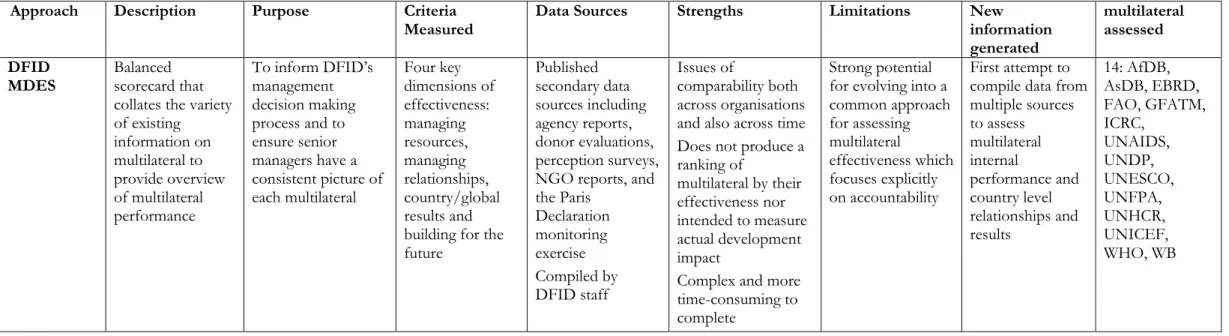
In 2003, DANIDA developed the PMF as part of a larger internal reform of the management of Danish development cooperation. The objectives of PMF are to: enhance the quality of Danish development cooperation; improve management and continuous learning; and strengthen accountability. It serves internal management purposes by providing timely and reliable information on progress of activities, and it ensures accountability and reporting to external stakeholders. The PMF uses a series of tools that combine qualitative and quantitative information gathered at three levels (DANIDA corporate, multilateral headquarter and multilateral country level) to assess multilateral development cooperation. Data sources include multilateral strategies, perception analyses (by its own embassy staff and through MOPAN), and assessments of multilateral organisations‟ evaluation and reporting systems. In the measurement of both organisational practices and field level results, the PMF relies on the objectives, targets and indicators established by the relevant organisations themselves as set out in the organisation‟s own vision and strategies (DADA International, 2006). The benefits of the PMF are its comprehensiveness – it solicits views from multiple levels – and its dual purpose of measurement and management. The PMF systematically focuses on results with a view to providing performance
30 AfDB, Arab Bank for Economic Development in Africa, EU, European Investment Bank, IDA, IFAD,