© 2019 by the Serbian Biological Society How to cite this article: Nikpour-Rashidabad N, Tavasolee A, Torabian S, 321 Farhangi-Abriz S. The effect of biochar on the physiological, morphological and
anatomical characteristics of mung bean roots after exposure to salt stress. Arch Biol Sci. 2019;71(2):321-7.
The effect of biochar on the physiological, morphological and anatomical characteristics
of mung bean roots after exposure to salt stress
Neda Nikpour-Rashidabad1, Alireza Tavasolee2, Shahram Torabian3 and Salar Farhangi-Abriz1,*
1Department of Plant Eco-Physiology, Faculty of Agriculture, University of Tabriz, Tabriz, Iran
2Soil and Water Research Department, East Azerbaijan Agricultural and Natural Resources Research and Education Center,
AREEO, Tabriz, Iran
3Department of Agronomy and Plant Breeding, College of Agriculture, Isfahan University of Technology, Isfahan, Iran
*Corresponding author: [email protected]
Received: October 5, 2018; Revised: March 5, 2019; Accepted: March 12, 2019; Published online: March 18, 2019
Abstract: To investigate the changes in the anatomical and physiological characteristics of mung bean roots in response to biochar treatment during salt stress, a pot experiment was conducted. Mung bean plants were subjected to three biochar
concentrations (0, 50 and 100 g kg-1 soil) and three salinity treatments (0, 5 and 10 dSm-1 NaCl). Salinity decreased root
growth, vascular cylinder (VC) and cortical parenchyma (CP) areas, affecting the VC/CP ratio, shoot dry weight, the rela-tive water content (RWC) of roots and leaves, and the root indole-3-acetic acid (IAA) content. It increased specific root length, the shoot/root ratio and root abscisic acid (ABA), and 1-aminocyclopropane-1-carboxylic acid (ACC) contents. Plant growth, RWC, the shoot/root ratio, specific root length, total root area, VC and CP areas, and the IAA/ABA and IAA/ ACC ratios were increased by biochar under saline media. Biochar improved xylem structure, the plant growth regulator IAA, and decreased stress hormones, ABA and ACC, which accelerate plant senescence, consequently increasing mung bean growth under salt stress.
Keywords: biochar; mung bean; plant hormones; root anatomy; salinity
INTRODUCTION
Environmental factors influence both root and shoot growth [1]. Plant survival under normal and stress conditions depends on the ability of the root system to establish itself in locations where water and nutri-ents are available for uptake and translocation [2-3]. A significant part of the world’s land area is affected either by salinity or sodicity [4]. A salt concentration of 4 dS m-1 causes an osmotic pressure of about 0.2 MPa and affects the ability of plants to take up water, reducing the rate of cell expansion. The root system influences crop productivity through uptake of water and nutrients [5]. Root anatomical and morphological parameters are affected by salt stress, especially sodium chloride [6-8]. It is obvious that under environmental stress, root biomass decreases but the anatomical and morphological alterations under saline conditions are still unclear. Salinity diminishes root diameter and length [9], affects expansion processes and cell
division [10,11], and reduces the size of apical meri-stems, the VC and cortex. Furthermore, exodermis and endodermis suberization processes are expedited by salt stress [12,13]. The main anatomical response to salinity is cell-wall alteration. In cotton plants, ac-celerated accumulation of suberin in the cells of the Casparian strip was observed [14]. These modifications cause substantial changes in the relative proportion of root tissue, altering its form and function. Anatomical variations could adjust the ability of a crop to absorb water and nutrients under salinity.
have indicated that the use of carbon-rich materials such as biochar, lignite and compost can alleviate the harmful effects of salt toxicity in plants [17- 20].
Biochar is a carbon-rich material obtained from heated biomass such as wood, manure or leaves under oxygen-limited conditions. The adjustment of the effects of biochar on soil water balance, nutrient cycling, soil fertility, ecology and other related valuable properties are still emerging [18]. The physicochemical proper-ties of biochar contribute to its role as an instrument for ecological management. The addition of biochar to the soil alters soil texture, structure, porosity and consistency by changing the physicochemical char-acteristics of the soil. Additionally, it can decrease and mitigate the adverse effects of salt stress. Biochar alleviates the salinity-induced reduction in mineral uptake and might be a novel technique to attenuate the salinization effects in arable and contaminated soils [1,20]. Farhangi-Abriz and Torabian [18] observed that biochar could increase the resistance of common bean seedlings against NaCl stress by oxidative stress abatement.
Mung bean productivity is limited by the salinity of soil and water. Although there have been several studies into the positive impacts of biochar on crops under unfavorable conditions, no study has been per-formed into the effects of biochar on the anatomical and physiological features of root such as the VC area and CP area and the VC/CP ratio, as well as the contents of IAA, ACC and ABA in roots. Therefore, the cur-rent study was conducted to assess these parameters in mung bean under increased salinity-induced stress.
MATERIALS AND METHODS
Preparation of biochar
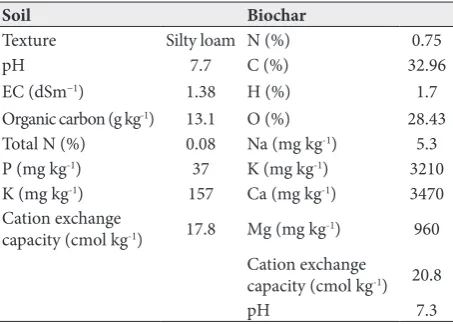
The pyrolysis process was set according to the method of Qian and Chen [21]. Maple (Acer pseudoplatanus L.) residues were chopped and passed through a 0.5-mm mesh and heated at 560°C for 6 h under non-oxygen conditions, at a rate of 7°C min−1. The ion content of the biochar was assayed by an elemental analyzer (vario MACRO CHNS analyzer, Elementar group, Hanau, Germany). The main biochar properties are shown in Table 1.
Experimental conditions
This experiment was conducted in a glass greenhouse with a factorial design on the basis of a completely randomized design with four replications. Three levels of salt stress (non-saline, 5 (moderate) and 10 (severe) dS m-1 of NaCl)) and three levels of biochar treatments (no biochar, 50 and 100 g kg-1 soil) were used for testing mung bean plants (Vigna radiata cv. MN92). Salinity levels were chosen according to the salinity threshold of the mung bean plants, and biochar levels were se-lected based on previous studies. Soil was thoroughly mixed with biochar and pots (30 cm radius and 50 cm height) were filled with 12 kg soil. Some properties of the soil are shown in Table 1. Three mung bean seeds were sown in each plastic pot. The pots were kept in the greenhouse under controlled conditions at 25/23ºC day/ night temperatures, respectively, 55-60% relative humid-ity, 150 W m-² light intensity and a 13-h photoperiod. After sowing, NaCl was added to the irrigation water. During the experiment, the electrical conductivity of each pot was measured via a digital conductivity meter (Inolab Model, Weilheim, Germany). Conductivity was preserved at the determined level by adding water or concentrated NaCl to the pots. During the growth period, pots were irrigated every day with tap water to maintain the soil water content near field capacity. At the seedling establishment stage, 10 g of a fertilizer (Master 20-20-20-Valagro-Italy) was dissolved in 1 L of water (EC 0.8 and pH 7.3) and added to the pots. Shoot and root dry weights were measured after oven-drying at 80°C for 48 h and specific root length was determined as the ratio between total root length and root dry mass.
Table 1. Some physicochemical properties of the experimental soil and biochar.
Soil Biochar
Texture Silty loam N (%) 0.75
pH 7.7 C (%) 32.96
EC (dSm−1) 1.38 H (%) 1.7
Organic carbon (g kg-1) 13.1 O (%) 28.43
Total N (%) 0.08 Na (mg kg-1) 5.3
P (mg kg-1) 37 K (mg kg-1) 3210
K (mg kg-1) 157 Ca (mg kg-1) 3470
Cation exchange
capacity (cmol kg-1) 17.8 Mg (mg kg-1) 960
Cation exchange
capacity (cmol kg-1) 20.8
Morphological and anatomical analyses
Fifty-eight days after sowing at the full flowering stage, the plants were harvested for morphological and ana-tomical measurements. Samples were stored under a liquid paraffin layer to minimize evaporation in 0.2-mL centrifuge tubes at 4°C for up to 3 days. The total root length, diameter, root area and root volume were quantified by scanning the roots and then analyzing the images with WinRHIZO Pro (Regent Instruments, Quebec, Canada) software.
Root fragments from the absorption zone (1.5 cm from the tip) were sampled to perform the an-atomical analysis. Tissues were fixed in an acetic acid:formaldehyde:ethanol:water solution (FAA, 5:10:52:33) at 10:1 (w:v) for a 4-6 day period, and then dehydrated with butyl alcohol, followed by embedding in paraffin. Digital images from the absorption zone were analyzed using the Cell-o-Tape V 0.7.7 software (Center for Plant Integrative Biology, University of Nottingham, UK), and the areas of the CP and VC were determined. Root density was calculated as root weight/root volume.
RWC
At the flowering stage, the fresh weight (FW) of the leaves and roots was recorded. Leaves and roots were waterlogged for 3-4 h in distilled water under normal room light and temperature, and the turgid weight (TW) was obtained. The DW was obtained after dry-ing at 80oC for 24 h. RWC was calculated using the equation: RWC=[(FW-DW)/(TW-DW)]×100.
IAA, ABA and ACC contents
The endogenous content of IAA and ABA was deter-mined by the ELISA method [22]. Root samples (1 g FW) were extracted in 10 mL of 80% cold methanol and butyl-hydroxy-toluene for 24 h at 4°C in the dark. The prepared samples were then centrifuged at 7000 x g for 15 min and the supernatant was collected and colored using Sep-Pak C18 cartridges. Methanol was removed with a rotary evaporator at 40°C and the residue of each sample was dissolved in a buffer with 1 mM Tris, 150 mM NaCl, 1 mM MgCl2, 0.1% gelatin and 0.1% Tween 20. The contents of IAA and ABA were determined by ELISA [22]. The antigens and
antibodies were obtained from Sigma Chemical Co. (Missouri, USA). For measuring the ACC content in root, 0.5 g of root samples were homogenized in 70% ethanol and centrifuged for 30 min at 2500 x g at 4°C. The ethanol was evaporated under vacuum at 40°C and the residue was dissolved in 1 mL water and prepared for the assay of ACC according to the method of Concepcion et al. [23] with a gas chromatograph (CP-3800 Varian, California, USA).
Analysis of variance
Data was analyzed using MSTATC software. The means were compared with Duncan’s multiple range test at p≤0.05. The figures were drawn using Microsoft Excel Software 2016.
RESULTS Root growth
Mung bean root length, diameter, DW and density were reduced by salinity as can be seen from the significantly lower values of these parameters measured at moderate and high levels of salt stress; in contrast, the specific root length was increased (Table 2). Root length, diameter, DW, density and specific root length of treated plants were considerably increased by biochar at 5 and 10 ds m-1. The application of biochar did not show a significant effect on root diameter and density under the non-saline conditions, but increased the root length, root DW and specific root length. Both biochar treatments produced a similar effect on root growth under salt stress.
Root anatomy
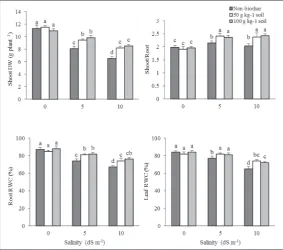
Shoot weight, shoot/root ratio and RWC
Shoot DW of plants exposed to salinity was decreased (Fig. 1). Biochar application increased shoot DW under moderate and severe salinities, but did not show a consid-erable effect in non-saline conditions. The shoot/root ratio was affected by salt stress and biochar applications and was signifi-cantly decreased by salt stress. Similarly, the shoot/root ratio was not changed by biochar application in non-saline conditions. How-ever, the shoot/root ratio was considerably
Table 2. Root characteristics of mung bean plants under different biochar treatments and salt stress.
Salinity concentrationBiochar Root length Root diameter Root dry weight Root density Specific root length
(dSm-1 NaCl) (g kg-1soil) (mm) (g plant-1) (g cm-3) (mm g-1)
Non-biochar 410.27±6.64b 0.7±0.06a 5.14±0.15b 0.4±0.08a 79.78±1.01e
0 50 463.16±8.34a 0.7±0.05a 5.96±0.14a 0.4±0.07a 83.73±1.01d
100 459.40±5.43a 0.7±0.03a 6.04±0.11a 0.4±0.07a 84.09±1.03d
Non-biochar 330.30±4.58c 0.5±0.04b 3.62±0.11d 0.2±0.05c 88.80±0.88c
5 50 406.10±7.44b 0.7±0.02ab 3.95±0.10c 0.3±0.04b 102.8±0.70a
100 389.76±7.26b 0.8±0.07a 4.01±0.07c 0.3±0.03b 99.12±1.23a
Non-biochar 287.20±5.74d 0.2±0.04b 3.01±0.10f 0.1±0.05d 92.74±0.58b
10 50 322.86±8.24c 0.3±0.02b 3.45±0.07e 0.2±0.02c 93.58±0.91b
100 332.56±6.55c 0.3±0.03b 3.35±0.12e 0.2±0.06c 93.67±0.92b
Data are presented as the mean±standard error of four replicates (n=4). Different letters in the columns indicate significant differences by Duncan’s multiple range test at (p<0.05).
Table 3. Root anatomical characteristics of mung bean plants under different levels of salt stress and biochar treatments.
Salinity Biochar concentration Total root area cylinder (VC)Vascular Cortical parenchyma (CP) VC/CP
(dSm-1 NaCl) (g kg-1soil) (mm2)
Non-biochar 0.69±0.04a 0.20±0.003a 0.47±0.11a 0.43±0.08a
0 50 0.68±0.04a 0.21±0.005a 0.45±0.09a 0.46±0.07a
100 0.71±0.07a 0.22±0.003a 0.48±0.08a 0.45±0.07a
Non-biochar 0.56±0.08c 0.11±0.004c 0.44±0.06a 0.24±0.05c
5 50 0.63±0.04b 0.14±0.002b 0.47±0.07a 0.29±0.11b
100 0.64±0.06b 0.15±0.007b 0.47±0.06a 0.31±0.08b
Non-biochar 0.40±0.07e 0.06±0.004e 0.30±0.07c 0.21±0.12c
10 50 0.47±0.09d 0.09±0.002d 0.35±0.05b 0.27±0.10b
100 0.48±0.05d 0.10±0.003d 0.36±0.09b 0.28±0.09b
Data are presented as the mean±standard error of four replicates (n=4). Different letters in the columns indicate significant differences by Duncan’s multiple range test at (p<0.05).
increased under 5 and 10 dS m-1 salinities in response to biochar applications. There was no difference between the two levels of biochar use in mung bean shoot DW and the shoot/root ratio. The RWC of leaves and roots was significantly influenced by the interaction effects of salinity and biochar. Biochar usage under non-saline conditions did not affect the RWC of roots and leaves (Fig. 1), however, biochar treatments under moderate and severe salinities considerably increased it.
IAA, ABA and ACC contents
The contents of ABA and ACC were increased, while the IAA content and the IAA/ABA and IAA/ACC
ratios were decreased under salt stress. The ABA and ACC contents were not affected by biochar treatments in the non-saline state; biochar increased the IAA content and the IAA/ABA and IAA/ACC ratios. Moreover, under saline conditions, the contents of ABA and ACC were remarkably reduced by biochar. However, the IAA content and the ratios of IAA/ABA (at a concentration of 50 g kg-1 biochar) and IAA/ACC were increased (Fig. 2).
DISCUSSION
The results of the present study revealed that mung bean biomass was considerably influ-enced by salt stress. The same response was described by Farhangi-Abriz and Torabian [18] in bean plants. Growth reduction is a general response of plants to salinity. Salinity inhibited root growth by enhancing ACC and ABA production and by reducing the content of growth hormones such as IAA. Decreasing root density was attributed to diminishing root DW under salt stress. The application of biochar improved root growth by decreasing oxidative damage [18] and increasing IAA/ABA and IAA/ACC ratios under salt stress.
A significantly higher shoot/root ratio at severe salinity showed that the root DW of mung bean was affected by salinity more than its shoot. The increase of the shoot/root ratio might be due to the adjustment of root mechanisms. Our results clearly indicate that the specific root length increased under salt stress as a result of adaptions to salt stress in mung bean. This adaptive system was also defined by Miller [24] as caused by root growth and ex-pansion. The addition of biochar to the soil decreased the harmful effects of salt stress and increased the shoot/root ratio and specific root length. These results revealed that biochar application under salt stress had more positive effects on the growth of shoots than on roots. Biochar enhanced shoot growth and consequently improved the shoot/root ratio and specific root length under salt stress by providing mineral nutrients for shoot growth and by decreasing oxidative and osmotic stress in roots
[18]. Biochar increases plant growth by directly sup-plying mineral nutrients, and indirectly, by improving the physical, chemical and biological characteristics of the soil [1,20,26]. Moreover, biochar influences soil pH, nutrient availability, nutrient cycling, ion exchange capacity and buffering capacity, which have not been assessed in the present study.
One of the main consequences of salt toxicity is increased ethylene production, which at high levels prevents root and shoot growth and limits plant growth overall [25]. Production of ethylene in crops is directly associated with endogenous ACC levels. When plants were treated with biochar, the contents of ABA and ACC were reduced; however, IAA was increased. In other words, using biochar decreased hormones, such as ABA and ACC, which are involved in the stress re-sponse; in contrast, increased plant growth promoter IAA reduced sodium uptake [20].
Some root morphological characteristics and ana-tomical parameters were adversely affected by salt stress, which was previously described in cotton [27]. Salt stress causes reductions in root elongation and the develop-ment of xylem through changed osmotic pressure and ion toxicity [28]. In the root, the width and features of xylem components of terminal cell walls are the key determinants of xylem hydraulic activity [29,30]. The observed increase in the areas of the VC and CP under salt stress after biochar treatment was related to the enhancement of root growth and reduction of Na ion toxicity in the root. Our findings are in agreement with the result observed after application of biochar, which significantly decreased Na concentrations in the xylem sap of potato [31]. Likewise, biochar decreased Na up-take by lettuce under salt stress [32]. The reduction of the RWC may be associated with the decrease in root growth, plant vigor, xylem component areas (VC and CP) and root density under increased salinity [18,33]. The increase in the RWC in roots and leaves brought about by biochar was closely associated with higher root growth under salt stress, which was due to the increase of total root area and xylem component area.
CONCLUSIONS
Salinity reduced root and shoot growth, total root area, VC area, cortical parenchyma area, RWC and the IAA content in roots of mung bean plants. Biochar
applica-tion increased specific root length, shoot/root ratio and ABA and ACC production. The use of biochar under non-saline conditions did not show a noticeable effect on root anatomy; however, it increased root length and weight by increasing IAA/ACC and IAA/ABA ratios. Biochar under moderate and severe salinities enhanced root and shoot growth, the shoot/root ratio, specific root length, total root area, VC area, CP area, the IAA content and IAA/ACC and IAA/ABA ratios. Our results show that biochar enhanced water avail-ability by improving hormonal and root anatomical characteristics under salt stress and consequently increased mung bean growth.
Acknowledgments: This research did not receive any specific grant from funding agencies in the public, commercial, or not for profit sectors.
Author contributions: All of the authors contributed in the same way to the preparation of all the parts of this manuscript. Conflict of interest disclosure: The authors declare that there is no conflict of interest.
REFERENCES
1. Farhangi-Abriz S, Torabian S. Effect of biochar on growth and ion contents of bean plant under saline condition. Environ Sci Pollut Res. 2018;25(12):11556-64.
2. Weston LA, Mathesius U. Root exudation: The role of second-ary metabolites, their localisation in roots and transport into the rhizosphere. In: Morte A, Varma A, editors. Root Engi-neering. Berlin, Heidelberg: Springer; 2014. p. 221-47.. 3. Nasri N, Maatallah S, Kaddour R, Lachâal M. Effect of salinity
on Arabidopsis thaliana seed germination and acid phospha-tase activity. Arch Biol Sci. 2016;68(1):17-23.
4. Parihar P, Singh S, Singh R, Singh VP, Prasad SM. Effect of salinity stress on plants and its tolerance strategies: a review. Environ Sci Pollut Res. 2015;22(6):4056-75.
5. Villordon AQ, Ginzberg I, Firon N. Root architecture and root and tuber crop productivity. Trends Plant Sci. 2014;19(7):419-25.
6. Akhtar N, Hameed M, Ahmad R. Structural and functional aspects of ionic relation in roots of Typha domingensis pers. ecotypes under salt stress. Pak J Bot. 2016;48(6):2195-203. 7. Jiang K, Moe-Lange J, Hennet L, Feldman LJ. Salt stress affects
the redox status of Arabidopsis root meristems. Front Plant Sci. 2016;7:81.
8. Farissi M, Mouradi M, Bouizgaren A, Ghoulam C. Variations in leaf gas exchange, chlorophyll fluorescence and mem-brane potential of Medicago sativa root cortex cells exposed to increased salinity: The role of the antioxidant potential in salt tolerance. Arch Biol Sci. 2018;70(3):413-23.
Milada Ciamporova SAoS, Gasparíková O, Barlow PW, edi-tors. Structure and Function of Roots. Proceedings of the Fourth International Symposium on Structure and Function of Roots; 1993 Jun 20-26 ; Stará Lesná, Slovakia. Dordrecht: Springer Netherlands; 1995. p. 299-304.
10. Hu L, Li H, Chen L, Lou Y, Amombo E, Fu J. RNA-seq for gene identification and transcript profiling in relation to root growth of bermudagrass (Cynodon dactylon) under salinity stress. BMC Genomics. 2015;16(1):575.
11. Shelden MC, Dias DA, Jayasinghe NS, Bacic A, Roessner U. Root spatial metabolite profiling of two genotypes of barley (Hordeum vulgare L.) reveals differences in response to short-term salt stress. J Exp Bot. 2016;67(12):3731-45.
12. Bastías E, González-Moro MB, González-Murua C. Combined effects of excess boron and salinity on root histology of Zea mays L. amylacea from the Lluta Valley (Arica, Chile). IDE-SIA (Chile). 2015;33(2):9-20.
13. Soda N, Ephrath JE, Dag A, Beiersdorf I, Presnov E,
Yermi-yahu U, Ben-Gal A. Root growth dynamics of olive (Olea
europaea L.) affected by irrigation induced salinity. Plant Soil. 2017;411(1-2):305-18.
14. Wilson CA, Peterson CA. Chemical composition of the epi-dermal, hypoepi-dermal, endodermal and intervening cortical cell walls of various plant roots. Ann Bot. 1983;51(6):759-69. 15. Farhangi-Abriz S, Torabian S. Biochar increased plant
growth-promoting hormones and helped to alleviates salt stress in common bean seedlings. J Plant Growth Regul. 2018;37(2):591-601.
16. Tian Q, Chen F, Liu J, Zhang F, Mi G. Inhibition of maize root growth by high nitrate supply is correlated with reduced IAA levels in roots. J Plant Physiol. 2008;165(9):942-51.
17. Lashari MS, Liu Y, Li L, Pan W, Fu J, Pan G, Zheng J, Zheng J, Zhang X, Yu X. Effects of amendment of biochar-manure compost in conjunction with pyroligneous solution on soil quality and wheat yield of a salt-stressed cropland from Cen-tral China Great Plain. Field Crops Res. 2013;144:113-8. 18. Farhangi-Abriz S, Torabian S. Antioxidant enzyme and
osmotic adjustment changes in bean seedlings as affected by biochar under salt stress. Ecotoxicol Environ Saf. 2017;137:64-70.
19. Farhangi-Abriz S, Nikpour-Rashidabad N. Effect of lignite on alleviation of salt toxicity in soybean (Glycine max L.) plants. Plant Physiol Biochem. 2017;120:186-93.
20. Torabian S, Farhangi-Abriz S, Rathjen J. Biochar and lignite affect H+-ATPase and H+-PPase activities in root tonoplast and nutrient contents of mung bean under salt stress. Plant Physiol Biochem. 2018;129:141-9.
21. Qian L, Chen B. Dual role of biochars as adsorbents for alu-minum: the effects of oxygen-containing organic components and the scattering of silicate particles. Environ Sci Technol. 2013;47(15):8759-68.
22. Li XJ, Meng FJ. Study on the photoperiodic-induced flowering in soybean: changes of plant hormones and assimilates of the first leaves. J China Agric Univ. 1996;1:35-9.
23. Concepcion M, Lizada C, Yang SF. A simple and sensitive assay for 1-aminocyclopropane-1-carboxylic acid. Anal Bio-chem. 1979;100(1):140-5.
24. Miller DE. Root systems in relation to stress tolerance. Hort Science. 1986;21(4):963-70.
25. Tao JJ, Chen HW, Ma B, Zhang WK, Chen SY, Zhang JS. The role of ethylene in plants under salinity stress. Front Plant Sci. 2015;6:1059.
26. Lehmann J, Rillig MC, Thies J, Masiello CA, Hockaday WC, Crowley D. Biochar effects on soil biota–a review. Soil Biol Biochem. 2011;43(9):1812-36.
27. Reinhardt DH, Rost TL. Salinity accelerates endodermal development and induces an exodermis in cotton seedling roots. Environ Exp Bot. 1995;35(4):563-74.
28. Fricke W, Akhiyarova G, Wei WX, Alexandersson E, Miller A, Kjellbom PO, Richardson A, Wojciechowski T, Schreiber L, Veselov D, Kudoyarova G, Volkar V. The short-term growth response to salt of the developing barley leaf. J Exp Bot. 2006;57:1079-95.
29. Davis SD, Sperry JS, Hacke UG. The relationship between xylem conduit diameter and cavitation caused by freezing. Am J Bot. 1999;86(10):1367-72.
30. Hacke UG, Sperry JS. Functional and ecological xylem anat-omy. Perspect Plant Ecol Syst. 2001;4(2):97-115.
31. Akhtar SS, Andersen MN, Liu F. Biochar mitigates salinity stress in potato. J Agron Crop Sci. 2015;201(5):368-78. 32. Hammer EC, Forstreuter M, Rillig MC, Kohler J. Biochar
increases arbuscular mycorrhizal plant growth enhancement and ameliorates salinity stress. Appl Soil Ecol. 2015;96:114-21. 33. Farhangi-Abriz S, Alaee T, Tavasolee A. Salicylic acid but