Available online throug
ISSN 2229 – 5046THE MODIFIED WEIBULL-G FAMILY
OF DISTRIBUTIONS: PROPERTIES AND APPLICATIONS
YASSMEN, Y. ABDELALL*
Department of Mathematical Statistics,Institute of Statistical Studies and Research, Cairo University, Egypt.
(Received On: 01-03-19; Revised & Accepted On: 25-03-19)
ABSTRACT
I
n this paper, we introduce a new family called the modified weibull-G (MW-G) family of distributions generated frommodified weibull distribution. This new family of distributions provides a lot of new and well known distributions as special cases. We discuss four special distributions for the new family. Some mathematical properties are derived including quantile function, moments, and order statistics. The estimation of the distribution parameters is performed by the maximum likelihood method. Applications show that the new family of distributions can provide a better fit than several existing distributions.
Key words: modified weibull-G family, modified weibull distribution, quantile, moments, maximum likelihood method.
1. INTRODUCTION
Applications in different areas of engineering, business economics, life time analysis shows that the data sets arising from various areas may require flexible distributions. So there is an increasing trend in developing generalized familiesof distributions by adding one or more additional parameters to the baseline distributions.
Some of well-known families are: generalized modified weibull (Carrasco et al. (2008)), beta modified weibull (Silva
et al. (2010)), gamma- exponentiated weibull distributions (Pinho et al. (2012)), generalized beta-G family (Alexander
et al. (2012)), exponentiated generalized-G family (Cordeiro et al. (2013)), transformed-transformer (T-X) family
(Alzaatreh et.al. (2013)), weibull-G family (Bourguignon et al. (2014)), Mcdonald exponentiated modified weibull (Merovci and Elbatal (2015)), gamma exponentiated modified weibull (Pu et al. (2016)), Kumaraswamy weibull-G family (Hassan and Elgarhy (2016a)), exponentiated weibull-G family (Hassan and Elgarhy (2016b), generalized additive weibull-G (Hassan et al. (2017)), inverse weibull-G (Hassan and Nassr (2018)) and more.
The aim of this article, we use the T-X generator approach suggested by Alzaatreh et al. (2013) with
X
follows modified weibull (Sarhan and Zaindin (2009)) random variable to define a new family of distributions called the modified weibull- generator (MW-G) family of distributions with the hope it yields a better fit in certain practical situations. Additionally, we provide a comprehensive account of the mathematical properties of the proposed family of distributions. According to this approach, the cumulative distribution function (cdf) of a random variableX
satisfy the relation:( )
=
[∫
] ) (0
)
(
x G Q
dt
t
v
x
F
, (1)where
T
∈
[ ]
a
,
b
is a random variable such that−
∞
a
b
∞
with the probability density function (pdf),v
(
t
)
, andQ
[
G
( )
x
]
be a function of the cdf of any random variableX
.The remainder of this article is organized as follows, In Secion 2, introduces the proposed modified weibull-G family of distributions model. Four special distributions of MW-G family are defined in Section 3. Some useful expansions for the pdf and cdf of MW-G family are obtained in Section 4. In the same section, explicit expressions for the quantile function, moments, and order statistics are derived. In Section 5, estimation of the distribution parameters is performed by maximum likelihood method. Section 6, provides two applications to two real data sets are discussed to illustrate the flexibility of the new family. Finally, some concluding remarks are presented in Section 7.
2. THE MODIFIED WEIBULL-G FAMILY
The modified weibull distribution has pdf and cdf given by
g
( )
t
=
(
β
+
λ
γ
t
γ−1)
e
−(
βt+λtγ)
,
( )
(
βt λtγ)
e
t
G
=
1
−
− +respectively.
Based on T-X generator, the cdf of modified weibull-G (MW-G) family is derived by replacing the generator
v
(
t
)
in (1) by modified weibull pdf, withQ
[
G
( )
x
]
=
G
( ) ( )
x
;
ξ
G
x
;
ξ
as the following:(
)
(
)
( )
( ) ( )( )
( ; ) ( ; )
1
0
; ;
; ;
( )
1
G x G x
t t
G x G x
G x G x
F x
t
e
dt
e
γ
γ
ξ ξ
β λ γ
ξ ξ
β λ
ξ ξ
β λ γ
− − +
− +
=
+
= −
∫
(2) where
G
(
x
;
ξ
)
is the baseline cdf, which depends on a parameter vectorξ
,
andG
()
.
=
1
−
G
(.).
The corresponding pdf of the MW-G family can be written as follows:(3)
We shall write
X
~MW-G(
β
,
λ
,
γ
,
ξ
)
to denote that the random variableX
has pdf (3). For eachG
distribution, we define the MW-G distribution with three extra parametersβ
,
λ
andγ
defined by the pdf (3). One can note the following special cases: forβ
=
0
, we have the Weibull-G (Bourguignon et al. (2014)). Ifβ
=
0
andγ
=
1
, we have the Exponential-G (Bourguignon et al. (2014)).Furthermore, the reliability function;
F
(x),
and hazard rate function;h
( )
x
are respectively, given by( )
( ) ( )( )
,
)
(
1
)
(
;; ;
;
+ −
=
−
=
γ
ξ ξ λ ξ ξ β
x G
x G x G
x G
e
x
F
x
F
and
( )
( )
;
[
( )
;
]
( )
;
.
;
)
(
)
(
)
(
21
ξ
ξ
ξ
ξ
γ
λ
β
γ
x
g
x
G
x
G
x
G
x
F
x
f
x
h
−−
+
=
=
3. SPECIAL DISTRIBUTIONS
A number of new distributions can be deduced as special models from the MW-G family of distributions. Here, four special distributions, namely; modified weibull-unifom (MW-U), modified weibull- weibull (MW-W), modified weibull-lomax (MW-L), and modified weibull-fre'chet (MW-F) are introduced.
3.1 Modified Weibull-Uniform Distribution
As a first distribution, suppose the parent distribution is uniform in the interval
( )
0
,
a
,a
>
0
. Then.
/
)
;
(
,
0
,
/
1
)
;
(
x
a
a
x
a
G
x
a
x
a
g
=
<
<
<
∞
=
The cdf of a random variableX
has MW-U distribution, say(
a
)
U
MW
X
~
−
β
,
λ
,
γ
,
is given by:0
,
,
,
0
,
1
)
(
=
−
<
<
<
∞
>
− +
− −
γ
λ
β
γ
λ β
a
x
e
x
F
a xx x a
x
MWU ,
The corresponding pdf is:
[
]
,
0
.
)
(
21
∞
<
<
<
−
−
+
=
− +
− − −
a
x
e
x
a
a
x
a
x
x
f
a xx x a
x
MWU
γ
λ β γ
λγ
β
(
)
(
)
(
(
)
)
( )
( ); ( )( );
1
; ;
2
;
;
( )
, , , ,
0
;
;
G x G x
G x G x
G x
g x
f x
e
x
G x
G x
γ
ξ ξ
γ β λ
ξ ξ
ξ
ξ
β λγ
β λ γ
ξ
ξ
− − +
=
+
The reliability function and hazard rate function are respectively, given by − + − −
=
γ λ β x a x x a xMWU
x
e
F
(
)
, and(
)
(
)
.
1 2
−
+
−
=
− −β
λγ
γx
a
x
x
a
a
x
h
MWU3.2 Modified Weibull-Weibull Distribution
The second distribution, consider the weibull pdf and cdf with parameter
θ
>
0
,
α
>
0
areg
(
x
)
=
α
θ
x
α−1e
−θxα,
and
G
(
x
)
=
1
−
e
−θxα, repectively. The cdf of a random variableX
has MW-W distribution, say(
β
,
λ
,
γ
,
θ
,
α
)
~
MW
W
X
−
is given by:0
,
,
,
,
,
,
1
)
(
1 1>
−
=
− + − −α
θ
γ
λ
β
γ α θ α θ λ βx
e
x
F
x x e e MWW ,The corresponding pdf is:
(
)
1 1 11
( )
1
.
x x
e e
x x
MWW
f
x
x
e
e
e
γ
α α
θ θ
α α γ β λ
α θ θ
α θ
β λγ
− − + − −
−
=
+
−
(4)The density function (4) reduces to modified weibull- exponential distribution for
α
=
1
.
Forα
=
2
,
the density function (4) reduces to modified weibull-rayleigh distribution. The density function (4) includes the weibull-weibull distribution ( Bourguignon et al. (2014)) whenβ
=
0
.So the reliability function and hazard rate function are respectively, given by
,
)
(
1 1 − + − −=
γ α θ α θ λβ e x ex
MWW
x
e
F
and(
)
1(
1
)
1.
+
−
=
α− θ α θ α γ−λγ
β
θ
α
x xMWW
x
x
e
e
h
3.3 Modified Weibull-Lomax Distribution
The third distribution is modified weibull-lomax whose cdf is derived by substituting the following cdf
0
,
,
1
1
)
(
>
+
−
=
−α
θ
θ
αx
x
G
in (2) as follows:0
,
,
,
,
,
,
1
)
(
1 1 1 1>
−
=
− + + − + −α
θ
γ
λ
β
γ α α θ λ θ βx
e
x
F
x x MWL .The pdf of a random variable
X
having MW-W distribution, sayX
~
MW
−
L
(
β
,
λ
,
γ
,
θ
,
α
)
is given by:.
1
1
1
)
(
1 1 1 1 1 1 − + + − + − − −
−
+
+
+
=
γ α α θ λ θ β γ α αθ
λγ
β
θ
θ
α
x xMWL
e
x
x
x
f
Moreover, the reliability function and hazard rate function are respectively, given by
,
)
(
1 1 1 1 − + + − + −=
γ α α θ λ θβ x x
MWL
x
e
F
and.
1
1
1
)
(
1 1
−
+
+
+
=
−− α γ
α
θ
λγ
β
θ
θ
α
x
x
x
h
MWL3.4 Modified Weibull-Fre'chet Distribution
Considering the baseline distribution is Fre'chet with pdf and cdf with parameter
a
>
0
,
b
>
0
are( )
,
)
(
x
a
b
ax
(a 1)e
bxag
=
− + − and ( )a x b
e
x
G
(
)
=
− , respectively. The cdf of a random variableX
has MW-F distribution, sayX
~
MW
−
F
(
β
,
λ
,
γ
,
a
,
b
)
is( ) ( )
0
,
,
,
,
,
,
1
)
(
1 1 1>
−
=
− + − − − −b
a
x
e
x
F
a x b a x b e eMWF
β
λ
γ
γ
λ β
The corresponding pdf is:
( ) ( )
( )
(
)
(
( ))
( ) ( )
.
1
1
)
(
1 1
1 2
1 1
− + − −
− −
− +
− − −
+
−
−
=
γ
λ β
γ
λγ
β
a x b a
x b a
a a
e e
x b x
b x b a a
MWF
e
e
e
e
x
b
a
x
f
The reliability function and hazard rate function are respectively, given by
( ) ( )
,
)
(
1 1
1
− + −
− − −
=
γ
λ β bxa bxa
e e
MWF
x
e
F
and
Figures 1 and 2 are illustrates possible shapes of the density functions for some modified weibull-g distributions.
0 0.2 0.4 0.6 0.8 1 0
2 4 6 8
(a)
D
ens
ity
f x 1.3(, ,1.2,1.3,0.6) f x 1.6(, ,1.3,1.2,0.6) f x 2(, ,1.6,1.3,0.5) f x 0.9(, ,1.3,1.3,0.3) f x 1.5(, ,1,0.05,0.9)
x
0 1 2 3 4 5
0 0.5 1 1.5
(b)
D
ens
ity
f x 0.25(, ,0.7,0.3,0.2,2) f x 0.2(, ,0.2,0.4,0.6,2) f x 0.25(, ,0.6,0.2,0.1,2.5) f x 0.4(, ,0.3,0.6,0.8,1.5) f x 0.3(, ,0.4,0.9,0.5,3)
x
0 0.2 0.4 0.6 0.8 1 0
1 2 3 4
(c)
D
ens
ity
f x 0.5(, ,1.7,1.3,1.2,2) f x 0.9(, ,1.2,1.4,1.6,3) f x 0.5(, ,1.6,1.2,1.1,2.5) f x 0.4(, ,1.3,1.6,1.8,4) f x 0.3(, ,1.4,1.9,1.5,3)
x
0 1 2 3 4 5
0 0.2 0.4 0.6
(d)
D
ens
ity
f x 0.25(, ,0.7,0.3,0.2,2) f x 0.2(, ,0.2,0.4,0.6,2) f x 0.25(, ,0.6,0.2,0.1,2.5) f x 0.4(, ,0.3,0.6,0.8,1.5) f x 0.3(, ,0.4,0.9,0.5,3)
x
Figure-1: (a) MW-U
(
β
,
λ
,
γ
,
a
)
, (b) MW-W(
β
,
λ
,
γ
,
θ
,
α
)
, (c) MW-L(
β
,
λ
,
γ
,
θ
,
α
)
, and (d) MW-F(
β
,
λ
,
γ
,
a
,
b
)
density plots for various values of parameters.0 0.2 0.4 0.6 0.8 1 0
6 12 18 24 30
(a)
H
azar
d
h t 1(,,0.7,0.1,1.4) h t 0.5(, ,0.2,0.4,1.1) h t 1.5(, ,1.8,0.6,0.7) h t 2.5(, ,0.4,1.7,0.9) h t 2(,,0.9,0.3,0.5)
t
1 1.5 2 2.5 3 3.5 4 0
0.3 0.6 0.9 1.2 1.5
(b)
H
azar
d
h t 0.9(, ,0.7,0.5,0.4,0.9) h t 1.1(, ,0.6,0.4,0.1,1.2) h t 0.7(, ,0.8,0.6,0.7,2.5) h t 0.5(, ,0.3,0.7,1,1.5) h t 0.2(, ,0.5,0.3,0.8,2)
t
1 1.5 2 2.5 3 3.5 4 0
0.12 0.24 0.36 0.48 0.6
(c)
H
azar
d
h t 0.9(, ,0.7,0.5,0.4,0.5) h t 0.1(, ,0.6,0.4,0.1,1) h t 0.4(, ,0.8,0.6,0.7,0.9) h t 0.5(, ,0.3,0.7,1,1.5) h t 0.2(, ,0.5,0.3,0.8,0.4)
t
1 1.5 2 2.5 3 3.5 4 0
0.3 0.6 0.9 1.2 1.5
(d)
H
azar
d
h t 1(, ,0.7,0.5,0.4,1.5) h t 1.5(, ,0.6,0.4,0.3,1.5) h t 1.5(, ,0.8,0.6,0.7,1.5) h t 1.5(, ,0.3,0.7,1,1.5) h t 2(, ,0.5,0.3,0.8,2)
t
Figure-2: (a) MW-U
(
β
,
λ
,
γ
,
a
)
, (b) MW-W(
β
,
λ
,
γ
,
θ
,
α
)
, (c) MW-L(
β
,
λ
,
γ
,
θ
,
α
)
, and (d) MW-F(
β
,
λ
,
γ
,
a
,
b
)
hazard plots for various values of parameters.( ) ( ) ( )
(
)
(
( ))
1 1
2
( ) 1 .
1
a
a a
a b x
a
b x MWF
b x
a b x e
h x e
e
γ
β λγ
− + − −
−
= + −
4. MATHEMATICAL PROPERTIES
In this section, we provide some of the basic mathematical properties of the MW-G family of distributions. 1.1 Useful Expansions
By using the power series representation for the exponential function twice, we have
( ) ( ) ( )( )
( )
( )
( )
;
,
;
!
!
1
0 , ; ; ; ;∑
∞ = + + + −
−
=
j i j i j i j i x G x G x G x Gx
G
x
G
j
i
e
γ ξ ξ λ ξ ξ βξ
ξ
λ
β
γ and( )
( ) ( ) ( )( )( )
( ) ( )
( )
;
.
;
;
!
!
1
;
)
;
(
0 , 2 ; ; ; ; 2∑
∞ = + + + + + −
−
=
j i j i j i j i j i x G x G x G x Gx
G
x
G
x
g
j
i
e
x
G
x
g
γ γ ξ ξ λ ξ ξ βξ
ξ
ξ
λ
β
ξ
ξ
γLet s be arbitrary positive integer, using the binomial theorem prove that
( )
( )
( )
( )
( )
( ),
;
;
;
;
0 1 1∑
= − − −
=
+
s t t t t s sx
G
x
G
t
s
x
G
x
G
γ γξ
ξ
λγ
β
ξ
ξ
λγ
β
hence( )
( )
[
( )
( )
]
( ) ( ) ( )( )=
+
+ − − γ ξ ξ λ ξ ξ β γξ
ξ
ξ
ξ
λγ
β
; ; ; ; 2 1;
;
;
;
G xx G x G x G s
e
x
G
x
g
x
G
x
G
( )
( )
( )
( )
( )
;
,
;
;
!
!
1
0 , 0
2 ) ( ) (
∑ ∑
= ∞ = + + −+ − + + + − + +
−
st i j
t t j i t t j i t t j t s i j i
x
G
x
G
x
g
j
i
t
s
γ γξ
ξ
ξ
γ
λ
β
(5)Using the negative binomial theorem, prove the following:
( )
(
)
( ( ) )( )
(
)
( )
,
;
1
1
;
0 2∑
∞ = − − + + −
+
+
−
+
+
−
=
k k k t t j ix
G
k
k
t
t
j
i
x
G
ξ
γγ
ξ
Therefore
( )
( )
[
( )
( )
]
( ) ( ) ( )( ),
)
;
(
)
;
(
;
;
;
;
) ( 0 , , 0, , , ; ; ; ; 2 1 k t t j i s
t ijk k j i s x G x G x G x G s
x
G
x
g
w
e
x
G
x
g
x
G
x
G
+ − + + = ∞ = + − −∑ ∑
=
+
γ ξ ξ λ ξ ξ β γξ
ξ
ξ
ξ
ξ
ξ
λγ
β
γwhere
( )
(
1
)
1
.
!
!
1
, , ,
+
+
−
+
+
−
=
+ + +− +k
k
t
j
i
t
s
j
i
w
t t j t s i k j i k j i sγ
γ
λ
β
In particular, For s=1 in the above expression, we get the MW-G density function as follows
( ) ( )
;
;
.
)
;
(
)
;
(
)
(
0 , , 1 ) 1 ( , , , 1 0 , , , , , 0∑
∑
∞ = − + + + ∞ = + ++
=
k j i k j i k j i k j i k j i k ji
g
x
G
x
w
g
x
G
x
w
x
f
ξ
ξ
γξ
ξ
γ (6)Additionally, using binomial theorem for
[
F
(
x
)
]
s, s is a positive integer, becomes[
]
( )
( ) ( ) ( )( ).
1
)
(
; ; ; ; 0 + − =∑
−
=
γ ξ ξ λ ξ ξ β x G x G x G x G t s t t se
t
s
x
F
Applying exponential expansion for( ) ( ) ( )( )
,
; ; ; ; + − γ ξ ξ λ ξ ξ β x G x G x G x G te
we obtain[
]
( )
( ) ( )
( )
( )
.
;
;
!
!
1
)
(
0 , 0
∑ ∑
= ∞ = + + +
−
=
st mn
Using negative binomial theorem in (7), leads to
[
(
)
]
( )
;
,
0 , , 0 , , ,
∑ ∑
= ∞
=
+ +
Ψ
=
st mnu
u n m u
n m t s
x
G
x
F
ξ
γ (8)where
( )
( ) ( )
1
.
!
!
1
, ,
,
+
+
−
−
=
Ψ
+ + +u
u
n
m
t
s
n
m
t
t
m nu n m t u
n m t
γ
λ
β
4.2 Quantile and Median
The quantile function
x
qQ
x
qF
( )
q
1
)
(
=
−=
of MW-G(
β
,
λ
,
γ
,
ξ
)
family, if q has a Uniform distributionU
( )
0
,
1
, is the real solution of the nonlinear equation:( )
( )
( )
( )
ln
(
1
)
0
.
;
;
;
;
=
−
+
+
q
x
G
x
G
x
G
x
G
q q q
q
ξ
ξ
β
ξ
ξ
λ
γ
(9)
The above equation has no closed form solution in
x
q, so we have to use a numerical technique to get the quantile. Put0.5,
q
=
in (9) one gets the median of MW-G(
β
,
λ
,
γ
,
ξ
)
family. Forβ
=
0
, (9) reduced to the quantile function of the W-G(
λ
,
γ
,
ξ
)
as follows:( )
{
(
) (
)
}
(
) (
)
{
1
ln
1
}
.
1
1
ln
1
1 1 1
−
−
+
−
−
=
=
−γ γ
λ
λ
q
q
G
x
Q
x
q qExample1: consider the MW-W
(
β
,
λ
,
γ
,
θ
,
α
)
distribution discussed in subsection (3.2) whenβ
=
0
. The quantile function of the W-W(
λ
,
γ
,
θ
,
α
)
distribution is obtained as follows:( )
(
{
(
{
)
}
}
)
.) 1 ( ln ) / 1 ( 1
) 1 ( ln / 1 1
ln 1
/ 1 / 1
/
1 α
γ
λ
λ
θ
γ
− −
+
− −
− − = =
q q x
Q
xq q
Kenny and Keeping (1962) proposed skewness based on quartiles called the Bowley skewness which is defined as follows:
( )
( )
( )
( )
3
/
4
( )
1
/
4
4
/
1
2
/
1
2
4
/
3
BS
Q
Q
Q
Q
Q
−
+
−
=
.Further, the Moors kurtosis (Moors (1988)) based on octiles is defined as follows:
( )
( )
( )
( )
6
/
8
( )
2
/
8
,
)
8
/
1
(
8
/
3
8
/
5
8
/
7
MK
Q
Q
Q
Q
Q
Q
−
−
+
−
=
where
Q
()
.
is the quantile function. Figure 4 illustrates plots of the skewness and kurtosis of the W-W distribution for some choices of the parameterγ
as a function ofα
and fixed values ofλ
andθ
. These plots indicate that the skewness and kurtosis decrease whenγ
=
0
.
5
,
0
.
8
,
1
,
2
(increases) for fixedα
,
λ
andθ
.0 1 2
0.5 0 0.5 1
BS(α,0.5)
BS(α,0.8)
BS(α,1)
BS(α,2)
α
0 1 2
0 10 20
M K(α,0.5)
M K(α,0.8)
M K(α,1)
M K(α,2)
4.3 Moments
The moments of the MW-G family of distributions are derived. More specially, the moments of the MW-U distribution is obtained.
The rth non-central moments of
X
has the MW-G, denoted byµ
r', is derived from (6) as follows:( ) ( )
;
;
,
)
;
(
)
;
(
0 , , 1 ) 1 ( , , , 1 0 , , , , ,0
∑
∫
∑
∫
∞ = ∞ ∞ − − + + + ∞ = ∞ ∞ − + ++
=
′
k j i k j i r k j i k j i k j i r k j ir
w
x
g
x
G
x
dx
w
x
g
x
G
x
dx
γ
γ
ξ
ξ
ξ
ξ
µ
(10)
1, 2, 3,..
r
=
Furthermore, the moment generating function of
X
, denoted byM
X( )
t
, is( )
( ) ( )
( ) ( )
;
;
.
!
;
;
!
!
0 , , 0
1 ) 1 ( , , , 1 0 , , 0
, , , 0 0
∑ ∑
∫
∑
∑
∫
∑
∞ = ∞ = ∞ ∞ − − + + + ∞ = ∞ ∞ − + + ∞ = ∞ =+
=
′
=
r i jk
k j i r k j i r r k j i r k j i k j i r r r r X
dx
x
G
x
g
x
w
r
t
dx
x
G
x
g
x
w
r
t
r
t
t
M
γ γξ
ξ
ξ
ξ
µ
Example 2: Consider the MW-U distribution discussed in subsection (3.1). The rth non-central moments of
X
has MW-U can be obtained from (10) with pdf and cdf as defined in subsection (3.1) as follows:(
)
(
(
)
)
.
1
1
0 ,
, , , 0
, , , 1 , , , 0 r k j
i i jk
k j i r k j i r
a
r
k
j
i
w
a
r
k
j
i
w
∑
∞∑
= ∞ =
+
+
+
+
+
+
+
+
+
=
′
γ
γ
µ
In particular, the mean and variance of the MW-U distribution are obtained, respectively, as follows:
( )
(
)
(
(
)
)
,
1
1
0 ,
, , , 0
, , , 1 , , , 0
∑
∞∑
= ∞ =
+
+
+
+
+
+
+
+
+
=
k ji i jk
k j i k j i
r
k
j
i
a
w
r
k
j
i
a
w
X
E
γ
γ
and( )
(
)
(
(
)
)
[
( )
]
.
1
1
2 0 ,, , , 0
2 , , , 1 2 , , , 0
X
E
r
k
j
i
a
w
r
k
j
i
a
w
X
Var
k ji ijk
k j i k j i
−
+
+
+
+
+
+
+
+
+
=
∑
∞∑
= ∞ =γ
γ
4.4 Mean Deviation
The mean deviation about the mean and the mean deviation about the median measures the amount of scattering in a population. For a random variable
X
have pdff
(
x
)
and cdfF
(
x
)
with meanµ
and medianM
. The mean deviation about the mean and mean deviation about the median are, respectively, defined by:( )
2
( )
2
(
)
,
1
∫
∞ −−
=
µµ
µ
δ
X
F
x
f
x
dx
(11)and
( )
2
(
)
.
2
∫
∞ −
−
=
Mx
f
x
dx
X
µ
δ
(12)Example 3: Consider the MW-U distribution discussed in subsection (3.1). The mean deviation about the mean and the mean deviation about the median of
X
has MW-U, respectively, can be obtained from (11) and (12) using (6) and cdf defined in subsection (3.1) assuming as follows:( )
(
)
(
)
(
(
( )
)
)
,
1
1
2
/
1
2
0 ,, , , 0
) 1 ( , , , 1 1 , , , 0 1
+
+
+
+
+
+
+
+
−
−
=
∑
∞∑
= ∞ = + + + + + + − + − − k ji i jk
and
( )
(
(
)
)
(
(
(
)
)
)
.
1
1
2
/
2
0 ,
, , , 0
) 1 ( ,
, , 1 1
, , , 0 2
+
+
+
+
+
+
+
+
−
=
∑
∞∑
=
∞
=
+ + + +
+ +
k j
i i jk
k j i k
j i k
j i k
j i
k
j
i
a
M
w
k
j
i
a
M
w
M
X
γ
γ
µ
δ
γ γ
where
µ
andM
are the mean and median of the MW-U distribution.4.5 Order Statistics
Let
X
(1),
X
(2),...,
X
(z) be an ordered random sample for a random sampleX
1,
X
2,...,
X
z of size z drawn from theMW-G family of distributions with pdf and cdf given by (6) and (8), respectively. The pdf of
X
(r),r
=
1
,
2
,...,
z
is given by( )
(
)
( )
[
1
(
)
]
,
)
1
,
(
1
1) (
r z r
X
f
x
F
x
F
x
r
z
r
B
x
f
r
− −
−
+
−
=
Using binomial series expansion of
[
1
−
F
(
x
)
]
z−r, we have( )
∑
−(
( )
)
[
]
=
− +
−
+
−
−
=
z rl
l r l
X
F
x
f
x
l
r
z
r
z
r
B
x
f
r
0
1
)
(
)
(
1
,
1
)
( , (13)
Substituting from (6) and (8) by replacing
s
=
(
r
+
l
−
1
)
into (13), we can get the pdf ofX
(r)as follows:( )
[
( )
;
]
(
;
)
( )
;
,
0 1
0 ,, , , , 0
1 ,
, , 1 , , , 0 , , , , )
(
∑ ∑ ∑
−
= − +
= ∞
=
−
+
=
z rl l r
t i jkmnu
h k
j i k j i u n m t l
X
x
w
w
G
x
g
x
G
x
f
r
η
ξ
ξ
ξ
γ
(14) where
(
)( )
1
,
(
)
,
1
,
1
, , , ,
, ,
,
h
i
j
n
k
m
u
l
r
z
r
z
r
B
tmnul u
n m t
l
Ψ
=
+
+
+
+
+
−
−
+
−
=
γ
η
and B(., .) is the beta function.In particular, we define the smallest order statistics
X
( )1 by substitutingr
=
1
in (14) and the largest order statistics( )z
X
by substituting r=z in (14), respectively, as follows:( )
[
( )
;
]
(
;
)
( )
;
,
1
0 0 , , ,, , , 0
1 ,
, , 1 , , , 0 , , , , )
1
(
∑∑ ∑
−
= = ∞
=
−
+
=
zl l
t ijktmnu
h k
j i k j i u n m t l
X
x
M
w
w
G
x
g
x
G
x
f
ξ
γξ
ξ
and
( )
[
( )
;
]
( ) ( )
;
;
,
1
0 ,, ,, ,, 0
1 ,
, , 1 , , , 0 , , , )
(
∑ ∑
− +
= ∞
=
−
+
=
z lt i jktmnu
h k
j i k j i u n m t
X
x
N
w
w
G
x
g
x
G
x
f
z
ξ
ξ
ξ
γ
where l,t,m,n,u
( )
1
l1
t,m,n,u,
and
l
z
z
M
Ψ
−
−
=
N
t,m,n,u=
z
Ψ
t,m,n,u.
5. PARAMETERS ESTIMATION
Here, we derive the maximum likelihood estimates (MLEs) of the unknown parameters for the new family of distributions based on complete samples. Let
x
1,
x
2,...,
x
n be a random sample of size n follows the MW-G( )
Θ
,(
β
λ
γ
ξ
)
T,
,
,
=
Θ
be a parameter vector, with pdf (3). The log-likelihood function from density (3) is given by:( )
[
(
)
]
(
)
(
)
(
)
(
;
)
.
;
;
ln
2
;
ln
;
ln
ln
1
1 1
1 1
1
∑
∑
∑
∑
∑
=
= =
= =
−
−
−
−
+
+
=
Θ
n
i i
n
i i n
i
i n
i
i n
i
i
x
T
x
T
x
G
x
g
x
T
L
γ γ
ξ
λ
ξ
β
ξ
ξ
ξ
λγ
β
where
(
)
(
)
(
;
)
.
;
;
=
ξ
ξ
ξ
i i i
x
G
x
G
x
The components of the score function
U
( )
Θ
=
(
U
β,
U
λ,
U
γ,
U
ξ)
Tare(
;
)
(
;
)
,
1 1∑
∑
= =−
=
n i i n ii
T
x
x
V
U
βξ
ξ
(
) (
)
[
;
;
]
(
;
)
,
1 1 1∑
∑
= = −−
=
n i i n i ii
T
x
T
x
x
V
U
λγ
ξ
ξ
γξ
γ(
)
[
(
)
]
(
)
(
;
)
ln
(
;
)
,
;
;
ln
1
;
1 1 1∑
∑
= = −−
+
=
n i i i n i i i ix
T
x
T
x
V
x
T
x
T
U
λ
ξ
ξ
ξ
ξ
γ
ξ
λ
γ γγ and
(
) (
)
[
(
)
]
(
)
[
(
(
)
)
]
(
)
[
]
(
;
)
[
(
;
)
]
[
(
;
)
[
(
;
)
]
]
,
;
2
;
;
;
;
;
1
1 1 1 1 1 1 2∑
∑
∑
∑
∑
= − = = = = −∂
∂
−
∂
∂
−
∂
∂
−
∂
∂
+
−
∂
∂
=
n i i i n i i n i i i n i i i n i i i ix
T
x
T
x
T
x
G
x
G
x
g
x
g
x
V
x
T
x
T
U
ξ
ξ
ξ
λγ
ξ
ξ
β
ξ
ξ
ξ
ξ
ξ
ξ
ξ
ξ
ξ
ξ
γ
λγ
γ γ ξwhere
V
(
x
i;
ξ
)
=
[
β
+
λγ
T
(
x
i;
ξ
)
γ−1]
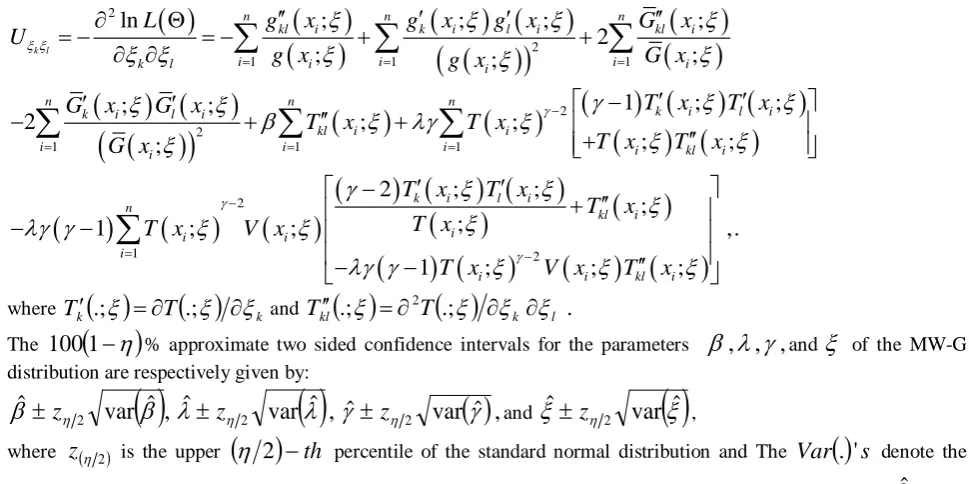
−1 . SettingU
β,
U
λ,
U
γ,
andU
ξequal to zero and solving the resultingsystem of non-linear equations simultaneously to obtain the MLEs, say
(
)
T
ξ
γ
λ
β
ˆ
,
ˆ
,
ˆ
,
ˆ
ˆ
=
Θ
ofΘ
=
(
β
,
λ
,
γ
,
ξ
)
Tof the MW-G family of distributions. The resulting equations cannot be solved analytically and statistical software can be used to solve them numerically.The elements of the information matrix are defined as follows:
( )
[
(
)
]
,
;
ln
2 2 2ξ
β
ββ
V
x
iL
U
=
∂
Θ
∂
−
=
( )
(
) (
[
)
]
,
;
;
ln
1 2 2∑
==
∂
∂
Θ
∂
−
=
n i ii
V
x
x
T
L
U
γ
ξ
ξ
λ
β
βλ( )
(
)
[
(
)
]
,
;
ln
1
;
ln
1 2ξ
γ
ξ
λ
γ
β
γβγ
T
x
iT
x
iL
U
=
+
∂
∂
Θ
∂
−
=
−( )
(
)
(
(
)
[
(
)
] (
)
)
(
)
,
;
;
;
;
1
ln
1 1 2 2 2∑
∑
= = −′
+
′
−
=
∂
∂
Θ
∂
−
=
n i i k n i i k i i kx
T
x
T
x
V
x
T
L
U
k
β
ξ
λγ
γ
ξ
ξ
ξ
ξ
γ βξ
( )
(
)
( )[
(
)
]
,
;
;
ln
1 2 1 2 2 2 2∑
= −=
∂
Θ
∂
−
=
n i ii
V
x
x
T
L
U
γ
ξ
ξ
λ
γ λλ( )
(
)
[
(
)
]
[
(
)
]
(
)
(
)
,
;
ln
;
;
ln
1
;
;
ln
1 2 1 1 2∑
∑
= − =+
+
−
=
∂
∂
Θ
∂
−
=
n i i i i i n ii
V
x
T
x
T
x
T
x
x
T
L
U
β
ξ
ξ
γ
ξ
ξ
ξ
γ
λ
γ γ λγ( )
(
)
(
)
[
(
)
] (
)
(
)
(
)
,
;
;
;
;
;
1
ln
1 1 1 2 2 2∑
∑
= − = −′
+
′
−
−
=
∂
∂
Θ
∂
−
=
n i i k i i k n i i i kx
T
x
T
x
T
x
V
x
T
L
U
k
λ
ξ
βγ
γ
ξ
ξ
ξ
γ
ξ
ξ
γ γ
λξ