Proceedings of the
Workshop on OCL and Textual Modelling
(OCL 2010)
MySQL
4
OCL: A Stored Procedure-Based MySQL Code Generator for
OCL
Marina Egea, Carolina Dania and Manuel Clavel
16 pages
Guest Editors: Jordi Cabot, Tony Clark, Manuel Clavel, Martin Gogolla Managing Editors: Tiziana Margaria, Julia Padberg, Gabriele Taentzer
MySQL
4
OCL: A Stored Procedure-Based MySQL Code Generator
for OCL
Marina Egea1, Carolina Dania12and Manuel Clavel12∗
IMDEA Software Institute, Madrid, Spain. [marina.egea,carolina.dania,manuel.clavel]@imdea.org1
Depto. Sistemas Inform´aticos y Computaci´on2, Universidad Complutense de Madrid, Spain.
Abstract: In this paper we introduce a MySQL code generator for a significant sub-set of OCL expressions which is based on the use of stored procedures for mapping OCL iterators. Our code generator is defined recursively over the structure of OCL expressions. We discuss the class of OCL expressions covered by our definition (which includes, possibly nested, iterator expressions) as well as some extensions needed to cover the full OCL language. We also discuss the efficiency of the MySQL code produced by our code generator, and compare it with previous known results on evaluating OCL expressions on medium-large scenarios. We have implemented our code generator in the MySQL4OCL tool.
Keywords:OCL, code generator, stored-procedures, MySQL
1
Introduction
In this paper we introduce a MySQL code generator for a significant subset of OCL expressions which is based on the use of stored procedures for mapping OCL iterators. We have implemented this code generator in the MySQL4OCL tool, which is available at [EDC10].
Motivation. Our motivation here is two-fold. On the one hand, our code generator addresses the problem, already discussed in [CED08] of evaluating OCL expressions on really large scenar-ios: instead of having to “load” them in memory (a time-consuming, or even impractical task for OCL evaluators), we can (i) store these scenarios in a database, (ii) apply our code generator to the expressions to be evaluated, and (iii) execute the resulting query statements on the database. On the other hand, our code generator provides a key component for any models-to-code devel-opment process, where the source models include OCL expressions and the target code evaluates these expressions on relational databases. This is precisely the case of our models-to-code tool-chain for developing smart, security-aware GUIs [DDS+10].
OCL to MySQL in a Nutshell. In general, given an expressionexpr, our code generator pro-duces a MySQL query, denoted bycodegen(expr), whose execution returns a result-set contain-ing the values correspondcontain-ing to the evaluation ofexpr. The case ofiterator expressions, i.e., of
∗Research partially supported by EU Program PCOFUND-2008-229599, Spanish MEC Projects
expressions whose top-operator is an iterator operator, deserves, however, a particular attention. Basically, for each iterator expressionexpr, our code generator produces a MySQLstored pro-cedure1that, when called, it creates a table containing the values corresponding to the evaluation ofexpr.
Our code generator is defined recursively over the structure of OCL expressions. That is, letexpr be an expression with top-operatoropand immediate subexpressionsexpr1, . . . ,exprn. Thus, in general,codegen(expr)has as subqueriescodegen(expr1), . . . ,codegen(exprn)(possibly with aliases, that we denote by codegen(expr1), . . . ,codegen(exprn)), which are produced by recursively calling our code generator on the corresponding subexpressions ofexpr.
Scope of our Mapping. As presented here, our code generator does not cover the full OCL language, a non-realistic task anyway given the limited space available. Among the features of OCL which are not currently covered are the followings: operations on sequences and ordered-sets; operations on collection of collections; operations on types; and user-defined operations. In our concluding remarks we briefly discussed how to extend our mapping to overcome its current limitations.
However, the subset of OCL that we do cover here is significant in two ways. First, it allows us to apply our code generator to (and experiment with) a large class of OCL queries: we have included some examples inAppendix Aand many more are available at [EDC10]. Second, it allows us to introduce the key idea underlying our mapping, namely, the use of stored procedures to deal with (possibly nested) iterator expressions. Interestingly, this idea was already hinted in [Sch98]. However, as it is recognized there, “this work did not succeed in finding a concise and complete formal representation for procedural mapping patterns”, and it was not further developed afterwards.
Organization. The rest of this paper is organized as follows. InSection 2we recall the basic mapping from UML class and object diagrams to MySQL. Then, inSection 3, Section 4, and Section 5, we give the definition of the mapping underlying our code generator. Afterwards, in Section 6, we discuss the efficiency of the MySQL code produced by our code generator and, in Section 7, we report on related work. We conclude the paper with our future work.
2
Mapping UML Class and Object Diagrams to MySQL
Our code generator assumes that the underlying UML class and object diagrams (i.e., the “con-texts” of the OCL queries) are represented using MySQL tables according to the following (rather) standard rules. Examples can be found in Appendix A. For the sake of simplicity, we do not consider here the full class of UML class diagrams. In particular, we do not consider the following modeling elements: generalizations, enumerations, multivalued attributes, n-ary associations (withn>2), and ordered or qualified associations.
1Stored procedures are routines (like a subprogram in a regular computing language) that are stored in the database.
LetMbe a class diagram and letObe an instance ofM. Then,
• Each classAinMis mapped to a tabledAe, which contains, by default, a columnpkof typeIntas its primary key. Then, each object inOof classAis represented by a row in dAeand it will be denoted by its key (i.e., the value inpk).
• Given a classA, each attributeW ofAis mapped to a columnW]indAe, the type ofW]
being the type ofW.2 Then, the value ofW in an objectoinOis represented by the value which the columnW]holds for the row that representsoindAe.
• Given two classesA andB, each association PbetweenA andB, with association-ends
rl A(at the classA) andrl B(at the classB), is mapped to a tabledPe, which contains two columnsrl A] andrl B], both of typeInt. Then, aP-link between an object oof class
Aand an objecto0 of classB is represented by a row indPe, whererl A] holds the key denotingoandrl B]holds the key denotingo0.
The above mapping rules assumes that the input UML class diagrams satisfy the following (rather) natural constraints:
• Each class has a unique name.
• Each attribute within a class has a unique name.
• Each association is uniquely characterized by its ends. Also, the association-ends in a self-association have different names.
3
Mapping Non-Iterator Expressions to MySQL Queries
In this section we define the querycodegen(expr)produced by our code generator for the case of expressionsexpr whose top-operator is a non-iterator operator. Examples can be found in Appendix A.
We proceed by cases, each case being characterized by the expression’s top-operator. Due to space constraints, we only consider a subset of the OCL non-iterator operators. Also, we assume that the types of these operators are either primitive types, sets or bags of primitive or class types, or class types. For the sake of presentation, we assume that, in all cases, the immediate subexpressions ofexpr are non-iterator expressions. The remaining cases are dealt with as explained inSection 5.
Primitive operators
Variables. Letvarbe a variable. Then,codegen(var)is:
selectvaras value
2More specifically, the UML/OCL primitive typesBoolean,Integer, andString, are mapped, respectively,
to the MySQL typesInt,Int, andchar(65). The UML/OCL class types are mapped to the MySQL typeInt
(which is the type of the primary keys of the tables representing classes). We have decided to mapStringto
Literals. Letlitbe a primitive literal. Then,codegen(lit)is:
selectlitas value
Operators. Letexprbe an expression or the formexpr1prim op expr2, whereprim opis+,-,
x,and,or,implies, or=. Then,codegen(expr)is:
select(codegen(expr1))prim op[(codegen(expr2))
whereprim op[ denotes the operation in MySQL that corresponds toprim op.3 Similarly, for expressions of the formprim op expr1, whereprim opis-ornot.
Type literals. Letclassbe a class identifier. Then,codegen(class)is:
selectpkas value fromdclasse
Boolean operators
isEmpty/notEmpty. Letexprbe an expression of the formexpr1->isEmpty(). Then,
codegen(expr)is:
select count(*)=0 as value from(codegen(expr1))ascodegen(expr1)
For the operatornotEmpty, “count(*)>0” replaces “count(*)=0” above.
includes/excludes. Letexprbe an expression of the formexpr1->includes(expr2).
Then,codegen(expr)is:
selectcodegen(expr2)incodegen(expr1)as value
For the operatorexcludes, “not in” replaces “in” above.
Numeric operators
size. Letexprbe an expression of the formexpr1->size(). Then,codegen(expr)is:
select count(*) as value from(codegen(expr1))ascodegen(expr1)
sum. Letexprbe an expression of the formexpr1->sum(). Then,codegen(expr)is:
select sum(*) as value from(codegen(expr1))ascodegen(expr1)
Model specific operators
allInstances. Letexprbe an expression of the formexpr1.allInstances(). Then,
codegen(expr)is:
select * from(codegen(expr1))ascodegen(expr1)
Association-ends. Letexprbe an expression of the formexpr1.rl A(resp.expr1.rl B), where
rl A(resp. rl B) is the A-end (resp. B-end) of an association Pbetween two classesA andB. Then,codegen(expr)is:
selectdPe.rl A]as value
from(codegen(expr1))ascodegen(expr1)
left joindPeoncodegen(expr1).value =dPe.rl B
wheredPe.rl A]is not null
Attributes. Letexpr be an expression of the form expr1.attr whereattr is an attribute of a
classA. Then,codegen(expr)is:
selectdAe.attr]as value
from(codegen(expr1))ascodegen(expr1)
left joindAeoncodegen(expr1).value =dAe.pk
Collection operators
asSet. Letexprbe an expression of the formexpr1->asSet(). Then,codegen(expr)is the
following MySQL statement:
select distinct * from(codegen(expr1))ascodegen(expr1)
asBag. Letexprbe an expression of the formexpr1->asBag(). Then,codegen(expr)is:
codegen(expr1)
union. Letexprbe an expression of the formexpr1->union(expr2), where bothexpr1and
expr2are sets. Then,codegen(expr)is:
codegen(expr2)unioncodegen(expr1)
Whenexpr1orexpr2are bags, then “union all” will replace “union” above.
including. Let expr be an expression of the form expr1->including(expr2), where
expr1is a set. Then,codegen(expr)is:
codegen(expr2)unioncodegen(expr1)
excluding. Let expr be an expression of the form expr1->excluding(expr2). Then,
codegen(expr)is:
select * fromcodegen(expr1)ascodegen(expr1)
where value not incodegen(expr2)
4
Mapping Iterator Expressions to MySQL Procedures
In this section we define the querycodegen(expr)produced by our code generator for the case of expressionsexprwhose top-operator is an iterator. Examples can be found inAppendix A.
Here, the basic idea is that, for each iterator expression expr, our code generator produces a MySQL stored procedure, denoted by codegenproc(expr), that, when called, it creates a table, denoted bydcodegenproc(expr)e, containing the values corresponding to the evaluation ofexpr. Due to space constraints, we only consider a subset of the iterator operators in OCL: namely,
forAll,exists,collect,select, andreject. Also, we assume that the types of the
source-subexpressions are either sets or bags of primitive or class types, and that, in the case of
collect-expressions, the types of theirbody-subexpressions are either primitive or class types, or set or bags of primitive or class types. For the sake of presentation, we assume that, in all cases, thesource- andbody-subexpressions ofexprare not themselves iterator expressions. The others cases (which include the cases of nested iterators) are dealt with as explained inSection 5.
Letexprbe an iterator expression of the formsource->iter op(var|body). Then,codegen(expr) is:
callcodegenproc(expr);
select * fromdcodegenproc(codegen(expr))e;
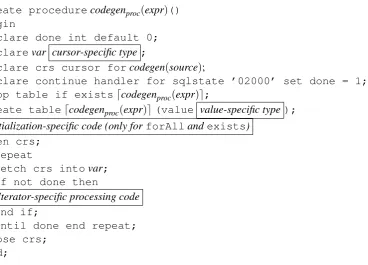
wherecodegenproc(expr) is a MySQL stored procedure. The definition of this procedure, also generated by our code generator, follows the scheme shown inFigure 1. Basically, the function
codegenproc(expr) creates the table dcodegenproc(expr)e and execute, for each element in the
source-collection, thebodyof the iterator expressionexpr. More concretely, until all elements in thesource-collection have been considered,codegenproc(expr)repeats the following process: i) it instantiates the iterator variablevarin thebody-subexpression, each time with a different element of thesource-collection, which it fetches fromcodegen(source)using a cursor; and ii) using the so called “iterator-specific processing code”, it processes in dcodegenproc(expr)e the result of the querycodegen(body), according to the semantics of the iteratoriter op. Additionally, in the case of the iteratorsforAllandexists, the tabledcodegenproc(expr)eis initialized, using the so called “initialization-specific code”. Moreover, for the iteratorsforAllandexists, the process described above will also be finished when, for any element in thesource-collection, the result of the querycodegen(body)contains the value corresponding, in the case of the iterator
forAll, to false (i.e.,0) or, in the case of the iteratorexists, to true (i.e.,1).
create procedurecodegenproc(expr)() begin
declare done int default 0;
declarevar cursor-specific type;
declare crs cursor forcodegen(source);
declare continue handler for sqlstate ’02000’ set done = 1; drop table if existsdcodegenproc(expr)e;
create tabledcodegenproc(expr)e(value value-specific type );
Initialization-specific code (only forforAllandexists)
open crs; repeat
fetch crs intovar;
if not done then
Iterator-specific processing code
end if;
until done end repeat; close crs;
end;
Figure 1: General schema for mapping iterator expressions as stored procedures.
forAll-iterator. Letexprbe an expression of the formsource->forAll(var|body). Then, the “holes” in the scheme shown inFigure 1will be filled as follows:
• value-specific type:int.
• Initialization code:
insert intodcodegenproc(expr)e(value) values (1);
• Iterator-processing code:
updatedcodegenproc(expr)eset value = 0 where (codegen(body)) = 0;
if exists (select 1 fromdcodegenproc(expr)ewhere value = 0)
then set done = 1; end if;
exists-iterator. Letexprbe an expression of the formsource->exists(var|body). Then, the “holes” in the scheme shown inFigure 1will be filled as follows:
• value-specific type:int.
insert intodcodegenproc(expr)e(value) values (0);
• Iterator-processing code:
updatedcodegenproc(expr)eset value = 1 where (codegen(body)) = 1;
if exists (select 1 fromdcodegenproc(expr)ewhere value = 1)
then set done = 1; end if;
collect-iterator. Letexpr be an expression of the form source->collect(var|body). Then, the “holes” in the scheme shown inFigure 1will be filled as follows:
• value-specific type:the MySQL type which represents, according to our mapping, the type of thebody.
• Iterator-processing code:
insert intodcodegenproc(expr)e(value)codegen(body);
select-iterator. Letexprbe an expression of the formsource->select(var|body). Then, the “holes” in the scheme shown inFigure 1will be filled as follows:
• value-specific type:the MySQL type which represents, according to our mapping, the type of the elements in thesource.
• Iterator-processing code:
if exists
(select 1 from (codegen(body)) ascodegen(body)
where value = 1)
then insert intodcodegenproc(expr)e(value) values (var);
end if;
reject-iterator. Letexprbe an expression of the formsource->reject(var|body). Then, the “holes” in the scheme shown inFigure 1will be filled as follows:
• value-specific type:the MySQL type which represents, according to our mapping, the type of the elements in thesource.
• Iterator-processing code:
if exists
(select 1 from (codegen(body)) ascodegen(body)
where value = 0)
then insert intodcodegenproc(expr)e(value) values (var);
5
Dealing with Iterator Subexpressions
The key idea underlying our mapping from OCL to MySQL is the use of stored procedures to deal with iterator expressions. However, since stored procedures cannot be called within queries, the recursive definition of our code generator needs to treat the case of immediate subexpressions which are iterator expressions in a special way.
More concretely, letexprbe an OCL expression with top-operatoropand immediate subex-pressionsexpr1, . . . ,exprn. Now, letexpri, 1≤i≤n, be an iterator expression. Then, except for the case of iterator expressions whosebody-subexpressions are themselves iterator expressions (i.e., the case of nested iterator expressions), which we will discuss later, the querycodegen(expr) produced by our code generator will be preceded by
callcodegenproc(expri);
and, moreover, any subquery codegen(expri) occurring in the definition of codegen(expr), as given inSection 3andSection 4, will be replaced by the following subquery
select * fromdcodegenproc(expri)e ascodegenproc(expr1);
Example1 For example, letexprbe the OCL expressionexpr1->notEmpty(), whereexpr1
is the non-iterator expressionCar.allInstances(). Our code generator will produce the following query:
select count(*)>0 as value from (codegen(expr1)) ascodegen(expr1);
On the other hand, letexprbe the OCL expressionexpr1->notEmpty(), whereexpr1is the
it-erator expressionCar.allInstances()->collect(c|c.model). Our code generator will produce the following query:
callcodegenproc(expr1);
select count(*)>0 as value from
(select * fromdcodegenproc(expr1)e) ascodegenproc(expr1);
5.1 Nested iterators
Letexprbe an iterator expression of the formsource->iter op(var|body). Then, if the subex-pressionsourceis itself an iterator expression, but not the subexpressionbody), we simply pro-ceed as explained above. However, when the subexpressionbodyis itself and iterator expression, the general scheme for mapping iterator expressions shown inFigure 1is slightly modified. More concretely, right before the “iterator specific processing code”, our code generator will insert
callcodegenproc(body)(var);
where now the procedure generated for mapping thebody-iterator subexpression takes one pa-rameter: namely, the iterator variablevarintroduced by the enclosing iterator expression.4 More-over, our code generator will replace any subquery codegen(body) occurring in the “iterator-specific processing code”, as given inSection 4, by the following subquery:
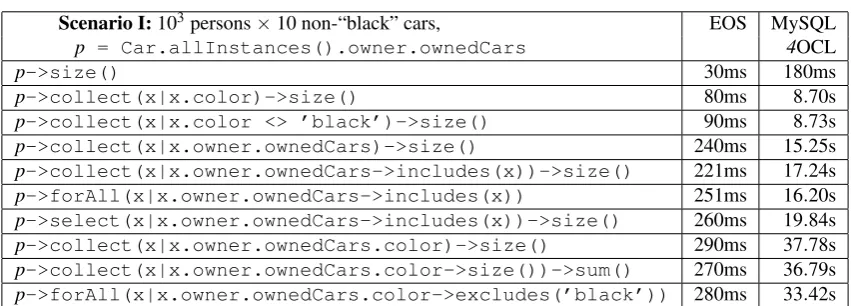
Scenario I:103persons×10 non-“black” cars, EOS MySQL
p = Car.allInstances().owner.ownedCars 4OCL
p->size() 30ms 180ms
p->collect(x|x.color)->size() 80ms 8.70s
p->collect(x|x.color <> ’black’)->size() 90ms 8.73s p->collect(x|x.owner.ownedCars)->size() 240ms 15.25s p->collect(x|x.owner.ownedCars->includes(x))->size() 221ms 17.24s p->forAll(x|x.owner.ownedCars->includes(x)) 251ms 16.20s p->select(x|x.owner.ownedCars->includes(x))->size() 260ms 19.84s p->collect(x|x.owner.ownedCars.color)->size() 290ms 37.78s p->collect(x|x.owner.ownedCars.color->size())->sum() 270ms 36.79s p->forAll(x|x.owner.ownedCars.color->excludes(’black’)) 280ms 33.42s
Table 1: Efficiency evaluation. Preliminary results.
select * fromdcodegenproc(body)(var)e
6
A Preliminary Discussion on Efficiency
In [CED08] we discussed: i) the need for an efficient implementation of OCL; ii) the aspects to be taken into consideration to improve the efficiency of OCL evaluators on medium-large scenarios; iii) the limits of the current OCL implementations for dealing with really large scenarios. To motivate i), we included a benchmark showing the performance of some OCL tools on medium-large scenarios.
Although the aim of our code generator is not to address i), that is, the efficient implementation of OCL evaluation, but rather to overcome iii), that is, the limits of the current OCL implemen-tations for dealing with really large scenarios, we found interesting to compare the execution of the code produced by our MySQL4OCL with EOS,5using for this purpose essentially the same benchmark proposed in [CED08]. All the expressions in the benchmark were evaluated on the same scenario, namely, an instance of the “Car-ownership” class diagram which contains 103 persons, each person owning 10 different cars, and each car with a color different from “black”. The results are shown inTable 1.6 Notice that, for the sake of the experiment, we artificially increased the size of the collections to be iterated upon: more concretely, inTable 1,pstands for the expressionCar.allInstances().owner.ownedCars, which, on the given scenario, evaluates to a collection with 105cars.
As expected, for small-medium size scenarios, it is faster to evaluate OCL expressions using EOS than to execute the code generated by MySQL4OCL. Interestingly, the cost of executing this MySQL code seems to depend, as in the case of EOS, on two measurements: first, the
5In the benchmark proposed in [CED08], EOS outperformed the other OCL evaluators. We do not have more recent
comparison figures.
6In the case of MySQL4OCL, the benchmark was run on a laptop computer with two processors at 2.40GHz, 2GB of
maximum number of times that objects’ properties will be accessed and, second, the maximum size of the collections that will be built. In fact, for the expressions in this benchmark, the extra-cost of executing the code generated by MySQL4OCL is essentially linear with respect to the cost of evaluating the expressions in EOS.
The advantage of using our code generator comes when evaluating OCL expressions on large scenarios. As reported in [CED08], none of the available OCL evaluators, including EOS, were able to finish loading a scenario with 106cars in less than 20 minutes.7 In contrast, loading this scenario on a MySQL server may take less than a minute. However, it remains to be addressed the question of whether executing the code produced by MySQL4OCL on large scenarios is sufficiently efficient. For this purpose, we have run again on MySQL4OCL the benchmark proposed in [CED08], but this time on a considerably larger scenario: namely, one that contains 105 persons, each person owning 10 different cars, and each car with a color different from
“black”. As expected, the execution times scale-up linearly with respect to those shown for MySQL4OCL in Table 1: basically, they are multiplied by 102, in line with the fact that the number of persons and cars are also multiplied by 102. Although these results are encouraging, more experiments and comparisons are still needed in order to extract definite conclusions about the efficiency on large scenarios of the code generated by MySQL4OCL.
7
Related Work
The work most directly related with this paper can be found in [DH99, Sch98] and provides the foundations of the OCL2SQL tool [DHL01, HWD08]. As already discussed in [CED08], the solution offered in [DH99, Sch98] is not satisfactory: it only considers a rather restricted subset of the OCL language; it only applies to boolean expressions and not to arbitrary queries; and the “complexity” of the produced code makes impractical its use for evaluating expressions on medium-large scenarios.8 There are many differences between our mapping and the one underlying OCL2SQL (along with some commonalities, of course). Here we only discuss the two most relevant differences. First, we map navigation expressions using “left join”, while OCL2SQL uses “in”. With “left join”, we avoid erroneously removing duplicated elements when dealing with bags in arbitrary OCL queries. Second, and more relevant for our present purposes, we give a well-defined mapping of OCL iterator operators using stored procedures. Interestingly, this idea was already hinted in [Sch98]. However, as it is recognized there, “this work did not succeed in finding a concise and complete formal representation for procedural mapping patterns”, and the idea was not further developed afterwards.
The mapping from OCL to MQL (the SAP metamodel repository query language) proposed in [Bur06] is also related with our work. Unfortunately, iterator expressions or boolean op-erators on collections (e.g., isEmpty() orincludes()) are not covered by the proposed mapping, due to the limited expressiveness of the target language. On a more abstract level,
7In fact, we do not know how long would it take to actually finish this task for the different OCL evaluators, since
we decided to stopped, in all cases, the loading process after 20 minutes. In any event, it is clear that, for most applications, loading large scenarios in memory will be rather impractical.
8As reported in [CED08], the cost of executing the code generated by OCL2SQL for a simpleforall-expression
several methodologies have been recently proposed in [MHS09,AN06,AN09] to generate code (possibly for specific data storage language) from OCL expressions. It remains to be investi-gated how our code generator fits in these (yet not fully developed) proposals. Also, there have been several interesting proposals for mapping OCL expressions into Java code [DBL05,Wil09]. However, we envision for the code generated by these mappings the same general limitation re-ported in [CED08] for OCL evaluators: namely, that for really large scenarios they need first to solve the loading problem within a practical time-frame.
Finally, it is worthwhile mentioning the work done in [MAB08,Coo09,GMRS09] on translat-ing other (constraint/query) languages to SQL, since they aim to bridge application and databases, which is also part of our motivation. A detailed discussion on the expressiveness and/or practical interest of OCL with respect to the (class of) source languages considered in [MAB08,Coo09, GMRS09] is, however, out of the scope of this paper.
8
Conclusions and Future work
In this paper, we have introduced a MySQL code generator for a significant subset of OCL ex-pressions (including, possibly nested, iterator exex-pressions) which is based on the use of stored procedures for mapping OCL iterators. Our code generator has been already implemented in the MySQL4OCL tool, which is available at [EDC10]. Since the features and language constructs that are employed in our mapping from OCL to MySQL are supported (leaving aside syntactic differences) by other relational databases such as Oracle and PostgreSQL, we expect that our code generator could be adapted for other database management systems. Also, we have dis-cussed the efficiency of the code produced by our code generator, and we have compared it with previous known results on evaluating OCL expressions on medium-large scenarios. Additional experiments and comparisons are still needed in order to extract more definite conclusions, and we plan to carry them on as part of our future work. In this context, we plan to investigate which transformations between equivalent OCL expressions are useful in order to optimize the code produced by our code generator.
Acknowledgements: We thank Michael Schl¨apfer for his interesting discussions and help dur-ing the initial stage of this proposal.
Bibliography
[AN06] A. Armonas, L. Nemurait´e. Pattern Based Generation of Full-Fledge Relational Schemas From UML/OCL Models. Information Technology and Control 35(1), 2006.
[AN09] A. Armonas, L. Nemurait´e. Using Attributes and Merging Algorithms for Trans-forming OCL expressions into Code. Information Technology and Control 38(4), 2009.
[Bur06] E. Burger. Query Infrastructure and OCL within the SAP Project “Modeling Infrastructure”- Studienarbeit. Technical report, Institut f¨ur Theoretische Informatik - Technische Universit¨at Karlsruhe, Germany, 2006.
[CED08] M. Clavel, M. Egea, M. G. de Dios. Building and Efficient Component for OCL Evaluation. InProc. of 8th OCL Workshop at the UML/MoDELS Conference: OCL Concepts and Tools: From Implementation to Evaluation and Comparison. ECE-ASST 15. Tolouse, France, September 2008.
[Coo09] E. Cooper. The Script-Writer’s Dream: How to Write Great SQL in Your Own Lan-guage and Be Sure It Will Succeed. In Gardner and Geerts (eds.),Proc. of 12th Inter-national Symposium Database Programming Languages - DBPL 2009. LNCS 5708, pp. 36–51. Springer, 2009.
[DBL05] W. Dzidek, L. Briand, Y. Labiche. Lessons Learned from Developing a Dynamic OCL Constraint Enforcement Tool for Java. InProc. of the 4th OCL workshop at MoDELS’05 Conference: Tool Support for OCL and Related Formalisms - Needs and Trends. LNCS 3844, pp. 10–19. Springer-Verlag Berlin Heidelberg, Montego Bay, Jamaica, October 2005.
[DDS+10] M. A. G. de Dios, C. Dania, M. Schl¨apfer, D. A. Basin, M. Clavel, M. Egea. SSG: A Model-Based Development Environment for Smart, Security-Aware GUIs. In Kramer et al. (eds.),Proc. of the 32nd ACM/IEEE International Conference on Soft-ware Engineering - Volume 2, ICSE 2010, Cape Town, South Africa, 1-8 May 2010. Pp. 311–312. ACM, 2010.http://www.bm1software.com.
[DH99] B. Demuth, H. Hußmann. Using UML/OCL Constraints for Relational Database Design. In France and Rumpe (eds.),Proc. of UML’99: The Unified Modeling Lan-guage - Beyond the Standard, Second International Conference, Fort Collins, CO, USA, October 28-30, 1999, Proceedings. LNCS 1723, pp. 598–613. Springer, 1999.
Language. Modeling languages, Concepts and Tools. LNCS 2185, pp. 104–117. Springer, Toronto, Canada, 2001.
[EDC10] M. Egea, C. Dania, M. Clavel. The MySQL-OCL Code Generator. August 2010. http://www.bm1software.com/mysql-ocl.
[GMRS09] T. Grust, M. Mayr, J. Rittinger, T. Schreiber. FERRY: Database-supported Program Execution. In Cetintemel et al. (eds.),Proc. of the 35th SIGMOD international con-ference on Management of data. SIGMOD ’09, pp. 1063–1066. ACM, New York, NY, USA, 2009.
[HWD08] F. Heidenreich, C. Wende, B. Demuth. A Framework for Generating Query Language Code from OCL Invariants. In Proc. of 7th OCL Workshop at the UML/MoDELS Conference: Ocl4All: Modelling Systems with OCL. ECEASST 9. Nashville, Tennessee, October 2008.
[MAB08] S. Melnik, A. Adya, P. A. Bernstein. Compiling Mappings to Bridge Applications and Databases.ACM Transactions Database Systems33:1–50, December 2008.
[MHS09] R. Moiseev, S. Hayashi, M. Saeki. Generating Assertion Code from OCL: A Transformational Approach Based on Similarities of Implementation Languages. In A.Sch¨urr and Selic (eds.), Proc. of Model Driven Engineering Languages and Systems, 12th International Conference, MoDELS 2009, Denver, CO, USA, October 4-9, 2009. Proceedings. LNCS 5795, pp. 650–664. Springer, 2009.
[Sch98] A. Schmidt. Untersuchungen zur Abbildung von OCL-Ausdr¨ucken auf SQL. Mas-ter’s thesis, Institut f¨ur Softwaretechnik II - Technische Universit¨at Dresden, Ger-many, 1998.
[Wil09] C. Wilke. Java Code Generation for Dresden OCL2 for Eclipse- Grosser Beleg. Technical report, Fakult¨at Informatik Institut f¨ur Software un Multimediatechnik -Technische Universit¨at Dresden - Lehrstuhl Softwaretechnolgie, Germany, 2009.
A
Examples
Consider the “Car-ownership” UML class diagram inFigure 2: it contains two classes, “Person” and “Car”, which are related by the association “Ownership”, which links persons (“owner”) with their cars (“ownedCars”). To illustrate the mapping rules for UML class and object diagrams given inSection 2, we show below the MySQL statements that create the tables corresponding to “Car-ownership”.
create table Person (pk int auto increment primary key, name char(65), age int, phoneno int);
create table Car (pk int auto incremente primary key, model char(65), color char(65));
create table ownership (owner int not null, ownedCars int not null, foreign key (owner) references Person (pk),
Car
+ model : Stringalaaa
+ color : Stringaaaaal Person
+ name : Stringaaallla
+ phoneno : Integerlal
+ age : Integeraaaaall
ownedCars
owner *
*
Figure 2: The “Car-ownership” class diagram
1 : Car
model = Peugeot 307 color = white
2 : Car
model = Peugeot 206 color = blue
3 : Car
model = Peugeot 206 color = grey 2 : Person
name = Teresa age = 25 phoneno = 67641875
1 : Person
name = Ale age = 26 phoneno = 68901037
3 : Person
name = César age = 29 phoneno = 63518996
4 : Person
name = Juan age = 26 phoneno = 65148161
Figure 3: A “Car-ownership” object diagram
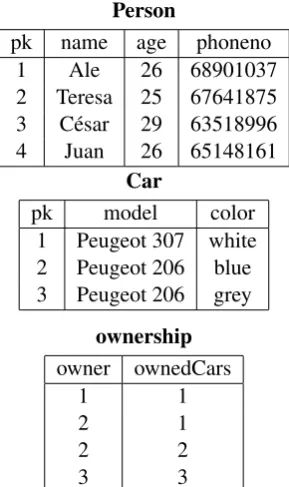
Person
pk name age phoneno 1 Ale 26 68901037 2 Teresa 25 67641875 3 C´esar 29 63518996 4 Juan 26 65148161
Car
pk model color 1 Peugeot 307 white 2 Peugeot 206 blue 3 Peugeot 206 grey
ownership owner ownedCars 1 1 2 1 2 2 3 3
Figure 4: Mapping a “Car-ownership” ob-ject diagram.
Also, consider the instance of “Car-ownership” inFigure 3. We show inFigure 4the repre-sentation of this object diagram in the tables created by our mapping for “Car-ownership”.
Next, to illustrate the recursive definition of our code generator given inSection 3 and Sec-tion 4, we introduce the following examples:
Example2 Letexprbe the OCL expressionCar.allInstances().model. Then,
codegen(expr)is the following MySQL statement:
select Car.model as value
from (select pk value from Car) as temp left join Car on temp.value = Car.pk;
Example3 Letexprbe the OCL expressionCar.allInstances().owner. Then,
codegen(expr)is the following MySQL statement:
from (select pk value from Car) as temp
left join ownership on temp.value = ownership.ownedCars where ownership.owner is not null;
Example4 Letexprbe the OCL expressionCar.allInstances()->forAll(c| c.owner.ownedCars->includes(c)). Then, codegen(expr) is the following MySQL statement:
create procedure forAll0() begin
declare done Int default 0;
declare result boolean default true; declare var Int;
declare crs cursor for (select pkCar from Car);
declare continue handler for sqltate ’02000’ set done = 1; drop table if exists forAll0;
create table forAll0(value int);
insert into forAll0 (value) values (1); open crs;
repeat
fetch crs into var; if not done then
update forAll0 set value = 0 where( select var in (
(select ownership.ownedCars as value from (select ownership.owner as value from (select var as value) as t3
left join ownership on t3.value=ownership.ownedCars where ownership.owner is not null) as t2
left join ownership on t2.value=ownership.owner where ownership.ownedCars is not null) as t1) = 0; if exists (select 1 from forAll0 where value = 0) then set done = 1;
end if; end if;
until done end repeat; close crs;
end;
call forAll0();