139
© 2017 by the Serbian Biological Society How to cite this article: Alasvandyari F, Mahdavi B, Hosseini Shahab M. Glycine betaine affects the antioxidant system and ion accumulation and reduces salinity-induced damage in safflower seedlings. Arch Biol Sci. 2017;69(1):139-47.
Glycine betaine affects the antioxidant system and ion accumulation and reduces
salinity-induced damage in safflower seedlings
Farnaz Alasvandyari, Batool Mahdavi* and Shahab Madah Hosseini
Department of Agronomy and Plant Breeding, Agriculture College, Vali-e-Asr University of Rafsanjan, Rafsanjan, Iran.
*Corresponding authors: [email protected]
Received: February 16, 2016; Revised: April 25, 2016; Accepted: May 23, 2016; Published online: October 21, 2016
Abstract: Safflower (Carthamus tinctorius L.) is an important oilseed crop, usually grown on a small scale and in salt-affected soils. Salinity stress can cause oxidative damage to plants. Upregulation of the antioxidant defense system induced by glycine betaine (GlyBet) alleviates the damaging effects of oxidative stress in plants. In the present investigation, seeds were treated with 0, 10, 30 and 60 mM of GlyBet solutions. Germination and the primary growth of the seedling were examined using sodium chloride salt (NaCl) at 0 (non-stress), 50, 100 and 150 mM concentrations. The obtained results indicate that at 50 and 100 mM NaCl, priming with 30 and 60 mM GlyBet increased root and shoot lengths compared to the control (0 mM). In addition, at all stress levels, priming with 60 mM GlyBet led to lower malondialdehyde, total soluble sugars and proline contents than in control seedlings. Priming with GlyBet increased catalase (CAT), superoxide dismutase (SOD) enzyme activities and protein content, while it reduced the activity of peroxidase (POD) under salinity stress. In addition, priming
with GlyBet reduced the Na+/K+ ratio of seedlings and increased K+ under all salinity stress levels. Priming with 60 mM
GlyBet also reduced the Na+ content under 150 mM NaCl. Together, these results show that 60 mM GlyBet had the most
pronounced effect on tolerance to salinity stress in safflower seedling. The GlyBet-increased tolerance to salt in safflower was mainly related to increased CAT and SOD activities, and the prevention of cell membrane damage as a result of reduced lipid peroxidation and improved ion homeostasis under salinity stress condition.
Key words: enzyme activity; germination; glycine betaine; safflower; salt stress
INTRODUCTION
Salinity is one of the major environmental stresses presenting a serious threat to field crops in many parts of the world, especially arid and semiarid re-gions. Salinity can cause water stress, malnutrition and accumulation of excess ions to potentially toxic levels in plants. Salt tolerance can differ dramatically between species/varieties and ontogenetic stages and is usually reflected by a reduction in biomass pro-duction, yield or survival rates [1]. Salinity influences seed germination, decreases node formation, retards plant development and decreases crop yield [2]. Seed germination is the first critical and the most sensitive process in plant growth[3]. Salt-induced inhibition of seed germination could be related to specific ion toxicity or to osmotic stress. Seedling establishment is compromised in seeds exposed to salinity stress conditions [4].
Osmolytes such as glycine betaine (GlyBet), pro-line, sugars, polyols and amino acids are synthesized in surplus in response to stress [5]. These osmotic adjust-ments maintain subcellular structures and decrease oxidative damage caused by free radicals produced in response to high salinity [6]. It has been shown that the biosynthesis of GlyBet is stress-inducible [7] and the level of accumulated GlyBet is dependent on the degree of salt tolerance [8]. Also, an exogenous supply of GlyBet increases the salt tolerance of a few plants that are otherwise unable to accumulate GlyBet [9].
The main role of GlyBet in plants exposed to saline soil is considered to be maintaining osmotic regulation in cells [10]. It was suggested that GlyBet supports various transporters for normal functioning under salt stress. From this, it can be proposed that GlyBet has a protective effect in discriminating Na+
pos-sible role of GlyBet is that it might enhance vacuolar efficiency in the roots of salt-stressed plants for ac-cumulating more Na+, as has earlier been reported in
rice [12]. Gadallah [10] reported that GlyBet improves germination and seedling growth of many crops under stressful condition. Plants treated with GlyBet also maintain higher antioxidative enzyme activities that minimize oxidative stress [13]. Hu et al. [14] showed that exogenous application of GlyBet increased cata-lase (CAT) and superoxide dismutase (SOD) activity and K+ content in perennial ryegrass under salinity
stress conditions. Also, they reported that the applica-tion of GlyBet reduced Na+, malondialdehyde (MDA)
and proline content in salt-stressed plants.
Safflower is commonly known as a moderately salt-tolerant crop and is grown in arid and semi-arid zones of the world where salinity can limit the growth of many other crops [15]. Dried seeds of safflower con-tain 40% protein, 21% oil, 34% carbohydrates and 5% ash. It is a very high-quality seed with a high economic performance [16]. Safflower is mostly cultivated for vegetable oil, which is considered as one of the best oils for human consumption regarding its high levels (70-75%) of linoleic acid or oleic acid [17]. The objectives of the present study were to assess the effectiveness of exogenously applied GlyBet on germination, seedling growth and some biochemical and physiological char-acteristics of safflower under salinity stress condition.
MATERIALS AND METHODS Growth conditions and treatments
The safflower (Carthamus tinctorius L.) seeds were presoaked in solutions of different concentrations (0-distilled water, 10, 30 and 60 mM) of GlyBet for 8 h at 25°C. After presoaking, the seeds were surface-dried on filter paper and then allowed to air-dry at room temperature. Three replicates of 50 seeds were placed on two layers of filter paper (Whatman No. 1) in 9-cm diameter Petri dishes. Five ml of saline solutions containing 50, 100 and 150 mM NaCl were applied in each Petri dish to impose salinity stress, while deionized water was applied for non-saline con-ditions. Petri dishes were incubated at 20±1°C under a 16/8 h regime. After 6 days, the number of total germinated seeds, and length and weight of shoots
and roots were measured. Samples of seedlings (25 seedlings per sample) were frozen in liquid nitrogen and stored at -80°C until biochemical analyses were done. The germination rate was calculated according to the equation of Ramana et al. [18]:
GR = N1/D1+N2/D2+…..+Ni/Di
where, Ni is the number of germinated seeds per day (Di).
Determination of proline
Proline was determined following the ninhydrin method described by Bates et al. [19], using L-proline as a standard. About 0.2 g of frozen seedlings were ho-mogenized in 3% sulfosalicylic acid, and the homog-enate was centrifuged at 10000 rpm. The supernatant was used for the estimation of proline content. The reaction mixture, consisting of 2 mL of acid ninhydrin and 2 mL of glacial acetic acid, was heated at 100°C for 1 h. The reaction mixture was extracted with 4 mL of toluene and absorbance was read at 520 nm.
Determination of malondialdehyde (MDA)
For determination of MDA, frozen seedlings (0.2 g) were homogenized in an aqueous solution of 5% (w:v) trichloroacetic acid, and the homogenate was centri-fuged at 14000 rpm for 20 min. Aliquots of the super-natant were heated in 0.25% thiobarbituric acid. The amount of MDA was determined from the absorbance at 532 nm. The value for nonspecific absorption at 600 nm was subtracted. The concentration of MDA was calculated by using the extinction coefficient of 155 mM-1 cm-1 [20].
Total soluble sugar determination
mg/L [21] and expressed in milligrams of glucose per gram of fresh matter (mg/g FW).
Determination of antioxidant enzyme activities
Frozen seedlings (0.2 g) were homogenized at 4°C in a mortar with 4 mL of 50 mM potassium phosphate buffer (pH 7.0). The homogenate was centrifuged at 20000 rpm for 20 min at 4°C. The supernatant was used for determination of enzyme activities and pro-tein content. Total propro-tein content was determined using bovine serum albumin as a standard according to the method described by Bradford [22]. Activities of CAT and POD were measured using the method of Cakmak and Marschner [23] and Pandolfini et al. [24] with some modification. The CAT reaction solution contained 50 mM potassium phosphate buffer (pH 6.8), 10 mM of H2O2 and protein extract. The decrease in absorbance was recorded at 240 nm for 1 min. CAT activity of the extract was expressed as unit mg−1
pro-tein min−1 (1 unit = 1 mM of H
2O2 reduction mg-1
protein min-1). The POD reaction mixture contained
100 μL of protein extract, 1900 μL 50 mM potassium phosphate buffer (pH 6.8), 500 μL 28mM guaiacol and 500 μL 5 mM H2O2. The increase in absorbance was recorded at 470 nm for 1 min (U-2000, Hitachi In-struments, Tokyo, Japan). POD activity of the extract was expressed as unit mg−1 protein min−1. One unit of
POD was defined as the amount of enzyme that caused the formation of 1 mM of tetraguaiacol per min. The activity of SOD was determined using the method described by Giannopolitis and Ries [25] with some modifications. The reaction solution contained 2300 μL 50 mM potassium phosphate buffer (pH 7.8), 100 μL 12 mM L-methionine, 100 μL 1 mM riboflavin, 100 μL 0.1 mM EDTA (pH 7.8), 100 μL 50 mM calcium carbonate, 100 μL 75 mM nitroblue tetrazolium (NBT) and 200 µl of the protein extract in a final volume of 3 ml. The test tubes containing the reaction mixture were irradiated under the light of white fluorescent lamps (120 W) at a distance of 40 cm for 15 min. The absorbance of the irradiated solution at 560 nm was determined with a spectrophotometer. Tubes without extract and containing potassium phosphate buffer, were either exposed or not exposed to light, and served as blanks in the reaction. One unit of SOD activity was defined as the amount of enzyme that caused 50% inhibition of photochemical reduction of NBT.
Determination of Na+ and K+ ion contents
The seedlings were dried at 60οC for 48 h. One g of
samples was powdered and burned in 550°C for 6 h to obtain ashes, which were subsequently digested in 10 mL of 1 N HCl. The concentration of Na+ and K+
in the digested samples was determined using a flame photometer (Model PFP7, Germany).
Statistical analysis
The experiments were performed in a completely ran-domized design arranged as a factorial with three rep-lications. Mean comparison was performed using the LSD test at the 5% level of significance (P<0.05). The statistical analysis was performed using SAS software.
RESULTS
Germination characteristics
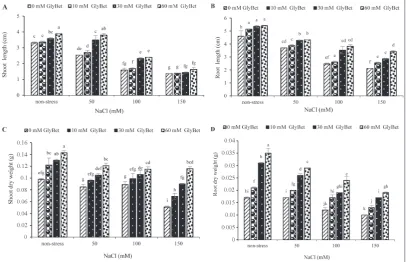
Salinity reduced the germination rate as the NaCl level increased (Fig. 1). However, both in non-stress and all of the salinity stress levels, priming with high levels of GlyBet (30 and 60 mM) resulted in an increase in germination rate in comparison the control without GlyBet. In non-stress conditions, seeds primed with 60 mM GlyBet showed a 65% germination increase as compared to the control. At the highest level of stress (150 mM NaCl), priming with 60 mM GlyBet resulted in a 23% increase in the germination rate (Fig. 1).
the shoot dry weight and in 150 mM NaCl, priming with all of GlyBet levels increased the dry weight (Fig. 2C). Priming with GlyBet at all tested concentrations increased the root dry weight compared to the control under non-stress and stress conditions (Fig. 2D).
Biochemical characteristics
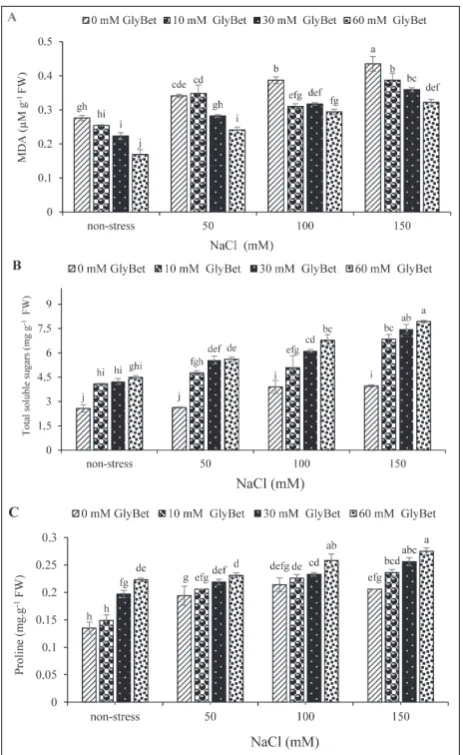
As the NaCl concentrations increased, the MDA con-tent increased as well. Under all of the stress condi-tions, priming with GlyBet reduced the MDA content
compared to the control, and the largest reduction was in seedlings pretreated with 60 mM GlyBet (Fig. 3A). The total soluble sugars content increased with the increase in NaCl concentrations, and proline content slightly increased with the increase in NaCl concen-trations. In non-stress and salinity stress conditions, priming with GlyBet concentrations increased total soluble sugars and proline content as compared to the control (Fig. 3B, C).
Antioxidant enzyme activities
As the NaCl concentrations increased, the activity of SOD increased, whereas POD activity and protein de-creased. Also, salinity slightly increased CAT activity. At all stress levels, priming with GlyBet increased CAT and SOD activity (Fig. 4A, B). Priming with 30 and 60 mM GlyBet increased CAT activity compared to the control under non-stress conditions and with 50 mM NaCl. In 100 and 150 mM NaCl, priming with all of GlyBet levels increased CAT activity (Fig. 4A). SOD activity increased at 30 and 60 mM GlyBet com-pared to the control under non-stress conditions and 50 and 100 mM NaCl. At 150 mM NaCl, priming with GlyBet at all tested concentrations increased SOD
ac-Fig 1. Effects of GlyBet pretreatment and NaCl concentrations on germination rate of safflower. Values are means±SE obtained from three replicates. Means followed by the same letter are not significantly different at P<0.05 according to LSD test.
tivity (Fig. 4B). The highest CAT and SOD activities were observed at 150 mM NaCl and 60 mM GlyBet. The lowest CAT and SOD activities were observed at non-stress condition and in the control (Fig. 4A, B).
Under non-stress and salinity stress conditions, priming with 60 mM GlyBet decreased POD activity compared to the control (Fig. 4C). Priming with all of the GlyBet concentrations increased the protein content as compared to the control under non-stress and salinity stress conditions (Fig. 4D).
Ion content
Priming with 30 and 60 mM GlyBet reduced the con-tent of Na+ of seedlings under 50 and 100 mM NaCl
concentrations. In 150 mM NaCl, priming with 60 mM GlyBet reduced the Na+ content (Fig. 5A). At all
stress levels, priming with GlyBet at all tested concen-trations increased K+ content and decreased the Na+/
K+ ratio compared to the control. The highest Na+
concentration and Na+/K+ ratio were obtained in the
control and 150 mM NaCl (Fig. 5A, C). The highest amount of K+ was observed in 60 mM GlyBet under
non-stress conditions (Fig. 5B).
DISCUSSION
The results of the study showed that an increase in salinity reduced the germination rate and growth of safflower seedlings. Other researchers also described a reduction in the germination rate and growth seedling with increasing salinity stress levels in wheat [26,27]. Salinity stress can influence seed germination through a decrease in water absorption leading to moisture stress (osmotic effect), by ion toxicity and/or ionic imbalance, or by the accumulation of Na+ and Cl- ions. Also, salinity stress through inhibition of the absorp-tion of several necessary nutrients such as K+ causes nutritional imbalance in plants and/or accumulation of several parameters [28]. The reduction in root and shoot development may be due to the toxic effects of the NaCl used as well as by unbalanced nutrient absorption by the seedlings [29]. Our results showed that priming with high levels of GlyBet (30 and 60 mM) increased the germination rate and growth of seedlings when compared to unprimed under salinity stress. The application of exogenous GlyBet has an important role in water availability for the imbibition of germinating seeds during limited water [30]. GlyBet also increased seed germination under increased salt and control conditions by enhancing the osmotic pres-sure [7]. Our results are in agreement with Kausar et al. [31] who reported that the exogenous application of GlyBet also increased the fresh and dry weight of roots and shoots in maize under salinity stress.
MDA is commonly measured as the end-product of lipid peroxidation and is increased during salinity
stress. Membrane lipid peroxidation is an indication of membrane damage and leakage under salt stress condi-tions [32]. In this study, as the salinity level increased, lipid peroxidation increased and the application/ad-ministration of GlyBet at high concentrations (30 and 60 mM) decreased the MDA content under salinity stress. Increased lipid peroxidation has been reported in other plants like safflower [33], wheat [34], tomato [35] and purslane [36] under salinity stress conditions. Hu et al. [14] suggested that GlyBet alleviated lipid per-oxidation and facilitated the protection of membrane functions under salinity stress. This facilitation could be attributed to the GlyBet-induced antioxidant responses that support the plant from oxidative damage [5].
In this research, total soluble sugars and proline content increased with increasing salinity stress levels. The current results are in accordance with the findings of Erdal et al. [33], who showed that salinity stress increased the content of proline and soluble sugars in safflower. Soluble sugars play a significant role in the osmotic adjustment of cells during reproduction and stress conditions [37]. Proline acts as an osmopro-tectant and is associated with the mechanism of salt tolerance under salinity stresses. Our results showed that priming with GlyBet led to an increase in total soluble sugars and proline content during the salinity
stress. Similarly, Demiral and Türkan [38] and Heuer [39] reported the GlyBet application increased pro-line content in rice and tomato under salinity stress. Also, Ibrahim and Aldesuquy [40] and Aldesuquy et al. [41] found that GlyBet led to the accumulation of more soluble sugars in sorghum and wheat under drought stress.
Reactive oxygen species (ROS) are toxic radicals and molecules that cause oxidative damage to DNA, proteins and lipids. Also, ROS function as signaling molecules that mediate various physiological pro-cesses, including programmed cell death and de-fense against biotic and abiotic stresses [42]. Salinity stress can stimulate ROS accumulation [43]. Plants protect themselves against oxidative stress-induced damage by their antioxidant defense systems, which include enzymatic and nonenzymatic antioxidants [44]. GlyBet protects the photosynthetic machinery by stabilizing the activity of repair proteins under high concentrations of NaCl [45]. Hoque et al. [5] reported that GlyBet at physiological concentrations provides a direct protective effect on antioxidant enzyme activi-ties under salinity stress.
Our results suggest that salinity slightly increased CAT activity and SOD activity increased with
ing NaCl concentrations. Also, GlyBet had a positive effect on the activity of the enzymes and increased their activity. With increasing salinity and GlyBet concentrations, POD activity decreased. Antioxidant enzyme activities increased in some crops such as pea [46] and wheat [47,48] under salinity stress. Kaya et al. [49] reported that salinity increased polyphenol oxidase (PPO) activity, but decreased POD and CAT activities in maize. Exogenous GlyBet alleviated the effect of salinity, most likely by scavenging free radi-cals and protecting antioxidant enzymes [5]. Chen and Murata [50] suggested that GlyBet overcome the del-eterious effects of oxidative stress by activating or sta-bilizing ROS-scavenging enzymes and/or repressing the production of ROS by an unknown mechanism. Demiral and Türkan [38] have shown that exogenous
application of GlyBet enhances CAT activity in a salt-sensitive rice cultivar under high salinity stress.
In this study, priming with 60 mM GlyBet de-creased Na+ at all concentrations of salt. With
in-creasing NaCl concentrations and GlyBet concentra-tions, the K+ content increased and the Na+/K+ ratio
decreased. Cuin and Shabala [51,52] suggested that compatible solutes, and GlyBet in particular, regulate the net fluxes of Na+ and K+ across the plasma
mem-brane at the cellular level in response to NaCl stress. Sobahan et al. [53] reported that GlyBet may play a role in maintaining cytosolic K+ homeostasis by
sup-pressing Na+-increased apoplastic flow to decrease
Na+ absorption.
CONCLUSIONS
The present study revealed that priming safflower seeds with GlyBet can enhance the plant’s tolerance to salt stress during the germination stage, and the higher concentration of GlyBet (60 mM) was more effective than the other concentrations. The results of this research can be a useful step toward eliminating the effects of salinity stress in the primary stages of plant growth, and the exogenous application of GlyBet appears to be a promising approach in safflower. How-ever, considering the fact that the study was carried out in the germination stage, it is essential to assess the effects of GlyBet in the next stages of growth in the greenhouse and field.
Authors’ contribution: Farnaz Alasvandyari performed the
ex-periments and wrote the paper. Batool Mahdavi and Shahab Ma-dah Hosseini designed and organized the study and participated in writing the paper. All authors have read and approved the final manuscript.
Conflict of interest disclosure: There is no conflict of interests between the authors.
REFERENCES
1. Munns R, Tester M. Mechanisms of salinity tolerance. Ann Rev Plant Biol. 2008;59:651-81.
2. Greenway H, Munns R. Mechanisms of salt tolerance in nonhalophytes. Annu Rev Plant Physiol. 1980;70:303-7. 3. Ahmad S, Ahmad R, Ashraf MY, Ashraf M, Waraich EA.
Sun-flower (Helianthus annuus L.) response to drought stress at germination and growth stages. Pak J Bot. 2009;41(2):647-54.
Fig 5. Effects of GlyBet pretreatment and NaCl concentrations on Na+ (A), K+ (B) and Na+/K+ ratio in safflower. Values are means±SE
4. Albuquerque FMCD, Carvalho NMD. Effect of type of envi-ronmental stress on the emergence of sunflower (Helianthus
annuus L.), soybean (Glycine max (L.) Merril) and maize
(Zea mays L.) seeds with different levels of vigor. Seed Sci Technol. 2003;31:465-7.
5. Hoque MA, Okuma E, Banu MNA, Nakamura Y, Shimoishi Y, Murata Y. Exogenous proline mitigates the detrimental effects of salt stress more than the betaine by increasing anti-oxidant enzyme activities. J Plant Physiol. 2007;164:553-61. 6. Hare PD, Cress WA, Van-Staden J. Dissecting the roles of osmolyte accumulation during stress. Plant Cell Environ. 1998;21(6):535-53.
7. Sakamoto A, Murata N. Genetic engineering of GlyBet syn-thesis in plants: current status and implications for enhance-ment of stress tolerance. J Exp Bot. 2000;51:81-8.
8. Saneoka H, Nagasaka C, Hahn DT, Yang WJ, Premachandra GS, Joly RJ, Rhodes D. Salt tolerance of GlyBet-deficient and -containing maize lines. Plant Physiol. 1995;107:631-8. 9. Hayashi H, Alia Sakamoto A, Nonaka H, Chen THH,
Murata N. Enhanced germination under high-salt condi-tions of seeds of transgenic Arabidopsis with a bacterial gene (codA) for choline oxidase. J Plant Res. 1998;111:357-62. 10. Gadallah MMA. Effects of proline and GlyBet on Vicia faba
responses to salt stress. Plant Biol. 1999;42:249-57. 11. Mansour MMF. Protection of plasma membrane of onion
epidermal cells by GlyBet and proline against NaCl stress. Plant Physiol Biochem. 1998;36(10):767-72.
12. Rahman MS, Miyake H, Takeoka Y. Effects of exogenous GlyBet on growth and ultra-structure of salt-stressed rice seedlings (Oryza sativa L.). Plant Prod Sci. 2002;5:33-44. 13. Ma Q, Wang W, Li Y, Li D, Zou Q. Alleviation of
photo-inhibition in drought-stresses wheat (Triticum aestivum) by foliar-applied GlyBet. Plant Physiol. 2006;163:165-75. 14. Hu L, Hu T, Zhang X, Pang H, Fu J. Exogenous GlyBet
ame-liorates the adverse effect of salt stress on perennial ryegrass. J Amer Sooc Hort Sci. 2012;137(1):38-46.
15. Bassil ES, Kaffka SR. Response of safflower (Carthamus tinc-torius L.) to saline soils and irrigation: II. Crop response to salinity. Agricult Water Manag. 2002;54(1):67-80.
16. Perry LM. Medicinal plants of east and Southeast Asia: Attrib-uted properties and uses. Cambridge, UK: MIT Press; 1980. 17. Singh V, Nimbkar N. Safflower (Carthamus tinctorius L.).
In: Singh RJ, editor.Genetic resources, chromosome engi-neering and crop improvement. Vol 4: Oilseed Crops. Boca Raton: CRC Press; 2006. p. 167-94.
18. Ramana S, Biswas AK, Kundu S, Saha JK, Yadava RBR. Effect of distillery effluent on seed germination in some vegetable crops. Bioresour Technol. 2002;82:273-5.
19. Bates LS, Waldern RP, Teave ID. Rapid determination of free proline for water stress studies. Plant Soil. 1973;39:205-7. 20. Heath RL, Packer L. Photoperoxidation in isolated
chloro-plasts. I. Kinetics and stoichiometry of fatty acid peroxida-tion. Arch Biochem Biophys. 1968;125(1):189-98.
21. Dubois M, Gilles KA, Hamilton JK, Reber PA, Smith F. Col-orimetric method for determination of sugars and related substances. Annu Chem. 1956;28(3):350-6.
22. Bradford, MM. A rapid and sensitive method for quantita-tion of microgram quantities of protein utilizing the prin-ciple of proteindye-binding. Annu Biochem. 1976;72:248-54.
23. Cakmak I, Marschner H. Enhanced superoxide radical production in roots of zinc-deficient plants. J Exp Bot. 1988;39:1449-60.
24. Pandolfini T, Gabbrielli R, Comparini C. Nickel toxicity and peroxidase activity in seedlings of Triticum aestivum L. Plant Cell Environ. 1992;15:719-25.
25. Giannopolitis CN, Ries SK. Superoxide dismutases occur-rence in higher plants. Plant Physiol. 1977;59(2):309-14. 26. Shafi M, Bakht J, Khan MJ, Khan MA. Effect of
salin-ity and ion accumulation of wheat genotypes. Pak J Bot. 2010;42(6):4113-21.
27. Sharma SK, Grag OP. Salinity induced changes in plant growth and activities of glutamate dehydrogenase, aspar-tate and alanine amino-transferases in wheat. Indian J Plant Physi. 1985;28:407-12.
28. Taamalli W, Abz L, Youssef NB, Miled DDB, Zarrouk M. Lipid breakdown in sunflower (Helianthus annuus L.) seeds during post germinative growth under salt-stress. Riv Ital Sostanze Gr. 2004;81:90-7.
29. Jamil M, Lee DB, Jung KY, Ashraf M, Lee SC, Rha ESh. Effect of salt (NaCl) stress on germination and early seed-ling growth of four vegetables species. Cent Eur Agric. 2006;7:273-82.
30. Iqbal N, Ashraf MY. Does seed treatment with GlyBet improve germination rate and seedling growth of sun-flower (Helianthus annuus L.) under osmotic stress. Pak J Bot. 2006;38(5):1641-8.
31. Kausar N, Nawaz Kh, Hussain Kh, Bhatti KhH, Siddiqi EH, Talla A. Effect of exogenous applications of GlyBet on growth and gaseous exchange attributes of two maize (Zea mays L.) cultivars under saline conditions. World Appl Scis J. 2014;29(12):1559-65.
32. Katsuhara M, Otsuka T, Ezaki B. Salt stress-induced lipid peroxidation is reduced by glutathione S-transferase, but this reduction of lipid peroxides is not enough for a recovery of root growth in Arabidopsis. Plant Sci. 2005;169:369-73. 33. Erdal SC, Cakirlar H. Impact of salt stress on photosystem II
efficiency and antioxidant enzyme activities of safflower ( Car-thamus tinctorius L.) cultivars. Turk J Biol. 2014;38:549-60. 34. Hala M, El-Bassiouny S, Bekheta MA. Effect of salt stress
on relative water content, lipid peroxidation, polyamines, amino acids and ethylene of two Wheat cultivars. J Agric Biol. 2005;3:363-8.
35. Neumann PM. The role of cell wall adjustment in plant resis-tance to water deficits. Crop Sci. 2001;35:1258-66.
36. Yazici I, Türkan I, Sekmen A, Demiral T. Salinity tolerance of Purslane (Portulaca oleracea L.) is achieved by enhanced antioxidant system, lower level of lipid peroxidation and proline accumulation. Environ Exp Bot. 2007;61:49-57. 37. Gill PK, Sharma AD, Singh P, Bhullar SS. Osmotic stress
induced changes in germination, growth and soluble sugar contents of Sorghum bicolor (L.) Moench seeds under vari-ous abiotic stresses. Plant Physiol. 2002;128:12-25. 38. Demiral T, Türkan I. Does exogenous GlyBet affect
antioxi-dative system of rice seedlings under NaCl treatment? J Plant Physiol. 2004;161:1089-100.
40. Ibrahim AH, Aldesuquy HS. Induction of increased water stress tolerance in Sorghum bicolor plants by glycine betaine and shikimic acid treatment. Phyton. 2003;43:351-63. 41. Aldesuquy HS, Abo-Hamed SA, Abbas MA, Elhakem AH.
Effect of glycine betaine and salicylic acid on growth and productivity of droughted wheat cultivars. I. Osmolytes in relation to osmotic adjustment and grain yield. J Environ Sci. 2009;37:13-3.
42. Apel K, Hirt H. Reactive oxygen species: metabolism, oxi-dative stress and signal transduction. Annu Rev Plant Biol. 2004;55:373-99.
43. Lee DH, Kim YS, Lee CB. The inductive responses of the antioxidant enzymes by salt stress in rice (Oryza sativa L.). J Plant Physiol. 2001;158:737-45.
44. Mittler R. Oxidative stress, antioxidants and stress tolerance. Trends Plant Sci. 2002;7:405-10.
45. Murata N, Takahashi S, Nishiyama Y, Allakhverdiev SI. Pho-toinhibition of photosystem II under environmental stress. Biochem Biophys Acta. 2007;1767:414-21.
46. Hernandez JA, Campillo A, Jimenez A, Alacon JJ, Sevilla F. Response of antioxidant systems and leaf water relations to NaCl stress in pea plants. New Phytol. 1999;141:241-51.
47. Meneguzzo S, Navari-Izzo F, Izzo R. Antioxidative responses of shoots and roots of wheat to increasing NaCl concentra-tions. J Plant Physiol. 1999;155:274-80.
48. Sairam RK, Srivastava GC. Changes in antioxidant activ-ity in subcellular fractions of tolerant and susceptible wheat genotypes in response to long term salt stress. Plant Sci. 2002;162:897-904.
49. Kaya C, Sönmez O, Aydemir S, Dikilitas M. Mitigation effects of GlyBet on oxidative stress and some key growth parameters of maize exposed to salt stress. Turk J Agric For. 2013;37:188-94.
50. Chen THH, Murata N. GlyBet: an effective protectant against abiotic stress in plants. Trends Plant. 2008;13:499-505. 51. Cuin TA, Shabala S. Exogenously supplied compatible
sol-utes rapidly ameliorate NaCl-induced potassium efflux from barley roots. Plant Cell Physiol. 2005;46:1924-33.
52. Cuin TA, Shabala S. Amino acids regulates salinity-induced potassium efflux in barley root epidermis. Planta. 2007;225:753-61.
53. Sobahan MA, Arias CR, Okuma E, Shimoishi Y, Nakamura Y, Hirai Y, Mori IC, Murata Y. Exogenous proline and GlyBet suppress apoplastic flow to reduce Na+ uptake in rice