Volume 14 (2008)
Proceedings of the
Third Workshop on Petri Nets and Graph Transformations
(PNGT 2008)
Reconfigurable Open Algebraic High-Level Systems
Conny Ullrich and Julia Padberg
14 pages
Guest Editors: Paolo Baldan, Barbara K ¨onig
Managing Editors: Tiziana Margaria, Julia Padberg, Gabriele Taentzer
Reconfigurable Open Algebraic High-Level Systems
Conny Ullrich and Julia Padberg1
1Technische Universit¨at Berlin Fakult¨at IV - Informatik und Elektrotechnik
Abstract: In this paper reconfigurable open algebraic high-level (AHL) systems are introduced as an extension of AHL systems [PER95]. In addition to the integra-tion of data structures open places and communicating transiintegra-tions allow modelling reactive behavior as communication with their environment. Reconfigurable open AHL systems are defined that comprise rules and transformations of these nets. For-mally they are an instance of weak adhesive HLR systems [EP06] and so yield the same results. Moreover, a case study is presented that demonstrates the practical need for reconfigurable open AHL systems.
Keywords:open Petri nets, reconfiguration, transformation, emergency scenarios
1
Motivation
A mobile ad hoc network (MANET) is an autonomous collection of mobile nodes that
commu-nicate with each other over wireless links. Since the nodes are mobile, the network topology may change unpredictably over time. Applications that are based on MANETs need extra ef-fort to be maintainable because of the nondeterministic nature of distribution and mobility. In order to facilitate more complex applications ofMANETs a modeling technique is needed that enables the modeling of flexible workflows and supports changes of the network topology and the transformation of workflows. In [HEP07] flexible processes inMANETs are realised by using
the formal notions of reconfigurable systems based on weak adhesive HLR systems ([EEPT06]). An instance of these systems are reconfigurable algebraic high-level (AHL) systemsbased on AHLSystems, the category of AHL systems and AHL system morphisms. AHL nets them-selves are an extension of the Place/Transition (P/T) Nets in the sense of [MM90] and combine P/T nets with algebraic specifications. A reconfigurable AHL system consists of an AHL sys-tem, i.e. an AHL net with an actual marking, and a set of rules whose application modify the AHL system’s structure at runtime. In our case studies [Ull08,HEP07] we have seen the need to model the workflows of different organisational units that communicate internally but also with other units. So, we need modeling means to express communication with the environment of each team. Communication can be modeled implicitly, as occurring messages or explicitly, where the message is send from some other unit via some channel. Open nets allows both: We can use open places for the implicit communication that abstract from the environment and we can use special transition to model explicit communication. For the adequate modeling of such systems suitable control structures are needed. In our project forMA`NET (Formal modeling and
Figure1illustrates a workflow of an emergency scenario in a hospital where two organisations are involved: the Fire Department and the hospital personnel which consists of three units. The different units are marked by light blue squares. Each line represents the workflow of one person. Hence, the unitNursesconsists of two Nurses (N1,N2),Securityconsists of three persons (SCO, S1,EO),Fire Departmentconsists of four persons (FDO,F1,F2,F3) andCEOrepresent one person. For the sake of clarity we omit the naming of the places, transitions and the arc inscriptions.
Nurses CEO Security
N2 N1 SCO S1 EO
Fire Department FDO F1 F2 F3
Figure 1: Emergency Scenario modelled with an AHL System
In emergency scenarios typically different organizational units are participating that should be modeled individually. So, we extend the formalism of AHL Nets with open places and com-municating transitions to open AHL nets. The idea of open places is to provide an interface, that serves for implicit communication. Communicating transitions represent the interconnec-tion between different organizainterconnec-tional units. Hence, the explicit communicainterconnec-tion event itself is represented by firing of the communicating transition, that is located between the corresponding input and output places. When examining one organizational unit the communication events are given implicitly by the creation and deletion of tokens.
are continued in [PW98], where an elementary calculus is introduced in which one can construct any Petri net with an interface from trivial constants (single places, single transitions) by drawing arcs, adding tokens, and hiding public places and transitions.Reconfigurable Petri netsare a sub-class ofnet rewriting systemsand formally equivalent to Petri nets. They have been introduced in [LO04]. Net rewriting systems are based on graph grammars and Valk’s self-modifying nets. Their rules are very similar to productions of graph grammars and the application of a rewriting rule is like a direct derivation in graph grammars. The formalism of reconfigurable Petri nets
is a particular net rewriting system where the set of places and transitions is left unchanged by rewriting rules. Such rules only change the flow relations of the places in their domains.
2
Open AHL Systems
Open AHL systems are an extension of AHL system (see [PER95]) with open places and com-municating transitions. Open places – as in [BCEH05] – may have token that are generated or removed independently of the net’s state. In contrast to AHL systems an open AHL system has three different modi for places—local, input and output—and two different modi of transitions– local and communicating. While local places are used to demonstrate the internal process scheme of a system, input and output places describe the interaction of this system with its environment. The embedding and transforming of an open AHL systemS1 in an adequate open AHL system
S2 is formally described by open AHL system morphisms. Here the structure and functionality of the modelled system must be preserved, i.e. amongst others an open AHL system morphism must preserve the modus of places. To keep at the categorical context we build the sets of places (P) by using the categorical coproduct, which ensures that the individual morphisms for the different modi are preserved by an open AHL system morphism. PL,PI andPOare objects of the categorySETS, hence, the coproduct is given by the disjoint union.
Definition 1(Open Algebraic High Level (AHL) Systems) An open AHL systemS= (N,m)
is given by an open AHL netN= (SP,P,T,pre,post,cond,type,A)and a markingm. An open AHL netNconsists of
• an algebraic specification SP= (Σ,E;X) with signature Σ= (S,OP), equations E, and additional variables X overΣ;
• the disjoint unionP=PL]PI]POof local (PL), input (PO) and output places (PO);
• the disjoint unionT =T L]TCof local (T L) and communicating transitions (TC);
• pre- and post conditions pre and post, withpre,post:T →(TΣ(X)⊗P)⊕where
– pre:T L→(TΣ(X)⊗(PL]PI)⊕,
post:T L→(TΣ(X)⊗PL]PO)⊕,
– pre:TC→(TΣ(X)⊗PO)⊕, post:TC→(TΣ(X)⊗PI)⊕;
• firing conditionscond:T → Pf in(Eqns(Σ;X));
• a type of places withtype:P→S • a(Σ,E)-algebra A
where
2. TΣ(X)is the set of terms with variables X over the signatureΣ,
3. (TΣ(X)⊗P) ={(term,p)|term∈ TΣ(X)type(p);p∈P},
4. Eqns(Σ,X)are all equations over the signatureΣwith variables X.
The markingmofNis given byM∈CP⊕whereCP= (A⊗P) ={(a,p)|a∈Atype(p),p∈P}.
The local places and local transitions comply with places and transitions of AHL nets. So, each AHL net can be mapped to an open AHL net with PI=PO=TC= /0. In the graphical representation of an open AHL net input and output places are distinguished from local places by incoming and outgoing arrows. In Example1we consider a part of our case study from Section4 as an introductory example.
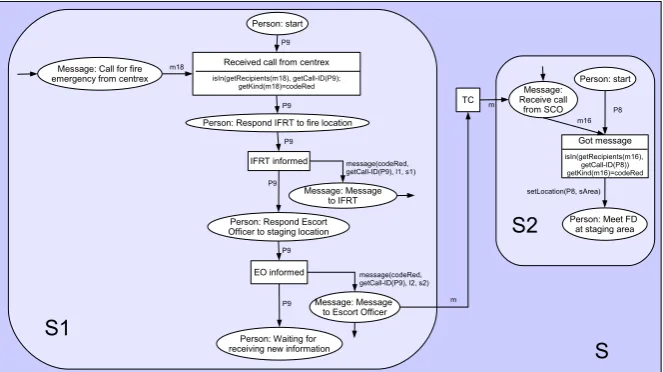
Example1 Figure2shows an open systemS, which consists of the subsystemsS1andS2. The subsystemS2starts operating when it has received an appropriate message from subsystemS1. The transitionTC, which is located between the output placeMessage to Escort OfficerofS1and the input placeReceive call from SCOofS2, serves as interconnection between these subsystems.
Message: Call for fire emergency from centrex
Person: Respond IFRT to fire location
IFRT informed
Message: Message to IFRT Person: start
P9
message(codeRed, getCall-ID(P9), l1, s1) m18 Received call from centrex
isIn(getRecipients(m18), getCall-ID(P9); getKind(m18)=codeRed
P9 P9 P9
Person: Respond Escort Officer to staging location
Message: Message to Escort Officer EO informed
P9 P9
m
Person: start
Person: Meet FD at staging area
P8
Got message
isIn(getRecipients(m16), getCall-ID(P8)) getKind(m16)=codeRed
Message: Receive call
from SCO
m16 m
setLocation(P8, sArea)
TC
S S1
S2
Person: Waiting for receiving new information
message(codeRed, getCall-ID(P9), l2, s2)
Figure 2: open AHL net of system S
For the formal definition of the operational behaviour of open AHL nets we first define functions to determine the data elements which must be removed from the pre-domain and added to the post-domain after firing of a transition. To fire a transitiont ∈T the conditions oft must be fulfilled. Let the set of variablesVar(t)of a transitiont∈ T be the variables of the net inscrip-tions inpre(t),post(t)andcond(t)andasg:Var(t)→ Abe a variable assignment. Then set of consistent transition assignmentsCT ={(t,asg)|t∈T,cond(t)holds in A under asg}gives the assignments for the variables oftso that the conditions oftare fulfilled.
Definition 2(A - Pre and Post Domains) The A-pre-domain and A-post-domainpreA,postA: CT →CP⊕ of a given open AHL net oAN = (SP, P, T, pre, post, cond, type, A) are defined by
Definition 3(Operational Behaviour) The operational behavior of an open AHL net N is de-scribed by the following three cases.
I Firing of a transition: A transitiont∈TN is enabled in M under asg iff (t,asg)∈CT and preA(t,asg)≤M. The follower marking M0 is given by M0 =M preA(t,asg)⊕ postA(t,asg).
II Creation of a token by the environment: Let the set of active input places of NIA be defined byIA=PIN\ {p∈PIN| ∃c∈TCN :p≤post(c). Then the creation of a token is given by the follower markingM0 as defined as follows:M0=M⊕(a,p)with p∈IA,a∈ type(p).
III Deletion of a token by the environment: Let the set of active output places of NOA be defined byOA=PON\{p∈PON| ∃c∈TCN:p≤pre(c)}. Then the deletion of a token is given by the follower markingM0as defined as follows: M0=M (a,p)with p∈OA,a∈ type(p).
An open AHL system morphism maps an open AHL system to another open AHL system which can have a different algebraic specification and algebra. This means that we have to deal with a morphism between algebras of different specifications. Therefore, we use generalised homomorphisms, a special case of generalised morphisms introduced in [EBO91]. A generalised homomorphism((fS,fOP),fA):((Σ,E),A)→((Σ,E)0,A0)is given by a specification morphism
(fS,fOP):(Σ,E)→(Σ,E)0 and a homomorphism fA :A→V(fS,fOP)(A
0) whereV(
fS,fOP) is the
forgetful functor induced by(fS,fOP).
Definition 4 (Open AHL System Morphisms) Given open AHL systems S, S’. Then f =
(fSP,fP,fT,fA):S→S0is given by
• fSP= (fS,fOP,fX)with fX :X →X0is an injective mapping of variables
• fP= (fPL:PL→PL0)](fPI:PI→PI0)](fPO:PO→PO0)
• fT = (fT L:T L→T L0)](fTC:TC→TC0)and
• ((fS,fOP),fA)is a generalised homomorphism. f is an open AHL system morphism iff
1. f is compatible with pre, post,condandtypeas shown in the following diagrams;
Pf in(Eqns(Σ; X)) T (TΣ(X)⊗P)⊕ P S
Pf in(Eqns(Σ0; X0)) T0 (TΣ0(X0)⊗P0)⊕ P0 S0
fT (f#
SP⊗fP)⊕
pre,post
pre0,post0
Pf in(f#
SP)
cond
cond0
fP fSP,S
type
type0 = =
=
2. f is marking-preserving, i.e. for all(a,p)∈(A⊗P):m1(a,p)≤m2(fA(a),fP(p)). An open AHL system morphismf is strict iff
1. fSPis strict injective, i.e. fSPis injective and fSP−1(E0)⊆E, 2. fPand fT are injective, and
3. f is marking strict, i.e. for all(a,p)∈(A⊗P):m1(a,p) =m2(fA(a),fP(p)).
The next theorem states that open AHL net morphisms preserve firing and communication.
(fSP,fP,fT,fA):N1→N2. Let M1be a marking of N1and M2:= (fSP# ⊗fP)⊕(M1)a marking of N2. Then
I. fN preserves the firing behaviour of N1:
(a) Let CT1 and CT2 be the sets of consistent transition assignments. If(t,asg1)∈CT1
with asg1:(Var(t))→A1and pre1A(t,asg1)≤M1then there is an assignment asg2:
Var(fT(t))→A2with(fT(t),asg2)∈CT2and pre2A(fT(t),asg2)≤M2;
(b) the follower marking after firing is preserved: if M1
(t,asg1)
−→ M10 in N1then M2
(fT(t),asg2) −→ M20 in N2with M20 = (fSP# ⊗fP)⊕(M10).
II. fN is communication preserving as follows:
(a) For all p∈IA,1 with fI(p)∈IA,2 the follower marking after creation of a token is
preserved: if M1⊕−→(a,p)M10 in N1then M2⊕(fA−→(a),fP(p))M20 in N2.
(b) For all p∈OA,1 with fO(p)∈OA,2 the follower marking after deletion of a token is
preserved: if M1 −→(a,p)M10 in N1then M2 (fA(−→a),fP(p))M20 in N2.
Proof sketch:
I. The proof is identical to AHL net morphisms.
II. (a) Given p ∈IA,1 with fI(p)∈ IA,2 and M10 = M1⊕(a,p) with a ∈type(p). To show (fSP,fP)(M10) =M20 :=M2⊕(fA(a),fI(p)).
II. (b) Given p∈OA,1 with fO(p)∈OA,2 and M1=M10 ⊕(a,p) witha∈type(p). ForM20 =
M2 (fA(a),fI(p))we show thatM20 = (fSP,fP)(M10).
Open AHL systems and open AHL system morphisms where fA :A→VSP(A0) is an iso-morphism form the categoryOAHLSystems. InOAHLSystemspushouts and pullbacks along strict open AHL system morphisms can be constructed componentwise as described in detail in Lemma 2.19 and 2.23 in [Ull08].
Remark: Open nets as in [BCEH05] have a precise and compositional process semantics based on occurrence nets. There the main focus has been to transfer the well-known concepts of deterministic processes and occurrence nets to open nets, that are nets with additional in or out places. The morphisms are defined accordingly. Since, our approach is focused on being reconfigurable and having open place, we are unfortunately forced to neglect the given notions, i.e. the definition of the morphisms as in [BCEH05]. Since we concentrate on reconfiguration we use morphisms that preserve the firing of transitions, and preserve communication in the sense that active places are mapped to active places or there is a corresponding communicating transition.
3
Reconfiguration of Open AHL Systems
transformation.
Definition 5(Rules and Transformation) Given the categoryOAHLSystemsand the morphism classM of all strict open AHL system morphisms (see Definition4).
• A rulep= (L←l K→r R)consists of three systemsL,KandRcalled left hand side, gluing object and right hand side respectively, and morphisms l:K→ L and r:K→R with
l,r∈M.
• Given a rulep= (L←l K→r R)and an systemGwith a morphismm:L→Gcalled match. A direct transformationG=p,⇒m HfromGto a systemH
is given by the following diagram, called DPO-diagram, where (1) and (2) are pushouts. A sequenceG0⇒G1⇒
··· ⇒Gn of direct transformations, writtenG0=∗⇒Gn, is called a transformation.
L K L
G D H
l r
m k n
f g
(1) (2)
The operational behaviour of reconfigurable Petri Systems in general and reconfigurable open AHL systems in particular can be considered as the arbitrary and interleaving of firing and trans-formation steps. Unfortunately there is up to now no formal definition of that.
Reconfigurable open AHL systems are open AHL nets that have explicit rules for establishing the communication,. In [BCEH05] this is achieved by pushout construction, where as we use specific rules, namely those in the setRCof rules.
Definition 6(Reconfigurable Open AHL System) Given an open AHL SystemS= (N,m)and a set of rules R. Then a reconfigurable open AHL system is defined by((N,m),R). The set R of rules consists of
• a setRMof rules to modify the structure of an open AHL system and
• a setRCof rules to describe the explicit communication of an open AHL system.
As for reconfigurable Petri nets in general we have rulesRMto modify the net and additionally we introduce a separate set of rules modelling explicitly the communication. Nevertheless, the syntactical definitions ofRM andRC are identical. But for practical reasons we separate these sets of rules w.r.t. the different use. The communication rules describe the explicit communica-tion of teams modelled as an open AHL system.
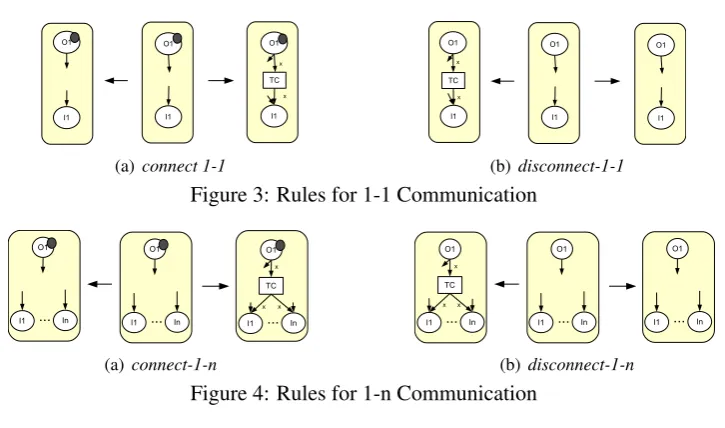
Possible communication rules are presented in the following. The rules connect 1-1 (Fig-ure3(a)) anddisconnect 1-1 (Figure 3(b)) describe an asynchronous communication between two subsystems. More precisely an output place sends a message to an input place. The rules
connect-1-n(Figure4(a)) anddisconnect-1-n(Figure4(b)) also describe asynchronous commu-nication. However, we extend the above mentioned rules so that an output place can send a message to more than one input places. In order to apply a rule in an open AHL system the so-called gluing condition must be satisfied. This condition assures that the application of a rule yields an open AHL system as given in Definition1. The gluing condition for open AHL systems complies with the gluing condition for AHL systems which is defined in [PER95,Rei08]. Results(for Reconfigurable Open AHL Systems) The subsequent Theorems hold:
O1
I1
O1
I1
O1
I1 TC
x
x
(a)connect 1-1
O1
I1
O1
I1 O1
I1 TC
x
x
(b)disconnect-1-1
Figure 3: Rules for 1-1 Communication
O1
I1
TC
In ...
O1
I1 ... In
O1
I1 ... In
x x
x
(a)connect-1-n
O1
I1 TC
In ... O1
I1 ... In O1
I1 ... In
x
x x
(b)disconnect-1-n
Figure 4: Rules for 1-n Communication
the same open AHL system in any order (sequential independence provided) or in parallel (parallel independence provided) yields the same result.
• Conflicts and Critical Pairs: If two transformations are not parallel independent as described above they are in conflict. A critical pair describes such a conflict between two transformations in a minimal context. Critical pairs are proven to be complete.
• Concurrency: If sequential dependencies occur the concurrent rule can be constructed establishing the same effect in one transformation step as the given sequence. The Con-currency Theorem states that the concurrent rule constructed from a sequence of rules is applicable and yields the same result.
Proof sketchTheorem 3.12 in [Ull08] yields that the categoryOAHLSystemsis a weak ad-hesive HLR category with the classM of all strict open AHL system morphisms. Therefore, a reconfigurable open AHL system with a set of rules forms a weak adhesive HLR system. Fur-thermore, Fact 4.7 in [Ull08] states thatOAHLSystemshas coproducts compatible with the class
M. Corollary 1 in [EP06] yields that for reconfigurable open AHL systems we can adopt the Local Church-Rosser Theorem, the Parallelism Theorem and the Concurrency Theorem where the classE consists of jointly surjective and marking minimal morphisms (see [Rei08]).
4
Case Study: Fire Incident Responsibilities
The basis of our case study is part of the ”Johns Hopkins Safety Manual” [JH007a,JH007b] for fire incident responsibilities in the Johns Hopkins Hospital (JHH). In this manual the responsi-bilities of different personnel groups are given. First we describe a possible scenario.
Escort Officer (EO) to the staging area, the Jefferson Entrance, to meet the Fire Department (FD). At the start of the scenario S1, S2 and the EO are located in the first floor of the Johns Hopkins Hospital. When S1 and S2 arrive at ward JHH3, mobile equipment, which can ob-struct the passage, is still standing on the corridor. Therefore, S2 assists the nurses and clears the corridor of this equipment before he secures the area. In the meantime S1 communicates the conditions to the SCO. The SCO forwards this information to the Fire Department. In the meantime the FD has arrived at the Jeffersen Entrance and is directed ward JHH3 by the EO to. After arriving at the ward the FD decides that this area must be evacuated. The clinic personnel begins to evacuate the patients and visitors of ward JHH3 and directs them into the first floor (JHH1).
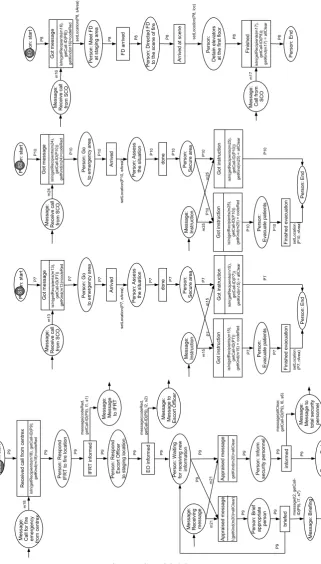
In order to define the open AHL system, we must decide on the internal system, i.e., which personnel groups we want to observe. To demonstrate internal and external communication we only observe the security group. This group consists of the security communication officer (SCO), the escort officer (EO) and the IFRT members (S1 and S2). This means our internal system is represented by an open AHL systemIS (shown in Figure10), which consists of one SCO workflow, one EO workflow and two IFRT workflows. A suitable set of rules (RM) to change this workflows at runtime are given in the appendix in Fig.11. Combining the system
IS, the rulesRMand the rules mentioned in Section3we obtain the reconfigurable open AHL system to simulate our scenario. We do not simulate all steps in detail, but give an example for the exchange of information inside of the systemISand an example for the communication between this system and its environment. Since the specification and the algebra are the same for all systems in our case study, we restrict our observation to the places and transitions.
For the system IS the scenario starts with the message from the Central Exchange Officer to the SCO. This means that IS interacts with an external system and we simulate this by the creation of a tokenM1 on the placeSCO:Call for fire emergency from centrex=P∗(see Figure5). The tokenM1 is a data element of the sortAMessage and is defined asM1 = message(codeRed, 54999, 100, ”Fire in ward B3A.”). Following Definition3the markingm1 ofISafter the creation ofM1 is given by:
m1 = (SCO,SCO:start)⊕(EO,EscortOfficer:start)⊕(S1,Security1:start)
⊕ (S2,Security2:start)⊕(M1,SCO:Call for fire emergency from centrex)
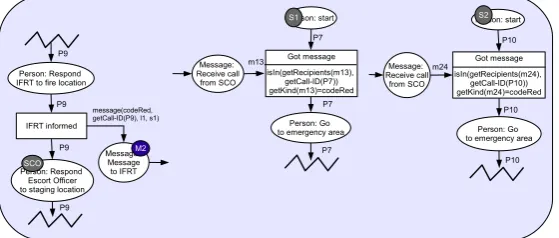
The next step which we consider is the sending of the messageM2 from SCO to S1 and S2. In this case we have an internal communcation from the output placeSCO:Message to IFRT to the input placesS1:Receive call from SCOandS2:Receive call from SCO. After the application of this rule the output placeSCO:Message to IFRTis connected with the input placesS1:Receive call from SCOandS2:Receive call from SCO. Via firing of transitionTCthe messageM2 is transmitted from SCO to S1 and S2. Figure 8shows the relevant part of systemIS0 after firing TC. After the transmission of a message we want to close the connection between the involved workflows. Therefore, we apply the ruledisconnect-1-n (see Figure4(b)) withn=2. The application of
Message: Call for fire emergency from centrex
Person: Respond IFRT to fire location
Person: start
P9 m18 Received call from centrex
isIn(getRecipients(m18), getCall-ID(P9); getKind(m18)=codeRed
P9 P9
SCO
⊕(M1,P∗)
−→
Message: Call for fire emergency from centrex
Person: Respond IFRT to fire location
Person: start
P9 m18 Received call from centrex
isIn(getRecipients(m18), getCall-ID(P9); getKind(m18)=codeRed
P9 P9
SCO
M1
Figure 5: Detail ofIS: Creation of tokenM1
Person: Respond IFRT to fire location
IFRT informed
Message: Message
to IFRT P9
P9
Person: Respond Escort Officer to staging location
P9
message(codeRed, getCall-ID(P9), l1, s1)
SCO
M2
Person: start
Message: Receive call from SCO
Person: Go to emergency area
P10 Got message isIn(getRecipients(m24),
getCall-ID(P10)) getKind(m24)=codeRed m24
P10 P10
S2
Person: start
Message: Receive call from SCO
Person: Go to emergency area
P7 Got message isIn(getRecipients(m13),
getCall-ID(P7)) getKind(m13)=codeRed m13
P7 P7
S1
P9
Figure 6: Detail ofISbefore applyingconnect-1-2
5
Conclusion
Reconfigurable open AHL systems are particularly suitable for modelling complex data and concurrent systems whose structure can change dynamically. Additionally, open AHL systems allow modelling reactive systems, which interact with its environment.
Future work concerns further results as given in [EEPT06]: The Embedding and Extension Theorem which allows embedding transformations into larger contexts, and the Local Conflu-ence Theorem that allows showing local confluConflu-ence of transformation systems on the basis of the confluence of critical pairs. To achieve these theorems we need additional properties for open AHL systems. In [Lam07] an extension of weak adhesive HLR categories toweak adhesive HLR categories with negative application conditions (NACs). NACs are used for the control of rule applications by prohibiting specific structures in the source system. Weak adhesive HLR cate-gories with NACs require some additional properties that have to be shown forOAHLSystems. Furthermore, open AHL systems can be extended to labeled open AHL systems. Labels offer an additional control structure for reconfigurable systems. The idea of labels is to mark every place with a fixed label and to allow only mappings of places with the same label. In [Rei08] this extension has been shown to be very useful for P/T systems.
Person: Respond IFRT to fire location
IFRT informed
Message: Message to IFRT P9
P9
Person: Respond Escort Officer to staging location
P9
message(codeRed, getCall-ID(P9), l1, s1)
SCO
M2
Person: start
Message: Receive call from SCO
Person: Go to emergency area
P10 Got message isIn(getRecipients(m24),
getCall-ID(P10)) getKind(m24)=codeRed m24
P10 P10
S2
Person: start
Message: Receive call from SCO
Person: Go to emergency area
P7 Got message isIn(getRecipients(m13),
getCall-ID(P7)) getKind(m13)=codeRed m13
P7 P7
S1
P9
TC
m
m m
Figure 7: Detail ofIS0 after applyingconnect-1-2
Person: Respond IFRT to fire location
IFRT informed
Message: Message to IFRT P9
P9
Person: Respond Escort Officer to staging location
P9
message(codeRed, getCall-ID(P9), l1, s1)
SCO
Person: start
Message: Receive call from SCO
Person: Go to emergency area
P10 Got message isIn(getRecipients(m24),
getCall-ID(P10)) getKind(m24)=codeRed m24
P10 P10
S2
Person: start
Message: Receive call from SCO
Person: Go to emergency area
P7 Got message isIn(getRecipients(m13),
getCall-ID(P7)) getKind(m13)=codeRed m13
P7 P7
S1
P9
TC
m
m m
M2 M2
Figure 8: Detail ofIS0 after firingTC
Person: Respond IFRT to fire location
IFRT informed
Message: Message to IFRT P9
P9
Person: Respond Escort Officer to staging location
P9
message(codeRed, getCall-ID(P9), l1, s1)
SCO
Person: start
Message: Receive call from SCO
Person: Go to emergency area
P10 Got message isIn(getRecipients(m24),
getCall-ID(P10)) getKind(m24)=codeRed m24
P10 P10
S2
Person: start
Message: Receive call from SCO
Person: Go to emergency area
P7 Got message isIn(getRecipients(m13),
getCall-ID(P7)) getKind(m13)=codeRed m13
P7 P7
S1
P9 M2 M2
References
[AB96] A. Asperti, N. Busi. Mobile Petri Nets. Technical report UBLCS-96-10, 1996.
[BCE+07] P. Baldan, A. Corradini, H. Ehrig, R. Heckel, B. Konig. Bisimilarity and
Behaviour-Preserving Reconfigurations of Open Petri Nets? LECTURE NOTES IN COMPUTER
SCI-ENCE4624:126, 2007.
[BCEH05] P. Baldan, A. Corradini, H. Ehrig, R. Heckel. Compositional Semantics of Open Petri Nets
based on Deterministic processes.MSCS15(1):1–35, 2005.
[EBO91] H. Ehrig, M. Baldamus, F. Orejas. New concepts for amalgamation and extension in the
framework of specification logics. InProc.ADT-Workshop Durdan. Pp. 199 – 221. Springer,
1991.
[EEPT06] H. Ehrig, K. Ehrig, U. Prange, G. Taentzer.Fundamentals of Algebraic Graph
Transforma-tion. EATCS Monographs in Theoretical Computer Science. Springer, 2006.
[EP06] H. Ehrig, U. Prange. Weak Adhesive High-Level Replacement Categories and Systems: A
Unifying Framework for Graph and Petri Net Transformations. In Algebra, Meaning and
Computation. Essays Dedicated to J.A. Goguen. Pp. 235–251. Springer, 2006.
[for08] forMAlNET Homepage. 2008. http://tfs.cs.tu-berlin.de/formalnet.
[HEP07] K. Hoffmann, H. Ehrig, J. Padberg. Flexible Modeling of Emergency Scenarios using
Recon-figurable Systems. In Proc. of the 10th World Conference on Integrated Design & Process
Technology. P. 15. 2007.
[JH007a] Fire Incident Responsibilities in JHH. 2007.
http://www.hopkinsmedicine.org/hse/Policies/HSE Policies/indiv sections/HSE406.pdf
[JH007b] Incipient Fire Response Team for JHH. 2007.
http://www.hopkinsmedicine.org/hse/Policies/HSE Policies/indiv sections/HSE409.pdf
[Lam07] L. Lambers. Adhesive High-Level Replacement Systems with Negative Application
Condi-tions. Technical report, Technische Universit¨at Berlin, 2007.
[LO04] M. Llorens, J. Oliver. Structural and Dynamic Changes in Concurrent Systems:
Reconfig-urable Petri Nets.IEEE Transactions on Computers53(9):1147–1158, 2004.
[MM90] J. Meseguer, U. Montanari. Petri Nets Are Monoids. In Information and Computation.
Pp. 105–155. 1990.
[NPS95] M. Nielsen, L. Priese, V. Sassone. Characterizing Behavioural Congruences for Petri Nets. In
International Conference on Concurrency Theory. Pp. 175–189. 1995.
[PER95] J. Padberg, H. Ehrig, L. Ribeiro. Algebraic High-Level Net Transformation Systems.
Mathe-matical Structures in Computer Science5:217–256, 1995.
[PW98] L. Priese, H. Wimmel. A uniform approach to true-concurrency and interleaving semantics
for Petri nets.Theor. Comput. Sci.206(1-2):219–256, 1998.
[Rei08] A. Rein. Reconfigurable Petri Systems with Negative Application Conditions. Technical
re-port 2008/01, Technische Universit¨at Berlin, 2008. Diploma Thesis.
[Ull08] C. Ullrich. Reconfigurable Open AHL Systems. Technical report 2008/10, Technische
P er son : sta rt P er son : Me et FD at sta gin g a rea FD a rrive d P er son : Di re ct ed FD to th e sc en e o f f ire A rr ive d a t s ce ne P ers on : De ta in el eva tors at th e fi rs t f lo or Me ssa ge: Ca ll f ro m S CO P 8 m 1 7 Go t m ess age is In( g et Rec ipien ts(m 1 6), get Call-ID( P 8 )) ge tKi nd(m 1 6) =c od eRed M essage : Re ce iv e ca ll fr om S CO m 1 6 P 8 P
8 P8 P8
P er so n: E nd P 8 Fin is he d is In( g et Rec ipien ts(m 1 7), g et C a ll-ID( P 8 )) ; get K in d( m 17 ) = a llCl e ar set Lo ca tion (P 8, s A rea ) set Lo ca tion(P 8, loc ) E O P er so n: sta rt Me ssa ge: Re ce iv e ca ll fro m S CO P er so n: G o to em er ge nc y a re a A rr ive d P er so n: A ssess th e sit uat io n do ne P er son : S ec ur e ar ea Me ss age : In str ucti on P 10 m 2 5 Go t m ess age is In( g et Rec ipien ts(m 2 4) , g et Call-ID( P 1 0) ) ge tKi nd(m 24 )=c od eRed m 2 4 set Lo ca tion(P 10 , e A re a) P 7 P 10 P er son : E nd P ers on : E va cu ate p ati en ts Go t in structi on is In( g et Rec ipien ts(m 2 5) , g et Call-ID( P 1 0) ) ge tKi nd(m 2 5) = code R e d Go t in str ucti on is In(get Rec ipie nt s( m 25), get Call-ID( P 1 0) ) ge tK in d(m 25 ) = allClear Fin ish ed ev acu at io n P 10 P 10 P 10 P 10 m 2 5 set Lo ca tion (P 1 0, r A rea) S 2 P 10 P 10 P 10 P 10 P er so n: sta rt Me ssa ge: Re ce iv e ca ll fro m S CO P er so n: G o to em er ge nc y a re a A rr ive d P er so n: A ssess th e sit uat io n do ne P er son : S ec ur e ar ea Me ss age : Instructi on P 7 m 1 5 Go t m ess age is In( g et Rec ipien ts(m 1 3) , g et Call-ID( P 7 )) ge tKi nd(m 13 )=c od eRed m 1 3 P 7 set Lo ca tion(P 7, eA rea ) P 7 P 7 P 7 P 7 P 7 P er son : E nd P ers on : E va cu ate p ati en ts Go t in structi on is In( g et Rec ipien ts(m 1 5) , g et Call-ID( P 7 )) ge tKi nd(m 1 5) = code R e d Go t in str ucti on is In(get Rec ipie nt s( m 15), get Call-ID( P 7) ) ge tK in d(m 15 ) = allClear Fin ish ed ev acu at io n P 7 P 7 P 7 P 7 m 1 5 set Lo ca tion (P 7 , rA re a) S 1 Me ssa g e: Ca ll fo r fire em er ge nc y from ce ntrex M essa g e: Re ce iv in g m ess age P er son : W ait in g fo r re cei vin g n ew in fo rm ati on A pp ra ise d m essa g e !( g et K ind(m 2 0)= a llC le ar) P ers on : Re sp on d IF R T to f ir e lo ca tio n IF R T in fo rm ed P ers on : In fo rm secu rity p er so nne l in fo rm ed Me ssa ge: M
essage to IFR
T P er so n: B rie f ap pr op riat e pe rs on P er son : sta rt P er son : E nd P 9 m 1 8 M essage : Me ssa ge to tot al se cu rity pe rs on nel A pp ra ise d m essa g e get K in d( m 20 )=allClea r br iefe d Me ssa ge: B rie fing Re ce ived ca ll fro m c en trex is In(get Rec ipie nt s( m 18), g et Call-ID( P 9 ); g et K ind (m 1 8)= cod eRed m 2 1 m 2 1 P 9 P 9 P 9 P 9 P 9 P
9 P9
P 9 P 9 P 9 P 9 P er son : Re sp on d E sco rt Of fic er to s ta gi ng lo ca tio n Me ssa g e: Me ss age to E sc or t Of fice r E O i nform ed P 9 P 9 m e ss age (c od eRed , g et C a ll-ID (P 9), l1 , s 1 ) m e ssa ge (c od eRed, g et C a ll-ID (P 9), l2 , s2) S CO m e ssa ge (t 2, ge tCall-ID (P 9), l7 , s7) m e ss age (allCle ar , g et C a ll-ID (P 9), l6 , s6)
The rules’assist in emergency procedures I + II’are concerned with the case that the nursing staff needs assistance in following the emergency procedures. Then the security member on location must assist before he secures the area.
Person: Communicate
conditions
informed
Person: Secure area
P
P
Person: Assist in emergency procedures
Assistance finished Person: Communicate
conditions
informed
Person: Secure area
Message: Information
for SOC P
P P P Person:
Communicate conditions
Person: Secure area Message: Information
for SOC Message:
Information for SOC
message(t1, getCall-ID(P), l5,s5)
message(t1, getCall-ID(P), l5,s5)
Figure 11: Rule:assist in emergency procedures I
Person: Assess the situation
done
Person: Secure area
P
P
Person: Assist in emergency procedures
Assistance finished Person: Assess
the situation
done
Person: Secure area
P
P P P Person: Assess
the situation
Person: Secure area
Figure 12: Rule: assist in emergency procedures II
The rule’communicate conditions’is intended for the workflow of the IFRT member which arrived at the emergency area first. This member must communicate the conditions to the SCO.
Person: Communicate
conditions
informed
Person: Secure area
Message: Information
for SOC P
P
message(t1, getCall-ID(P),l5,s5) done
Person: Assess the situation
P
P
Person: Secure area Person: Assess
the situation
Person: Secure area
done
P P
Person: Assess the situation