ARTIGO ORIGINAL
Anxiety in Clinical Settings: Constructing a
Scale for Medical Students
Ansiedade em Meio Clínico: Construção de uma Escala para Estudantes de
Medicina
1. Faculdade de Ciências da Saúde. Universidade da Beira Interior. Covilhã. Portugal.
2. Departamento de Psicologia e Educação. Unidade de Investigação em Psicologia e Saúde. Universidade da Beira Interior. Covilhã. Portugal. 3. Departamento de Psicologia e Educação. Unidade de Investigação e Formação sobre Adultos e Idosos. Universidade da Beira Interior. Covilhã. Portugal. Recebido: 30 de Maio de 2014 - Aceite: 28 de Outubro de 2014 | Copyright © Ordem dos Médicos 2014
Joana Ramos RODRIGUES1, Miguel CASTELO-BRANCO1, Henrique PEREIRA2, Rosa Marina AFONSO3
Acta Med Port 2014 Nov-Dec;27(6):731-736
RESUMO
Introdução: A Escala de Ansiedade em Meio Clínico foi construída para avaliar o nível de ansiedade dos estudantes de Medicina quando expostos ao meio clínico e identificar quais as situações mais propensas a desencadear maior nível de ansiedade nesse contexto.
Material e Métodos: Este instrumento é constituído por doze itens e foi construído tendo por base a revisão da literatura sobre a temática da ansiedade em meio clínico e os dados provenientes de um focus group realizado com estudantes entre o 1º e o 5º ano do curso de Medicina da Universidade da Beira Interior (n = 10). As suas propriedades psicométricas foram testadas mediante um estudo com 557 alunos do curso de Medicina de quatro universidades portuguesas, entre o 1º e o 6º ano.
Resultados: A validação da Escala de Ansiedade em Meio Clínico contemplou a análise de três parâmetros principais: sensibilidade, fiabilidade e análise da estrutura fatorial, sendo que a última resultou na obtenção de quatro factores: ‘Incómodo perante procedimen-tos invasivos’, ‘Ansiedade face ao doente’, ‘Ansiedade face ao desempenho’ e ‘Ansiedade face à dimensão humana’ com 70,6% da variância explicada.
Discussão: A Escala de Ansiedade em Meio Clínico total demonstra uma boa coerência interna (Alpha de Cronbach = 0,84) e boa ca-pacidade de discriminação de sujeitos, apresentando-se, assim, como instrumento consistente e fiável para a avaliação de ansiedade nos estudantes de Medicina quando expostos ao meio clínico.
Conclusão: A Escala de Ansiedade em Meio Clínico permite avaliar a ansiedade nos estudantes de Medicina quando expostos ao meio clínico e poderá vir a ser útil na delineação de estratégias de ensino para a preparação dos futuros médicos.
Palavras-chave: Ansiedade; Escalas; Ensino Médico Pré-Graduado; Estudantes de Medicina; Stress Psicológico.
ABSTRACT
Introduction: The Scale of Anxiety in Clinical Setting (SACS) was constructed to assess the level of anxiety of medical students when exposed to the clinical setting and also to identify what situations are more likely to trigger higher levels of anxiety in that context.
Material and Methods: This instrument consists of 12 items and was constructed on the basis of the review of the literature on the topic of anxiety in clinical setting, and data from a focus group conducted with students between the 1st and the 5th year of the Medical course at University of Beira Interior (n = 10). The Scale of Anxiety in Clinical Setting psychometric properties were tested through a study with 557 medical students of four Portuguese universities, between the 1st and the 6th year.
Results: The Scale of Anxiety in Clinical Setting validation included the analysis of three key parameters: sensitivity, reliability and factorial validity, the last resulting in four factors: ‘displeasure before invasive procedures’, ‘anxiety toward the sick’, ‘anxiety about performance’ and ‘anxiety toward the human dimension’ with 70.6% of the variance explained.
Discussion: Total Scale of Anxiety in Clinical Setting shows a good internal consistency (Cronbach’s Alpha = 0.84) and a good dis-criminatory ability, presenting as a consistent and reliable instrument for the assessment of anxiety in medical students when exposed to the clinical setting.
Conclusion: The Scale of Anxiety in Clinical Setting evaluates the anxiety in medical students when exposed to the clinical setting and may be useful in the delineation of teaching strategies for the preparation of future doctors.
Keywords: Anxiety; Education, Medical, Undergraduate; Students, Medical; Stress, Physiological; Questionnaires.
INTRODUCTION
The Medicine Course is one of the most demanding courses within Portuguese Higher Education and if, on the one hand, it allows access to significant professional achievement, on the other, it involves years of work and full-time dedication starting from the first years of training. Medi-cal students, who frequently show indicators associated to high levels of psychological morbidity in which anxiety is included1-3 have been involved in different studies aimed to
assess the levels of well-being and health, as well as the circumstances that may be related to a higher vulnerability to psychiatric pathology.
The word anxiety (ansiedade) comes from the Latin
anxietas4 and is used to express a feeling of apprehension,
worry, concern or fear.5 Despite its usually negative
connotation, anxiety may however have a protective or adaptive role. Anxiety becomes pathological when it is excessive and when it interferes with the individual’s adaptive functioning.5,6 Anxiety may be triggered, among
other factors, by stress situations, related to a difficulty in managing available resources that may be important for its prevention.
The medical career and specifically the Medicine Course
35
35 anos a p
rom
ov
er
as
ciê
CA
P
ORT
UGUE
SA
ARTIGO ORIGINAL
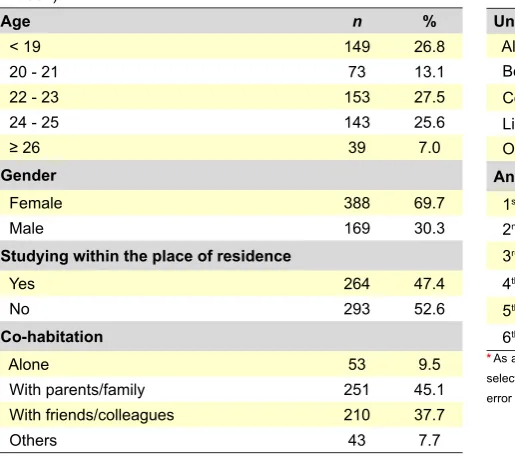
Table 1 - Demographic characteristics of our group of participants (n = 557)
Age n %
< 19 149 26.8
20 - 21 73 13.1
22 - 23 153 27.5
24 - 25 143 25.6
≥ 26 39 7.0
Gender
Female 388 69.7
Male 169 30.3
Studying within the place of residence
Yes 264 47.4
No 293 52.6
Co-habitation
Alone 53 9.5
With parents/family 251 45.1 With friends/colleagues 210 37.7
Others 43 7.7
were traditionally associated to high levels of stress and anxiety,7,8-11 consistent with the fact that Health professions
come third on a classification of professions according to stress intensity.12 Psychopathology affects physicians
with higher prevalence when compared to the general population,9,11 with up to 52.4% of these professionals in
a burnout situation9. Medical students also show a high
prevalence of psychological morbidity, namely depression, suicide and drug addiction.8,12,13
Admission to the Medicine Course is a highly demanding issue; in addition, the training of the future physician is associated to important stressful factors, such as the pressure related to learning large quantities of new information, the lack of free time for social activities,7
the first contact with patient’s suffering and with death, among others. The beginning of clinical involvement may be associated to an increase in obsessive and anxiety symptoms, as well as to significant levels of stress.8,14
Therefore, approximately 21% of medical students have described feelings of anxiety.12
Anxiety disorders in adolescence are a risk factor for subsequent anxiety, depression and addictive behaviours.15
Medical career is also associated to high levels of occupational stress and psychological morbidity, with a negative impact on the physician’s health and wellbeing and a possibly negative impact on patient’s healthcare. Therefore, it is important to identify and change situations associated to higher levels of stress and anxiety in medical students, in order to ensure lower psychological morbidity during training and in future professional practice.
Our study aimed to study the following, in the clinical setting: (1) to design a scale of anxiety to be applied to medical students; (2) to assess the levels of anxiety in medical students; and (3) to identify the most relevant situations inducing anxiety.
MATERIAL AND METHODS
The design of the Scale of Anxiety in Clinical Setting (SACS) [Escala de Avaliação da Ansiedade em Meio Clínico (EAMC)] (Appendix 01) was initially based on a literature survey regarding the major sources of anxiety in the clinical setting and was followed by data collection from a focus group (Table 1, 2 and 3) involving a group of ten medical students belonging to the Faculty of Health Sciences (Faculdade de Ciências da Saúde) from the 1st to the 5th grade of the Medicine course and to the University of Beira Interior (Universidade da Beira Interior). All were encouraged to identify the most important situations along the clinical internship associated to higher levels of anxiety. This focus group was organized along a one-hour session carried out in a classroom at the Faculdade de Ciências da Saúde. Student’s participation was voluntary.
According to the literature survey, the situations associated to higher levels of anxiety were: facing patient’s suffering and death, facing patients, autopsies and the sight of blood. The results of the focus group identified situations related to: painful procedures involving patients, the approach to frail patients, the communication with the patient, clinical activities under supervision of a tutor, colleagues or others, autopsies, facing death, the sight of blood and discrepancies between technical procedures taught at the faculty and their application in a clinical setting. Thirteen items were thereby constructed. We should emphasize the inclusion of an item related to episodes of loss of consciousness (item 13) although it has not been described in previous studies or described within focus group, as it has traditionally been associated to some of the situations previously mentioned. The items were assessed with a Likert-type scale, with four positions for the level of anxiety associated to each situation. The greater the score assigned to an item, the higher the association to anxiety. There were no reverse-scored items.
Table 2 - Educational level of our group of participants (n = 557)
University n %
Algarve 35 6.2
Beira Interior 135 24.3
Coimbra 2 0.4
Lisbon 381 68.3
Other Universities * 4 0.8
Ano de Curso
1st 126 22.6
2nd 89 16.0
3rd 78 14.0
4th 93 16.7
5th 84 15.1
6th 87 15.6
ARTIGO ORIGINAL
As regards the application of the questionnaire, different Universities were previously contacted by telephone, study’s objectives were explained and student’s participation was requested. The decision whether to apply the questionnaire was left to the responsible entities. The questionnaire was available online, in a site designed for the study, between 14 October and 14 November 2013.
Upon the construction of the scale, a psychometric validation was carried out studying the psychometric characteristics (sensitivity, reliability and analysis of the functional structure) of the results of SACS’s application to medical students attending to different Portuguese universities.
The results found were analysed with the Statistical Package for Social Sciences software, version 21 for Microsoft Windows.
RESULTS
Validation of SACS
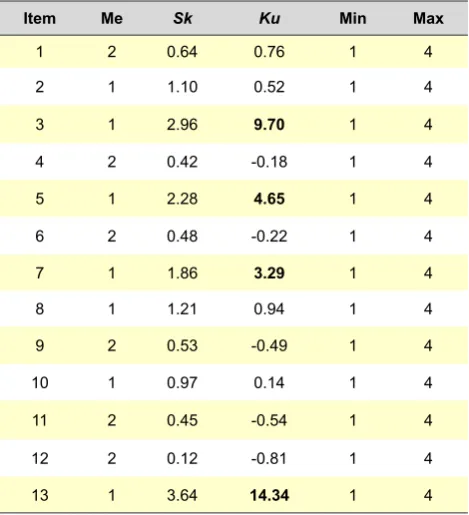
As regards the SACS, the sensitivity analysis was carried out through skewness (sk) and kurtosis (ku) asymmetry measurements related to the process of construction of the instrument. Item 13 was removed due to a kurtosis value = 14.344 (> 3).16 Internal coherence was then assessed upon
exclusion of item 13 through Cronbach’s Alpha. The factorial analysis was then carried out, upon application of the Kaiser-Meyer-Olkin (KMO) test and the Varimax Rotation was used to group all the items into different factors. Four dimensions were obtained and reliability was subsequently estimated by Cronbach’s Alpha for each dimension (Table 4).
Given the high number of participants (n = 557), a normal distribution was assumed to exist, according to Central Limit Theorem16 and, even so, normality of distribution was
confirmed through the Kolmogorov-Smirnov test.
Sensitivity
Item’s sensitivity was assessed by skewness (sk) and kurtosis (ku) asymmetry measurements. The obtained data refer to an instrument with good discriminative capacity,
except for item 13 (with a 14.34 kurtosis value [> 3]), which was removed.16 We opted not to exclude items 3, 5 and 7
despite presenting a > 3 kurtosis value, as their theoretical contribution was considered as relevant to evaluate the construct validity. In addition, the exclusion of these items would affect the instrument’s internal coherence, reducing Cronbach’s alpha from 0.84 to 0.82 (Table 5).
Reliability
Internal coherence was evaluated upon exclusion of item 13, with a Cronbach’s alpha of 0.84, which corresponds to an adequate qualitative classification.17
Factorial structure analysis
The KMO measure of sample adequacy was calculated for adequacy validation through the exploratory factorial analysis with principal component extraction and a 0.81 value was obtained (≥ 0.5), which is considered as very good.16
From the four factors obtained, the first one explains 37.6% of the results’ variance and saturates within four items, assigned as ‘Discomfort when facing invasive procedures’ (‘Incómodo perante procedimentos invasivos’). The second factor, ‘Anxiety when facing the patient’ (‘Ansiedade face ao doente’), explains for 14.9% of result’s variance and saturates within three items. ‘Anxiety related to performance’ (‘Ansiedade face ao desempenho’) is the third factor, explaining for 9.3% of the results’ variance and saturates within three items. Finally, the fourth factor, ‘Anxiety related to human dimension’ (‘Ansiedade face à
dimensão humana’), explains 8.8% of the result’s variance
and saturates within two items.
Table 3 - Self-assessment of the academic performance and satisfaction with the course by students (n = 557)
Self-assessment of the
academic performance n %
Not good 0 0
Bad 8 1.4
Reasonable 210 37.7
Good 320 57.5
Excellent 19 3.4
Satisfaction with the course
Not good 0 0
Bad 15 2.7
Reasonable 100 18.0
Good 294 52.7
Excellent 148 26,6
Table 4 - Median, skewness (sk) and kurtosis (ku), minimum and maximum for the 13 items of the SACS (n = 557)
Item Me Sk Ku Min Max
1 2 0.64 0.76 1 4
2 1 1.10 0.52 1 4
3 1 2.96 9.70 1 4
4 2 0.42 -0.18 1 4
5 1 2.28 4.65 1 4
6 2 0.48 -0.22 1 4
7 1 1.86 3.29 1 4
8 1 1.21 0.94 1 4
9 2 0.53 -0.49 1 4
10 1 0.97 0.14 1 4
11 2 0.45 -0.54 1 4
12 2 0.12 -0.81 1 4
ARTIGO ORIGINAL
Cronbach’s alpha for all the factors are considered as good or satisfactory, except for the factor ‘Anxiety related to human dimension’ (‘Ansiedade face à dimensão humana’) with a 0.52 value, considered as unsatisfactory.17
Results of SACS
As regards the levels of anxiety in clinical setting, 12.00 was the minimum and 37.00 was the maximum score. The average score was 20.72 (SD = 5.43) and 20.00 was the median score obtained, while theoretical median score (expected theoretical cut-off) was 30.00. Therefore, with the latter as a reference, we found that 91% of the medical students showed low levels of anxiety in clinical setting. The ‘possibility to cause pain or damage to the patient during different procedures’ (‘possibilidade de infligir dor ou dano ao doente durante diferentes procedimentos’) was the item associated to the highest levels of anxiety in clinical setting, with a 2.42 average (SD = 0.92) while the item ‘discomfort with the sight of blood’ (‘incómodo ao ver sangue’) was associated to the lowest (M = 1.21; SD = 0.52). The factor related to ‘anxiety when facing the patient’ ( ‘ansiedade face ao doente’) including the items 2, 3, 5 and 10 showed the highest levels of anxiety in clinical setting, with a 6.38 average (SD = 1.91), while the item ‘anxiety related to human dimension’ ( ‘ansiedade face à dimensão humana’ ) obtained a 2.82 mean score (SD = 1.02) (Table 6).
As regards student’s awareness towards any actions taken by the institutions, we found that 55.3% of the medical
students considered that their faculty did not implement any activities or other actions aimed to reduce the levels of anxiety in clinical setting. As regards the promotion of any sort of support regarding situations that may trigger a higher level of anxiety when involved in a clinical setting, 91% of the inquired medical students considered this as relevant.
DISCUSSION
Four of the 13 items (3, 5, 7 and 13) in the scale showed kurtosis values > 3. Even so, we opted not to exclude items 3, 5 and 7 as their theoretical contribution were relevant for construct’s evaluation and their exclusion would reduce, even slightly, the Cronbach’s alpha calculated for the scale. The factor ‘anxiety related to human dimension’ (‘ansiedade face à dimensão humana’) was kept, as despite a low internal coherence value (α = 0.52), the corpse’s dissection as well as the communication with the patients, which were items included in this component, represented two of the most emphasized situations during the focus group determining our decision. Therefore, keeping the theoretical median of the scale as a reference, 91% of the medical students showed low levels of anxiety in the clinical setting. The items associated to patient’s suffering were the most frequently described as causing anxiety, in line with other studies.8,12
The lack of validation using an external validity may represent a limitation, although this procedure may be used in future studies involving the scale, in an effort to analyse
Table 5 - Factorial weights for each item within the four factors retained, internal coherence (Cronbach’s alpha), eigenvalues and % of the explained variance, upon an Average Variance Extracted (AVE) with factor extraction by the principal component method, followed by a Varimax Rotation
Items
Factors
Discomfort when facing
invasive procedures Anxiety when facing the patient Anxiety related to performance human dimensionAnxiety related to
2 0.80
3 0.78
5 0.83
10 0.73
1 0.71
4 0.77
12 0.72
6 0.81
9 0.84
11 0.60
7 0.61
8 0.74
Alpha 0.80 0.71 0.70 0.52
Eigenvalue 4.51 1.79 1.11 1.05
ARTIGO ORIGINAL
Table 6 - Average, median, minimum and maximum value of the results obtained by the medical students in the different factors of the SACS (n = 557)
Discomfort when facing
invasive procedures Anxiety when facing the patient Anxiety related to performance human dimensionAnxiety related to
N Valid 339 367 352 221
Missing 218 190 205 336
Average 5.74 6.38 6.14 2.82
Median 5.00 6.00 6.00 3.00
SD 2.19 1.91 2.01 1.02
Minimum 4.00 3.00 3.00 2.00
Maximum 14.00 12.00 12.00 7.00
its psychometric soundness.
We should mention that most students find the promotion of some sort of support regarding the situations that may trigger a higher level of anxiety as relevant, emphasizing this dimension as well as to its evaluation.
The major limitations of our study include the effect of social desirability underlying any self-questionnaire and the fact that a convenience sample was used, a fact that may prevent the mainstreaming of the results. In addition, a test-retest was not carried out, which would allow for the analysis of a stability study of the variable.
Therefore, its application in the future was considered as important, allowing for deeper study of the psychometric characteristics of the scale and for a highest stability guarantee. We consider that a future study of the external validity using for instance the cross-validation and correlation with other variables would be relevant.
CONCLUSION
SACS shows a good overall internal coherence (Cronbach’s alpha = 0.84) and discriminative capacity of subjects. It is therefore a consistent and reliable instrument for the evaluation of anxiety in medical students when exposed to the clinical setting. In addition, the application of this scale may be useful in designing training strategies for future physicians. Almost all students considered the promotion by the institutions of some sort of support regarding those situations that may trigger a higher level of anxiety in clinical setting as relevant initiatives. These may benefit many students, despite the low prevalence of anxiety in the clinical setting found in this study.
CONFLICTS OF INTEREST
The authors declare no conflict of interest in writing this manuscript.
FINANCIAL SOURCES
The authors declare no financial source for writing this manuscript.
REFERENCES
1. Bayram N, Bilgel, N. The prevalence and sociodemographic correlations of depression, anxiety and stress among a group of university students. Soc Psychiatr Epidemiol. 2008;43:667-2.
2. Kötter T, Tautphäus Y, Scherer M, Voltmer E. Health-promoting factors in medical students and students of science, technology, engineering, and mathematics: design and baseline results of a comparative longitudinal study. BMC Med Educ. 2014;14:134.
3. Dyrbye L, Thomas M, Shanafelt T. Systematic review of depression, anxiety, and other indicators of psychological distress among U.S. and Canadian medical students. Acad Med. 2006;81:354-73.
4. Dicionário de termos médicos. 2ª ed. Porto: Porto Editora; 2005. 5. Dicionário Médico Enciclopédico - Taber. 17ª ed. Lisboa: Lusodidacta
Limitada; 2000.
6. Crujo M, Marques C. As perturbações emocionais - ansiedade e depres-são na criança e no adolescente. Rev Port Clinic Geral. 2009;25:576-82. 7. Cunha M, Neves A, Moreira M, Henh F, Lopes T, Ribeiro C, et al.
Trans-tornos psiquiátricos menores e procura por cuidados em estudantes de
medicina. Rev Bras Educ Med. 2009;33:321-8.
8. Aguiar S, Vieira A, Vieira K, Aguiar S, Nobrega J. Prevalência de sin-tomas de estresse nos estudantes de medicina. J Bras Psiquiatr. 2009;58:34-38.
9. Frasquilho M. Medicina, uma jornada de 24 horas? Stress e burnout em médicos: prevenção e tratamento. Rev Port Saude Publica. 2005;23:89-98.
10. Dyrbye L, West C, Satele D, Boone S, Tan L, Sloan J, et al. Burnout among U.S. medical students, residents, and early career physicians relative to the general U.S. population. Acad Med. 2014;89:443-51. 11. Ritter H. Anxiety. J Religion Health. 1990;29:49-53.
12. Ramos F. El Síndrome de burnout. Madrid: UNED-FUE; 1999. 13. Lima M, Domingues M, Cerqueira A. Prevalência e fatores de risco para
transtornos mentais comuns entre estudantes de medicina. Rev Port Saude Publica. 2006;40:1035-41.
2007;24:103-ARTIGO ORIGINAL
11.
15. Peixoto B, Saraiva C, Sampaio D. Comportamentos suicidários em Por-tugal. Coimbra: Sociedade Portuguesa de Suicidologia; 2006. 16. Maroco J. Análise estatística com utilização do SPSS. 3ª ed. Lisboa:
Edições Sílabo; 2007.