ISSN-L: 2501 - 1235 Available on-line at: www.oapub.org/edu
doi: 10.5281/zenodo.1475925 Volume 5 │ Issue 1 │ 2018
IMPLICATIONS OF THE PRACTICE STYLE TEACHING
ON MOTOR AND KNOWLEDGE PERFORMANCE OF
A BASIC GYMNASTICS SKILL
Michalis Proiosi
Faculty of Physical Education and Sport Science, Aristotle University of Thessaloniki, Greece
Abstract:
The purpose of this study was to examine the impact of practice style teaching on motor skill and Knowledge performance, of a basic gymnastics skill, such as the cartwheel, in high school students, of different gender and skill level. Participants were 27 girls and 41 boys of first grade high school, belonging in three different classes. They were taught the cartwheel task under school conditions throughout twelve (12) lessons, 30 minutes each, 2 times per week. The skill performance was recorded and evaluated prior, post and two weeks after the end of the program. Based on the initial compound measurement scores, students were grouped into three equal groups of low, medium and high skill. Knowledge outcomes were measured by the use of a written test prior and following the treatment phase of the study. The 2x3x3 analysis of variance (Gender x Skill Level x Test) with repeated measurements in the last factor showed that all the groups improved their motor and knowledge performance on the cartwheel. No significant differences between girls and boys were uncovered on the skill execution or skill knowledge. However, significant differences between student's skill level on motor performance were revealed: Low skilled learners improved to a greater extent, compared to those of medium and high skill, particularly as for the skill outcome.
Keywords: teaching styles, motor learning, gymnastics skills, cognitive understanding
1. Introduction
Issues related to learning and improving motor skills are of great interest and concern to Physical Education Teachers (PET) who, in their teaching practice, are looking for effective teaching methods. One form of teaching adopted by most PETs in school is the practice style of teaching (Cothran, et al., 2005; Curtner-Smith, Todorovich, McCaughtry, & Lacon, 2001; Salvara & Birone, 2002). The practice style of teaching,
known from the Mosston's spectrum of teaching styles, (1966), is the "method" used by all coaches and PETs for instruction of motor skills (Mosston & Ashworth, 2002).
Motor skill learning is an active process, interrelated with cognition. Skill concepts are aspects of cognitive concept learning in physical education that focus on learning the way the body parts should move while performing motor skills (Gallahue & Cleland, 2003). Motor skills are learned when they are placed into long-term memory, which makes practice one of the most critical variables in learning these skills. According to Silverman (1996), motor learning occurs as a result of training and experience converting therefore the acquisition of motor experience and practice to the most powerful predictors of skill learning. A useful general rule is that more practice produces more learning. Silverman, (1996) emphasizes that student's individual practice is the most important and determinant success factor of learning a motor skill, and that the teaching strategies which promote the practice are also very important.
Practice style is the form of teaching aimed at increasing students' practice, giving them a relative freedom and independence in practice, so that they can make efficient use of the traineeship available (Mosston & Ashworth, 2002). On the basis of the theory of spectrum, in practice style PE Teacher decides on the purpose of the teaching unit, the exact tasks that must be completed, as well as the criteria of the acceptable performances. The aim of the practice style is to teach students to work individually, giving time and opportunity to practice in their own pace (Mosston & Ashworth, 2002). Researchers claim that the opportunity to maximize the available practice time by students is associated with improving performances (Goldberger & Gerney, 1986; Goldberger, Gerney, & Charnberlain, 1982). Other researchers argue that during the practice style of teaching, students receive individual feedback on skills at a higher rate (Byra, Sanchez, & Wallhead, 2014).
During a practice teaching unit, the PET prepares a series of exercises to be performed in the learning area. He or she describes the specific roles of the teacher and the student, presents the exercises, provides some organizational information, and informs students about getting started when they are ready. Students are then practice at stations, separated into small groups. While students are practicing, PET moves around, observes and provides feedback. After a few minutes or a certain number of trails, the PET systematically moves students from one station to another. Important components of the practice style are the criteria sheets that provide students with the necessary information about the exercises, as well as the teacher himself, providing feedback about the progress of the students. Instructions and drawings of the exercises should be provided to help students remember what to do and how to do it, so as to increase exercise time.
learners’ motor learning ability (Beckett, 1991; Boyce, 1992; Goldberger & Gerney, 1986; 1991; Goldberger et al., 1982; Griffey, 1983; Harrison, Fellingham, Buck, and Pellett, 1995; Zeng, Leung, Liu, Bian, 2009). Few studies looked specifically at learners’ cognitive abilities. These surveys have highlighted the effectiveness of practice style in order to improve motor skills, for the majority of learners. However, some contradictions have turned up concerning the influence of the practice style in the students’ skill level. Other studies showed that the practice style was more effective in medium skilled learners (Boyce, 1992; Goldberger & Gerney, 1986; Goldberger et al., 1982; Jenkins & Byra, 1997), where others that was equally appropriate to medium and high skilled learners (Beckett, 1991; Griffey, 1983), but also to students of low potential (Harrison et al., 1995). The authors attributed these findings to the different ages of the subjects, the nature of learning skills, but also to the different learning environments.
However, the studies showed controversial results about the effect of gender. Zeng et al, (2009) identified differences between boys and girls in volleyball skills learning and concluded that the practice style worked better for college boys than for girls. On the contrary, Griffey (1983) observed that girls performed significantly better than boys. The same researcher in a different study also reported that low-skilled girls had lower final scores in performing volleyball drills than those of low-skilled boys, while high-skilled girls scored higher than high-skilled boys (Griffey, 1980).
Based on the above findings, the impact of practice style teaching on learning different motor skills as well as, on gender and skill level of the students have not been studied adequately. Despite the widespread use of practice style in schools, the studies are limited and they are absent in the field of gymnastics.
It is important that PETs have the information to purposefully prepare and implement their teaching so that they match up various teaching objectives and the characteristics of diverse learners. The purpose of the present study was to examine the impact of the practice style of teaching on motor skill and knowledge (cognitive) performance, of a basic gymnastics skill, such as the cartwheel, in high school students. In addition, this study was conducted in an attempt to investigate the effect of the practice style on motor learning and knowledge outcome for different gender and ability level of learners.
2. Material & Methods
2.1 Participants and Setting
lesson plans, and all sessions were attended by the investigator to ensure fidelity to experimental procedures and teaching style.
All participants received instruction on cartwheel according to the practice style of teaching. Firstly, there were two (2) preliminary lessons for the students to understand the practice style of teaching and the whole process. Then the main program was carried out, which was completed during (12) lessons, 30 minutes each, 2 times per week. The skill of cartwheel was utilized because it was a novel task to the subjects. None of the subjects had athletic experience in gymnastics or received any formal instruction in cartwheel prior to the study.
All instruction took place in the gymnasium used by the students during their regularly scheduled physical education classes. On the basis of the PE curriculum of the grades of the school, six (6) small homogeneous groups (3 of boys, and 3 of girls) were formed in order to facilitate teaching.
2.2 Skill and Knowledge Tests
Prior to the instructional phase of the study, all 68 subjects were pretested on (a) their ability to perform the cartwheel task and (b) their knowledge of cartwheel. Pretesting was conducted to determine the learner’s level of skill and knowledge prior to receiving instruction. Following the treatment phase of the study, all of the subjects were post-tested to determine the effects of the treatment on learner skill and knowledge performance. Following all testing, students were scheduled to assess skill performance retention after two weeks. All measurements during the cartwheel retention test followed the same protocol used during the pretest and initial posttest.
2.3 Skill Test
The evaluation process included a quantitative measurement (outcome) and a quality measurement (technique). “Outcome” assessment included the measurement of points from the task parts the student performed. The parts of the task omitted or executed with very poor technique were not assessed. Outcome scores are the total number of separate phases of movement executed in the best trial. “Technique” assessment included the measurement of reductions for the technique mistakes appeared in each part of the task. Technique scores are the number of separate phases of movement demonstrated without mistakes in the best trial.
To assess coding biases and reliability, three trained coders who were trained by one of the coaches coded each subject’s tests (pre-post- and retention) twice. At first, they learned to evaluate properly the execution of the cartwheel, observing 10 different students. Then, after having coded 10 different students, the coders’ scores were compared to those of the coach. If agreement was less than 90 percent, then the training program was repeated until the reliability criterion of 90% achieved. Total scores in each case, were the average of the scores of the three coders.
Percentage agreement and intra-observer reliability was calculated using intraclass correlation coefficient (ICC; Fleiss & Cohen, 1973). The ICC values were given with 95% confidence intervals. An ICC value greater than 0.75 was considered as excellent agreement, 0.40 to 0.75 was fair to good and below 0.40 was poor. In the present study the intra-observer reliability, both for outcome and technique were excellent (outcome: pretest .94 to .96, posttest .94 to 98, and technique: pretest .94 to 97, posttest .94 to .96). Similarly, the inter-observer reliability for outcome (.95 to .98), and technique (.94 to .96), were excellent.
2.4 Knowledge Test
describing what the learner saw as a result of the cartwheel movement were labeled skill outcome. The following are examples of statements grouped within this category: “he started the cartwheel correctly; he didn’t place the hands properly; and, he was wrong at the ending.”
To assess coding biases and reliability, both evaluators coded each subject’s pre and post-test written responses twice. Intra-observer percentage of agreement scores of 89 and 92 were yielded for the pretest scores and 88 and 94 for the post-test scores. Inter-observer percentage of agreement scores of 90 and 93 were yielded for the pretest and posttest scores, respectively.
2.5 Treatment
The treatment for this investigation involved twelve 30-minute lessons on the skill of cartwheel that was presented by the teacher in Practice Style. All groups (3 consisted of boys n = 41, and 3 consisted of girls n = 27) followed the same teaching style (practice), and the same training program to learn the cartwheel. They also, had equal practice time and used the same tasks and the same equipment. Furthermore, there were specific positions and equipment, for each task and students practiced two by two in each equipment. In each lesson, students practiced circular in four tasks, both of which focused on learning the cartwheel and the rest on different gymnastics tasks. Totally six (6) tasks were used for learning the cartwheel, referred to in the relevant literature (Knirsch, 1998). Two tasks were used in 1st – 4th, two in 5th -8th and two in 9th – 12th lessons.
Each lesson began with a short introduction of the subject matter followed by a warm-up (5 minutes). At the beginning, the teacher introduced the practice style of teaching, explained the objectives of the style, described the different roles of the learner and teacher, demonstrated and explained the cartwheel task and criteria sheet, and provided opportunity to practice. During the practice, the teacher offered individual feedback to the students on performance, and systematically moved students to the next station, every five (5) minutes.
2.6 Groups Composition Procedures
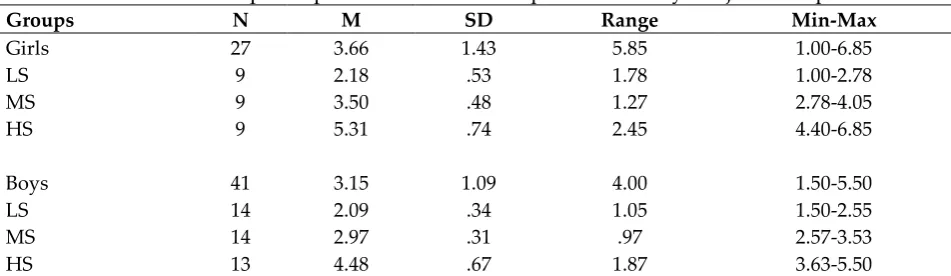
Table 1: Composite pretest scores for skill performance by Subject Group
Groups Ν Μ SD Range Min-Max
Girls 27 3.66 1.43 5.85 1.00-6.85
LS 9 2.18 .53 1.78 1.00-2.78
MS 9 3.50 .48 1.27 2.78-4.05
HS 9 5.31 .74 2.45 4.40-6.85
Boys 41 3.15 1.09 4.00 1.50-5.50
LS 14 2.09 .34 1.05 1.50-2.55
MS 14 2.97 .31 .97 2.57-3.53
In order to examine the influence of the ability level on learner’s skill performance in cartwheel, all students were classified into three equal groups (low-, medium- and high-skilled). The pretest complex scores of boys and girls were hierarchically arranged and divided by three. Students with scores in the top 33% were placed in the high-skilled group, the middle 33% in the medium-high-skilled group, and the lowest 33% in the low-skilled group. In Table 1 the pretests means and standard deviations are presented for skill performance scores in cartwheel by gender and ability group.
2.7 Data Analysis A. Skill Performance
Separate three-factor 2x3x3 analysis of variance (gender x skill level group x test), with repeated measurements on the last factor (MANOVA) were used to examine student learning (from pretest to post-test and to retention test) for each skills test and to detect if one group was superior to each other. In total, two analyses of variance were conducted for each independent variable (outcome and technique) on cartwheel. Bonferroni post hoc analysis was also conducted to detect statistically significant differences between the levels of each factor and analyses of simple main effects were conducted to examine the interactions between the factors.
B. Knowledge Performance
Frequency counts were calculated for each knowledge category within each question for the treatment groups. Group means and standard deviations were subsequently calculated for the emergent categories. The students’ pre- and post-test scores, for the two knowledge categories (skill outcome and skill technique), were analyzed separately using 2x3x2 (Gender x Skill Level x Test) repeated measures MANOVA. This analysis was used to examine student learning from pre-test to post-test and to detect if one group was superior to each other. Bonferroni post hoc analysis was also conducted to detect statistically significant differences between the levels of each factor. A .05 level of significance was employed in all analyses.
3. Results
3.1 Skill Performance
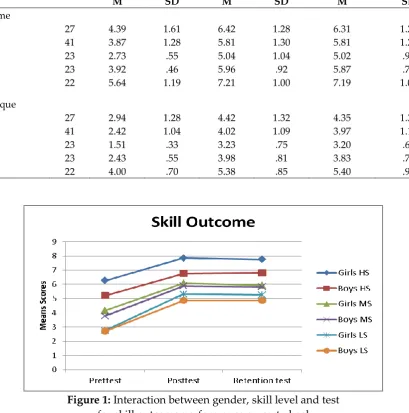
The subjects’ pre-, post-, and retention-test scores, for outcome and technique, were analyzed separately using 2x3x3 (Gender x Skill Level x Test) repeated measures MANOVA. Pretest, posttest and retention -test means for the outcome and technique skill scores are presented in Table 2.Significant differences were revealed amongst the "test" factor for the outcome scores (F2,124=297.87, p<.001); and technique scores
(F2,124=296.22, p<.001). Bonferroni post hoc analyses revealed that all students, regardless
posttest and retention test, and there were no differences between the posttest and the retention test.
Table 2: Descriptive Statistics for each test and group for skill performance on cartwheel
Groups Ν Pretest Posttest Retention Test
Μ SD Μ SD Μ SD
Outcome
Girls 27 4.39 1.61 6.42 1.28 6.31 1.21
Boys 41 3.87 1.28 5.81 1.30 5.81 1.29
LS 23 2.73 .55 5.04 1.04 5.02 .99
MS 23 3.92 .46 5.96 .92 5.87 .76
HS 22 5.64 1.19 7.21 1.00 7.19 1.00
Technique
Girls 27 2.94 1.28 4.42 1.32 4.35 1.30
Boys 41 2.42 1.04 4.02 1.09 3.97 1.12
LS 23 1.51 .33 3.23 .75 3.20 .69
MS 23 2.43 .55 3.98 .81 3.83 .71
HS 22 4.00 .70 5.38 .85 5.40 .91
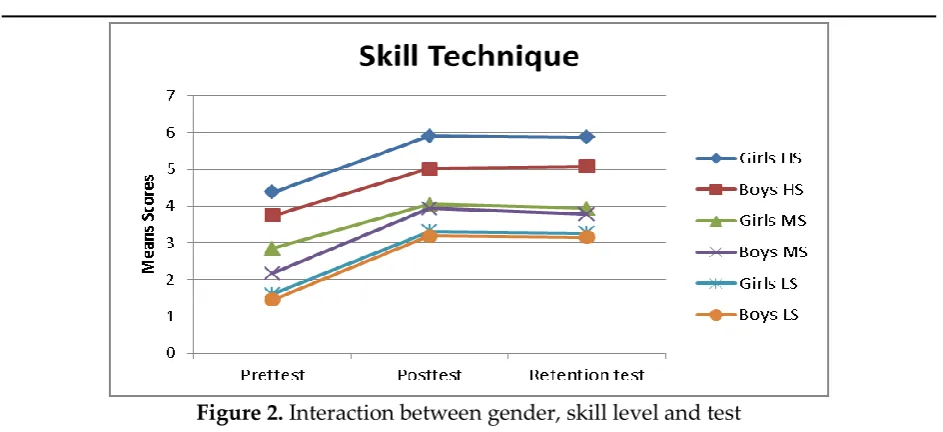
Figure 1: Interaction between gender, skill level and test for skill outcome performance on cartwheel
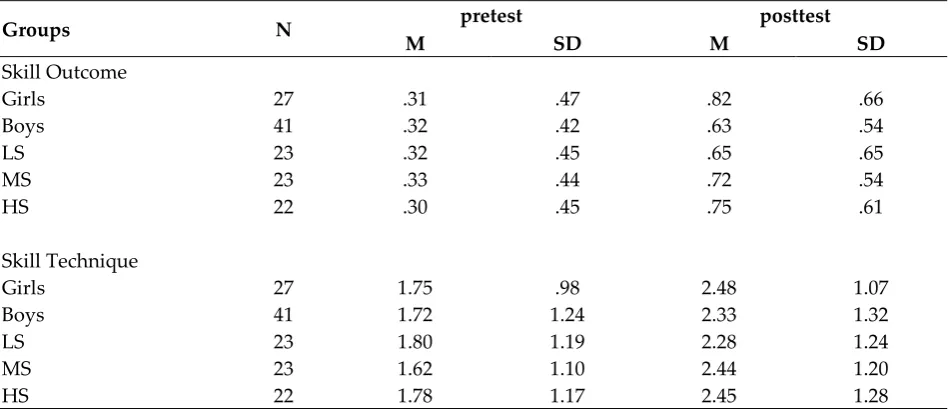
Figure 2. Interaction between gender, skill level and test for skill technique performance on cartwheel
Note: Technique scores are the number of separate phases of movement demonstrated without mistakes
in the best trial.
Tests of between-subjects effects showed that there was a significant primary effect of the "gender" factor (F1,62=7.61, p<.05) for the outcome, and (F1,62=7.27, p<.05) for
the technique. The separate univariate analyses for skill outcome revealed significant differences between girls and boys (F1,62=6.92, p<.05) for pretest, (F1,62=6.13, p<.05) for
posttest, and (F1,62=4.59, p<.05) for retention test. Girls were superior in all three
measurements. The separate univariate analyses for skill technique revealed also significant girls' superiority over boys (F1,62=16.28, p<.001) for pretest scores, without
significant differences for posttest (F1,62=3.71, p>.05), and retention test (F1,62=3.46, p>.05).
However, tests of within-subjects effects also showed that there was no statistically significant interaction between the factors, "gender" and "test", (F2,124=.20, p>.05) for skill
outcome, and (F2,124=.52, p>.05) for skill technique.
Tests of between-subjects effects showed that there was a significant primary effect of the "skill level" factor (F2,62=59.12, p<.001) for the outcome, and (F2,62=83.37,
p<.001) for the technique. The separate univariate analyses for skill outcome revealed significant differences between students of different skill levels (F2,62=88.64, p<.001) for
pretest, (F2,62=29.80, p<.001) for posttest, and (F2,62=33.40, p<.001) for retention test. Also,
significant differences between students of different skill levels were revealed for skill technique (F2,62=147.71, p<.001), for pretest, (F2,62=44.80, p<.001) for posttest, and
(F2,62=50.47, p<.001) for retention test. Bonferroni post hoc analyses revealed that the HS
students scored higher than did those MS, and MS students scored higher than did those LS, in all tests and measurements.
Tests of within-subjects effects also showed that there was a statistically significant interaction between the factors "skill level" and "test" (F4,124=4.09, p<.05), for
skill outcome, and no significant interaction (F4,124=1.39, p>.05), for skill technique. The
and from posttest to retention test. Separate univariate analyses computed between the difference scores of the three groups, (F2,62=4.31, p<.05), did reveal a significant
difference between pretest and posttest scores, and no significant difference between posttest and retention test scores (F2,62=.27, p>.05) for skill outcome. A Bonferroni post
hoc analysis for skill outcome showed a significant improvement from pretest to posttest for the LS group (M=2.36) which was superior to HS group, while HS (M=1.57) and MS group (M=2.02) did not differ significantly. There was no significant improvement from posttest to retention test for any group. Separate univariate analyses also showed that there was no statistically significant difference between pretest and posttest scores (F2,62=1.24, p>.05), and no significant difference between posttest and
retention test scores (F2,62=1.78, p>.05) for skill technique. A Bonferroni post hoc analysis
for skill technique showed that there was no significant improvement from pretest to posttest and from posttest to retention test for any group, although the LS group (M=1.72), had the highest improvement (gain), than had the MS group (M=1.48) and HS group (M=1.40).
Tests of within-subjects effects also showed that there was no significant interaction between the factors "gender", "skill level", and "test" for skill outcome (F4,124=.67, p>.05), and for skill technique (F4,124=1.71, p>.05).Group mean scores by gender
and skill level for the skill outcome and for skill technique are represented in Figures 1-2. Low-skilled learners of both genders tend to reduce the difference between medium- and high-skilled learners in the posttest and retention test for outcome and technique performance on cartwheel.
3.2 Knowledge Performance
The students’ pre-, and post-test scores, for the two knowledge categories (outcome and technique), were analyzed separately using 2x3x2 (Gender x Skill Level x Test) repeated measures MANOVA. Pretest and posttest means and standard deviations are presented in Table 3.Significant differences were revealed amongst the "test" factor for the outcome scores (F1,62=24.34, p<.001); and technique scores (F1,62=16.82, p<.001).
Bonferroni post hoc analyses revealed that all students, regardless of gender and skill level, showed a significant increase in the number of statements reported from pretest to posttest for the knowledge categories labeled skill outcome or skill technique.
Tests of between-subjects effects showed that there was no significant primary effect of the "gender" factor (F1,62=.83, p>.05) for the outcome, and (F1,62=.12, p>.05) for the
technique. Also, no significant results were found for the effect of the "skill level" factor (F1,62=.02, p>.05) for the outcome, and (F1,62=.12, p>.05) for the technique, and there was
Table 3: Descriptive Statistics for each test and group for knowledge performance on cartwheel
Groups Ν pretest posttest
Μ SD Μ SD
Skill Outcome
Girls 27 .31 .47 .82 .66
Boys 41 .32 .42 .63 .54
LS 23 .32 .45 .65 .65
MS 23 .33 .44 .72 .54
HS 22 .30 .45 .75 .61
Skill Technique
Girls 27 1.75 .98 2.48 1.07
Boys 41 1.72 1.24 2.33 1.32
LS 23 1.80 1.19 2.28 1.24
MS 23 1.62 1.10 2.44 1.20
HS 22 1.78 1.17 2.45 1.28
4. Discussion
The present study attempted to investigate the impacts of the practice style of teaching on motor and knowledge performance by first grade high school students of different gender and skill level, when learning a basic gymnastics skill. The results revealed that all students improved their skill performance from pretest to posttest, for both skill technique (achieving better quality of movement) and skill outcome (showing more parts of the skill). These results suggest that learning took place during the teaching period and that teaching in the context of practice style had a positive effect, regardless of the students’ gender or skill level. These findings come in agreement with the results of other researchers (Babatunde, 2014; Beckett, 1991; Boyce, 1992; Goldberger & Gerney, 1986; Goldberger et al., 1982).
The results of the retention test (skill technique and skill outcome) also confirmed that learning was preserved significantly, during the two weeks retention period for all groups. These findings are reinforced by the findings of other surveys (Beckett, 1991; Boyce, 1992; Goldberger & Gerney, 1986), and are of particular interest, because, in the research of teaching style, the retention period was not taken into account.
skills, practice style worked better for college boys than for girls (Zeng et al, 2009). In addition, the results of the study are in contradiction with the findings of studies that have demonstrated the superiority of girls (Griffey, 1980; Griffey, 1983).
On the influence of the practice style of teaching to the learners’ skill level, the results of this study showed that high-skilled students performed higher than did those medium-skilled, and medium-skilled students performed higher than did those low-skilled students, for skill outcome and for skill technique of cartwheel. However, there was a significant interaction between the factors "skill level" and "test" for skill outcome. The low-skilled students showed the greatest progress, especially in relation to high-skilled, while high-skilled students showed less improvement and did not differ significantly with medium-skilled students. The same image was also observed for skill technique, although there was no statistically significant interaction. Perhaps this skill required more teaching time for a more substantial improvement in technique that is justified by the low scoring change in students' performance. This finding suggests that beginners can achieve easier and in a greater degree, the coarse features of the skill, while they control less the subtle changes that need to be done to improve the quality of the movement. Also, these results suggest that instruction presented within the framework of the practice style of teaching can have a positive effect on student skill learning, particularly for lower skilled learners. The above findings contradict those researchers who argued that the practice style was most effective in medium-skilled learners (Boyce, 1992; Goldberger & Gerney, 1986; Goldberger et al., 1982; Jenkins & Byra, 1997), as well as those that showed it was equally appropriate to medium- and high-skilled learners (Beckett, 1991; Griffey, 1983). This study supports the findings of Goldberger & Gerney, (1991). In their study, it was found that low-skilled fifth grade students in primary school, who have implemented two alternative forms of practice style of teaching, have improved most of the others, medium- and high-skilled, in a football punting skill performance. These findings also supports in part the research of Harrison et al., (1995) who found that the practice style helped more the low skilled college students in performance on spike in volleyball, while it did not work equally in the other skills (serve, set and forearm pass), where medium- and high-skilled students were better.
Regarding the gender of the students, the comparisons within the three skill levels did not show statistically significant effects. Although girls were better than the boys in the cartwheel performance, at all skill levels they did not show a major gain in skill learning. The results of this study showed also that Low-skilled learners of both genders tend to reduce the difference between medium- and high-skilled learners in the post-test and retention test for outcome and technique performance on cartwheel. These findings are in conflict with those of the Griffey study (1980), which showed that low-skilled girls have improved most of the boys and also that high-low-skilled girls were overcrowded by boys in performing volleyball skills.
others they had much more room for improvement, as they were in a completely original stage of the skill learning, where learning is faster, b) high ability students showed the least increase possibly because they were at a more advanced stage of learning the skill that functioned as a ceiling effect, c) medium ability students had an average improvement, as they were on a modest stage of learning the skill, d) the predetermined practice time was not appropriate for every skill level, i.e., high ability students might need more practice time to show improvement in skill performance compared to low ability students, and e) the feedback given by the PET benefited more the low ability students, a result that was found in similar studies (Ernst, & Byra, 1998; Rikard, 1991).
With regard to the skill knowledge, performance the results of this study revealed that all groups showed significant change from pretest to posttest for both written responses that were labeled skill technique and skill outcome. All students, regardless of gender or skill level, made a greater number of comments about the technical elements of the movement during the post-test than the pre-test (e.g., “He needs to place the first leg close to the second hand; He needs to keep his eyes looking forward.”). These subjects made also a greater number of comments about the result of the movement during the posttest than the pretest (e.g., “He needs to start the cartwheel correctly; He needs to put his hands properly.”). The students in this study did not display any difficulty in understanding the form-specific criteria necessary to adequately evaluate performance on the cartwheel. Beckett (1991), assessing students' cognitive development, mentioned that students in practice style had higher levels of motor engagement enabling them to experience more samples of their motor performance. Also, this study supports the findings of Jenkins and Byra, (1997). In their study, it was found that learners in the Inclusion and Practice styles made significant gains from pretest to posttest in the number of skill elements identified regarding striking with a racquet, and learners in the Inclusion style reported a significantly greater number of skill elements during posttest than learners in the Practice style.
However, the results of this study did not reveal significant differences by gender factor nor by skill level factor for any of the knowledge tests. Girls gave the greater number of responses for skill technique and skill outcome but its performance was not significantly superior to that of boys. Similarly, students of high skill level group gave the greater number of responses for skill technique and skill outcome but showed similar progress with the other groups from pretest to posttest measures. This result may be attributed to the fact that the cognitive part was related to skill concepts of motor learning. Assuming that knowing more about skill technique represents an increase in one’s knowledge, it seems plausible to suggest that instruction presented within the framework of the practice style of teaching can have a positive effect on student knowledge of subject matter.
an important component of the practice style of teaching (Mosston & Ashworth, 2002) may be beneficial to a student’s understanding of the movements required to successfully cartwheel.
Given these results, student ability level seems to have no impact on learners’ knowledge gains. These findings contradict those of Griffey (1983). Specifically, in his study, Griffey examined student skill learning of the volleyball forearm pass and serve within the command and task (a combination of practice and inclusion styles of teaching) styles (Byra, 2000). Griffey found that the higher ability learners had sufficient knowledge of the skill to make informed decisions about appropriate use of practice time, while lower ability students lacked this knowledge. Instead, the above findings are related to Ernst & Byra, (1998), who, in their study about pairing junior high school level learners in the reciprocal style of teaching, found that observer ability level seems to have little impact on learner cognitive understanding of skill execution (juggling). Also, in a study of college-aged students, who received instruction on soccer-juggling under the conditions of Inclusion and Practice style, Beckett (1991) found that there were no significant differences on the written knowledge test for learners of average and exceptional aptitude (membership in heterogeneous or homogeneous classes).
5. Conclusions
The findings of this study provide evidence to verify that the practice style of teaching might be an appropriate choice for learning gymnastics skills, which require enough practice. Results indicate that the practice style of teaching helps high school students to improve, both in outcome and in technique of cartwheel, while it seems more effective for low-skilled students, particularly on skill outcome performance. Since initial success is important, especially for low-skilled learners, PETs can be used the practice style of teaching for high school low-skilled students to improve and retain motor-task performance in a skill such as cartwheel.
The results from this study suggest also that the practice style of teaching was an effective method, enabling students to develop an accurate knowledge of subject matter. The important information gained on learner cognitive understanding is that this teaching style is appropriate for all students, regardless of gender and skill level.
References
Babatunde, E.O. (2014). Effects of two methods of teaching Badminton strokes on skill performance of children. Journal of Emerging Trends in Educational Research and Policy Studies (JETERAPS), 5(8), 118-123.
Beckett, K. D. (1991). The effects of two teaching styles on college students’ achievement of selected physical education outcomes. Journal of Teaching in Physical
Education, 10(2), 153-169. Retrieved from https://doi.org/10.1123/jtpe.10.2.153
Boyce, B. A. (1992). The effects of three styles of teaching on university students’ motor performance. Journal of Teaching in Physical Education, 11,4, 389-401. Retrieved
from https://doi.org/10.1123/jtpe.11.4.389
Byra, M. (2000). A Review of Spectrum Research: The Contributions of Two Eras. Quest, 52, 229-245.
Byra, M., Sanchez, B., & Wallhead, T. L. (2014). Behaviors of students and teachers in the command, practice, and inclusion styles of teaching: Instruction, feedback, and activity level. European Physical Education Review, 20(1), 3–19. doi: 10.1177/1356336X13495999
Chatoupis, C. (2009). Contributions of the Spectrum of teaching styles to research on teaching. Studies in Physical Culture and Tourism, 16, 193–205.
Cothran, D. J., Kulinna, P. H., Banville, D., & Choi, E., Amade-Escot, C., MacPhail, A., Macdonald, D., Richard, J-F, Sarmento, P., & Kirk, D. (2005). A Cross-cultural investigation of the use of teaching styles. Research Quarterly for Exercise and Sport, 76(2), 193-201.
Curtner-Smith, M.D., Todorovich, J.R., McCaughtry, N.A., & Lacon, S.A. (2001). Urban teachers' use of productive and reproductive teaching styles within the confines of the National Curriculum for Physical Education. European Physical Education Review, 7(2), 177-190. doi:10.1177/1356336X010072005
Ernst, M., & Byra, M. (1998). Pairing learners in the reciprocal style of teaching: Influence of student skill, knowledge, and socialization. The Physical Educator, 55, 24-37.
Fleiss, J. L., & Cohen, J. (1973). The equivalence of weighted kappa and intraclass correlation coefficient as measures of reliability. Educ Psychol Meas., 3, 613-619. Gallahue, D.L., & Cleland, F. (2003). Developmental physical education for all children. 4th ed. Champaign, IL: Human Kinetics.
Goldberger M., Ashworth, S. & Byra, M. (2012). “Spectrum of Teaching Styles Retrospective”, Quest, 64, 4, 268-282. doi: 10.1080/00336297.2012.706883
Goldberger, M., & Gerney, P. (1986). The effects of direct teaching styles on motor skill acquisition of fifth grade children. Research Quarterly for Exercise and Sport. 57, 215-219.
Goldberger, M., & Gerney, P. (1991). Effects of learner use of practice time on skill acquisition of fifth grade children. Journal of Teaching in Physical Education,
Goldberger, M., Gerney, P., & Chamberlin, J. (1982). The effects of three styles of teaching on the psychomotor performance and social skill development of fifth grade children. Research Quarterly for Exercise and Sport, 53(2), 116-124.
Griffey, D.C. (1980). A study of aptitude x treatment interactions associated with student decision making in physical education classes (Doctoral dissertation, Stanford University). Dissertation Abstracts International, 41, 3475A. (University Microfilms NO. 81-03, 514.
Griffey. D.C. (1983). Aptitude X treatment interactions associated with student decision making. Journal of Teaching in Physical Education, 3(2), 15-32.
Harrison, J, M., Fellingham, G, W., Buck, M, M., & Pellett, T, L. (1995). Effects of practice and command styles on rate of change in volleyball performance and self-efficacy of high-, medium-, and low-skilled learners. Journal of Teaching in
Physical Education, 14(3), 328-339. Retrieved from
https://doi.org/10.1123/jtpe.14.3.328
Hein, V., & Kivimets, M. (2000). The effects of two styles of teaching and teachers qualification on motor skill performance of the cartwheel. Acta Kinesiologiae Universitatis Tartuensis (Tartu), 5, 67-78.
Jenkins, J.,& Byra, M.(1997). An exploration of theoretical constructs associated with the Spectrum of Teaching Styles. In F. Carreiro da Costa, (ed.), Research on teaching and research on teacher education: What do we know about the past and what kind of future do we expect? Lisbon, Portugal: AIESEP.
Knirsch, K. (1998). Gerätturnen mit Kindern. Methodische Turnfibel zur Erarbeitung der Fundamentalbewegungen des Gerätturnens für Jungen und Mädchen. Knirsch-Verlag, Kirchentellinsfurt.
Mosston, M. (1966). Teaching physical education: From command to discovery. Columbus, OH: Charles E. Merrill Publishers.
Mosston, M., & Ashworth, S. (2002). Teaching Physical Education (5th ed). San Fransisco: Benjamin Cummings.
Patton, M.Q. (1990). Qualitative evaluation and research methods. (2nd ed.). Newbury Park, CA: Sage.
Rikard, G.L. (1991). The short term relationship of teacher feedback and student practice. Journal of Teaching in Physical Education, 10,3, 275-285. Retrieved from
https://doi.org/10.1123/jtpe.10.3.275
Salvara, I. M., & Birone, N. E. (2002). Teacher’s use of teaching styles: A comparative study between Greece and Hungary. International Journal of Applied Sports Sciences, 14(2), 46-69.
Creative Commons licensing terms