International Journal Advances in Social Science and Humanities
Available Online at: www.ijassh.com
RESEARCH ARTICLE
Linking Ways of Knowing and Cognitive Flexibility to a Critical
Controversial Issue: Guns on Campus
Schommer-Aikins M
1*, Easter M
21Counseling, Educational Leadership, Educational and School Psychology, Wichita State University,
USA.
2Marketing and Decision Sciences, San Jose State University, USA.
*Corresponding Author: Schommer-Aikins M
Abstract
The purpose of this study was to determine if ways of knowing and cognitive flexibility are linked to students’ openness to rethinking and/or balanced thinking about highly controversial issues. Over 150 students (either from a university that does not allow guns or one that will have guns in the following academic year) completed measures of separate knowing, connected knowing, and cognitive flexibility. They wrote their opinion about guns on campus. After reading a debate presenting both sides of the debate, they summarized the debate and completed a comprehension test. Students, whose opinion about guns on campus were conditional and who wrote summaries presenting both sides of the debate, had significantly higher scores for connected knowing and cognitive flexibility. Higher scores in cognitive flexibility, separate knowing, and balanced summaries predicted high comprehension scores.
Keywords:Cognitive Flexibility, Guns, Ways of Knowing.
Introduction
The objective of this study is to determine if ways of knowing and cognitive flexibility are linked to students’ openness to rethinking and/or balanced thinking about highly controversial issues.
Background
Individuals face controversial issues every day. Some issues are critical to one’s personal welfare, such as guns on a college campus. It is easy to take a strong stance and resist thinking about an issue that is contemptuous. However, this rigid form of thinking is not conducive to critical thinking. Past research suggests that ways of knowing and cognitive flexibility may contribute to persistence in cognitive processing of difficult, controversial issues.
Ways of knowing were first conceptualized by Belenky and her colleagues [1] in investigation into women’s beliefs about the nature of knowledge. Their work indicated
that as women mature in their thinking they develop a propensity for either connected knowing (attempting to walk in the other’s shoes before judgment is made) or separate knowing (being a devil’s advocate). Recent research indicates that these ways of knowing are experienced by men as well [2]. Although there is a tendency for men to be separate knowers and women to be connected knowers, it is theorized that the most cognitively mature individuals use both ways of knowing depending on the context [2].
Research provides evidence that there are links between ways of knowing and embracing multiple sides of an argument. In one study [3], participants completed scales to assess their willingness to argue.
connected knowing, the more students were willing to argue.
Furthermore, the more likely they defined the word “argument” as a lively debate, in contrast to a fight to win. Separate knowing and connected knowing have also been linked to openness to diversity [4].
Cognitive flexibility is linked to embracing multiple viewpoints, as well. Cognitively flexibility is defined as being aware of contextual nuances and the need to adjust one’s thinking based on the situation [5]. Based on this theory, the Cognitive Flexibility Scale [5] was developed. Research indicates that this instrument predicts competence in assertiveness and competence in response to situational changes [6.
Other research [7] has uncovered the combined effect of connected knowing, separate knowing, and cognitive flexibility. Students completed of these three concepts and a measure of study habits [8]. Analyses indicated the both separate and connected knowing predicted cognitive flexibility. Path analyses revealed the separate knowing and connected knowing had a direct effect on cognitive flexibility and an indirect effect on deep processing study habits (e.g., searching for opposing points of view and seeking multiple solutions to problems). Cognitive flexibility served as the mediating variable between ways of knowing and study habits.
In this study we addressed the following question: Is willingness to think about both sides of a highly controversial issue and the ability to comprehend a two-sided debate on this issue linked to separate knowing, connected knowing, and cognitive flexibility?
Method
Participants
Ninety-three students (43 men and 52 women) from one university where guns were being allowed on campus the next academic year served as participants. Sixty-six students (8 men and 58 women) from a university were guns are not allowed on campus also served as participants. Age of the students ranged from 19 to 52 (M = 24.6,
SD = 5.86) and from various ethnicities (African American = 3; Asian American = 42; Euro American = 68; Latino/a or Hispanic = 21; Middle Eastern = 3; Other = 15).
Measures
Cognitive Flexibility (COGFLEX) was measured using a 12-item instrument developed by Martin and Rubin [6]. Items such as “In any given situation, I can act appropriately” assess individual’s flexible communication styles. Test-retest reliability is reported at .83 [6].
Ways of Knowing were measured with the Galotti, Clinchy, Ainsworth, Lavin, & Mansfield [9] instrument (ATTLS). Students responded to 10 separate knowing (SK) statements (e.g., It’s important for me to remain as objective as possible when I analyze something.”) and 10 connected knowing (CK) statements (e.g., “I try to think with people instead of against them.”) Inter-item correlations from each scale are .83 (CK) and .77 (SK).
Students’ basic attitudes towards guns on campus were assessed with the question. Do you think that students and/or faculty should be allowed to carry concealed guns on campus?
In order to measure students’
comprehension and interpretation of a two-sided debate about guns on campus, students read a short debate presenting both sides of the argument of guns on campus. The Con argument was 237 words and
assessed at a 10th grade reading level
(WORD: Flesh-Kincaid Level). The Pro argument was 250 words and was assessed a
9th grade reading level. A 16-item true-false
assessment was constructed by university faculty with expertise in the field of reading. A 20-item vocabulary test [10] was also administered in order to determine if verbal ability accounted for reading comprehension scores.
Available online at: www.ijassh.com on campus. You’ve got the article all done
except for the conclusion. Please complete the debate article by writing a good final paragraph that draws a conclusion (or conclusions) based on what is already written on the debate. Be as clear as possible in your conclusion.
Procedure
Students completed the survey online using Qualtrics. Students first answered the open-ended questions on guns on campus. Next they completed measures of SK and CK.
Two weeks later, they read the debate, wrote a summary of the debate, completed the comprehension test, vocabulary test, and completed the COGFLEX instrument.
Results
Preparing Scores
Scores were calculated for SK, CK, and COGFLEX according to the original authors’ specifications. Scores for the comprehension and vocabulary tests were the number of correct answers. Descriptive statistics and reliability measures are shown in Table 1.
Table 1: Descriptive statistics for overall scores
Variable Mean SD Cronbach Alpha
SK 3.82 0.58 .71
CK 4.66 0.56 .79
COGFLEX
Debate Comprehension Vocabulary
54.59 11.76 3.00
6.62 3.00 1.25
.80 .73 .66
Open ended responses were examined for patterns of response. Specifically, responses to the question, should guns be allowed on campus (ALLOW GUNS) were given one of the following codes: yes, no, and depends on the situation.
The written summaries of the debate were coded for two key ideas. Did they present both sides of the debate, yes or no (Both Sides)? Their overall ultimate conclusion (Ultimate Conclusion) for this summary was coded as one of the following: pro guns, con gun, a balanced view suggesting that both sides have legitimate arguments.
Since the focus of this study is openness to rethinking issues and looking about both sides of an issue, variables were bifurcated. Allow Guns was coded 1 for depends on the situation and 0 for all other responses. Both Sides (of the debate summarized) was coded 1 for presented only one side and 2 for presented both sides. Ultimate Conclusion was coded 1 for a balanced conclusion suggesting that each side of argument had valid points and 0 for all other responses.
Inter scorer reliability was .95.
Disagreements were resolved with
discussion. Table 2 presents examples of these coding’s.
Table 2: Coding of open-ended responses
Variable Code Example
ALLOW GUNS Yes Yes, I do think students and/or faculty should be allowed to carry concealed guns on campus No Absolutely not. Only authorized personnel like security or campus police department should
have that authority. Depends on
the Situation
It depends on the situation because guns on any school campuses are a sensitive topic due to the recent incidents. I believe that guns should be allowed if properly registered and legally purchased because it is a citizen's right to carry a concealed gun. This might possibly save a life by retaliating or discouraging dangerous gunman. On the other perspective, I can see how guns being carried around campus can give off a very intimidating presence and lot of people could feel uncomfortable.
BOTH SIDES One side Agony across the nation has tagged along with burial of those affected by gun violence. School shootings resonate in our hearts as we stand idly by waiting for a nation to change its course for a brighter future. We must fight public agony with tenacity to fight for change. Challenging this issue with more guns on campus is not the right approach in order to save lives. Rather than feeling safer with more guns, we must encourage society that safety is defined by peace rather than protection. It is not guns who kill people, people kill people.
campus by students and teachers, however, wat if the one in control of the gun feels threatened by a situation in a classroom that is unique to a university/college classroom? Those who oppose guns on campus say that the university/college classroom will have moments of tension and heated debates and that if one student who is caught in this debate feels out of control and threatened by the situation, a gun may be used incorrectly.
ULTIMATE
CONCLUSION Pro Gun There are many reasons for and against the subject of gun control on campuses. Ultimately, it would be beneficial for professors or instructors of an institution to be allowed to carry concealed weapons in case of an emergency event.
Con Gun In conclusion, students, faculty and community members continue to worry about safety on campus. Although the idea of carrying guns on campus relieves many who are concerned for their safety, the real question still remains unanswered. Is a campus full of students constantly under pressure and stress the right crowd to be carrying a gun? A college campus is a place for education; where people of all different ages, gender, ethnicities, and socioeconomic status come together to further their knowledge. Although safety is a huge concern for many, perhaps leaving that in the hands of campus officials and police is the best.
Balanced View
In conclusion and both debates have valid points and ideas on the restriction of gun control. Yes, allowing guns on campus could be a safe alternative for people to protect themselves during mass shootings. At San Jose State University, there have been countless times where a student has been approached with some sort of weapon and taken their things. With guns on campus we would be able to defend yourself. While some believe, guns will protect others are feared by the mention of it. If guns were on campus students would be on high alert and feel uncomfortable because you would never know if someone would pull their gun out on you. All in all, guns on campus could benefit and also cause repercussions on campus. Do you believe students should be allowed concealed weapons on school grounds?
Test School and Gender Differences
We ran a series of Chi Squares to determine if there were differences between the school and/or gender in the open-ended responses. There were no significant differences
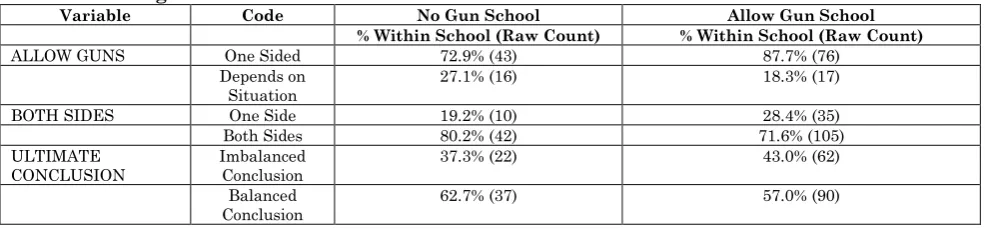
between schools or gender. Since there were no significant differences, gender and school were not included in the remaining analyses. Table 3 presents the percentages and frequencies of bifurcated responses within each school.
Table 3: Response Rates to Open-Ended Question for the School Not Allowing Guns and School Allowing Guns within a Semester
Variable Code No Gun School Allow Gun School
% Within School (Raw Count) % Within School (Raw Count)
ALLOW GUNS One Sided 72.9% (43) 87.7% (76)
Depends on Situation
27.1% (16) 18.3% (17)
BOTH SIDES One Side 19.2% (10) 28.4% (35)
Both Sides 80.2% (42) 71.6% (105)
ULTIMATE CONCLUSION
Imbalanced Conclusion
37.3% (22) 43.0% (62)
Balanced
Conclusion 62.7% (37) 57.0% (90)
Open-Ended Responses
We ran two multivariate analyses
(MANOVA) to determine if the open-ended responses were associated the key factors of this study. SK, CK, and COGFLEX served as dependent measures.
When ALLOWS GUNS and BOTH SIDES were the independent variables, there were two significant findings. There was a main effect for BOTH SIDES on COGFLEX: F(1, 132) = 5.93, p < .02, η2 = .04. Participants who presented both sides of the argument had significantly larger cognitive flexibility scores.
There was also a significant interaction between ALLOWS GUNS and BOTH SIDES
on COGFLEX: F(1, 132) = 8.02, p < .005, η2
= .06. Participants who presented both sides of the argument and said that their opinion about guns on campus was dependent on the situation had a significantly higher cognitive flexibility scores compared to all other groups in the analysis. See Fig 1.
Available online at: www.ijassh.com
Figure 1: Interaction between BOTH SIDES and ALLOW GUNS on COGFLEX.
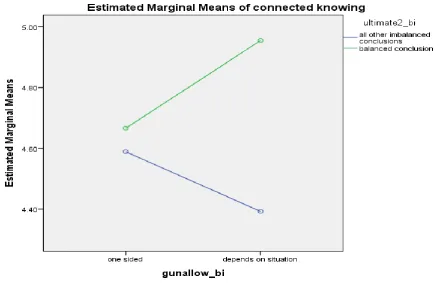
There was a main effect for ultimate Conclusion on CK: F(1, 142) = 8.16, p < .005,
η2 = .05. Participants who presented a
balanced conclusion had significantly higher connected knowing scores.
There was also a significant interaction between allow guns and ultimate conclusion
on CK: F(1, 132) = 4.70, p < .03, η2 = .03.
Participants who presented balanced
conclusion and said that their opinion about guns on campus was dependent on the situation had a significantly higher cognitive flexibility scores compared to all other groups in the analysis. See Fig 2.
Variables that may have contributed to the
comprehension of the debate were
determined with a step-wise regression analysis. The comprehension score served as the dependent variable. The following variables competed for entry as predictor variables: gender, vocabulary, Cogflex, SK, CK, allow guns, both sides, and ultimate conclusion. Three variables significantly
contributed to comprehension scores:
Cogflex: F (1, 133) = 25.69, p < .001, R2 =
.16; SK F(1, 132) = 8.34, p < .005, R2 = .05;
and ultimate conclusion: F(1, 131) = 6.25, p
< .01, η2 = .04. Participants scored higher on
the comprehension test if they had higher cognitive flexibility scores, higher separate knowing scores, and wrote conclusions that presented both sides of the argument for guns on campus.
Discussion
Dealing with controversial issues is a part of everyday life. However, during the time of this data collection, the controversy we focused on is hotly debated in the USA as well as globally. Furthermore, within the last five years’ death by guns has occurred in grade schools, college campuses, churches, and movies theaters. This controversy is potentially lethal to the students in this study.
The aim of this work is to determine if students are able to maintain a balanced view and continue to look at both sides of the controversy, despite the potential danger.
First, we found no significant difference between schools with regard to their opinion to have guns on campus (the majority were against it) or in their summaries, interpretations, and comprehension of the debate. This leads to the next questions,
what variables contribute to students’ ability to maintain open thinking in the face of stressful issues?
We had three major findings. Students, whose opinions about guns on campus were conditional, and also presented both sides of the debate, had significantly higher cognitive flexibility. It would seem cognitive flexibility supported students to thinking through multiple viewpoints.
Students, whose opinions on campus were conditional, and came to the ultimate conclusion that both sides of the debate have legitimate arguments, had significantly higher connected knowing. It would appear that connected knowing allowed students to acknowledge the viewpoints of others different than themselves.
Students comprehension scores were
predicted by higher cognitive flexibility, higher separate knowing, and balanced ultimate conclusions. One interpretation of these results is that cognitive flexibility and separate knowing allowed students to attend to both sides of the debate. In addition, providing a balanced ultimate conclusion
was a consequence of students’
comprehension.
Conclusion
Students will face serious controversial issues throughout their lifetime. Our educational system would serve them well if it included instruction on ways of knowing and cognitive flexibility. Teaching these concepts in the context of contemporary and everyday issues will provide students with an opportunity to embrace the authenticity of the instruction.
References
1 Belenky MF, Clinchy BM, Goldberger NR, Tarule JM, Women's ways of knowing: The development of self, voice, and mind (New York, NY, US: Basic Books 1997).
2 Clinchy BM, Revisiting women’s ways of knowing. In B. K. Hofer & P. R. Pintrich (Eds.), Personal epistemology: The psychology of beliefs about knowledge and knowing
Mahwah, NJ: Lawrence Erlbaum Associates. (2002, 63-87).
Available online at: www.ijassh.com 4 Schommer-Aikins M, Easter MK (2015)
Epistemic Processing of Communication and Openness to Diversity Preparing Students for a Global Society, American Society of Business and Behavioral Sciences e Journal, 11:114-121.
5 Martin MM, Anderson CM (1998) The cognitive flexibility scale: Three validity studies. Communication Reports, 11(1):1-9.
6 Martin MM, Rubin RB (1995) A new measure of cognitive flexibility. Psychological Reports, 76(2):623-626.
7 Schommer-Aikins M, Easter MK (2016) Epistemic beliefs and cognitive flexibility among students from emerging markets. Proceedings of the American Society of Business and Behavioral Sciences 23rd Annual Conference, Las Vegas, NV.
8 Thompson P (2013) The digital natives as learners: Technology use patterns and approaches to learning, Computers & Education, 65:12-33.
9 Galotti KM, Clinchy BM, Ainsworth KH, Lavin B, Mansfield AF (1999) A new way of assessing ways of knowing: The attitudes toward thinking and learning survey (ATTLS). Sex Roles, 40:745-766.