Available online throug
ISSN 2229 – 5046
EFFECTS OF HEAT TRANSFER ON PERISTALTIC PUMPING OF
A NEWTONIAN FLUID IN ASYMMETRIC CHANNEL WITH RADIATION
G. RAVINDRANATH REDDY*
1, S. RAVIKUMAR
2AND G. S. S. RAJU
31
Department of Mathematics,
Tadipatri Engineering College, Tadipatri, (A.P.), India-515411.
2
Department of Mathematics,
N. B. K. R. Institute of Technology, Nellore, (A.P.), India.
3
Department of Mathematics,
JNTUA College of Engineering Pulivendula, Pulivendula, (A.P.), India-516390.
(Received On: 01-03-16; Revised & Accepted On: 12-03-16)
ABSTRACT
I
n this paper, the influence of radiation on peristaltic flow of a viscous fluid in an asymmetric channel has received little interest. Hence, an attempt is made to study the peristaltic flow of a Newtonian fluid in an asymmetric channel under the assumptions of long wavelength and low Reynolds number. Expressions for the velocity, temperature and pressure gradient are obtained analytically. The effects of various emerging parameters on the pumping characteristics and temperature field are studied in detail.Keywords: Asymmetric channel; Heat transfer; Radiation.
1. INTRODUCTION
Past five decades researchers have extensively paying attention on the peristaltic pumping of Newtonian and non-Newtonian fluids. Especially, peristaltic pumping occurs in many practical applications involving biomechanical systems such as roller and finger pumps. In particular, the peristaltic pumping of corrosive fluids and slurries could be useful as it is desirable to prevent their contact with mechanical parts of the pump. In these investigations, solutions for peristaltic flow of the fluid, the geometry of the channel and the propagating waves were obtained for various degrees of approximation.
A lot attention had been restricted to symmetric channels or tubes, but there exist also flows which may not be symmetric. An interesting study was made by Eytan and Elad [3] whose results have been used to analyze the fluid flow pattern in a non-pregnant uterus. In another paper, Eytan et al. [4] discussed the characterization of non-pregnant women uterine contractions as they are composed of variable amplitudes and a range of different wave lengths. Mishra and Ramachandra Rao [5] studied the peristaltic flow of a Newtonian fluid in an asymmetric channel. In another attempt, Ramachandra Rao and Mishra [8] investigated the non-linear and curvature effects on peristaltic transport of a Newtonian fluid in an asymmetric channel when the ratio of channel width to the wave length is small. An example for a peristaltic type motion is the intra-uterine fluid flow due to momentarily contraction, where the myometrial contractions may occur in both symmetric and asymmetric directions. Elshewey et al. [2] analyzed peristaltic transport of a Newtonian fluid through a porous medium in an asymmetric. Peristaltic transport of a power law fluid in an asymmetric channel was investigated by Subba Reddy et al. [9]. Prasanth Reddy and Subba Reddy [6] studied the peristaltic pumping of third grade fluid in an asymmetric channel under the effect of magnetic fluid.
The study of heat transfer analysis is another important area in connection with peristaltic motion, which has industrial applications like sanitary fluid transport, blood pumps in heart lungs machine and transport of corrosive fluids where the contact of fluid with the machinery parts are prohibited. There are only a limited number of research available in literature in which peristaltic phenomenon has discussed in the presence of heat transfer [7, 10, 11].
Corresponding Author: G. Ravindranath Reddy*
1However, the influence of radiation on peristaltic flow of a viscous fluid in an asymmetric channel has received little interest. Hence, an attempt is made to study the peristaltic flow of a Newtonian fluid in an asymmetric channel under the assumptions of long wavelength and low Reynolds number. Expressions for the velocity, temperature and pressure gradient are obtained analytically. The effects of various emerging parameters on the pumping characteristics and temperature field are studied in detail.
2. MATHEMATICAL FORMULATION
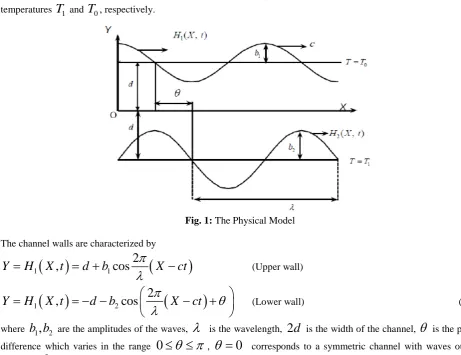
We consider the flow of an incompressible viscous fluid in a two-dimensional asymmetric channel induced by sinusoidal wave trains propagating with constant speed c along the channel walls. A rectangular co-ordinate system
(
X Y
,
)
is chosen such thatX
-axis lies along the centre line of the channel in the direction of wave propagation andY
-axis transverse to it, as shown in Fig. 1. The lower and upper walls of the channel are maintained at constant temperaturesT
1 andT
0, respectively.Fig. 1: The Physical Model
The channel walls are characterized by
(
)
(
)
1 1
2
,
cos
Y
H
X t
d
b
π
X
ct
λ
=
= +
−
(Upper wall)(
)
(
)
1 2
2
,
cos
Y
H
X t
d
b
π
X
ct
θ
λ
=
= − −
−
+
(Lower wall) (2.1) whereb b
1,
2 are the amplitudes of the waves,λ
is the wavelength,2
d
is the width of the channel,θ
is the phase difference which varies in the range0
≤ ≤
θ π
,θ
=
0
corresponds to a symmetric channel with waves out of phase andθ π
=
.In fixed frame
(
X Y
,
)
, the flow is unsteady but if we choose moving frame(
x y
,
)
, which travel in theX
-direction with the same speed as the peristaltic wave, then the flow can be treated as steady.The transformation between two frames are related by
and (2.2)
where and are the velocity components, and are the pressures in wave and fixed frames of reference respectively.
The pressure remains a constant across any axial station of the channel, under the assumption that the wavelength is large and the curvature effects are negligible.
In the absence of an input electric field, the equations governing the flow field in a wave frame, are
0
u
v
x
y
∂
+
∂
=
∂
∂
(2.3),
,
,
x
X
ct y
Y u
U
c v
V
p x
( )
P X t
( , )
( , )
u v
( , )
U V
p
P
2 2
2 2
u
u
p
u
u
u
v
v
x
y
x
x
y
ρ
∂
+
∂
= −
∂
+
∂
+
∂
∂
∂
∂
∂
∂
(2.4)2 2
2 2
v
v
p
v
v
u
v
x
y
x
x
y
ρ
∂
+
∂
= −
∂
+
µ
∂
+
∂
∂
∂
∂
∂
∂
(2.5)2 2
2 2
2
p
T
T
u
v
u
v
q
c
u
v
k
T
x
y
x
y
y
x
y
ρ
∂
∂
+
∂
∂
= ∇ +
µ
∂
∂
+
∂
∂
+
∂
∂
+
∂
∂
−
∂
∂
(2.6)where
ρ
is the density,µ
is the co-efficient of viscosity of the fluid,c
p is the specific heat at constant pressure,v
is kinematic viscosity of the fluid,
k
is thermal conductivity of the fluid andT
is temperature of the fluid. Following Cogley et al. [1], it is assumed that the fluid is optically thin with a relatively low density and the radiative heat flux is given by(
)
2 04
q
T
T
y
α
∂
=
−
∂
(2.7) hereα
is the mean radiation absorption coefficient.In order to write the governing equations and the boundary conditions in dimensionless form the following non - dimensional quantities are introduced.
2
1 1
1
;
;
,
,
,
,
,
,
x
y
U
V
d
a p
ct
H
x
y
u
v
p
t
h
d
c
c
δ
c
d
λ
δ
λ
µ λ
λ
=
=
=
=
=
=
=
=
2 1 2
2
,
,
,
H
b
b
h
a
a
d
d
d
=
=
=
0 21 0 1 0
, Pr
,
(
)
p
p
c
T
T
c
Ec
T
T
k
c T
T
ρν
−
Θ =
=
=
−
−
(2.8) whereδ
is the wave number anda
andb
are amplitude ratios of upper and lower waves respectively.In view of (2.8), the Equations (2.3) – (2.6), after dropping bars, reduce to
0
u
v
x
y
∂
+
∂
=
∂
∂
(2.9)2 2
2
2 2
Re
u
u
v
u
p
u
u
x
y
x
x
y
δ
∂
+
∂
= −
∂
+
δ
∂
+
∂
∂
∂
∂
∂
∂
(2.10)2 2
3 2 2
2 2
Re
u
v
v
v
p
v
v
x
y
x
x
y
δ
∂
+
∂
= −
∂
+
δ δ
∂
+
∂
∂
∂
∂
∂
∂
(2.11)2 2
2
2 2
2 2
2 2 2
4 2
4
1
Re
Pr
2
u
u
x
y
u
v
E
N
x
y
x
y
v
u v
x
y x
δ
δ
δ
δ
δ
∂
∂
+
∂
∂
∂Θ
+
∂Θ
=
∂ Θ ∂ Θ
+
+
−
Θ
∂
∂
∂
∂
+
∂
+
∂ ∂
∂
∂ ∂
(2.12)where
Re
ρ
dc
µ
=
is the Reynolds number,2 2
2
4
d
N
k
α
=
is the radiation parameter.Under the assumption of long wave length
(
δ
1
)
the Equations (2.10) - (2.12) become2 2
p
u
x
y
∂
∂
=
∂
∂
(2.13)0
p
y
∂
=
2 2 2 2
1
0
u
Ec
N
Pr
y
y
∂ Θ
+
∂
−
Θ =
∂
∂
(2.15)The non-dimensional boundary conditions are
1
u
= −
aty
=
h x h
1( ) ( )
,
2x
(2.16)0
Θ =
aty
=
h x
1( )
(2.17)1
Θ =
aty
=
h x
2( )
(2.18)here
h x
1( )
= +
1
a
cos 2
π
x
andh
2( )
x
= − −
1
b
cos 2
(
π
x
+
θ
)
.Equation (2.14) implies that , hence is only function of x. Therefore, the Equation (2.13) can be
rewritten as 2 2
dp
u
dx
y
∂
=
∂
(2.19)The rate of volume flow rate through each section in a wave frame, is calculated as
1
2
h
h
q
=
∫
udy
(2.20)The flux at any axial station in the laboratory frame is
( )
1(
)
2
1 2
,
1
h
h
Q x t
=
∫
u
+
dy
= + −
q
h
h
(2.21)The average volume flow rate over one period (T= ) of the peristaltic wave is defined as
0
1
2
T
Q
Qdt
q
T
=
∫
= +
(2.22)The dimensionless pressure rise per one wavelength in the wave frame is defined as
1
0
dp
p
dx
dx
∆ =
∫
(2.23)3. SOLUTION: Solving Equation (2.19) using boundary conditions (2.16), we get
(
)
(
2)
1 2 1 2
1
1
2
dp
u
y
h
h
y
h h
dx
=
−
+
+
−
(3.1)Substituting Equation (3.1) in the Equation (2.15) and Solving Equation (2.15) using the boundary conditions (2.17) and (2.18), we obtain
(
) (
)
22
1 1 2 1 2 1 2 1 2 2
1 1
Pr
8
cos
sin
4
4
4
Ec
c
N y
c
N y
y
h
h
y
h
h
N
N
Θ =
+
−
−
+
+
+
−
(3.2) herec
1=
(
A
1sin
Nh
2−
A
2cos
Nh
1)
/ sin
N h
(
2−
h
1)
,(
)
(
)
2 2
cos
1 1cos
2/ sin
2 1c
=
A
Nh
−
A
Nh
N h
−
h
,(
)
2
2 0
1 2 1 2 2
1 1
Pr
8
4
dp
Ec
A
h
h
N
dx
N
=
−
−
and(
)
2
2 0
2 2 1 2 2
1 1
Pr
8
1
4
dp
Ec
A
h
h
N
dx
N
=
−
−
−
.( )
p
p y
p
The volume flow rate in the wave frame of reference is given by
(
) (
)
2 2
1 2 1 2 1 2 1 2
1
6
12
dp
q
h
h
h h
h
h
h
h
dx
=
+
+
−
−
−
(3.3)From (3.3), we have
(
)
(
)
1 2
2 2
1 2 1 2 1 2
12
6
q
h
h
dp
dx
h
h
h h
h
h
+
−
=
+
+
−
(3.4)
4. DISCUSSION OF THE RESULTS
In order to get a the physical insight of the problem, pumping characteristics and temperature field are computed
numerically for different values of various emerging parameters, viz., phase shift
θ
, amplitude ratiosa b
,
,Pr,
Ec
andN
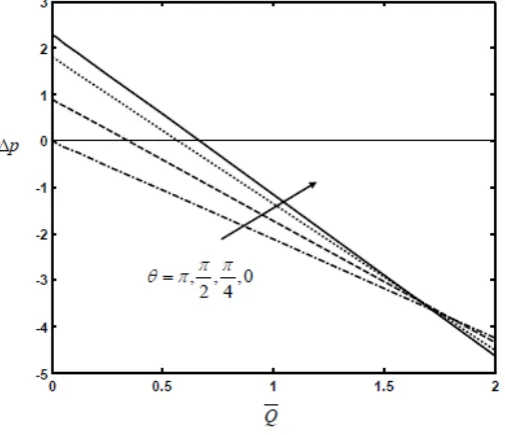
and are presented in figures 2-11.The variation of pressure rise
∆
p
with time averaged fluxQ
for different values of phase shiftθ
witha
=
0.5
and0.5
b
=
is shown in Fig. 2. It is found that, theQ
decreases with increasing phase shiftθ
in all the three regions, vz., pumping region(
∆ >
p
0
)
, free pumping region(
∆ =
p
0
)
and co-pumping region(
∆ <
p
0
)
. Moreover, theQ
increases with increasingθ
for appropriately chosen∆ <
p
( )
0
.The variation of pressure rise
∆
p
with time averaged fluxQ
for different values ofa
withb
=
0.5
and,
4
π
θ
=
is shown in Fig. 3. It is found that, the
Q
increases with an increase ina
in both pumping and free pumping regions.But in the co-pumping region, the
Q
decreases with increasinga
, for an appropriately chosen∆ <
p
( )
0
.Fig. 4 represents the variation of pressure rise
∆
p
with time averaged fluxQ
for different values ofb
with0.5
a
=
and4
π
θ
=
. It is noted that, theQ
increases on increasingb
in the both pumping and free pumpingregions, while in co-pumping region, the
Q
decreases asb
increases, for an appropriately chosen∆ <
p
( )
0
.Fig. 5 shows the variation of temperature
Θ
withy
for different values of phase shiftθ
witha
=
0.5
,b
=
0.5
,0.5
x
=
,Pr
=
0.7
,Ec
=
0.1
,N
=
1
andQ
= −
1
. It is found that, the temperatureΘ
decreases with an increase inθ
.The variation of temperature
Θ
withy
for different values of upper wave amplitudea
with4
π
θ
=
,b
=
0.5
,0.5
x
=
,Pr
=
0.7
,Ec
=
0.1
,N
=
1
andQ
= −
1
is shown in Fig. 6. It is observed that, the temperatureΘ
initially increases and then decreases with increasinga
.Fig. 7 depicts the variation of temperature
Θ
withy
for different values of lower wave amplitudeb
witha
=
0.5
,4
π
θ
=
,x
=
0.5
,Pr
=
0.7
,Ec
=
0.1
,N
=
1
andQ
= −
1
. It is found that, the temperatureΘ
increaseswith an increase in
b
.The variation of temperature
Θ
withy
for different values of Prandtl numberPr
witha
=
0.5
,b
=
0.5
,0.5
x
=
,4
π
θ
=
,Ec
=
0.1
,N
=
1
andQ
= −
1
is depicted in Fig. 8. It is noted that, the temperatureΘ
increases with increasing
Pr
.Fig. 9 shows the variation of temperature
Θ
withy
for different values of radiation parameterN
witha
=
0.5
,0.5
b
=
,x
=
0.5
,Pr
=
0.7
,Ec
=
0.1
,4
π
θ
=
andQ
= −
1
. It is found that, the temperatureΘ
increaseswith increasing
N
.The variation of temperature
Θ
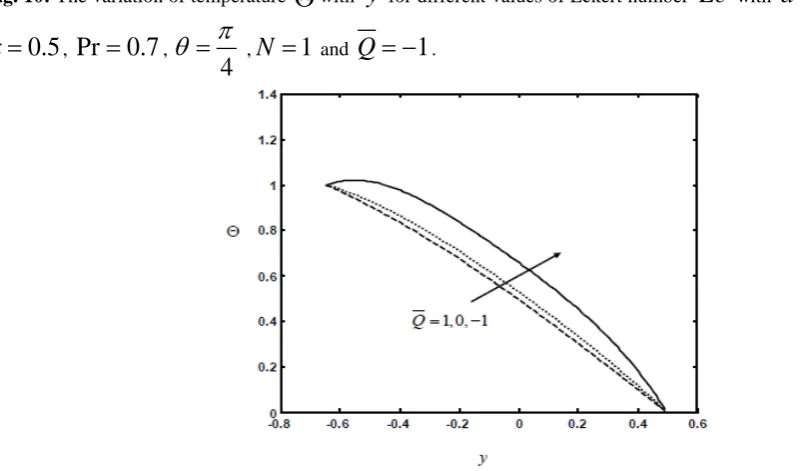
withy
for different values of Eckert numberEc
witha
=
0.5
,b
=
0.5
,0.5
x
=
,Pr
=
0.7
,4
π
θ
=
,N
=
1
andQ
= −
1
is shown in Fig. 10. It is observed that, the temperatureΘ
increases with an increase in
Ec
.Fig. 11 illustrates the variation of temperature
Θ
withy
for different values of time averaged fluxQ
witha
=
0.5
,
b
=
0.5
,x
=
0.5
,Pr
=
0.7
,Ec
=
0.1
,N
=
1
and4
π
θ
=
. It is noted that, the temperatureΘ
decreaseswith increasing
Q
. 5.CONCLUSIONS
In this chapter, we investigated the effects of Heat transfer and radiation on the peristaltic flow of a Newtonian fluid in an asymmetric channel under longwavelength approximation. The expressions for the velocity filed and temperature
field are obtained. It is found that, in the pumping region the time averaged flux
Q
increases with increasinga
andb
while it decrease with increasingθ
. It is observed that the temperature fieldΘ
increases with increasingb
,Pr,
N
andEc
, while it decreases with increasinga
andθ
.Fig. 3: The variation of pressure rise
∆
p
withQ
for different values ofa
with4
π
θ
=
andb
=
0.5.
Fig. 4: The variation of pressure rise
∆
p
withQ
for different values ofb
witha
=
0.5
and.
4
π
θ
=
Fig. 5: The variation of temperature
Θ
withy
for different values of phase shiftθ
witha
=
0.5
,b
=
0.5
,0.5
Fig. 6: The variation of temperature
Θ
withy
for different values of upper wave amplitudea
with4
π
θ
=
,0.5
b
=
,x
=
0.5
,Pr
=
0.7
,Ec
=
0.1
,N
=
1
andQ
= −
1.
Fig. 7: The variation of temperature
Θ
withy
for different values of lower wave amplitudeb
witha
=
0.5
,4
π
θ
=
,x
=
0.5
,Pr
=
0.7
,Ec
=
0.1
,N
=
1
andQ
= −
1
.Fig. 8: The variation of temperature
Θ
withy
for different values of Prandtl numberPr
witha
=
0.5
,b
=
0.5
,0.5
x
=
,4
π
Fig. 9: The variation of temperature
Θ
withy
for different values of radiation parameterN
witha
=
0.5
,0.5
b
=
,x
=
0.5
,Pr
=
0.7
,Ec
=
0.1
,4
π
θ
=
andQ
= −
1
.Fig. 10: The variation of temperature
Θ
withy
for different values of Eckert numberEc
witha
=
0.5
,b
=
0.5
,0.5
x
=
,Pr
=
0.7
,4
π
θ
=
,N
=
1
andQ
= −
1
.Fig. 11: The variation of temperature
Θ
withy
for different values of time averaged fluxQ
witha
=
0.5
,0.5
b
=
,x
=
0.5
,Pr
=
0.7
,Ec
=
0.1
,N
=
1
and 4REFERENCES
1. Cogley, A. C. L., Vinvent, W. G. and Giles, E. S. Differential approximation for radiative heat transfer in non-linear equations-grey gas near equilibrium, American Institute of Aeronautics and Astronautics, 6(1968), 551–553.
2. EL Shehawey, E.F., Eldabe, N.T., Elghazy, E.M. and Ebaid, A. peristaltic transport in an asymmetric channel through a porous medium, Appl. Math. Comput. 182(2006), 140-150.
3. Eytan, O. and Elad, D. Analysis of Intra – Uterine fluid motion induced by uterine contractions, Bull. Math. Bio., 61(1999), 221-238.
4. Eytan, O., Jaffa, A.J. and Elad, D. Peristaltic flow in a tapered channel: application to embryo transport within the uterine cavity, Med. Engng. Phys., 23(2001), 473-482.
5. Mishra, M. and Ramachandra RAO, A. Peristaltic transport of a Newtonian fluid in an asymmetric channel, Z. Angew. Math. Phys. (ZAMP), 54(2003), 532-550.
6. Prasanth Reddy, D. and Subba Reddy, M. V. Peristaltic pumping of third grade fluid in an asymmetric channel under the effect of magnetic fluid, Advances in Applied Science Research, 3(6) (2012), 3868 – 3877.
7. Radhakrishnamacharya G, Srinivasulu Ch. Influence of wall properties on peristaltic transport with heat transfer, C R Mecanique, 335(2007), 369–373.
8. Ramachandra Rao, A. and Mishra, M. Peristaltic transport of a power-law fluid in a porous tube, J. Non-Newtonian Fluid Mech. 121 (2004) 163-174.
9. Subba Reddy, M.V., Ramachandra Rao, A. and Sreenadh, S. Peristaltic motion of a power law fluid in an asymmetric channel, Int. J. Non-Linear Mech., 42 (2007), 1153-1161.
10. Vajravelu K, Radhakrishnamacharya G, Radhakrishnamurty V. Peristaltic flow and heat transfer in a vertical porous annulus with long wave approximation. Int. J. Nonlinear Mech, 42(2007), 754 – 759.
11. Vasudev, C., Rajeswara Rao, U., Subba Reddy, M.V. and Prabhakara Rao, G. Influence of magnetic field and heat transfer on peristaltic flow of Jeffrey fluid through a porous medium in an asymmetric channel, ARPN Journal of Engineering and Applied Sciences, 5(12) (2010), 87-103.
Source of support: Nil, Conflict of interest: None Declared
[Copy right © 2016. This is an Open Access article distributed under the terms of the International Journal of Mathematical Archive (IJMA), which permits unrestricted use, distribution, and reproduction in any medium, provided the original work is properly cited.]