International Journal of Advances in Management, Economics and Entrepreneurship Available online at:
www.ijamee.info
RESEARCH ARTICLE
The Impact of Financial Liberalization on Stock Price Volatility in
Nigeria
Rolle Remi Ahuru1, Olabisi Julius Olaposi2*
1Department of Economics and Statistics, University of Benin, Benin City.
2Department of Economics University of Jos, Plateau State.
*Corresponding Author: Email: [email protected]
Abstract
This study is a test of the financial liberalization hypothesis, which states that stock price volatility will reduce following financial liberalization. In August 1995, the Nigerian government liberalized the capital market. The study therefore examined the role of the liberalization exercise on stock market volatility in Nigeria. Utilizing quarterly time series for the period 1985:1 to 2012: Q4 and the methodology of GARCH and Co-integration and Error Correction Model, the study found out that financial liberalization has rather fuelled stock price volatility in Nigeria, thereby refuting the claim of the financial liberalization theorists. Furthermore, macroeconomic variables were found to significantly impact on stock return volatility. The study recommended among other things the use of policies to downplay volatility and censoring foreign capital, so as to disallow short term capital with speculative nature.
Keywords: Financial liberalization, stock price volatility, GARCH, ECM and Nigeria.
Introduction
Since 1986, Nigerian government has embarked on wide-scale economic reforms design to reposition the economy on the path of sustainable development. The economy was characterized by dismal macroeconomic aggregates, such as triple digit exchange rate, double digit inflation rate, chronic BOP deficit, slow and oftentimes negative GDP growth rate and illiquidity of the Nigerian capital market. Report by some researchers [1,2] had it that Nigerian capital market could not finance the economy. The wide and extensive liberalization of the capital market was meant to reposition the capital market in line with global standards, and also leveraged it so that it can engender impressive growth performance.
Since the 80s, many developing countries have resorted to the liberalization of their financial markets, with the intents of increasing their share of global capital flow. However, it is noted that such wide-scale liberalization of financial market has occasional volatility in stock markets [3,4].
Consequently, such markets become
informationally more efficient leading to higher volatility, as prices quickly respond to relevant information. Basically, there are two schools of thought on the impact which financial liberalization will have on stock price volatility.
The first school of thought, who refuted financial liberalization hypothesis, argued that liberalization of the market will instigate volatility of the stock market. While the second school of thought debunked the claim of the first school, but they argued that since financial liberalization will lead to diversification of risk, then it will dampen volatility in the stock market. Volatility of stock prices which have been defined as the gyrations and fluctuations in stock prices over a time varying period has occupied a central place in finance literature. Research has showed that the degree of volatility will be of immense help to speculators in deciphering, the time path of the economy, and also to unravel the behaviors of investors and portfolios managers [5]. This is principally the reason why it is important to understand the concept of volatility.
In addition, a good number of studies in this regard focused on group of countries, so that country-specific studies are sparse. Against this backdrop, this present study attempts to resolve the conflict by utilizing quarterly sample observation for the period 1985: Q1 to 2012: Q4. It is worthy of note that myriads of studies only utilize annual data. Quarterly data as it is used in this study will give enough sample observation with sufficient degrees of freedom to study the phenomenon.
Section 11 of the remaining part of this study focused on relevant theoretical and empirical literatures. Section III presents the theoretical framework and estimation procedure. Section IV presents estimated models and their discussion. Finally, section V concludes the study and proffer relevant recommendations.
Theoretical
and
Empirical
Literature
The impact of financial liberalization on stock market has been extensively investigated in finance literature. It is believed that financial liberalization produces structural changes in developing countries and accelerates the development of the capital market. Financial liberalization will produce diverse effects, which among others include the stimulation of economic growth, reduce capital costs and interest rates on international diversification. Therefore, financial liberation will indirectly affect stock market. The issue of financial liberation and its impact is indeed controversial [7]. While some researchers have argued that financial liberalization will trigger financial bubbles and burst, others are of the opinion that it guarantees smooth and efficient working of the capital market and ensure that capital flows to their most efficient destination. In finance literature, it is well documented that the analysis of financial liberation is pertinent to build efficient portfolio. The interest placed on stock price volatility is based on the fact that investment decision depends on both expected return and the risks of various assets comprising the portfolio. It has become important to study the volatility of emerging markets, Nigeria inclusive and particularly important to study the relationship between financial liberalization and stock price volatility. Considerable research has focused on the relationship between stock price volatility and financial liberalization, Bekaert and Harvey [8], Bekaert, Harvey and Lumsdaine [9], Kassimatis [10], Desantis and Imrohoroglas [11], Huang and Yang [12], Kim and Singal [13], Aggarwal et al. [14] have all obtained mixed empirical evidence.
A number of studies have supported the positive relationship between stock price volatility and financial liberalization. Kim and Singal [13] in their study examine the benefits and risk associated with stock market liberalization. The study utilized both ARCH and GARCH for 20 emerging markets. They found out that stock returns increases immediately after liberalization, without corresponding increase in volatility. The study concludes that financial liberalization creates market efficiency and downplay on volatility. However, the combination of ARCH, GARCH and EGARCH to examine the relationship between financial liberalization and monthly stock returns for four (4) Latin American and two Asian countries namely: Argentina, Brazil, Chile, Mexico, South Korea and Thailand. The study reveals that volatility in emerging market is higher than developed markets. This implies that financial liberalization leads to higher volatility in Latin American and Asian economies.
Panoply of studies has provided mixed evidence on the relationship between financial market liberalization and stock market volatility. In a study by Huang and Yang [12] and Wang and Theobald [15] conclude that the impact of financial liberalization depends on country specific characteristics. The GARCH models find that volatility may increase or decrease or even remain unchanged after a financial liberalization process. Miles [16] also obtained mixed results on the relationship between financial market liberalization and volatility in stock prices. He pointed out that the results tend to be country-specific and do not support the hypothesis of decrease in volatility in emerging market following reforms. He concludes that volatility will rather increase following financial liberalization.
Methodology
approach is suitable since our interest is just to generate volatility.
Model Specification
In this study we infer that Stock market volatility (SMV) depends on financial liberalization and macroeconomic variables of interest rate (R), inflation rate (INFL) and the real growth rate of the GDP (GDPG). Financial liberalization as qualitative variable was proxy by dummy (LDUM). Based on the forgoing the model is specified below:
SMV = B0 + B1R + B2INFL + B3GDPG + B4LDUM
+ Ut - - - (1)
Where:
SMV = Stock market volatility R = Interest Rate
INFL = Inflation rate
GDPG = Growth rate of GDP
LDUM = Dummy variable for financial liberalization
Ut = Stochastic error term
Based on apriori considerations, the coefficient of interest rate and inflation rate will be negative. The growth rate of the GDP is expected to have a positive coefficient and financial liberalization dummy will have negative coefficient.
Data and Its Sources
The nature of the study necessitated the use of secondary data obtained from various reputable sources, such as the Central Bank of Nigeria Statistical Bulletin, the Nigerian Stock Exchange and the Security and Exchange Commission. Financial liberalization being a qualitative variable
was proxy by dummy. This approach was earlier used by Edison and Warnock [17], since there are no reliable liberalization indexes. Following this approach, we assigned zero to pre-liberalization era and one to post-liberalization era. Considering that the official date for financial liberalization in Nigeria was in August, 1995. We assigned zero to the period (1985:Q1 to 1995:Q2) and assigned one to the period (1995:Q3 to 2012:Q4). Furthermore, quarterly time series of All Share Index was used to generate market volatility series using E-GARCH methodology. The All Share Index was used to proxy the general market price assessment. It is a composite of the average price of all stocks traded in the Nigerian stock market. It is not traceable to any particular stock; hence it is best used for the general assessment of the market price.
Empirical Analysis
In this section of the study, we present the
estimated model, analyzed them and thereafter proffer the policy implications. The results are presented in the order of stationarity tests, co-integration test and the Error Correction Model. Stationarity
The essence of regression analysis is to obtain both short and long-run relationship among economic variables. Such analysis is to test theoretical economic postulations. Recent development in econometrics has revealed the need to conduct stationarity test. This present study utilized Elliot-Rothenberg stock DFGLS tests. The results of the tests are presented in table1 below.
Table 1: Elliot-Rothenberg-stock DF-GLS unit root test results
- Elliot-Rothenberg-stock DF-GLS
unit root test Statistics
Critical Values Comment
Variables - 1% 5% 10% -
SMV -1.62 2.65 -1.94 -1.61 Non Stationary
R -1.58 2.65 -1.94 -1.61 Non Stationary
INFL -0.92 2.65 -1.94 -1.61 Non Stationary
GDPG -0.81 2.65 -1.94 -1.61 Non Stationary
LDUM -1.24 2.65 -1.94 -1.61 Non Stationary
DSMV -3.65 2.65 -1.94 -1.61 Stationary
DR -2.27 2.65 -1.94 -1.61 Stationary
DINFL -1.62 2.65 -1.94 -1.61 Stationary
DGDP -2.37 2.65 -1.94 -1.61 Stationary
Source: Authors computation (2015) using E-view 7.0
Note: *** significant at the 0.01 level, significant at the 0.05 level, *significant at the 0.1 level.
The ADF and PP unit root tests are known to suffer potentially severe finite sample and size problems. A variety of alternative procedures have been proposed that try to resolve these problems, including Ng and Person and Elliot Rothenberg and Stock DF-GLS tests. The Elliot-Rothenberg and stock test presented in table 2 above shows
Co-integration Test
In the literature, two or more variables are said to be co-integrated if a long-run meaningful relationship exist among them. When two or more variables are co-integrated, even the variables drift apart in the short run, there is always a long- run
equilibrium between or among the variables. This study utilized the Johansen approach in testing for co-integration. We utilized both the trace statistics and the maximum Eigen values. The results are respectively shown in table 3 and 4 below.
Table 2: Unrestricted Co-Integration Rank Test (Trace)
Hypothesized
No. of (ECS) Eigen Value Trace Statistics critical 0.05
value
Prob.**
None 0.4508 64.1831 58.1832 0.000
One 0.2866 52.1942 50.1398 0.042
Two 0.2542 48.9041 48.9831 0.032
Three 0.3152 45.3124 46.3121 0.1842
Four 0.4038 44.4284 45.3421 0.5242
Max-Eigen value test indicates 4 cointegrating equ(s) at the 0.05 level *denotes rejection of the hypothesis at the 0.05 level
**MacKinnon-Hawg-Michelis (1999) p-values
Table 3: Unrestricted Co-integration Rank Test (Maximum Eigen Value)
Hypothesized No. of (ECS)
Eigen Value Trace
Statistics
0.05 critical value
Prob.**
None* 0.4508 58.1324 57.1919 0.000
At most 1* 0.3421 56.1842 55.1218 0.032
At most 2* 0.8142 54.1452 50.1312 0.002
At most 3* 0.2418 48.1251 49.2132 0.483
At most 4* 0.1842 44.1242 46.4056 0.564
Max-eigen value test indicates 3 cointegrating equ(s) at the 0.05 level. *denotes rejection of the hypothesis at the 0.05 level
**MacKinoon-Haug-Michellis p-values
Both the trace test and the maximum Eigen values show that there are three (3) co-integrating equations, hence the variables utilized in this study are co-integrated and a common stochastic drift exist among them.
The Parsimonious Short Run ECM
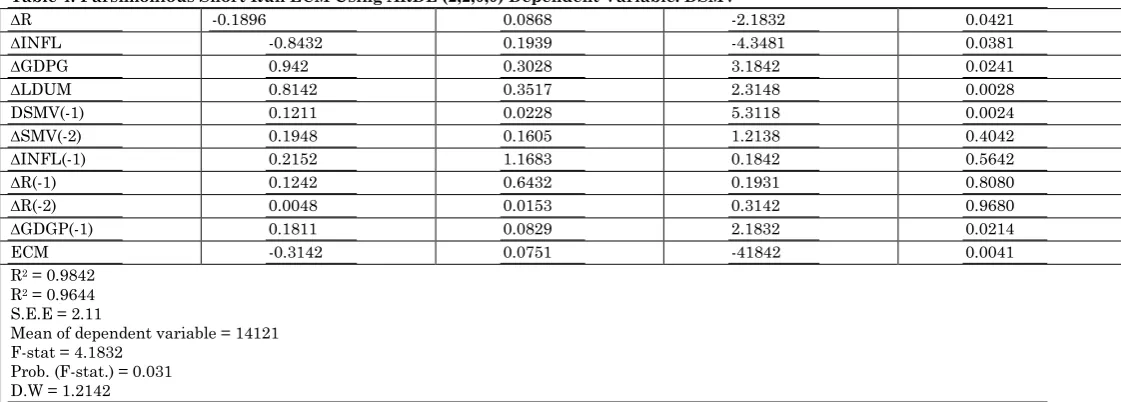
Under the short run Parsimonious ECM, we simply regressed the first difference of the dependent variable (stock market volatility) on the first difference of the independent variables (the interest rate, inflation rate, real gross domestic product, dummy variable for liberalization). We allow restricted numbers of lags; hence it is a parsimonious mode.
Table 4: Parsimonious Short Run ECM Using ARDL (2,2,0,0) Dependent Variable: DSMV
∆R -0.1896 0.0868 -2.1832 0.0421
∆INFL -0.8432 0.1939 -4.3481 0.0381
∆GDPG 0.942 0.3028 3.1842 0.0241
∆LDUM 0.8142 0.3517 2.3148 0.0028
DSMV(-1) 0.1211 0.0228 5.3118 0.0024
∆SMV(-2) 0.1948 0.1605 1.2138 0.4042
∆INFL(-1) 0.2152 1.1683 0.1842 0.5642
∆R(-1) 0.1242 0.6432 0.1931 0.8080
∆R(-2) 0.0048 0.0153 0.3142 0.9680
∆GDGP(-1) 0.1811 0.0829 2.1832 0.0214
ECM -0.3142 0.0751 -41842 0.0041
R2 = 0.9842
R2 = 0.9644
S.E.E = 2.11
Mean of dependent variable = 14121 F-stat = 4.1832
Prob. (F-stat.) = 0.031 D.W = 1.2142
Source: Author’s computation (2015) using E-View 7.0
The results in table 5 based on equation 1 show that all the explanatory variables are correctly
and inflation rate travests apriori expectations. However, one time lagged value of change in growth rate of real GDP conforms to apriori expectations. The estimated coefficient of the short run relationship show that a unit rise in interest rate will reduce stock market volatility by 0.1896 units if all things being equal. The result further shows that a unit rise in inflation rate will reduce stock market volatility by 0.1896 units if all things being equal. The result further shows that unit rise in inflation rate will reduce stock market volatility by 0.8432units. However, if the real growth rate of the GDP and liberalization dummy rises by a unit, then stock market volatility will respectively rise by 0.9642 and 0.8142 units.
Furthermore, both R2 and its adjusted counterpart
show that the estimated model has commendable goodness of fit and high explanatory power. R2 puts
at 0.9842 shows an explained variation of 98.42%. The F-stat (4.1832) and P-value (0.031), shows an estimated model that is significant at 5%. The ECM coefficient (-0.3142) is both correctly signed and significant. The coefficient of -0.3142 shows that 31.42% of the disequilibrium will be reconciled aftershock the speed of adjustment is slow.
Discussion of Results
To start with, our estimated model reveals that financial liberalization positively and significantly impact on stock market volatility. This portends that the dismantling of barriers in the Nigerian capital market in August, 1995 has engendered volatility in the market. This finding contradicts the financial liberalization hypothesis that position that stock market volatility will reduce following capital market liberalization. The fact that this study shows that financial liberalization significantly impact on stock market volatility contradicts findings by both Stiglitz [3] and Calvo et al. [4]. Both authors present that financial liberalization does not yield any significant benefit. In the same vein, Haung and Yang [12], Stiglitz [3], all found out that stock market volatility may increase or decrease following financial liberalization, but not significantly. In contrast with our findings, Kassimatis [10] and all found out that volatility in stock prices decreases following capital market liberalization. However, study by Oaikhenan [2] corroborate the findings of this study.
Essentially, the study reveals the impact of certain macroeconomic variables on stock price volatility. Interest rate both negatively and significantly impact on stock market volatility. This is in line with apriori expectations and supports findings by Shiller and Beltratti [18], Humpe and Macmillan [19], Abugri [20] and Al-sharkas [21]. However, Maysami et al. [22] found a positive and significant relationship between interest rate and stock market volatility. Real growth rate of the GDP both positively and significantly impact on stock market volatility. Thus, a boom in the economy will engender volatility in the stock market . Finally, a negative and significant impact for inflation rate was revealed, corroborating findings by Udegbunam and Eriki [23]. Other studies that supported this position are Rizwarn and Khan [24]. In contrast, Schwert [25] and Davis and Kutan [26] found a negative and insignificant impact of inflation rate on stock market volatility.
Policy Recommendations and Conclusion
Instructively, this study shows that both one time and two time lagged values of stock market volatility positively and significantly impact on current stock market volatility. The policy implication of this is volatility persistence. This reinforces the need for policy makers to put up policies that will dampen volatility in the stock market. For instance, the “circuit breaker policy” is a policy in the right direction. This policy was introduced by the Security and Exchange Commission. The policy set a band limit of ±10% as maximum and minimum price for all stocks in the market.It is quite unimpressive that financial reforms in Nigeria have rather engender volatility in the market. This does not mean that reforms are evil, but provoke the need to censor the capital that is coming into the stock market. Short-term capital with volatile nature in the form of speculative investment should be discouraged. Finally, there is need to put up policies that will help regain the confidence of investors in the market. To this extent, excessive regulations and bottlenecks in the stock market should be relaxed and the country must fight endlessly to put an end to all forms of unrest in the country [27-35].
References
1. Ojo, M.O. (1988). A Review and Appraisal of Nigeria’s Experience with Financial Sector Reform, Central Bank of Nigeria. Quarterly Publication, 2, 2.
2. Oaikhenan, H.E. (2003). The Impact of Economic Reforms on the Behaviour of Stock Prices: Empirical Evidence from the Nigerian Stock Market. The Indian Journal of Economics, LXXXIII, III.
3. Stiglitz, J.E. (2000). On the Optimality of the Stock Market Allocation of Investment. Quarterly Journal of Economics LXXVI (1972), 25-60.
5. Krainer, J. (2002). Stock Market Volatility, FRBSF Economic Letter, Federal Reserve Bank of San Francisco, Issue Oct. 25.
6. Schnabi, G. (2007). Exchange Rate Volatility and Growth in Small Open Economies at the EMU Periphery, Working Paper Series 0773, European Central.
7. Kaminsky, G. & Schmukler, S. (2003). Short-run Pain, Long-run Gain. The Effects of Financial Liberalization, IMF Working Paper No wp/03/34, February.
8. Bakaert, G. & Harvey, C.R. (1997). Emerging Equity Market Volatility. Journal of Financial Economics, 43: 29-78.
9. Bakaert, G., Harvey, C.R. & Lumsdaine, R.L. (2002a). Dating the Integration of World Equity Markets. Journal of Financial Economics (Forthcoming).
10.Kassimatis, K. (2002). Financial Liberalization and Stock Markets Volatility in Selected Developing Countries. Applied Financial Economics 12, 389-395.
11.De Santis & Imrohoroglas, S. (1997). Stock Returns and Volatility in Emerging Financial Markets. Journal of International Money and Finance, 16, 561-579.
12.Huang, B.N. & Yang, C.Y. (1999). The Impact of Financial Liberalization on Stock Price Volatility in Emerging Markets. Journal of Comparative Economies, 28, 321-339.
13.Kim, E.K. & Singal, V. (2000). Opening up of Stock Markets: Lessons from Emerging Economics. Journal of Business, 73, 25-66. 14.Aggarwal, R., Inclan, C. & Leal, R. (1999). Volatility in Emerging
Stock Markets, Journal of Financial and Quantitative Analysis, 34, 33-55.
15.Wang, P. & Theobald, M. (2008). Regime-Switching Volatility of Six East Asian Emerging Markets. Research in International Business and Finance, 22:267-283.
16.Miles, W. (2002). Financial Deregulation and Volatility in Emerging Equity Markets. J. ECM Dev, 27(2): 113-126.
17.Edison, H. & Warnock, F.E. (2009). Cross Border Listings, Capital Controls and Equity Flows to Emerging Markets. IMF Working Paper
18.Shiller, R.J. & Bettraffi, A.E. (1992). Stock Prices and Bond Yields: Can them Co-movements be Explains In terms of Present Value Models? Journal of Monetary Economics, 30 (1): 25-46.
19.Humpe, A. & Macmillan, P. (2007). Can Macroeconomic Variables Explain Long term Stock Market Movement? Comparison of the US and Japan CDMA Working Paper No. 07/20.
20.Abugri, B. A (2008). Empirical relationship between macro-economic volatility and stock returns: Evidence from Latin American Markets, international Review of financial Analysis, vol. 17 issue 2 pp 396-410.
21.Al-Sharkas, A. (2004). The Dynamic Relationship Between macroeconomic factors and the Jordanian Stock Market. International Journal of Applied Econometrics and Quantitative studies, vol. 1-1, pp. 97-114.
22.Maysami, R.C., Howe, L. C., Itamza, M.A. (2004). Relationship between macro economic variable and stock market induces: Co integration evidence from stock exchange Singapore’s All-Sector Indices, Journal Pengurusan, vol. 24, 47-77
23.Udegbunam, R.I. & Eriki, P.O. (2001). Inflation and Stock Price Behaviour: Evidence from Nigerian Stock Market. Journal of Financial Management and Analysis, XX (14).
24.Riwan, M.F. & Khan, S.U. (2007). Stock Return Volatility in Emerging Enquiry Markets (KSE): The Relative Effects of Counting and Global Factors, International Review of Business Research Paper, 3, 2: 362-375.
25.Schwert, G.W. (1989). Why Does Stock Market Volatility Change Over Time. The Journal of Finance, Vol. 44. Issue 5.
26.Davis, N. & Kutan, A.M. (2003). Inflation and Output as Predictors of Stock Returns and Volatility: International Evidence, Applied Financial Economics, 13, 693-700.
27.Adesegun, O. (2014). Effects of Financial Sector Liberalization on Bank Performance in Nigeria. British Journal of Marketing Studies, 2, 1, 59-78.
28.Adeusi, S.O., Azeez, B.A. & Olanrewaju, H.A. (2012). The Effect of Financial Liberalization on the Performance of Informal Capital Market. Research Journal of Finance and Accounting, 3(6):1-6. 29.Bekaert, G. & Harvey, C.R. (2000). Foreign Speculators and
Emerging Markets. Journal of Finance 55(2):565-613.
30.Bekaert, G. & Harvey, C.R. (2002). Research in Emerging Markets Finance: Looking to the Future Emerging. Markets Reviews, 3, 429-448.
31.Bekaert, G. & Harvey, C.R. (2003a). Research in Emerging Markets Finances: Looking to the Future. Journal of Empirical Finance, 10: 3-55.
32.Harold, R.F. (1939). An Essay in Dynamic Theory. The Economic Journal, XLIX, 14-33.
33.Henry, P.B. (2000). Stock Market Liberalization, Economic Reform and Emerging Market Equity Prices. Journal of Finance, 55, 529-564.
34.Johnston, R., Barry and Sundarajan, V. (1999). (Eds.) Sequencing Financial Sector Reforms: Country Experiences and Issues. Washington, DC: International Monetary Fund.