ISSN: 2278-3369 International Journal of Advances in Management and Economics
Available online at: www.managementjournal.info
RESEARCH ARTICLE
Does Demography Influence Online Purchase Intention? Evidence
from North-West India
Sethi UJ
1, Sethi RS
2*1Professor, University Institute of Applied Management Sciences, Punjab University, Chandigarh, India. 2Research Scholar, University School of Applied Management, Punjabi University, Patiala, India.
*Corresponding Author: Rajbir Singh Sethi
Abstract
The phenomenal increase in online shoppers across the globe has influenced India also. A review of extant literature on the relation between demographic factors and online purchase intention revealed that demographic variables and their relation to online purchase intention were not studied in the context of Punjab, India. Three demographic factors; gender, income and marital status were studied and Independent sample T-test was used to study the effect of gender on online purchase intention while One -Way ANOVA was used to study the effect of income and marital status on online purchase intention. It emerged that gender and marital status has a significant effect on online purchase intention. Males are more likely to shop online than females and unmarried people are the most likely to shop online. Online retailers can segment the online shoppers based on gender and marital status. Important managerial implications deal with use of gender as the basis for the allocation of advertisement budgets. In addition, marketing campaigns should direct towards making females more familiar with the use of technology for online shopping.
Keywords:Online shopping, Gender, income, Marital status, Purchase intention, One-way ANOVA,
Introduction
India’s e-commerce market, which was US $3.8 billion [4] is expected to touch US$ 38 billion by the end of 2016 [37]. Favourable demographics is one important factor, which has helped the online retailers to connect with their customer base [4].
Amplified rivalry, more knowledgeable and educated customers with constant changing demands urge companies to pay attention to segmentation issues [26]. Market segmentation is important as customers have different characteristics [9]. As online retailers look to increase their market share, it is imperative to have a clearly segmented market. Although recent research studies have emphasized on psychographic segmentation, still [25] advocates the use of demographic segmentation.
A study conducted in European Union (Survey on ICT, 2015) gave two important findings: more percentage of men shop
online and people in the highest income category shopped more online in the preceding 12 months. Bellman S et. al. [6] states the online shoppers are wealthier as compared to the average US population. A survey in the US by Experian in 2013 found that people who shop online have an annual family income above US $ 75,000.
Assocham India in 2015 reported that males account for 65 % of the online shoppers. In the US in 2013, 57 % of women made an online purchase as compared to 52 % men. Kanchan U et. al. [22] find that gender significantly effects online purchase intention.
research on the relation between marital status and online purchase intention.
The present study looks to plug the aforementioned gaps by studying the relationship between the above-mentioned demographic variables and online purchase intention. The findings of the study will be beneficial to the online retailers for finding a basis for segmentation of online buyers.
Literature Review
Gender and Online Purchase Intention An increasing body of literature suggests that information processing is influencing gender differences [44]. Also, there exist gender differences in individuals’ reactions to environment stimuli [28] providing evidence of gender differences in online purchasing” [27]. With different genders, the purchase intention and sensitivity of consuming the product will be different too [35] and the concept of working women has enhanced it [31]. Gender is “one of the most common segmentation criteria used by marketers”[29].
A review of literature illustrates that females are more inspired by non-economic goals than men are and have a lower risk preference [10; 36]. [21] find males to be more intense Internet users than females and have higher purchase intention and attitude to buy online [42].These gender-linked viewpoints and conduct qualities submit that the prospect of purchasing over the internet “will also vary among men and women” [2].
Women are less inclined to use internet for online shopping [8; 34] and do not devote much time in using Internet as males. The gap between males and females in the use of Internet [5] may be attributed to contrasting online shopping behaviors. Women express excessive privacy concerns and perceived risk when shopping online [16;30]. Shimp et. al. [45] acknowledge that perceived risks adversely distresses purchase intention of consumers.
Nel J et. al. [32] found that gender moderated the influence of perceived trust, perceived enjoyment and self-efficacy on behavioural intention. In case of females, “perceived trust and perceived self-efficacy
had a stronger influence on behavioural intention” (ibid) while in case of males perceived enjoyment had greater influence on behavioural intention. Female consumers being less confident in using new technology need assurance of its accuracy that is why perceived trust on behavioural intention between genders differed significantly [15]. Amin M et. al. [3] find that gender differences between male and females are higher in trust propensity.
Chiu Yu-Bin et. al. [13] finds that personal innovativeness and perceived usefulness influence attitudes and online purchase intentions for males and females. Compared to above analysis of differences in purchase intentions between males and females, Costello AJ et. al. [14] conclude “no overall effect of gender was found for purchase intention”.
Income Level and Online Purchase Intention
Income is a critical factor affecting purchase intention [33]. Wang CCI [53] believe income “plays a crucial role in purchasing decision process” and income has a “certain impact on consumer’s purchase intention” [55]. Consumers with dissimilar income amounts seem to have different perceptions of the product [23]. With an increase in income “the purchase intention for the product increases” [11].
Qin Y et. al.[38] studied purchase of life insurance in China and found that different income groups have compelling divergences in the “life insurance purchase intention in different income groups”. In other words, with high income the peoples’ intention to purchase a life insurance is more intense (ibid).
Goritz ASet. al. [18] found that buyers with a higher income level buy online more often.
Hansen T et. al. [19] finds that household income positively relates to online shopping. Von Alvensleben R et. al. [52] have also found in their study that income has a positive correlation to purchase intention. Even in a developing country like Bangladesh, consumers with adequate earnings are marked by business organizations [20].
Marital Status and Online Purchase Intention
Marital status is an important demographic variable but there is a difference of opinion among researchers whether it influences online purchase intention or not. Shalini GR et. al. [43] mention that married respondents of their study preferred online shopping as compared with unmarried respondents. Gong W et. al. [17] state that along with demographic factors like age, income education, marital status and the perceived usefulness of these are significant predictors of online shopping. Wongsiriwat K et. al. [54] discovers that demographic factors are important for luxury handbags. As for as the purchase of luxury brands is concerned, people with different marital status respond differently to the various attributes of products. The perception of value like functional value, financial value, individual value and social value can be “different for people of different marital status” [46].
Richa D et. al. [41] indicates that marital status precisely does not influence online shopping parameters. This consequence is founded on the “nascent stage of online shopping in India” (ibid) which is due to the single or married people chiefly “using Internet for their specific needs” (ibid). Studying the purchase of luxury goods and brands, Chen Chiang-Yawet. al. [12] find that demographic variables (age, education, occupation, marital status and income) do not have a remarkable effect on purchase of luxury brands. Ravi P et. al. [39] study of cosmetic products demonstrates that gender and marital status “have a minimum effect
on attitude, factors towards online shopping”. Shukla RK et. al.[47] find that
regardless of marital status “customer’s expectations from residential real estate service providers for home buying remains moreover same”.
Kim EYet. al. [24] found that the number of children in a home is positively associated with online purchases. On the contrary, Bhatnagar Aet. al. [7] find no noteworthy relationship between marital status and online shopping. Singh P [48] find that unmarried people shop more online as compared with married respondents. The reasons advanced (ibid) for this result are that unmarried respondents have a smaller amount of obligations as rivalled by married people who have to take up responsibilities of their families.
The review of literature, led to the formulation of the hypothesis:
Gender has a significant influence on online purchase intention.
Income level significantly influences online purchase intention.
Marital status has a significant influence on online purchase intention.
Methodology
The sampling frame of the study included the north-west areas of India including Punjab, Chandigarh and Panchkula. Two-stage non-probability sampling was used to carry out the data collection. Initially, judgment sampling formed the basis to determine whether the person met the criteria for being a respondent for the survey. Only those people were included in the survey who had carried out online purchase at least once in the last one year. In the second stage, data collection was carried out based on convenience sampling.
Demographic Profile
Considering the demographic profile of the respondents, 49 % were males and 51 % were females.
Table 1: The gender breakup of respondents
Gender Frequency Percent
Male 292 48.8
Female 306 51.2
Total 598 100.0
31 % of the respondents were in the income group of 0-4 lacs INR per year, 37 % were in the income group of 4.1-8 lacs INR per year, 18 % were in the income group of 8.1-12 lacs INR per year, 7.7 % were in the income group of 12.1-16 lacs INR per year and 6 % were in the income group of above 16 lacs INR per year.
Table 2: The income breakup of the respondents (in lacs)
Income Frequency Percent
0-4 186 31.1
4.1-8 222 37.1
8.1-12 108 18.1
12.1-16 46 7.7
>16 36 6.0
Total 598 100.0
56.4% of the respondents were unmarried, 40.1 % were married and 3.5 % of the respondents were divorced.
Table 3: The marital status of the respondents
Marital Status Frequency Percent
Unmarried 337 56.4 Married 240 40.1 Divorced 21 3.5
Total 598 100.0
Independent Sample T-Test
The collected data was analyzed with a view of gaining a comprehensive into how demography influences the online purchase intention. For understanding the role of gender on online purchase intention, an independent sample t-test was run. The group statistics highlighted that there were 292 males and 306 female respondents. The mean value for online purchase intention for males and females was 3.3059 and 3.1242 respectively while the standard deviation for
males and females was 1.023 and .962 respectively. It is shown in the Table 4.
Table 4: Difference in mean of online purchase intention across gender
Gender N Mean
Std. Deviation
Std. Error Mean
Male 292 3.3059 1.02322 .05988
Fem ale 306 3.1242 .96222 .05501
Group Statistics
Purchase Intention
Levene’s Test for Equality of Variances The Levene’s test for equality of variances (F=1.015, p>.05) shows that the condition for equality of variances is met. For the purpose of analysis, equal variances are assumed. There is a significant difference in the scores for males (M= 3.3059, S.D. =1.023) and females (M= 3.1242, S.D. = 0.962); t (596) = 2.239, p <0.05.
Table 5: T-Test for effect of gender on online purchase intention
F Sig. t df Sig. (2-tailed)
Equal variances assumed 1.015 .314 2.239 596 .026
Equal variances not assumed 2.235 589.104 .026 Purchase
Intention
t-test for Equality of Means Independent Samples T-Test
Levene's Test for Equality of Variances
One-Way ANOVA The results of descriptive statistics and
ANOVA outputs are provided below. Descriptive Statistics
A One-Way ANOVA was run to understand the influence of income and marital status on online purchase intention. The mean and standard deviation values for income and marital status are discussed below:
Income Groups
lacs INR and above the mean and standard deviation was 2.944 and 1.251 respectively.
Marital Status
The descriptive statistics for marital status show the mean and standard deviation for unmarried people was 3.367 and 0.903, for married people the mean and standard deviation was 3.002 and 1.058 and for divorced people the mean and standard deviation was 3.142 and 1.254 respectively. The values are depicted in the Table 6 below:
Table 6: Differences in mean for income and
marital status on online purchase
intention
Lower Bound
Upper Bound
186 3.2670 .89565 .06567 3.1375 3.3966
222 3.2462 .96308 .06464 3.1189 3.3736
108 3.1636 1.08945 .10483 2.9558 3.3714
46 3.1594 1.08580 .16009 2.8370 3.4819
36 2.9444 1.25103 .20851 2.5212 3.3677
598 3.2129 .99580 .04072 3.1330 3.2929
Unmarried 337 3.3670 .90351 .04922 3.2702 3.4638
Married 240 3.0028 1.05805 .06830 2.8682 3.1373
DIvorced 21 3.1429 1.25420 .27369 2.5720 3.7138
Total 598 3.2129 .99580 .04072 3.1330 3.2929
Marital Status Income (In Lacs)
Descriptives
4.1-8
8.1-12
12.1-16
16 and above
Total
N Mean Std.
Deviation Std. Error
95% Confidence
0-4
ANOVA Output
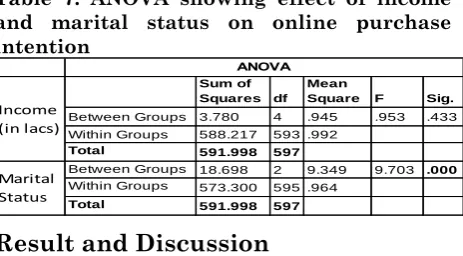
On running the one-way ANOVA for income, it is found that for between groups, F (4,593) =0.953, p > 0.05. Income has insignificant influence on online purchase intention.
On running the one-way ANOVA for marital status, it is found that for between groups, F (2,595) =9.703, p < 0.001.Marital status has a significant influence on online purchase intention.
Table 7: ANOVA showing effect of income and marital status on online purchase intention
Sum of
Squares df
Mean
Square F Sig.
Between Groups 3.780 4 .945 .953 .433
Within Groups 588.217 593 .992
Total 591.998 597
Between Groups 18.698 2 9.349 9.703 .000
Within Groups 573.300 595 .964
Total 591.998 597
Marital Status
ANOVA
Income (in lacs)
Result and Discussion
The results suggest that gender has a significant influence on online purchase intention. Males have a stronger online
purchase intention than females. It is inferred that income does not have a significant influence on online purchase intention while marital status has a significant effect on online purchase intention.
Based on the research important insights have been gained as to how gender, income and marital status of the shoppers effects the online purchase intention. The gap in the field of research related to demography and online purchase intention in Punjab has been fulfilled.
The research has important ramifications for the online marketing managers. Purchase intention should be considered carefully by the marketing managers as it is an important precursor to actual purchase behaviour.
Demography is the traditional, easy to apply and perhaps the most important parameter for carrying out market segmentation. It is found that online purchase intention can be segmented based on demographic variables of gender and marital status, but not based on annual family income.
The results of the study reflect that males have a stronger online purchase intention which may be attributed to males having a higher comfort level with the use of technology. Marketing managers of online retailers should be engaged in making females more acquainted and comfortable with using technology for online shopping. Secondly, for females the feel of a given product is a vital yardstick for shaping the online purchase intention. There is no possibility of offering this facility in any digital medium.
Another important learning dealt with allocation of promotion budgets of online retailers. A relatively larger portion of the promotions budget of online stores should be targeted at males. As the intention to shop online is stronger for males, less efforts need to be made to convert the intention into actual buying behaviour.
intention as compared to married and divorced people. The reasons may lie on the grounds that married people may go in for joint decision making and different considerations may come into the picture while making purchase decisions. Another reason is that married people generally combine shopping and recreational trips and this option is severely limited in case of online shopping. The nature of products required to set up a house after marriage are high involvement products and for the reason, people may avoid shopping online. Conclusion
Although this study has thrown up important learnings still it cannot be claimed that it is devoid of any limitations. One major limitation came in the form of using convenience sampling for the purpose of data collection. It resulted in all the shortcomings which are inherent to convenience sampling being a part of the research. Electronic means of data collection were not employed, so the efficiency of data collection was low. Additionally, this led to the sampling frame to be restricted. The
study covered the purchase intention of only actual online buyers and was silent on the intentions of prospective buyers.
Perceptual mapping may be considered as a basis to further elaborate demographic segmentation as a basis for online purchase intention in future studies. Future studies may consider the role of psychographic variables as a basis for carrying out online shopping market segmentation activities. The combined effect of the different demographic variables on purchase intentions should be considered as a basis for forthcoming studies. Probability sampling techniques should form the basis of data collection for future studies. This will help limit the bias in the sample collected for analysis. Electronic means of data collection should be employed as they often result in efficiencies of operation. Also, a wider sampling frame is advisable for future studies. The buying intentions of potential online shoppers should be deliberated in upcoming studies.
References
1. Ajzen I (2005) Attitudes, personality and behavior, Open University Press, England.
2. Akhtar S (2003) Digital divide and purchase intention: why demographic psychology matters, Journal of Economic Psychology, 24(3).
3. Amin M, Rezael S, Tavana FS (2015) Gender differences and consumer’s repurchase intention: the impact of trust propensity, usefulness and ease of use for implication of innovative online retail, International Journal of Innovation and Learning, 17(2).
4. Assocham India (2016) E-Commerce Industry will cross $38 billion mark by 2016, viewed January 1, 2016 from http://www.assocham.org/newsdetail.php?id= 5427
5. Bae S, Lee T (2011) Gender differences in consumers’ perception of online consumer reviews , Electron Commerce Research 11:201
6. Bellman S, Lohse GL, Johnson EJ (1999) Predictor’s of Online Buying Behavior, Communications of the ACM ,42(12)
7. Bhatnagar A, Misra S, Rao HR (2000) On risk, convenience, and internet shopping behaviour. Communications of ACM, 43(2)
8. Bimber B (2000) Measuring the gender gap on the Internet’, Social Science Quarterly, 81(3)
9. Brassington F, Pettitt S (2006) Principles of Marketing, Pittman, London.
10. Chagnati, R. (1986) Management in women-owned enterprises’, Journal of Small Business Management , 24 (4)
11. Chawla D, Sodhi N (2011) ‘Research Methodology Concepts and Cases’, Vikas Publishing House Pvt. Ltd., Noida.
12. Chen Chiang-Yaw, Huichao C, Lee Yu-Jee, Pei-Chen T (2012) Exploration of the differences in Taiwanese women’s purchasing decisions toward luxury goods and general products, African Journal of Business Management, 6(2)
service, International Journal of Service Industry Management, 16(5).
14. Costello AJ, Hellier EJ, Edworthy J (2003) G M Informational labels – does shape matter. In Paul T McCabe, (ed.), Contemporary Ergonomics, Taylor and Francis, London.
15. Elliot KM, Hall MC (2005) Assessing consumers’ propensity to embrace self-service technologies: Are there gender differences?, Marketing Management Journal,15(2)
16. Garbarino E, Strahilevitz M (2004) Gender differences in the perceived risk of buying online and the effects of receiving a site recommendation, Journal of Business Research, 57(7)
17. Gong W, Stump Rodney L. Maddox LM ( 2013) Factors influencing consumers’ online shopping in China , Journal of Asia Business Studies, 7(3)
18. Goritz AS, Singh RK, Subrahmanyam (2012) Human Behavior on the www’, in Zheng Yan (ed.), Encyclopedia of Cyber Behavior, Information Science Reference, Hershey
19. Hansen T (2005) Consumer Adoption of Online Grocery Buying: A Discriminant Analysis, International Journal of Retail and Distribution Management,33(2)
20. Howladar MH, Rahman M, Mohiuddin MG, Islam FM (2012)Developing Online Shopping Intention Among People: Bangladesh Perspective, Developing Countries Studies,2(9).
21. Jones S, Johnson-Yale C, Millermaier S, Pérez FS (2009)U.S. college students’ Internet use: race, gender and digital divides, Journal of Computer-Mediated Communication,14(2)
22. Kanchan U, Kumar N, Gupta A (2015) A study of online purchase behaviour of customers in India, Ictact Journal on Management Studies,1(3)
23. Khumart S (2012)Factors affecting behavioral intention to buy tablet, Master Thesis of Business Administration, University of Thai.
24. Kim EY, Kim YK (2004)Predicting online purchase intentions for clothing products, European Journal of Marketing, 38(7)
25. Kotler P, Armstrong G (2013) Principles of Marketing, 14th Ed. Pearson Prentice Hall,
N.J.
26. Lancaster G, Reynolds P (2002) Marketing Made Simple, Elsevier Science, Oxford.
27. Mark B, Pope N, Voges K (2003) Buying or browsing? An exploration of shopping orientations and online purchase intention, European Journal of Marketing, 37(11/12)
28. Meyers-Lecy, J. & Maheswaran, D. (1991) Exploring differences in males’ and females’ processing strategies’, Journal of Consumer Research ,18
29. Miquel MJ, Caplliure EM, Perez C, Bigne E (2014) Do men and women differ when purchasing private label goods?, In Juan Carlos Gazquez, Esteban-Millat Martinez-Lopez & Juan Antonia Monderjar-Jimenez (Eds.), Springer International Publishing, Switzerland.
30. Miyazaki AD, Fernandez A (2001) Consumer perception of privacy and security risks for online shopping, Journal of Consumer Affairs ,35(1)
31. Nagra G, Gopal R (2013) A study of factors affecting on online shopping behaviour of consumers’, International Journal of Scientific and Research Publication, 3(6)
32. Nel J, Raubenheimer, J, Bounagui, M (2009) Gender differences in purchase intention of music downloads, Management Dynamica, 18(3).
33. Omar NA, Nazri MA, Osman LH, Ahmad MS (2016) The effect of demographic factors on consumer intention to purchase organic products in the Klang valley: an empirical study, Malaysian Journal of Society and Space, 12(2)
34. Ono H, Zavodny M (2003)Gender and the Internet, Social Science Quarterly, 84 (1)
35. Plabdaeng C (2010) Gender influence on purchase intention – the case study of Thailand. Master in Business Administration Thesis, Universiti Sains Malaysia.
36. Powell M, Ansic D (1997) Gender differences in risk behaviour in financial decision-making: an experimental analysis, Journal of Economic Psychology, 18
37. PTI (2016) India’s e-commerce industry likely to touch $38 billion mark in 2016 – Assocham’, viewed July 24,2016 from
38. Qin Y, Zhang Y (2012) Empirical study of the effects of consumer attitude to Life-Insurance purchase intentions in China’, In Ran Chen (ed.), 2011 International Conference in Electrics, Communication and Automatic Control Proceedings, Springer, New York.
39. Ravi P, Subhalakshmi R (2015) The impact of gender and marital status on the online shopping attitude of cosmetic products,Indian Journal of Applied Research,5(7).
40. Reinecke P (2015) E-Commerce Statistics for individuals, viewed 24th August, 2016 from
http://ec.europa.eu/eurostat/statisticsexplaine d/index.php/Ecommercestatistics_for_individ uals
41. Richa D (2012) Impact of demographic factors of consumers on online shopping behaviour: A study of consumers in Indi’, International Journal of Engineering and Management Sciences,3(1)
42. Rodgers S, Harris MA (2003) Gender and e-commerce: an exploratory study, Journal of Advertising Research 43(3)
43. Shalini GR, Malini KSH (2015) A study of online shopping website characteristics and its impact on consumer intention to purchase online in Chennai, International Research Journal of Engineering and Technology, 2(9).
44. Shao CY, Baker J, Wagner JA (2004) The effects of appropriateness of service contact personnel dress on consumer expectations of service quality and purchase intention: The moderating influences of involvement and gender, Journal of Business Research, 57:1164
45. Shimp TA, Bearden WO (1982) Warranty and other extrinsic cue effects on consumers’ risk perceptions, Journal of Consumer Research,9(1)
46. Srinivasan R, Srivastava RK, Bhanot S (2015) Impact of marital status on purchase behaviour of luxury brands, IOSR Journal of Business and Management ,17(7)
47. Shukla RK, Upadhaya A, Uprety M (2015) Effect of marital status on home buyers’ perception toward residential real estate services, In Alok Bansal, Yogeshwari Pathak & Raj Kishore Sharma, (Eds.), Quality Management Practices for Global Excellence, Prestige Institute of Management and Research. Allied Publishers Pvt. Ltd., New Delhi.
48. Singh P, Kashyap R (2015) Online shopping behaviour of consumers, International Journal of Innovative Research in Science, Engineering and Technology, 4(10):9953
49. Smith C (2014)The Surprising Demographics Of Who Shops Online And On Mobile, Business Insider. viewed 24 August,2016, from http://www.businessinsider.in/The- Surprising-Demographics-Of-Who-Shops-Online-And-On
Mobile/articleshow/36449798.cms
50. Swinyard WR, Smith SM (2003)Why People (Don’t) Shop Online: A Lifestyle Study of the Internet Consumer, Psychology and Marketing 20(7):567-597.
51. Turban E, King D, Lee JK, Liang Ting-Peng, Turban DC (2015) Electronic Commerce: A Mangerial and Social Networks Perspective, Springer International Publishing, Switzerland.
52. Von Alvensleben R, Altmann M (1987) Determinants of the demand for organic foods in Germany, Acta Horticulturae 203: 235
53. Wang CCI, Chan AKK, Chen ZX (2001) Segment intenders and non-intenders in China’s property market: A hybrid approach, Journal of Consumer Marketing 18 (4-5):319
54. Wongsiriwat K (2007) A study of influences of values, attitudes and lifestyles (VALSII) on brand, Master of Business Administration in Management project, School of Management, Shinawatra University.