A reassessment of
Anthurium
species with palmately
divided leaves, and a reinterpretation of
Anthurium
section
Dactylophyllium
(Araceae)
Thomas B. Croat1, Mónica M. Carlsen1,2
1 Missouri Botanical Garden, P.O. Box 299, St. Louis, MO 63166, USA 2 Department of Biology, University of Missouri–St. Louis, One University Boulevard, St. Louis, MO 63121, USA
Corresponding author:Mónica M. Carlsen ([email protected])
Academic editor:W. John Kress | Received 23 January 2013 | Accepted 12 May 2013 | Published 10 June 2013
Citation: Croat TB, Carlsen MM (2013) A reassessment of Anthurium species with palmately divided leaves, and a reinterpretation of Anthurium section Dactylophyllium (Araceae). PhytoKeys 23: 41–54. doi: 10.3897/phytokeys.23.4754
Abstract
A reappraisal is made of the Anthurium Schott species with palmately divided leaves with 3 or more seg-ments free to the base (i.e. palmatisect leaves), previously recognized as section Dactylophyllium Schott (Engler), as well as those species with 5 or more segments united at the base (i.e. palmatifid leaves), for-merly placed in section Schizoplacium Schott (Engler). New molecular data indicates that several species (A. pedatum (Kunth) Schott, A. pedatoradiatum Schott, and possibly, A. podophyllum (Schltdl. & Cham.) Kunth) should be excluded from section Schizoplacium, and other species previously placed in that sec-tion cannot be separated from secsec-tion Dactylophyllium. Thus, Anthurium section Schizoplacium is here synonymized within section Dactylophyllium and type species are designated for both groups. This paper also provides an updated description of section Dactylophyllium as here emended, listing the 24 accepted taxa now included (20 species and 4 varieties or subspecies), along with their geographic distributions.
Keywords
Anthurium, molecular phylogeny, palmately divided leaves, palmatisect leaves, palmatifid leaves, section
Schizoplacium, sectional classification www.phytokeys.com
Copyright Thomas B. Croat, Mónica M. Carlsen. This is an open access article distributed under the terms of the Creative Commons Attribution License 3.0 (CC-BY), which permits unrestricted use, distribution, and reproduction in any medium, provided the original author and source are credited.
introduction
Anthurium Schott species with palmately divided leaves (as included in Madison 1978)
represent a very distinct morphological group within the genus (Fig. 1). In these spe-cies, leaf segments (i.e. leaflets) are free to the base, in palmatisect leaves, or leaf seg-ments (i.e. lobes) are united at the base, in palmatifid leaves (Fig. 2). The current sec-tional classification of Anthurium (Croat and Sheffer 1983) separates these species into two groups, section Dactylophyllium (Schott) Engler (Engler 1879), comprising species with three or more segments (leaflets) free to the base (Fig. 2 A–B), and section
Schizo-placium (Schott) Engler (Engler 1879), including species with five or more segments
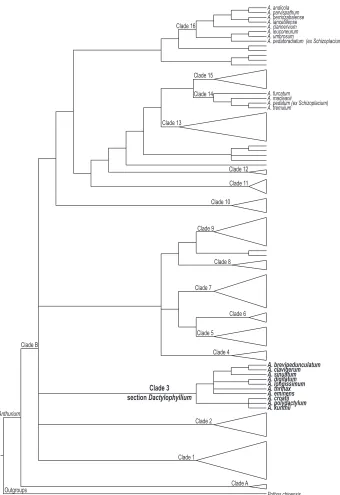
(lobes) united at the base (Fig. 2 C). A recent molecular phylogeny (Carlsen 2011, Carlsen and Croat in press) has shown that most of the species of Anthurium with palmately divided leaves belong to a single highly supported clade (Fig. 3, Clade 3), therefore suggesting that previous divisions of the group are unnecessary. Indeed, the newly circumscribed Clade 3 merits sectional rank. Moreover, although all members of Clade 3 share palmately divided leaves, this leaf form has evolved independently at least two more times within Anthurium, in Clades 14 and 16 (Fig. 3). The goal of this study is to reevaluate the limits of sections Dactylophyllium and Schizoplacium in the light of the new molecular evidence and provide an updated description of this rede-fined group of Anthurium species with palmately divided leaves (Fig. 1).
taxonomic history
In the first comprehensive revision of the genus, Schott (1860) classified Anthurium
species with lobed or divided leaves in three groups (Table 1): grex Semaeophyllium, comprising species with “hastate-trilobed” blades with segments united at the base; grex Schizoplacium, including species with “pedately-partite” blades with five or more leaf segments united at the base (i.e. palmatifid leaves, according to our definition) (Fig. 2 C); and grex Dactylophyllium, containing species with “digitisect” leaf blades with three or more segments divided completely (i.e. free) to the base (i.e. palmatisect leaves, in our definition) (Fig. 2 A–B).
Carlsen and Croat (2007) recently revised the 23 species included in Anthurium
section Semaeophyllium (Schott) Engler (Engler 1879). The section comprises species with trilobed leaf blades, where leaf lobes are always united at the base, and the lobes can be directed forward (i.e. falcate) or to the sides (i.e. spreading) but never toward the back. On the basis of molecular evidence (Carlsen 2011, Carlsen and Croat in press), section Semaeophyllium appears not to be monophyletic. However, species with trilobed leaves are more closely related to other Anthurium species with cordate leaves than to the species with palmately divided leaf morphology clustered in Clade 3 (Carls-en 2011, Carls(Carls-en and Croat in press). Therefore, this paper will only deal with the
Anthurium species with palmately divided leaves (Fig. 1), those included in sections
Schott (1860) included 27 names in his grex # 28 (Table 1), Dactylophyllium, but according to the most updated species synonymy for the genus (Govaerts et al. 2012), only seven species are currently recognized: Anthurium clavigerum Poepp.,
A. digitatum (Jacq.) Schott, A. eminens Schott, A. kunthii Poepp., A. pentaphyllum
(Aubl.) G.Don, A. sinuatum Benth, and A. triphyllum (Willd. ex Schult.) Brongn. ex Schott. On the other hand, Schott (1860) included seven names in his grex # 27 (Table 1), Schizoplacium, but only four species are now recognized, A. palmatum
(L.) Schott, A. pedatoradiatum Schott, A. pedatum (Kunth) Schott, and A.
podo-phyllum (Schltdl. & Cham.) Kunth. Engler (1879) gave formal sectional ranking
to these, and others, of Schott’s greges, maintaining the species circumscriptions in both groups.
table 1.Anthurium species with palmately divided leaves formerly included in Dactylophyllium and
Schizoplacium, a comparison of previous circumscriptions. This is not an exhaustive list of all species names that have been previously included in these groups, it only contains taxa that were accepted at the time of publication of each work. Names in bold denote species included in the newly redefined section
Dactylophyllium (Schott) Engler emend. Croat & Carlsen, as proposed here. Species marked with (*) are now formally excluded from this emended section. All other species names are either synonyms or species dubia, fide Madison (1978).
Species name published Schott (1860)Year Engler (1905) Madison (1978) Croat & Sheffer (1983)
A. aemulum Schott 1859 Dactylophyllium Schizoplacium series Dactylophyllium A. pentaphyllumsynonym of
var. bombacifolium A. andersonii Schott 1857 Dactylophyllium Schizoplacium series Dactylophyllium A. palmatumsynonym of
(*) A. angustisectum
Engl. 1898 Group 6 Schizoplacium
A. araliaefolium
Regel 1869 Schizoplacium series Euschizoplacium probably a hybridspecies dubium,
A. arisaemoides
Madison 1978 SchizoplaciumGroup 7 Dactylophyllium
A. aubletii Kunth 1841 Dactylophyllium A. pentaphyllumsynonym of A. pentaphyllumsynonym of
var. pentaphyllum A. bombacifolium
Schott 1858 Dactylophyllium synonym ofA. aemulum var. A. pentaphyllumbombacifolium A.
brevipedunculatum
Madison 1978
Group 7
Schizoplacium Dactylophyllium
A. buchtienii K.
Krause 1910 SchizoplaciumGroup 7 Dactylophyllium
A. clavigerum
Poepp. 1845 Dactylophyllium Semaeophyllium SchizoplaciumGroup 7 Dactylophyllium
A. clavigerum var.
subpedatipartitum
Engl. 1905 Semaeophyllium not mentioned
A. croatii Madison 1978 SchizoplaciumGroup 7 Dactylophyllium
A. digitatum (Jacq)
Schott 1829 Dactylophyllium Schizoplacium series Dactylophyllium
A. pentaphyllum
var. digitatum
Group 7 Schizoplacium
not mentioned
A. elegans Engl. 1881 Schizoplacium series Euschizoplacium A. palmatumsynonym of
A. eminens Schott 1855 Dactylophyllium Schizoplacium series Dactylophyllium SchizoplaciumGroup 7 Dactylophyllium
A. expansum
Gleason 1929 Group 6 Schizoplacium
A. fissum K. Koch 1864 Semaeophyllium A. palmatumsynonym of
A. ghiesbrechtii
Linden ex Schott 1860 Schizoplacium A. podophyllumsynonym of not mentioned
A. grossum Schott 1859 Dactylophyllium A. pentaphyllumgrossum var. A. pentaphyllumsynonym of
var. pentaphyllum A. helleborifolium
Species name published Schott (1860)Year Engler (1905) Madison (1978) Croat & Sheffer (1983)
A. hoffmannseggii
Schott 1857 Dactylophyllium A. pentaphyllumsynonym of synonym ofA. kunthii A. holtonianum
Schott 1857 Dactylophyllium Semaeophyllium A. clavigerumsynonym of A. holtonianum var.
cohaerens Engl. 1905 Semaeophyllium not mentioned
A. kalbreyeri Mast. 1881 Schizoplacium series Dactylophyllium A. clavigerumsynonym of
A. karwinskii Schott 1859 Dactylophyllium synonym ofA. aemulum A. pentaphyllumsynonym of
var. bombacifolium
A. kunthii Poepp. 1845 Dactylophyllium Schizoplacium series Dactylophyllium SchizoplaciumGroup 7 Dactylophyllium
A. longissimum
Pittier 1947 Group 6 Schizoplacium
A. martini Schott 1857 Dactylophyllium Semaeophyllium A. sinuatumsynonym of
A. ottonianum
Kunth 1841 Dactylophyllium A. variabileottonianum var. not mentioned A. pachirifolium
Schott 1855 Dactylophyllium Schizoplacium series Dactylophyllium
synonym of
A. pentaphyllum
var. pentaphyllum A. pachirifolium var.
angustifolium Engl. 1881 Schizoplacium series Dactylophyllium
synonym of
A. pentaphyllum
var. pentaphyllum A. palmatum (L.)
Schott 1829 Schizoplacium Semaeophyllium Group 6 Schizoplacium
A. panduratum
Mart. ex Schott 1855 Dactylophyllium Semaeophyllium A. clavigerumsynonym of A. panduratum var.
burchellianum Engl. 1905 Semaeophyllium A. clavigerumsynonym of
(*) A. pedatoradiatum
Schott 1859 Schizoplacium Schizoplacium series Euschizoplacium Group 4 Schizoplacium (*) A. pedatum
(Kunth) Schott 1829 Schizoplacium Schizoplacium series Euschizoplacium Group 5 Schizoplacium
A. pentaphyllum
(Aubl.) G. Don 1839 Dactylophyllium Schizoplacium series Dactylophyllium SchizoplaciumGroup 7 Dactylophyllium
A. pentaphyllum
var. bombacifolium
(Schott) Madison 1978
Group 7
Schizoplacium Dactylophyllium (*) A. podophyllum
(Schltdl. & Cham.)
Kunth 1841 Schizoplacium Schizoplacium series Euschizoplacium Group 4 Schizoplacium
A. polydactylum
Madison 1978 SchizoplaciumGroup 7 Dactylophyllium
A. polyschistum
R.E. Schultes & Idrobo 1959
Group 7
Schizoplacium Dactylophyllium
A. polytomum Schott 1859 Schizoplacium A. podophyllumsynonym of A. podophyllumsynonym of
A. pseudopodophyllum
Schott 1859 Schizoplacium A. podophyllumsynonym of A. podophyllumsynonym of A. repandum Schott 1857 Dactylophyllium Semaeophyllium A. clavigerumsynonym of
A. sinuatum Benth
Species name published Schott (1860)Year Engler (1905) Madison (1978) Croat & Sheffer (1983)
A. smilaciforme K.
Koch 1855 Dactylophyllium synonym ofA. undatum not mentioned
A. sonderianum
Schott 1858 Dactylophyllium A. pentaphyllumsynonym of
synonym of
A. pentaphyllum
var. pentaphyllum A. sylvestre S. Moore 1895 Semaeophyllium A. sinuatumsynonym of
A. thrinax Madison 1978 SchizoplaciumGroup 7 Dactylophyllium
A. triphyllum
(Willd. ex Schult.)
Brongn. ex Schott 1860 Dactylophyllium Schizoplacium series Dactylophyllium
Group 7
Schizoplacium Dactylophyllium
A. trisectum Sodiro 1905 SchizoplaciumGroup 7 Dactylophyllium
A. undatum Schott 1832 Dactylophyllium Schizoplacium series Dactylophyllium A. pentaphyllumsynonym of
var. pentaphyllum A. undatum var.
undulifolium (K.
Koch ex Ender) Engl. 1878
Schizoplacium series
Dactylophyllium not mentioned
A. undulatum K. Koch & C. D.
Bouché 1854 Dactylophyllium
synonym of
A. undatum var.
undulifolium not mentioned
A. variabile Kunth 1841 Dactylophyllium Schizoplacium series Dactylophyllium A. pentaphyllumsynonym of
var. pentaphyllum A. warscewiczii K.
Koch 1855 Dactylophyllium synonym ofA. sinuatum not mentioned
A. wendlandii Schott 1858 Dactylophyllium Semaeophyllium A. clavigerumsynonym of
gated internodes, but peduncles often short (Engler 1905). Engler placed most of the species from Schott’s grex Schizoplacium in the Euschizoplacium group and the remain-ing species from Schott’s grex Dactylophyllium in the Dactylophyllium group (Table 1). The last taxonomic revision of Anthurium species with palmately divided leaves (Madison 1978) recognized 27 species and three varieties divided into seven “natural” groupings based on the author’s understanding of the taxonomy, morphology and growth habit of the species (Table 1). Groups 1–3 included species with trilobed leaves with falcate lobes united at the base now placed in section Semaeophyllium (Carlsen and Croat 2007). The remaining groups in Madison’s (1978) revision included typical examples of species in sections Dactylophyllium and Schizoplacium (Table 1; follow-ing Croat and Sheffer 1983). Group 4 contained two terrestrial Mexican species with short stems, elongated peduncles and “pedately divided” (i.e. palmatifid) leaf blades
(A. pedatoradiatum and A. podophyllum). Group 5 consisted only of the Colombian
an-gustisectum Engl., A. expansum Gleason, A. longissimum Pittier and A. palmatum). The species in Madison’s groups 4, 5 and 6 were placed in section Schizoplacium by Croat and Sheffer (1983). His group 7 is a predominantly Amazonian group of species with “digitisect” (i.e. palmatisect) leaf blades, where the leaf segments are free to the base and have a basal pulvinus (Fig. 2 A–B), and spadices are purple to gray. Madison called this group section Schizoplacium, apparently following Engler’s (1905) circumscrip-tion of that seccircumscrip-tion, but it indeed includes species placed in seccircumscrip-tion Dactylophyllium by both Schott (1860) and Croat and Sheffer (1983) (Table 1).
Croat and Sheffer (1983) provided the previously accepted treatment of the sec-tions of Anthurium with palmately divided leaf blades. Following Schott’s (1860) original classification system, they separated the species of Anthurium with lobed or divided leaf blades into three sections, Semaeophyllium, Schizoplacium and
Dactylo-phyllium (Table 1). They provided a key to the sections, descriptions, and illustrative
examples of species belonging to each group.
results and discussion
The current molecular phylogeny of the genus Anthurium, based on chloroplast (trnG
intron, trnH–psbA and trnC–ycf6 intergenic spacers) and nuclear (first intron of CHS
and partial flanking coding regions) DNA sequences (Carlsen 2011, Carlsen and Croat in press) shows that the palmately divided leaf morphology is homoplasious within the genus, having evolved at least three times independently, in Clades 3, 14 and 16 (Fig. 3).
Based on this molecular phylogeny (Carlsen 2011, Carlsen and Croat in press) (Fig. 3), some of the Anthurium species with palmately divided leaves previously rec-ognized as section Schizoplacium (Schott 1860, Engler 1879, Engler 1905, Croat and Sheffer 1983), do not form a monophyletic group and are not even closely related to other palmately divided species. For example, A. pedatum, a high elevation Colombian species with a highly divided palmatifid leaf blade, consistently clustered in the moder-ately supported Clade 14 (Fig. 3), along with A. furcatum Sodiro, with trilobed leaves,
and A. tremulum Sodiro and A. macleanii Schott, both with cordate leaves. Clade 14
is not easily characterized morphologically, although most of its species have hood-ed spathes and pendent spadices (Carlsen and Croat in press). Madison (1978) had pointed out the possible segregation of A. pedatum from all other palmately divided
Anthurium species by placing it alone in Group 5 of his revised classification.
Molecu-lar data now suggests that indeed A. pedatum is not closely related to other palmately divided Anthurium species and therefore does not belong to section Dactylophyllium as currently defined here.
Anthurium pedatoradiatum, a Mexican species with palmatifid leaves and a
Figure 3. A schematic molecular phylogeny of Anthurium showing major clades recovered by Carlsen and Croat (in press). This phylogeny was based on combined chloroplast (trnG intron, trnH–psbA and
trnC–ycf6 intergenic spacers) and nuclear (first intron of CHS and partial flanking coding regions) DNA sequences. Clade numbering follow these authors. Species in bold are recognized here as members of
Anthurium section Dactylophyllium (Schott) Engler, emend. Croat & Carlsen. Placement of Anthurium
Anthurium species with palmately divided leaves (Clade 3) (Fig. 3). The strongly sup-ported Clade 16, although quite variable in terms of leaf morphology, presents very uniform reproductive features, including only species that possess bright orange ber-ries with a mealy mesocarp, characteristics also found in A. pedatoradiatum. Madison (1978) previously separated A. pedatoradiatum from the rest of palmately divided
An-thurium species, and grouped it along with the other Mexican species with palmatifid
leaves, A. podophyllum, in his Group 4. The latter species have not been sampled for the current molecular phylogeny of Anthurium (Carlsen 2011, Carlsen and Croat in press). However, geographical affinities and similarities in fruit characteristics with other species of Clade 16 (Fig. 3) have made us consider that A. podophyllum is also a member of this clade, and as such, it should be excluded from section Dactylophyllium
as delimited here.
There are only four currently recognized species names included in the original description of Schott’s grex Schizoplacium (Schott 1860), all of which match well the protologue of the section. However, according to molecular studies (Carlsen 2011, Carlsen and Croat in press) (Fig. 3), A. pedatum, A. pedatoradiatum, and very likely
A. podophyllum, do not belong to the same clade and are not closely related to other
palmately divided Anthurium species. Therefore, these three species are also excluded from section Dactylophyllium according to the circumscription presented here. Thus, of the initial group, only A. palmatum remains. This climbing plant with elongated internodes and palmatifid leaves (Fig. 2 C), restricted to the Lesser Antilles, is there-fore here selected as the lectotype species for section Schizoplacium. Two other
An-thurium species with palmatifid leaves (A. expansum and A. longissimum) (Fig. 1 B)
also belong to this section under its traditional circumscription (Table 1). Anthurium
palmatum was not sampled in the current molecular phylogeny of the genus (Carlsen
2011, Carlsen and Croat in press) (Fig. 3), but the closely related A. longissimum, with which it shares climbing habit, palmatifid leaf morphology, peduncle shorter than the petiole, green spathe, grayish purple spadix and reddish-purple berries, was used as a representative of this group of palmatifid species.
The molecular phylogeny of Anthurium (Carlsen 2011, Carlsen and Croat in press) clearly shows that most of the palmately divided species sampled in the study (except
for A. pedatum and A. pedatoradiatum), belong in a single clade, Clade 3 (Fig. 3). These
species were previously included in either section Schizoplacium (e.g. A. longissimum, a representative of the group with palmatifid leaves) or section Dactylophyllium by Croat and Sheffer (1983). The findings of molecular analyses indicate that the group of species with palmatifid leaf morphology (i.e. A. longissimum, A. palmatum and A.
expansum) (Figs 1 B, 2 C), all sharing similar vegetative and reproductive characters, is
not distinct from other species with palmately divided leaves. Thus, these two sections are here combined, and the morphological limits of this emended, more inclusive, group are redefined.
In terms of nomenclatural choice, since both names, Schizoplacium and
Dacty-lophyllium, were published, albeit without a formal rank (i.e. as grex names), at the
simul-taneously formalized as sections by Engler (1879), none of them has priority over the other. Therefore, in this study, section Schizoplacium, the smaller (probably containing only three currently accepted species names) and geographically more isolated group (mainly occurring in the Lesser Antilles and Cordillera de la Costa in Venezuela) has been placed into synonymy with the larger (probably including a total of 21 species, some undescribed) and more widespread group, section Dactylophyllium.
Anthurium kunthii (Fig. 2 A) is here chosen as the lectotype for this emended
section Dactylophyllium for several reasons. Anthurium kunthii was among the origi-nal species included in Schott’s (1860) first delimitation of the group and represents very well the morphological characters described in the protologue. Also, this species was sampled in the current molecular phylogeny of the genus (Carlsen 2011, Carlsen and Croat in press) (Fig. 3), and it clearly belongs to the group of species with pal-mately divided leaves in Clade 3. Additionally, A. kunthii is among the oldest species described within the group (in 1845) (Table 1), but unlike A. digitatum (the oldest described species, from 1829), its taxonomic status as a species has not been previously questioned.
The following section provides an updated description of Anthurium section
Dac-tylophyllium (Schott) Engler, emend. Croat & Carlsen, and lists all currently
recog-nized species now comprising this group and their known geographic distribution.
taxonomic treatment
Anthurium section Dactylophyllium (Schott) Engler, emend. Croat & Carlsen, Prodr. Syst. Aroid. 542. 1860. Lectotype (designated here): Anthurium kunthii Poepp., Nov. Gen. Sp. Pl. 3: 84–85. 1845.
Figures 1, 2
Anthurium grex Schizoplacium Schott, Prodr. Syst. Aroid. 538. 1860.Lectotype
(desig-nated here): Anthurium palmatum (L.) Schott, Wiener Z. Kunst 1829(3): 828. 1829.
Remarks. Mostly appressed-climbing or scandent plants with internodes usually long-er than broad, or tlong-errestrial short stemmed plants; roots modlong-erately sparse at each node on climbing plants, sometimes moderately dense on terrestrial species with short internodes; cataphylls usually persisting as fibers, sometimes deciduous, rarely persist-ing intact, the cataphyll fibers typically pale, sometimes dark reddish brown; petioles typically subterete, usually at least weakly sulcate adaxially, typically drying green-ish to gray-green, sometimes dark brown; blades palmately divided and deeply lobed with 5–7 lobes united at the base (i.e. palmatifid leaves) (Figs 1 B, 2 C) (Anthurium
expansum, A. longissimum, and A. palmatum) or palmatisect with segments (leaflets)
divided completely to base and free (Fig. 2 A–B), sometimes 3-sect (Fig. 1 C) (A.
ari-saemoides Madison, A. thrinax Madison, A. triphyllum, and A. trisectum Sodiro), more
croatii Madison, A. eminens, A. kunthii, A. pentaphyllum, A. polyschistum R.E. Schul-tes & Idrobo, and A. sinuatum), the petiolules of each segment short or long (Fig. 2 A–B), the segments usually entire, sometimes sinuate (A. clavigerum, A. sinuatum) or weakly to strongly pinnately lobed (A. clavigerum); the medial segment or lobe largest; side segments or lobes diminishing in size; juvenile blades simple; leaf surface usually smooth, glabrous, generally drying greenish, sometimes yellow-brown or dark brown; midrib typically raised on both surfaces; primary lateral veins typically conspicuous, usually well spaced, weakly raised or sunken above, usually narrowly rounded and prominently raised below; tertiary veins typically visible, sometimes moderately well-raised beneath. INFLORESCENCE short- (A. brevipedunculatum, A. pentaphyllum) or more commonly long-pedunculate; spathe typically green, spreading, sometimes ovate and erect (A. brevipedunculatum), usually persistent; spadix green to purplish violet, usually long-tapered, sometimes short-tapered. FRUITS purple, violet-purple or reddish-purple berries.
Species of Anthurium included in section Dactylophyllium, under this revised de-limitation, are mainly distributed in the Amazon lowlands, with a few widespread species ranging into Central America (A. clavigerum, A. kunthii, and A. trisectum), and into the Atlantic coast of South America to Brazil (A. pentaphyllum).Three taxa have disjunct distributions in the coastal mountain ranges of the Cordillera Central of Venezuela (A. digitatum and A. longissimum) and the Lesser Antilles (A. palmatum).
Presently, 24 accepted taxa (20 species and 4 varieties or subspecies) occur in sec-tion Dactylophyllium as emended here. These taxa and their geographic distribution are as follow:
Anthurium arisaemoides Madison (Ecuador, Peru)
A. brevipedunculatum Madison (Bolivia, Brazil, Colombia, Ecuador, Peru)
A. buchtienii K.Krause (Bolivia)
A. clavigerum Poepp. (widespread, Nicaragua to Venezuela and Peru)
A. croatii Madison (Bolivia, Brazil, Colombia, Ecuador, Peru)
A. digitatum (Jacq.) Schott (Venezuela)
A. eminens Schott var. eminens (Bolivia, Brazil, Colombia, Ecuador, French Guiana)
A. eminens Schott var. longispadix Croat & M.Mora (Colombia)
A. expansum Gleason (French Guiana, Guyana, Suriname, Venezuela)
A. kunthii var. cylindricum Croat (Bolivia)
A. kunthii Poepp. var. kunthii (Costa Rica to Peru and Bolivia) (Fig. 2 A)
A. longissimum Pittier ssp. longissimum (Venezuela) (Fig. 1 B)
A. longissimum Pittier ssp. nirguense Bunting (Venezuela)
A. moonenii Croat & E.G.Gonçalves (French Guiana)
A. palmatum (L.) Schott (Lesser Antilles) (Fig. 2 C)
A. pentaphyllum (Aubl.) G. Don var. bombacifolium (Schott) Madison (Belize,
Costa Rica, Guatemala)
A. pentaphyllum (Aubl.) G.Don var. pentaphyllum (widespread Costa Rica to the
A. polydactylum Madison (Bolivia, Peru) (Fig. 1 D)
A. polyschistum R.E. Schultes & Idrobo (Brazil, Colombia, Ecuador, Peru)
A. sinuatum Benth ex Schott (Brazil, French Guiana, Suriname, Venezuela)
A. thrinax Madison (French Guiana, Guyana)
A. triphyllum (Willd. ex Schult.) Brongn. ex Schott (Bolivia, Ecuador, Peru)
A. trisectum Sodiro (Costa Rica to Ecuador) (Fig. 1 C)
A. zuloagae Croat (Colombia)
There are also at least four more currently undescribed species in the section, and at least two more varieties that need formal recognition. A complete taxonomic re-vision, including identification keys, species synonymy, descriptions and illustrative photographs, of all the species of Anthurium with palmately divided leaves comprising the newly amended section Dactylophyllium is indeed needed, but beyond the scope of this article.
Acknowledgements
This study was based, in part, on the results of the PhD dissertation of the second author, and thus MMC would like to thank Peter Stevens (Advisor), Elizabeth Kel-logg, Mick Richardson and Simon Mayo for helpful discussions. This study was sup-ported by a National Science Foundation Doctoral Dissertation Improvement Grant (DEB0709851), and graduate research grants from the Botanical Society of America, the American Society of Plant Taxonomists, the Garden Club of America, the Des-mond Lee Fund at the University of Missouri–St. Louis, and the Royal Botanical Gar-dens in Kew, England with a Kew Latin American Research Fellowship. MMC is also thankful to the W. R. Harris World Ecology Center at the University of Missouri–St. Louis through its Christensen Fellowship, and the Missouri Botanical Garden for fi-nancial support during her doctoral studies. We would also like to thank two anony-mous reviewers for their valuable suggestions to improve the original manuscript.
references
Carlsen MM (2011) Understanding the origin and rapid diversification of the genus Anthu-rium Schott (Araceae), integrating molecular phylogenetics, morphology and fossils. PhD thesis, University of Missouri–St. Louis, USA. https://apps.umsl.edu/webapps/weboffice/ ETD/query.cfm?id=r6587
Carlsen MM, Croat TB (2007) Taxonomic revision of Anthurium section
Semaeo-phyllium Schott (Araceae). Harvard Papers in Botany 12(1): 173–234. doi:
10.3100/1043-4534(2007)12[173:TROASS]2.0.CO;2
Croat TB, Sheffer RS (1983) The sectional groupings of Anthurium (Araceae). Aroideana 6(3): 85–123.
Engler A (1879) Araceae. In: De Candolle A, De Candolle C (Eds) Monographiae Phaneroga-marum Prodomi vol. II. C. Wolf & Fils, Munich, 1–681.
Engler A (1905) Araceae-Pothoideae. In: Engler A (Ed) Das Pflanzenreich IV 23B (Heft 21). W. Engelmann, Leipzig and Berlin, 1–330.
Govaerts R, Bogner J, Boos J, Boyce PC, Cosgriff B, Croat TB, Gonçalves E, Grayum MH, Hay A, Hetterscheid WLA, Ittenbach S, Landolt E, Mayo SJ, Murata J, Nguyen VD, Sakuragui CM, Singh Y, Thompson S, Zhu G (2012) World Checklist of Araceae. http:// www.kew.org/wcsp/ [accessed 24.06.2012]
Madison MT (1978) The species of the Anthurium with palmately divided leaves. Selbyana 2: 239–282.