A new species of
Dorstenia
(Moraceae)
from southeastern Brazil
Alessandra dos Santos1, Sergio Romaniuc Neto1
1 Instituto de Botânica, Núcleo de Pesquisa e Curadoria do herbário, avenida Miguel Stéfano, 3687, CEP 04301-902, São Paulo, SP, Brasil
Corresponding author: Alessandra dos Santos ([email protected])
Academic editor: Hanno Schaefer | Received 27 January 2012 | Accepted 2 May 2012 | Published 8 May 2012
Citation: Santos A, Romaniuc Neto S (2012) A new species of Dorstenia (Moraceae) from southeastern Brazil. PhytoKeys 12: 47–51. doi: 10.3897/phytokeys.12.2772
Abstract
Dorstenia stellaris is a new species from southeastern Brazil. This species is endemic to the region and dif-fers from the others by its star shaped coenanthium and cordiform leaves. A description and illustration
of this species is presented here. Dorstenia stellaris is found in moist and shady places, in small populations
within the type locality, thus we recommend its inclusion in the endangered (EN) status of conservation.
Resumo
Dorstenia stellaris é uma espécie nova do sudeste do Brasil. A espécie é endêmica da região e difere-se das demais, pelo cenanto estrelado e folha com base cordada. Neste trabalho foi apresentada descrição
e ilustração da espécie. Dorstenia stellaris é encontrada em locais úmidos e sombreados, em pequenas
populações, somente na localidade típica, desta forma, recomendamos sua categorização como em perigo.
Keywords
Atlantic forest,Mantiqueira, Pindamonhangaba
Introduction
Dorstenia was described by Carl Linnaeus (1753), and differs from the other Moraceae
genera by the presence of rhizomes, herbaceous and sometimes succulent habit and patelliform inflorescences, the coenanthium. It is the second largest genus in the Moraceae, ca. 105 species distributed through Africa and neotropics, with one species www.phytokeys.com
Copyright A. dos Santos, S. R. Neto. This is an open access article distributed under the terms of the Creative Commons Attribution License 3.0 (CC-BY), which permits unrestricted use, distribution, and reproduction in any medium, provided the original author and source are credited.
Alessandra dos Santos & Sergio Romaniuc Neto / PhytoKeys 12: 47–51 (2012) 48
extending into Asia. Brazil holds about 37 species, with the majority of these species Brazilian endemics (Romaniuc Neto et al. 2010).
The great number of species and morphological variation in this genus is reflected by numerous infrageneric groups established by Berg and Hijman (1999). The authors proposed the subdivision of the genus into 9 sections, three of which (Lecanium,
Dor-stenia and Emygdioa) occur within the neotropical region. Dorstenia stellaris is placed
in Lecanium section, being characterized mostly by showing camephytes and
nano-phanerophytes species with simple leaves, subulate or foliaceous stipules, and an entire coenanthium.
Dorstenia is the only genus in the family that shows an herbaceous habit and its
populations often tend to occupy restricted areas with favorable ecological niches. D.
stellaris is endemic to Mantiqueira Ridge area and has a restricted distribution, being
found only on its type locality, in the municipality of Pindamonhangaba. This species occurs in small populations along moist and shady areas.
taxonomic treatment
Dorstenia stellaris A. Sant. & Romaniuc, sp. nov.
urn:lsid:ipni.org:names:77119223-1
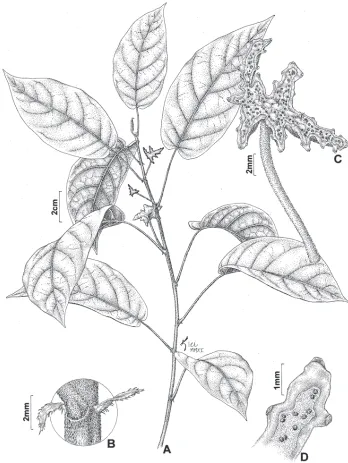
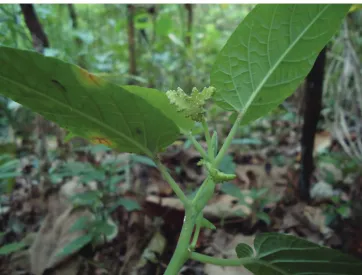
http://species-id.net/wiki/Dorstenia_stellaris Fig. 1 A–D; Fig. 2
Diagnosis. Coenanthium ellipticum, irregulariter stellatum et lamina basis cordi-formis differt.
Type. BRASIL. São Paulo, Pindamonhangaba, distrito de Ribeirão Grande, near Fazenda São Sebastião do Ribeirão Grande, 26 Nov. 2011, A. Santos et al. 142 (Holotype: SP!); Brasil. São Paulo, Pindamonhangaba, distrito de Ribeirão Grande, Fazenda São Sebastião do Ribeirão Grande, 30 Mar. 1994, I. Cordeiro et al. 1323 (Paratype: SP!); São Paulo, Pindamonhangaba, distrito de Ribeirão Grande, near Fazenda São Sebastião do Ribeirão Grande, 26 Nov. 2011, A. Santos et al. 143, 144, 145, 146 (Paratype: SP!).
Pistilate flowers distributed through the whole coenanthium: perianth short lobed, whit apex minutely 2–3 lobed, puberulous; stigma 0.5–1 mm long., slender, white. Drupes elliptical, endocarp smooth to verrucosus; stigmas persistent. Seeds with a flat testa.
Figure 1.Dorstenia stellaris A.Sant. & RomaniucA habit B ciliate stipule C stellate coenanthium D
in-florescence, detail of coenanthium fringes and bracts on the angles of the coenanthium margin. (A. Santos
Alessandra dos Santos & Sergio Romaniuc Neto / PhytoKeys 12: 47–51 (2012) 50
Phenology. Collected with flowers in march and november, and fruits in march.
Ecology.Dorstenia stellaris is a camephyte from shady and moist areas within the Atlantic forest, which occur in litter soils, near waterfalls inside forests of the type locality.
Similar species. The angulate shape of D. bowmaniana, and D. carautae coenan-thium is similar to that D. stellaris, however, the differs on the strongly irregularly-stellate coenanthium and on the cordate leaves. D. milaneziana and D. setosa are also similar to D. stellaris by the cordate leaves, however, they differ from D. stellaris by the
rounded coenanthium. The other species of the Lecanium section are mostly orbicular
to elliptic coenanthium.
table 1. Morphological comparison between Dorstenia species related to D. stellaris.
Taxa coenanthiumstellate coenanthiumangulate coenanthiumrounded subulate stipule base cordate leaves acute leavesbase
D. stellaris x x x
D. bowmaniana x x x
D. carautae x x x
D. milaneziana x x x
D. setosa x x x
Distribution and conservation status. As D. stellaris is a newly described and very restricted taxon occurring in a non-conserved area, it warrants special attention with regard to its conservation status. This species has only been found within its type local-ity in small populations. We believe, indeed, that this species is endangered and fol-lowing IUCN (2011) criteria we recommend its classification within the endangered status of conservation (EN).
Etymology. stellaris epithet refers to the irregularly-stellate shape of the coenanthium.
Acknowledgments
This study was financially supported by Conselho Nacional de Desenvolvimento Cien-tífico e Tecnológico (CNPq). We are grateful to Rafael Felipe de Almeida for translat-ing the paper and Dr. Jorge Pedro Pereira Carauta for all suggestions. The authors are also grateful to the graduation program on Plant Biodiversity and Environment from Instituto de Botânica of São Paulo.
References
Berg CC, Hijman MEE (1999) The genus Dorstenia (Moraceae). Ilicifolia 2: 1–211.
IUCN Standards and Petitions Subcommittee (2011) Guidelines for using the IUCN Red List Categories and Criteria. Version 9.0. Prepared by the Standards and Petitions Subcommittee. Linnaeus C (1753) Species plantarum. Impensis Laurentii Salvii, Holmiae.