QUALITY STATUS OF DOXYCYCLINE IN TABLETS
Loren Fernanda Ghidini
[a], Ana Carolina Kogawa
[a]*and Hérida Regina Nunes
Salgado
[a]Keywords: Doxycycline, generic, quality control, interchangeability, tablets.
Doxycycline is a second-generation semi-synthetic antimicrobial of tetracyclines family. It is a broad spectrum antimicrobial agent used in several countries for the treatment of diseases such as chronic prostatitis, sinusitis, syphilis, chlamydia, pelvic inflammatory disease as well as additives in animal feed to improve its growth. Doxycycline is distributed free of charge through Unified Health System in Brazil, which, according to its acquisition, for subsequent distribution, does not always guarantee the same brand. Five different brands of doxycycline tablets (the reference pharmaceutical of doxycycline, two generic and two similar products) were used for evaluation of the interchangeability of the tablets by determination of average weight, hardness, friability, disintegration, the active principle content, content uniformity and in vitro dissolution. All tablets submitted to the tests of average weight, friability, hardness, and disintegration were according to specification. Tests of content uniformity show drugs out of specification, with contents higher than 105%. In the trial of dissolution, there were no statistical differences in the profiles. Due to the results obtained, all doxycycline tablets analyzed should not be approved by the Quality Control authorities. Sectors of production, analytical development, and quality control should meet to resolve this issue. Thus, the importance of a pharmaceutical equivalence study is important to guarantee a safe interchangeability and consequently the same therapeutic effect.
* Corresponding Authors Phone: +55 16 3301 4681 Fax: +55 16 3301 6967
E-Mail: [email protected]
[a] School of Pharmaceutical Sciences, UNESP, Rodovia Araraquara-Jaú km 1, CEP 14800-903, Araraquara, SP, Brazil.
INTRODUCTION
Doxycycline (DOX) is a second generation semi-synthetic antibiotic of tetracyclines family.1 DOX is an antibiotic used
for treatments of diseases caused by anaerobic and aerobic bacteria2 as well as Gram-negative and Gram-positive
bacteria.3
DOX is, preferentially, chosen when compared to the other tetracycline in specific infections due to the high absorption and its long half-life which allows a lower dosage frequency4 and to have a better clinical efficacy in
low concentrations, such as between 2 or 4 times the level of minimal of inhibition concentration (MIC) for susceptible microorganisms. Therefore, the inhibition of microorganisms by the drug occurs in a time-dependent manner.5
In Brazil, the public health system is called the Unified Health System (UHS) and distributes free and low-cost medicines to the population. The drugs that are distributed conform to the local epidemiological profile and aim for therapeutic gains. However, the UHS also aims economic controls, and therefore, procurement of distributed drugs is done by an acquisition process. This process is intended to ensure compliance with the constitutional principle of isonomy and to select the most advantageous proposal for Public Administration. The best options, presented by the suppliers, will be acquired by UHS bringing a variation of brands of the medicines available. Thus, it is evident the need for an antimicrobial quality control in order to guarantee a quality standard, as well as its effectiveness and
safety since the population has easy access to the antibiotic and there are variations of the brands.
DOX are found in tablet forms, oral liquid formulations, and capsules in Brazil.
In the market, there are currently generic and similar forms of doxycycline tablets. The company that developed and markets the reference product is Pfizer under the trade name VibramycinTM.
According to the National Agency of Sanitary Surveillance (ANVISA), reference products are those innovative products registered at the federal agency responsible for sanitary surveillance and marketed in the country whose effectiveness, safety and quality have been scientifically proven by the competent federal agency at the time of registration, as is defined in item XXII, article 3, Law. 6,360, of 1976, as amended by Law. 9,787 of February 10, 1999.6
Generic medicines are those containing the same active principle, at the same dose and in the same pharmaceutical form, administered in the same way and with the same dosage and therapeutic indication of the reference medicine, presenting efficacy and safety equivalent and which may be interchangeable.6
Finally, similar medicines are those containing the same or the similar active principles, have the identical concentration, pharmaceutical form, route of administration, dosage and therapeutic indication, and which is equivalent to the medicine registered in the federal agency responsible for health surveillance, differ only in characteristics related to the size and shape of the product, shelf-life, packaging, labeling, excipients and vehicle, and should always be identified by trade name or brand.6
same in vitro specifications, bioequivalence and dissolution profiles compared with the reference ones in order to obtain therapeutic equivalence between them and be possible to substitution by generic or similar products.6
If there is no interchangeability between the medicines, the clinical efficacy and safety will not be the same, the treatment of the patient will be compromised and generate a public health problem.
Therefore, the quality control of drugs and medicines is very important, it ensures that the drug has the capacity to exert the therapeutic effect that is expected. Thus, the study on the pharmaceutical equivalence of DOX is extremely relevant, since it does form the part of the list of medicines of the UHS with easy access to the population through medical prescription and due to its acquisition of by UHS. In addition, the pharmaceutical form which DOX is distributed to the population is coated tablet, therefore, solid medicament, and since these may present greater problems with regard to bioavailability, it becomes relevant to evaluate the impact of these factors on the dissolution of the drug in the pharmaceutical form, performing an in vitro test that allows visualizing how its dissolution occurs as a function of time.7
This study aimed to evaluate the quality and the equivalence of doxycycline tablets currently sold, by determining the average weight, hardness, friability, disintegration, the active principle content, content uniformity and in vitro dissolution of the reference medicine of doxycycline, two generic and two similar products.
EXPERIMENTS
The adjuvants contained in the dosage form were doxycycline coated tablets containing 80 mg (labeled content) of Similar A and 100 mg (labeled content) of Similar B, Generic C 100 mg (labeled content), Generic D 100 mg (labelled content), and Reference 100 mg (labelled content). The raw material was doxycycline, content 97.10 %, lot 0900002795, kindly provided by União Química Pharmaceutical Industry (São Paulo, Brazil). All chemicals used were of pharmaceutical grade.
Determination of average weight
Twenty randomized tablets of doxycycline of each sample were individually weighed in Mark's semi-analytical balance (Bel EngineeringTM).
Hardness test
Ten randomized tablets of each brand were tested to determine their radial crushing strength by model 298-AT durometer (Nova ÉticaTM).8,9
Friability test
Twenty doxycycline tablets of each brand were used in order to obtain the percentage of friable particles by model 300-1 friabilometer (Nova ÉticaTM).8,9
Disintegration test
Six tablets of each sample were used for the disintegration test within the time limit specified by the Brazilian Pharmacopoeia8 and USP.9
Uniformity of content
One tablet at a time was crushed, weighed and analyzed. The equivalent of 5 mg of doxycycline standard was working sample of the Similar sample A, Similar doxycycline B, Generic doxycycline C, Generic doxycycline D and Reference doxycycline. The crushed tablet mass was dissolved and transferred to a 50 mL amber-coloured volumetric flask. From this, aliquots of 750 μL were transferred by the use of automatic pipettes, to a 5 mL amber-coloured volumetric flask to obtain a concentration of 15μg mL-1. A method of estimation was also developed
using the UV-1800 spectrophotometer (ShimadzuTM) and
1.0 cm quartz cells.
Content
The assay was performed using a crushed tablet pool, which was weighed and analyzed. The equivalent of 5 mg of doxycycline standard the Similar sample A, Similar doxycycline B, Generic doxycycline C, Generic doxycycline D and Reference doxycycline was weighed. A spectrophotometric method was developed using the UV-1800 spectrophotometer (ShimadzuTM).
The mass of the crushed tablets was dissolved and transferred to a 50 mL amber-coloured volumetric flask. From this, aliquots of 750 μL were transferred by using automatic pipettes, to a 5 mL amber-coloured volumetric flask to obtain a concentration of 15μg mL-1.
Dissolution test
The dissolution test was performed according to the methodology recommended by USP 37.9 The test was
performed using Technologies 8000 Dissolution sampling Station VK7025 dissolver (VarianTM), apparatus II (paddle)
under stirring speed 75 rpm and 900 mL of 0.01 M hydrochloric acid at 37 ± 0.5 °C. Aliquots of 10 mL were collected at pre-determined time intervals of 5, 10, 15, 20, 30, 45, 60, 75 and 90 min. After the removal of each aliquot, the medium was not replaced, but this was discounted in the calculations. The cumulative percentage of drug release, determined by reading the absorbance in a spectrophotometer, was plotted against time, in order to obtain the release profile and calculate the in vitro dissolution data (n = 6).
RESULTS
Average weight
According to the Brazilian Pharmacopoeia,8 film-coated
300 mg have a variation limit up to 7.5 %. Similar and generic drugs fall into the classification of coated tablets and reference into sugary tablets, and none have exceeded the specified limits.
Hardness
According to the Brazilian Pharmacopoeia,8 the result on
the hardness test should be expressed with the average of the values obtained in the determinations and the unit of force (N). The results of the analyzed drugs are contained in table 1.
Table 1. Hardness of the tablets
Tablet no.
Force (N)
A B C D Ref.
1 68.65 105.91 142.20 114.74 111.80
2 65.70 117.68 129.45 136.31 106.89
3 91.20 90.22 182.40 114.74 104.93
4 71.59 88.26 140.24 148.08 106.89
5 68.65 86.30 129.45 157.89 94.14
6 72.57 79.43 145.14 135.33 109.85
7 67.67 94.14 138.27 166.71 96.11
8 68.65 97.09 133.37 154.95 108.85
9 69.63 90.22 113.76 161.81 129.45
10 58.84 108.85 155.93 166.71 105.91
Average 70.32 95.81 141.02 145.73 107.48
SD 8.24 11.70 18.35 19.71 9.58
RSD (%) 11.72 12.22 13.01 13.52 8.91
Ref. = Reference
Friability
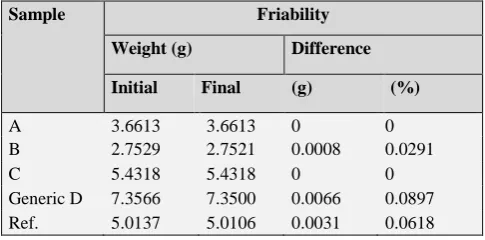
The total mass of the 20 tablets of each sample used in the test, as well as its final mass and possible loss of friable particles are given in Table 2.
Table 2. Masses of DOX tablets before and after the friability test.
Sample
Friability
Weight (g) Difference
Initial Final (g) (%)
A 3.6613 3.6613 0 0
B 2.7529 2.7521 0.0008 0.0291
C 5.4318 5.4318 0 0
Generic D 7.3566 7.3500 0.0066 0.0897
Ref. 5.0137 5.0106 0.0031 0.0618
Disintegration
According to the Brazilian Pharmacopoeia,8 the time limit
established as the general criterion for the disintegration of film-coated and sugar-coated tablets is 30 min and 60 min, respectively. The time each drug took for total disintegration
is shown in table 3, and at the end of the test, no residue from the tested units remained on the metal screen of the disintegrating apparatus except for insoluble tablet coating fragments.
Uniformity of content
The uniformity test was performed with unit doses. The results of the test are given in table 4.
Content
The dosing was performed with a pool of crushed tablets. The results of the test are given in table 5.
Table 3. Total time for the disintegration of doxycycline tablets.
Sample A B C D Ref.
Disintegration time (min)
27 25 28 18 10
Table 4. Determination of content uniformity of DOX tablets by the spectrophotometric method in the UV region.
Sample A B C D Ref.
Content (%) 120.12 110.72 121.19 123.56 118.96
RSD (%) 1.83 1.10 1.67 3.06 0.95
RSD = = relative standard deviation
Table 5. Determination of dosing of DOX tablets by the spectrophotometric method in the UV region.
Sample Tablets DOX content Content (%)
RSD (%) Average ABS
DOX standard
Average ABS DOX
pool
A 0.569 0.689 121.15 1.98
B 0.555 0.629 121.16 1.28
C 0.546 0.644 117.94 1.07
D 0.557 0.650 116.69 2.96
Ref. 0.540 0.641 120.54 1.41
Dissolution
The dissolution test was performed with six tablets of each example, the solvent being 900 mL of 0.01 M HCl, paddle rotation of 75 rpm at 37 ± 5 °C. The absorbance of aliquots of 10 mL drawn at different intervals of time, at 268 nm, was determined. As there was no replacement of solvent, the calculations were discarded, and the release of drug was determined from the line obtained in the analytical curve (Figure 1).
DISCUSSION
for the efficient and safe quality of the product. Adequate verification of the physicochemical characteristics allows a greater quality and therapeutic efficacy.10
The quality control made during and after the production of each batch is essential to ensure that the qualities of the product are met.10 Among the general methods applied
during and after production are average weight, friability, hardness, disintegration, and dissolution.
Determining the average weight is intended to ascertain whether the units of the same batch have a uniform weight.
Figure 1. Dissolution profiles of doxycycline tablets.
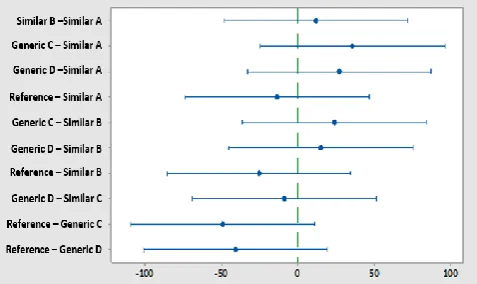
Figure 2. Paired comparison of Tukey for the dissolution profiles of reference, A, B, C and D tablets.
Figure 3. Box plot analysis of the dissolution profiles of different doxycycline tablets.
As the similar doxycycline, A and B, generic C and D are coated or film-coated tablets with an average weight of 250 mg or more, the prescribed tolerance limit is ±5 % of the average weight. However, the reference drug is of the
category of sugar-coated tablets and limits of variation for such tablets of 150-300 mg weight is 7.5 %.8 In this test, no
tablet of any brand exceeded the limits specified by the Brazilian Pharmacopoeia.8
The hardness test enables to determine the strength of the tablet to the crushing or rupture under radial pressure. The result of the hardness test is only informative and the force exerted must be in expressed in Newton.8 Therefore, the
data should only be compared with the reference medicine. Therefore, the similar drugs have hardness with lower values, and the generics have hardness with higher values when compared to the reference, and this difference of values depends on the adjuvants contained in each formulation and technological procedure.
The friability test allows determining the resistance of the tablets to the abrasion when submitted to the mechanical action at specific apparatus. No tablet must be present at the end of the test chipped, cracked or broken. Tablets with the loss of 1.5% or less of their weight9 are considered
acceptable. In the case of the doxycycline tablets analyzed, in some cases, there was no loss of mass, and in others, there were losses but within the limits prescribed by the Brazilian Pharmacopoeia.8
The disintegration test checks whether tablets and capsules disintegrate within the specified time limits, which according to the Brazilian Pharmacopoeia,8 are 30 min and
60 min for sugar- and film-coated tablets respectively. At the end of the test, all the tablets had disintegrated completely. The disintegration test time for all samples was less than the time specified by the Pharmacopoeia.
In the development of the analytical curve for DOX, concentrations ranging from 0.5 to 60 μg mL-1 were
explored. Concentrations of 6 to 21 μg mL-1 were chosen
since they have the linearity of response. After that, a graph of concentration versus absorbance was constructed. The equation was y = 0.0382x + 0.0013 with a correlation coefficient of 0.9999, and it was possible to determine the content of doxycycline present in the tablets in the dissolution test.
The spectrophotometric determination in the UV region used in these analyses was previously validated by Kogawa and Salgado.11
The content uniformity test, as well as the dosing test, aims to demonstrate the amount of DOX present in the samples analyzed and according to the official specification should be between 95.0 and 105.0 %.12 All the analyzed
samples are in disagreement with the specification, presenting contents higher than 105 %. Hence these tablets should be disapproved by Quality Control.
Dissolution studies are indispensable in the production stages of a drug. With the dissolution characteristics, it is possible to predict the in vivo behavior of the pharmaceutical forms, leading to the reduction of the costs and work required to develop a pharmaceutical form, as well as to the number and size of the required clinical studies.13
The dissolution test is a physical test in which the percentage of drug dissolved versus time is evaluated.
Thus, doxycycline reference tablets, similar A, similar B, generic C and generic D may be interchangeable.
However, unfortunately, all doxycycline tablets analyzed, reference, similar A, similar B, generic C and generic D should not be approved by the Quality Control sector because of the dosage values and content uniformity found. All of them presented values above those specified.
Sectors of production, analytical development and quality control should meet to resolve this issue. Involvement of all the sectors is vital to achieve the desired goals.
To summarize, the parameters evaluated are important and critical to making the certificate of equivalence between samples.
This study was designed to introduce the concern to the several aspects (planning, producing and controlling).
It is important to note that these products are commercialized or distributed as equivalent, and they were approved by industrial, pharmaceutical quality control.
In order to guarantee the production of high-quality products for both animal and human use, it is essential that all production steps and producers are maintained through the strict observance of standard operations rules.
CONCLUSION
Due to the results obtained, all doxycycline tablets analyzed should not be approved by the Quality Control sector, the interchangeability is not satisfactory. Sectors of production, analytical development and quality control should meet to resolve this issue. Thus, the importance of a pharmaceutical equivalence study is fundamental to guarantee a safe interchangeability and consequently the same therapeutic effect.
ACKNOWLEDGMENTS
The authors acknowledge FAPESP (São Paulo, Brazil) and CNPq (Brasília, Brazil).
REFERENCES
1Garrido-Mesa, J., Algiere, F., Rodriguez-Nogales, A., Utrilla, M.
P., Rodriguez-Cabezas, E. R., Zarzuelo, A., Ocete, M. A. Garrido-Mesa, N., Galvez, J., Pharmacol. Res., 2015, 97, 48-63. https://doi.org/10.1016/j.phrs.2015.04.005
2Suaréz, D. F., Consuegra, J., Trajano, V. C., Gontijo, P. P. G. G.,
Cortés, M. E., Denadai, A. L., Sinisterra, R. D., Colloids Surf. B. Biointerfaces, 2014, 118, 194-201. https://doi.org/10.1016/j.colsurfb.2014.01.028
3Pomorska – Mól, M., Kwit, K., Markowska – Daniel, I., Pejsak, Z.,
Toxicol. Appl. Pharmacol., 2004, 278, 31-38.
4Ramesh, P. J., Basavaiah, K., Tharpa, K., Vinay, K. B.,
Revanasiddappa, H. D., J. Pre-Clin. Clin. Res., 2010, 4, 101-107.
5Ruiz, S. M. A., Olvera, L. G., Bernad, M. J. B., Chacón, S. C. C.,
Estrada, D. V., Eur. J. Pharm., 2015, 80, 9-15. https://doi.org/10.1016/j.ejps.2015.09.012
6Brasil. Lei n° 9.787, de 10 de fevereiro de 1999. Dispõe sobre a
vigilância sanitária, estabelece o medicamento genérico, dispõe sobre a utilização de nomes genéricos em produtos farmacêuticos e dá outras providências. Brasília, DF.
7Storpirtis, S., Marcolongo, R., Gasparotto, F. S., Vilanova, C. M.,
Infarma, 2004, 16, 51-56.
8Farmacopeia Brasileira. 5. ed. Brasília; Anvisa, 2010.
9USP 37. The United States Pharmacopeia. Rockville: United
States Convention Inc. 2014.
10Pugens, A. M., Donaduzzi, C. M., Melo, E. B., Rev. Eletrônica
Farmácia, 2008, 1, 32-45.
11Kogawa, A. C., Salgado, H. R. N., World Res. J. Pharm. Res., 2013, 1, 21-24.
12British Pharmacopoeia. London. Her Majesty’s Stationary Office, 2010.
12Manadas, R., Pina, M. E., Veiga, F., Rev. Bras. Cienc. Farm., 2002, 38, 375-399. https://doi.org/10.1590/S1516-93322002000400002