349
© 2018 by the Serbian Biological Society How to cite this article: Chen Y, Shafi J, Li M, Fu D, Ji M. Insecticidal activity of endophytic actinomycetes isolated from Azadirachta indica against Myzus persicae. Arch Biol Sci. 2018;70(2):349-57.
Insecticidal activity of endophytic actinomycetes isolated from
Azadirachta indica
against
Myzus persicae
Yan Chen1, Jamil Shafi1,2, Maohai Li3, Danni Fu1 and Mingshan Ji1,*
1Department of Pesticide Science, Plant Protection College, Shenyang Agricultural University, 120 Dongling Road, Shenhe
District, Shenyang, Liaoning, P.R. China.,110866
2Department of Plant Pathology, University of Agriculture Faisalabad, Sub-Campus Depalpur, Okara, 6-KM, Lahore Road,
G.T. Road, Okara, Punjab, Pakistan, 56300
3Institute of Plant Protection, Jilin Academy of Agricultural Sciences, No. 303 Kemao West Street, Gongzhuling, Jilin,
P.R. China, 136100
*Corresponding author: [email protected]
Received: July 29, 2017; Revised: December 4, 2017; Accepted: December 5, 2017; Published online: December 12, 2017
Abstract: In the present study, 85 strains of actinomycetes were isolated from the neem tree (Azadirachta indica) and
screened for their insecticidal activity against the green peach aphid, Myzus persicae. The results showed that crude extracts
from 24 strains exerted a contact effect against M. persicae with different insecticidal efficacies. Crude extracts from 8
acti-nomycetes strains exhibited the highest insecticidal activity (above 60%). Out of these 8 strains, 3 isolates that produced the maximum mortalities were screened a second time. The crude extract from strain G30 was the most virulent against
the green peach aphid, with LC50 and LC95 values of 1.680 mg/mL and 4.370 mg/mL, respectively, after 48 h of treatment.
The following morphological, culture, physiological and biochemical characteristics of strain G30 were recorded: (i) ovate-orbicular and smooth surface spores with short and curve filaments; (ii) an aerial off-white mycelium with a mustered yellow base; (iii) inability to produce soluble pigments; (iv) the ability to hydrolyze starch but not cellulose; (v) the ability to utilize glycerin and several sugars as a carbon source but not L-rhamnose and sorbitol. Molecular identification of G30
revealed a 99.6% genetic similarity of the 16S rDNA sequence with Streptomyces albidoflavus. We conclude that the isolate
G30 was S. albidoflavus and that the insecticidal activity of its crude extract was sufficiently high to become a candidate
for bioinsecticide development.
Key words: Azadirachta indica; endophytic actinomycetes; Myzus persicae; insecticidal activity; S. albidoflavus
INTRODUCTION
Myzus persicae is a cosmopolitan and highly polypha-gous phytophapolypha-gous pest whose host range exceeds 400 plant species, including many economically impor-tant agricultural and forest plants. It mainly damages cruciferous, nightshade vegetables and drupe fruit trees [1,2]. M. persicae causes damage to its hosts by direct feeding, the production of honeydew and the transmission of plant viruses. It is capable of trans-mitting over 100 different plant viruses [2]. Chemi-cal pesticides are still the main effective method for controlling green peach aphid. However, the use of chemical pesticides may seriously damage human health and cause environmental pollution. Moreover,
due to intensive use of chemical pesticides over many years, widespread and multiple forms of aphid resis-tance have evolved. M. persicae is now reported to be resistant to most classes of insecticides, including organophosphates, carbamates, pyrethroids, cyclodi-enes and neonicotinoids, making M. persicae one of the most resistant species worldwide [3]. According to the WHO, in the next 20 to 30 years chemically based pesticides will lose their efficacy [4,5]. There-fore, scientists are searching for novel strategies and agents for long-term and environmentally safe plant protection [6].
was hailed as “a tree for solving global problems” by the United States Department of Agriculture [7]. Among the many uses of the neem tree, its insecticidal activity against nearly 400 species of agricultural and forest pests is well-known [8,9]. Many insecticidally active substances have been isolated from seeds, bark and other parts of the neem tree, the most common being azadirachtin, nimbin, nimbidin, nimbidol, nimbinate, queceretin and salannin [10,11]. Siddiqui et al. [12] reported that all parts of the neem tree are valuable. Because of the antiseptic, bactericidal and insecticidal activity of its leaves, branches, bark, roots and fruits, the neem tree neem is called a “rural pharmacy”.
There are over 250 thousand plant species in na-ture, but only several hundred of them have been stud-ied for their insecticidal activity and the study of their endophytic actinomycetes is more scarce [13]. Various neem formulations have been registered for their ef-ficacy against numerous plant pests [14-16]. Neem ex-tracts are recognized as highly efficient pesticides, but studies on the isolation of endophytic actinomycetes from neem have just started in the past few years and are rarely reported. Plant endophytic actinomycetes have always been an important source of natural ac-tive products and thus honored as a “natural treasury” [17]. Therefore, the development of pesticides based on neem endophytic actinomycetes has great poten-tial. Insecticidally active endophytic actinomycetes isolated from neem can overcome the shortcomings of traditional preparation modes (crushing, grinding, and extraction of bioactive compounds from plant organs), and the lack of natural neem. Endophytic ac-tinomycetes are natural internal inhabitants of plants. Although actinomycetes have been known for a long time, their importance only recently became more evi-dent when their role in protecting host plants against insects and diseases was recognized. Actinomycetes have great economic value and widespread practical applications. They contain a wide variety of bioactive metabolites, including antibiotics, enzymes, vitamins, amino acid and steroids [18]. Over 8000 bioactive sub-stances have been found in microbes, and nearly 70% of them are produced by actinomycetes [19].
Thus, screening of insecticidally active substances from the endophytic actinomycetes of neem is of great significance to the development of a novel insecticide. In this study, 85 actinomycete strains isolated from
the neem tree were screened for insecticidal activ-ity against green peach aphid. The study was aimed at finding neem endophytic actinomycetes with the highest insecticidal activity and its identification based on morphological, culture, physiological, bio-chemical characteristics and 16S rDNA sequencing.
MATERIALS AND METHODS
Isolation and purification of endophytic actinomycetes
The leaves and fruits of A. indica were collected from Thailand and preserved at 4°C in the Pesticide Sci-ence Laboratory of Shenyang Agricultural University. Nuts and leaves of neem were washed in running tap water and then surface-sterilized with 70% ethanol for 1 min, sodium hypochlorite (2.0-2.5% active Cl) for 4 min and 70% ethanol for 30s. The nuts and leaves were then washed three times with sterile distilled water [20]. After washing and sterilizing, neem nuts (4.0 g) and leaves (2.0 g) were ground with a mortar, homogenized in 10 mL deionized water, and 0.1 mL of the homogenate was gradient diluted. Homogenates (100 µL) were painted on Gauserime 1 agar medium plates composed of 20 g of soluble starch, 0.5 g NaCl, 0.001 g FeSO4, 0,05 g MgSO4·7H2O, 1 g KNO3, 0.5 g K2HPO4 and 20 g of agar in 1 L of distilled water, supplemented with 0.005% potassium dichromate to inhibit the growth of fungi and bacteria. The plates were inverted and cultured in constant-temperature incubators at 28°C for 7 days. The strains of different colonial morphology were selected and purified on Gauserime No.1 agar medium [21]. A total of 85 iso-lates were identified up to genus level by conventional microbiological methods [22]. After purification and preliminary identification, the actinomycetes were numbered and preserved for further use in insecti-cidal activity screening.
Fermentation and preparation of crude extracts
shaking incubator at 180 rpm for 7 days at 28°C. The fermentation liquor was filtered and extracted by an equal volume of ethyl acetate three times. The extract-ed upper organic phases were mixextract-ed and concentratextract-ed to dryness by a rotary evaporator (35°C). The crude extracts with active substances were obtained from fermentation liquor.
Primary screening for insecticidal activity
Actinomycete strains were screened according to the method of Luo and Miao [24] with some modifica-tions. Cabbage leaves were cut from plants that con-tained many aphids. Fifty aphids were kept per leaf by removing extra individuals with a paintbrush. The leaves were placed in Petri dishes (90×14 mm) lined with moisturized filter papers. Different crude extracts from fermentation liquors were dissolved in acetone and diluted with distilled water to obtain quantita-tive solutions of 20 mg/mL concentration. An aquatic acetone solution (acetone:distilled water=1:10) was used as a control.
The prepared Petri dishes were sprayed with 1 mL of crude extract solutions using a Potter spray tower and settled for 15 s at 24°C. The control was sprayed with 1 mL of aquatic acetone solution. The experiment was performed in three replicates. After spraying, the leaves were air dried for 45 min. The Petri dishes were then covered with sealing film to reduce evaporation of the crude extracts and incubated at 25±1°C. The number of dead aphids was recorded after 24 h and 48 h to calculate the mortalities and corrected mor-talities. Aphid death was judged by the immobility of aphids after touching their feet and antenna with a paintbrush.
Secondary screening for insecticidal activity
Strains with corrected mortalities above 70% in the primary screening were further screened by the spray method. The crude extracts from the liquor of these strains were prepared at 5.00 mg/mL, 3.33 mg/mL, 2.50 mg/mL, 2.00 mg/mL and 1.70 mg/mL concentra-tions. To identify the crude extract with the highest insecticidal activity, insecticidal activities were tested by the same method as described above for primary screening. The experiment was conducted with five
replicates and 50 aphids in each replicate. The mor-tality and corrected mormor-tality were calculated using equations 1 and 2, respectively.
Mortality (%) = Number of dead insects x 100 (1) Number of insects tested
x 100 (2) Treatment mortality – Control mortality
100 – Control mortality Corrected mortality (%) =
In addition, the LC50 and LC95 for these selected strains were also calculated after 48 h of treatment.
Specific identification of the strain with the strongest insecticidal activity
Identification at the genus level of the strain with the highest insecticidal activity was performed by conven-tional methods on the basis of morphological, physi-ological and culture characterization [22], while spe-cies-level identification was performed by 16S rDNA sequencing. The strain was cultured at 28°C for 7~10 days and the morphological characteristics, includ-ing colony morphology, aerial and substrate mycelia, spore morphology and pigmentation were studied. Also, gelatin liquefaction, starch hydrolysis, coagula-tion of milk and peptone, nitrate reduccoagula-tion, hydrogen sulfide production, cellulose decomposition, nitrogen source utilization and carbon source utilization were evaluated using the methods described by Locci [22].
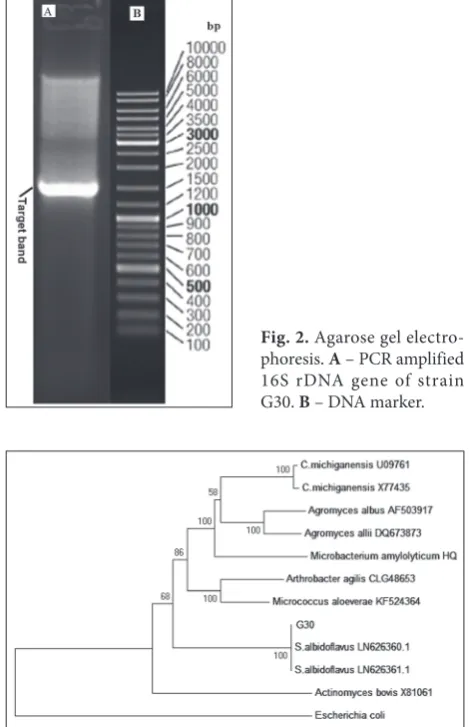
[27]. PCR products (5.0 μL) were separated by 0.8% agarose gel electrophoresis in TBE buffer with DL2000 DNA marker. The electrophoresis was performed for 1 h at 100 V and the results were visualized under UV light after ethidium bromide (EB) staining. PCR amplified products were sequenced by the Shanghai Biochemistry Company using the same primers as above. The 16S rDNA gene sequence was compared for similarity with the reference species of actinomy-cetes contained in the genomic database using the NCBI-BLAST tool. The neighbor-joining method was employed to construct a phylogenetic tree using MEGA 5.0 software [28].
Statistical analysis
The data were analyzed by one-way ANOVA using SPSS 22.0 software (SPSS Inc., Chicago, IL, USA). For specific post hoc comparisons among strains of actinomycetes, Duncan’s multiple range tests at a level of significance of P<0.05 were carried out. For calculation of LC50 and LC95, the mortality data were subjected to probit analysis in SPSS 22.0 software.
RESULTS
Determination of insecticidal activities of crude extracts from actinomycetes
Primary screening
Out of 85 isolates of actinomycetes, the crude extracts from 24 isolates showed contact toxicities to green peach aphids after 24 h. The results given in Table 1 show that the crude extracts from 24 actinomycetes produced certain contact toxicity effects, while 8 of them caused a peach aphid mortality higher than 60%. The insecticidal activities of the crude extracts from G11, G30, G34, and R9 were the highest. After 24 h, corrected mortalities were 89.28%, 78.56%, 92.85% and 71.41%, respectively, while after 48 h the mor-talities were 92.75%, 81.88%, 96.38% and 75.36%, re-spectively. Medium insecticidal activities against green peach aphids were recorded for crude extracts from the G2, G5, G18 and G50 strains. Corrected mortality induced by these extracts ranged between 60.66% and 65.70% after 24 h, and between 62.32% and 68.12%
after 48 h. The insecticidal activities of the rest of the 16 strains were below 60%.
Secondary screening
In this investigation, the 3 actinomycetes (G30, G34, and G11) that caused the highest mortality in primary screening were used for the secondary screening. The results presented in Table 2 show that strain G30 was the most effective against M. persicae as compared to G34 and G11 (P<0.05). Even the corrected mor-tality at a lower concentration (2.00 mg/mL) caused by G30 was higher than 50%, and the efficacy of its crude extract at a concentration of 5 mg/mL was sufficient to control M. persicae (Table 2). The G30 strain showed conspicuous insecticidal activity, with an LC50 value of 1.68 mg/mL (95% fiducial limits of
Table 1. Insecticidal activity (means±SE) of crude extracts from selected strains of actinomycetes against Myzus persicae after 24- and 48 h-treatments (primary screening).
Strain number
24 h 48 h
Mortality (%)
Corrected mortality
(%)
Mortality (%)
Corrected mortality
(%)
G2 68.00±2.31 65.70±2.47 70.00±1.15 67.39±1.10 G3 53.33±1.76 49.95±1.84 54.67±0.67 50.73±0.96 G5 63.33±1.76 60.66±1.84 65.33±2.91 62.32±3.64 G11 90.00±3.06 89.28±3.23 93.33±2.91 92.75±3.26 G18 66.67±3.53 64.31±3.71 70.67±1.33 68.12±1.82 G20 36.67±1.33 32.12±1.25 40.00±2.31 34.78±3.33 G22 50.00±3.06 46.41±3.54 52.67±1.33 48.55±1.57 G27 46.67±1.33 42.84±1.27 49.33±1.76 44.92±2.61 G30 80.00±2.00 78.56±2.06 83.33±1.76 81.88±2.15 G33 60.00±2.31 57.13±2.22 64.67±1.33 61.60±1.90 G34 93.33±1.76 92.85±1.87 96.67±2.91 96.38±3.20 G41 53.33±1.76 49.98±1.84 58.67±1.33 55.08±1.98 G42 58.67±2.91 55.70±3.38 59.33±1.76 55.79±2.47 G49 23.33±1.76 17.82±1.86 26.67±1.33 20.29±2.39 G50 66.00±2.31 63.56±2.26 68.67±1.33 65.95±1.85 G53 40.00±2.00 35.69±1.94 43.33±1.76 38.40±2.69 G56 56.00±2.31 52.84±2.48 59.33±1.76 55.79±2.47 G59 48.00±2.31 44.27±2.49 52.00±2.31 47.83±3.17 R56 54.67±1.33 51.41±1.28 60.00±2.00 56.52±2.26 R3 62.00±3.06 59.27±3.08 65.33±1.76 62.32±2.39 R9 73.33±2.91 71.41±3.07 77.33±1.76 75.36±2.23 R12 51.33±1.76 47.83±1.84 53.33±1.76 49.27±2.56 R13 61.33±2.91 58.55±3.07 64.00±2.31 60.87±3.00 R6 52.00±2.31 48.55±3.37 54.67±1.33 50.73±2.03
CK 6.67±0.67 8.00±1.15
1.255-1.957 mg/mL), and an LC95 value of 4.370 mg/ mL (95% fiducial limits of 3.510-7.127 mg/mL) after 48 h of treatment (Table 3).
Morphological and culture characteristics of the G30 strain
Strain G30 was grown on Gauserime 1 medium, pota-to dextrose medium, Klinefelter medium 1, a medium containing glycerol-asparaginase, glucose-aspartate medium, glucose-yeast extract medium, inorganic salt medium, starch medium, yeast extract, malt extract medium and oatmeal medium. In these media, the mycelia were yellowish-white or dust gray, the base
of the mycelia were light yellow, pale mango brown or colorless. The strain grew well on Gauserime 1 medium, Klinefelter 1 medium and inorganic salt starch, whereas moderate growth was observed in the glucose-yeast extract, glycerol-asparaginase and glucose-aspartate media. On the Gauserime 1 medi-um, strain G30 produced an off-whitish, lush aerial mycelium with a mustered yellow base, but it lacked soluble pigments (Fig. 1A and B). Under the optical microscope, the hyphae were lush green, while the spores were oval shaped with a smooth surface, short and curvy filaments (Fig. 1C and D).
Table 2. Corrected mortalities (means±SE) of Myzus persicae
caused by crude extracts from three selected strains (secondary screening).
Strain
No. Concentration(mg/mL) Corrected mortality (%) 24 h 48 h
G30
5.00 79.06±1.43 a 94.61±1.07 a
G34 41.01±3.44 c 35.74±1.44 c
G11 62.03±1.18 b 70.63±1.96 b
G30
3.33
71.31±1.44 a 91.22±1.49 a
G34 33.06±1.33 c 23.68±1.58 c
G11 50.23±1.86 b 54.05±1.71 b
G30
2.50
60.06±0.92 a 78.01±1.35 a
G34 10.39±1.33c 16.72±2.25c
G11 42.89±1.23 b 43.83±1.09b
G30
2.00
50.78±1.24 a 61.97±1.97 a
G34 5.05±0.82 c 12.48±1.04c
G11 26.87±1.32 b 30.63±1.29b
G30
1.70
39.24±1.45 a 46.10±1.74 a
G34 3.38±0.52c 7.93±1.07 c
G11 12.23±1.19 b 18.16±1.22b
Values marked with different letters a, b, c differ significantly among strains within each concentration (Duncan’s multiple range test, P<0.05).
Table 3. Toxicity of various crude extracts against Myzus persicae (48 h).
Strain Regression equation
Concentration
(mg/mL) Chi-square P value
**LC50 ***LC95
G30 Y=-0.893+3.961X 1.680 (1.255-1.957) 4.370 (3.510-7.127) 5.523 0.137
G34 Y=-1.816+2.093X 7.379 (5.828-11.191) 45.081 (23.857-145.316) 0.256 0.968
G11 Y=-1.414+2.882X 3.094 (2.868-3.374) 11.516 (8.975-16.643) 2.872 0.412
The numbers in parentheses represent 95% fiducial limits based on a probit analysis.
** LC50 is the concentration of crude extract that caused the death of 50% of the population of Myzus persicae.
*** LC95 is the concentration of crude extract hat caused the death of 95% of the population of Myzus persicae.
Physiological and biochemical characterization of the G30 strain
Strain G30 exhibited strong gelatin liquefaction ability, producing milk from peptone instead of solidifying. It showed a strong ability for starch hydrolysis but lacked a hydrogen sulfide production ability. No growth was observed on cellulose. The strain also showed an in-ability to produce melanin. It exhibited a positive result for nitrate reduction and an efficient use of D-glucose, D-fructose, maltose, lactose, D-mannose and glycerin as the carbon source, while it lacked the ability to utilize sucrose, L-rhamnose and sorbitol as the carbon source (Table 4).
Table 4. Physiological and biochemical characteristics of strain G30.
Characteristics test Result Characteristics test Result
Starch hydrolysis + D-glucose +
Nitrate reduction + D-fructose +
Gelatin liquefaction + Maltose +
Cellulose hydrolysis - Lactose +
Production of
hydrogen sulfide - D-mannose +
Milk peptone + Glycerin +
Melanin - L-rhamnose
-Sucrose - Sorbitol
-“+” – positive results; “-” – negative results
Molecular identification of the G30 strain
The PCR product had a clear band of about 1500 bp, showing successful amplification of the 16S rDNA region of strain G30 (Fig. 2). Comparison of the 16S rDNA sequence with the sequences deposited in the NCBI database showed 99% similarity with 11 species of actinomycetes. The phylogenetic tree of strain G30 and related species was constructed using MEGA 6.0, which showed that strain G30 belongs to the genus
Streptomyces and that it has the highest similarity with
Streptomyces albidoflavus (Fig. 3).
DISCUSSION
Biopesticides produced by microorganisms and used in agriculture have gained significant importance among researchers and the farming community be-cause of their safety as regards non-target organisms
and the environment. Moreover, biopesticides have reduced the emergence of natural and cross resistance in plant pests [29]. Actinobacteria, particularly Strep-tomyces spp., have provided a diverse range of sec-ondary metabolites of high commercial significance and continue to be regularly screened for new bioac-tive compounds [30]. In the present study, a total of 85 actinomycetes were isolated from the neem plant and screened for insecticidal activity against M. per-sicae. All the isolates were identified up to the genus level by a conventional microbiological approach. The morphological, biochemical and physiological charac-teristics of the selected isolates and comparison with those mentioned in the Manual of Systematic Bacte-riology [22] clearly suggest that these isolates belong
Fig. 2. Agarose gel electro-phoresis. A – PCR amplified 16S rDNA gene of strain G30. B – DNA marker.
to the genus Streptomyces. However, the species-level identification of the actinomycetes is not possible by morphological, biochemical and physiological charac-terization. It requires identification at the genetic level, such as provided by comparison of the 16S rDNA gene sequences with the type strains. Only the G30 strain, which exhibited promising insecticidal activity, was identified to the species level by 16S rDNA gene se-quencing.
Of the 85 isolates, the crude extracts from 24 strains showed different contact toxicities against the green peach aphid. In the primary screening, crude extracts from 8 actinomycetes strains showed higher insecticidal activity with corrected mortalities above 60%. Crude extracts from the remaining 16 strains had relatively low insecticidal activities. Similar re-ports are available for the insecticidal activity of ac-tinomycetes and their products [31-35]. Karthik et al. [36] found that some actinomycete isolates pro-duced strong insecticidal activity. Horikosh et al. [37] screened 300 microbial natural products and found pyripyropene A as a promising insecticidal compound against aphids on cabbage.
During the second screening, the G30 strain showed prominent insecticidal activity with an LC50 value of 1.680 mg/mL after 48 h of treatment; how-ever, this LC50 value was higher than the previously reported value of Liao et al. [38], who investigated the virulence of three fermentation products of actinomy-cetes against M. persicae and showed that isolate 31-1 was the most effective, having an LC50 value of 0.0447 mg/mL and a corrected mortality of 82.9% after 24 h. Similarly, strain G30 displayed a slightly higher LC50 value than some of the other natural environment-friendly biopesticides, such as the Illicium verum
fruit extract (LC50, 0.00014 mg/mL at 72 h) [39] and
Partheniumhysterophorus (LC50, 1.141 mg/mL at 48 h) [40], but a lower LC50 value than the essential oil of
Pogostemon cablin (LC50, 1.694 mg/mL at 48 h) [41]. The higher LC50 value for G30 may be due to impuri-ties present in the crude extract used in this study.
Based on the morphological, biochemical, physio-logical and molecular characterization, strain G30 be-longs to the genus Streptomyces. The results of cluster analysis showed the highest similarity between strain G30 and whitish yellow Streptomyces albidoflavus that
are located on the same branch of the phylogenetic tree. Their homology was high, and clustering analy-sis had high repeatability. The genus Streptomyces is an economically important group of actinomycetes and a key source of copious amounts of biologically active compounds. Several agriculturally important compounds with antibacterial [42], antifungal [31], insecticidal, antiparasitic [43] and antiviral [44] activi-ties have been obtained from Streptomyces spp. [45]. Moreover, about 60% of antibiotics and most of the agricultural antibiotics are from the genus Streptomy-ces [46].
The results obtained in the present study on the insecticidal activity of the selected isolates indicate that the crude extract from strain G30 (S. albidoflavus) possesses strong insecticidal activity against green peach aphid, and might contain novel insecticidal components. In a recent study [47], a novel polyketide metabolite with insecticidal properties was identified from a marine actinomycete Streptomyces sp. AP-123. Similarly, Kaur and Manhas [48] identified Streptomy-ces hydrogenans DH16, which possesses an antifungal, insecticidal and plant growth-promoting potential. Regarding strain G30, further studies on the identifi-cation and structure elucidation of the produced ac-tive components are required before novel insecticidal compounds are obtained.
Acknowledgments: The financial support by the Ministry of Ag-riculture of the People’s Republic of China to the Department of Pesticide Science, College of Plant Protection, Shenyang Agricul-tural University as a special fund for agroscientific research in the public interest (2013325) is gratefully acknowledged.
Author contributions: YC and JS were involved in the conception, plan, design and preparation of the manuscript. YC, DF and ML performed the experiments, analyzed the data and interpreted the results. MJ, YC and JS conducted data collection and critical revision of the article. All the authors approved the final version of the article.
Conflict of interest disclosure: The authors declare that there is no conflict of interest.
REFERENCES
1. Bass C, Puinean AM, Zimmer CT, Denholm I, Field LM, Foster SP, Gutbrod O, Nauen R, Slater RWilliamson MS. The evolution of insecticide resistance in the peach potato aphid,
2. Blackman RL, Eastop VF. Aphids on the world’s herbaceous plants and shrubs. Chichester: John Wiley & Sons; 2008. 215 p. 3. Pesticide Environmental Stewardship [Internet]. Washington.
Center for Integrated Pest Management. Insecticide Resis-tance Mechanisms. [cited 2017 Sept 20]; [about 1 screen]. Available from: https://pesticidestewardship.org/resistance/ insecticide-resistance/insecticide-resistance-mechanisms/. 4. World Health Organization. Global Plan for insecticide
resis-tance management in malaria vectors. Geneva: WHO; 2012. 44-86 p.
5. Liu N. Insecticide resistance in mosquitoes: impact, mechanisms, and research directions. Annu Rev Entomol. 2015;60:537-59.
6. Gonzalez CA, Reina M, Diaz C, Fraga BSMO. Natural prod-uct-based biopesticides for insect control. In: Mander L, Liu HW, editors. Comprehensive natural products. Oxford: Else-vier Science; 2010. p. 237-68.
7. Noel V. Neem: a tree for solving global problems. 1st ed. New York: The Minerva Group, Inc; 2004. 132 p.
8. Li XZS. The toxic effects and mode of azadirachtin on insects. J South China Normal Univ. 1995;17(1):118-22.
9. Jadeja G, Maheshwari RNS. Extraction of natural insecticide azadirachtin from neem (Azadirachta indica A. Juss) seed kernels using pressurized hot solvent. J Supercrit Fluids. 2011;56(3):253-8.
10. Xu H. Insecticidal plants and botanical insecticide. Beijing: China Agriculture Press; 2001. 309 p.
11. Xuan TD, Tsuzuki E, Hiroyuki T, Mitsuhiro M, Khanh TDCIM. Evaluation on phytotoxicity of neem ( Azadi-rachta indica. A. Juss) to crops and weeds. Crop Protect. 2004;23(4):335-45.
12. Siddiqui BS, Afshan F, Faizi S, Naqvi STR. Two insecticidal tetranortriterpenoids from Azadirachta indica. Phytochem. 2000;53(3):371-6.
13. Schulz B, Boyle C, Draeger S, Römmert AK, Krohn K. Endo-phytic fungi: a source of novel biologically active secondary metabolites. Mycol Res. 2002;106(9):996-1004.
14. Shannag H, Capinera JFN. Efficacy of different neem-based biopesticides against green peach aphid, Myzus persicae
(Hemiptera: Aphididae). Int J Agr Policy Res. 2014;2(2):61-8. 15. Faraone N, Hillier NKC. Plant essential oils synergize and
antagonize toxicity of different conventional insecticides against Myzus persicae (Hemiptera: Aphididae). Plos One. 2015;10(5):e0127774.
16. Christopher Cutler G, Ramanaidu K, Astatkie T, Isman MB. Green peach aphid, Myzus persicae (Hemiptera: Aphi-didae), reproduction during exposure to sublethal concen-trations of imidacloprid and azadirachtin. Pest Manage Sci. 2009;65(2):205-9.
17. Strobel GDB. Bioprospecting for microbial endophytes and their natural products. Microbiol Mol Biol Rev. 2003;67(4):491-502.
18. Shi N, Yang RIL. Screening and Primary Study of Acti-nomycetes with Insecticidal Activity. Chin J Bio Control. 2009;25(1):45-7.
19. Tao S, Zong MS. Ecological distribution of actinomycetes in the southwest part of Shandong province. Shandong Agric Sci. 2006;2:017.
20. Araújo W, Lima AS, Azevedo J, Marcon J, Sobral JLP. Manual: isolamento de microrganismos endofíticos. Piracicaba: Calq; 2002. 86 p.
21. Caruso M, Colombo A, Fedeli L, Pavesi A, Quaroni S, Sarac-chi MVG. Isolation of endophytic fungi and Actinomycetes taxane producers. Ann Microbiol. 2000;50(1):3-13.
22. Locci R. Streptomyces and related genera. In: Williams ST, Sharpe ME, Holt JG, editors. Bergey’s manual of systematic bacteriology. Baltimore: Williams & Wilkins; 1989. p. 245-9. 23. Zhang YM, Li HY, Hu C, Sheng HF, Zhang Y, Lin BR, Zhou GX. Ergosterols from the culture broth of marine Streptomy-cesanandii H41-59. Mar Drugs. 2016;14(5):84.
24. Luo L, Miao F. Screening and Identification of two actinomy-ces strains with insecticidal activity for radish aphid. Agro-chem. 2013;2(1):20.
25. Kataoka M, Ueda K, Kudo T, Seki TY. Application of the vari-able region in 16S rDNA to create an index for rapid species identification in the genus Streptomyces. FEMS Microbiol Lett. 1997;151(2):249-55.
26. Mehling A, Wehmeier UFPW. Nucleotide sequences of
streptomycete 16S ribosomal DNA: towards a specific iden-tification system for streptomycetes using PCR. Microbiol. 1995;141(9):2139-47.
27. Lin Y, Du D, Si C, Zhao Q, Li ZP. Potential biocontrol Bacil-lus sp. strains isolated by an improved method from vinegar waste compost exhibit antibiosis against fungal pathogens and promote growth of cucumbers. Biol Control. 2014;71:7-15. 28. Tamura K, Dudley J, Nei MKS. MEGA4: molecular
evolution-ary genetics analysis (MEGA) software version 4.0. Mol Biol Evol. 2007;24(8):1596-9.
29. Vijayabharathi R, Kumari BR, Sathya A, Srinivas V, Abhishek R, Sharma HCS. Biological activity of entomopathogenic acti-nomycetes against lepidopteran insects (Noctuidae: Lepidop-tera). Can J Plant Sci. 2014;94(4):759-69.
30. Nan S, Runlei Ylikun Z. Progress in Actinomycetes with Insecticidal Activities. J Anhui Agric Sci. 2009;11(1):015. 31. Berdy J. Bioactive microbial metabolites. J Antibiot.
2005;58(1):1.
32. Xiong L, Li J, Kong F. Streptomyces sp. 173, an insecti-cidal microorganism from marine. Lett Appl Microbiol. 2004;38(1):32-37.
33. Deng Y, Hu J, Liu L, Wang N, Wang S. Screening for marine actinomycetes producing insecticidal metabolites. J Biotech-nol. 2008;136:533.
34. El-khawaga M, Megahed M. Antibacterial and insecticidal activity of actinomycetes isolated from sandy soil of (Cairo-Egypt). Egypt Acad J Biol Sci. 2012;4(1):53-67.
35. Shobha K, Onkarappa R, Goutham S, Raghavendra H. Screening biological activities of a Streptomyces species iso-lated from soil of Agumbe, Karnataka, India. Int J Dug Dev Res. 2012;4(3):104-14.
36. Karthik L, Gaurav K, Rao KB, Rajakumar G, Rahuman AA. Larvicidal, repellent, and ovicidal activity of marine actino-bacteria extracts against Culex tritaeniorhynchus and Culex gelidus. Parasitol Res. 2011;108(6):1447-55.
38. Liao W, Ye L, Deng J, Gao JH. Virulence of fermentation products of actinomycetes against Myzuspersicae. Anhui Agric Sci. 2004;32(6):1191-1202.
39. Zhou BG, Wang S, Dou TT, Liu S, Li MY, Hua RM, Li S, GLin HF. Aphicidal activity of Illicium verum fruit extracts and their effects on the Acetylcholinesterase and Glutathione S-transferases activities in Myzus persicae (Hemiptera: Aphi-didae). J Insect Sci. 2016;16(1):11.
40. Reddy SE, Dolma SK, Verma PK, Singh B. Insecticidal activi-ties of Parthenium hysterophorus L. extract and parthenin against diamondback moth, Plutella xylostella (L.) and aphid,
Aphis craccivora Koch. Toxin Rev. 2017;https://doi.org/10.10 80/15569543.2017.1339281.
41. Chen Y, Li Y, Su Zxian J. Insecticidal and repellent action of pogostone against Myzuspersicae (Hemiptera: Aphididae). Fla Entomol. 2017;100(2):346-9.
42. Ramesh S Mathivanan N. Screening of marine actinomycetes isolated from the Bay of Bengal, India for antimicrobial activ-ity and industrial enzymes. World J Microbiol Biotechnol. 2009;25(12):2103-11.
43. Pimentel-Elardo SM, Kozytska S, Bugni TS, Ireland CM, Moll H, Hentschel U. Anti-parasitic compounds from Streptomyces
sp. strains isolated from Mediterranean sponges. Mar Drugs. 2010;8(2):373-80.
44. Sacramento DR, Coelho RRR, Wigg MD, Linhares LFTL, Santos MGM, Semêdo LT, Silva AJR. Antimicrobial and anti-viral activities of an actinomycete (Streptomyces sp.) isolated from a Brazilian tropical forest soil. World J Microbiol Bio-technol. 2004;20(3):225-9.
45. Subramani R, Aalbersberg W. Marine actinomycetes: an ongoing source of novel bioactive metabolites. Microbiol Res. 2012;167(10):571-80.
46. Tanaka Y Omura S. Agroactive compounds of microbial ori-gin. Annu Rev Microbiol.. 1993;47(1):57-87.
47. Arasu MV, Al-Dhabi NA, Saritha V, Duraipandiyan V, Muth-ukumar CKim SJ. Antifeedant, larvicidal and growth inhibi-tory bioactivities of novel polyketide metabolite isolated from
Streptomyces sp. AP-123 against Helicoverpa armigera and
Spodopteralitura. BMC Microbiol. 2013;13(1):105.