Research Article
a
December
2017
Computer Science and Software Engineering
ISSN: 2277-128X (Volume-7, Issue-12)
On Topological Indices of Sudoku Graphs and Titania
TiO
2
Nanotubes
K. Pattabiraman*
Department of Mathematics, Annamalai University, Annamalainagar, Tamilnadu, India
A. Santhakumar
Department of Mathematics, CK College of Engineering and Technology, Cuddalore, Tamilnadu, India
Abstract— In this paper, we obtain the exact formulae for some topological indices such as the general sum-connectivity index, atom-bond sum-connectivity index, geometric arithmetic index, inverse sum indeg index, symmetric division deg index and harmonic polynomial of titania TiO2 Nanotubes and Sudoku graphs.
Keywords— sum-connectivity index, Sudoku graph, TiO2 Nanotubes. MSC: Primary: 05C35; Secondary: 05C07, 05C40
I. INTRODUCTION
A topological index is a mathematical measure which correlates to the chemical structures of any simple finite graph. They are invariant under the graph isomorphism. They play an important role in the study of QS AR / QS PR. In theoretical chemistry, molecular structure descriptors (also called topological indices) are used for modeling physicochemical, pharmacologic, toxicologic, nanoscience, biological and other properties of chemical compounds. Among these topological descriptors the degree-based topological indices are of great importance. The first degree-based topological indices that were defined by Gutman and Trinajstić in [8] 1972, are the first and second Zagreb indices. These indices were originally defined as M1(G) =
2
( ) ( )
( ) ( ) ( )
G G G
u V G uv E G
d u d u d v
andM2(G) =
( )
( ) ( )
G G uv E G
d u d v
, where M1 (G) and M2(G) denote the first and second Zagreb indices, respectively.
The sum-connectivity index was proposed by Zhou and Trinajstić [15] in 2009, which is defined as the sum over
all the edges of the graph of the terms
1 2
(
d u
G( )
d
G( )) .
v
This concept was extended to the general sum-connectivityindex in 2010 [16], which is defined as
( )
( ) ( G( ) G( )) ,
uv E G
G d u d v
where α is a real number. If α = 1, 1 2
and 2, then
1(G) =M
1 (G), 1 2( )
G
( )
G
and
2(G) = HM (G) (hyper Zagreb index). The sum-connectivityindex and product-connectivity index correlate well with the π- electron energy of benzenoid hydrocarbons [12]. Another
variant of the Randic index of G is the harmonic index, denoted by H(G) and define as
H(G) =
1 2 ( ) 1 2
2
2 1( ). ( ) ( )
a a E G G G
G
d a d a
Motivated by definition of the Randić connectivity index, Vukicević and Furtula [14] proposed another vertedx-degree-based topological index, named the geometric-arithmetic index. The geometric-arithmetic index of a graph G is
denoted by GA(G) and defined as GA(G) =
( )
2 ( ) ( )
.
( ) ( )
G G uv E G G G
d u d v
d u d v
One of the well-know degree based topological index is the atom-bond connectivity (ABC) index of G, proposed
by Estrada et al. in [4], and defined as ABC(G) =
( )
( ) ( ) 2 . ( ) ( )
G G
uv E G G G
d u d v d u d v
The inverse sum indeg index IS I (G) of a simple graph G is defined [5] in as IS I (G) =
( )
( ) ( ) . ( ) ( )
G G uv E G G G
d u d v d u d v
The symmetric division deg index of a connected graph G, (S DD) is defined in [7] as S
DD (G) = 2 2
( )
( ) ( ) . ( ) ( )
G G
uv E G G G
d u d v d u d v
The harmonic polynomial is defined in [9] as H (G, x) = ( ) ( ) 1( )
2
dG u dG v.
uv E G
x
Note that 1
ISSN(E): 2277-128X, ISSN(P): 2277-6451, pp. 96-103
In this paper, we obtain the exact formulae for some topological indices such as the general sum-connectivity index, atom-bond connectivity index, geometric arithmetic index, inverse sum indeg index, symmetric division deg index and harmonic polynomial of titania TiO2 nanotubes and Sudoku graphs.
II. n x n SUDOKU GRAPHS
Sudoku is a popular puzzle game. An n x n sudoku puzzle is a grid of cells partitioned into n smaller block of n
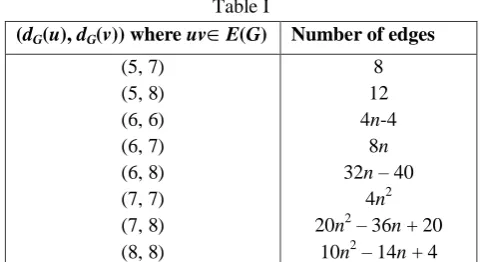
element. Sudoku can also be viewed as a bipartite graph. From the structure of n x n sodoku graph, the edge set can be partitioned into eight sets show in Table 1
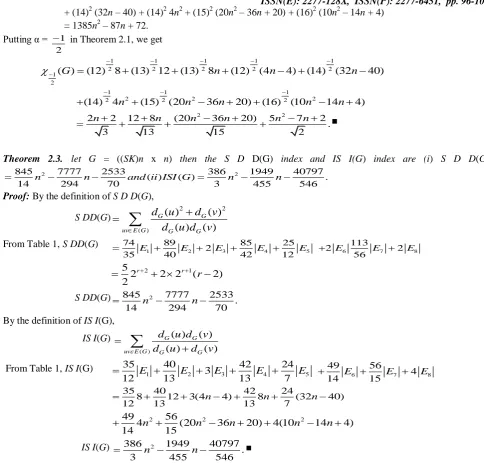
Theoren 2.1.Consider G = (SK) n x nis a sudoku graph for n ≥ 2, Then its general sum connectivity index is
(G) =(12)α 8 + (13)α 12+(13)α 8n + (12)α (4n – 4) + (14)α (32n – 40) + (14)α 4n2 + (15)α (20n2 – 36n + 20) + (16)α (10n2 – 14n + 4).
Proof:Now we compute the sum connectivity index of n x n sudoku graph and by the definition of
, we have
, ( )
(
)
(
G( )
G( ))
v u E G
G
d
u
d
v
= (12)α |E1| + (13)α |E2| + (12)α |E3| + (13)α |E4| + (14)α |E5|+ (14)α |E6| + (15)α |E7| + (16)α |E8| Hence
(G)= (12)α 8 + (13)α 12 + (13)α 8n + (12)α (4n – 4) + (14)α (32n – 40)+ (14)α 4n2 + (15)α (20n2 – 36n + 20) + (16)α (10n2 – 14n + 4).■
Table I
(dG(u), dG(v)) where uv
E(G) Number of edges (5, 7)(5, 8) (6, 6) (6, 7) (6, 8) (7, 7) (7, 8) (8, 8)
8 12 4n-4
8n
32n – 40 4n2
20n2 – 36n + 20 10n2 – 14n + 4 Table 1. Edge partition of sudoku (S K)1 X 1 based on degrees of end vertices of each edge.
Theorem 2.2. Using the above theorem,we obtain the following result Let G = (S K)n x nsudoku graph for n ≥ 2, Then
4(129n2 – 41n + 2), if α = 1; 2
3055 362 6380 , 1560
n n if α = -1;
(G) = 1385n2 – 87n + 72, if α = 2;
2
220 36 20
2 2 12 8 5 7 2
,
3 13 15 2
n n
n n n n if α = 1;
2
Proof:Putting α = 1 in Theorem 2.1, we get
(G) = (12)8 + (13)12 + (13)8n + (12) (4n – 4) + (14) (32n – 40) + (14)4n2 +(15) (20n2 – 36n+ 20) + (16) (10n2 – 14n+4)= 4(129n2 – 41n + 2). Putting α = -1 in Theorem 2.1, we get
– 1 (G) = (12) -18 + (13)-1 12+(13)-1 8n+(12)-1 (4n – 4) + (14)-1 (32n – 40) + (14)-1 4n2 + (15)-1 (20n2 – 36n + 20) + (16)-1 (10n2 – 14n + 4) = 3055 2 362 6380
1560
n n
Putting α = 2 in Theorem 2.1, we get
2 (G) = (12) 2ISSN(E): 2277-128X, ISSN(P): 2277-6451, pp. 96-103
+ (14)2 (32n – 40) + (14)2 4n2 + (15)2 (20n2 – 36n + 20) + (16)2 (10n2 – 14n + 4) = 1385n2 – 87n + 72.
Putting α = 1 2
in Theorem 2.1, we get
1 1 1 1 1
2 2 2 2 2
1 2
(G) (12) 8 (13) 12 (13) 8n (12) (4n 4) (14) (32n 40)
1 1 1
2 2 2
2 2 2
(14) 4n (15) (20n 36n 20) (16) (10n 14n 4)
2 2
2 2 12 8 (20 36 20) 5 7 2 .
3 13 15 2
n n n n n n
■
Theorem 2.3. let G = ((SK)n x n) then the S D D(G) index and IS I(G) index are (i) S D D(G)
2 2
845 7777 2533 386 1949 40797
( ) ( ) .
14 n 294 n 70 and ii ISI G 3 n 455 n 546
Proof:By the definition of S D D(G),
S DD(G)
2 2
( )
( ) ( ) ( ) ( )
G G
uv E G G G
d u d v d u d v
From Table 1, S DD(G)
1 2 3 4 5
74 89 85 25
2
35 E 40 E E 42 E 12 E
2 6 113 7 2 8
56
E E E
5 2 1
2 2 2 ( 2)
2
r r
r
S DD(G) 845 2 7777 2533
. 14 n 294 n 70
By the definition of IS I(G),
IS I(G)
( )
( ) ( ) ( ) ( )
G G uv E G G G
d u d v
d u d v
From Table 1, IS I(G)
1 2 3 4 5
35 40 42 24
3
12 E 13 E E 13 E 7 E
49 6 56 7 8
4 14 E 15 E E
35 40 42 24
8 12 3(4 4) 8 (32 40)
12 13 n 13 n 7 n
2 2 2
49 56
4 (20 36 20) 4(10 14 4)
14 n 15 n n n n
IS I(G) 386 2 1949 40797.
3 n 455 n 546
■
Theorem 2.4.The Harmonic polynomial for (S K)nxn is given by, H(G, x) = 22x11(4+6x+4(n-1) + 2nx + 4x2(4n – 5) + 2n2x2
+ 2x3(5n2 – 9n + 5)) + 2x15(5n2 – 7n + 2).
Proof:By the definition of Harmonic polynomial
H(G, x) ( ) ( ) 1
( )
2
dG u dG vuv E G
x
1 1 1 1 1 1
1 2 3 4 5 6
2 1
x
E
2 2
x
E
2 1
x
E
2 2
x
E
2 3
x
E
2 3
x
E
1 17 8
2 4
x
E
2 6
x
E
2 11 2 2 2 3 2
2
x
(4 6
x
4(
n
1) 2
nx
4
x
(4
n
5) 2
n x
2 (5
x
n
9
n
5))
15 22
x
(5
n
7
n
2).
■From the structure of 1 X 1 sodoku graph, the edge set can be patitiand into four sets show in Table 2
Table 2
(dG(u), dG(v)) where uv
E(G) Number of edges (5, 7)(5, 8) (7, 7) (7, 8)
16 4 4 4
ISSN(E): 2277-128X, ISSN(P): 2277-6451, pp. 96-103
Now we compute the general sum connectivity index of 1 x 1 sudoku graph.
Theorem 2.5.Consider a Sudoku graph G = (S K)1x1, Then its general sum connectivity index is
(G) = (12)α16 + (13)α 4+ (14)α 4 + (15)α. 4Proof:By the definition of Xα and Tabel 2, we have
, ( )
(
)
(
G( )
G( ))
v u E G
G
d
u
d
v
1 2 3 4
(12) E (13) E (14) E (15) E
Hence
(G)(12) 16 (13) 4 (14) 4 (15) 4. ■Theorem 2.6.Using the above theorem, we obtain the following result, consider a Sudoku graph G = (S K)1x1, Then
360 if α = 1;
1286 , 585
if α = -1;
(G) = 4664, if α = 2;8 4 4 4
, 2 13 14 15
if α = 1;
2
Proof:Putting α = 1 in Theorem 2.5, we get
(G) = (12)16 + (13)4 + (14)4 + (15)4 = 360.Putting α = -1 in Theorem 2.5, we get
– 1 (G) = (12) -116 + (13)-14 + (14)-14 + (15)-14 = 1286.
585
Putting α = 2 in Theorem 2.5, we get
2
(G) = (12)216 + (13)24 + (14)24 + (15)24 = 4664.Putting α = 1 2
in Theorem 2.5, we get
1
(G) =1 1 1 1
2 2 2 2
(12) 16 (13) 4 (14) 4 (15) 4
= 8 4 4 4 .
2 13 14 15 ■
Theorem 2.7.For sudoku graph G = (S K)1x1 then S DD(G) index and IS I (G) index are (i) S DD(G) = 294
5
and (ii) IS
I(G) = 51426.
586
Proof: by the definition of S DD(G) we have
S DD(G) 2 2
( )
( ) ( ) ( ) ( )
G G
uv E G G G
d u d v d u d v
From Table 2, S DD(G)
1 2 3 4
74 89 113
2
35 E 40 E E 56 E
S DD(G) 294. 5
IS I(G)
( )
( ) ( ) ( ) ( )
G G uv E G G G
d u d v d u d v
From Table 2, IS I(G)
1 2 3 4
35 40 49 56
12 E 13 E 14 E 15 E
IS I(G) 51426.
585
ISSN(E): 2277-128X, ISSN(P): 2277-6451, pp. 96-103 Theorem 2.8.The Harmonic polynomial for G = (S K)1x1 is given by H(G, x) = 23x11(4+x6).
Proof:By the definition of Harmonic polynomial
( ) ( ) 1
( )
( , ) 2 dG u dG v uv E G
H G x x
11 12 13 14
1 2 3 4
2x E 2x E 2x E 2x E
3 11 6 2 x (4 x ).
■
III. TIO2 NANOTUBES
The molecular graph of TiO2[m, n] has total 2n + 2 rows and m columns. For TiO2 nanotubes 2 ≤ d(v) ≤ 5, for all v
V(TiO2). We denote the partitions of the vertex set of TiO2 by Vi(TiO2), where v
V(TiO2) if d(v) = i. Thus we havethe following partitions of the vertex set.
Table 3
Vertex Partition V2 V3 V4 V5 Cardinality 2mn + 4n 2mn 2n 2mn
Table 3. The vertex partition of TiO2 nanotubes
where, V2(TiO2) = {v
V(TiO2) : d(u) = 2}, V3(TiO2) = {v
V(TiO2) : d(u) = 3},V4(TiO2) = {v
V(TiO2) : d(u) = 41} and V5(TiO2) = {v
V(TiO2) : d(u) = 5}.The direct calculation we get, |V2(TiO2)| = 2mn + 4n, |V3(TiO2)| = 2mn, |V4(TiO2)| = 2n and |V5(TiO2)| = 2mn. The partitions of the vertex set of TiO2 nanotubes is given in Table 3.
Again the edge set of TiO2 is divided into three edge partitions based on the sum of degrees of the end vertices and denote it by Ej(TiO2) so that if e = uv
Ej (TiO2) then d(u)+d(v) = j for
(G) ≤ j ≤ ∆ (G). Thus we write,E(TiO2) =
2 ( ),
j
Ej TiO
where E6 (TiO2) = {e = uv
E(TiO2) : d(u) = 2 & d(v) = 4},E7(TiO2) =E
7'∪E
7",
where E’7 = {e = uv
E(TiO2) : d(u) = 2 & d(v) = 5} and" 7
E
= {e = uv
E(TiO2) : d(u) = 3 & d(v) = 4}.E8(TiO2) = {e = uv
E(TiO2) : d(u) = 3 & d(v) = 5}. From direct calculation, we get |E6(TiO2)| = 6n, |E2(TiO2)| = 4mn + 4n and |E8(TiO2)| = 6mn – 2n.Similarly, the edge set of TiO2 is also divided into four edge partitions based on the product of degrees of the end vertices and denote it by (TiO2) so that if then d(u)d(v) = k for δ(G)2 ≤ k ≤ ∆(G)2. Thus we have the following partitions of the edge set.
(TiO2) = {e = uv
E (TiO2) : d(u) = 2 & d(v) = 4}, (TiO2) = {e = uv
E (TiO2) : d(u) = 2 & d(v) = 5}, (TiO2) = {e = uv
E (TiO2) : d(u) = 3 & d(v) = 4} and (TiO2) = {e = uv
E (TiO2) : d(u) = 3 & d(v) = 5}.Table 4
Edge Partition E6 = E7 E8 = Cardinality 6n 4mn + 4n 6mn -2n 4mn +2n 2n
Table 4. The edge partition of TiO2 nanotubes
From the structure of TiO2 nanotubes, we get | (TiO2)| = 6n, | (TiO2)| = 4mn + 2n, | (TiO2)| = 2n and | (TiO2)| = 6mn – 2n. Clearly, E7 = , E6 = , E8 = . The partitions of the edge set of TiO2 nanotubes is given in Table 4. In the following we calculate the general sum-connectivity index, atom-bond connectivity index, geometric arithmetic index, inverse sum indeg index, symmetric division deg index and harmonic polynomial TiO2[m, n] nanotube as defined in the previous section.
Theorem 3.1.General sum connectivity index of TiO2 is given by Xα(G) = (6)α 6n + (7)α (4mn + 12n) + (7)α 2n + (8)α 6mn
– 2n.
ISSN(E): 2277-128X, ISSN(P): 2277-6451, pp. 96-103
, ( )
(
G( )
G( ))
v u E G
d
u
d
v
G
* * * *
8 10 12 15
(6) E (7) E (7) E (8) E
Hence (G)(6) 6 n(7) (4 mn12 )n (7) 2 n(8) .6 mn2 .n■
Theorem 3.2.Using the above theorem, we obtain the following result, consider G = TiO2, Then
4(19mn + 12n) if α = 1;
37 37 , 28
mn n if α = -1;
(G) = 580mn + 284n, if α = 2;6 4 14 3
,
6 7 2
n mn n mnn if α = 1;
2
Proof:Putting α = 1 in Theorem 2.9, we get
( )G (6)6n7(4mn2 )n (7)2n8(6mn2 )n 4(19mn12 ).nPutting α = -1 in Theorem 2.9, we get
1 1 1 1
1( )G (6) 6n (7) (4mn 12 )n (7) 2n (8) .6mn 2n
37 37
28
mn n
Putting α = 2 in Theorem 2.9, we get
2( )
G
(6) 6
2n
(7) (4
2mn
12 )
n
(7) 2
2n
(8) .6
2mn
2
n
580mn284 .nPutting α = 1 2
in Theorem 2.9, we get
1 1 1 1
2 2 2 2
1(G) (6) 6n (7) (4mn 12 )n (7) 2n (8) .6mn 2n
6 4 4 3 .
6 7 2
n mn n mnn
■
Theorem 3.3. For G = TiO2, we have
8 4 5 6 2
( ) ( ) .
2 3 2
5
n mn n mn n
i ABC G
2 15
( ) ( ) 4 2 10(4 2 ) 12(2 ) 3 .
7 2
ii GA G n mn n n mnn
756 613
( ) ( ) .
30
mn n iii SDD G
475 295
( ) ( ) .
28
mn n vi ISI G
Proof. By the definition of atom-bond connectivity index,
( )
( ) ( ) 2 ( )
( ) ( )
G G
uv E G G G
d u d v ABC G
d u d v
* *
8( ) 10
( ) ( ) 2 ( ) ( ) 2 ( ) ( ) ( ) ( )
G G G G
uv E G G G uv E G G
d u d v d u d v d u d v d u d v
* *
12( ) 15
( )
( )
2
( )
( )
2
( )
( )
( )
( )
G G G G
uv E G G G uv E G G
d
u
d
v
d
u
d
v
d
u d
v
d
u d
v
8 4 5 6 2
.
2 3 2
5
n mn n mn n
ISSN(E): 2277-128X, ISSN(P): 2277-6451, pp. 96-103
By the definition of Geometric Arithmetic index,
( )
2 ( ) ( ) ( )
( ) ( )
G G
uv E G G G
d u d v GA G
d u d v
* *
8 10
2
( )
( )
2
( )
( )
( )
( )
( )
( )
G G G G
uv E G G uv E G G
d
u d
v
d
u d
v
d
u
d
v
d
u
d
v
* *
12 15
2
( )
( )
2
( )
( )
( )
( )
( )
( )
G G G G
uv E G G uv E G G
d
u d
v
d
u d
v
d
u
d
v
d
u
d
v
4
2
2
( 10(4
2 )
122
15
3
.
7
2
n
mn
n
n
mn
n
Similarly we can prove (iii) and (vi) ■
Theorem 3.4.The Harmonic polynomial for G = TiO2is given by H(G, x) = 22x5 (3n + x(2mn + n) + xn + x2 (3mn – n)).
Proof:By the definition of Harmonic polynomial
( ) ( ) 1
( )
( , ) 2 dG u dG v uv E G
H G x x
2
x E
5 8*
2
x
6E
10*
2
x
6E
12*
2
x
7E
15*2 5 2
2 x (3n x(2mn n) xn x (3mn n)).
■
Table 4
Edge Partition E6 E7 E8 Cardinality 6n 4mn + 4n 6mn -2n
Theorem 3.5.For G = TiO2, we have
2(5 2 ) 56 2
( ) ( ) .
2 2
5
n mn mn n
i ABC G
2 2 8 10 15 15
( ) ( ) ( 10( ) 2 3 .
3 7 2 2
ii GA G mnn n mnn
276 365
( ) ( ) .
15
mn n iii SDD G
475 279
( ) ( ) .
28
mn n
vi ISI G
Proof.By the definition of atom-bond connectivity index,
( )
( )
( )
2
( )
( )
( )
G G
uv E G G G
d
u
d
v
ABC G
d
u d
v
6 7
( ) ( ) 2 ( ) ( ) 2 ( ) ( ) ( ) ( )
G G G G
uv E G G uv E G G
d u d v d u d v d u d v d u d v
8
( )
( )
2
( )
( )
G G
uv E G G
d
u
d
v
d
u d
v
2(5 2 ) 56 2 .
2 2
5
n mn mn n
By the definition of Geometric Arithmetic index,
( )
2
( )
( )
(
)
( )
( )
G G
uv E G G G
d
u d
v
GA G
d
u
d
v
6 7 8
2 ( ) ( ) 2 ( ) ( ) 2 ( ) ( ) ( ) ( ) ( ) ( ) ( ) ( )
G G G G G G
uv E G G uv E G G uv E G G
d u d v d u d v d u d v d u d v d u d v d u d v
2 2 8 10 15 15
( 10 ( )) 2 3 .
3 7 mn n 2 n 2 mn n
ISSN(E): 2277-128X, ISSN(P): 2277-6451, pp. 96-103
Similarly we can prove (iii) and (vi)
Theorem 3.6.The Harmonic polynomial for G = TiO2 is given by H(G, x) = 22x5(3n+2x(mn + n) + x2 (3mn – n)).
Proof:By the definition of Harmonic polynomial
( ) ( ) 1
( )
( , ) 2 dG u dG v uv E G
H G x x
5 6 7
6 7 8
2x E 2x E 2x E
2
2x
5(3
n
2 (
x mn
n
)
x
2(3
mn
n
)).
■IV. CONCLUSION
The study of the degree based topological indices for important classes of graphs is an essential problem in Chemical graph theory. In this view, we obtain the same topological indices of Titania TiO2 Nanotubes and Sudoku
graphs.
REFERENCES
[1] M. Caramia and P.Dellólmo, A lower bound on the chromatic number of Mycielski graphs, Discrete Math., 235 (2001) 79-86.
[2] V. Chavatal, The minimality of the mycielski graph, Lecture Notes in Math., 406 (1974) 243-246.
[3] K.L. Collins and K.Yysdal, Dependent edges in Mycielski graphs and 4-colorings of 4-skeletons, J.Graph Theory, 46 (2004) 285-296.
[4] E.Estrada, L.Torres, L.Rodriguez, I.Gutman, An atom-bond connectivity index: modelling the enthalpy of formation of alkanes, Indian J.Chem. 37A (1998) 849-855.
[5] Falahati-nezhad, M.Azari, T.Doleslić, Sharp bounds on the inverse sum indeg indices, Discrete Appl.Math. doi.org ---10.1016----j.dam.2016.09.014.
[6] S.Fajtlowicz, On conjectores of Grafiti II, Cong. Number. 60(1987)187-197.
[7] C.K.Gupta, On the symmetric division deg index of graph, southeast Asian Bulletin of Math. 40(2016) 59-80. [8] I.Gutman, N.Trinajstić, Graph theory and molecular orbitals. Total π-electorn energy of alternant hydrocarbons,
Chem. Phys.Lett. 17 (1972) 535-538.
[9] M.A. Iranmanesh, M.Sahehi, On the harmonic index and harmonic polynomial of caterpillars with diameter four, Iranian J. of Math. Chem. 6(2015) 41-49.
[10] A.Jonsson, A trace theorem for the Drichlet form on the Sierpin’ ski gasket, Math. Z 250(2005) 599-609. [11] X. Li, I. Gutman, Mathematical aspects of Randić type molecular structure description, University of
Kragujevac, Kragujevac(2006).
[12] B.Lucić, N. Trinajstić, B. Zhou,, Comparison between the sum-connectivity index and product-connectivity index for benzenoid hydrocarbons, Chem. Phys. Lett. 475 (2009) 146-148.
[13] M.Randić On characterization of molecular branching, J.Am.Chem. Soc. 97(1975) 6609-6615.
[14] D. Vukicević, B.Furtula, Topological index based on the ratios of geometrical and arithmetical means of end-vertex degrees of edges, J.Math. Chem. 46(2009), 1369-1376.