Proceedings of the
Ninth International Workshop on
Graph Transformation and
Visual Modeling Techniques
(GT-VMT 2010)
Defining Models – Meta Models versus Graph Grammars
Berthold Hoffmann, Mark Minas
13 pages
Guest Editors: Jochen K ¨uster, Emilio Tuosto
Managing Editors: Tiziana Margaria, Julia Padberg, Gabriele Taentzer
Defining Models – Meta Models versus Graph Grammars
Berthold Hoffmann1, Mark Minas2
Universit¨at Bremen und DFKI Bremen, Germany
Universit¨at der Bundeswehr M¨unchen, Germany
Abstract: The precise specification of software models is a major concern in
model-driven design of object-oriented software. Metamodelling and graph grammars are apparent choices for such specifications. Metamodelling has several advantages: it is easy to use, and provides procedures that check automatically whether a model is valid or not. However, it is less suited for proving properties of models, or for generating large sets of example models. Graph grammars, in contrast, offer a natural procedure – the derivation process – for generating example models, and they support proofs because they define a graph language inductively. However, not all graph grammars that allow to specify practically relevant models are easily parseable. In this paper, we propose contextual star grammars as a graph grammar approach that allows for simple parsing and that is powerful enough for specify-ing non-trivial software models. This is demonstrated by definspecify-ing program graphs, a language-independent model of object-oriented programs, with a focus on shape (static structure) rather than behavior.
Keywords: Graph grammar, Meta-model
1
Introduction
The precise specification of software models is a major concern in model-driven design of object-oriented software. Such specifications should support a checking procedure for distinguishing valid from invalid models, they should be well-suited for proofs in order to reason about the specified models, and they should allow for automatically generating model instances that may be used as test cases for computer programs being based on such models. The meta-modeling approach is an apparent choice for such specifications. It allows for precise model definitions and provides checking procedures. However, it is less suited for proofs and for instance generation.
pro-gram graphs, a language-independent model of object-oriented propro-grams that has been devised for specifying refactoring operations on programs [MEDJ05]. However, neither hyperedge re-placement grammars [DHK97], nor the equivalent star grammars [DHJM10, Theorem 2.8], nor node replacement grammars [ER97] are powerful enough for completely specifying program graphs. Even the recently proposed adaptive star grammars [DHJ+06,DHJM10] fail for cer-tain more delicate properties of program graphs. Their rules must be extended by application conditions in order to describe program graphs completely [Hof10].
In this paper, we propose the simpler graph grammar approach of contextual star grammars, an extension of star grammars that allows for easy parsing. Plain star rules are extended with positive and negative contexts, which must exist (or must not exist, respectively) in order to ap-ply a star rule. Contexts may specify the existence of paths to certain nodes in the host graph, which may then be linked by the rule application. It turns out that program graphs can be defined by a contextual star grammar. Hence, this graph grammar approach allows for the precise spec-ification of program graphs, i.e., non-trivial software models, supports a natural procedure for generating model instances, is well-suited for proofs, and allows for easy parsing. We contrast this grammar with the definition of program graphs using a conventional meta-model, which is specified by a UML class diagram and logical OCL constraints.
The paper is structured as follows. InSection 2, we recall how object-oriented programs can abstractly be represented as program graphs. We define the language of program graphs by a metamodel that consists of a class diagram with additional OCL constraints. Then we introduce star grammars in Section 3, show that they can define program skeletons, a sub-structure of program graphs, but fail to define program graphs themselves. We introduce contextual star grammars inSection 4, define program graphs with them, and outline an easy parsing procedure. We discuss these specifications—by metamodels and by contextual star grammars—inSection 5. We conclude with some remarks on related and future work inSection 6.
2
Graphs Representing Object-Oriented Programs
Program graphs have been devised as a language-independent representation of object-oriented code that can be used for studying refactoring operations [MEDJ05]. Therefore, they do not represent the abstract syntax of an object-oriented program, but rather its structural components and their dependencies. For instance, they capture single inheritance of classes and method overriding. Data flow between parameters, attributes, and method invocations represents the structure within method bodies.
Consider the object-oriented program shown inFigure 1as an example. The program, written in object-oriented pseudo code, consists of class Cell and its subclassReCell. The superclass has an attribute variablectsand two methods getandset. SubclassReCellinherits these three features and additionally has an attribute variablebackup and a method restore. Moreover, it overrides the methodsetof its superclass.
class Cell is
var cts: Any;
method get() Any is return cts;
method set(var n: Any) is
cts := n
subclass ReCell of Cell is
var backup: Any;
method restore() is
cts := backup;
override set(var n: Any) is
backup := cts;
super.set(n)
Figure 1: An object-oriented program and its program graph
Access Variable
Body
Invoc Class
Expr Feature
Method
value
1
expr 1..* bodyClass
1
sig 1
calls 1
param feature
sub
super 0..1
body featureClass 0..1
impl
0..1 body
0..1
param method
0..1
/parent
/child {union}
{union}
callee {subsets parent}
var {subsets parent} {subsets child} 0..1{subsets child}
refersTo
0..1 0..1
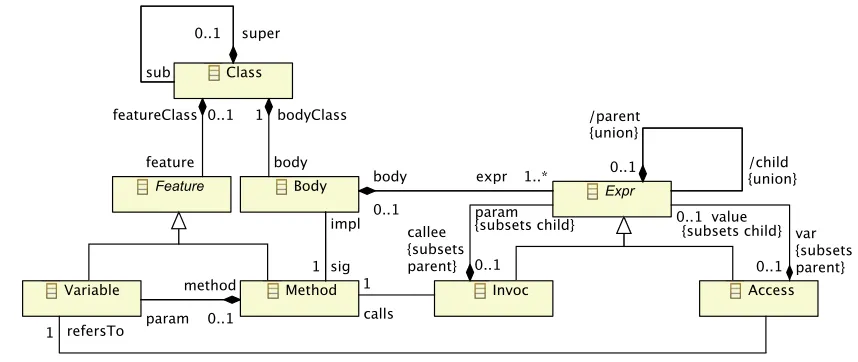
Figure 2: A modelM for program graphs shown as a class diagram
correspond to the composition associations ofFigure 2.
Figure 2 shows a UML class diagram for program graphs. The class diagram represents a model M of program graphs and also a meta-model because program graphs are models of
object-oriented programs, i.e., M is a model of a modeling language. As usual, missing
car-dinalities mean0..*. Also note thechild-parentassociation at classExpr. It is subsetted by the corresponding associations (actually their association ends) for the subclassesInvocandAccess. However, not all instances of the model represented by the class diagram are valid program graphs. Certain syntactic properties, usually called static semantics or consistency conditions, cannot be expressed by just a class diagram. The classPof all program graphs is rather defined
by the class diagram and additional constraints:
Definition 1 (Program graphs) The classPof program graphs consists of all instances of the
modelM inFigure 2that additionally satisfy the following constraints:
1. There is exactly one root class, i.e.,classnode without superclass.
2. AVariablenode either belongs to a class (linkfeature) or to a method (linkparam).
3. AnExprnode either belongs to aBody(linkbody) or to another expression (linkparent).
4. A body b may implement a method contained in some class c if b is contained in c or in a subclass of c.
5. Every class may contain at most one body defining or overriding a particular method m.
6. AnAccessnode e may refer to aVariablenode representing an attribute contained in some class c if e is a sub-expression of a body that is contained in c or some subclass of c.
7. AnAccessnode e may refer to a parameter of aMethodnode m if e is a sub-expression of a body implementing m.
context Class
def: visible : Set(Feature) = if super→isEmpty() then
feature
else
feature→union(super.visible)
endif
context Expr
def: visible : Set(Feature) = if body→isEmpty() then
parent.visible
else
body.bodyClass.visible
→union(body.sig.param)
endif
1) inv uniqueRoot: Class.allInstances()
→select(c|c.super→isEmpty())→size() = 1
2) context Variable inv validVariable:
featureClass→isEmpty()<>method→isEmpty()
3) context Expr inv validExpr:
body→isEmpty()<>parent→isEmpty()
4) context Body inv implementsVisibleMethod: bodyClass.visible→includes(sig)
5) context Body inv methodImplementedOnce:
not bodyClass.body→exists(b|b<>self and b.sig = self.sig)
6,7) context Access inv accessesVisibleVariable: visible→includes(refersTo)
The Object Constraint Language OCL of the UML has been defined for formally defining such consistency conditions [Obj06]. Figure 3shows the OCL constraints for program graphs based on the class diagram in Figure 2. The derived attributes visible of eachClass instance contain all features directly defined in the own class together with all visible features of its superclass. These sets, together with all parameters of the implemented method, are propagated to sub-expressions of method bodies. Conditions1–5are formalized by constraintsuniqueRoot,
validVariable,validExpr, implementsVisibleMethod, andmethodImplementedOnce, respectively. ConstraintaccessesVisibleVariable formalizes conditions6as well as7. Numbers inFigure 3 correspond to the ones used above.
Note that conditions1–3require each node, except a uniqueClassnode, to be a composite part of exactly one other node. The following observation follows from the fact that compositions cannot form cycles:
Fact 1 The subgraph ¯P of a program graph P induced by the composition edges is a spanning tree of P; the root of ¯P is aClassnode.
3
Star Grammars
We first recall many-sorted graphs:
Definition 2 (Graph) LetΣ=hΣ,˙ Σ¯ibe a pair of disjoint finite sets of sorts.
A many-sorted directed graph overΣ(graph, for short) is a tuple G=hG,˙ G,¯ s,t,σiwhere ˙G is a finite set of nodes, ¯G is a finite set of edges, the functions s,t : ¯G→G define the source and˙ target nodes of edges, and the pairσ=hσ˙,σ¯iof functions ˙σ: ˙G→Σ˙ and ¯σ: ¯G→Σ¯ associate nodes and edges with sorts.
Given graphs G and H, a pair m=hm,˙ m¯iof functions ˙m : ˙G→H and ¯˙ m : ¯G→H is a morphism¯ if it preserves sources, targets and sorts.
Star grammars are a special case of double pushout (DPO) graph transformation [EEPT06]. By [DHJM10, Theorem 2.8], they are equivalent to hyperedge replacement grammars [DHK97] a well-understood context-free kind of graph grammars.
Definition 3 (Star) We assume that the node sorts contain nonterminal sorts ˙Σv⊆Σ˙ so that the terminal node sorts are ˙Σt=Σ˙\Σv˙ .
Consider a (star-like) graph X , with one center node cX of nonterminal sort x∈Σv˙ , and with some border nodes (of terminal sorts from ˙Σt) so that the edges of X connect cX to some of the border nodes. Then X is called an incomplete star named x. An incomplete star is called a star if each border node is incident with at least one edge. An (incomplete) star is straight if every border node is incident with at most one edge. LetX denote the class of stars,G(X)the graphs
with stars, andG those without stars (where all nodes are labeled by ˙Σt). We assume that nodes
of nonterminal sort are not adjacent to each other in any graph.
C 1
Prg : := start
C 1
Hy
C 1
Hy : := hy ∗ C 1 C Cls Hy C 1
Cls : := cls ∗ C 1 Fea C 1
Fea : := var
C 1
V C 1
Fea : := meth ∗ ? C 1 M B V Bdy C 1
Fea : := ovrd C 1 M B Bdy B 1
Bdy : := bdy ∗ B 1 Exp x 1
Exp: := exp x 1 A Acc x 1 I Inv A 1
Acc : := acc ? A 1 Exp V I 1
Inv : := call
I 1
∗
M
Exp
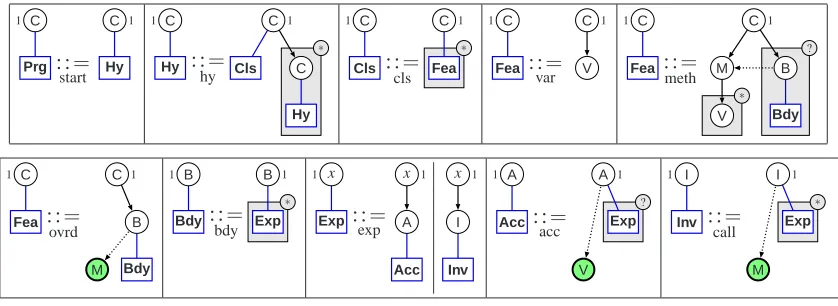
Figure 4: The rules of the star grammarPT
R∈G(X)that contains the border nodes of L. An incomplete star rule is called a star rule if L
is a star.
The (incomplete) star rule r applies to some graph G if there is a morphism m : L→G, yielding a graph H that is constructed by adding the nodes ˙R\˙L and edges ¯R disjointly to G, and by replacing, for every edge in ¯R, every source or target node v∈ ˙L by the node ˙m(v), and by removing the edges ¯m(¯L)and the node ˙m(cL).
We write G⇒rH if such a star replacement exists, G⇒R H if G⇒rH for some r from a
finite setR of (incomplete) star rules, and denote the reflexive-transitive closure of this relation
by⇒∗R.
In the remainder of this section, we consider star rules only; incomplete star rules will only be used as a part of contextual star rules inSection 4.
Example 1 (Star Replacement) Figure 4shows a set of star rules. The center nodes of stars are depicted as boxes enclosing the star name. Nodes with terminal symbols are drawn as circles with their sort inscribed.
The replacements of some rules show examples of abbreviating notation for repetitions in graphs and for optional subgraphs, which we will use frequently in star rules. Shaded boxes with a “∗” in the top-right corner, like those in ruleshy, cls,meth,bdy, andcall, designate multiple subgraphsthat may occur n times, n>0, in the graph, with the same connections to the rest. If the shaded box has a “?” in its top-right corner (in rulesmethandacc), its contained subgraph may occur 1 or 0 times in the graph. Note that this notation is similar to the EBNF notation of context-free string grammars. Likewise, it is just an abbreviating notation; one can always replace rules with this notation by several plain star rules using auxiliary stars and recursion, as long as shaded boxes do not include any of their rules’ border nodes.
Definition 5 (Star Grammar) Γ=hG(X),X,R,Ziis a star grammar with a start star Z∈X.
Example 2 (Star Grammar for Program Skeletons) Figure 4shows the star rules generating the program skeletons that underlie program graphs. The rules define a star grammarPT, with the left-hand side of the first rule indicating the start star (named Prg). Terminal node sorts are abbreviations of the class names inFigure 2, e.g.,Cinstead ofClass. Terminal edge sorts are omitted completely. They can be easily inferred from the sorts of the incident nodes. Ruleexp, which already is a shorthand for two rules, indicated by the two alternative replacements, uses xas border node sort where x stands for B,A, orI. Note that this is again just an abbreviating notation.
Consider rules ovrd, acc, and call, which generate method overriding, variable access, and method invocations. The overridden method, the accessed variable, and the invoked method, respectively, are distinguished by drawing them as filled circles with thick lines. In the skeleton rules, they are created anew. In a correct program graph according toSection 2, these distin-guished nodes have to be identified (“merged”) with the corresponding nodes that have been created elsewhere by rulesvarandmeth, and represent their declarations. However, identifica-tion of nodes cannot be represented by star grammars, but requires contextual star grammars as defined in the next section.
PTgenerates graphs that are closely related to program graphs. Given any graph G∈L(PT),
let GTdenote the graph obtained from G by removing all filled nodes and dashed edges from G. Let LT(PT):={GT |G∈L(PT)} denote the class of all such graphs. The following fact
directly follows from the structure of rules inPT:
Fact 2 LT(PT)is a language of trees.
Obviously, grammarPTcreates a single root class, and for each class an arbitrary number of subclasses. Each class gets arbitrarily many variables, method declarations, and bodies that con-sist of an arbitrary number of expressions that are either variable accesses or method invocations, consistent with the class diagram inFigure 2. Apparently,LT(PT)is the language of all trees that fit the class diagram when considering just its composition associations and additionally requiring the conditions1–3inDefinition 1. Based onFact 1we can infer:
Fact 3 The spanning tree ¯P of each program graph P∈P(cf.Fact 1) is a member ofLT(PT).
LetLM(PT)denote the language of all graphs that can be obtained from a member ofL(PT)
by merging each filled node with a corresponding declaration node. Let P∈P be an arbitrary
program graph. Its spanning tree ¯P is equal to graph GT of some graph G∈L(PT) because
ofFact 3. P can be obtained by identifying the filled nodes of G with appropriate declaration nodes, i.e., P∈LM(PT). On the other hand, it is obvious that each identification of filled nodes with declaration nodes fits the class diagram and conditions1–3inDefinition 1. Therefore, each graph G∈LM(PT)satisfying conditions4–7, too, is a program graph. We can summarize:
Fact 4 The set of all graphs G∈LM(PT)that satisfy conditions4–7inDefinition 1is equal toP.
their generative power is limited. Indeed, we have the following
Fact 5 There is no star grammarΓwithL(Γ) =P.
Proof Sketch Consider the rulecallinFigure 4. (The situation is similar for rulesovrdandacc.) This rule generates a new node for a method (drawn filled, and with thick lines). However, for generating a program graph, the rule should insert a call to a method that already exists in the host graph, and may be called in the expression. Due to the restricted form of star rules, the method had to be on the border of the rule. Since expressions may call every method in the graph, the star rule must have all these methods as its border nodes so that one of them can be selected. However, the number of callable methods depends on the size of the program, and is unbounded. Thus a finite set of star rules does not suffice to define all legal method calls.
4
Contextual Star Grammars
The adaptive star grammars defined in [DHJ+06] overcome the deficiencies illustrated in the proof sketch forFact 5by allowing the left-hand sides of star rules to adapt to as many border nodes as needed. A further extension, by positive and negative application conditions, extended their power, however with rather complicated rules [Hof10]. In this paper, we therefore consider a different extension of star rules with which program graphs can be completely defined in a simple way. We allow that the application of a star rule depends on its context in the host graph. Some positive context may be required whereas other, negative, context is forbidden if the rule shall apply. Nodes of the positive context may be used by the replacement graph of the rule.
Definition 6 (Contextual Star Rule) A contextual star rule r has the form r=P/N≀L ::=R, where L ::=R is an incomplete star rule, and the positive contexts P as well as the negative contexts N are (decidable) sets of graphs that contain the border nodes of L as subgraph. (Note that r is a star rule if L is a star and the sets P and N are empty.)
The contextual star rule r applies to some graph G if there is a morphism m : L→G that can be extended to a morphism C→G for at least one positive context C∈P (if P6= /0) and that cannot be extended to a morphism C→G for any negative context C∈N, yielding a graph H by applying the incomplete star rule L ::=R to G with morphism m.
Then we write G=⇒c rH, G c
=⇒RH if G
c
=⇒rH for some r from a finite setRof contextual star rules, and denote the reflexive-transitive closure of this relation by=c⇒∗R.
Definition 7 (Contextual Star Grammar) Γ=hG(X),X,R,Ziis a contextual star grammar
(CSG) with a start star Z∈X and a finite setR of contextual star rules. The language ofΓ
is obtained by exhaustive application of its rules, starting from the start star:L(Γ) ={G∈G |
Z=⇒c ∗R′G}.
M 2
C 1
Fea : := ovrd
C 1
M B
Bdy
P= C C M
+
1 2
N=1 C B M 2
V 2
A 1
Acc : := acc
? A 1
Exp
V
P1= A x B C V
+ +
1 2
P2= A x B M V
+
1 2
M 2
I 1
Inv : := call
I 1
∗
M
Exp
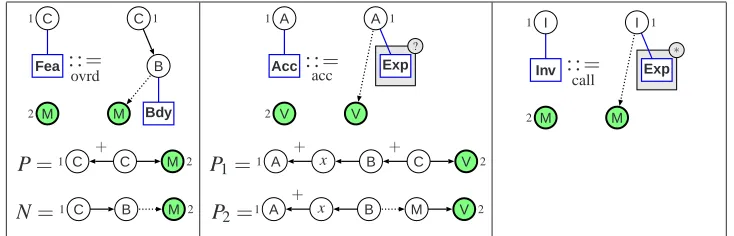
Figure 5: The contextual star rules of the grammarPG
is not necessary for specifying program graphs.
Example 3 (Contextual Star Grammar for Program Graphs) The CSG for program graphs con-tains the star rulesstart, hy,cls, var, meth, bdy, andexpofPTinFigure 4, and the contextual rules inFigure 5. In these rules, specifications of positive and negative contexts are drawn below their incomplete star rules. Small numbers indicate the correspondence between context nodes and border nodes.
So filled nodes in rulesovrd, acc, andcallofPT are turned into context nodes inPG. Path expressions encode conditions4–7inDefinition 1. A small “+” above an edge represents any path of length>1. In ruleovrd, the path expression of the positive context P encodes condition4, i.e., the method declaration must be inherited by the current class, while the negative context encodes condition5, i.e., the current class must not have a second body for the same method declaration. Ruleaccdoes not have a negative context, but two positive contexts. Ruleaccmay be applied either with context P1 or with context P2. P1and P2encode conditions 6and7, i.e., access to a visible attribute variable and to a visible parameter, respectively. The node labeled x represents a node of any sort. Rulecallhas empty positive and negative contexts and is applicable if its incomplete star rule applies. However, it still is a contextual star rule because its left-hand side requires the existence of anM-node in the context.
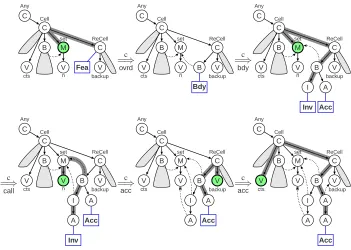
InFigure 6, some steps in the derivation of the program graph in Figure 1 are shown. The first graph represents the class hierarchy of the program graph. The grey bubbles in these graphs abstract from parts of the derived graph that are nor relevant for the derivation steps shown. The ruleovrdcan be applied to this graph, where we draw the context node filled, with thick lines, and underlay the path leading to it in grey. We use the same drawing convention for the remaining derivation steps usingbdy,call,acc, and againacc.
The following fact is a direct implication ofFact 4:
Fact 6 L(PG) =P.
C Any C Cell B M set C ReCell V cts V n Fea V backup c =⇒ ovrd C Any C Cell B M set C ReCell V cts V n B V backup Bdy c =⇒ bdy C Any C Cell B M set C ReCell V cts V n B V backup I A Inv Acc c =⇒ call C Any C Cell B M set C ReCell V cts V n B V backup I A A Inv Acc c =⇒ acc C Any C Cell B M set C ReCell V cts V n B V backup I A A Acc c =⇒ acc C Any C Cell B M set C ReCell V cts V n B V backup I A A A Acc
Figure 6: Deriving the program graph of Figure1withPG
can be used to parse star grammars. The same parser with only slight extensions can also be used for parsing CSGs. This parser is outlined below.
The parser works on CSGs like a Cocke-Younger-Kasami (CYK) parser for string grammars. The CSG has to be in Chomsky normalform (CNF) so that each production rule is either terminal or nonterminal. The right-hand side of a terminal rule is a terminal graph with only one edge, the right-hand side of a non-terminal rule is the union of two stars. Similar to string grammars, each CSG that does not produce the empty graph can be transformed into CNF. Given a terminal graph G, the parser creates a derivation for G, if it exists, in two phases. The first phase completely ignores contexts of contextual star rules and creates candidates for derivations. The second phase searches for a derivation by checking these candidates, this time considering contexts.
The second parser phase checks these derivation candidates by testing for each application of a contextual star rule whether required context has already been created and forbidden context has not (yet) been created earlier in the derivation. The parser stops when it finds the first valid derivation, or when it has checked the last derivation candidate without success.
5
Discussion
In the previous sections we have used two different techniques to describe program graphs. We have shown that the specification of program graphs by CSGs is indeed equivalent to their defi-nition using a model together with OCL constraints. Moreover, both approaches allow for auto-matic checking whether a given graph is a valid program graph. Both specifications are actually even more closely related as the following discussion shows.
The CSG for program graphs consists of (plain) star rules and contextual star rules. As de-scribed byFact 2, the tree structure (made from composition links) of program graphs can be constructed by (plain) star rules. Plain star grammars, however, fail for linksrefersToandcall, i.e., those program graph edges that represent references to objects that are located “far away” in the program structure. Contextual star rules are needed to add those edges; the far away ob-jects are represented by the rules’ context nodes (Figure 5). The positive and negative contexts of those rules play the same role like the OCL constraints for conditions4–7inFigure 3. These con-straints actually can be considered as an OCL implementation of the rules’ context conditions. E.g., constraintmethodImplementedOncefor condition5inDefinition 1prohibits a second body of the same method within the same class; this exactly corresponds to the negative context N of ruleovrd(Figure 5). The path expressions P, P1, and P2 of rulesovrdandacc, respectively, re-alize conditions 4, 6, and7. Their OCL realizations make use of the derived attributesvisible
whose recursive definition exactly reflects the iteration operator “+” in the path expressions. The contextual star grammar PG (Figure 4 and 5) for program graphs has been created by hand. The discussion, however, has revealed a close relation between OCL constraints and pos-itive as well as negative contexts on the one hand, and between class diagram and contextual star rules without those contexts on the other hand. This close relation may lead to a procedure for translating CSGs and meta models with OCL constraints into each other at least in a semi-automatic way. This line of research is also motivated by work of Ehrig et al. [EKT09]. They create graph transformation rules with graph constraints from meta models with OCL constraints. The graph transformation system is then used to automatically generate model instances of the meta model. However, they only consider very restricted OCL constraints that are not sufficient for the specification of program graphs, and their generated layered graph transformation rules are rather complicated, and are less suited for parsing.
6
Conclusions
for inductive proofs or for automatic instance generation than the proposed grammar-based ap-proach. A comparison of both specification approaches, however, has shown close relations be-tween both specification approaches which may allow for a semi-automatic translation process between both specification approaches. This will be subject of future work.
Too many kinds of graph grammars are related to contextual star grammars to mention all of them. So we restrict our discussion to those that aim at similar applications. Contextual star rules re-use path expressions first devised by M. Nagl [Nag79], which have later been implemented in the PROGRES graph transformation language [Sch97]. Using context conditions and exam-ining their relation to logical graph properties and constraints is not new either. A. Habel and K.-H. Pennemann have shown that nested graph conditions are equivalent to first-order graph formulas [HP09]. These conditions are still too weak to specify program graphs, as they only allow to require or forbid the existence of subgraphs of bounded size. Only in [HR10], A. Habel and H. Radke devised nested graph conditions with variables that allow to express the conditions of CSGs (and more). However, rules and grammars using such conditions are not yet consid-ered in that paper. Context-embedding rules [Min02] extend hyperedge replacement grammars by rules that add a single edge to an arbitrary graph pattern. They are used to define and parse diagram languages, but are not powerful enough to define models like program graphs. Graph reduction grammars [BPR10] have been proposed to define and check the shape of data struc-tures with pointers. While the form of their rules is not restricted, reduction with them is required to be terminating and confluent, so that random application of rules provides a backtracking-free parsing algorithm. It is still open whether graph reduction grammars suffice to define program graphs.
The nested patterns [HJG08] recently introduced to GRGEN [GBG+06], an efficient graph rewrite tool, allow to express nested graph conditions with variables that are defined by hyper-edge replacement systems, and can thus be used to implement contextual star grammars (like that for program graphs) in the future.
Acknowledgements: We thank the reviewers for their constructive criticism that helped to improve our paper.
Bibliography
[BPR10] A. Bakewell, D. Plump, C. Runciman. Specifying Pointer Structures by Graph Re-duction. Mathematical Structures in Computer Science, 2010. To appear.
[CEM+06] A. Corradini, H. Ehrig, U. Montanari, L. Ribeiro, G. Rozenberg (eds.). 3rd Int’l Conference on Graph Transformation (ICGT’06). Lecture Notes in Computer Sci-ence 4178. Springer, 2006.
[Cou87] B. Courcelle. An Axiomatic Definition of Context-free Rewriting and its Applica-tion to NLC rewriting. Theoretical Computer Science 55:141–181, 1987.
[DHJM10] F. Drewes, B. Hoffmann, D. Janssens, M. Minas. Adaptive Star Grammars and Their Languages. Theoretical Computer Science, 2010. Accepted for publication.
[DHK97] F. Drewes, A. Habel, H.-J. Kreowski. Hyperedge Replacement Graph Grammars. Chapter 2 in [Roz97].
[EEPT06] H. Ehrig, K. Ehrig, U. Prange, G. Taentzer. Fundamentals of Algebraic Graph Trans-formation. EATCS Monographs on Theoretical Computer Science. Springer, 2006.
[EKT09] K. Ehrig, J. M. K¨uster, G. Taentzer. Generating instance models from meta models. Software and System Modeling 8(4):479–500, 2009.
[ER97] J. Engelfriet, G. Rozenberg. Node Replacement Graph Grammars. Chapter 1 in [Roz97].
[GBG+06] R. Geiß, G. V. Batz, D. Grund, S. Hack, A. Szalkowski. GrGen: A Fast SPO-Based Graph Rewriting Tool. Pp. 383–397 in [CEM+06]. URL:http://www.grgen.net. [HJG08] B. Hoffmann, E. Jakumeit, R. Geiß. Graph Rewrite Rules with Structural Recursion.
In Mosbah and Habel (eds.), 2nd Intl. Workshop on Graph Computational Models (GCM 2008). Pp. 5–16. 2008.
[Hof10] B. Hoffmann. Conditional Adaptive Star Grammars. Electr. Comm. of the EASST, 2010. To appear.
[HP09] A. Habel, K.-H. Pennemann. Correctness of high-level transformation systems rela-tive to nested conditions. Mathematical Structures in Computer Science 19(2):245– 296, 2009.
[HR10] A. Habel, H. Radke. Expressiveness of graph conditions with variables. In Ehrig and Ermel (eds.), International Colloquium on Graph and Model Transformation (GraMoT’10). 2010. To appear in Electr. Comm. of the EASST.
[MEDJ05] T. Mens, N. V. Eetvelde, S. Demeyer, D. Janssens. Formalizing refactorings with graph transformations. Journal on Software Maintenance and Evolution: Research and Practice 17(4):247–276, 2005.
[Min02] M. Minas. Concepts and Realization of a Diagram Editor Generator Based on Hy-pergraph Transformation. Science of Computer Programming 44(2):157–180, 2002.
[Nag79] M. Nagl. Graph-Grammatiken: Theorie, Anwendungen, Implementierungen. Vieweg-Verlag, Braunschweig, 1979. In German.
[Obj06] Object Management Group. Specification of the Object Constraint Language. http://www.omg.org/spec/OCL/2.0/, 2006.
[Roz97] G. Rozenberg (ed.). Handbook of Graph Grammars and Computing by Graph Transformation, Vol. I: Foundations. World Scientific, Singapore, 1997.