0
S
OCIAL
W
ORK
P
ROGRAM
P
ROGRAM
C
OMPETENCY
A
SSESSMENT
R
EPORT
January 16, 2013
Department of Social Work The College of St. Scholastica
1200 Kenwood Avenue Duluth, Minnesota 55811
Phone: (218) 723-7048
Website: http://www.css.edu/Academics/School-of-Health-Sciences/Social-Work.html E-mail: [email protected]
1
Program Competency Assessment Report
The faculty of the Social Work Program has and specified forty-one interrelated practice behaviors associated with the program’s ten competencies and drawn from the CSWE 2008
Educational Policy and Accreditation Standards. These forty-one exemplar behaviors, consistent with the program’s Mission and Purpose, operationalize the program’s curriculum design and define how students in the Social Work Program at the College of St. Scholastica are evaluated for each of the core competencies. Graduation from the program requires students to successfully demonstrate all ten core competencies and continuously meet program guidelines through the exercise of these exemplar practice behaviors. Table 1 specifies the Program’s competencies and the associated forty-one practice behaviors.
For example, the first of the program’s competencies specifies that students must identify with the social work profession and behave in a professional manner. As the six behavioral exemplars of this competency specify, social work students at The College of St. Scholastica must: (a) demonstrate professional demeanor in behavior, appearance, and communication; (b) attend to their professional roles and boundaries; (c) advocate for client access to the services of social work; (d) practice personal reflection and self-correction to assure continual professional development; (e) engage in career-long learning; and (f) use supervision and consultation. In the case of the second program competency which pertains to the application of social work ethical principles, students are expected to apply ethical principles to guide professional practice. This is behaviorally operationalized through four assessed practice behaviors that require students to: (a) make ethical decisions by applying standards of the National Association of Social Workers Code of Ethics and, as applicable, of the International Federation of Social Workers/International Association of Schools of Social Work Ethics in Social Work, Statement of Principles; (b) recognize and manage personal values in a way that allows
professional values to guide practice; (c) tolerate ambiguity in resolving ethical conflicts; and (d) apply strategies of ethical reasoning to arrive at principled decisions. In this way, Table 1 delineates each of the program’s ten competencies and the interrelated comprehensive practice behaviors associated with each competency.
2
Table 1: Social Work Professional Competencies and Associated Practice Behaviors
Competency Practice Behaviors The Student will . . .
1. Identify as a professional social worker and conduct oneself accordingly
a) Demonstrate professional demeanor in behavior, appearance, and communication;
b) Attend to professional roles and boundaries;
c) Advocate for client access to the services of social work;
d) Practice personal reflection and self-correction to assure continual professional development;
e) Engage in career-long learning; and f) Use supervision and consultation 2. Apply social work ethical
principles to guide professional practice
a) Make ethical decisions by applying standards of the National Association of Social Workers Code of Ethics and, as applicable, of the International Federation of Social Workers/International Association of Schools of Social Work Ethics in Social Work, Statement of Principles;
b) Recognize and manage personal values in a way that allows professional values to guide practice;
c) Tolerate ambiguity in resolving ethical conflicts; and
d) Apply strategies of ethical reasoning to arrive at principled decisions 3. Apply critical thinking to inform
and communicate professional judgments
a) Distinguish, appraise and integrate multiple sources of knowledge, including research-based knowledge and practice wisdom;
b) Demonstrate effective oral and written communication in working with individuals, families, groups, organizations, communities, and colleagues; and c) Analyze models of assessment, prevention, intervention, and evaluation.
4. Engage diversity and difference in practice
a) Recognize and communicate their understanding of the importance of difference in shaping life experiences;
b) Recognize the extent to which a culture’s structures and values may oppress, marginalize, alienate, or create or enhance privilege and power;
c) Gain sufficient self-awareness to eliminate the influence of personal biases and values in working with diverse groups; and
d) View themselves as learners and engage those with whom they work as informants
5. Advance human rights and social and economic justice
a) Understand the forms and mechanisms of oppression and discrimination;
3
c) Engage in practices that advance social and economic justice.
6. Engage in research-informed practice and practice-informed research.
a) Use research evidence to inform practice; and
b) Use practice experience to inform scientific inquiry.
7. Apply knowledge of human behavior and the social environment
a) Critique and apply knowledge to understand person and environment; and
b) Utilize conceptual frameworks to guide the processes of assessment, intervention, and evaluation.
8. Engage in policy practice to advance social and economic well-being and to deliver effective social work services
a) Collaborate with colleagues and clients for effective policy action; and
b) Analyze, formulate, and advocate for policies that advance social well-being.
9. Respond to contexts that shape practice.
a) Provide leadership in promoting sustainable changes in service delivery and practice to improve the quality of social services; and
b) Continuously discover, appraise, and attend to changing locales, populations, scientific and technological developments, and emerging societal trends to provide relevant services.
10. Engage, assess, intervene, and evaluate with individuals, families, groups, organizations, and
communities
A) Engagement: a) Substantively and affectively prepare for action with individuals, families, groups, organizations, and communities;
b) Use empathy and other interpersonal skills; and
c) Develop a mutually agreed-on focus of work and desired outcomes. B) Assessment: a) Collect, organize, and interpret client data;
b) Assess client strengths and limitations;
c) Develop mutually agreed-on intervention goals and objectives; and d) Select appropriate intervention strategies.
4
b) Negotiate, mediate, and advocate for clients;
c) Help clients resolve problems;
d) Initiate actions to achieve organizational goals; and
e) Facilitate transitions and endings.
D) Evaluation: a) Critically analyze, monitor, and evaluate interventions.
Comprehensive Assessment Plan
The Social Work Program at The College of St. Scholastica has developed a comprehensive plan for assessing the attainment of these program competencies as operationalized through the associated practice behaviors and based on our curricular review. This plan specifies the practice behaviors associated with each competency; the benchmarks used to ensure that students in the program achieve the core competencies, as operationalized through the measureable practice behaviors (AS 4.0.1); the multiple measures and instruments used to gauge attainment of each of the forty-one behaviors; procedure for implementation of the plan, including time-frames; and general analysis procedure. Practice Behaviors
The impact of implementing the forty-one behavioral exemplars as specified by CSWE within the program’s overall curriculum design and assessment plan was reviewed by faculty with various
linkages between each competency and the corresponding practice behaviors specified within the explicit curriculum. Faculty members identified areas within all courses and field content where they believed students best learn and then demonstrate the practice behaviors determined to exemplify each competency. Measurable practice behaviors were identified, linked to each competency in the
curriculum, and then specified in course learning goals and outcome.
As part of our program assessment plan, faculty members have designed rubrics for each course to be used with students across all our program locations to insure uniform assessment methods. These rubrics are provided to students at the beginning of each semester so they can understand how they are to be evaluated in performance of the various practice behaviors embedded within each course. Students are then scored on these embedded measures according to the rubric using a five-point score (0 – 4), with the individual student scores reported to the program’s administration.
5
Table 2: List of Measures
Measure Benchmark Course(s)/Timing
1. Embedded Measures (at least one for each competency associated behavior) Mean of 2.0 All classes (near end )
2. Field I Performance Plan Mean of 2.0 SWK 3555
3. Field II Performance Plan Mean of 2.5 SWK 4555
4. Student Assessment of Self Competency I (Junior year) Mean of 2.0 Junior Year
5. Student Assessment of Self Competency II (Senior year) Mean of 2.5 Senior Year
Data Analysis Plan
Three types of data have been analyzed to determine how well student learning meets the benchmarks for our core competencies: (1) Embedded measures; (2) Field Performance Plans; and (3) Student Assessment of Self Competencies. The Social Work Program has identified these assessment measures for the purpose of program analysis, as well as identified how each of the measures is to be used for assessing student achievement of the practice behaviors associated with the program
competencies. The analysis of data collected in the Field Practicum using the Field Performance Plans involves calculating the mean score for each practice behavior and then the calculation of the mean score for each competency. Additionally, senior students who fall below the benchmark of 2.5 in a specific behavior or across an entire competency are compared to the total number of students included in field. In a similar fashion, the mean score of each embedded measure is calculated for each practice behavior and then the calculation is made for each competency, based on a benchmark of 2.0 for embedded measures. Scores on the SASC I and SASC II are analyzed in the same way, with a
benchmark of 2.0 being used for the SASC I and a benchmark of 2.5 being used for the SASC II. Scores for all three measures also are analyzed using weighted means – after faculty discussions, it was
determined that a consensus believed instruments measuring classroom learning (embedded measures) and another judging field practice experiences (Field Performance Plan), with faculty assessment in both cases, appear as more valid measures of performance compared to a student’s own assessment of self efficacy (SASC I & II). As a result, part of our analysis contains information in which the
embedded measures and Field Performance Plan scores each contribute 35% to the mean score for the competency and the SASC I contributes 10%, with the SASC II contributing 20%.
The Social Work Program at CSS is one program with multiple sites. Since we operate through four locations – Duluth, St. Paul, Brainerd, and Fond du Lac Tribal and Community College – the data are analyzed in ways that allow any variations across our sites to be observed. Data from the four sites
6 also are combined to produce a composite view of our overall program’s performance with the
7 Summary of Program Assessment Data
Data for this report was planned and collected between the 2010 - 2012 academic years and has been analyzed as previously described. It should be noted that in addition to the above mentioned data collection activities, the Social Work Program collects a wide array of data for program, student, and faculty evaluation, including student satisfaction surveys each semester in each class, periodic alumni and agency need surveys, field satisfaction survey, faculty job satisfaction surveys, and a number of other measures to help improve our overall program. For the purposes of this report, the three
previously discussed primary measures are analyzed to determine how well student learning outcome meet our benchmarks for our core competencies. Since the embedded measures were assessed within the classroom setting, the number of students scored in each of these key behavioral indicators varied from as few as nine to as many as fifty-four students, depending on the number of sections and the class size (overall 94% response rate). Thirty-one student responses were evaluated through the Field
Performance Plan (91%). Fifty-two students completed the SASC I as they prepared for Junior Field while forty-seven responses of senior students were captured with the SASC II (an 87% response rate) near the end of Field II. Not all evaluations have been included due to missing data, evaluations completed incorrectly, or an occasional situation where a student did not complete the course, resulting in an incomplete grade status at the end of the evaluation period.
Summary of Results
SASC II – Student Self Evaluation (n = 47)
Senior students SASC II scores exceeded the benchmark of 2.5 on all ten competencies; Senior students felt most confident in
1. Competency 1 - identification with the profession of social work and their ability to conduct themselves accordingly (mean of 3.37);
2. Competency 2 - applying social work ethical principles to guide professional practice (3.23);
3. Competency 10 - engaging, assessing, intervening, and evaluating with individuals, families, groups, organizations, and communities (3.10); and
4. Competency 5 - advancing human rights and social and economic justice (3.03). Senior students felt least confident in
8 2. Competency 6 - engaging in research-informed practice and practice-informed
research (2.79);
3. Competency 7 – applying knowledge of human behavior and the social environment (2.92); and
4. Competency 4 - engaging diversity and difference in practice (2.98).
Senior students’ scores reflected significant gains in self-confidence in their ability to perform competency associated behaviors between year one and two in the program. It is felt that this helps affirm the programs’ incorporation of two field experiences (125 hours in the junior year; 425 hours in the senior year). The largest gains across the year were in
1. Competency 10 - engaging, assessing, intervening, and evaluating with individuals, families, groups, organizations, and communities (gain of .81 point on a 4-point scale); 2. Competency 8 - engaging in policy practice to advance social and economic well-being and to deliver effective social work services (.70 point);
3. Competency 7 - applying knowledge of human behavior and the social environment (.67 point); and
4. Competency 3 - applying critical thinking to inform and communicate professional judgments (.60 point).
SASC I – Self Evaluation (n = 52)
Junior students SASC I scores exceeded the benchmark of 2.0 on all ten competencies. Junior student felt most confident in
1. Competency 1 - identification with the profession of social work and their ability to conduct themselves accordingly (mean of 2.88);
2. Competency 5 - advancing human rights and social and economic justice (2.67); 3. Competency 2 - applying social work ethical principles to guide professional practice (2.65); and
3. Competency 4 - engaging diversity and difference in practice (2.54). Junior student felt least confident in
1. Competency 9 - responding to contexts that shape practice (mean of 2.15);
2. Competency 7 - applying knowledge of human behavior and the social environment (2.25);
9 3. Competency 10 - engaging, assessing, intervening, and evaluating with individuals, families, groups, organizations, and communities (2.29); and
4. Competency 6 - engaging in research-informed practice and practice-informed research (2.35).
No Duluth student self-reported a SASC score below the established behavioral benchmarks of 2.0 for juniors and 2.5 for seniors. Similarly, no senior students at the distance-sites reported lower than benchmark scores on the SASC II. Some distance-sites students did report some scores on these indicators lower than benchmarks within junior-level SASC I data:
Brainerd junior students reported lower than benchmark levels with two competency behaviors:
Competency associated behavior 9.b (mean of 1.79);
10.D.a (1.95) – see Action Plan for Brainerd campus, below.
Although they achieved the benchmark on all ten competencies, St. Paul junior students self-reported their confidence in seven specific competency associated behaviors lower than the benchmarks:
3.c (mean of 1.88);
6.b (1.77);
7.b (1.77);
8.a (1.69);
9.b (1.81);
10.A.a (1.72) – see Action Plan for St. Paul campus, below.
Fond du Lac Tribal and Community College junior students self-reported several scores lower than the benchmarks on the SASC I:
5.c (mean score of 1.71);
7.a (1.71);
8.a (1.86);
9.b (1.57);
10.A.a (1.71);
10A.b (1.57);
10
10.B.d (1.45);
10.C.a (1.57);
10.D. (1.64) – see Action Plan for FDLTCC site.
It should noted, again, that the SASC I scores reflect the students’ self-confidence in their ability to carry out the competency behaviors prior to entering the first field practice experience (SWK 3555 – Field I). In all cases, there was
significant improvement in these scores when reported on the SASC II near the end of the second field experience (SWK 4555 – Field II). The gain in the mean value of each score between year one and year two is illustrated in Graph 3: Gain in SASC scores from year 1 to year 2.
Graphs 1- 3. represent data drawn from the SASC I and II. Mean scores for each competency are included in the graph for ease of comparison. These three graphs illustrate the summary data in
Chart 3: Data from SASC I and SASC II.
Graph 1: SASC II data from senior year.
Graph 2: SASC I data from junior year.
3.37 3.23
3.00 2.98 3.03 2.79 2.92 3.00 2.75 3.10
0.00 1.00 2.00 3.00 4.00
1 2 3 4 5 6 7 8 9 10
SASC II (Senior Year)
2.88 2.65
2.40 2.54 2.67 2.35 2.25 2.30 2.15 2.29
0.00 1.00 2.00 3.00 4.00
1 2 3 4 5 6 7 8 9 10
SASC I (Junior Year)
Benchmark
11 Graph 3: Gain in SASC scores from year 1 to year 2.
Chart 3: Mean scores from SASC I and SASC II.
Embedded Measures (n = 9 – 54)
The program achieved the overall benchmark of 2.0 on competencies through our embedded measures;
The overall three highest scores within embedded measures were achieved on
1. Competency 3 - applying critical thinking to inform and communicate professional judgments (mean score of 2.63);
2. Competency 6 - engaging in research-informed practice and practice-informed research (2.59); and
3. Competency 9 – responding to contexts that shape practice (2.57).
The overall three lowest scores within embedded measures taken from our classrooms were on
1. Competency 5 – advancing human rights and social and economic justice (mean score of 2.11);
2. Competency 8 – engaging in policy practice to advance social and economic well-being and to deliver effective social work services (2.19); and
3. Competency 4 – engaging diversity and difference in practice (2.20).
While all sites were able to achieve benchmarks within the overall competencies, analysis allowed identification of mean scores lower than the benchmarks on specific
0.49 0.58 0.60 0.44
0.36 0.44
0.67 0.70 0.60
0.81
0.00 0.20 0.40 0.60 0.80 1.00
1 2 3 4 5 6 7 8 9 10
Gain is SASC Scores
between Year I & Year II
Competency 1 2 3 4 5 6 7 8 9 10
SASC I 2.88 2.65 2.40 2.54 2.67 2.35 2.25 2.30 2.15 2.29
12 key indicator behaviors across our different campus sites. These specific behavioral indicators are targets for change in the curriculum and/or programming:
The Duluth campus achieved the benchmark established on each competency associated behaviors within the embedded measures and, as a result, achieved the overall benchmark scores on these measures of the competencies.
The Brainerd campus identified six competency associated behaviors within the embedded measures as change targets:
3.a. (mean of 1.62);
4.a (1.77);
4.d (1.57);
5.b (1.46);
7.b (1.64); and
10.A.c (1.62) - see Action Plan for Brainerd campus, below.
The St. Paul campus identified one competency associated behaviors within the embedded measures as a change target:
10.A.c (mean score of 1.77) - see Action Plan for St. Paul Campus, below As with other sites, students at the Fond du Lac Tribal and Community College site exceeded the benchmarks on all overall competencies. There were six behaviors within the embedded measures that became targets for change:
1.b (mean score of 1.94);
1.d (1.95);
1.e (1.95);
1.f (1.95);
9.b (1.88); and
10.A.a (1.82) - see Action Plan for FDLTCC campus, below.
Graphs 4 - 9. represent data drawn from the embedded measures used to evaluate performance on the competency associated behaviors within our classroom environment. The mean score for each competency is included in each graph for ease of comparison. These six graphs illustrate the summary data in Chart 3: Data from SASC I and SASC II.
13 Graph 4: Means scores on competencies from embedded measures for all sites.
Graph 5: Means scores on competency associated behavior from embedded measures for all sites.
Graph 6: Means scores on competencies from embedded measures for Duluth campus.
Graph 7: Means scores on competencies from embedded measures for St. Paul Campus.
2.37 2.35 2.63 2.20 2.11 2.59 2.38 2.19 2.57 2.28
0.00 1.00 2.00 3.00 4.00
1 2 3 4 5 6 7 8 9 10
Mean Scores of Competencies from Embedded Measures - Composite
0.00 1.00 2.00 3.00 4.00
1.a 1.d 2.b 3.a 4.a 4.d 5.c 7.a 8.b
10
.A.a
10
.B.a
10
.B.c
10
.C.b
10
.C.e
Composite Mean Scores of Behaviors
from Embedded Measures
2.52 2.53 2.45 2.47 2.39 2.32 2.51 2.59 2.50 2.36
0.00 2.00 4.00
1 2 3 4 5 6 7 8 9 10
Mean Scores of Competencies for Embedded Measures Duluth Campus
2.31 2.30 2.18 2.35 2.18 2.22 2.19 2.36 2.22 2.22
0.00 2.00 4.00
1 2 3 4 5 6 7 8 9 10
Mean Scores of Competencies for Embedded Measures St. Paul Campus
Benchmark
Benchmark
Benchmark Benchmark
14 Graph 8: Means scores on competencies from embedded measures for Brainerd Campus.
Graph 9: Means scores on competencies from embedded measures for Fond du Lac Tribal and Community College site.
Field Performance Plan (n = 31)
The program achieved the overall benchmark of 2.5 on competencies in our Field Performance Plan;
The overall three highest scores within embedded measures were achieved in 1. Competency 9 – responding to contexts that shape practice (mean score of 2.96); 2. Competency 1 – identification with the profession of social work and their ability to conduct themselves accordingly (2.91); and
3. Competency 8 – engaging in policy practice to advance social and economic well-being and to deliver effective social work services (2.83) and Competency 10 - engage, assess, intervene, and evaluate with individuals, families, groups, organizations, and communities (2.83).
The overall three lowest scores derived from the Field Performance Plan data include 1. Competency 7 - Apply knowledge of human behavior and the social environment (means score of 2.55);
2.52 2.44 2.17 2.04 2.02 2.37 2.07 2.37 2.47 2.28
0.00 2.00 4.00
1 2 3 4 5 6 7 8 9 10
Mean Scores of Competencies for Embedded Measures Brainerd Campus
2.04 2.23 2.31 2.29 2.22 2.10 2.15 2.46 2.11 2.16
0.00 2.00 4.00
1 2 3 4 5 6 7 8 9 10
Mean of Competencies for Embedded Measures FDLTCC Campus
Benchmark
15 2. Competency 6 - engaging in research-informed practice and practice-informed
research (2.60); and
3. Competency 4 - engaging diversity and difference in practice (2.61).
Comparison of scores in the assessment of competencies through Field, compared to assessment through embedded measures reflect a gain in all scores except Competency 6 which remained unchanged (see Graph 11: Comparison of scores on competencies from Field II Performance Plan and scores on embedded measures; and Chart 4).
Graph 10. represents data drawn from the Field Performance Plan measures used to evaluate competency. The mean score for each competency is included in the graph for ease of comparison.
Graph 10: Means scores on competencies from Field II Performance Plan for all sites.
Graph 11: Comparison of scores on competencies from Field II Performance Plan and scores on embedded measures.
Chart 4: Gains in competency score means between embedded measures and Field Performance Plan.
2.91 2.82 2.78
2.61 2.68 2.60 2.55 2.83 2.96 2.83
0.00 1.00 2.00 3.00 4.00
1 2 3 4 5 6 7 8 9 10
Field II Mean Scores on Competencies
0.00 1.00 2.00 3.00 4.00
1 2 3 4 5 6 7 8 9 10
Comparison of Field Scores and Embedded Measures on Competencies
Field
Embedded Measures
Instrument Competency 1 2 3 4 5 6 7 8 9 10
Field ADJ Mean 2.91 2.82 2.78 2.61 2.68 2.60 2.55 2.83 2.96 2.83
Embedded MeasuresADJ Mean 2.37 2.35 2.63 2.20 2.11 2.59 2.38 2.19 2.57 2.28
Difference 0.54 0.47 0.15 0.41 0.56 0.00 0.17 0.64 0.39 0.56
16 Weighted Mean Scores of Competencies
The program achieved the overall benchmark of 2.5 on all competencies assessed through our weighted mean scores;
The three highest scores within the weighted mean scores were achieved in
Competency 1 - identification with the profession of social work and the ability of students to conduct themselves accordingly (mean score of 2.81);
Competency 3 – apply critical thinking to inform and communicate professional judgments (2.73); and
Competency 2 – (2.72) apply social work ethical principles to guide professional practice. The three lowest scores within the weighted mean scores were achieved in
Competency 4 – engage diversity and difference in practice (mean score of 2.53);
Competency 7 – apply knowledge of human behavior and the social environment (2.54); and
Competency 5 – advance human rights and social justice (2.55).
As previously discussed, scores for the embedded measures and Field Performance Plan each contribute 35% to the mean score for the competency using weighted means, while the SASC I contributes 10%, with the SASC II contributing 20% for the measure.
Graphs 12- 15. represent data developed from the weighted mean scores of the competency data.. The mean score calculated for each competency is included in each graph for ease of comparison.
Graph 12: Weighted mean scores on competencies from all measures.
2.81 2.72 2.73 2.53 2.55 2.61 2.54 2.59 2.70 2.64
0.00 1.00 2.00 3.00 4.00
1 2 3 4 5 6 7 8 9 10
Weighted Mean Scores of Competencies - All Sites
17 Graph 12: Weighted mean scores on competencies for Duluth Campus.
Graph 13: Weighted mean scores on competencies for St. Paul Campus.
Graph 14: Weighted mean scores on competencies for Brainerd Campus.
2.75 2.76 2.69 2.84 2.65 2.67 2.70 2.61 2.68 2.62
0.00 1.00 2.00 3.00 4.00
1 2 3 4 5 6 7 8 9 10
Weighted Means on Competencies for Duluth Campus
2.74 2.61 2.69 2.66 2.76 2.54 2.57 2.64 2.55 2.59
0.00 1.00 2.00 3.00 4.00
1 2 3 4 5 6 7 8 9 10
Weighted Means on Competencies for St. Paul Campus
2.84 2.78 2.63 2.64 2.60 2.67 2.57 2.69 2.69 2.70
0.00 1.00 2.00 3.00 4.00
1 2 3 4 5 6 7 8 9 10
Weighted Means on Competencies for Brainerd Campus
Benchmark
Benchmark
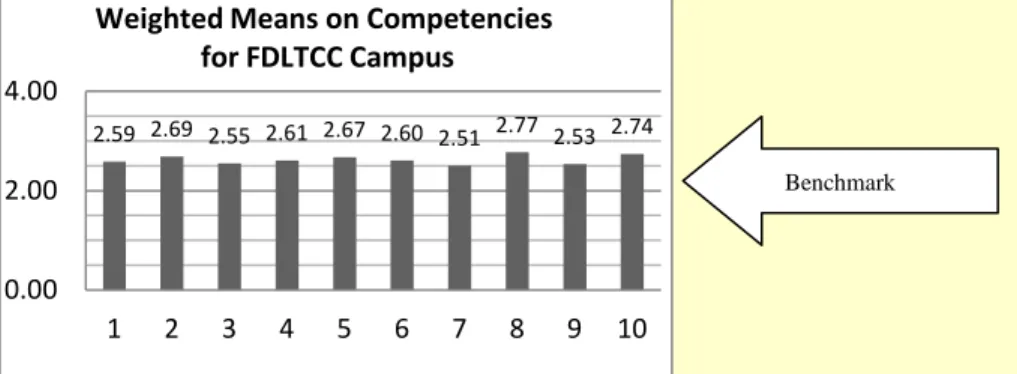
18 Graph 15: Weighted mean scores on competencies for Fond du Lac Tribal and
Community College CSS site.
Summary data for all measures according to the program location has been included in Table 3: Data for mean scores.
Table 3: Data for mean scores.
Summary Data for Duluth:
Summary Data for St. Paul Campus:
2.59 2.69 2.55 2.61 2.67 2.60 2.51 2.77 2.53 2.74
0.00 2.00 4.00
1 2 3 4 5 6 7 8 9 10
Weighted Means on Competencies for FDLTCC Campus
Instrument 1.a 1.b 1.c 1.d 1.e 1.f 2.a 2.b 2.c 2.d 3.a 3.b 3.c 4.a 4.b 4.c 4.d
Field I SASC 2.92 2.31 2.85 2.62 2.85 2.69 3.00 2.69 2.69 2.62 2.77 2.62 2.92 3.00 3.08 3.31 3.00
Field II SASC 3.46 3.38 2.77 3.38 3.23 3.31 3.38 3.46 3.15 2.92 2.77 3.38 3.23 3.62 3.38 3.54 3.31
Embedded 2.54 2.51 2.51 2.51 2.51 2.51 2.51 2.40 2.60 2.63 2.44 2.63 2.27 2.44 2.51 2.50 2.44
Composit 2.52 2.31 2.48 2.31 2.30 2.33 2.32 2.53 2.55 2.63 2.03 2.63 2.27 2.13 2.51 2.60 2.08
5.b 5.c 6.a 6.b 7.a 7.b 8.a 8.b 9.a 9.b 10.A.a 10.A.b 10.A.c 10.B.a 10.B.b 10.B.c 10.B.d 10.C.a 10.C.b
2.54 2.15 1.77 2.54 2.46 2.08 2.15 1.85 2.00 2.62 3.31 2.92 2.62 2.62 2.38 2.17 2.46 2.62 2.77
3.31 3.15 2.62 2.54 3.38 3.23 3.15 2.77 3.08 3.38 3.46 3.85 3.46 3.15 3.54 3.15 2.69 2.77 3.15
2.44 2.20 2.35 2.29 2.51 2.50 2.54 2.64 2.49 2.51 2.51 2.60 2.50 2.40 2.33 2.28 2.34 2.30 2.32
1.96 2.70 2.54 2.70 2.55 2.60 2.65 2.64 2.50 2.68 2.70 2.60 1.95 2.75 2.53 2.28 2.34 2.56 2.32
10.C.c 10.C.d 10.C.e 10.D.a Mean Values
2.46 2.15 2.31 1.73 2.57
3.15 3.00 2.92 3.15 3.19
2.28 2.12 2.51 2.22 2.44
2.28 2.12 2.32 2.55 2.31
Instrument 1.a 1.b 1.c 1.d 1.e 1.f 2.a 2.b 2.c 2.d 3.a 3.b 3.c 4.a 4.b 4.c 4.d 5.a
SWK 4555 3.00 2.70 2.73 3.00 2.40 2.90 2.50 2.50 2.53 2.70 2.25 2.50 2.39 2.00 2.00 2.00 2.00 2.33
Field I SASC 2.69 2.31 2.15 2.35 2.62 2.54 2.12 2.35 2.35 2.27 2.00 2.27 1.88 2.23 2.31 2.17 2.69 2.23
Field II SASC 3.75 3.50 3.33 3.50 3.75 3.42 3.58 3.33 3.33 3.33 3.58 3.50 3.25 3.67 3.42 3.33 3.75 3.58
Embedded 2.30 2.27 2.66 2.21 2.19 2.24 2.24 2.22 2.23 2.50 2.09 2.10 2.35 2.25 2.20 2.50 2.36 2.49
5.b 5.c 6.a 6.b 7.a 7.b 8.a 8.b 9.a 9.b 10.A.a 10.A.b 10.A.c 10.B.a 10.B.b 10.B.c 10.B.d 10.C.a 10.C.b
2.33 2.00 2.00 2.00 2.50 2.67 2.66 3.00 2.90 2.50 2.67 2.50 2.87 2.67 2.50 2.90 3.00 2.40 2.50
2.23 2.00 1.88 1.77 2.08 1.77 1.92 1.81 1.69 1.81 1.88 2.77 2.08 2.04 2.35 2.00 1.85 1.92 2.15
3.67 3.42 3.58 3.25 3.58 3.50 3.25 3.08 3.25 3.33 3.42 3.75 3.67 3.67 3.58 3.58 3.25 3.42 3.58
2.04 2.00 2.10 2.33 2.31 2.07 2.32 2.40 2.23 2.21 2.19 2.14 1.77 2.40 2.35 2.16 2.16 2.22 2.40
10.C.c 10.C.d 10.C.e 10.D.a Mean Values
2.58 2.25 2.50 2.40 2.51
2.27 1.85 1.92 1.73 2.13
3.58 3.50 3.25 3.25 3.47
2.28 2.20 2.25 2.32 2.25
19 Summary Data for Brainerd Campus:
Summary Data for FDLTCC Campus:
Faculty Findings
Competency 1: Identify oneself as a professional social worker and conduct oneself accordingly. As explained in the preceding discussion, students scores were well above the benchmark on scores of the Field Performance Plan, embedded measures, and the SASC I & II scores. The weighted mean score for Competency 1 was 2.81.
Competency 2: Apply Social Work Ethical Principles to Guide Practice.
Students scored relatively high scores on this competency; the CSS Social Work Program prides itself on the ethical principles developed in collaboration with our students and field placement supervisors. This is partially reflected in the SASC scores into the 3.5 range on a number of these practice behaviors. The weighted mean score for Competency 2 was 2.72.
Instrument 1.a 1.b 1.c 1.d 1.e 1.f 2.a 2.b 2.c 2.d 3.a 3.b 3.c 4.a 4.b 4.c 4.d 5.a
SWK 4555 PP 2.84 2.97 2.97 2.89 2.97 2.89 3.00 2.95 3.00 3.00 2.95 2.95 2.92 2.97 2.87 2.97 2.97 3.00
Field I SASC 2.95 2.63 2.16 2.47 2.63 2.53 2.37 2.63 2.47 2.32 2.26 2.26 2.00 2.63 2.53 2.44 2.84 2.53
Field II SASC 3.62 3.48 3.29 3.14 3.38 3.67 3.29 3.43 2.95 3.05 3.10 3.29 3.00 3.14 2.95 3.10 3.43 3.14
Embedded 2.80 2.39 2.52 2.44 2.44 2.47 2.42 2.30 2.40 2.63 1.62 2.60 2.30 1.77 2.50 2.30 1.57 2.22
5.b 5.c 6.a 6.b 7.a 7.b 8.a 8.b 9.a 9.b 10.A.a 10.A.b 10.A.c 10.B.a 10.B.b 10.B.c 10.B.d 10.C.a 10.C.b
2.92 3.00 2.95 2.95 2.92 2.92 2.89 3.00 2.92 2.89 2.97 2.95 2.97 2.92 2.95 2.97 2.97 2.95 2.92 2.26 2.26 2.21 2.00 2.42 2.16 2.26 2.16 2.05 1.79 2.16 3.11 2.53 2.32 2.21 2.21 2.11 2.00 2.16 3.14 2.90 3.10 2.86 3.10 2.90 3.24 2.86 3.00 3.10 3.29 3.71 3.38 3.29 3.38 3.19 3.00 3.05 3.05 1.46 2.40 2.44 2.30 2.49 1.64 2.41 2.33 2.50 2.45 2.49 2.60 1.62 2.20 2.19 2.28 2.40 2.40 2.30
10.C.a 10.C.b 10.C.c 10.C.d 10.C.e 10.D.a Mean Values
2.95 2.92 3.00 3.00 3.00 2.92 2.95
2.00 2.16 2.21 2.21 2.00 1.95 2.33
3.05 3.05 3.29 3.05 2.95 2.90 3.17
2.40 2.30 2.28 2.12 2.49 2.30 2.29
Instrument 1.a 1.b 1.c 1.d 1.e 1.f 2.a 2.b 2.c 2.d 3.a 3.b 3.c 4.a 4.b 4.c 4.d 5.a
Field I SASC 2.57 2.57 2.43 2.14 2.50 2.57 2.43 2.00 2.14 2.14 2.00 2.14 2.00 1.86 2.43 2.14 2.00 2.33
Field II SASC 2.50 2.31 2.48 2.31 2.30 2.33 2.32 2.60 2.70 2.63 2.03 2.63 2.27 2.13 2.51 2.50 2.08 2.36
Embedded 2.60 1.94 2.07 1.95 1.95 1.95 2.02 2.30 2.20 2.40 2.23 2.20 2.00 2.23 2.30 2.20 2.23 2.43
Composit 2.31 2.48 2.31 2.30 2.33 2.32 2.60 2.70 2.63 2.03 2.63 2.27 2.13 2.51 2.50 2.08 2.36
5.b 5.c 6.a 6.b 7.a 7.b 8.a 8.b 9.a 9.b 10.A.a 10.A.b 10.A.c 10.B.a 10.B.b 10.B.c 10.B.d 10.C.a 10.C.b 2.29 1.71 2.00 2.00 1.71 2.14 1.86 2.00 2.00 1.57 1.71 1.57 2.71 1.83 2.14 2.29 1.43 1.57 1.50 1.96 2.60 2.55 2.29 2.37 2.04 2.39 2.64 2.49 2.30 2.30 2.60 1.95 2.60 2.65 2.28 2.34 2.55 2.32 2.23 2.40 2.10 2.30 2.07 2.23 2.43 2.50 2.40 1.88 1.82 2.60 2.23 2.50 2.50 2.60 2.56 2.50 2.60 1.96 2.60 2.55 2.29 2.37 2.04 2.39 2.64 2.49 2.30 2.30 2.60 1.95 2.60 2.65 2.28 2.34 2.55 2.32
10.C.c 10.C.d 10.C.e 10.D.a 10.D.b Mean Values 1.92 1.93 1.90 1.64 1.57 2.03 2.28 2.12 2.70 2.50 2.70 2.39 2.60 2.50 2.60 2.70 2.55 2.30 2.28 2.12 2.32 2.50 2.52 2.37
20 Competency 3: Apply Critical Thinking to Inform and Communicate Professional Judgments.
Social workers require the ability to think critically, use multiple sources of knowledge, and communicate well. Mean scores on the key behaviors linked to this competency suggest this is an area for targeting some change in the curriculum. Although only a handful of students received scores below the benchmark, faculty chose to target this competency for department-wide efforts. These efforts will be discussed in the Action Plans, below. The weighted mean score for Competency 3 was 2.73.
Competency 4: Engage Diversity and Difference in Practice.
Social workers must be able to work with a variety of cultures, including oppressed and
marginalized peoples. Although program-wide scores were at the benchmark on this competency, the Brainerd distance-sites scored student’s learning low on this competency with the FDLTCC site
students scoring themselves low on confidence in working with these clients. As a result, both of these campuses developed site-specific approaches to improving student learning outcome on these behaviors (see Action Plans, below). The weighted mean score for Competency 4 was 2.53.
Competency5: Advance Human Rights and Social and Economic Justice.
CSS students historically have been strong advocates for human rights and social justice. Program-wide scores on the weighted mean assessment indicators for this competency were above the benchmark for all sites. None the less, scores on our student self-assessment (SASC) failed to bear this out through our FDLTCC campus; scores on embedded measures for some students at that campus, as well as at Brainerd were not in line with faculty expectations on this competency. As a result, the Action Plans for these two sites include ways to improve these key indicators. The weighted mean score for Competency 5 was 2.55.
Competency 6: Engage in Research-Informed Practice and Practice-Informed Research. Many CSS Social Work Program students find research to be one of their more challenging subjects. This may be reflected in many student’s lack of confidence in this area as reflected in lower scores on the SASC I & II measures. The majority of scores on the various measures are above the benchmarks for this competency, but special planning was initiated for the St. Paul campus to improve outcome through efforts explained in that site’s Action Plan. The weighted mean score for
21 Competency 7: Apply Knowledge of Human Behavior and the Social Environment.
The mean scores on this competency were above benchmarks while individual sites experienced problems with some students. In particular, the St. Paul campus scored below the benchmark for part of the competency associated behaviors linked to this competency. As a result, site-specific planning was implemented to correct this issue. The weighted mean score for Competency 7 was 2.54.
Competency 8: Engage in Policy Practice to Advance Social and Economic Well-Being and to Deliver Effective Social Work Services.
Classroom instructors, field faculty, and field supervisors scored students learning efforts above the benchmark for this competency’s practice behaviors. Students at several distance-sites rated themselves lower. In response to this student lack of self-confidence, the faculty is attempting to be more intentional in the use of language of the competencies and also in demonstrating the ways the competencies tie into field and classroom experiences (see Action Plan). The weighted mean score for Competency 8 was 2.59.
Competency 9: Respond to Contexts That Shape Practice.
Students assessed their confidence levels in this competency as relatively low, resulting in a number of SASC mean scores below the benchmark. While the weighted mean scores for this competency are above the benchmark, the majority of scores falling below the benchmark are due to student’s low scoring on the SASC. As with other measures, faculty decided to address this lack of confidence through the intentional use of competency-based language in the classroom and field while also developing site-specific approaches to the issues. The weighted mean score for Competency 9 was 2.70.
Competency 10: Engage, assess, intervene, and evaluate with Individuals, Families, Groups, Organizations, and Communities.
Faculty, students, and alumni of CSS take pride in the extensive practice component of the Social Work Program; the program requires students to complete four separate practice courses in order to graduate. The relatively high scores on a number of behaviors underlying this competency reflect that pride. While two sites experienced lower than benchmark scores on some practice behaviors, the overall program performance was well above the benchmark, as were all sites on the weighted means. The belief of faculty was that the transition between academic and field work is difficult for students
22 and that lower scores on SASC I and II reflects anxiety of that transition. Individual sites developed plans to address these issues. The weighted mean score for Competency 10 was 2.64.
Action Plans – faculty findings for program-wide changes
SASC: The faculty examined the SASC I versus SASC II results which demonstrate substantial differences in the scores, ranging from a .36 point to a .81 point improvement over the span of the academic year (see Graph 3). Faculty members felt this gain reflected the developmental nature of the curriculum as well as the value of two field experiences in the program. This echoed comments obtained in previous alumni surveys where former students identified the value of the extensive field experience while they were in the program (575 hours over two field experiences).
Embedded measures were discussed for each program. Faculty discussed several measures that were of concern to the entire program based on the assessment findings:
3.b. – Demonstrate effective oral and written communication: Embedded measure in
SWK 4441 - Communities class: It was determined that in some cases, this is our students’ first-time major writing assignment. Depending on the students’ background, faculty are unsure of the curriculum rigor or focus on writing skills provided through previous community colleges or other transfer sources for our students. On the SASC, students rated themselves as 2.36, substantially higher than was found through the embedded measures or in other class assignments for these skills. Faculty developed a plan to start new students in the program with comprehensive discussions on writing standards and substantial classroom and lab help with APA standards and style. One suggested idea involved providing mini-workshops for new students on writing skills as part of the program orientation, especially for the distance sites. Another suggestion was for faculty to require APA format in online discussion post assignments.
Department Plan: Adopt a departmental-wide policy for all courses, including our SWK 2240 - Introduction to Social Work course, requiring use of APA standards in all written products and requiring students to buy the current APA manual. The site coordinators will include this expectation in all courses and help students with learning and using APA in all assignments through new student orientation and lab sections.
23 5.c. – Engage in practices that advance social and economic justice: Embedded measures in SWK 4441 – Communities class: The faculty discussed that one of the texts -
Rothman and Erlick - is doing a better with the competencies. Faculty discussed reevaluating all our texts to find which are doing a better job with the competencies. Faculty also discussed redesigning the distance-site course sequencing.
Department Plan: Spring Coordinators’ Retreat will focus part of the discussion on to the new “laddering” of course content to develop new cross-course content. This is to include case studies that span multiple courses.
9.a. – Provide leadership in promoting sustainable changes in service delivery: The faculty discussed difficulties experienced by student in identifying leadership activities.
Faculty is examining the possibility of developing and adding a new social work leadership course specifically to address this competency associated behavior. 9b – Continuously discover, appraise, and attend to change: Some faculty integrate new technology into their courses to address this competency. Brainerd campus plans to develop and disseminate a brief survey to those students that took an elective Technology in Social Work course to see if confidence in this behavior is different compared to those students on other campuses that have not taken this course.
Departmental Plan: Consider moving this embedded measure from SWK 4440 – Group Practice to SWK 4441 - Communities. This decision will be made prior to fall of the 2012 – 2013 academic year.
10.A.a. – Substantively and affectively prepare for action with individuals, families, groups: Faculty discussed the need to address student anxiety by the midterm point in the first semester. The belief was that the transition between academic and field work is difficult for students. Faculty considered having students meet with advisors another time to discuss anxiety, but it is difficult to get students in for another advisement session. The final discussion was that it is not realistic to require students at varying locations and with different expectations to attend additional meetings outside of class time. This issue is to be decided within each distance-sites’ Action Plan.
24 Field - Faculty examined and agreed to the need to be more intentional in the use of language of
the competencies and also in demonstrating the ways the competencies tie into both field and classroom experiences. Faculty felt it is especially critical to use the language of the
competencies when discussing program content associated with Competencies 8 and 10. Action Plans – faculty findings for site-specific changes (see below)
25
Action Plan for Brainerd Campus
Competency Plan of Action Priority
3.a., 10.a. Create and implement critical thinking Likert scale for discussion posts
2012 Spring
9.b. Social Work and Technology Class
Implement or provide the option for e-readers/ipad with online books
2012 Fall
? 4.a., 4.b. “Roots” weekend training for faculty
“Roots” one day training for students and community members (CEU event open to professionals from community)
2013 Fall 2013 Fall
5.b. Mandate Social Work Day at the Capital
(implement 2013)
Offer the opportunity for students to attend SWK Day at the Capital
Develop and offer “Intro to Social Work” which introduces social work language and opportunities to advocate.
2013 Spring 2012 Spring
2013 Fall
Create, implement and evaluate one case study which will be examined throughout various courses (layering the case study so student can look at it from different perspectives – micro, mezzo macro).
2012 Fall
5.b. Assignment in Policy – Research Medicare
(HMO’s and Standard part B)
2012 Fall 3.a.,4.a.,4.d.,5.b.,7.b.,9.b.,
10.A.c.,10.D.a.
Implement “consultation role plays” by bringing in community professionals that represent other disciplines (or students can role play other roles). Students would be assigned a social work role, research the role, and
participate in role play.
2013 Fall
Overall, we discussed the need as faculty to be more intentional about the use of language of the competencies and how they tie into classroom learning and experiences.
2012 Immediate
26
Social Work Program Action Plan for St. Paul Campus
Competency Plan of Action Priority
3. c. Intentionally introduce “critical thinking” vocabulary in beginning coursework.
Create and implement critical thinking rubric scale for discussion posts and in-class participation.
Enhance course assignments reflecting various models of assessment, prevention, intervention, and assessment.
2012 Fall
6. a., 6.b. Utilize intentional language to define and describe behavior.
Discuss with field supervisors the roles of evidence-based practice research related to setting. Identify paradigm or theory base
2012 Fall & Spring 2013
7. b. Re-locate 3362 HBSE from Spring to Fall, integrating frameworks with GIM process in 3370 Gen. Practice
2012 Fall
8.a., 8.b. Continue to mandate Social Work Day at the Capital participation
Students will participate in SWK DAC preparation training
Complete fall SW policy analysis and planning assignment that could flow into 4441
Communities course in spring.
2012 Spring 2012 Fall 2013 Spring
9.a., 9.b. Offer opportunities for students to engage in social work club activities
Utilize intentional language to describe “contexts” and develop an “in the news” assignment that links current local issue relative to generalist and HBSE themes
2012 Fall 2013 Spring
10. a. Develop further opportunities to discuss and role-play engagement with diverse systems
2012 Fall
10. B.b., 10. C.c., 10. D.d.
Introduce more case examples for discussion, team analysis; design role-plays specific to strengthen behaviors;
Include intentional language
2013 Fall
Overall, we discussed the need as faculty to be more intentional about the use of language of the
competencies and how they tie into classroom learning and experiences. Especially in #10 behaviors, students may not identify themselves as competent prior to Field I (spring).
2012 Immediate
27
Action Plan for FDLTCC
From meeting on February 10, 2012
Competency Plan of Action
1,b
(proposed by Brainerd faculty) “Create, implement and evaluate one case study which can be examined throughout various courses (layering the case study so students can look at it from different perspectives—micro/mezzo/macro).”
(FDLTCC) suggests Frozen River film for case study, with different shells organized for each foundation/practice course. Idea: Clusters of students could be assigned different practice domains (i.e. child welfare, family counseling) for
assessment/intervention/follow-up.
Suggestion made to have Coordinators get current case study assignments from faculty and bring to Coordinators’ Meeting for review.
2.a, 2.b, 2.c
1. SWK 3370 is going back to previous text, which will strengthen students’ preparedness & performance on ethics and videotape assignments and final exam.
2. Assignments on ethics implemented/measured in each of core SWK courses important to competency standards across micro/mezzo/macro practice realms. Course assignments focus on the process of discernment in conflicting values and
principles, integrating different practice realms with relevant case scenarios provided for each course. (Focus in Field Practicum is on identifying a dilemma for discernment in practice settings).
1.b, 2.a, 2.b, 2.c, 10.A.a,
Integrated Lab 4000 (Term II-immediate) will focus on micro-practice skill building, and include: student-self assessments; mock client interviews and attending behaviors; giving and receiving feedback; ethical and boundary dilemmas; and professionalism. These activities will be expanded on in (current) 3383 and (future 3370 with use of previous text). 9.a, 9.b
Matt will develop measurement criteria for SWK 4440
(check with Cindy and Kevin Skwira-Brown, may have already worked something up for this course)
ALL COURSES Syllabi need to be updated with all 41 competencies & associated behaviors.
Social Work & Technology Course to be added Fall 2012 (developed by Brainerd faculty)
ADVISEMENT Part-time students will be advised to enroll in HBSE before other foundation courses.
28 Summary of Report
This report has been developed as a comprehensive plan for assessing student attainment of our program competencies as operationalized through forty-one associated practice behaviors (Table 1: Social Work Professional Competencies and Associated Practice Behaviors). Our plan specifies multiple measures and benchmarks for each practice behavior to ensure that students achieve the core competencies, as operationalized through those practice behaviors. (AS 4.0.1) This comprehensive plan links our competencies with practice behaviors to instruments and observation intervals. A summary of this comprehensive plan which specifies the procedures, multiple measures, and
benchmarks to assess the attainment of each of our program’s competencies is attached to this report as
Appendix I: Plan for Attainment of Program Competencies.
The faculty has established where, when, and how often each of the practice behaviors associated with each of the competencies is addressed within each specific course in the curriculum. This enabled the program to identify embedded measures such as course assignments, projects, classroom and extra-classroom projects, and activities that have been developed to measure student achievement of our competencies. The program also has developed the Field Performance Plan as a measure of student performance on the key indicators of competent behavior while the student is in field. A third measure used to assess our students’ performance is the Student Assessment of Self Competency I and II, used to gauge self-confidence of each student’s ability to perform competently while in the junior year and in the senior year of the program. Samples of the embedded assignments, SASC, and Field Performance Plan are provided at the end of this report as appendices.
Ongoing program assessment findings are described, with summary data for each of our multiple measures analyzed and discussed (AS 4.0.2). Summary data for the past year for each measure used to assess student attainment of each competency has been included in this report, along with graphs and tables to help with clarification. Finally, discussion of how our findings have been used to affirm our program, as well as Action Plans of how those findings have been used to make changes to our program in order to improve student performance is contained in this report.
29
30
Appendix I: Plan for Attainment of Program Competencies
Competency Benchmark Practice
Behavior
Measure Procedure for
Implementation
Analysis Procedure(s)
1. Identify as a professional social worker
Mean of 2.0 or better (on a scale of 0 - 4.0) of all embedded measures; 2.0 for Junior SASC I and Field I practice behaviors; 2.5 for Senior SASC II and Field II a. Demonstrate professional demeanor in behavior, appearance, and communication
Item 1.a on Field I
Performance Plan
By field supervisor and faculty supervisor
Individual and Aggregate mean scores Item 1.a on Field II
Performance Plan
By field supervisor and faculty supervisor
Individual and Aggregate mean scores Item 1.a on Student
Assessment of Self Competency (SASC)
Self-report, collected each year in program
Mean Scores
Class Assignment: 20 Minute Video-Taped Interview & Critique (SWK 3383)
Class Assignment By Instructor
Graded assignment Transformed mean score on items
b. Attend to professional roles and boundaries
Item 1.b on Field I
Performance Plan
By field supervisor and faculty supervisor
Individual and Aggregate mean scores Item 1.b on Field II
Performance Plan
By field supervisor and faculty supervisor
Individual and Aggregate mean scores Item 1.b on SASC Self-report, collected
each year in program
Mean Score Vang Case Study
(SWK 3370)
By Instructor Graded assignment Transformed mean score on items
c. Advocate for client access to the services of social work
Item 1.c on Field I
Performance Plan
By field supervisor and faculty supervisor
Individual and Aggregate mean scores Item 1.c on Field II
Performance Plan
By field supervisor and faculty supervisor
Individual and Aggregate mean scores Item 1.c on SASC Self-report, collected
each year in program
Mean Score
Class Assignment: Gilbert Grape (SWK 3370)
Class Assignment By Instructor
Graded assignment Transformed mean score on items d. Practice personal reflection and self-correction to assure continual professional development
Item 1.d on Field I
Performance Plan
By field supervisor and faculty supervisor
Individual and Aggregate mean scores Item 1.d on Field II
Performance Plan
By field supervisor and faculty supervisor
Individual and Aggregate mean scores Item 1.d on SASC Self-report, collected
each year in program
Mean Score Class Assignment:
Reflection Paper (SWK 3370)
Class Assignment By Instructor
Graded assignment Transformed mean score on items
e. Engage in career-long learning
Item 1.e on Field I
Performance Plan
By field supervisor and faculty supervisor
Individual and Aggregate mean scores Item 1.e on Field II
Performance Plan
By field supervisor and faculty supervisor
Individual and Aggregate mean scores Item 1.e on SASC Self-report, collected
each year in program
Mean Score Class Assignment:
Professional Preparedness
Assignment (SWK 3383)
Class Assignment By Instructor
Graded assignment Transformed mean score on items
f. Use supervision and consultation
Item 1.f on Field I
Performance Plan
By field supervisor and faculty supervisor
Individual and Aggregate mean scores Item 1.f on Field II
Performance Plan
By field supervisor and faculty supervisor
Individual and Aggregate mean scores Item 1.f on SASC Self-report, collected
each year in program
Mean Score Class Assignment:
20 Minute Video-Taped Interview & Critique (SWK 3383)
Class Assignment By Instructor
Graded assignment Transformed mean score on items
31
2. Apply social work ethical principles to guide professional practice.
Mean of 2.0 or better (on a scale of 0 - 4.0) of all embedded measures; 2.0 for Junior SASC I and Field I practice behaviors; 2.5 for Senior SASC II and Field II
a. Maintain ethical standards of practice by applying standards of the National Association of Social Workers Code of Ethics and, as applicable, of the International Federation of Social Workers/Interna tional Association of Schools of Social Work Ethics in Social Work Statement of Principles
Item 2.a on Field I
Performance Plan
By field supervisor and faculty supervisor
Individual and Aggregate mean scores Item 2.a on Field II
Performance Plan
By field supervisor and faculty supervisor
Individual and Aggregate mean scores Item 2.a on SASC Self-report, collected
each year in program
Mean Score Class Assignment:
Social Work Ethics Assignment (SWK 3370)
By faculty Embedded in Class Graded
Mean Score
b. Recognize and manage personal values in a way that allows professional values to guide practice
Item 2.b on Field I
Performance Plan
By field supervisor and faculty supervisor
Individual and Aggregate mean scores Item 2.b on Field II
Performance Plan
By field supervisor and faculty supervisor
Individual and Aggregate mean scores Item 2.b on SASC Self-report, collected
each year in program
Mean Score Class Assignment:
Key Indicator Items on Final Examination (SWK 3370)
By Instructor Embedded in class Graded Mean scores c. Tolerate ambiguity in resolving ethical conflicts
Item 2.c on Field I
Performance Plan
By field supervisor and faculty supervisor
Individual and Aggregate mean scores Item 2.c on Field II
Performance Plan
By field supervisor and faculty supervisor
Individual and Aggregate mean scores Item 2.c on SASC Self-report, collected
each year in program
Mean Score Class Assignment:
Social Work Ethics Assignment (SWK 3370)
Graded Individual and Aggregate mean scores d. Apply
strategies of ethical reasoning to arrive at principled decisions
Item 2.d on Field I
Performance Plan
By field supervisor and faculty supervisor
Aggregate mean score Item 2.d on Field II
Performance Plan
By field supervisor and faculty supervisor
Aggregate mean score Item 2.d on SASC Self-report, collected
each year in program
Mean Score Class Assignment:
Social Work Ethics Assignment (SWK 3370)
By Instructor Graded Mean Score 3. Apply critical
thinking to inform and communicate professional judgments.
Mean of 2.0 or better (on a scale of 0 - 4.0) of all embedded measures; 2.0 for Junior SASC I and Field I practice behaviors; 2.5 for Senior SASC II and Field II a. Distinguishes, appraises and integrates multiple sources of knowledge, including research-based knowledge and practice wisdom
Item 3.a on Field I
Performance Plan
By field supervisor and faculty supervisor
Individual and Aggregate mean scores
Item 3.a on Field II
Performance Plan
By field supervisor and faculty supervisor
Individual and Aggregate mean scores Item 3.a on SASC Self-report, collected
each year in program
Mean Score Class Assignment:
Research Article Critique Assignment (SWK 3385)
Evaluation by Instructor Graded assignment Transformed mean score on items b. Demonstrates
effective oral
Item 3.b on Field I
Performance Plan
By field supervisor and faculty supervisor
Individual and Aggregate mean scores
32
and written communication in working with individuals, families, groups, communities, organizations, and colleagues
Item 3.b on Field II
Performance Plan
By field supervisor and faculty supervisor
Individual and Aggregate mean scores Item 3.b on SASC Self-report, collected
each year in program
Mean Score Class Assignment:
20 Minute Video-Taped Interview & Critique (SWK 3383)
By Instructor Graded assignment Transformed mean score on items Class Assignment:
Key Indicators on Instructor Group Facilitation Assessment (SWK 4440)
Evaluation in group setting by Instructor
Embedded in Class Graded
Score
Class Assignment: Community Organizing Project (SWK 4441)
By Instructor Embedded in Class Graded Score c. Analyze models of assessment, prevention, intervention, and evaluation
Item 3.c on Field I
Performance Plan
By field supervisor and faculty supervisor
Aggregate mean score Item 3.c on Field II
Performance Plan
By field supervisor and faculty supervisor
Aggregate mean score Item 3.c on SASC Self-report, collected
each year in program
Mean Score Class Assignment:
Key Indicators on Instructor Group Facilitation Assessment (SWK 4440)
By Instructor Graded Individual and Aggregate mean scores
4. Engage diversity and difference in practice.
Mean of 2.0 or better (on a scale of 0 - 4.0) of all embedded measures; 2.0 for Junior SASC I and Field I practice behaviors; 2.5 for Senior SASC II and Field II a. Recognize and communicate their understanding of the importance of difference in shaping life experiences
Item 4.a on Field I
Performance Plan
By field supervisor and faculty supervisor
Individual and Aggregate mean scores Item 4.a on Field II
Performance Plan
By field supervisor and faculty supervisor
Individual and Aggregate mean scores Item 4.a on SASC Self-report, collected
each year in program
Mean Score Class Assignment:
Psychosocial Assessments (SWK 3362)
By Instructor Embedded in Class Graded
Mean Score on all b. Recognize the
extent to which a culture’s structures and values may oppress, marginalize, alienate, or create or enhance privilege and power
Item 4.b on Field I
Performance Plan
By field supervisor and faculty supervisor
Individual and Aggregate mean scores Item 4.b on Field II
Performance Plan
By field supervisor and faculty supervisor
Individual and Aggregate mean scores Item 4.b on SASC Self-report, collected
each year in program
Mean Score Class Assignment:
Community Organizing Project (SWK 4441)
By Instructor Embedded in Class Grade Transformed score c. Gain sufficient self-awareness to eliminate the influence of personal biases and values in working with diverse groups
Item 4.c on Field I
Performance Plan
By field supervisor and faculty supervisor
Individual and Aggregate mean scores Item 4.c on Field II
Performance Plan
By field supervisor and faculty supervisor
Individual and Aggregate mean scores Item 4.c on SASC Self-report, collected
each year in program
Mean Score Class Assignment:
Split Horn Assignment SWK 3362
Bt Instructor Individual and Aggregate mean scores d. View
themselves as learners and engage those with whom they work as
Item 4.d on Field I
Performance Plan
By field supervisor and faculty supervisor
Individual and Aggregate mean scores Item 4.d on Field II
Performance Plan
By field supervisor and faculty supervisor
Individual and Aggregate mean scores Item 4.d on SASC Self-report, collected
each year in program