Face Recognition Based on Improved LBP Algorithm
Zhi-Yuan Shi1, Mei-Jia Lin1, Zhi-Bin Gao2*, Yan-Yang Wu2, Hao Zhang1, Li-Zhong Li2 1 Department of Electrical Engineering, Xiamen University, Xiamen, China2 Department of Communication Engineering, Xiamen University, Xiamen, China [email protected]
Received 13 January 2019; Revised 3 March 2019; Accepted 12 March 2019
Abstract. With the emergence of online payment, smart home, and automated attendance, efficient and convenient identity authentication can greatly improve our quality of life. Among them, face recognition technology has received more and more attention from the society, and more and more face recognition algorithms have been proposed. Because LBP (local binary patterns) is simple in calculation and strong in feature classification, it is widely used by many researchers in face recognition. In this paper, the traditional LBP algorithm and existing improvements are investigated, and the characteristics of the LBP algorithm are verified by experiments. According to some shortcomings of the current LBP algorithm, several improved schemes are proposed. The recognition rate and speed of the improved LBP algorithm are tested on the ORL (Olivetti Research Laboratory) database to verify the performance improvement. Keywords: face recognition, feature extraction, LBP, recognition rate
1 Introduction
In recent years, biometrics technology has been widely used in identity authentication. Among them, face recognition has been widely used in e-commerce, public safety, education and other fields due to its low cost, convenient collection, friendly and easy to use.
The traditional face recognition method extracts algebraic features from face images, and calculates the difference between them by comparing the features of different face images. LBP algorithm is very robust to environmental factors such as illumination, and has good performance on small data sets. Its advantage is that the algorithm is simple and the recognition speed is very fast. Based on these advantages, the LBP algorithm has been widely used in the field of face recognition. However, there is still room for improvement in LBP algorithm. This paper improves on the basis of traditional LBP algorithm. Under the premise of control algorithm complexity, several improved LBP algorithms with higher accuracy are proposed. The characteristics of LBP algorithm are verified by experiments.
2 Related
Work
In order to make the LBP feature not limited to the square neighborhood, Ahonen et al. used a circular neighborhood instead of a square neighborhood to extend this transformation to any neighborhood [1]. An algorithm for face description and recognition, which based on multi-resolution with multi-scale local binary pattern (multi-LBP) features, is proposed [2]. S. Nikan proposed to use Gabor and Centrally Symmetric Local Binary Pattern (G-CS-LBP) algorithm to extract distinctive features insensitive to appearance variations [3]. S. Dalali proposed an idea of Daubechives wavelet based with modified Local Binary Pattern (LBP) for face recognition with minimum significant information [4]. In the above papers, the accuracy and speed of face recognition are not ideal, and there is room for improvement. In this paper, several improved LBP algorithms with higher accuracy are proposed.
3 Improved LBP Algorithms
LBP is an operator used to describe the local texture features of images. It was proposed by T. Ojala et al., University of Oulu, Finland, in 1994 [5-6]. At first, LBP was widely used in large-scale data retrieval [7], dynamic video monitoring [8], image texture analysis [9], etc. Because of its robustness to illumination and posture, and then Ahonen et al. [10-11] began to apply this technology to the study of face recognition.
3.1 Original LBP Algorithm
The original LBP algorithm calculates a local eigenvalue in the window range of 3*3. The specific calculation process is shown in Fig. 1.
Fig. 1. Original LBP feature calculation process
The feature value is recorded in the feature map at the same position as the original image center pixel point g= to represent the texture feature of the region. Then, the 3*3 window is swept in steps of one pixel unit, and the LBP feature value of each region is calculated to obtain the LBP feature map of the original image. For an image of M*N size, the feature value in the range of the edge region (M-2)*(N-2) in the original image can be calculated by this method, and the edge pixel value in the feature image is usually directly set to 0.
3.2 Proposed NLBP_4 Algorithm
The original LBP algorithm compares the relationship between the center point and the neighborhood point to obtain the regional LBP value, thereby describing a local texture feature within a range. However, this feature only describes the relationship between the neighborhood point and the center point, and ignores the relationship between the neighborhood points. Thus, the LBP value only contains the gray correlation between the pixel value of the center point and the neighborhood point.
In order to enhance the description of the LBP value for the regional texture features, the comparison results between the neighborhood points are introduced to improve the original LBP algorithm. In order to find the comparison value of the g0, the comparison value of the g0 is determined only by g0 and gc, and the improved g0 is not only compared with the center point gc, but also with the g1 and g7 adjacent thereto. Based on this comparison, the NLBP_4 (Neighborhood Local Binary Patterns 4) algorithm is proposed. The comparison relationship is shown in Fig. 2.
Fig. 2. Improved LBP neighborhood point and center point comparison
( )
1(
)
0
_ 4 P 4x 4P 1 255
c x
x
NLBP g − n
=
⎡⎛⎜⎢ ⎞⎟ ⎤⎥ =⎢⎜⎜ ⎟⎟⎟÷ − × ⎥
⎝ ⎠
⎣
∑
⎦ (1)The improved NLBP_4 operator can improve the accuracy of the central point LBP value for the texture description of the whole region.
3.3 Proposed NLBP_2 Algorithm
The NLBP_4 algorithm includes a binary to quaternary and a quaternary to decimal operation in each comparison. To simplify this operation, the NLBP_2 algorithm is proposed based on NLBP_4. The algorithm separates the whole process of comparison into two parts. The first part compares the pixel values of the neighborhood point and the middle point. The basic process is the same as the original LBP algorithm. The second part compares the pixel values of the neighborhood point with its precursor and subsequent points. The process is similar to the one in NLBP_4. The two calculated binary values are respectively converted into decimal values, and then weighted and summed, wherein the optimal weights are found by an iterative method.
3.4 Proposed SPLBP Algorithm
Based on the improvement of the circular LBP algorithm, combined with the idea of partitioning, the SPLBP (Simple Partition Local Binary Patterns) algorithm is proposed. The main purpose is to improve the speed of extracting picture features by the circular LBP operator and improve the accuracy of face recognition.
(a) (b)
Fig. 3. Key face area
Taking the SPLBPP PR R1, 21, 2 operator as an example, the algorithm first calculates two sets of coordinates according to the result of face alignment to divide the face into key feature areas and minor feature areas. And using circular LBPPR11 operator with a smaller radius and more regional sampling points to extract
features for the key feature areas to ensure that the region can extract more detailed facial features. For the secondary feature regions, the circular LBPPR22 operator with larger radius and less sampling points is
used for feature extraction, which improves the speed of feature extraction.
( )
(
) (
)
(
)
(
)
(
) (
)
(
)
1, 2 , 1, 2 1 11, 1 1, 1 1, 1 1, 1
min max min max 1 1
0 2 1
2, 2 2, 2 2, 2 2, 2 1 1 0
( )
4 2 , , ,
4 2 , , ,
R R c x y P P P
i P R P R P R P R
x c x x x
i P
i P R P R P R P R
x c x x x
i
SPLBP g
S cg g C cg cg cg if x x x andy y y
S cg g C cg cg cg else
− − + = − − + = ⎧⎡ ⎤ ⎪⎪⎢ ⋅ − + ⎥ ≤ ≤ ≤ ≤ ⎪⎪⎢ ⎥ ⎪⎣ ⎦ ⎪ = ⎨⎪⎡⎪⎢ ⎤ ⎥ ⎪ ⋅ − + ⎪⎢ ⎥ ⎪⎣ ⎦ ⎪⎩
∑
∑
(2)3.5 Proposed APLBP Algorithm
In order to improve the accuracy of partitioning, based on the SPLBP algorithm, combined with face feature point detection and face alignment, this paper proposes an APLBP (Alignment Partition Local Binary Patterns) algorithm based on improved alignment.
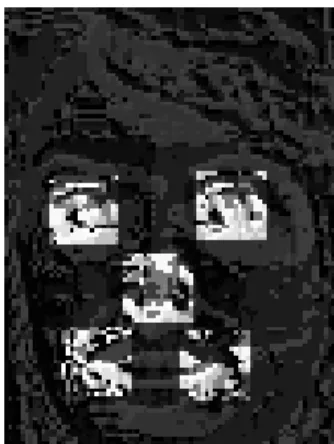
The APLBP algorithm requires pre-processing operations on training pictures and test pictures, including face detection, face feature point detection, and face alignment. When different circular LBP operators are used to extract features of different regions, the LBP operator with more regional sampling points is usually used for the key feature regions, and the LBP operator with fewer regional sampling points is used for the secondary feature regions. The feature values of the two regions will have different mode values. Taking Fig. 4 as an example, the key feature area uses LBP81 operator with 28=256 mode
values, while the secondary feature area uses LBP61 operator with 26=64 mode values. Therefore, if
the alignment operation is not performed, the two feature regions with different mode values will cross, which leads to the misalignment of the feature vectors obtained by the statistical feature histogram, which will affect the recognition result.
Fig. 4. APLBP feature map
4 Experimental Results and Analysis
In this section, the design experiment tests several improved LBP algorithms proposed in the previous section, and compares the recognition rate and speed of the improved LBP algorithm.
4.1 Testing Platform
Test system information.
System version: windows10 professional version
Processor: Intel(R) Core(TM) i5-3470 CPU @ 3.20 GHz Installed memory (RAM): 8.00GB (available at 7.87GB) System type: 64-bit operating system
Face data set. The ORL face data set contains 400 face images of 40 people. Each person has 10 face images with different angles, different postures and different expressions. The size of each face image is 122*92.
4.2 Square LBP Algorithm Test
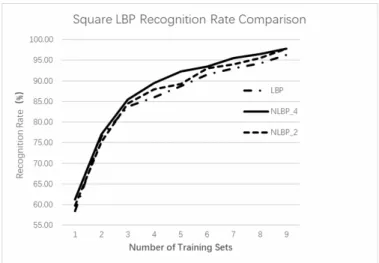
Recognition rate test. The recognition rate of the original LBP algorithm and the improved square LBP algorithm are tested under different training sample numbers. The test results are shown in Fig. 5.
Fig. 5. Comparison of square LBP recognition rates in ORL library
It can be seen from Fig. 5 that the recognition rates of the three algorithms are gradually increasing with the increase of the number of training samples. The NLBP_4 algorithm is better than the NLBP_2 and the original LBP algorithm in the overall recognition rate. Under the conditions, there is an optimal recognition rate. Summary Table 1 shows that when the number of training samples is 9 pictures, both NLBP_4 algorithm and NLBP_2 algorithm reach the highest recognition rate of 97.75%, which is 1.5% higher than the original LBP algorithm’s 96.25%, which indicates the original LBP algorithm. In conclusion, the improvement is effective.
Table 1. Comparisons of recognition rate between algorithms proposed in this paper and others
Improved LBP Algorithms Recognition Rate(%)
ILBP [12] 94.00
G-CS-LBP [3] 94.90
Multi-LBP [2] 96.20
NLBP_4 97.75 NLBP_2 97.75 SPLBP 98.00 APLBP 98.48
Recognition speed test. The average time-consuming test results of the square LBP algorithm for extracting a single picture feature are shown in Fig. 6. After the code is optimized, the NLBP_4 algorithm and the NLBP_2 algorithm are less time-consuming than the original LBP.
4.3 Circular LBP Algorithm Test
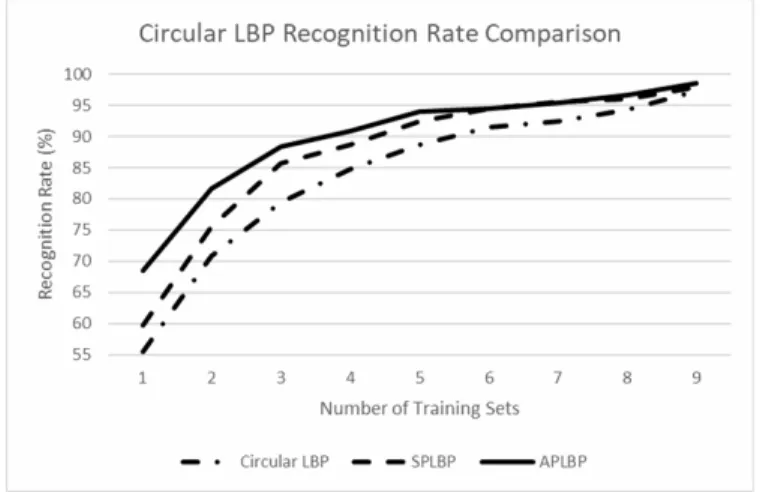
Recognition rate test. The recognition rate of the circular LBP algorithm and the improved circular LBP algorithm are tested under different training sample numbers. The test results are shown in Fig. 7.
Fig. 7. Circular LBP recognition rate comparison
As can be seen from the comparison in Fig. 7, the recognition rate of the APLBP algorithm is better than the circular LBP algorithm and the SPLBP algorithm as a whole. When the number of training samples is less than or equal to 6, the recognition rate of the APLBP and SPLBP algorithms is much higher than that of the circular LBP. When the number of samples is small, the advantage of the APLBP algorithm is more obvious. This is because the pre-processed images are highly aligned using the APLBP algorithm. Even when the number of training samples is small, it is easier to distinguish two different samples. When the number of samples is greater than 6, the difference between APLBP algorithm and SPLBP algorithm is reduced. This is because more training samples can provide sufficient sample features for SPLBP, which improves the recognition ability, but the recognition rate of APLBP algorithm is still slightly better than that of SPLBP algorithm.
Recognition Speed Test. Before comparing the speed of the improved circular LBP algorithm, firstly test the influence of the radius and the number of regional sampling points on the extraction of an image feature by the circular LBP operator. Fig. 8 shows the time required to extract the same 128*128 image from five circular LBP operators with different radius and area sampling points.
0.535 0.513
0.491
0.368
0.248
0 0.1 0.2 0.3 0.4 0.5 0.6
Ti
m
e
(
ms
)
LBP Operator
Comparison of Circular LBP Speeds with Different Radii and Sampling Points
1 8
LBP 2
8
LBP 3
8
LBP 3
6
LBP 3
4 LBP
Fig. 8. Comparison of circular LBP speeds with different radii and sampling points
Note that the larger the sampling radius of the LBP operator, the smaller the number of sampling points in the region, the faster the image feature will be extracted, and the rougher the texture features of the extracted image. The smaller the radius, the more the sampling points in the region. It takes more time, but it can extract more fine texture features.
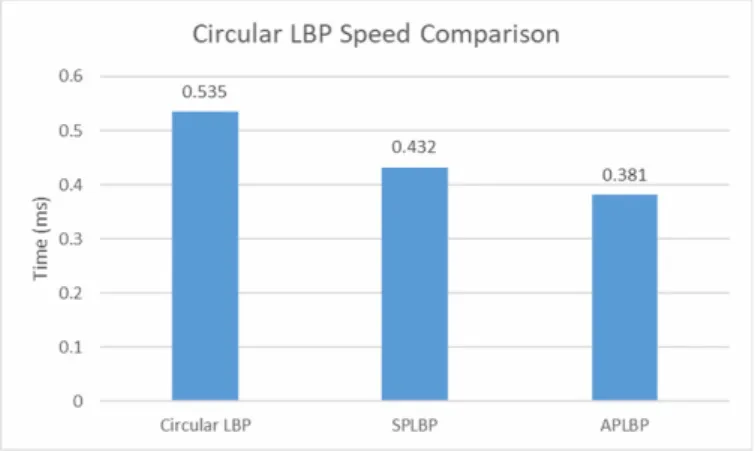
features of a single picture is shown in Fig. 9. It is obvious from the histogram that the improved circular LBP algorithm SPLBP and APLBP have an advantage in speed compared to the circular LBP algorithm.
Fig. 9. Circular LBP speed comparison
4.4 Analysis of Results
Several improved LBP algorithms have their own advantages and disadvantages. Although the APLBP algorithm has advantages in overall recognition rate and speed, it needs to preprocess the picture. The recognition rate of the SPLBP algorithm is largely dependent on the offset ratio, which is usually solved by statistics and does not necessarily apply to all cases. The NLBP algorithm is relatively compromised in recognition rate and speed, but its highest recognition rate is not as good as APLBP algorithm. The NLBP_2 algorithm is slightly faster than the NLBP_4 algorithm, and the highest recognition rate is the same as NLPB_4, but the overall performance is slightly insufficient. Comparisons of recognition rate between algorithms proposed in this paper and others are shown in Table 1. It can be concluded that, in terms of recognition rate, algorithms proposed in this paper are much better than others.
5 Conclusion
This paper introduces the basic theory of LBP algorithm, at the same time, verifies and analyzes some characteristics of LBP algorithm. Then based on this, specific improvement schemes are proposed for the square LBP algorithm and the circular LBP algorithm, and the improved ideas and implementation steps of the algorithm are described in detail. The recognition rate of the original algorithm is improved to some extent, and the complexity of the improved LBP algorithm is tested experimentally.
Acknowledgements
The work was supported in part by the Key Laboratory of Digital Fujian on IOT Communication, Architecture and Security Technology under Grant 2010499.
References
[1] T. Ahonen, A. Hadid, M. Pietikainen, Face recognition with local binary patterns, in: T. Pajdla and J. Matas (Eds.), Computer Vision-ECCV, Springer-Verlag Berlin Heidelberg, pp. 469-481.
[2] X. -R Pu, Face recognition on partial and holistic lbp features, Journal of Electronic Science and Technology 10(1)(2012) 56-60.
[3] S. Nikan, Classification fusion of global and local G-CS-LBP features for accurate face recognition, in: Proc. 2015 International Conference on Testing and Measurement: Techniques and Applications, 2015.
[4] S. Dalali, L. Suresh, Daubechives wavelet based face recognition using modified LBP, Procedia Computer Science 93(2016) 344-350.
[5] T. Ojala, M. Pietikainen, D. Harwood, A comparative study of texture measures with classification based on featured distribution, Pattern Recognition 29(1)(1996) 51-59.
[6] T. Ojala, M. Pietikainen, T. Maenpaa, Multiresolution gray-scale and rotation invariant texture classification with local binary patterns, IEEE Transactions on pattern analysis and machine intelligence 24(7)(2002) 971-987.
[7] T. Ahonen, M. Pietikainen, A framework for analyzing texture descriptors, in: Proc. 2013 International Conference on Computer Vision Theory and Applications, 2013.
[8] M. Heikkila, M. Pietikainen, J. Heikklia, A texture–based method for modeling the backgcircular and detecting moving objects, IEEE Transations on Pattern Analysis and Machine Intelligence 28(4)(2006) 657-662.
[9] M. Pietikainen, Image analysis with local binary patterns, in: Proc. 2005 Scandinavian Conference on Image Analysis, 2005. [10] T. Ahonen, A. Hadid, M. Pietikainen, Face description with local binary patterns: application to face recognition, IEEE
Transactions on Pattern Analysis and Machine Intelligence 28(12)(2006) 2037-2041.
[11] T. Ahonen, A. Hadid, M. Pietikainen, Face recognition with local binary patterns, in: Proc. 2004 Europen Conference on Computer Vision, 2004.
[12] L. -H. Zhao, Face recognition based on LBP and genetic algorithm, in: Proc. 2016 China Control and Decision Conference, 2016.