A Saas-Based Approach in an E-Learning System
Abdelraheem Mousa Basal Michigan, USA
Corresponding Author: [email protected]
A. L. Steenkamp ,Ph.D. Lawrence Technological University, USA
email: [email protected]
Abstract
used and adopted in several countries, there are still barriers to entry in developing countries.
Keywords: E-Learning, Saas, Cloud Computing, Web 2.0, K12 System.
Introduction
Academic institutions at all levels are introducing Internet based technologies to
enhance student learning, management and delivery of coursework (Rienzo & Han,
2009). Countries such Saudi Arabia are investing in the initiative of implementing an
E-learning and looking to learn from successful experience of some other countries such
as the USA, Canada, England, and Malaysia. (Ministry of Education - Kingdom of
Saudi Arabia, 2008).
There has been much interest in the notion of software as a service (SaaS) as a new
model for delivering software to the end user. Most of the discussion on SaaS focuses
on business-to-business and business-to-consumer services (Gianpaolo, Carraro; Fred,
Chong, 2006). In the education sector current implementations of supporting
information technology (IT) based systems face many challenges. This is equally true in
many K-12 Schools in the United States that lack funding to support their IT systems
and are short on IT technical staff to manage the IT infrastructure and many applications
running on it (Schooldude, 2008). This paper presents the business case for an
integrated E-Learning System, addressing issues regarding E-Learning systems in K-12
Schools. It contrasts the capability to adopt such systems in Michigan, United States
with that of some developing countries in the Middle-East. The challenges posed to
implement SaaS in developing countries and barriers to entry are examined. The paper
reports on research done on a SaaS based product for an E-learning system and presents
the case for school management to consider it as a solution. A prototype of the proposed
system was built utilizing Open Source Technology, Web 2.0 technology, and Cloud
Computing (Basal & Steenkamp, 2009). Section 2 provides some background to the
research project and presents the motivation for the study. Section 3 presents an
overview of E-learning in the context of E-Business. Section 3 also describes the
challenges facing schools in implementing SaaS as well as barriers to entry for
developing countries in the Middle-East. Section 4 presents the systems diagram of the
proposed integrated system, and Section 5 summarizes the project, the lessons learned,
and offers some conclusions.
Background
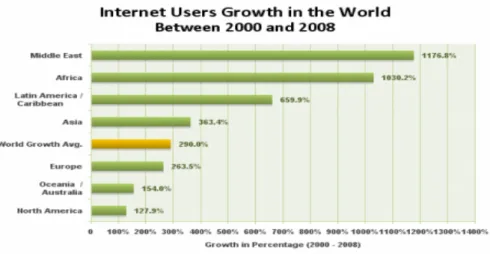
In recent years there has been a large increase in Internet usage worldwide (Internet
East and Africa are at the top of the growth trend. The Internet has become accessible to
almost everyone in the world in the past decade. This trend has led to many changes in
the maturity of web application technology. “IDC increased its SaaS growth projection
for 2009 from 36% growth to 40.5% growth over 2008 (IDC, 2008). Also, while
statistics have shown that SaaS demand is highest in North America, other countries in
the Middle East, Africa, and Asia are also becoming customers (IDC, 2008). With the
advancement of tools for web application development there has been a shift in the way
software is acquired. The SaaS model, which is supported by a service oriented
architecture (SOA) design, has led to a shift of ownership of software (Gu & Qing,
2008). Part of this research project has examined SaaS in relation to E-Learning
Systems.
Figure 1. Growth of Internet usage worldwide. Source: http://www.internetworldstats.com/
Need of the Study
With the rapid growth of Internet based technologies in recent years, there has been
a paradigm shift toward emerging web application technologies. This includes the Web
2.0 tools, supporting Open Source Technologies, Cloud Computing, and SOA that are
adopted to improve ubiquitous services to clients and their customers. Implementations
of some of these technologies have been demonstrated by social networking on websites
such as Facebook, Micro blogging Twitter, YouTube, Second Life and the Image
sharing Flicker (Harris & Rea, 2009). One common aspect of these applications is that
Web applications are moving from read-only static applications to user generated
applications. Research has been done on student interest and participation in Virtual
This phenomenon of dynamic interaction has been the main force behind part of
this research project, with objective to analyze the features and functionality of these
technologies for potential applicability in the education sector. The literature review and
discussions with educators have revealed that school system have disparate information
systems to support teaching, learning and school management and administration. The
intent in this research has been to provide a solution that gives the users (for example
teachers, school administrators) some control, with tools enabling them to generate
content for the learning system, and also improving collaboration between all
stakeholders (for example students with teachers, parents with teachers, school
administrators with parents, and more). An early decision was made that such a learning
system would be based on the SaaS model, where the school and its stakeholders take
full advantage of the benefits of the model as described by Basal (2009). The goal is
that a school will be able to focus its efforts on enhancing student learning supported by
technology, where the technology is well integrated into the business processes and
pedagogy of the school. When examining the existing K-12 Learning System in the
United States one sees a strong need for teachers to enhance and enrich student learning
by utilizing the capabilities of IT (Hew & Brush, 2007) . It is also apparent that K12
schools are aiming to solve some manual processes, and searching actively for solutions
to enhance student learning. There have been several attempts using Open Source
Technologies to enhance student learning (Dougiamas & Peter, 2003), such as Moodle,
an Open Source learning management system, which is widely used all over the world
(Moodle, 2009). An analysis of Moodle shows that it is an excellent learning
management system for creating online courses that provide opportunities for rich
interaction, but does not include tools for managing school information, leaving the
burden of hosting and configuration to the end-user. While Moodle may solve some of
the problems schools are facing in terms of functionality and integration, it is not the
comprehensive integrated solution that schools need.
Purpose of study
When examining existing problems with systems integration related to enhancing
student learning, and management of multiple school systems, it is clear that this
research lies at the juxtaposition of two major issues, namely application system
integration and E-Learning management systems. The purpose of this research project
was to develop a solution which integrates multiple disparate application systems of
schools into one integrated online system that may be accessed via a single sign-on
process. The intent of this system is to utilize new web-based technologies to enhance
This paper addresses several questions related to integration of technology and
E-learning within K-12 schools, namely
• How can an architecture approach to integrate a learning management system, student information system, content management system, and a file
management system address the stated integration problem in the K-12 system?
• How can the SaaS model help faster implementation of the E-learning system?
• Why is SaaS ideal for K-12 schools in developing countries?
Overview of Focal Area and Application
E-learning in the context of E-Business.
One of the aspects of E-Learning from an E-Business perspective is that it involves
multiple vendors and business customers, over and beyond the students. For example, a
vendor providing a SaaS solution to a school (the end-user or customer) represents an
E-business/ E-commerce transaction between the vendor and the school (known as
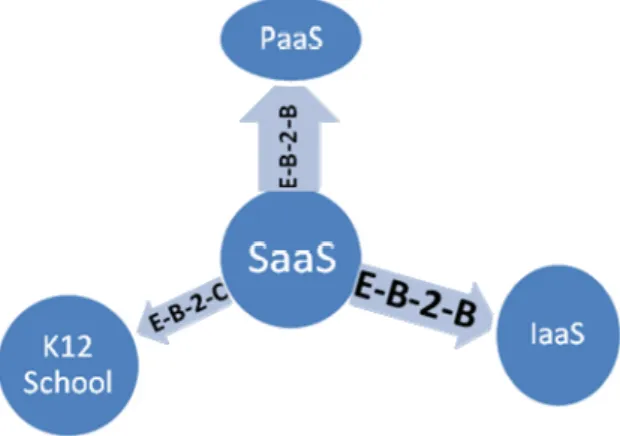
Business-to-Customer, or B-2-C). Also, this transaction may involve other transactions
between vendors themselves (Business-to-Business, or B-2-B), where independent
software companies utilize the power of Cloud Computing, using Platform-as-a-Service
(PaaS) and Infrastructure- as-a-Service (IaaS). Figure 2 shows the relationship of these
technologies and illustrates an E-Learning System in the context of E-Business. This
model has been widely adopted in recent years in the United States, after the emergence
of Web 2.0 technologies and Cloud Computing (Gerard & Marinos, 2009). Typical
features and benefits to the end users and vendors include:
• Fast Implementation
• Scalability to more comprehensive implementations
• The model provides a lower cost IT solution to schools by offering multiple services without upfront investment.
• Runs on an IT infrastructure with minimum investment; it usually needs an Internet connection with a web browser.
• Pay as you go approach
• Maintenance, Free upgrades and support are typically included
• Access to latest technology
• No lengthy contract
• Reduces the technical support requirements of the end-user.
• Provides greater flexibility when adopting new services.
Figure 2.SaaS B-2-B and B-2-C relationship with PaaS and IaaS for K12 schools
Concerns about SaaS.
While SaaS has become popular some of the concerns are related to security when
customers implement SaaS based systems. The main concern of customers is whether
their data are truly secure at the SaaS site. This type of insecurity sometimes causes a
deterrent for customers who wish to implement SaaS. Another issue of SaaS concerns
the integration of the SaaS server. If there is no clear IT strategy in a school it might end
up with several overlapping SaaS solutions that may cause duplicate and inconsistent
data within the school, Such unintended consequences cause additional issues instead of
providing a sound solution. Data location is another issue with SaaS, and some
customers have concerns regarding how to access their data. A strong service level
agreement (SLA) is needed to protect user data. One of the biggest issues with SaaS is
the possibility that the end-users feel they are losing control. Some customers actually
believe that by adopting the SaaS model they will lose control of their systems.
Barriers to entry in developing countries
One of the challenges of applying the SaaS model in developing countries in the
Middle-East is that these countries, while classified in the category of “developing
countries”, vary considerably in level of IT maturity and IT enablement of business
processes. Saudi-Arabia for example has invested US $3.6 billion in 2009, and this is
expected to rise to US $4.9 billion by 2010, in IT communications and infrastructure
(Report Buyer, 2009). In addition these countries have different rules and regulations,
with different barriers to adopting new ITs, depending on their development status.
Outlined below are some of the typical barriers that are faced in implementing SaaS in
Infrastructure. Implementing a SaaS solution requires minimal investment in
infrastructure at the client side, but does require a level of infrastructure providing a
stable Internet connection. An example of the infrastructure requirements is having
stable Internet connectivity between the end-user and the service provider of the
solution. While Middle-Eastern countries generally have access to the Internet at this
time, the connection and reliability of the connections are often unsteady. Intermittent
electricity outages are experienced that cause unstable Internet connections. Such
conditions pose a major barrier when planning to implement SaaS for clients.
Culture and regulation. Culture and regulations in any given country are unique
and may present a barrier to adopt new technologies. Some countries require that data
reside within a business location, or within the countries’ boundaries. Such regulations
can prevent the adoption of the latest technologies available outside of the countries’
borders. Another example is that certain customers might decline to use Amazon.com
services due to the fact that the organization resides in the United States.
Owning vs. Renting. Many customers in developing countries consider software
from the perspective of either owning or renting. Many customers prefer to own the
software but this entails unique challenges and it is important that the cost-of-ownership
be calculated first. The rationale for wanting to own the software is that if the
investment in the software is up front, the buyer can save money in the long run. While
this may seem to be a good idea at first there is the disadvantage of not getting the latest
technology offered by the SaaS model. SaaS is unique in that, while it may be rented it
gives one the latest available updates and upgrades. If the software will be purchased
(owned) then it is a final transaction according to the terms of the purchase. Renting
gives the end-user opportunities to work with the SaaS vendor and have continuing
customer care.
Government Schools. One of the drawbacks of implementing a system is that the
schools are run by the government and therefore decision-making at a school must be
escalated and approved by the government appointed bodies. Without government
approval new IT systems cannot be implemented. While the government might approve
a project, the decisions and meetings involved may be drawn out over months if not
years. It is a challenge to influence governments in Middle Eastern countries about
specific IT solutions that will improve their education.
Barriers from the Vendor Perspective. The vendor faces many challenges while
pursuing accounts in foreign countries. One of those barriers is the lack of proper
infrastructure. Also, a major concern is the lack of reliable service providers of PaaS
and IaaS vendors. When a vendor is dealing with a developing country it is a known
fact that the network of business and people may not be strong and reliable such as in
concern for vendors. Many developing countries compromise the integrity of the
software by obtaining illegal access to the source code. While copyright infringement
occurs often there are few deterrents in place to prevent it from happening, and this
situation is a major obstacle from the vendor perspective. Other issues are related to
cultural barriers when vendors deal with customers in the different developing
countries. While business as usual might be easy in the United States, business as usual
might be defined in very different terms in another country. This often leaves vendors
confused and frustrated while dealing business customs and culture of a developing
country. It is also imperative for the vendor to learn about the culture and language, and
exercise self control and patience when doing business in an environment very different
from his or her own.
Potential Advantages
As many developing countries are becoming accustomed and moving towards
computer information systems, they have many advantages in their favor. In particular
these countries can learn a lesson from other countries which have already implemented
systems in the past and had a mild to moderate difficulty in adopting their school to the
new technology. The lesson which can be learned for these developing countries is that
they can analyze and pinpoint problems which occurred in the developed countries, and
in turn they can avoid those potential issues. This will save the developing countries
time, money, and energy. An example of that is that schools in the United States are
working on the area of integrating those disparate systems with different functionality
and trying to connect them together and have had difficulty while trying to succeed but
have worked out the major kinks and have solutions for problem solving when issues
arise. So a school in a developing country can look forward to their system and
transition being very smooth and easy. These schools in the developing countries will
have solutions which combine multiple functionality as has been proposed in this paper.
Why SaaS is ideal for E-Learning
In this day and age we want everything right now without the wait or fuss. SaaS is
perfect for E-learning because of its fast implementation. Within hours or just a few
days SaaS is up and running alleviating the need to wait. Also, SaaS lessens the burden
of maintenance and support from the school to the vendor, allowing schools to focus on
their core business. Instead of multiple areas of the school being focused on the school
management system and trying get it to function to meet their needs, secretaries,
librarians, and teachers can focus on what really counts; the education and betterment of
since schools will receive the latest updates and features without any extra financial
obligation.
Another advantage with SaaS is that it helps administration and teachers to share
key resources all with the simple click of a button, using Web 2.0 technology.
To understand this better we can look at a small school in Jordan. With the software
service model, this school can utilize the latest software solution with a minimal amount
of cost and infrastructure to benefit from these solutions. This system is the same
solution being used by the most advanced and successful schools in the world. With
SaaS this small school in Jordan with its 200 students and 20 staff will be able to have a
system which can be implemented within hours or days and the only requirement they
will have to have is a stable internet connection. Once the system is implemented, they
will continue to receive the latest updates and features, since technology is always
advancing and changing. This will be convincing for this school is Jordan since the
updates will not incur any further fees. This ideal for a developing country like Jordan,
in order for this country to be able to place its money in other necessities needed to
make it stable.
Research Approach
A positivist-empirical research approach was followed for the project, based on
observation and interventions using several methods (Remenyi et al., 1998; Curtis and
Cobham (2002) . This approach is appropriate for research into the phenomena,
processes, and behaviors that form part of the K12 educational environment. The action
research paradigm formed part of the research approach since the primary author was
engaged in the domain of discourse, and participated actively in all the research
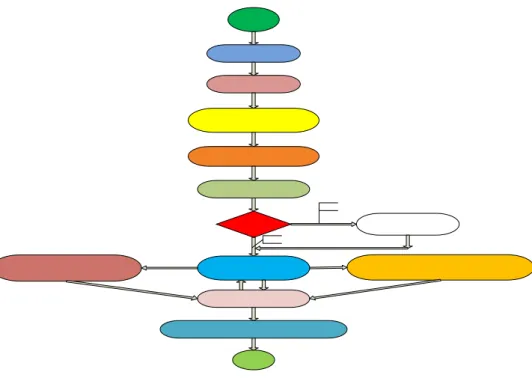
processes. The research life cycle is illustrated in Figure 4. It depicts the research
processes that were conducted, and is explained in detail in another research paper by
Figure 4. Positivist-Empirical life cycle.
The architecture approach followed to redesign the E-Education System
architecture consists of the following key tenets: the principles guiding the architecture
(including overarching principles of the education domain of discourse, and architecture
viewpoint principles for each viewpoint of concern); the architecture meta framework
used when performing systematic viewpoint analysis; the architecture process model
and the supporting architecture methodology that is followed (Steenkamp, 2007).
Overarching principles pertinent to this research are:
• Interoperability
• Scalability
• Adoptability
• Ease of Use
• Affordability
• Use software as service for delivery model
• Service oriented architecture
• Use of open source technology
• Use of object oriented methodology
Proposed System
This section presents the high-level architecture of the E-Education System, the
functionality of the proposed system and the context diagram of the web technologies
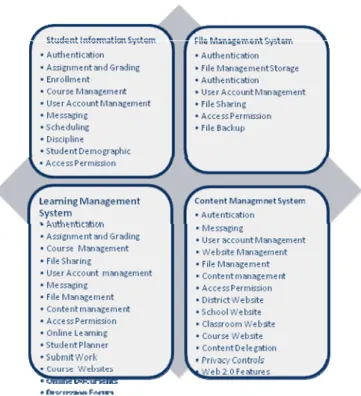
Figure 3.Typical ESIS, LMS, CMS, and FMS functionality in K12 schools
The proposed solution combines the four pillars of a typical K12 system into one integrated solution with features that eliminate overlapping functionality, enhance data consistency by having one source of data, and also provides a cost effective solution by eliminating the separate solutions from different vendors. The ability to access the system using a single-sign-on enables the end-user to access the system, and manage all functionalities according to responsibility and authority
The expectation is that the proposed solution will help education authorities in
developing countries in the following ways:
• Reduce the cost of ownership of software solution by eliminating the purchase of individual system and integration cost to connect these
systems.
• Increase the number of educational websites by providing every district, school, teacher, and course within a province region with website to
enhance student learning.
• Allow family and community involvement through a school
website and Parent Connect.
• Improve teachers’ ability in a school to communicate, monitor student progress
• Improve the school administration’s ability to manage multiple systems from one integrated E-Education System.
• Encourage and increase sharing of resources and best practices.
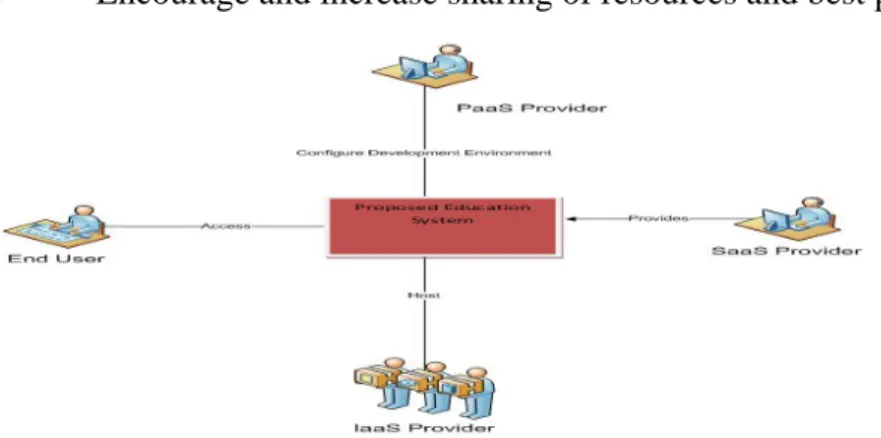
Figure 5. SaaS based E-Education System
SaaS architecture
Figure 5 shows the proposed system is being delivered using the SaaS model. It
utilizes Cloud Computing Technology, where the system is being configured from the
PaaS Provider and hosted from the IaaS provider. All this is being done on the “Cloud”.
This model shows that this architecture requires that the end user only use an Internet
browser to access the E-Education System.
Summary and Conclusions
This paper has considered the IT enabled of K-12 learning systems in the United
States, and found that there is a strong need for enhancing and enriching student
learning using Web 2.0 technologies. It was also found that schools have disparate
reports on part of the research project, namely the business case for an integrated
E-Education System, based on SaaS in K-12 schools. Also, the paper describes at a high
level an integrated solution of a learning management system, student information
system, content management system, and the file management system into one system
delivered via the SaaS model. This integration utilizes Cloud Computing, Open Source,
and Web 2.0 technologies. The literature review revealed that there are considerable
barriers to entry into developing countries of this type of SaaS model. There are
numerous potential advantages for developing countries if they choose to implement
SaaS.
It is recommended that future research should focus on how to overcome the
barriers of entry of the new Internet based technologies into developing countries.
Furthermore a topic for research is to examine how to best initiate and implement the
integrated E-Education System by collaborating with education authorities in a
developing country.
Acknowledgements
The authors of this paper acknowledge Global Educational Excellence (GEE) by
providing their support and use of k-12 school campuses to perform the action research.
References
Aulbach, S., Grust, T., Jacobs, D., Kemper, A., and Rittinger, J. (2008). Multi-tenant databases for software as a service: schema-mapping techniques. In Proceedings of the 2008 ACM
Basal,A .(2009). Service Oriented Approach in Information Technology Enabled Education Systems
Basal, A. and Steenkamp, A.L. (2009). An Integration Approach to IT Enabled K12 School System, submitted to ISECON2009, Washington DC, United States.
Curtis, G. and Cobham, D. (2002). Business Information Systems: Analysis, Design and Practice, 4th edn., Pearson, Essex.
Dougiamas, M., & Peter, T. (2003). Moodle: Using Learning Communities to Create an Open Source Course Management System. Journal of Educational Multimedia and Hypermedia , 171-178.
Fruth, L., Larry, C. a., Michael, S., & Elizabeth, L. (2007). The Right Data to the Right People at the Right Time:How Interoperability Helps America’s Students Succeed. Council of Chief State School Officers and Data.
Ecosystems and Technologies Conference. IEEE Press, 2009.
Gu, Q., & Lago, P. (2008). SOA process decisions: new challenges in architectural knowledge modeling. ACM Special Interest Group on Software Engineering , 3-10. Hew, K. F., & Brush, T. (2007). Integrating technology into K–12 teaching and
learning: Current knowledge gaps and recommendations for future research. Educational Technology Research and Development , 223–252.
Harmon, P. (2003). A Manager’s Guide to Improving, Redesigning and Automating Processes. Morgan Kaufmann.
Harris, A.L. and Rea, A. (2009). Web 2.0 and Virtual World Technologies: a Growing Impact on IS Education, Journal of Information System Education, Vol. 20(2).
IDC. (2009, August August). Retrieved August 12, 2009, from IDC: http://www.idc.com/
internet world stats. (2009, July). Retrieved August 12, 2009, from internet world stats: http://www.internetworldstats.com/
M. A. Roth, D. C. (2002). Information integration: A new generation of information technology. IBM System Journal , 563.
Mahmoud, Q. H. (2005, April). Web Services. Retrieved 11 1, 2008, from sun microsystem: http://java.sun.com/developer/technicalArticles/WebServices/soa/ Mark, G., & Cindy, G. (2006). Integrating Technology For Meaningful Learning. 2006. Remenyi, D., Williams, B., Money, A. and Swartz, E., 1998, Doing Research in
Business and Management, Sage, pp.73.
Rienzo, T. And Han, B. (2009), Microsoft or Google Web.0 Tools for Course Management. Journal of Information System Education, Vol. 20(2).
Shen, Jia and Eder, L.B. (2009), Intentions to Use Virtual Worlds for Education. Journal of Information System Education, Vol. 20(2).
Steenkamp, A.L. (2007), An Approach to Developing IT Architectures, The Open Group Enterprise Architecture Practitioner’ s Conference, San Diego.
Report Buyer. (2009, August 18). Retrieved August 18, 2009, from Report Buyer: http://www.reportbuyer.com/computing_electronics/country_overview_computing_ electronics_/saudi_arabia_information_technology_report_q1_2009.html
Schooldude. (2008). Retrieved July 15, 2009, from Schooldude: http://www.schooldude.com/elements/media/article_file/The_Unique_Challenges_F acing_the_IT_Professional_in_K12_Education.pdf