A Solution to the Problem of the Maximal Number of Symbols for
Biomolecular Computer
Jacek Waldmajer
Institute of Computer Science, University of Opole, Oleska 48, 45-052 Opole, Poland E-mail: [email protected]
Sebastian Sakowski
Faculty of Mathematics and Computer Science, University of Lodz, Banacha 22, 90-238 Lodz, Poland E-mail: [email protected]
Keywords:biomolecular computer, biomolecular systems, DNA computing
Received:March 15, 2019
The authors present a solution to the problem of generating the maximum possible number of symbols for a biomolecular computer using restriction enzyme BbvI and ligase as the hardware, and transition molecules built of double-stranded DNA as the software. The presented solution offers an answer to the open question, in the algorithm form, of the maximal number of symbols for a biomolecular computer that makes use of the restriction enzymeBbvI.
Povzetek: Razvit je nov naˇcin izraˇcuna najveˇcjega števila simbolov za biomulekularni raˇcunalnik.
1
Introduction
The beginnings of research into possibilities of applying biomolecules to control biological systems, and also to construct computers, are to be found in theoretical works of the 1960s (Feynman 1961). Then, in the 1980s, Charles Bennett (1982, Bennett and Landauer 1985) pointed to po-tential possibilities of application of biomolecules to con-struct energy-efficient nanodevices. However, the world had to wait to see the first practical experiments realiz-ing simple calculations with the use of biochemical reac-tions until the mid-1990s, when Leonard Adleman (1994) solved the problem of Hamilton’s path in graph, using ex-clusively a biomolecule for this purpose. Successive re-search revealed the possibility of spontaneous formation of multidimensional structures built from biomolecules, which were made with the use of the conception of self-assembly (Whitesides et al. 1991, Seeman 2001, Gopinath et al. 2016). The multidimensional DNA structures made it possible to realize fractals, e.g., ones of Sierpi´nski tri-angle type (Rothemund 2004), which revealed a great po-tential in calculations based on self-assembly. In 2006, Paul Rothemund (2006) made use of self-assembling DNA molecules to obtain different multidimensional biomolec-ular structures. Properly prepared DNA molecules also made it possible to carry out a theoretical simulation of Tur-ing machine (Rothemund 1995). Prior to this, in 2001 (Be-nenson et al. 2001) a practically acting non-deterministic finite automaton based on such DNA molecules, restriction enzyme F okI and DNA ligase was presented. In succes-sive research, it was proved experimentally that such an automaton can work without the use of ligase enzyme
(Be-nenson et al. 2003, Chen et al. 2007) and its complex-ities were extended in practical experiments, ones under-stood as the number of states using numerous restriction enzymes (Sakowski et al. 2017). It is worth adding that it was with success that laboratory experiments were car-ried out, in which this biomolecular system was applied to medical diagnosis and treatment (Benenson et al. 2004) and also to simple logical inference (Ran 2009). In an-other work which dealt with possibilities of applying DNA molecules, a challenge was taken up to not only increase the number of states of such an automaton (Unold et al. 2004), but also that of symbols possible for an automaton built from DNA (Soreni et al. 2005). Moreover, presented the notion of biomolecular automaton, informally charac-terized in the papers of Rothemund (1995), Benenson et al. (2001), Soreni et al (2005), was presented in a formal way (as a mathematical model called a tailor automaton in a new theory of tailor automata) in the paper Waldmajer et al. (2019).
In the above-mentioned work, Soreni and co-workers (Soreni et al. 2005) put forward a 3-state 3-symbol biomolecular automaton which used the restriction enzyme
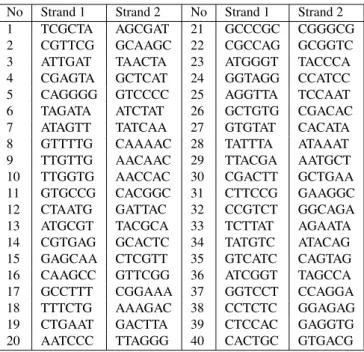
strands is 40. It is with reference to this open question that the authors of the present work undertook and man-aged to solve the problem mentioned by Soreni et al. in their work (2005) through: (1) indicating 40 symbols (see Tab. 4) which make the solution to the open problem, (2) proposing the idea of working of an algorithm that enables to generate 40 symbols for a biomolecular automaton us-ing the restriction enzymeBbvI, and (3) formulating two general problems in the sphere of generating symbols for biomolecular automata which use one restriction enzyme (among which a biomolecular automaton using the restric-tion enzymeBbvI is a particular case) and more than one restriction enzyme.
The second section presents the idea of constructing and working of a 3-state 3-symbol biomolecular automaton us-ing the restriction enzymeBbvI as presented by Soreni and co-workers in their work (Soreni et al. 2005). In the third section the conception of working of an algorithm generat-ing the maximal number of symbols for a biomolecular au-tomaton using the restriction enzymeBbvI was presented together with a discussion of various undesired situations which may occur in the course of working of a biomolecu-lar automaton that makes use of one restriction enzyme (in particular for the restriction enzymeBbvI). In the last sec-tion, there were formulated two general problems of gener-ating the maximal number of symbols for a certain class of biomolecular automata using one or more than one restric-tion enzymes.
2
Biomolecular finite automaton
and the idea of its actions
In this section, we make a presentation of the state 3-symbol biomolecular finite DNA automaton (see Fig. 1), which was presented by Soreni and co-workers (Soreni et al. 2005). The automaton uses the restriction enzyme
BbvI, ligase enzyme and DNA double-stranded fragments (input molecule, set of transition molecules and set of de-tection molecules). The double-stranded DNA fragments include the adenine, cytosine, guanine, and thymine bases marked as A, C, G and T, respectively.
s2
?
b,c
-a
b
s0
? a
-c
s1
? a,b,c
Figure 1: Graph representing a 3-state 3-symbol determin-istic finite automatonM1.
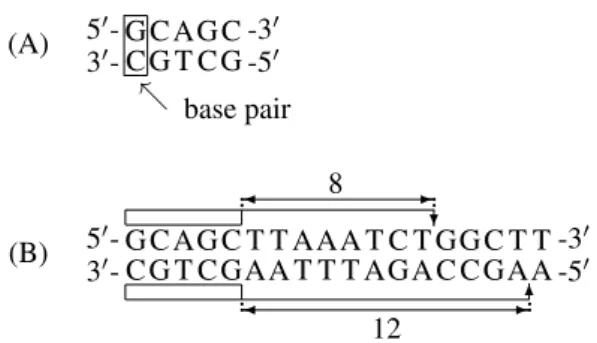
The task of the BbvI restriction enzyme is to cut the double-stranded DNA after recognizing a specific sequence (see Fig. 2A) in the double-stranded DNA.
The BbvI restriction enzyme will cut the double-stranded DNA after the 8th nucleotide in the DNA strand in the 50-30direction and after the 12th nucleotide in the DNA strand in the 30-50 direction from the recognized specific
?
6
.. 8 -..
..
-12 ..
- base pair (A) 50- G C AG C -30
30- C G T C G -50
(B) 50- G C AG C T T AAA T C T GG C T T -30 30- C G T C GAA T T T AGA C C GAA -50
Figure 2: (A) Specific sequence recognized by the BbvI restriction enzyme. (B) The action of restriction endonu-clease:BbvI.
sequence (see Fig. 2B).
The task of the ligase enzyme is to ligate the two double-stranded DNAs having complementary sticky ends (see Fig. 4A and 4B), where a sticky end is a single-stranded DNA at the end of a double-stranded DNA. In the given sense, the sticky end ‘TTTA’ of a single-stranded DNA (see Fig. 4A) is complementary to a sticky end ‘AAAT’ of the other double-stranded DNA (see Fig. 4B). The result of their ligation is one double-stranded DNA (see Fig. 4C).
Both the restriction enzymeBbvI and the ligase enzyme play the key role in the action of a biomolecular automa-ton, determining, respectively: the operation of cutting of a fragment of the double-stranded DNA and the operation of ligating of two fragments of double-stranded DNAs.
The input molecule (see Fig. 3) is a double-stranded DNA fragment in which it is possible to distinguish the following three basic parts: the input word xconsisting of the symbols a, b and c (x = acb), the terminal sym-bol and the base sequence. At the both ends of the input molecule there occur additional base pairs and their occur-rence is determined by the properties related to the action of the restriction enzyme.
To construct an input word of the 3-state 3-symbol deter-ministic finite automaton, the following three symbols:a,b
andc(see Fig. 5) were used. These symbols were coded by means of six base pairs. Besides the aforementioned sym-bols, the additional terminal symboltwas introduced. This symbol is coded by means of the same number of base pairs as the symbolsa,bandc. This symbol was used to acquire an output molecule which is used to determine whether the automaton has finished acting in the required state and has accepted the input wordx.
The base sequence consists of a certain number of base pairs, contains a specific sequence recognizable by the
| {z }
Abp
| {z }
base sequence
| {z }
wordx
| {z }
terminal symbol
| {z }
Abp
a
-c
- b - t
-22 bp
21 bp 50- G C AG C T T AAA T C T GG C T T G C GA T GAG T GA T G T C G C -30 30- C G T C GAA T T T AGA C C GAA C G C T A C T C A C T A C AG C G -50
Figure 3: Input molecule containing the input wordx=acb; Abp – Additional base pairs.
Table 1: Connection of the statess0,s1ands2of a biomolecular automaton with the permanent cut places of the symbols
a,b,candtof the biomolecular automaton.
state symbol a symbol b symbol c symbol t
s0 5
0- C T GG C T -30
30-GA C C GA-50
50-GAG T GA-30 30- C T C A C T -50
50- T G C GA T -30 30-A C G C T A-50
50- T G T C G C -30 30-A C AG C G-50
s1 5
0- C T GG C T -30
30-GA C C GA-50
50-GAG T GA-30 30- C T C A C T -50
50- T G C GA T -30 30-A C G C T A-50
50- T G T C G C -30 30-A C AG C G-50
s2 5
0- C T GG C T -30
30-GA C C GA-50
50-GAG T GA-30 30- C T C A C T -50
50- T G C GA T -30 30-A C G C T A-50
50- T G T C G C -30 30-A C AG C G-50
..
-sticky end .... ... 50- G C AG C T T -30 (A)
30- C G T C GAA T T T A -50
..
-sticky end ..
50- AAA T C T GG C T T G -30 (B)
30- GA C C GAA C -50
50- G C AG C T T AAA T C T GG C T T G -30 (C)
30- C G T C GAA T T T AGA C C GAA C -50
Figure 4: (A) and (B) Double-stranded DNAs with the complementary sticky ends. (C) The result of a ligation be-tween the double-stranded DNAs with the complementary sticky ends included in (A) and (B).
a
50- C T GG C T -30 30-GA C C GA -50
b
50- GAG T GA -30 30- C T C A C T -50
c
50- T G C GA T -30 30-A C G C T A -50
t
50- T G T C G C -30 30- A C AG C G -50 Figure 5: Symbolsa,b,cand the terminal symbolt.
(Soreni et al. 2005), the reading of a symbol in a certain state of the automaton is identified with the cutting of the double-stranded DNA by the BbvI restriction enzyme in the area of a symbol, in a determined (permanent) place of the DNA strand, in the 50-30direction and in a determined (permanent) place of the DNA strand in the 30-50direction. Tab. 1 presents a connection between the states and two permanent cut places of the symbols.
In accordance with the input molecule presented on Fig. 3, the first cutting input molecule with the use of the restric-tion enzymeBbvI will follow in the area of the symbola,
which corresponds to the states2. In this way, in the state
s2, the symbolawas read and a fragment of DNA was
ob-tained as presented on Fig. 6. In this sense, the states2is
a initial state. Adding to the base sequence of one or two pairs of nucleotides can set the start state to be the follow-ing:s1ors0, respectively.
c
- b - t
-21 bp 50-GG C T T G C GA T GAG T GA T G T C G C -30 30- A C G C T A C T C A C T A C AG C G -50
Figure 6: Double-stranded DNA fragment obtained after
BbvI acting on the input molecule.
The set of transition molecules is used to implement a set of transitions in the 3-state 3-symbol deterministic fi-nite automaton. We obtain transition from one state to the other (the same or another state), upon reading a symbol, through ligating with the use of ligase enzyme, of a DNA fragment obtained on Fig. 6 with one of the transition molecules. Each transition molecule contains a specific se-quence recognizable by theBbvI restriction enzyme and the additional base pairs. Exemplary transition molecules are presented in Fig. 7: the transition molecule presented on Fig. 7A enables transition from the states0 to that of
s1after reading the symbolc; the transition molecule
pre-sented on Fig. 7B enables transition from the states1to that
of s1 after reading the symbol b; the transition molecule
presented on Fig. 7C enables transition from the states2to
that ofs0after reading the symbola.
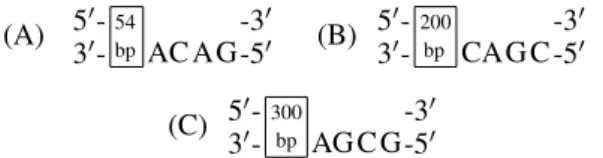
For each state, one detection molecule is constructed and thus a set of detection molecules is specified (see Fig. 8). It should be noted that the detection molecules have different numbers of additional base pairs, which makes it possible to determine laboratorily the state in which the automaton finished its action.
(A) 50- 35bpG C AG C T -30 30- C G T C GAA C G C -50
(B) 50- 39bpG C AG C T T -30 30- C G T C GAA T C A C -50
(C) 5 35bp
0- G C AG C T A T T -30
30- C G T C GA T AA C C GA -50
Figure 7: Selected transition molecules used in the transi-tion functransi-tion: (A)T1: (s0,c)→s1, (B)T2: (s1,b)→s1,
(C)T3: (s2,a)→s0.
(A) 50-54bp -30 30- AC AG-50 (B)
200 bp
50- -30
30- CAG C -50
(C) 50-300bp -30 30- AG C G-50
Figure 8: (A) Detection moleculeD1for the states0. (B)
Detection molecule D2 for the state s1. (C) Detection
moleculeD3for states2.
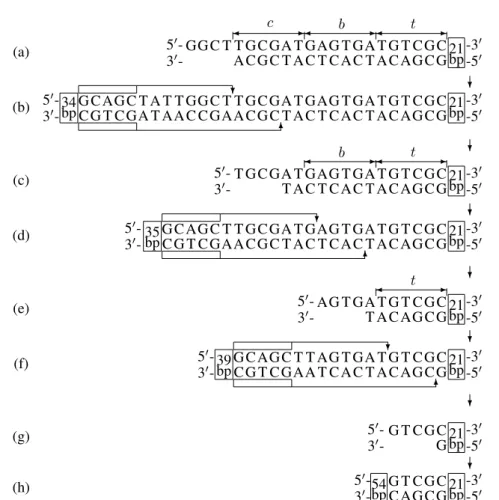
of the detection molecules are placed in a laboratory tube; the final addition is many copies of the input molecule. Af-ter these elements have been mixed in the test tube, the biomolecular automaton starts its action. In successive steps there follows reading of the symbol a in the state
s2 (see Fig. 9a), making use of the transition molecule
shown in Fig. 7C to transition from the state s2 to that
ofs0 after reading the symbola(see Fig. 9b), reading of
the symbolcin the states0(see Fig. 9c), using the
transi-tion molecule presented in Fig. 7A to transitransi-tion from the states0to the states1after reading the symbolc(see Fig.
9d) reading the symbolbin the states1(see Fig. 9e), using
the transition molecule presented in Fig. 7B and reading the terminal symbolt in the states1(see. Fig. 9f-g). In
the last step there follows ligation of a fragment of double-stranded DNA presented in Fig. 9g with one of the detec-tion molecules (see Fig. 8B). As a result of ligadetec-tion of these DNA fragments an output molecule is formed (see Fig. 9h), which – from the laboratory point of view – serves to de-termine the end state of a biomolecular finite automaton.
3
Algorithm for the problem of the
maximal number of symbols
3.1
The formal aparatus used in the
description of the algorithm
Let the set∆ ={A, C, G, T}and the functionσ, which is bijection of the set∆on∆, which is defined in the follow-ing way: σ(A)= T,σ(T)= A,σ(C)= G andσ(G)= C be given. The set∆is called aset of nucleotides, the elements of the set∆are called nucleotides, and the functionσis calledcomplementarity of nucleotides.
We call any finite sequence of nucleotides of the set∆as aword. The wordxwhich is the sequenceX1, X2, . . . , Xj
of nucleotides of the set∆(Xi ∈ ∆,0 < i ≤j ∈ N) is written as followsx =X1X2. . . Xj. The number of the elements of the sequencexis called thelength of the word
x(denoted symbolically:|x|), while thei-th nucleotide of the wordx(thei-th element of the wordx) asx(i). The set of all the words formed from the nucleotides of the set∆, whose length is greater than zero, is denoted as∆+.
Let∆+ 3x=X
1X2. . . Xj (Xi∈∆,0< i≤j∈N) and∆+3y=Y
1Y2. . . Yj(Yi∈∆,0< i≤j∈N). We call the word Xj. . . X2X1 anopposite word (we denote
symbolically: x−1) to the wordx. We call the wordxy=
X1X2. . . XiY1Y2. . . Yj aconcatenationxyof two words
xandy such that ∆+ 3 x = X1 X2. . . Xi (Xi ∈ ∆,
0 < i ∈ N)and∆+ 3 y = Y1Y2. . . Yj (Yj ∈ ∆,0 <
j ∈N). We say that the wordxisincluded in the wordy,
beginning with thek-th(1 ≤k ∈N)position(we denote
symbolically: x ⊆k y), ifk+|x| ≤ |y|+ 1and∃u, v ∈
∆∗(y =uxv∧ |u| =k−1).The wordxis asub-word of y(we denote symbolically:x⊆y)when the wordxis included in the wordy, beginning with a certain positionk, i.e.,x⊆y ⇔ ∃k(x⊆k y). The wordxis a prefix of the wordy, whenx⊆1 y. The wordxis a suffix of the word
y, whenx−1is the prefix of the wordy−1.
The introduced notion of complementarity of nu-cleotides and the introduced denotations make it possible to define the function which will be called
complemen-tariness of words. The mapping Ξ : ∆+ → ∆+ defined
in the following way: Ξ(x) = y, where|y| = |x| and
y(i) =σ(x(i))for eachi∈ {1, . . . ,|y|}and, forx∈∆+
is calledcomplementarity of words. Let∆+3x=X
1X2X3X4(Xi∈∆,0< i≤j∈N) and∆+ 3y =Y
1Y2Y3Y4(Yi ∈∆,0< i≤l ∈N). The wordsxandyaresynthesable over the length3, when there exists the wordu∈∆+of the length 3 being the suffix of
the wordxand the prefix of the wordy. The concatenation of the synthesable words xandyover the length 3 is the wordz= [x, y]3, wherez=X1X2X3X4Y4.
3.2
Description of the algorithm
The idea of the algorithm of generating the maximal num-ber of symbols for a biomolecular automaton using the re-striction enzymeBbvI will be characterized through four stages, which are distinguished in the algorithm: the initial stage, the stage of deployment and verification, the stage of generation and the final stage. At each of the indicated stages we make use only of strands of symbols in the direc-tion 50-30, since having strands of symbols in the direction 50-30, we can – by means of the principle of complementar-ity of nucleotides – obtain strands of symbols in the direc-tion 30-50.
Let the set A0 of all 4-element sequences of
nu-cleotides be given: A0 = {x : x ∈ ∆+ ∧ |x| =
(a)
c
- b - t
-21 bp 50- GG C T T G C GA T GAG T GA T G T C G C -30 30- A C G C T A C T C A C T A C AG C G -50
?
(b)
?
6
34
bp 21bp
50- G C AG C T A T T GG C T T G C GA T GAG T GA T G T C G C -30 30- C G T C GA T AA C C GAA C G C T A C T C A C T A C AG C G -50
?
(c)
b
- t
-21 bp 50- T G C GA T GAG T GA T G T C G C -30 30- T A C T C A C T A C AG C G -50
?
(d)
?
6
35
bp 21bp
50- G C AG C T T G C GA T GAG T GA T G T C G C -30 30- C G T C GAA C G C T A C T C A C T A C AG C G -50
?
(e)
t
-21 bp 50- AG T GA T G T C G C -30 30- T A C AG C G -50
?
(f)
?
6
39
bp 21bp
50- G C AG C T T AG T GA T G T C G C -30 30- C G T C GAA T C A C T A C AG C G -50
?
(g) 21
bp 50- G T C G C -30 30- G -50
?
(h) 54
bp 21bp
50- G T C G C -30 30- C AG C G -50
Figure 9: Control serving the reading of symbols of the word acb from the input molecule and obtaining an output molecule in the biomolecular automaton using the enzymeBbvI.
TCGA, TGCA, TATA from the setA0of all 4-element
se-quences of nucleotides.
The appearance of the indicated sixteen words (4-element sequences of nucleotides) causes a biomolecular automaton to malfunction due to the possibility of ligation of a transition molecule with itself – each of the transition molecules exists in multi copies.
Let the transition molecule be given, in which we use the sticky end: CATG(see Fig. 10A). Let us note that this molecule occurs in many copies. Thus, as a result of action of the biomolecular automaton and ligation of one copy of the transition molecule TN S1 (cf. Fig. 10A)with
an-other copy of the same transition molecule there forms the double-stranded fragment of DNA presented in Fig. 10B. In consequence, this causes the number of copies of the moleculeTN S1, to be limited, which can be made use of in
further computations carried out by the biomolecular au-tomaton.
So as to prevent the possibility of ligation of copies of the same transition molecule, it is necessary to remove from the setA0the words which satisfy the following condition:
(∗) x−1= Ξ(x), wherex∈ A0.
In this way, we reject sixteen words, given earlier, from the setA0and as in consequence we obtain the set:
A1={x:x∈ A0∧x−16= Ξ(x)}=
(A) 50- 35bpG C AG C T -30 30- C G T C GA C A T G-50
(B) 5 35bp 35bp
0
-G C A-G C T -G T A C A-G C T -G C -30 30- C G T C GA C A T G T C GA C G -50
Figure 10: (A) Transition moleculeTN S1 using the sticky
end: CATG. (B) Double-stranded fragment of DNA formed as a result of ligation of two copies of the transition molecule presented in (A).
{x:x∈∆+∧ |x|= 4∧x−16= Ξ(x)},
where the number of the elements of the setA1amounts
to 240. Availing ourselves of the elements of the set A1,
we form the maximal setA2of pairs of the elements in the
following manner:
A2={(x, y) :x, y∈ A1∧x−1= Ξ(y)},
where the number of the elements of the setA2amounts to
240. Then, using the setA2, we form the setA3of pairs
in the following way: the setA3is the setA2, from which
we removing certain pairs according to the principle of (P). The principle of (P): if the pairs(x, y)and(y, x)belong to the setA2, then we will remove from the setA2 a pair
el-Table 2: Part I: 120 pairs (x,y) of four-element sequences of nucleotides.
No x y No x y No x y
1 A A A A T T T T 21 A C C C G G G T 41 A G T C G A C T 2 A A A C G T T T 22 A C C G C G G T 42 A G T G C A C T 3 A A A G C T T T 23 A C C T A G G T 43 A T A A T T A T 4 A A A T A T T T 24 A C G A T C G T 44 A T A C G T A T 5 A A C A T G T T 25 A C G C G C G T 45 A T A G C T A T 6 A A C C G G T T 26 A C G G C C G T 46 A T C A T G A T 7 A A C G C G T T 27 A C T A T A G T 47 A T C C G G A T 8 A A C T A G T T 28 A C T C G A G T 48 A T C G C G A T 9 A A G A T C T T 29 A C T G C A G T 49 A T G A T C A T 10 A A G C G C T T 30 A G A A T T C T 50 A T G C G C A T 11 A A G G C C T T 31 A G A C G T C T 51 A T G G C C A T 12 A A G T A C T T 32 A G A G C T C T 52 A T T A T A A T 13 A A T A T A T T 33 A G A T A T C T 53 A T T C G A A T 14 A A T C G A T T 34 A G C A T G C T 54 A T T G C A A T 15 A A T G C A T T 35 A G C C G G C T 55 C A A A T T T G 16 A C A A T T G T 36 A G C G C G C T 56 C A A C G T T G 17 A C A C G T G T 37 A G G A T C C T 57 C A A G C T T G 18 A C A G C T G T 38 A G G C G C C T 58 C A C A T G T G 19 A C A T A T G T 39 A G G G C C C T 59 C A C C G G T G 20 A C C A T G G T 40 A G T A T A C T 60 C A C G C G T G
ements of the pairs: (x, y)and(y, x), is lexicographically posterior (see Examp. 1). Tables Tab. 2 and Tab. 3 present 240 elements forming 120 pairs (x,y) of the setA3, where
x, y∈ A1.
Example 1: Let us note that the pairs (AAAA, TTTT),
(TTTT, AAAA)∈ A2. The first(element: AAAA)of the
first pair(AAAA, TTTT)is lexicographically prior to the first element(element: TTTT)of the second pair(TTTT, AAAA). Thus, the pair(AAAA, TTTT)belongs to the set A3, and the pair(TTTT, AAAA)does not belong toA3.
Let us consider pair (x,y)=(AAAA, TTTT) from Tab. 2 (No 1) and two transition molecules in the biomolecular automaton with sticky ends: AAAA and TTTT (see Fig. 11A and Fig. 11B). As a result of ligation of these transi-tion molecules is formed the double-stranded fragment of DNA presented in Fig. 11C. As a consequence, this causes the number of the copies of the moleculesTN S2andTN S3,
to be limited, which may be used in further calculations done by the biomolecular automaton. In connection with this, in the algorithm of generating the maximal number of symbols for a biomolecular automaton using the restriction enzyme BbvI only one element of each of the given 120 pairs of the setA3should be used. Selecting individual
el-ements of the successive pairs in this manner, we obtain the familyP(A1)of maximal setsB⊂A1, such that for each
x, y∈Bthe condition holds,
(**)x−16= Ξ(y).
The indicated condition (**) prevents the formation of transition molecules which could ligate with one another during the action of the biomolecular automaton.
In the next part of the algorithm, we will select elements of the family P(A1)as sets meant to serve to check the
possibilities of generating 40 symbols for the biomolecular automaton using the restriction enzymeBbvI. Thus, let the setCbe a chosen element of the familyP(A1).
In the first part of the stage of deployment and verifi-cation, we select a single assignment of 120 words being the elements of the setC, to three setsG1,G2andG3(40
words to each set) from among successive possible combi-nations of assigning the 120 words of the set Cto 3 sets consisting of 40 each.
In the second part of the stage of deployment and verifi-cation we pre-check whether we are able to form 40 words of length 6 (whether we can create 40 strands in the direc-tion 50-30). We examine this by comparing the elements of: first, the setsG1,G2and thenG2,G3in the following way:
1. for the setsG1andG2we check whether the number
Table 3: Part II: 120 pairs (x,y) of four-element sequences of nucleotides.
No x y No x y No x y
61 C A G A T C T G 81 C G G A T C C G 101 G C A C G T G C 62 C A G C G C T G 82 C G G C G C C G 102 G C C A T G G C 63 C A G G C C T G 83 C G T A T A C G 103 G C C C G G G C 64 C A T A T A T G 84 C G T C G A C G 104 G C G A T C G C 65 C A T C G A T G 85 C T A A T T A G 105 G C T A T A G C 66 C C A A T T G G 86 C T A C G T A G 106 G G A A T T C C 67 C C A C G T G G 87 C T C A T G A G 107 G G A C G T C C 68 C C A G C T G G 88 C T C C G G A G 108 G G C A T G C C 69 C C C A T G G G 89 C T G A T C A G 109 G G G A T C C C 70 C C C C G G G G 90 C T G C G C A G 110 G G T A T A C C 71 C C C G C G G G 91 C T T A T A A G 111 G T A A T T A C 72 C C G A T C G G 92 C T T C G A A G 112 G T C A T G A C 73 C C G C G C G G 93 G A A A T T T C 113 G T G A T C A C 74 C C T A T A G G 94 G A A C G T T C 114 G T T A T A A C 75 C C T C G A G G 95 G A C A T G T C 115 T A A A T T T A 76 C G A A T T C G 96 G A C C G G T C 116 T A C A T G T A 77 C G A C G T C G 97 G A G A T C T C 117 T A G A T C T A 78 C G A G C T C G 98 G A G C G C T C 118 T C A A T T G A 79 C G C A T G C G 99 G A T A T A T C 119 T C C A T G G A 80 C G C C G G C G 100 G C A A T T G C 120 T G A A T T C A
(A) 50- 35bpG C AG C T -30 30- C G T C GAAAAA -50
(B) 50- 35bpG C AG C T -30 30- C G T C GA T T T T -50
(C) 5 35bp 35bp
0- G C AG C T T T T T AG C T G C -30
30- C G T C GAAAAA T C GA C G -50
Figure 11: (A) Transition molecule TN S2 using the
sticky end: AAAA. (B) Transition moleculeTN S3 using
the sticky end: TTTT. (C) Double-stranded fragment of DNA formed as a result of ligation of the two transition molecules presented in (A) and (B).
number of occurrences of the wordxas a prefix in the words of the setG2.
2. for the setsG2 andG3 we check whether the
num-ber of occurrences of each wordxof length 3 being a suffix in the words of the setG2is identical with the
number of occurrences of the wordxas a prefix in the words of the setG3.
At the stage of generating we introduce the auxiliary set
D = ∅ and examine the possibility of forming40words of length 6 (40 strands of symbols in the direction 50-30) making use of the elements of the setsG1,G2andG3, as
well as synthesizable concatenations of words of length 3. Each word of length 6 is obtained through a double use of synthesizable concatenations of two words of length 3:
1. we select one word from each of the three setsG1,G2
andG3in such a way as to make possible
concatena-tion of synthesizable wordsx∈G1,y∈G2of length
3 and also to enable concatenation of synthesizable wordsy∈G2,z∈G3of length 3.
2. having selected the wordsx ∈ G1, y ∈ G2, z ∈
G3which satisfy the above-mentioned condition, we
form a worduof length 6 (a strand of symbol in the direction 50-30):u= [[x, y]3, z]3(symbol assembling,
see Fig. 12),
3. the word u obtained upon satisfying the above-presented condition is added to the setD.
In the case where it is impossible to form 40 words (40 wordsu) from the elements of the setsG1,G2andG3in
the way given above, we return to checking another pos-sibility of assigning the elements of the setC to the sets
G1,G2andG3. In the case where all the possible
assign-ments of the eleassign-ments of the setCto the setsG1,G2 and
G3, we return to examining the next element of the family
&% '$
G1
&% '$
G2
&% '$
G3
@
@
@R
?
+
(
Informal symbol assembling
x=CACT
y= ACTG
z= CTGC
u=CACTGC (see Tab. 4, symbol no. 40, Strand 1)
o Formal
symbol assembling
[x, y]3= [CACT, ACTG]3= CACTG
u= [[x, y]3, z]3= [CACTG, CTGC]3= CACTGC
Figure 12: Idea of symbol assembling.
P(A1)have been checked and it is impossible to obtain
40 symbols, the algorithm communicates: “Unable to ob-tain 40 symbols for the biomolecular automaton using the restriction enzymeBbvI".
If the setDhas 40 words determined from the elements of the setG1,G2andG3, we check whether the words of
this set (the strands of the symbols in the direction 50-30) avoid each of the four, described below, undesired situa-tions, due to the appearance of the sequence recognized by the restriction enzymeBbvI.
The first undesired situation concerns an inclusion of a sequence recognized by the restriction enzymeBbvI inside any symbol. An example to illustrate the above undesired situation is presented in Fig. 13A. Let us note that the sec-ond, analogous, undesired situation can occur if a sequence recognized by the restriction enzymeBbvI is included in-side any symbol “reversed by 180o". An example of the latter is shown in Fig. 13B.
(A) 5
0
-GCAGCG-30 30- C G T C G C -50 (B)
50-AG C T G C -30 30- TCGACG-50
Figure 13: Undesired situations: (A) a sequence recog-nized by the restriction enzyme BbvI is included in the symbol. (B) a sequence recognized by the restriction en-zymeBbvI is contained in the symbol “reversed by180o".
The third undesired situation concerns an inclusion of a sequence recognized by the restriction enzymeBbvI in connection of two symbols. An instance illustrating the above-described situation is presented in Fig. 14A. Let us note that the fourth, analogous, undesired situation can occur if a sequence recognized by the restriction enzyme
BbvI is included in the connection of two symbols “re-versed by 180o". An example to illustrate the above un-desired situation is shown in Fig. 14B.
The appearance of any of the four undesired situations can lead to the occurrence of an undesired action of a biomolecular automaton. In connection with these situa-tions, it is necessary to examine, respectively:
1. whether each wordx∈ D satisfies the condition: ∼
(ex⊆x),
2. whether each wordx∈ D satisfies the condition: ∼
((Ξ(ex))−1 ⊆x), where∼((Ξ(ex))−1 ⊆x)means
(A) 5
0- T AGGCAGC
T T A T -30 30-A T C C G T C GAA T A-50
(B) 50- T C C G C T G C GGGG-30 30-AGGCGACGC C C C -50
Figure 14: Undesired situations: (A) a sequence recog-nized by the restriction enzyme BbvI is included in the ligation of two symbols. (B) a sequence recognized by the restriction enzymeBbvI is included in ligation of two sym-bols “reversed by180o".
that a sequence recognized by the restriction enzyme
BbvI cannot be included in the symbol “reversed by
180o” and relativized solely to one considered strand in the direction 50-30,
3. whether the concatenationz =xyof any wordsx∈
Dandy∈Dsatisfies the condition:∼(ex⊆z),
4. whether the concatenationz =xyof any wordsx∈
Dandy∈Dsatisfies the condition:∼((Ξ(ex))−1⊆
z), where∼((Ξ(ex))−1 ⊆z)means that a sequence recognized by the restriction enzymeBbvI cannot be included in the ligation of two symbols “reversed by 180◦" and relativized only to one considered strand in the direction 50-30.
In the case one of the four undesired situation is detected, we return to checking another possibility of assigning the elements of the setC to the setsG1,G2 andG3. When
all the possible assignments of the elements of the setC
to the sets G1,G2 andG3 have been checked, we return
to examining another element of the family P(A1). In
the case all the elements of the familyP(A1)have been
checked and it has been found that it is impossible to ob-tain 40 symbols that do not include undesired situations, the algorithm returns the message: ”Unable to obtain 40 symbols for a biomolecular automaton using the restriction enzymeBbvI". If the setDhas 40 words formed from the elements of the setsG1,G2,G3 and there does not occur
a single undesired situation, then we move on to the last stage.
Table 4: List of 40 symbols (Strand 1 with its complementary Strand 2) consisting of 6 bp obtained for a biomolecular automaton using restriction enzymeBbvI.
No Strand 1 Strand 2 No Strand 1 Strand 2
1 TCGCTA AGCGAT 21 GCCCGC CGGGCG
2 CGTTCG GCAAGC 22 CGCCAG GCGGTC
3 ATTGAT TAACTA 23 ATGGGT TACCCA
4 CGAGTA GCTCAT 24 GGTAGG CCATCC
5 CAGGGG GTCCCC 25 AGGTTA TCCAAT
6 TAGATA ATCTAT 26 GCTGTG CGACAC
7 ATAGTT TATCAA 27 GTGTAT CACATA
8 GTTTTG CAAAAC 28 TATTTA ATAAAT
9 TTGTTG AACAAC 29 TTACGA AATGCT
10 TTGGTG AACCAC 30 CGACTT GCTGAA
11 GTGCCG CACGGC 31 CTTCCG GAAGGC
12 CTAATG GATTAC 32 CCGTCT GGCAGA
13 ATGCGT TACGCA 33 TCTTAT AGAATA
14 CGTGAG GCACTC 34 TATGTC ATACAG
15 GAGCAA CTCGTT 35 GTCATC CAGTAG
16 CAAGCC GTTCGG 36 ATCGGT TAGCCA
17 GCCTTT CGGAAA 37 GGTCCT CCAGGA
18 TTTCTG AAAGAC 38 CCTCTC GGAGAG
19 CTGAAT GACTTA 39 CTCCAC GAGGTG
20 AATCCC TTAGGG 40 CACTGC GTGACG
the functionΞof complementarity of words. In this way we acquire pairs of words which mean: a strand of the symbol in the direction 50-30and a strand of the symbol in the di-rection30−50, respectively. On the basis of the presented conception of the algorithm, there were generated 40 words (strands in the direction 50-30) denoted as Strand 1 in Tab. 4, as well as 40 words (strands in the direction30−50) de-noted as Strand 2 in Tab. 4. At the same time, this is giving an answer to the open question asked in 2005: It is possi-ble to generate 40 symbols for a biomolecular automaton using the restriction enzyme BbvI, in which the symbols are coded by means of 6 pairs of nucleotides.
4
Conclusions
The considerations developed in this work aim, on the one hand, to give an answer to the open question posed in the work of Soreni and co-workers (Soreni et al. 2005), relating to the possibility of indicating 40 symbols for a biomolecular automaton which makes use of the restric-tion enzymeBbvI, in which symbols are coded by means of 6 pairs of nucleotides. On the other hand, they point to the possibility of characterizing the idea of acting of an algorithm which makes it possible to generate 40 symbols for a biomolecular automaton using the restriction enzyme
BbvI. Let us note that the open question posed by Soreni and co-workers (Soreni et al. 2005) relating to the possibil-ity of obtaining 40 symbols for a biomolecular automaton using the restriction enzyme BbvI can be generalized in three possible ways: (1) as symbols coded with the use of a different number of pairs of nucleotides, (2) as any other restriction enzyme (used in a biomolecular automaton) and also (3) as the possibility of using more than one restriction
enzyme in a biomolecular automaton. Thus, to point to the possibilities of generalization of the question one can start pondering over: (1) the possibility of generating the max-imal number of symbols (coded bynpairs of nucleotides) for a biomolecular automaton using one restriction enzyme, (2) the possibility of generating the maximal number of symbols (coded bynpairs of nucleotides) for a biomolecu-lar automaton using more than one restriction enzyme, and also (3) the possibility of an algorithmic approach in each of the two indicated cases. In this way it is possible to raise two general problems which are relativized to the num-ber of restriction enzymes used in a biomolecular automa-ton and require working out relevant algorithms. Problem 1: generate the maximal number of symbols (coded byn
References
[1] Adleman, L. (1994). Molecular computation of solu-tions to combinatorial problems. Science, 226, 1021-1024.
https://doi.org/10.1126/science.7973651
[2] Benenson, Y., Paz-Elizur, T., Adar, R., Keinan, E., Livneh, Z., & Shapiro, E. (2001). Programmable and autonomous computing machine made of biomolecules. Nature, 414, 430-434.
https://doi.org/10.1038/35106533
[3] Benenson, Y., Adar, R., Paz-Elizur, T., Livneh, Z., & Shapiro, E. (2003). DNA molecule provides a comput-ing machine with both data and fuel. PNAS, 100, 2191-2196.
https://doi.org/10.1073/pnas.0535624100
[4] Benenson, Y., Gil, B., Ben-Dor, U., Adar, R., Shapiro, E. (2004). An autonomous molecular computer for log-ical control of gene expression. Nature, 429, 423–429. https://doi.org/10.1038/nature02551
[5] Bennett, Ch. (1982). The Thermodynamics of compu-tation – a Review. International Journal of Theoretical Physics, 21(12), 905-940.
https://doi.org/10.1007/BF02084158
[6] Bennett, Ch., & Landauer, R. (1985). The fundamen-tal physical limits of computation. Scientific American, 253, 48–56.
https://doi.org/10.1038/scientificamerican0785-48
[7] Chen, P., Jing, L., Jian, Z., Lin, H., Zhizhou, Z. (2007). Differential dependence on DNA ligase of type II re-striction enzymes: a practical way toward ligase-free DNA automaton. Biochem. and Bioph. Research Com-munications, 353, 733-737.
https://doi.org/10.1016/j.bbrc.2006.12.082
[8] Feynman, R. P. (1961). There’s plenty of room at the bottom, In D. Gilbert (Ed.) Miniaturization, Reinhol, 282–296.
[9] Gopinath, A., Miyazono, E., Faraon, A., Rothemund, P.W.K. (2016). Engineering and mapping nanocavity emission via precision placement of DNA origami. Na-ture, 535, 401-405.
https://doi.org/10.1038/nature18287
[10] Krasi´nski, T., Sakowski, S., Waldmajer, J., Popławski, T. (2013). Arithmetical analysis of biomolecular finite automaton. Fundamenta Infor-maticae, 128, 463-474.
https://doi.org/10.3233/FI-2013-953
[11] Ran, T., Douek, Y., Milo, L., & Shapiro, E. (2012). A programmable NOR-based device for transcription pro-file analysis. Scientific reports, 2, 641.
https://doi.org/10.1038/srep00641
[12] Rothemund P. W. K. (1995). DNA and restriction enzyme implementation of Turing machines. Discrete Mathematics and Theoretical Computer Science, 27, 75-120.
https://doi.org/10.1090/dimacs/027/06
[13] Rothemund, P. W., Papadakis, N., & Winfree, E. (2004). Algorithmic self-assembly of DNA Sierpinski triangles. PLoS biology, 2(12), 2041-2053.
https://doi.org/10.1371/journal.pbio.0020424
[14] Rothemund, P.W.K (2006). Folding DNA to Create Nanoscale Shapes and Patterns. Nature, 440, 297-302. https://doi.org/10.1038/nature04586
[15] Seeman, N. (2001). DNA Nicks and Nodes and Nan-otechnology. Nano Letters, 1, 22-26.
https://doi.org/10.1021/nl000182v
[16] Sakowski, S., Krasi´nski, T., Sarnik, J., Blasiak, J., Waldmajer, J., Poplawski, T. (2017). A detailed exper-imental study of a DNA computer with two endonu-cleases. Zeitschrift für Naturforschung C, 72(7-8), 303-313.
https://doi.org/10.1515/znc-2016-0137
[17] Sakowski, S., Krasinski, T., Waldmajer, J., Sarnik, J., Blasiak, J., & Poplawski, T. (2017). Biomolecular com-puters with multiple restriction enzymes. Genetics and molecular biology, 40(4), 860-870.
https://doi.org/10.1590/1678-4685-gmb-2016-0132
[18] Soreni, M., Yogev, S., Kossoy E., Shoham Y., Keinan E. (2005). Parallel biomolecular computation on sur-faces with advanced finite automata. Journal of the American Chemical Society 127, 3935-3943.
https://doi.org/10.1021/ja047168v
[19] Unold, O., Tro´c, M., Dobosz, T., Trusiewicz, A. (2004). Extended molecular computing model. WSEAS Transactions on Biology and Biomedicine 1, 15-19.
[20] Waldmajer, J., Bonikowski, Z., Sakowski, S. (2019). Theory of tailor automata. Theoretical Computer Sci-ence 785, 60-82.
https://doi.org/10.1016/j.tcs.2019.02.002
[21] Whitesides, G. M., Mathias, J. P., & Seto, C. T. (1991). Molecular self-assembly and nanochemistry: a chemical strategy for the synthesis of nanostructures. Science, 254(5036), 1312-1319.