‘Push’ and ‘Pull’ Modeling for RosettaNet’s PIPs
Ting Tin Tin, Ph.D. Student Vincent Khoo, Ph.D.
School of Computer Sciences School of Computer Sciences University of Sains Malaysia University of Sains Malaysia email: [email protected] email: [email protected]
Abstract
This paper analyses and compares the performances of Business-to-Business e-Commerce data quality and service quality among the use of the ‘Push’ and ‘Pull’ models. RosettaNet’s original Partner Interface Processes use the ‘Push’ model which suffers from data redundancy when the volume of business-to-business transaction increases. However, when the ‘Pull’ model is used, although it reduces data redundancy, it has a greater chance of not getting the latest updates. It is then argued that if the ‘Push’ and ‘Pull’ models are combined, the resulting model would further enhance the overall trade document interchange performance with improved data quality and greater personalizability, especially among the smaller non-Electronics industries.
Keywords: Push Model, Pull Model, RosettaNet Partner Interface Processes, Data
Quality and Service Quality.
Introduction
Information and Communications Technology (ICT) helps organizations achieve
high performance in information access from shared data banks and the Internet
(Accenture, 2004). One of the electronic business applications in the ICT industry is
electronic commerce which uses electronic communications technology in the daily
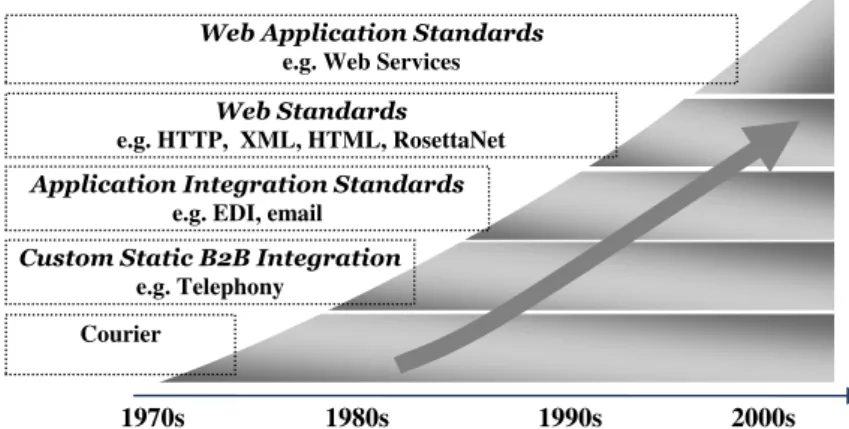
business transactions (Wikipedia, 2007a). Since 1990s, many organizations have been
moving towards electronic business document interchange (RosettaNet, 2002), as
shown in Figure 1. The emergence of the Internet has encouraged the evolution of
electronic document interchange from traditional electronic data interchange (EDI) into
Internet-based data interchange. However, the high initial investment cost has slowed
down the adoption of EDI (Wikipedia, 2007b), especially among the small and
medium-sized industries.
Figure 1. Business-to-business technologies evolution.
This paper represents the initial work of a series of projects described in Ting, Khoo
& Cheah (2007). The main research objective of Ting et al. (2007) is to model, analyze,
and design a next generation Business-to-Business Standards Component Model in a
service oriented architecture by using Web services on an open platform for a more
effective interchange or even sharing of trade documents in a more personalized
manner.
RosettaNet is a non-profit organization established in 1998 defining standards in
global supply chain. RosettaNet Partner Interface Processes (PIPs) standardize business
processes by defining business documents format and content in seven sectors: demand
creation, design, forecast, order, payment, logistics, and manufacture. Each document is
complemented with a business document specification, business process specification,
PIP process specification and message structure to ease the implementation of the
standards. Through the standardized business processes and document content and
format, the flow of data can be easily observed, analyzed and controlled to improve the
overall efficiency of the business-to-business (B2B) integration. RosettaNet standards
have been widely endorsed by some 500 companies worldwide. More details about
RosettaNet PIPs standards can be found in (RosettaNet, 2007a).
Since RosettaNet has been used by the project partners, its trade document
interchange standards have first been chosen in this research project. RosettaNet
standards increase the efficiency of business processes by reducing the number of
manual transactions, contract costs, inventory and administrative costs, shipments and
logistics costs, etc. (RosettaNet, 2007d). Moreover, the standards facilitate direct
connections between trading partners without any third-party intermediary such as
Value Added Networks (Damodaran, 2005). Over the years, RosettaNet has reduced the
costs of Partner Interface Processes creation. The cost improvements include XML
1970s 1980s 1990s 2000s
Web Application Standards
e.g. Web Services
Web Standards
e.g. HTTP, XML, HTML, RosettaNet
Application IntegrationStandards
e.g. EDI, email
Custom Static B2B Integration
e.g. Telephony
Courier
schema representation, shared UML models, and automated XML schema creation.
RosettaNet Automation Enablement (RAE) is another program introduced to help the
small and medium-sized industries to adopt the RosettaNet standards. RAE eliminates
RosettaNet Implementation Framework development which enables the 24/7 Internet
connection among the smaller industries. However, there are problems in maintaining
data quality and service quality when the volume of Business-to-Business transaction
increases (Damodaran, 2004). The original Partner Interface Processes use a ‘Push’
model which has a high rate of data redundancy (Damodaran, 2004). The size of a
Partner Interface Processes is usually between ten megabytes and a hundred megabytes.
A complete Partner Interface Processes business transaction normally consumes
hundreds of gigabytes. As a result, the need for larger disk storage and higher network
speed will increase exponentially as a business grows. Therefore, a ‘Pull’ model is
introduced to pull only the required data. Nevertheless, the ‘Pull’ model has its
drawback of not getting the most current data (Bhide et al., 2002). Based on the
research done by Bhide et al. (2002) which describes the dynamic dissemination of Web
data, a combination of the ‘Push’ and ‘Pull’ models is proposed in this paper for trade
document interchange among the users’ trading partners.
RosettaNet Partner Interface Processes (PIPs)
A case study has been carried out in Schönberger (2006) to realize the RosettaNet
PIPs compositions as Web service orchestrations. It proposes a framework to execute
PIPs using a ‘Push’ model through some Web services. While the public business
processes have been extensively standardized in the document format and interchanged
among the trading partners using the ‘Push’ model, this research project attempts to
personalize some of the private processes through Web services in some other models
such as the ‘Pull’ Model. Prior to this project, the same research team has reviewed and
analyzed some possible approaches to enhance B2B integration in the RosettaNet
environment. The research outcome has been documented in the form of a research
roadmap in (Ting et al., 2007).
B2B procurement process using PIPs
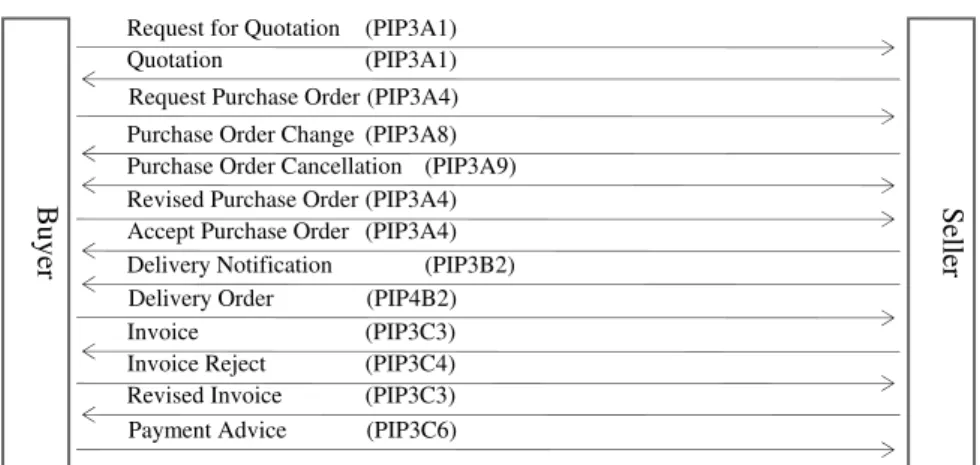
This section examines the ‘Push’ model by observing the business documents
interchanged in a typical B2B procurement process as shown in Figure 2. Based on the
latest update from the RosettaNet Website when this paper was written, there was a
total of 109 PIPs to-date (RosettaNet, 2007a). Figure 3a and 3b show how the PIPs and
Figure 2. B2B transactions pushed through PIPs.
Figure 3a. PIPs and RNIF in B2B integration.
Figure 3b.One-way PIP and two-way PIP.
Emailing is a good example of using a ‘Push’ model for document interchange. A
sender can send an unlimited number of emails to a receiver without the need for any
response. As a result, junk messages tend to overload the mailboxes.
Data quality and service quality in PIPs
The multi-national companies in the Electronics industry use PIPs and RNIF to
interchange business documents with their trading partners. The sequence of trade
document interchange is predefined in the Trading Partner Agreement. Based on the
data provided by a large international electronic company (Intel), more than 90% of its
trading partners are the small and medium-sized industries. As such, it is necessary to
study and analyze the data quality and service quality of PIPs so that the small and
medium-sized industries will be more ready to adopt the standards.
Adopted from RosettaNet Technical Overview (RosettaNet, 2007b)
B u y er S el le r
Request for Quotation (PIP3A1)
Quotation (PIP3A1)
Request Purchase Order (PIP3A4) Purchase Order Change (PIP3A8) Purchase Order Cancellation (PIP3A9) Revised Purchase Order (PIP3A4) Accept Purchase Order (PIP3A4) Delivery Notification (PIP3B2) Delivery Order (PIP4B2)
Invoice (PIP3C3)
Invoice Reject (PIP3C4)
Revised Invoice (PIP3C3) Payment Advice (PIP3C6)
Company A Company B
PIP
RosettaNet PIPs via Internet
Translate from RosettaNet standards to Company A system data set
Translate from RosettaNet standards to Company B system data set
R N IF R N IF PIP RosettaNet defines: 1. Business processes
2. Framework for how data gets passed over the Web 3. Certain handshake criteria
E R
ERP E
R
ERP
Private Processes Public Processes Private Processes
Adapted from RosettaNet Training Material [15]
S en de r R ec eiv er
2.Confirmation PIP
(b) Two-way PIP
1.PIP S en de r R ec eiv er
2.Acknowledgment message
(a) One-way PIP
Data quality
Relevancy and completeness are two of the main attributes for data quality.
Enterprises invest heavily to provide customized documents in some specific format and
content to meet the needs of their partners’ requests on data relevance and
completeness. Although PIPs take into account the entire content of trade documents
which comply with completeness, Damodaran (2004) asserts that PIPs have a problem
in ‘large messages with redundant content’. In this study, an analysis is carried out to
compare the contents of two PIPs, they are Request Purchase Order and Query Order
Status. Among the first 100 data fields in Query Order Status, some 90 data fields have
been found to be redundant in the Request Purchase Order. In other words, some 90%
of the information exchanged in these two processes are redundant. The entire Request
Purchase Order and Query Order Status have accumulated up to some 50% of redundant
fields. Therefore, a large amount of redundant data has actually been interchanged
among the partners. It is pointed out in Surfcontrol (2007) that large amount of emailing
reduces network efficiency and speed and thereby affects a company’s ability to meet
tight deadlines. Likewise, redundant data could also clog the network and delay the
business processes. Nevertheless, customizing or personalizing documents to meet
different partners’ request is very costly and time consuming. This particular need has
motivated this research to provide personalization Web services for the small and
medium-sized industries.
PIPs standardize the documents’ format and content. In the business processes,
many business documents need to be produced manually or system generated. For
example, in PIP3A (Quote and Order Entry), at least ten business documents with
thousands of data fields need to be created and sent to the trading partners. PIP Request
Purchase Order and PIP Query Order Status are two of the primary business documents
involved. As the business grows, the content of a predefined document needs to be
updated. In PIPs, it is costly and time consuming to alter the content. Therefore,
partners are reluctant to change the predefined content. In short, although PIPs
standardize the document content, they sometimes do not comply with the ‘relevancy’
requirement of the users.
Service quality
In business-to-business document interchange, electronic document standardization
has been introduced to ease the communications among the trading partners. From the
perspective of the small and medium-sized industries, the standardized formats have
increased data redundancy, communication overheads, storage overheads, as well as the
inflexibility in satisfying their respective needs and wants. Three possible
products/services, (b) the Website where the partners interact, and (c) the
communication and messaging that reach the partners through a variety of channels and
media.
In addition, real time accessibility of data depends on the availability of the sender.
If a small company does not push out the data, the receiver will never get it.
Accessibility refers to a situation whether a request for service could be met. The ‘Push’
model has lower accessibility in terms of data retrieval (Bhide et al., 2002).
Alternative Models of B2B Document Interchange
In view of the drawbacks identified in the ‘Push’ model using the original PIPs, this
paper attempts to propose other alternative models for enhancing the B2B document
interchange through PIPs.
Document interchange using data-blocks
It is proposed to use a so-called ‘data-block structure’ for minimizing data
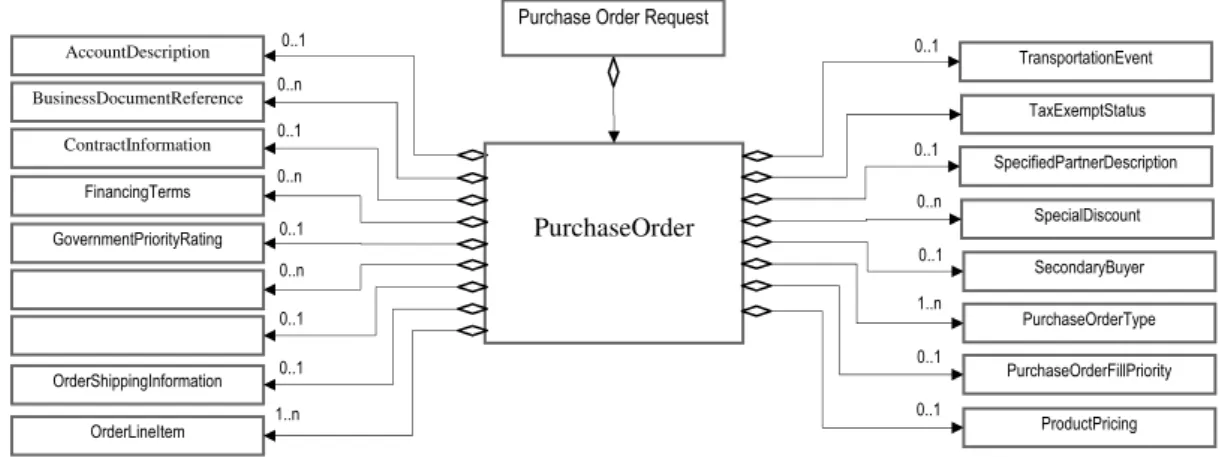
redundancy. RosettaNet PIPs use the UML models to represent the business
requirements. XML messages are produced based on the UML models. Inheritance and
aggregation are used to achieve consistency and reduce the size of the XML messages
Damodaran (2005). XML messages are produced based on the UML model shown in
Figure 4.
The data redundancy stated in Damodaran (2004) can be identified and estimated
from the above-mentioned UML models. The Purchase Order Request and Purchase
Order Change Request are used for discussion, as shown in Figure 5. The available data
groups for each PIP are represented in alphabets.
Figure 4. UML model for Purchase Order Request.
Adapted from RosettaNet PIP Directory (RosettaNet, 2007a)
BusinessDocumentReference AccountDescription
ContractInformation
FinancingTerms
TransportationEvent
GovernmentPriorityRating
OrderShippingInformation
OrderLineItem ProductPricing
PurchaseOrderFillPriority PurchaseOrderType
SecondaryBuyer SpecialDiscount SpecifiedPartnerDescription
TaxExemptStatus
PurchaseOrder
Purchase Order Request
0..1
0..n
0..1
0..n
0..1
0..n
0..1
0..1
1..n 0..1
Figure 5. Fourtypical business documents interchanged.
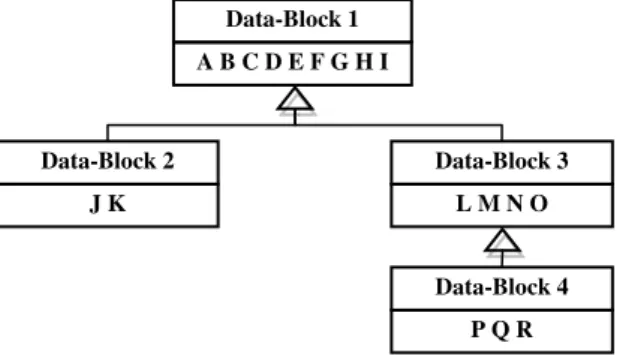
Figure 6. Possible data-block hierarchy.
In Figure 6, block 4 inherits all or some classes from block 1 or
data-block 3. Therefore, data-data-block 4 may have classes such as C and D from data-data-block 1
and classes L and M from data-block 3. The nature of such inheritance is predefined in
the Trading Partner Agreement. Figure 7 shows the document interchange using the
proposed data-block hierarchy.
Figure 7. Data-blocks interchanged.
In a typical procurement process, data-blocks are interchanged accordingly. Data
sent in the previous data-block will not be re-sent in the second data-block unless there
are changes to the data. This reduces data redundancy. The data-block hierarchy also
helps to ensure the completeness of data. The receiver can check the received data
based on a checklist to ensure that no data elements are missing.
‘Push’ model using data-blocks
The data-block structure can be used to reduce redundancy in the original ‘Push’
model as shown in Figure 8. However, the main drawback of this model is that the
receiver does not have the control over what and when to receive the data.
Purchase Order Request
Purchase Order Request Confirmation )
Purchase Order Change Request
Purchase Order Change Request Confirmation
S
en
de
r
R
ec
eiv
er
(Data Groups: A B C D E F G H I)
(Data Groups: A B C D E F G H I J K)
(Data Groups: B C D I L M N O)
(Data Groups: B C D I L M N O P Q R)
Data-Block 1
A B C D E F G H I
Data-Block 2
J K
Data-Block 3
L M N O
Data-Block 4
P Q R
Data-Block 4 Data-Block 1
Data-Block 2
Data-Block 3
(Data Groups: A B C D E F G H I)
(Data Groups: A B C D E F G H I J K)
(Data Groups: B L M N O)
(Data Groups: B L M N O P Q R)
S
en
de
r
R
ec
eiv
er
Purchase Order Request
Purchase Order Request Confirmation )
Purchase Order Change Request
Figure 8.‘Push’ model using data-blocks.
‘Pull’ model using data-blocks
In the receiver-oriented ‘Pull’ model, the receiver has the control over what and
when to receive the data. However, the receiver might not be aware of the latest updates
and therefore the fidelity is lower compared to the ‘Push’ model.
Figure 9.Receiver-oriented ‘Pull’ model.
‘Push and Pull’ model using data-blocks
The ‘Push and Pull’ model is introduced in this study to overcome the shortcomings
arising from the previous models. There is an intermediary server between two trading
partners. A sender pushes the updated data to the intermediary server with a
confirmation message in return. A receiver can then pull the desired data from the
intermediary server. Therefore, the fidelity for this model is high.
Figure 10. ‘Push and Pull’ model using data-blocks.
‘Push and Pull’ model using data-blocks
The ‘Push and Pull’ model is introduced in this study to overcome the shortcomings
arising from the previous models. There is an intermediary server between two trading
partners. A sender pushes the updated data to the intermediary server with a
confirmation message in return. A receiver can then pull the desired data from the
intermediary server. Therefore, the fidelity for this model is high.
‘Push and Pull’ model using Web services
In order to provide personalizable capabilities to the trading partners, Web services
can be incorporated in the ‘Push and Pull’ model. The trading partners can pull any
S en de r R ec eiv er
1.Push Purchase Order data-blocks
2.Send acknowledgement message
(a) One-way data-blocks
2.Send Purchase Order Confirmation data-blocks
R
ec
eiv
er
1.Push Purchase Order data-blocks
(b) Two-way data-blocks
S
en
de
r
Sender Pull data-blocks Receiver
S en de r R ec eiv er
1.Push data-blocks 3.Notification
Intermediary
Server 4.
Pull data-blocks 2.Acknowlegement
(a) One-way data-blocks
S en de r R ec eiv er
1.Push data-blocks 3.Notification
Intermediary
Server 4.Pull data-blocks
2. Confirmation data-blocks
desired data from the intermediary server upon receiving a notification. This is
supposedly the most ideal model for the small and medium-sized industries to freely
access the most up-to-date data anytime with minimal data redundancy. In effect, a
decision support Web service could be implemented at the intermediary server through
which the users can set the prioritized criteria and in return the Web service would
recommend the most appropriate model(s) for the users to make more-informed
document interchange decisions. Some of the criteria may include cost, accessibility,
tolerable level of data redundancy, frequency of data updates, flexibility in timing and
content of document interchange, etc
Figure 11. ‘Push and Pull’ model using Web services.
Performance of Document Interchange Models
The small and medium-sized industries have been slown in adopting the RosettaNet
standards for document interchange mainly due to its high initial cost, which may be
attributed to the high data redundancy and low accessibility in using the ‘Push’ model
with the original PIP formats. Four different models were proposed in the previous
section to encourage more widespread use of the RosettaNet standards. The models are
evaluated in terms of their data quality and service quality, as shown in Table 1. The
evaluation is based on four criteria namely, data redundancy, fidelity, accessibility and
personalizability.
Table 1
Performance of Various Models
Data Quality Service Quality
Personalizability
No. Model Data
redundancy
Fidelity (Data updates)
Accessibility
Timing Content
1 ‘Push’ model using original PIPs
High Updated Low Not flexible Coarse grain
2 ‘Push’ model using data-blocks
Low Updated Low Not flexible Coarse grain
3 ‘Pull’ model using data-blocks
Low Out-dated Low/Medium Flexible Medium grain
4 ‘PnP’ model using data-blocks
Low Updated High Flexible Medium grain
5 ‘PnP’ model using Web services
Low Updated High Flexible Fine grain
S
en
de
r
R
ec
eiv
er
1.
Push data-blocks 3.Notification
Intermediary
Server 4.Pull data-fields 2.Acknowlegement
(a) One-way data-blocks
S
en
de
r
R
ec
eiv
er
1.
Push data-blocks 3.Notification
Intermediary
Server 4.Pull data-fields 2. Confirmation data-blocks
Data redundancy
The ‘Push’ model using the original PIPs has a high rate of data redundancy
(Damodaran, 2004). Two such PIPs in the ‘Push’ model could give rise to as high as
some 50% of data redundancy. Since a complete PIP business transaction could
consume hundreds of gigabytes, the usage of structured data-blocks in models nos. 2, 3,
and 4 listed in Table 1 could reduce the rate of data redundancy to a large extent.
Comparatively, model no. 5 has the lowest rate of data redundancy.
In the ‘Push’ model, the PIP formats are established by RosettaNet in the Trading
Partner Agreement (TPA), while the data-blocks in models nos. 2, 3 and 4 are
determined between the trading partners and fixed in the TPA. However, in model no. 5
the data fields extractable through the Web services could be determined dynamically
during the execution. As such, model no. 5 has the lowest data redundancy. If the users
do not wish to deploy the services of an intermediary party, models nos. 3 or 4 could be
the wise choices.
Fidelity
The ‘Push’ model using the original PIPs has a higher rate of data accuracy or
higher fidelity, since the sender pushes all data to the receiver. However, in the ‘Pull’
model, the receiver may not be aware of the new updates. As such, the sender has to
notify the receiver on the new updates and request the receiver to pull them. This
problem does not arise in the ‘Push and Pull’ model because the sender always pushes
the latest data-blocks to the receiver. In the case of model no. 5 listed in Table 1 where
Web services are used, the receiver would be notified whenever there are new updates.
Accessibility
Accessibility is the availability of the receiver’s server for the ‘Push’ model or the
sender’s server for the ‘Pull’ model. In other words, both the partner’s server(s) must be
online. Among the five models, models nos. 4 and 5 listed in Table 1 have the highest
accessibility since it is assumed that the intermediary server(s) has multiple levels of
server backup and will always be communicating with the trading partners. In these two
models, the sender always pushes the updates to the intermediary server which in turn
would notify the receiver for some data pulling actions. Models nos. 1 and 2 have low
accessibility because the small and medium-sized industries do not have the budget to
purchase additional server facilities.
Personalizability
Personalizability is the ability to suit one’s needs and wants. Such capabilities are
where the partners interact, and through all the available communication channels and
media. The advantage of using a third party’s services is that a common set of
programmable services are stored at the server which provide 24-hour accessibility. At
least two aspects of the services could be personalized namely, timing and content. The
sender can push data to the server and the receiver can pull the smallest possible units of
data from it at the most convenient time.
Models nos. 1 and 2 listed in Table 1 are inflexible in both timing and content due
to the predefined PIPs format, while model no. 5 is the most flexible in timing and
could provide the smallest possible units of data through the Web services.
Conclusion and Future Work
With the ulterior aim of researching into the personalizable Web services for the
smaller industries, this paper analyzed the original ‘Push’ model in the RosettaNet
Partner Interface Processes, and generally compared it with the proposed ‘Pull’ model
and ‘Push and Pull’ model. Their performances are assessed and evaluated in terms of
data redundancy, fidelity, accessibility and personalizability. It is argued that when the
‘Pull’ and ‘Push’ models are combined, the resulting model would enhance the overall
document interchange performance and flexibility. The outcome of this research would
add value to the provision of personalizable Web services which may eventually
converge and/or interface with the new RosettaNet implementation framework in the
future. With these personalizable Web services, the users among the small and
medium-sized industries would then have better-informed choices of document interchange
models to suit their individual interaction styles.
Further research on industrial gap analysis is required to possibly standardize some
of the private business processes among the smaller non-Electronics industries so that
they will be more ready to use the new RosettaNet implementation framework and other
References
Accenture. (2004). Breaking away: Creating business value through information technology. Retrieved October 1, 2007, from http://www.accenture.com/Global/ Research_and_Insights/ Outlook/By_Alphabet/BreakingTechnology.htm
Bhide, M., Deolasee, P., Katkar, A., Panchbudhe, A., Ramamritham, K. & Shenoy, P.
(2002). Adaptive push-pull: Disseminating dynamic web data. IEEE Transactions on Computers, 51, 652-668.
Chung, J. Y. (2002). Beyond e-marketplace & next generation e-business: Grid,
autonomic computing & web services. The 4th International Conference on Electronic Commerce, Oct. 24, 2002, Hongkong.
Damodaran, S. (2004). B2B Integration over the Internet with XML: RosettaNet
successes and challenges. The 13th International World Wide Web Conference on Alternate Track Papers & Posters. New York, NY, USA, ACM press, 188-195. Damodaran, S. (2005). RosettaNet: Adoption brings new problems, new solutions. The
XML 2005 Conference. November, Atlanta, USA, 1-14.
Hanson, W. A. & Kalyanam, K. (2007). Internet marketing & e-commerce. Canada: Thomson South-Western.
RosettaNet. (2002). RosettaNet: implementing e-business processes on a global scale.
RosettaNet Executive Insights.
RosettaNet. (2007a). PIP directory. Retrieved September 1, 2007, from http://www. rosettanet.org.my/PIP_Directory.aspx
RosettaNet. (2007b). RosettaNet technical overview. Penang, Malaysia: RosettaNet Engineering.
RosettaNet. (2007d). Why RosettaNet. Retrieved September 20, 2007, from http:// www.rosettanet.org.my, 2007
Schönberger, A. (2006). Modelling and validating business collaborations: A case study
on rosettanet. Bamberger Beiträge zur Wirtschaftsinformatik und Angewandten Informatik, 65.
Surfcontrol. (2007). Excessive spam e-mails were beginning to slow down the network, jeopardizing fast turnarounds on customer projects. Retrieved September 1, 2007, from http://www. surfcontrol.com/ general / assets /case_studies / imagemaster.pdf,
2007.
Ting, T. T., Khoo, K. T. & Cheah, Y.-N. (2007). Approaches to enhancing rosettanet
standards component. Computer Science Postgraduate Colloquium, 8-9.
Wikipedia. (2007a). Electronic commerce. Retrieved September 20, 2007, from http://en.wikipedia.org/wiki/E-commerce.