Inductive Data Types Based on
Fibrations Theory in Programming
Decheng Miao
1, Jianqing Xi
2, Yubin Guo
3and Deyou Tang
21School of Information Science and Engineering, Shaoguan University, Shaoguan, China 2School of Software, South China University of Technology, Guangzhou, China
3School of Information, South China University of Agriculture, Guangzhou, China
Traditional methods including algebra and category theory have some deficiencies in analyzing semantics properties and describing inductive rules of inductive data types, we present a method based on Fibrations theory aiming at those questions above. We systemati-cally analyze some basic logical structures of inductive data types about a fibration such as re-indexing functor, truth functor and comprehension functor, make semantics models of non-indexed fibration, single-sorted indexed fibration and many-sorted indexed fibration respectively. On this basis, we thoroughly discuss semantics prop-erties of fibred, single-sorted indexed and many-sorted indexed inductive data types, and abstractly describe their inductive rules with universality. Furthermore, we briefly introduce applications of the three inductive data types for analyzing semantics properties and describing inductive rules based on Fibrations theory via some ex-amples. Compared with traditional methods, our works have the following three advantages. Firstly, brief de-scriptions and flexible expansibility of Fibrations theory can analyze semantics properties of inductive data types accurately, whose semantics are computed automatically. Secondly, superior abstractness of Fibrations theory does not rely on particular computing environments to depict inductive rules of inductive data types with universal-ity. Thirdly, its rigorousness and consistence provide sound basis for testing and maintenance of software development.
ACM CCS (2012) Classification: Theory of computation →Logic→Constraint and logic programming
Keywords: inductive data types, Fibrations theory, se-mantics properties, induction rules, ad joint functor
1. Introduction
Traditional methods of inductive data types are mainly algebra and categorical theory [1-3]. The former focuses on describing the finite syn-tax construction of inductive data types, e.g.,
Abstract Data Type Research Groups encapsu-lated inductive data types and their operations in-algebras. The latter presents model of type theory in local Cartesian closed category, but both render inductive data types and predicates denoting their semantic properties to coexist in the same category, which leads to functors and their lifting are equivalent. Traditional methods are difficult to process the recursive computa-tions of inductive data types effectively, and there are some limitation to analyze semantic properties and describe inductive rules.
in the same category any more, but constructs functor lifting in total category to depict recur-sive computing and program logic of inductive data types abstractly. Hermida and Jacobs have done lots of foundational researching works for this in[9]. The main idea of inductive data types based on Fibration theory is that we take induc-tive data types in programming to be object-set in base category, semantic properties of induc-tive data types to be object-set in total category, establish the responsible relations in program logic directly between inductive data types and their semantic properties by semantic models of fibration, construct recursive operations of inductive data types to analyze semantic prop-erties by the tools of endo-functors in base cat-egory and their lifting in total catcat-egory as well as and abstractly describe inductive rules with universality by initial property of initial algebra. Our primary works are researching inductive data types and their inductive rules by Fibrations theory. The rest of this paper is structured as follows. In Section 2, we firstly introduce some basic concepts for our research works, such as Cartesian arrow and fibration, then demonstrate adjunction properties of re-indexing functor and op-re-indexing functor. In Section 3, we make semantic model of non-indexed fibration to an-alyze semantics of fibred inductive data types and depict their inductive rule with universality abstractly. In Section 4, we extend non-indexed fibration to single-sorted indexed fibration on slice category, make its semantic model to ana-lyze semantics of single-sorted indexed induc-tive data types and depict their inducinduc-tive rule. In Section 5, we develop single-sorted discrete ob-ject to indexed category, further extend single-sorted indexed fibration to many-single-sorted indexed fibration, make its semantic model to analyze many-sorted indexed inductive data types and depict their inductive rule. In Section 6, we study some related works in the research field of inductive data types. At last, we summarize our conclusions and discuss our future research.
2. Fibration and Opfibration
2.1. Fibration and Re-Indexing Functor
We assume readers have the categorical foun-dations, functor, adjunction, natural
transforma-tion, etc. Considering not making set theoret-ical models by mathemattheoret-ical logic, currently, some basic math literatures do not require all morphisms to be a set, but from the practical applications perspective of computer process-ing discrete objects, we deem it is reasonable to take all morphisms to be a set. If all objects and morphisms can form two sets respectively in a category, the category is called a small cat-egory, as stated by [10]. All research objects in this paper are based on small category, more details about Fibrations theory can be found in
[10-12]. LetObj be a set of objects for cat-egory , and Mor a set of morphisms for category . We introduce some basic concepts in this paper.
Definition 1. LetP : → be a functor be-tween small categories and ,f : C → D ∈
Mor ,u:X→Y ∈Mor . We call morphism
u a Cartesian arrow of f and Y if P(Y) = D,
P(u) = f, for ∀Z ∈ Obj , v : Z → Y ∈
Mor and ∀h : P(Z) → C ∈ Mor , it sat-isfiesf ◦h = P(v), and there exists a unique
w : Z → X ∈Mor such that u◦w = v and
P(w) =h.
For Cartesian arrowuoff andY, we callulies abovef; and similarly forf,Y lies aboveD. If
u is a cone [10] in category , in definition 1 the Cartesian arrow u is also a universal cone in by the uniqueness of cones morphism w, namely, limit cone. Accordingly, the vertexX
of universal coneuis the terminal object in[13] ofX.
Definition 2. Let P : → be a functor between small categories and ; then if for
∀Y ∈Obj and∀f :C →P(Y)∈Mor there exists a Cartesian arrow off andY, we callPa fibration.
By definition 2, we know that fibration is a func-tor that in fact ensures a large supply of Carte-sian arrows. For a fibration P : → , we call the base category of P, and its total category. If for an object C in Obj , ∃X ∈
Obj , k ∈ Mor is satisfied P(X) = C and
P(k) =idC, then the subcategory Cis called a
fiber overCin[10], andkis vertical morphism. Fiber C is actually a full subcategory of total
category . Without loss of generality, we write
Definition 3. A morphism f : C → D in base category is extended to be a functor
f∗ : D → Cbetween fibers Dand C; we
callf∗a re-indexing functor induced byf.
f is the relationship between inductive data types in base category, and re-indexing func-tor f∗ is a lifting of fin total category, which is related to their semantic properties. The dual concept to fibration, i.e., opfibration, is as fol-lows.
2.2. Opfibration and Op-Re-Indexing
Functor
Definition 4. LetP : → be a functor be-tween small categories and ,f :C →D ∈
Mor , u : X → Y ∈ Mor . We call mor-phism u an opposite Cartesian arrow off and
X if P(X) = C, P(u) = f, for ∀Z ∈ Obj ,
v : X → Z ∈ Mor and ∀h : D → P(Z) ∈
Mor , it satisfiesh◦f = P(v), and there ex-ists a unique w : Y → Z ∈ Mor such that
w◦u=vandP(w) =h.
Similarly to definition 1, ifu is a co-cone[10]
in category , the opposite Cartesian arrowuin definition 4 is a universal co-cone in by the uniqueness of co-cones morphism w, namely, co-limit co-cone. Accordingly, the vertexY of universal co-cone uis the initial object of uin
[13].
Definition 5. LetP : → be a functor be-tween small categories and ; if for ∀X ∈
Obj and ∀f : P(X) → D ∈ Mor , there exists an opposite Cartesian arrow off andX, we callPan opfibration.
Definition 6. If the functor P : → be-tween small categories and is simultane-ously a fibration and an opfibration, then it is a bifibration.
Without loss of generality, we writefX
↓ for the
opposite Cartesian arrowuoff andX; let∗f(X)
be the codomain off↓X, then we say∗f(X)lies aboveD, that is,X ∈Obj C,∗f(X)∈Obj D.
Definition 7. A morphism f : C → D in base category is extended to be a functor
∗f : C → Dbetween fibers C and D, we
call∗f is an op-re-indexing functor induced by
f.
2.3. Adjunction Properties of Re-Indexing Functor and Op-Re-Indexing Functor
Definition 8. If F G : → is a pair of ad joint functors,, is the unit and co-unit of this adjunction respectively, and for∀X ∈ Obj
, ∀Y ∈ Obj , ∃f : F(X) → Y ∈ Mor ,
∃g : X → G(Y) ∈ Mor , then the transpose off andgisG(f)X andYF(g)respectively.
Theorem 1. LetP: → be a fibration be-tween small categories and ;Pis a bifibra-tion iff∀f : C → D ∈Mor , the re-indexing functorf∗ has a left ad joint functor ∗f which is an op-re-indexing functor.
Proof. ⇒. Let ∗f f∗ : C → D be a
pair of ad joint functors, the unit is, the co-unit is , and P : → is a fibration be-tween small categories and . For ∃Y ∈
Obj D, we can construct a Cartesian arrow
fY↓ : f∗(Y) → Y whose codomain is Y. ∃X ∈
Obj C, letl: X→∗f(X)be a morphism above
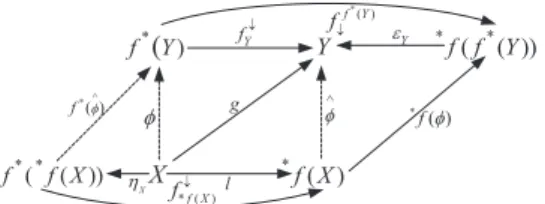
f, the proof thatlis an opposite Cartesian arrow abovef is as follows: it satisfiesl=f∗↓f(X)◦X
by the adjunction properties of∗f f∗, seen from Figure 1. We write id to identify mor-phism, ifg:X →Yis another morphism above
f, let : X → f∗(Y) be vertical morphism in
C, we get P() = idC. By definition 1 we
knowg=fY↓◦, Cartesian arrowfY↓is an uni-versal cone, whose uniuni-versal property ensures
is the unique morphism fromgtofY↓. We write
∧
for the transpose of under the adjunction
∗f f∗, then ∧ = Y ◦∗f() : ∗f(X) → Y,
f∗(∧)◦X =. Universal property of universal
conefY↓ ensures the unique existence off∗(∧),
and it satisfies∧◦f∗↓f(X) = fY↓◦f∗(∧). Above all, there exist two equalities, that are, ∧◦l =
∧
◦f∗↓f(X)◦X =fY↓◦f∗(
∧
)◦X =fY↓◦ =g,
g = ∧◦l, then the transpose of is the unique morphism fromltog, andP(∧) =idD. We thus
prove that l is an opposite Cartesian arrowf↓X
* ) ( f Y * * ( ( ))
f f X X
Y * ( ) f X * * ( ( ))
f f Y
I I X K l g Y
fp HY
*
( )
fI *
( )
f I
* (f X)
fp
* ( ) f Y
fp
Figure 1.Proof of opposite Cartesian arrow.
⇐. We assumeg:X →Y ∈Mor lies above
f, write C(X,f∗(Y))for set composed of mor-phisms aboveC in fiber C, D(∗f(X),Y)for
set composed of morphisms above D in fiber
D. For ∀k : X → X ∈ Mor C, ∀h : Y →
Y ∈ Mor D, because P : → is a
bi-fibration, this gives us one-to-one correspond-ing mapX,Y : D(∗f(X),Y)→ C(X,f∗(Y)).
We writekop :X →X∈Mor Cfor an
oppo-site morphism ofk, it satisfies thatkop◦fXop
↓ =
f↓Xop◦∗f(kop)andid
f∗(Y)◦fY↓op =fY↓op◦idY,
so the left part of diagram in Figure 2 com-mutes. Similarly, it also satisfiesidX ◦f↓Xop =
f↓Xop◦id∗f(X) andf∗(h)◦fY↓op =fY↓op, i.e., the right part of diagram in Figure 2 commutes, so
X,Y is natural isomorphism. We thus prove
∗f f∗ by definition of ad joint functors in
[13].
* ( , ( )) C X f Y
* ( , C ,, (
* *
( ( ), ) D f X Y
* * D f( )(
* ( ', ( )) C X f Y
* ( ', C ',',f
* *
( ( '), ) D f X Y
* (* ( D ((
*
( , ( ))
C(idX f h CidX,,f *
( ( ), )
D op
Y f k id
*
(
D op f k((
, X Y M ', X Y M * ( , ( )) C X f Y
* ( , C , (
* *
( ( ), ) D f X Y
* * D f( )
* ( , ( ')) C X f Y
* ( , C ,, (
* *
( ( ), ') D f X Y
* (* ( ) D ( )(
* ( )
( , )
D(idf X h D *f X((
( , X Y M , ' X Y M *( ) ( , ) C op f Y k id ( , C op ,,
Figure 2.Proof of adjunction properties.
Theorem 1 provides a convenient condition for judgment of bifibration. At the same time, it also amalgamates well adjunction property of re-indexing functorf∗and op-re-indexing
func-tor∗f in the framework of bifibration.
3. Semantic Properties and Inductive
Rule of Fibered Inductive Data Types
Fibered inductive data types, such as natural numbers and finite partial order sets, are usual inductive data types with fibered structures from the view of Fibrations theory. This section presents a semantic model of non-indexed fi-bration by Fifi-brations theory, which analyzes
se-mantic properties and describes inductive rule of fibered inductive data types.
3.1. Semantic Model of Non-Indexed Fibration
Definition 9. LetP: → andP: →
be two fibrations between small categories, a fibered functorF : → fromPtoPabove
base category satisfies diagram commutes, that is, P = P ◦F, and we call F preserves
Cartesian arrow.
Definition 10. LetF : → andG: →
be two fibered functors above base category , we callG a right fibered ad joint functor toF, andF Gis a pair of fibred adjunction above , iffGis a right ad joint functor toF, the unit or co-unit ofFGis vertical.
Definition 9 and definition 10 lift standard cate-gory structures to fibered structures. It is easy to process many practical problems with discrete structures in computer science effectively, that is, semantic properties of inductive data types in programming are mapped to their correspond-ing fibers in total category, which is closely re-lated to inductive data types to their semantic properties further. At the same time, what is more important is that describing inductive rules with universality and program logic abstractly by the tools of fibered functor and fibered ad-junction does not depend on particular comput-ing environments, which improves the cohesion of inductive data types, and further enhances in-dependence of program languages.
Definition 11. Let P : → be a functor between small categories and , F: →
is an endo-functor in base category , the lift-ing of F with respect to P is an endo-functor
F⊥ : → in total category . If there exists diagram commute, i.e., PF⊥ = FP, then we callPa non-indexed fibration.
Definition 11 makes the semantic model of non-indexed fibration. For∀D ∈ Obj , if∃1D ∈
Obj D, which is the terminal object of fiber D, and ∀f : C → D ∈ Mor , f∗(1D) is
then the terminal object of fiber C, namely,
3.2. Semantic Properties of Fibered Inductive Data Types
Definition 12.LetP: → be a non-indexed fibration, functorT : → maps∀C ∈Obj
to the terminal object in fiber C,T is called a truth functor ofP. IfTF ∼= F⊥T, we callF⊥
a lifting ofFwith respect toPpreserving truth. We write that 1 and 1 are terminal objects of base category and total category respec-tively, we thus getP(1 ) =1 . For ∀C ∈Obj
there exists a unique morphismu:C→1 in base category , so we have a isomorphism ex-pression, that is,T(C)∼=u∗(1 ). For∀f :C→
D ∈ Mor , we have an isomorphism expres-sionf∗(T(D))∼=T(C), and the truth functorT
mapsf to a Cartesian arrowfT↓(D) in total cate-gory . If the truth functorTis full and faithful
[13], then it is a fibered right ad joint functor to non-indexed fibrationP[8].
For each object C in category , a F-algebra
(C,i : F(C) → C)is constructed by the endo-functor F, we call the carrier of this F -algebra. The morphism between (C,i) and another F- algebra (D,j : F(D) → D) is a morphism f : C → D between their carri-ers, which satisfies diagram commutes, that is, f ◦ i = j ◦ F(f). F-algebra category is constituted ofF-algebras and their morphisms, we write AlgF for it. If the initial F-algebra (F,in : F(F) → F) exists, it is up to a unique isomorphism, whose properties of this unique isomorphism determined by its initial universal property is our main tool for research-ing semantics and inductive rules of inductive data types. An inductive data typeF, as the carrier of initialF-algebra, is least fixed point of functorF. The functorFdenotes syntax con-struction of F, and its morphism in gives a kind of semantic interception of F under this syntax construction.
AF-algebra(C,i: F(C)→ C)is mapped to a
F⊥-algebra(T(C),T(i):T(F(C)) ∼=F⊥(T(C))
→ T(C))by the truth functorT. Accordingly,
T(F) is the carrier of initialF⊥-algebra, i.e., truth functor preserves initial objects. We write
Alg(T)for the functor fromF-algebra category
AlgF to F⊥-algebra category AlgF⊥, and de-fine Alg(T)def= T. Objects and morphisms in base category with respect to non-indexed
fibration P are mapped to those responded in total category by the truth functorT, which further makes connections fromAlgF toAlgF⊥ viaAlg(T)and isomorphism property of com-posed functors of definition 12. The initialF⊥ -algebra(T(F),in⊥ : F⊥(T(F)) → T(F))
in total category with respect to the non-indexed fibrationP, is the homomorphism im-age of in which is the morphism of initial F -algebra (F,in) by the action of Alg(T), that is,Alg(T)(in) = in⊥. Initial property of initial
F-algebra ensures thatin⊥ is up to unique iso-morphism, whose existence provides extreme convenience for analyzing semantic properties and depicting inductive rule of fibered inductive data types.
Definition 13. Let P : → be a non-indexed fibration between small categories and ,T : → is a truth functor of P. If
{−} is a right ad joint functor to T, namely,
T {−}, then{−}is called a comprehension functor ofP.
Let : {−} → P be a natural transformation,
Fis also a natural transformation by composed theorem of natural transformations, as stated in
[13], then for∀X ∈Obj ,∗(FX) : F{X} →
FP(X)is an op-re-indexing functor induced by
FX, and F⊥(X) = ∗(FX)(T(F{X})) ∈ Obj FP(X), i.e., the action F⊥(X) of each object
X in total category by the liftingF⊥ of endo-functorF in base category, is determined com-pletely by its semantic behaviors of F above
{X}, and {X} is the extension of X over the comprehension functor {−}. For ∀k : X →
X ∈ Mor , F⊥(k) = F⊥(X) → F⊥(X) =
∗(FX)(T(F{X}))→∗(FX)(T(F{X})), that
is,F⊥(k)∈∗(FP(k)), thenF⊥(k)is an element
of re-indexing functor morphism∗(FP(k)). Similar to Alg(T), we write Alg{−} for the functor fromF⊥-algebra categoryAlgF⊥ toF -algebra category AlgF, define Alg{−}def={−},
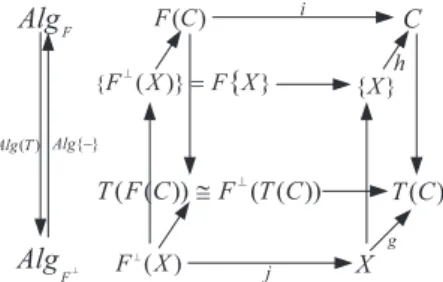
it satisfiesAlg(T) Alg{−} in[9] by adjunc-tion property of T {−} from definition 13. For each F⊥-algebra (X,j : F⊥(X) → X),
Alg{−}(j) =F{X} → {X}, that is,Alg{−}(j)
fromjtoAlg(T)(i), then aF-algebra morphism
h : {X} → C from Alg{−}(j) to i is a F -algebras homomorphism aboveg. Accordingly,
gis aF⊥-algebras homomorphism aboveh. The right ad joint functor Alg{−}toAlg(T) estab-lishes a kind of intuitively mutual induction re-lations betweenF⊥-algebra whose carrier is X
andF-algebras whose carrier is{X}, which fur-ther supplies a succinct and coherent modeling method for describing inductive rules of induc-tive data types formally, whose initial algebra carrier isF.
C ( )
F C
{ }X
( ( )) ( ( ))
T F C #FA T C T C( )
( )
FA X
X
i
j
F Alg
{ }
Alg
F Alg A
( )
Alg T
{FA(X)} F X{ } h
g
Figure 3.Adjunction properties ofAlg(T)Alg{−}.
3.3. Inductive Rule of Fibered Inductive Data Types
For semantic model of non-indexed fibration with comprehension functor, formal descrip-tion of inductive rules and semantic analysis of fibered inductive data types are coherent. A non-indexed fibrationP : → , its compre-hension functor{−}is right ad joint to its truth functor T, i.e., P T {−}. Let F be an endo-functor in base category , andF is the carrier of initial F-algebra, then each preserv-ing truth liftpreserv-ingF⊥ofFwith respect toPhas a inductive rule[9], which provides a sound foun-dation for judging on validity of inductive rules generated from fibered inductive data types for
F⊥ applied by initialF-algebra. Accordingly, if semantic model of non-indexed fibration P
defines and utilizes comprehension functor to compute recursively on fibered inductive data types, then its inductive rule based onF-algebra is valid when processing semantic logic analysis in programming.
In the framework of Fibrations theory, describ-ing inductive rule of fibered inductive data types with universality is as follows: we consider re-cursive computation of fibered inductive data types firstly, which arises from initial algebra
semantics categorically in [2]. Let inductive data typesFbe the carrier of initialF-algebra, we utilize endo-functorFin base category to construct a recursive operation on fibered induc-tive data typesfold:(F(C)→C)→F →C. For eachF-algebra(C,i : F(C) → C), by the action of recursive operationfold, fold iis the map sending i to the unique F-algebra mor-phismfold i : F → C from initialF-algebra morphism in to i, seen from Figure 4. The essence of fold stems from initial algebra se-mantics is a parameterized recursive operation on inductive data types, which possesses lots of good properties such as correct semantics, flexible extension and succinct expression.
( )
F PF
F P
( )
F C
C
in i
fold i
( )
F fold i
Figure 4. F-algebra morphism.
Henceforth, the following isomorphism equa-tions hold: TF(C) ∼= F⊥T(C), TF(F) ∼=
F⊥T(F), and by the property of truth functor
Tpreserving initial objects,T(F)is the carrier of initialF⊥-algebra, we writeF⊥ = T(F),
X = T(C) ∈ Obj . Similarly, we can con-struct a recursive operation fold : (F⊥(X) →
X) → F⊥ → X, which depicts semantics of fibered inductive data types in total category by the tool of preserving truth liftingF⊥ of F, see Figure 5. So for∀C ∈Obj ,X ∈Obj C,
we have the inductive rule of fibered inductive data types with universality, that is,
IndGen :(F⊥(X)→X)→T(F) →X.
If(X,j: F⊥(X) → X)is a F⊥-algebra overF -algebra (C,i : F(C) → C), then IndGen X j :
T(F) → X is a F⊥ algebra homomorphism overfold i.
( )
FA PFA
F
P A
( )
FA X
X
inA j
fold j
( )
F fold j
3.4. Example Analysis of Fibered Inductive Data Types
Example 1. Let natural number type Nat be the carrierFof initialF-algebra in base cate-gory , we write1for the terminal object. For
∀N ∈Obj , it is to be saidF :N →1+N, then its inject in1(1) = 0 is the minimum natural
number, its injectin2(N) =N+1 is a
success-ful function. For any natural number property
X ∈ Obj N in total category with respect
to the non-indexed fibrationP, e.g., transitivity, compatibility and completeness, an induction
(X(in1(1)) → (X(N) → X(in2(N))) → X(N)
holds for property X of Nat. For each F -algebra (N,h : F(N) → N), it is lifted to be a F⊥-algebra (X,k : F⊥(X) → X) via the non-indexed fibration P, which satisfies dia-gram commutes, that is, FP(X) = PF⊥(X). A recursive operation fold h is defined by the initial property of initialF-algebra, it executes to be judgment of fibered inductive data type
Nat; And another recursive operation defined by the initial property of initialF⊥-algebra de-scribes semantics ofNat. Ifk lies overh, then
IndGen X kis aF⊥-algebra homomorphism over
fold h, and when it iterates each object in total category , we can get the semantics set de-scribing properties ofNat, that is{X(N)|∀N ∈
Obj }.
Compared with traditional methods including algebras and category theory, inductive rule
IndGen depicting recursive computing of Nat
is established based on semantic model of non-indexed fibrationPgiven by example 1, which presents a succinct descriptive pattern for se-mantic properties and program logic of fibered inductive data typeNat, especially in functional program languages, such as ML and Haskell, in-ductive ruleIndGenmakes code fragments easier
to read, write and understand.
4. Semantic Properties and Inductive
Rule of Single-Sorted Indexed
Inductive Data Types
As a simple inductive data type, fibered induc-tive data type is limited to analyze semantics and depict inductive rule, but indexed inductive data types are a kind of inductive data types whose syntax construction and semantic computation
are stronger than fibered inductive data types, and can process more complex data structure. Dybjer in[14]and Morris in[15]obtained some prominent achievements in the field of initial al-gebra semantics, but there has been few works about inductive rules of indexed inductive data types nowadays. This section presents a seman-tic model of single-sorted indexed fibration by Fibrations theory, analyzes semantic properties of some classical single-sorted indexed induc-tive data types, such as streams, lists, trees, and so on. On the basis of [15], and borrowing from research production of Ghani et al. [16], we present an inductive rule of single-sorted in-dexed inductive data types with universality.
4.1. Semantic Model of Single-Sorted Indexed Fibration
Theorem 2. Let P : → be a fibra-tion or bifibrafibra-tion between small categories and , T : → is the truth functor of P.
∃I ∈Obj is a discrete indexed object in base category , let single-sorted indexing functor
P/I : /T(I) → /I be P/I(u) = P(u) :
P(Y) → I ∈ Obj /I for ∀u : Y → T(I) ∈
Obj /T(I), then single-sorted indexing func-torP/Iis also a fibration or bifibration.
Proofs. For∀f :C→D ∈Mor , there exists a Cartesian arrowfX↓ :f∗(X)→Xabovef with respect to fibrationPsuch thatP(X) = D, and exists an unique morphismw: TP(I)→f∗(X)
such that v = fX↓ ◦ w and P(v) = f ◦ h, seen from Figure 6. Let : D → I ∈ Obj
/I, : C → I ∈ Obj /I, we thus have two morphisms in the slice category /I, i.e.,
: P(u) → = P(Y) → D ∈ Mor /I
and : P(u) → = P(Y) → C ∈ Mor
/I, which satisfy diagram commutes, that is
=f ◦. In total category /T(I)of functor
P/I, s: X → T(I) ∈Obj /T(I),t : f∗(X) → T(I)∈Obj /T(I), sog : u→ s =Y →X ∈
Mor /T(I), there exists a unique morphism
Y
* ( )
f X X
( )
T I I
D
( )
P Y
C k
w t X
fp v
s
g
u /
P I
( )
P u
P
( )
P v
f
D
E h
J
G
Figure 6.Cartesian arrowfX↓abovef with respect to
P/I.
We assume thatm : Z → T(I) ∈ Obj /T(I), then P/I(m) = by the definition of single-sorted indexing functor P/I. Let fZ
↓ : Z →
∗f(Z) be an opposite Cartesian arrow with
re-spect toPabovef, seen from Figure 7. In slice category /Ithe diagram commutes =◦f, there exists a unique morphism n : ∗f(Z) →
TP(I)in total category /T(I) with respect to the functorP/Isuch thatm=n◦fZ
↓, by
defini-tion 4 we know thatfZ
↓ is an opposite Cartesian
arrow with respect toP/I abovef, that is, ifP
is an opfibration, then the single-sorted indexed functorP/I is also an opfibration.
Above all, ifPis a bifibration, then the single-sorted indexed functorP/I is also a bifibration.
Z
* ( )
f Z
( )
T I P I C
D
/
P I
Z fp
m
n
f
E
D
Figure 7. Opposite Cartesian arrowfZ
↓ abovef with
respect toP/I.
Theorem 2 demonstrates single-sorted functor
P/IandPhave the same properties of fibrations or bifibrations, for ∀ : C → I ∈ Obj /I, fiber C above C is up to isomorphism with
indexed fiber ( /T(I)) above in [16], i.e.,
C ∼= ( /T(I)). We construct domain
func-tordom : /I → , dom( : C →I) = C ∈
Obj . By the property of pullback preserv-ing structures, namely, the pullback of fibra-tion along any functor is also a fibrafibra-tion in
[10], and the pullback of fibration P : →
alongdomforms a single-sorted indexed fibra-tion P/I : /T(I) → /I, which preserves fibered terminal objects[15], so it has property of preserving truth functor, that is, if fibrationP
has truth functor, then single-sorted indexed fi-brationP/I constructed by its pullback also has truth functor. The semantic model of single-sorted indexed fibration is as follows:
Definition 14. Let P : → be a bifibra-tion with truth functor T and comprehension functor{−}, P/I : /T(I) → /I is a single-sorted indexed fibration of P. We write TP/I
for truth functor ofP/I, a right ad joint functor
{−}P/I to TP/I is called to be a
comprehen-sion functor of P/I. Let F be a endo-functor in base category /I, F is called a preserv-ing truth liftpreserv-ing ofFwith respect toP/Iin total category /T(I), which satisfies diagram com-mutes, that is, (P/I)F = F(P/I) such that
TP/IF∼=FTP/I andF{−}P/I ∼={−}P/IF.
4.2. Semantic Properties of Single-Sorted Indexed Inductive Data Types
For ∀ : C → I ∈ Obj /I, a F-algebra
(, :F()→)is constructed by the action of endo-functorF, and the truth functorTP/I of single-sorted indexed fibrationP/Imaps(,)
to aF-algebra(TP/I(),TP/I():TP/I(F())
∼
= F(TP/I()) → TP/I()). Let F be the carrier of initial F-algebra, by the property of truth functor TP/I preserves initial objects we know that TP/I(F) is the carrier of initial
F-algebra(TP/I(F),in : F(TP/I(F)) → TP/I(F)). Similarly for subsection 2.2, we writeAlg(TP/I)for the functor fromF-algebra category AlgF to F-algebra category AlgF, defineAlg(TP/I)def= TP/I. We thus haveAlg(TP/I) (in) =in, thenin is the homomorphism im-age ofin, which is the morphism of initial F -algebra (F,in) by the action of the functor
Alg(TP/I).
For each F-algebra (Y, : F(Y) → Y), the comprehension functor {−}P/I of
single-sorted indexed fibration P/I maps (Y,) to a F-algebra ({Y}P/I,{}P/I : {F(Y)}P/I ∼=
F{Y}P/I → {Y}P/I), seen from Figure 8. If
homomorphism overm. We define the functor
Alg{−}P/Idef= {−}P/I from AlgF to AlgF,and
Alg{−}P/Ipresents an intuitional mutual deriva-tion reladeriva-tionship between F-algebra Y as its carrier andF-algebra{Y}P/Ias its carrier, which
provides a succinct and consistent modeling method for describing inductive rule of single-sorted indexed inductive data types and F as the carrier of initial F-algebra. That is, if the functorAlg(TP/I)preserves initial objects, then the preserving truth liftingFofFwith respect toP/I generates a sound inductive rule.
( )
FD D
/ /
{F Y( )}P I#F Y{ }P I
/( ) P I T D /( ( )) ( /( ))
P I P I
T FD #F T D
Y ( )
F Y
M
I F
Alg
/ } { P I
Alg
F
Alg
/
(P I)
Alg T
/
{ }Y P I
/
{I}P I
/( ) P I T M
n m
Figure 8.Adjunction properties ofAlg(TP/I)and Alg{−}P/I.
4.3. Inductive Rule of Single-Sorted Indexed Inductive Data Types
LetP: → be a bifibration with truth func-tor T and comprehension functor {−}, ∀I ∈
Obj is a discrete indexed object in base cate-gory . F is an endo-functor in base category /I, and the carrier of initialF-algebra isF, then each preserving truth liftingF ofFwith respect to single-sorted indexed fibration P/I
of P has an inductive rule [16], which further ensures the validity of inductive rules generated on single-sorted indexed inductive data types by single-sorted indexed fibration. The following is the inductive rule of single-sorted indexed in-ductive data types with universality presented by us in the framework of Fibrations theory. For∀ :C→I ∈Obj /I,F∈Obj /I, a re-cursive operationfold:(F()→)→F →
is constructed on single-sorted indexed induc-tive data types in base category /I byF. For eachF-algebrar :F()→, fold rmapsrto unique F-algebra morphism fold r : F →
from initialF-algebra (F,in :F(F) → F)
to(,r).
By definition 14, we get the following two iso-morphism expressions:TP/I(F())∼=F(TP/I
()), TP/I(F(F)) ∼= F(TP/I(F)). The truth functorTP/I preserves initial objects, then
TP/I(F)is the carrier of initialF-algebra. We writeF =TP
/I(F), andY =TP/I().
Ap-plying endo-functorFto construct a recursive operationfold : (F(Y) → Y) → F → Y
on single-sorted indexed inductive data types in total category /T(I), for each F-algebra
q : F(Y) → Y, fold q maps q to a unique
F-algebra morphismfold q: F→ Y from initial F-algebra (F,in : F(F) →
F) to (Y,q). For ∀ ∈ Obj /I, Y ∈ Obj
/T(I), inductive rule of single-sorted indexed inductive data types with universality is as fol-lows:
IndGen :(F(Y)→Y)→TP/I(F)→Y. If(Y,q:F(Y) →Y)is aF-algebra over the
F-algebra(,r:F()→), thenIndGen Yqis aF-algebra homomorphism overfold r.
4.4. Example Analysis of Single-Sorted Indexed Inductive Data Types
Example 2. Element types of single-sorted in-dexed inductive data types including streams and infinite lists are designated by indexed ob-jectI, such as natural numberNat, integerInt, characterCharand so on,∀I ∈Obj . For any stream : S → I ∈Obj /I, F : → I×
is an endo-functor in /I, head : → I is head function of this stream, andtail : →
is tail function after cut head element in the stream. Let stream typeStream(I) be the car-rier F of initial F-algebra in base category /I, for each stream propertyY ∈Obj /T(I)
in total category /T(I) on single-sorted in-dexed fibration P/I, such as merging and in-versing, there exists an induction for property of streamStream(I): (Y(head()) → (Y() →
Y(tail()))→Y(). For anyF-algebra(,r :
F() → ), it is lifted to be an F-algebra
(Y,q : F(Y) → Y) with respect to P/I such thatF(P/I)(Y) = (P/I)F(Y). Initial property of initialF-algebra defines a recursive operation
of data type of Stream(I); a recursive opera-tion by initial property of initialF-algebra de-scribes semantics ofStream(I). Ifqlies above
r, then IndGenYq is an F-algebra homomor-phism abovefold r, and when it iterates each object in total category /T(I)with respect to single-sorted indexed fibration P/I, finally we obtain the semantics set{Y()|∀ ∈Obj /I}
depicting properties ofStream(I).
In the research of semantic computing and pro-gram logic for propro-gramming, codes describing procedure of input/output based on streams or infinite lists are a dynamic executing process. Traditional methods including algebras and do-main theory are difficult to effectively manage formal semantics of streams whose complex single-sorted indexed inductive data types are dynamic process of input/output. Example 2 establishes a semantic model of single-sorted in-dexed inductive data types by Fibrations theory, analyzes semantic properties of stream deeply, and depicts inductive rule of stream abstractly, which lays strong mathematical foundations for semantic computing and program logic in pro-gramming.
5. Semantic Properties and Inductive
Rule of Many-Sorted Indexed
Inductive Data Types
Modeling by slice category /I processes to analyze semantic properties and depict induc-tive rule of single-sorted indexed inducinduc-tive data types indexed by I well, but I only aims at single-sorted indexed inductive data types, it is difficult to manage effectively more com-plex many-sorted indexed inductive data types, e.g., mutual recursive. On the basis of ahead works, we extend discrete indexed object I to indexed category , present semantic model of sorted indexed fibration, describe many-sorted indexed inductive data types in base cate-gory indexed byObj , make semantic logic model of many-sorted indexed inductive data types in indexed category by the fibration
G : → , choose different program logics pointing to different indexes.
5.1. Semantic Model of Many-Sorted Indexed Fibration
Let P : → and G : → are two
fi-brations between small categories, by the com-posed property that composing of two fibrations is also a fibration in [10], GP is a fibration. For ∀a ∈ Obj , a is a fiber in total
cate-gory on fibrationGPovera. The restriction
Pa : a → a of P at a is a pullback of P
along including functorInc : a → , and a
is a fiber in total category on fibrationGover
a, then by the property of pullbacks preserving structure,Pais also a fibration. Different
fibra-tionsPa processes different indexed objects a,
ifPis an opfibration or bifibration, then its re-strictionPais also an opfibration or bifibration.
Henceforth, ifPhas truth functor, thenPa also
has truth functor, writeTafor it. In fact,Pais a
subfibration ofPin[15], i.e.,PaandPhave the
same fibration structures and logical properties. For a bifibrationP, by the right adjunction prop-erty that re-indexing functor preserves termi-nal objects, when a iterates each indexed ob-ject in indexed category the set of Ta
con-structs the truth functorTof fibrationP, namely,
T = {Ta|∀a ∈Obj }. ButF : a → a is
indeed an endo-functor in fiber a not in base
category , so whether its liftingFG⊥is also an endo-functor in total category is not decid-able. Similar to undesirability ofF⊥G, that each restriction Pa of P at a has truth functor and
comprehension functor cannot decide P itself has a truth functor and a comprehension func-tor; on the contrary, what P has truth functor and comprehension functor cannot also decide its each restrictionPaatahas truth functor and
comprehension functor. In the following works we introduce the definition of fibered fibration and demonstrate the decidability of P and its restrictionPaon the existences of truth functor
and comprehension functor based on[16]. Definition 15. LetP: → andG: →
are two fibrations between small categories,
T : → is a truth functor of P. If T has a fibered right ad joint functor{−}:GP→G, then P is called a fibered fibration with truth functorT and comprehension functor{−}over
G.
to whatPis a fibered fibration overGand what
Pis a fibration with truth functor and compre-hension functor. Then, by the demonstration of theorem 3 below we research deeply the decid-ability of fibered fibration Pand its restriction
Pa at a on the existence of truth functor and
comprehension functor.
Theorem 3. Let P : → andG : → be two fibrations between small categories,Pis a fibered fibration overG, then for∀a∈Obj , a restrictionPa : a → a of P ata is also a
fibered fibration.
Proofs. Let fibered adjunction T {−} be truth functor and comprehension functor of the fibration P respectively, for ∀a ∈ Obj , Ta
and {−}a are the restriction of T and {−} at
a respectively. For any f : a → b ∈ Mor ,
fY↓:f∗(Y)→Y ∈Mor ais a Cartesian arrow
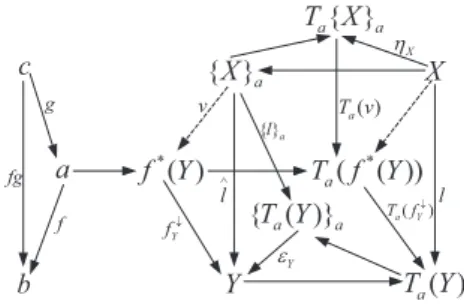
off on fibrationG, now we prove thatTa(fY↓)
is also a Cartesian arrow of f on fibrationGP, i.e., truth functorTa preserves Cartesian arrow.
∃g:c→a∈Mor , letl:X →Ta(Y)∈Mor
alies abovef g, we can see it from Figure 9.
a c
b Y
* ( )
f Y
{ }X a
{ }
a a
T X
X
( )
a T Y
{ ( )}T Ya a
* ( ( ))
a T f Y
g
f fg
Y
fp v
l l
Y
H
{ }la ( )
a T v
( )
a Y T fp X
K
Figure 9.Truth functorTapreserves Cartesian arrows.
Let :1 a → Ta{−}a and : {−}aTa →1 a
be two natural transformations, the transpose
∧
l = Y{l}aofl lies abovef g, then in fiber a
there exists a unique morphism v : {X}a →
f∗(Y) ∈ Mor a over g such that diagram
commutes fY↓v = ∧l. Henceforth, in fiber a
we obtain an unique morphism (Ta(v))X :
X → Ta(f∗(Y)) ∈ Mor a over g such that
Ta(fY↓)(Ta(v)X) = l, so Ta(fY↓) is a
Carte-sian arrow of f on the fibration GP, namely, the truth functorTapreserves Cartesian arrows.
Similarly, we also can prove the comprehension functor {−}a preserves opposite Cartesian
ar-rows by dual principles. We omit this proof by length of this paper.
Above all, we proveTa {−}a,andis unit
and co-unit of this adjunction, andis vertical morphism, that is, the restrictionPa : a → a
ofPatais also a fibered fibration.
Fibration G : → depicts indexed types, and theorem 3 ensures ifP: → is a fibered fibration overG. Then for∀a∈Obj , the re-striction Pa : a → a of P at a is also a
fibered fibration with truth functorTaand
com-prehension functor{−}a, andTa {−}a. The
following is semantic model of many-sorted in-dexed fibrationPa.
Definition 16. LetG : → be a fibration in indexed category ,P: → is a fibered fibration overG with truth functorT and com-prehension functor{−}. ∀a∈ Obj is an in-dexed object, then the restrictionPa : a → a
ofPatais a many-sorted indexed fibration con-structed by the pullback ofP. F⊥Gis called to be a lifting ofFonPa, which preserves truth such
thatPaF⊥G =FPaand there exists two
isomor-phism expressions, namely, TaF ∼= F⊥GTa and
{−}aF⊥G ∼=F{−}a.
5.2. Semantic Properties of Many-Sorted Indexed Inductive Data Types
For∀D∈Obj a, we can construct aF-algebra (D, : F(D) → D) by the action of endo-functorF. The restrictionPaof fibered fibration
Pat indexed objectais a many-sorted indexed fibration, whose truth functor, that is,Ta maps
the(D,)to a FG⊥-algebra (Ta(D),Ta() : Ta (F(D))∼=F⊥G(Ta(D))→Ta(D)). We letFbe the carrier of initialF-algebra, since truth func-torTapreserves initial objectsTa(F)is the
car-rier ofF⊥G-algebra(Ta(F),in⊥G :Ta(F(F))∼=
F⊥G(Ta(F)) → Ta(F)). Similarly, for sub-section 3.2, we write Alg(Ta) for the functor from F-algebra category AlgF to F⊥G-algebra
categoryAlgF⊥
G, and define Alg(Ta)
def
= Ta, we
then have Alg(Ta)(in) = in⊥G, that is, in⊥G is the isomorphism image ofinwhich is the mor-phism of initialF-algebra(F,in)by the action of functorAlg(Ta).
For any F⊥G-algebra (Z, : FG⊥(Z) → Z), the comprehension functor {−}a of many-sorted
to a F⊥G-algebra ({Z}a,{}a : {FG⊥(Z)}a ∼=
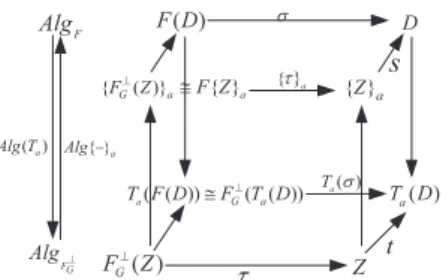
F{Z}a → {Z}a), as it can be seen from
Fig-ure 10. If t : Z → Ta(D) is a FG⊥-algebra morphism from toTa(), then theF-algebra morphism s : {Z}a → D from{}a to is a
F-algebra homomorphism overt. Similarly,tis aFG⊥-algebra homomorphism overs. We define
Alg{−}adef= {−}a, and Alg{−}a is the functor
fromAlgF⊥
G toAlgF. Alg{−}aestablishes a kind of intuitive mutual derivation relation between
FG⊥-algebraZas its carrier and F-algebra{Z}a
as its carrier, which presents a succinct and co-herent modeling means for describing formally inductive rule of many-sorted indexed induc-tive data types and F as the carrier of initial
F-algebra. That is, if the functorAlg(Ta) pre-serves initial object, then the preserving truth liftingF⊥G ofF, with respect toPa, generates a
sound inductive rule.
( )
F D D
{FG( )}Z a F Z{ }a
A #
( )
a T D
( ( )) ( ( ))
a G a
T F D #F T DA
Z
( )
G
FA Z
V
W F
Alg
}
{ a Alg
FG
AlgA
( )a Alg T
{ }Za
{W}a
( )
a T V
t
s
Figure 10.Adjunction properties ofAlg(Ta)and Alg{−}a.
5.3. Inductive Rule of Many-Sorted Indexed Inductive Data Types
Let P : → be a fibered fibration over the fibration G : → , for ∀a ∈ Obj ,
F : a → a is an endo-functor in fiber a,
andF is the carrier of initialF-algebra. Each preserving truth liftingF⊥G : a → aofFhas
an inductive rule in[16], so it ensures the valid-ity of inductive rules generated on many-sorted indexed inductive data types by many-sorted in-dexed fibrations. Then we present and describe inductive rule of many-sorted indexed inductive data types with universality in the framework of Fibrations theory.
For ∀D ∈ Obj a, (D,m : F(D) → D) is a
F-algebra in fiber a. A recursive operation
fold :(F(D)→D) →F → Dis constructed
by fibration Pa in base category a on
many-sorted indexed inductive data types, andfold m
mapsmto a unique morphismfold m :F →D
from the initial F-algebra (F,in : F(F) →
F)tom. By the property that truth functorTa
preserves initial objects,Ta(F)is the carrier of initialFG⊥-algebra. We write F⊥G = Ta(F), and the two isomorphism expressions are as fol-lows: Ta(F(D)) ∼= F⊥G(Ta(D)), Ta(F(F)) ∼=
F⊥G(Ta(F)) = F⊥G(FG⊥). A recursive opera-tionfold : (F⊥G(Z) →Z) →F⊥G →Z is con-structed byFG⊥in total category aon fibration
Pa, for any F⊥G-algebra (Z,n : FG⊥(Z) → Z),
fold nmapsnto uniqueFG⊥-algebra morphism
fold n : FG⊥ → Z from initial F⊥G-algebra
(F⊥,in⊥G : F⊥(F⊥) → F⊥) to n. For
∀D∈Obj a,∀Z ∈Obj a, an inductive rule of
many-sorted indexed inductive data types with universality is as follows:
IndGen :(F⊥G(Z)→Z)→Ta(F)→Z. If(Z,n:FG⊥(Z)→ Z)is aFG⊥-algebra over the
F-algebra(D,m: F(D) →D), then IndGenZm
is aFG⊥-algebra homomorphism overfold n.
5.4. Example Analysis of Many-Sorted Indexed Inductive Data Types
Example 3.Even numberEVENand odd num-ber ODD are mutually recursive many-sorted indexed inductive data types, we leta,bbe only two indexed objects andsucce,pree : a → b,
succo,preo :b→ abe two pairs of morphisms
in indexed category , a is indexed object of
EVEN, and b is indexed object of ODD. We
define a functorF : × → × on
bi-nary production × in base category, for
∀E ∈ EVEN, ∀O ∈ ODD, F(E,O) = (O,E). For any pair of properties(Z,Z)of even num-ber type and odd numnum-ber type in total category
( a, b) with respect to many-sorted indexed
fibration(Pa,Pb), such as Z ∈ Obj a, Z ∈
Obj b, the former is exactly divisible by 2 and
the latter is indivisible by 2, then there exists an induction principle forEVEN andODD:
(Z(0)→((Z(E)→(Z(succe(E))
∧Z(pree(E)))∧(Z(O)→(Z(succo(O))