Application of Case-based
Methodology for Early Diagnosis
of Computer Attacks
Gulnara Yakhyaeva and Olga Yasinskaya
Department of Information Technologies, Novosibirsk State University, Russia
In this article we consider the mathematical foundations and software implementation of the early diagnosis of computer attacks. For this we used the JSM method of automatic hypothesis generation and the theory of case-based models.
This software outputs hypotheses about the properties and expected consequences of a new computer attack. The system analyses a set of properties of the computer attack known to the user. For this we use the Base of the cyber attack’s precedents, described in the language of fuzzification of Boolean-valued models. Each potential property of the new attack is studied by using the JSM method. This process builds sets of positive and negative hypotheses concerning each property, giving a set of properties and consequences characteristic of the attack that has yet not happened at the time of analysis. The developed algorithm has polynomial complexity. Keywords: information security, computer attack, case of the computer attack, case-based model, fuzzification of the case-based model, JSM-method, JSM-reasoning
1. Introduction
Technology helps improve communication by allowing easy, rapid exchange of information. However, the convenience of digital networks has a downside. As enterprises use comput-ers and digital networks more and more, cyber crimes can do greater damage. Every day al-most 200,000 pieces of malicious code infect 150,000 computers in corporate and state net-works. According to the Internet Crime Com-plaint Center(IC3), cyber crimes caused losses in the United States of more than $550 million in 2009, almost twice as much as in the previous year.
Every year the number of detected cyber crimes worldwide increases dramatically. Russia and the U.S. are the largest malware contributors. A useful analysis of cyber crimes is the 2013 Data Breach Investigations Report released by the Verizon Enterprise risk team. This report com-bines the expertise of 19 organizations world-wide and covers more than 47,000 incidents, among which there were 621 confirmed data disclosures[1].
Because of these risks, companies must con-sider and implement well-developed informa-tion security systems, which are becoming one of the most important conditions to remain com-petitive and even viable. One of the most promising developments in this area is mod-eling information security by using ontologies as specifications of a given subject domain [2, 3].
Using this methodology, a team at Novosibirsk State University developed the RiskPanel soft-ware system[4], a workplace for experts to en-sure corporate information security. This soft-ware system aims at implementing risk man-agement in information security.
2. Mathematical Foundations of the Developed Approach
2.1. Case-based Models
The principal difference between the mathemat-ical foundations of the proposed approach[5–7] and traditional methods of information-risk as-sessment is that in this approach we do not work with numerical estimates of risk probabilities, but instead with sets of cases on which these risks have worked. In the standard approach, information is first digitized (or fuzzificated)
and then processed. Under the proposed ap-proach, all available information, including the description of the domain ontology and empiri-cal data, is first processed and then fuzzificated
(converted to numbers in the interval [0, 1]). The proposed approach allows one to work with relevant data not yet distorted by digitization during all stages of information processing. We will describe each case of computer attack by the algebraic systemU =A,, whereAis the universe of the algebraic system, andis its signature. Signature is a set of concepts that describe the subject domain: the vulnerabilities, threats, countermeasures, consequences, and so on. We assume that all the cases of computer attacks have the same signature. For exam-ple, set Aand signature would be denoted as
A = ∪ {ca|a ∈ A}. The algebraic systems
by which we describe instances of the domain belong to the following class
K(A)={U= {cUa|a∈A},A |cUa=cUb ifa=b}.
Let P(X) denote the set of all subsets of X. LetS(A)denote the set of all sentences of the signatureA.
The algebraic systemA, the model of some com-puter attack, is called thecaseof the considered subject domain. For each set of cases E we define a case systemUE.
Definition 1. LetE ⊆K(A)be a set of cases. The algebraic system UE = A,,E, where
E : S(A) → P(E), is called a case-based
system (generated by set E). E() = {U ∈
E|U |=}for any sentenceof signatureA.
Most techniques for information risk-manage-ment use objective and/or subjective probabil-ities to eliminate risks[8]. The objective
prob-abilityis the relative frequency of an event oc-curring over total observations or the ratio of fa-vorable outcomes to the total observations. The subjective probability(or Bayesian probability)
is a measure of sureness of an expert or group of experts that an event will occur. Contrasting objective probability, the Bayesian probability is a quantity that we interpret as a state of know-ledge[9]or a state of belief[10].
The approach developed in this paper also uses objective and subjective probability to identify and evaluate risks. In our case, the objective probability is a function of the truth()in the fuzzy model U (defined below), and the
sub-jective probability is an estimation made by an expert. The approach compares the subjective knowledge of the expert to objective reality. If it does not exist, or if the expert knowledge is inconsistent, we forecast the consequences of the new computer attack.
2.2. Definition of the Problem Involving Early Diagnosis of Computer Attacks
Let the object domain knowledge be formal-ized in the form of the case-based model UE
defined by the signature A. This model is a
mathematical formalization of the knowledge base of computer-attack cases. To calculate the objective probabilities of the origins of differ-ent computer attacks, we define the notion of case-based model fuzzification.
Definition 2. ModelU =A,A, is called
fuzzification of the case-based model UE (
de-notedU = Fuz(UE)) if() = E(E) for
any sentence of signatureA. LetU |=
if() =.
ModelU =Fuz(UE)gives us objective proba-bilistic estimates of events in this object domain. Consider the case of a new computer attack for-malized by some modelN ∈ K(A). The ele-mentary diagram D = { ∈ Sa(A)|N |= }
of this model is unknown. However we know some subset SN ⊆ D of this diagram. We must determine whether some sentence ∈
2.3. JSM Method in the Language of Case-based Models
To answer the question posed at the end of the last section, we will use the JSM method of automatic hypothesis generation[11, 12]. The JSM method originated from the attempts to formalize John Stuart Mill’s inductive logic by using the multi-valued logic of predicates. The JSM method is a theory of automated reason-ing and a method for knowledge representation when solving forecasting problems in situations with incomplete information.
However it is difficult to describe the JSM method in the language of multi-valued logics for implementation in an algorithm so different formalisms are commonly used for computer implementation. The best known formalism used to effectively implement an algorithmic JSM method is Galois correspondences and for-mal concept analysis[13].
First, let us formally describe the JSM method of automatic hypothesis generation in the lan-guage of case-based models. This method has two stages: In the first stage the sets of atomic sentences which in principle can be prerequi-sites for the truth/falsehood of sentence, are found by analyzing the known subject domain knowledge. (Traditionally such sets are called positive and negative hypotheses.)
In the second stage each of the resulting hy-potheses is checked for compatibility with a set SN. Then the final answer to the posed question is given. (This procedure can be called rules for plausible reasoning.)
Note that a final(positive or negative)answer is not always possible. For example, there might be insufficient information to make a decision, such as when the set SN is too small or one’s knowledge of the subject domain(modelUE)is
inadequate. Inconsistent information can also complicate decision-making, in which case the inconsistent information would have to be fil-tered.
So, let the knowledge of the subject domain of information security be formalized as a case-based modelUE of a signatureA. Knowledge
of the new attack is formalized in a set of sen-tencesSN ⊆Sa(A)of the same signature.
Definition 3. Consider fuzzification U =
Fuz(UE). The sentence ∈ S(A) is called theconcept of modelU if
1. = 1&2&. . .&n where 1, . . . ,n ∈
Sa(A);
2. ()>(&)for any ∈Sa(A)\ {1, . . . ,n}.
Definition 4. Formula is called apositive hy-pothesisin relation to property in modelU
if
1. & – concept of modelU
2. () =(&).
Definition 5. Formula is called a negative hypothesis in relation to property in model
U if
1. &¬ – concept of modelU 2. () =(&¬).
Thus, we understand the positive hypothesis as the maximum property set of computer attacks that are executed for some attacks during which property is executed, and are not executed on all attacks during which property is not executed. The negative hypothesis is defined similarly.
In practice, it is often difficult to define the threshold number of cases in which the positive or negative hypothesis must be performed for it to be considered informative[14]. To solve this problem, we can use the ratio of truth degrees of appropriate sentences ()
() or
()
(¬) as a
metric, which allows us to quantify the informa-tiveness of the positive and negative hypotheses. Let us denote+()and−()for sets of all
positive/negative hypotheses in relation to the property in modelU. Then, we check each hypothesis for compatibility with known infor-mation about the new attack.
Rules for plausible reasoning: 1. N |= if and only if
a)∃ ∈+():N |=; b)¬∃ ∈−():N |=.
2. N |=¬ if and only if c)∃ ∈−():N |=;
Remark 1. Because model N is not fully de-fined, the expressionsN |= andN |= are not mutually exclusive. In essence, the truth value of sentence in modelN may be unde-fined.
Remark 2. There can be a situation when con-ditions b) and d)are both true. This situation suggests insufficient knowledge to make pre-diction. If a) and c) are true, then we have inconsistent knowledge.
Thus, we assume that computer attack N has
(does not have)property if at least one pos-itive (negative) hypothesis is compatible with condition SN and all negative (positive) hy-potheses are incompatible with this condition. This again raises the question of probabilis-tic assessment of this assumption. Intuitively, as more cases support this assumption, the as-sumption will become more likely true. Quan-titatively, this can be expressed by the following metrics:
(∈)
()
and
(∈)
(¬) ,
where ⊆ +(), ⊆ −()– sets of
hy-potheses compatible with the set of sentences SN.
3. Software Implementation of the Developed Approach
Within the RiskPanel information risk manage-ment system, we developed a module for diag-nosing early computer attacks.
We used OntoBox to organize and work with a case database [15, 16]. OntoBox is a pow-erful, flexible system used to represent, store, and process data formatted as ontologies. It is very modular and allows for mobile knowledge bases, an advantage when developing difficult information systems. This technology is based on the idea of using “smart” tools of mathe-matical logic to solve massive tasks of building information resources.
OntoBox uses an object-oriented data structure, whose basic concepts are the class, object, and
property. The class is a set of objects, and any object can belong to multiple classes. There are two types of properties: t-properties and o-properties. T-properties have a value (string, integer, etc.), while o-properties have an object value. OntoBox is designed for use as data stor-age and organization built in a Java application. We used OntoBox firstly because it allows or-ganization of data in treelike structures. For this purpose one can simply create a class and define its o-property, whose values are objects of this class. This approach gives flexibility to the de-veloped system. For example, while detecting a new type of virus, there is no need to rewrite the data structure of the system modules; in On-tobox, one can simply add the new type of virus as a sub-object in the “Virus” object describing the connections between objects.
To describe attack cases in OntoBox, we created seven categories of attributes(classes): symp-toms, threats, vulnerabilities, consequences, los-ses, countermeasures, and configuration. Each of these attribute categories is represented in OntoBox as a treelike structure, and each at-tack case in the database is characterized by attributes from these categories. When consid-ering a concrete case, its attributes are read from the database.
We represent the architecture of the software module for diagnosing early computer attacks by using several major classes, most promi-nently for interactions between the interface and data. Filling (+) and (−) lists of cases from a database uses the special class. Separate classes provide treelike-structured data models for each of the attribute categories. User ac-tions are processed by classes that implement a standard event-listener pattern. JSM reasoning is implemented using another class. As hy-potheses are created, a class using the Chein algorithm[17]receives a set of all concepts for the entrance modelU. The time complexity of this algorithm isO( E 3 Sa(A) ), where
E is a set of all attack cases, and is a set of all concepts in the model U = Fuz(UE).
Finding a set of positive and negative hypothe-ses requires O( 2) operations. Performing
JSM reasoning and obtaining the final answer requires O( 2) operations. Thus, we have
O( E 3 Sa(A) + 2+ , which gives
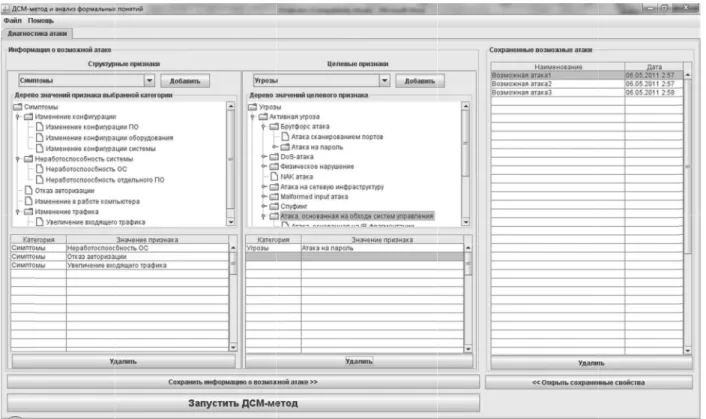
Figure 1.General view of the “Attack Diagnosis” tab.
Figure 1 shows the module interface of the “At-tack Diagnosis” tab. To input data into the main algorithm, the user must fill in two tables. The first table is filled in with known information on the new computer attack(structural attributes); the second table is filled in with the attributes, which the program determines whether the at-tack possesses(target attributes)or not. For this purpose, we divided part of the “Attack Diag-nosis” tab, called “Information about possible attack”, into two parts. The “Information about possible attack”, entered at the left, are the at-tributes of the attack noticed by the user at the moment. From a drop-down list, the user can select from the attribute categories: symptoms, threats, vulnerabilities, consequences, losses, countermeasures, and configuration. Informa-tion on the attribute categories and their possible values are stored in the OntoBox database file. The “Start JSM method” button executes the JSM method for the input information on the possible attack and target attributes. This pro-cess constructs hypotheses based on cases, the information about which is stored in an Onto-Box database file.
The module produces a window with three ta-bles. The first table contains the target attributes
the new computer attack will possess, while the second table contains those it will not possess. The third table contains the target attributes that could not be classified.
We put the developed system into test mode to forecast known cyber attacks. Its forecasting accuracy was 87.5%.
Acknowledgment
The research for this paper was financially sup-ported by the Ministry of Education of the Rus-sian Federation(project no. 2014/139)and was partially supported by RFBR(project no. 14-07-00903 a).
References
[1] The 2013 Data Breach Investigations Report: http://www.verizonenterprise.com/DBIR/ 2013/,[Accessed: March 2014].
[2] D. E. PALCHUNOV, The solution of the problem of
[3] D. E. PALCHUNOV, Knowledge search and
produc-tion: creation of new knowledge on the basis of natural language text analysis. Filosofiya nauki,
4(43) (2009), 70–90.
[4] D. E. PALCHUNOV, G. E. YAKHYAEVA, A. A. HAMUT
-SKYA, Software system for information risk man-agement “RiskPanel”. Programmnaya ingeneriya,
7(2011), 35–50.
[5] D. E. PALCHUNOV, G. E. YAKHYAEVA, Interval fuzzy algebraic systems.Proceedings of the Asian Logic Conference 2005,(2006)World Scientific Publish-ers, pp. 23–37.
[6] G. E. YAKHYAEVA, Fuzzy model truth values. Pro-ceedings of the 6th International Conference Apli-mat,(2007)Bratislava, Slovak Republic, pp. 423– 431.
[7] D. E. PALCHUNOV, G. E. YAKHYAEVA, Fuzzy
alge-braic systems. Vestnik NGU. it Seriya: Matematica, mexanica, informatica,10(3) (2010), 75–92.
[8] S. A. PETRENKO, S. B. SIMONOV,Controlling of the
information risks. DMK Press, Moscow, 2005.
[9] E. T. JAYNES, Bayesian Methods: General
Back-ground. InMaximum-Entropy and Bayesian Meth-ods in Applied Statistics(J. H. JUSTICE, Ed.),(1986)
pp. 1–25. Cambridge, Cambridge Univ. Press.
[10] B. DEFINETTI, Theory of probability (2 vols.). J.
Wiley & Sons, Inc., New York, 1974.
[11] O. M. ANSHAKOV, T. GERGELY,Cognitive
Reason-ing. A Formal Approach Series, Springer, 2010.
[12] S. O. KUZNETSOV, Machine Learning on the
Ba-sis of Formal Concept AnalyBa-sis. Automation and Remote Control,62(10) (2001), 1543–1564.
[13] S. O. KUZNETSOV, Galois Connections in Data Analysis: Contributions from the Soviet Era and Modern Russian Research. InFormal Concept Anal-ysis: Foundations and Applications(B. GANTER, G. STUMME, R. WILLE, Eds.),(2005)pp. 196–225. Lecture Notes in Artificial Intelligence(Springer), State-of-the Art Ser., Vol. 36262005.
[14] O. M. ANSHAKOV, The JSM method: A set-theoretical explanation.Automatic Documentation and Mathematical Linguistics,46(5) (2012), 202– 220.
[15] A. A. MALIH, A. V. MANCIVODA, Ontobox: on-tologies for objects. Izvestia Irkutskogo gosy-darstvennogo universiteta,2(2) (2009), 94–104.
[16] A. MALYKH, A. MANTSIVODA, Query Language for Logic Architectures. InPerspectives of System In-formatics: Proceedings of the 7th International Conference, (2010) pp. 294–305. Lecture Notes in Computer Science, Vol. 5947. Springer-Verlag Berlin Heidelberg.
[17] S. O. KUZNETSOV, S. A. OBIEDKOV, Comparing
performance of algorithms for generating concept lattices. Journal of Experimental and Theoretical Artificial Intelligence,14(2-3) (2002), 189–216.
Received:March, 2014
Revised:September, 2014
Accepted:September, 2014
Contact addresses:
Gulnara Yakhyaeva Department of Information Technologies Novosibirsk State University Russia e-mail:gul [email protected]
Olga Yasinskaya Department of Information Technologies Novosibirsk State University Russia e-mail:[email protected]
GULNARAYAKHYAEVA is an Associate Professor in the Department of Information Technologies at the Novosibirsk State University, Rus-sian Federation. She is a senior researcher at the Institute of Discrete Mathematics and Informatics. Her research areas include knowledge representation and reasoning and also uncertainty and fuzziness repre-sentation and reasoning.
OLGAYASINSKAYAreceived her MS degree in Engineering and