Hungarian Association of Agricultural Informatics European Federation for Information Technology in Agriculture, Food and the Environment
Journal of Agricultural Informatics. Vol. 9, No. 1 journal.magisz.org
Spectroscopic study on chemical composition of essential oil and crude extract
from Albanian
Pinus halepensis
Mill.
Krenaida Taraj1, Ilirjan Malollari2, Fatos Ylli3, Ramiz Maliqati1, Adelaida Andoni1, Jonilda Llupa4
I N F O
Received 28 Feb 2018 Accepted 17 Mar 2018 Available on-line 23 Mar 2018 Responsible Editor: M. Herdon
Keywords:
Pinus halepensis Mill., Soxhlet and Clevenger extraction, FTIR and UV-Vis. spectroscopy
A B S T R A C T
Balkan countries are home to outstanding natural bioresources such as large number of herbs, plants and forestry species. They are also, among the most important export regions for medicinal and aromatic plants in Europe. Balkan has various flora with different tree species as well. Pinus halepensis, also known as the Aleppo pine, is native to the Mediterranean region. However, its range extends to Balkan countries as well, such as Albania, Greece, Croatia and Montenegro. It is one of the many trees that are well known for their medicinal properties, as well as for their economical significance. In this work essential oils/extracts of Pinus halepensis needles were acquired by hydro-distillation (Clevenger type) and Soxhlet extraction. The pine oils and crude extracts were analysed by FTIR spectroscopy and UV-Vis spectrophotometry aiming the identification of the main chemical constituents of the oil extracts of Albanian pine needles. FTIR analyses indicated presence of caryophyllene and pinene as the main chemical constituents in the essential oil and extract of pine needles.
1. Introduction
Balkan countries possess rich ecosystems with enormous natural and biological value (Katheet al. 2003, Metaj 2007, Pieroni & Quave 2014, Schmiderer et al. 2013). Balkan region has very various flora with a great deal of different tree species as well, including pine species. Pinus halepensis (Pinaceae), also known as the Aleppo pine, is native to the Mediterranean region (Abi-Ayad et al. 2011). It is one of the many trees that are well known for their medicinal properties, as well as for their economical significance (Cheikh-Rouhou et al. 2006). Its range expands from Morocco, Algeria, Spain to France, Italy, Croatia, Albania (Toromani et al. 2015) and Greece (Roussis et al. 1995). In Albania, conifer forests cover an area of 104780 ha with a standing volume of 10.7 million cubic
1Krenaida Taraj
University of Tirana, Department of Chemistry, Faculty of Natural Sciences, University of Tirana, Blv. Zog I, 1001, Tirana, Albania
2Ilirjan Malollari
University of Tirana, Department of Chemical Engineering, Faculty of Natural Sciences, University of Tirana, Blv. Zog I, 1001, Tirana, Albania
3Fatos Ylli
Insitute of Applied Nuclear Physics, P.O. Box 85, University of Tirana, Tirana, Albania
1Ramiz Maliqati
University of Tirana, Department of Chemistry, Faculty of Natural Sciences, University of Tirana, Blv. Zog I, 1001, Tirana, Albania
1Adelaida Andoni
University of Tirana, Department of Chemistry, Faculty of Natural Sciences, University of Tirana, Blv. Zog I, 1001, Tirana, Albania
4Jonilda Llupa
Laboratory of Food Chemistry, Department of Chemistry, University of Ioannina, Greece [email protected]
meters, while the Mediterranean pine species occupy 18440 ha. Pinus species (P. halepensis and P. pinea)cover approximately 85% of that area (Toromani et al. 2015).
Essential oils and crude extracts from Pinus species are reported to have different therapeutic properties. They are used as fragrances, flavoring additives for food and beverages, and intermediates in synthesis of perfumes (Fekih et al. 2014). In this respect, many authors have reported, the major chemical components of Pinus halepensis extract oils are β-caryophyllene and α-pinene (Roussis et al. 1995, Dob et al. 2005, Cheikh-Rouhou et al. 2006, Abi-Ayad et al. 2011, Fekih et al. 2014).
Usually the oil extraction from plants are carried out by water distillation and organic solvent extraction using a Soxhlettechnique(Dob et al. 2005, Taraj et al. 2013, Andoni et al. 2014, Ciko et al. 2016, Taraj et al. 2017). Following our previous studies on the essential oils extraction from Albanian plants(Taraj et al. 2013, Andoni et al. 2014, Ciko et al. 2016, Taraj et al. 2017), we further extended this work by utilizing a Clevenger type apparatus (hydrodistillation extraction) and a Soxhlet extractor to obtain essential oil from P. halepensis needles. Chemical composition analyses were carried out by spectroscopy techniques. Spectroscopy methods are effective in assessing the qualitative difference between samples (Andoni 2009, Andoni et al. 2009, Andoni 2014, Schulz et al. 2004, Schulz et al. 2005).
The first contribution of this paper is to obtain essential oils or extracts from Albanian P. halepensis by different traditional methods. The second contribution is to determine the chemical composition (major bioactive components) by spectroscopic techniques and subsequently compare the obtained findings with those reported in the literature.
The paper is structured as follows. Section 2 presents the methodology used for all the oil extractions. Section 3 presents the results on extractions by different methods and the relevant spectra by different spectroscopic techniques. Section 4 presents a brief discussion on the results. At last some conclusions are drawn in Section 5.
2. Methodology
The origin of P. halepensis used in this work is from Western Albania. The pine needles were dried in shadow at room temperature and cut off in small pieces. The water distillation extraction was carried out by means of Clevenger apparatus in a round bottom flask using a ratio of 10:1 water/dried needles. The water-flower mixture was then subjected to distillation for an optimum number of hours, which was determined to be 3 hours. In the first 30 minutes once the oil had started collecting in the collecting column of the Clevenger apparatus, about 1 ml of hexane (oil phase) was put through the condenser to wash down any oil which had stuck to the walls of the condenser. The essential oil (dissolved in hexane) was then separated in a separating funnel (Ciko et al. 2016).
In the Soxhlet extraction, pine needles were placed inside a container made of thick filter. The container is located into the main chamber of the Soxhlet extractor. The Soxhlet can be slotted onto a flask which contains hexane (in this work), as extraction solvent. The Soxhlet is afterward equipped with a condenser, whereas the hexane is heated and allowed to reflux. The amount of the herb used for Soxhlet extraction was ~10 g, whereas the amount of the solvent (hexane) used was 300 mL. In the current work the extraction process was allowed to run approximately 3 hours. Hexane is removed, by means of a rotary evaporator, yielding though the extracted compounds (Ciko et al. 2016).
FTIR spectra were obtained by Nicolet 6700 spectrometer, manufactured by Thermo Electron. In this study, measurements were carried out in the range mid Infra-Red (4000 – 400 cm-1). The spectra were analyzed using OMNIC software. Vis spectra measurements were carried out by 6800 UV-VIS Jenway spectrophotometer.
3. Results
Table 1. Overall results for the extraction of essential oil and crude extract of P. halepensis.
Extraction method
Amount of P. halepensis
Extraction solvent
Extraction time
Extraction Temperature
Yield of extract
Clevenger (distillation) 10 g Water 3 h 1200C 0.30%
Soxhlet (distillation) 10 g Hexane 3 h 800C 3.54%
Figure 1 exhibit FTIR spectrum of the P. halepensis oil extract obtained with the hydro-distillation method (in the insert) and FTIR spectrum of the P. halepensis crude extract obtained with Soxhlet extractor. The spectra of all extracts revealed very similar features. The acquired essential oil obtained by hydro-distillation had a pale yellow color whereas the crude extract obtained with the Soxhlet apparatus had yellow color.
Figure 1. FTIR spectra of P. halepensis essential oil obtained by a Clevenger type hydro-distillation (in the insert) and Soxhlet type distillation. The main components identified in the FTIR spectrum are
indicated by arrows.
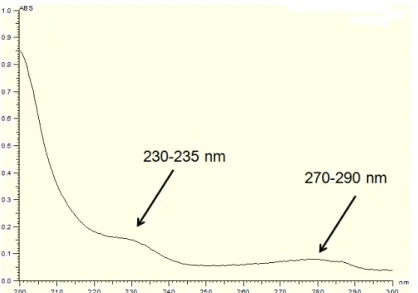
Figure 2. UV-Vis spectrum of P. halepensis essential oil obtained by hydro-distillation.
4. Discussion
In the FTIR spectrum of the P. halepensis essential oil appears two peaks positioned at ~1466 cm-1 and at ~1380 cm-1. It is known that isopropyl and gem-dimethyl groups give rise to a split umbrella mode with two peaks in the IR spectrum positioned at ~1385 to 1365 cm-1 (Smith 1999). The splitting is caused by vibrational interaction between the umbrella modes of the two methyl groups. The split of the umbrella modes is of about equal intensity. Meanwhile, t-butyl and isopropyl groups also give rise to a split umbrella mode with two peaks positioned between ~ 1393 to 1366 cm-1 (Smith 1999). However, the approximate intensity ratio in this case is 1:2 (Smith 1999). Additionally, the band at ~ 1466 cm-1 can also indicate the presence of a CH
3, a CH2 or both groups; whereas CH3 symmetric bend (umbrella mode) shows up at 1375±10 cm-1 (Smith 1999). The chemical structures of caryophyllene consists of isopropyl or isobutyl groups, therefore we assign the peaks at at ~1466 cm-1 and at ~1380 cm-1 to caryophyllene. These findings are in good agreement with IR data reported for oil extracts of different herbs (peak position of the same functional groups) (Schulz et al. 2004, Schulz et al. 2005). In this respect, the same authors (Schulz et al. 2004, Schulz et al. 2005) reported IR spectrum of caryophyllene and indicated presence of three peaks in the region 1500-1300 cm-1. The latter is in good agreement with our findings. The C=C stretches appear at ~1660-1630 cm-1 (Smith 1999), therefore the IR at ~1630 cm-1 belong to pinene and caryophyllene (vinyl group, =CH
2) (Schulz et al. 2004, Schulz et al. 2005).
The FTIR spectrum of the crude extract of P. halepensis features similiar signals as the IR spectrum of essential oil of pinus needles. The FTIR peaks in the region 1464-1378 cm-1 and 1645 cm -1 suggests presence of caryophyllene and pinene respectively. In comparison to the IR spectrum of the
essential oil, the IR spectrum of the crude extract is characterised by three additional signals in the region 1730-1700 cm-1, ~1240 cm-1 and ~1181 cm-1. It has been reported by Mohareb et al. 2017, that crude extracts of pinus species contain fatty acids, resin acids and phthalates as well. In this respect, the additional signals in the IR spectrum are characteristic for the ester or acid functional group (Smith 1999). In addition, UV-VIS spectrum of pine essential oil gives rise to features in 200-290 nm region. These features originate from the double bonds (or conjugated double bonds) of caryophyllene and pinene (Taraj et al. 2013).
5. Perspectives and conclusion
major chemical constituents in the extract. IR signals for the isopropyl groups (1466-1380 cm-1) and vinyl group (1645-1637 cm-1) were in good agreement with IR data reported by Schulz and co-authors. UV-Vis signals supported IR findings for the caryophyllene and pinene presence. To this end, the chemical composition of Albanian P. halepensis oil is similar to the chemical composition reported in the literature for the pine needles (P. halepensis). Extractions by Clevenger and Soxhlet apparatuses could also be combined with the extractions with liquid CO2 at different temperatures (sub-critical conditions). Compressed CO2 is frequently used as it represents an environmentally friendly solvent (Taraj et al. 2013). The extraction by liquid CO2 is a very selective extraction. The lower temperature of the extraction allows better separation of thermally labile compounds (Taraj et al. 2013).
References
Abi-Ayad, M., Abi-Ayad, F.Z., Lazzouni, H.A., Rebiahi, S.A, Ziani_Cherif C., and Bessiere, 2011. Chemical composition and antifungal activity of Aleppo pine essential oil. Journal of Medicinal Plants Research, 5(22), pp. 5433-5436.
Andoni, A. 2009. A flat model approach to Ziegler-Natta olefin polymerization catalysts Eindhoven, PhD Thesis. Technische Universiteit Eindhoven (Eindhoven University of Technology). The Netherlands. Ch. 7.
Andoni, A., Chadwick, J.C., Niemantsverdriet. J.W., Thüne, P.C., 2009. Investigation of Planar Ziegler-Natta Model Catalysts Using Attenuated Total Reflection Infrared Spectroscopy. Catalysis Letters, 130, pp. 278-285.
Andoni, A., 2014. High resolution electron energy loss spectroscopy for studying planar model catalyst: A test of NO on Rh(100). Revue Roumaine de Chimie, 59(3-4), pp. 245-249.
Andoni, A., Xhaxhiu, K., Taraj, K., Çomo, A., 2014. An adsorption method for characterization of surface area and pore size of solid surfaces. Asian Journal of Chemistry, 26, pp. 6833-6838.
https://doi.org/10.14233/ajchem.2014.16991
Cheikh-Rouhou, S., Hentati, B., Besbes, S., Blecker, C., Deroanne, C., and Attia, H., 2006. Chemical Composition and Lipid Fraction Characteristics of Aleppo Pine (Pinus halepensis Mill.) Seeds Cultivated in Tunisia, Food Science and TechnologyInternational, 15(5), pp. 407-416.
Ciko, L. Andoni, A., Ylli, F., Plaku, E, Taraj, K., Çomo, A., 2016. Extraction of essential oil from Albanian Salvia Officinalis L. and its characterization by FTIR spectroscopy: A Soxhlet method extraction. Asian Journal of Chemistry, 28(6), pp. 1401-1402. https://doi.org/10.14233/ajchem.2016.19658
Dob, T. Berramdane T., Chelgoum C., 2005. Chemical Composition of essential oil of Pinus halepensis Miller growing in Algeria, Comptes Rendus Chimie, 8(11-12), pp. 1939-1945.
https://doi.org/10.1016/j.crci.2005.05.007
Fekih, N. Allali, H., Merghache, S., Chaïb, F., Merghache, D., Amine, M.E., Djabou, N., Muselli, A., Tabti, B., Costa, J., 2014. Chemical composition and antibacterial activity of Pinus halepensis Miller growing in West Northern of Algeria, Asian Pacific Journal of Tropical Disease, 4(2), pp. 97-103. https://doi.org/10.1016/S2222-1808(14)60323-6
Kathe, W., Honnef, S. & Heym A., 2003. Medicinal and Aromatic Plants in Albania, Bosnia-Herzegovina, Bulgaria, Croatia and Romania, BFN (German Federal Agency for Nature Conservation), Bonn. https://www.bfn.de/fileadmin/MDB/documents/skript91.pdf
Metaj, M., 2007. Biodiversity and the protected areas systems in Albania, Biodiversity, 8, pp. 3-10.
https://doi.org/10.1080/14888386.2007.9712823
Mohareb, S.A., Kherallah, EA.I., Badawy, EI.M., Salem, ZM.M., Yousef,, A.H., 2017, Chemical Composition and Activity of Bark and Leaf Extracts of Pinus halepensis and Olea Europaea Grown in Al-Jabel Al-Akhdar Region, Libya Against some Plant Phytopathogens, Journal of Applied Biotechnology & Bioengineering, 3(3), pp. 67.
Pieroni A. & Quave C.L., 2014. Ethnobotany and biocultural diversities in the Balkans. Wild food and medicinal plants used in the mountainous Albanian north, north east and east: A comparison, ch. 10, pp 183-194, ISBN 978-1-4939-1491-3. https://doi.org/10.1007/978-1-4939-1492-0
Schmiderer, C., Torres-Londoño, P. & Novak, J., 2013. Proof of geographical origin of Albanian sage by essential oil analysis, Biochemical Systematics and Ecology, 51, pp. 70-77. https://doi.org/10.1016/j.bse.2013.08.007
Schulz, H. Baranska, M., Belz, H-H., Rösch, P., Strehle, M.A., Popp J., 2004. Chemotaxonomic characterisation of essential oil plants by vibrational spectroscopy measurements, Vibrational Spectroscopy, 35, pp. 81–86. https://doi.org/10.1016/j.vibspec.2003.12.014
Schulz, H. Özkan, G., Baranska, M., Krüger, H., Özcan M., 2005. Characterisation of essential oil plants from Turkey by IR and Raman spectroscopy, Vibrational Spectroscopy, 39, pp. 249-256.
https://doi.org/10.1016/j.vibspec.2005.04.009
Smith, B., 1999. Infrared spectral interpretation: A systematik approach. CRC Press LLC.
Taraj, K. Delibashi, A., Andoni, A., Lazo, P., Kokalari, (Teli) E., Lame, A., Xhaxhiu, K., Çomo A., 2013. Extraction of chamomile essential oil by subcritical CO2 and its analysis by UV-VIS spectrophotometer. Asian Journal of
Chemistry, 25, pp. 7361-7364. https://doi.org/10.14233/ajchem.2013.14642
Taraj, K. Malollari, I., Andoni, A., Ciko, L., Lazo, P., Ylli, F., Osmeni, A., Çomo, A., 2017. Eco-extraction of Albanian chamomile essential oils by liquid CO2 at different temperatures and characterization by FTIR
Spectroscopy, Journal of Environmental Protection and Ecology18(1), pp. 117–124.