Community Building around
Encyclopaedic Knowledge
Josef Kolbitsch
1and Hermann Maurer
2 1Graz University of Technology, Austria2Institute for Information Systems and Computer Media, Graz University of Technology, Austria
This paper gives a brief overview of current technologies in systems handling encyclopaedic knowledge. Since most of the electronic encyclopaedias currently available are rather static and inflexible, greatly enhanced func-tionality is introduced that enables users to work more effectively and collaboratively. Users have the ability, for instance, to add annotations to every kind of object and can have private and shared workspaces. The techniques described employ user profiles in order to adapt to users and involve statistical analysis to improve search results. Moreover, a tracking and navigation mechanism based on trails is presented.
The second part of the paper details community building around encyclopaedic knowledge with the aim to involve “plain” users and experts in environments with largely editorial content. The foundations for building a user community are specified along with significant facets such as retaining the high quality of content, rating mech-anisms and social aspects. A system that implements large portions of the community-related concepts in a heterogeneous environment of several largely indepen-dent data sources is proposed. Apart from online and DVD-based encyclopaedias, potential application areas are e-Learning, corporate documentation and knowledge management systems.
Keywords: digital libraries, electronic encyclopaedias, knowledge brokering systems, active documents, anno-tations, knowledge management, tracking, adaptation, community building.
1. Introduction
Numerous electronic encyclopaedic systems are available, however most are rather conservative, inflexible and static. Their focus is on technical aspects such as data storage, retrieval and links to the Internet.
The following sub-section gives a brief overview of the capabilities of traditional electronic
en-cyclopaedias; sections 1.2 and 1.3 introduce two popular state-of-the-art encyclopaedias, and sec-tions 1.3 and 1.4 address substantially different approach to encyclopaedic knowledge.
1.1. Traditional Electronic Encyclopaedias
Electronic Encyclopaedias were introduced in the 1980s(e.g.,15]). Early versions were pub-lished on CD-ROMs in order to host the large amount of data. In the 1990s the Internet was discovered as a way to offer access to elec-tronic encyclopaedias. The approach of most electronic encyclopaedias available on the mar-ket is rather conservative in that they focus on simplicity of information retrieval, embedding into applications such as word processors, links to search engines on the Internet, inclusion of multimedia content(images, videos, 3D anima-tions), etc.
As such, the typical electronic encyclopaedia is a digital collection of material that used to be available in a series of books. Currently, the benefits of a digital representation are mainly ease of search and retrieval, as well as the facts that they are relatively easily kept up-to-date, that they are available any time anywhere, and that they can offer media such as animations or video clips. However, many things people usu-ally do in printed dictionaries and encyclopae-dias cannot be done in their digital counterparts. Users cannot make annotations, do not have the possibility to highlight parts of the content or to make clippings, etc.
More importantly, digital encyclopaedias can open up entirely new perspectives and modes of application. The power of distributed envi-ronments, for instance, and the potentiality for users to collaborate are still mostly ignored.
1.2. Brockhaus Multimedial
The “Brockhaus Multimedial 2005 Premium” Encyclopaedia 5] is undoubtedly one of the most advanced electronic encyclopaedias cur-rently available. Apart from the functional-ity of conventional electronic encyclopaedias, the Brockhaus Multimedial includes several in-novative features such as the “knowledge net-work”(see29; 30]). The software finds simi-larities and connections and graphically depicts them in an intuitive way. The encyclopaedia also offers a large number of links to external articles, to an image database, to specialised re-sources on the Internet, and to popular general-purpose search engines.
1.3. Wikipedia
The Wikipedia is the prime example for a free, web-based, community-driven encyclopaedia based on Ward Cunningham’s idea of wikis(see
41]and25]). The content of the Wikipedia can be edited any time by anyone on the Internet, i.e., every reader can also be an author.
The project is growing rapidly: as of July 2006, Wikipedia is available in more than 200 lan-guages with about 4.6 million articles in all languages combined. The largest editions are the English one with more than 1.2 million and the German one with almost 420.000 articles
(source:42]). The success of the project builds on the concept of tight involvement of all users, the sense of community, and the intent to watch each other and look after the articles.
The methodology and architecture of the Wiki-pedia make it much more flexible than a print version or an edited online version of an en-cyclopaedia. Content can be added faster and when it is needed, e.g., when the space mis-sion to Titan was in the news, the Wikipedia article on Titan was largely extended and sup-plemented with links to the web-sites of Nasa and ESA and the most current photos available. Moreover, Wikipedia can contain articles that are not suitable for edited encyclopaedias such as extensive information on TV series, video
games, black magic, sexual practices or con-spiracy theories.
The open structure of the Wikipedia is prone to a number of complications, though. Van-dalism – deleting articles, appending incorrect or inappropriate information, inserting vulgar-ities, etc. – and repair, for instance, is only one phenomenon to be observed in Wikipedia
(e.g., 39]). Another example are edit wars, where certain paragraphs of an article are re-peatedly inserted and deleted by two users or groups. Also antisocial behaviour and “identity fraud” of a small group of users are pestering the Wikipedia community.
open source community: work in a commu-nity is done to meet one’s own needs, for the good of the public and for free. (See also GNU Free Documentation License,14], and Creative Commons Project,10].)
1.4. Blogs
Weblogs, often called blogs, are web-pages that contain newsgroup-like articles in a reversed chronological order. They are updated fre-quently, typically once a day, and can be main-tained by a single person, a group of individuals or even by the public(e.g.,4]).
Although most blogs are employed for personal use (as a sort of diary, where people can add their comments, for example), businesses be-gin to discover their value in a corporate back-ground(see38]). In most cases, they are used strictly inside companies in order to keep co-workers up-to-date on the progress of a project, to discuss certain topics in an informal way, etc. Sometimes, however, they are also used exter-nally to ignite discussions between developers of a product and the consumers.
In their nature, blogs resemble wikis as they of-fer users a way to express their opinions on cer-tain topics, share their experiences and knowl-edge. The main difference is, though, that users are not able to modify articles once they are posted. Thus, information in a blog is fairly persistent.
1.5. Google Answers
A radically different approach to encyclopaedic knowledge is taken in knowledge brokering en-vironments such as Google Answers(16]). In this system, users choose a problem domain, ask a specific question, and determine how much they are willing to spend on an answer. Do-main experts reading the question can post an appropriate answer along with references and other resources. They are remunerated for ev-ery satisfactory answer. Registered users have the possibility to submit answers too; they will not be paid, though. Questions and their cor-responding answers are archived in the system and other users can browse the repository. The question “Why is the sky blue”, for in-stance, is answered by a registered user. Later, a domain expert, a physicist, appends a detailed
explanation of the phenomena leading to the blue colour of the sky. The question and both answers are stored in the “geophysics” category of the system and are available to all users. Although a knowledge brokering system largely deals with encyclopaedic knowledge, there are fundamental differences to conventional ency-clopaedias: the information is not structured, does not necessarily have to be persistent, its authenticity cannot be guaranteed, etc. How-ever, both experts and registered users attempt to maintain a high quality and professional style. Thus, knowledge brokering systems like Google Answers are largely community-driven and their quality as well as content depend on experts and users participating in the project.
2. Functionality Beyond Traditional Electronic Encyclopaedias
The approaches to electronic encyclopaedias described above are too static, offer too little flexibility, do not support users in their work, and do not open new prospects as they could. In order to counter these deficiencies, seven dis-tinct demands that are essential in an elaborate electronic encyclopaedia system are pointed out in the following sub-sections.
It is quite surprising that despite the fact that these technologies have been employed in hy-pertext and digital libraries for years, they have not yet been introduced in the field of electronic encyclopaedias. We believe that together with the collaborative functionality described in Sec-tion 3, truly new applicaSec-tions can be realised.
2.1. Annotations
People working with physical encyclopaedias, and books in general, are used to highlight-ing sections of text with markers, writhighlight-ing down comments with pencils or attaching post-it notes
etc. Users should also have the possibility to highlight certain portions of text or mark sec-tions of images, videos or sound files. More-over, users should be able to attach(potentially varicoloured)labels such as “important” or “for project A” to all kinds of objects.
In order to support collaboration among users annotations can be on different levels of ac-cess: private annotations are only available to one user, group annotations can be seen within a specified group of users, and public annotations are visible for everyone. Private and group an-notations may simply be created by users them-selves, whereas public annotations need some kind of regulations by administrators of the sys-tem in order to prevent confusion(see28]).
2.2. Active Multimedia Documents
The idea of active documents is that users can pose arbitrary questions to documents, and an-swers are provided immediately and seemingly by the document itself(see 18]). The imple-mentation of this concept includes an “online” and an “offline” component. If a semantically equivalent question can be found in the system, the answer is presented to the user. Thus, the answer is provided online.
If an appropriate, existing question cannot be retrieved, the user’s request is forwarded to a human expert, and the user gets an apologetic message that an answer will be provided as soon as possible. In this case, the answer is provided offline by an expert. In the course of time, typically after some 500 to 1 000 users per doc-ument, answers are available for the most sig-nificant and most frequently asked questions. Therefore human experts are no longer required and answers can be provided by the online com-ponent.
In an environment that handles encyclopaedic knowledge, it should be possible to pose ques-tions to every piece of content, i.e., most objects in the system are active documents. Answers are provided either by an editor or by a user of the system(see section 3 below). A large num-ber of questions to an editorial article causes a notification to be sent to the respective editor, and the article has to be reviewed. If there are too many questions from the community to an article written by a user, the article is(at least temporarily) disabled and not visible to other users.
2.3. Links to External Resources
An electronic encyclopaedia should be mas-sively hyperlinked – both internally and to ex-ternal resources. Exex-ternal resources do not only comprise general-purpose search engines such as Google and specialised databases such as the Internet Movie Database, IMDb, or a dedicated encyclopaedia on chemistry, but also the links to other kinds of(relatively)persistent informa-tion such as newspapers, magazines and jour-nals. With these resources, an encyclopaedia can offer features such as “in the news”. More-over, editorial articles from the encyclopaedia can be supplemented with high-quality, up-to-date information from the news. Content on the Ukraine, for example, could be complemented with a report from the BBC on recent elections in the country.
The inclusion of external resources, however, causes interesting problems such as the consis-tency of links and quality control. Link con-sistency is relevant internally as well as exter-nally(cf.,21]). A hyperlink to the current pro-gramme of the Globe Theatre in an article on London has to be removed, for instance, when it becomes unavailable. On the other hand, access to articles referenced in the user’s bookmarks has to be ensured even if an article has been modified. Persistent URLs might offer a partial solution to this problem(e.g.,33]).
When external resources are offered, quality be-comes an issue as well. Hence, techniques such as blacklisting and whitelisting might have to be employed(see section 3.3 below).
2.4. Private and Shared Workspaces
Electronic encyclopaedias should allow for the users’ demand to retain clippings of articles, other pieces of content and information (e.g.,
they discover or, alternatively, they can extract parts thereof by way of transclusions(see 31; 32]and23]). In the latter approach, the infor-mation is not duplicated but the original data is “cited”, i.e., every time a transcluded piece of information is accessed, it is retrieved from the corresponding, original document. More-over, users can make annotations to objects in their personal workspaces, they can save hyper-links to external resources, store search queries, put external documents into their workspace, start assembling new information and perform-ing similar tasks. Personal workspace also pro-vides an overview of articles recently read and a history of most recent comments and discus-sions.
Shared workspaces are essential for collabora-tion in user groups (e.g., 37]). They provide basic functionality of personal workspaces, but have to take access control and communication facilities into consideration. To the benefit of ease of use, only two access modes are pro-vided: private(to the author)and public(to the group).
Functions to support communication among group members in a shared workspace are sim-plistic: a user can leave a note for one user or for the entire group. When a user actively work-ing in the workspace receives a message, it is displayed instantly; otherwise it is presented as soon as the user returns to the workspace (see also section 3.6 below).
2.5. User Profiles and Adaptation
Electronic encyclopaedias should adapt to their users in order to provide better search results in shorter time and to facilitate the discovery of knowledge that might otherwise not be found. Adaptation to the user allows for differing levels of experience and knowledge as well as distinct interests and varying aims. Students doing re-search for their homework need to be confronted with different tools and need to get different search results than a teacher, for example, who is looking up a particular detail of the coloni-sation of New Zealand. Therefore adaptation has to take place in various aspects of an ency-clopaedic application: from the user interface and the tools provided to the presentation and level of detail of search results (content-level adaptation) to the material supplied(link-level adaptation; e.g.,7]).
User profiles are utilised to create an adaptive environment. Several differing strategies are suggested for generating a profile: submission of a general profile, creation of an ad hoc profile, or dynamic profiling. A general user profile, for instance, can be filled out by the user on the first use of the encyclopaedia. It contains gen-eral questions about the user’s experience and interests in certain domains such as geography, history, literature, science, etc. The type of user interface – ranging from a simplistic, Google-like search window to an expert mode – can be selected as well(e.g.,6]).
Both as an alternative and in addition to the gen-eral profile, users can employ ad hoc profiles. The encyclopaedia could ask the user a question such as “What are you searching for today?”
Users select a problem domain, subsequently determine what types of material they are inter-ested in, and define a search query. The system combines the ad hoc profile with the general user profile, executes the query and is capable of providing more accurate and more specific articles while filtering content that match the user’s profile.
An advanced version could include dynamic profiling and adaptation, which basically means that the user’s actions in the environment, the kind of content displayed, the areas from which articles are retrieved, etc. are tracked. Based on these data, the system can adjust the user interface and display more precise results. The system might also put up personalised messages such as“Did you know that ...” or“You might also be interested in ...” where appropriate. The encyclopaedia’s featured article of the day can be adapted or recent news items might be pointed out to the user.
2.6. Trails
Electronic encyclopaedias should make use of an advanced tracking and navigation technique. The mechanism consists of two parts: a tracking component and a navigation component. The tracking component uses a database to retain weights for every possible connection CAB
be-tween any two articles A and B. Whenever a user navigates from A to B the weight of the CAB
The connection weights are utilised by the navi-gation component in order to suggest articles to the user(cf.9; 12; 13]). The trail shows the arti-cles the user has displayed so far(see Figure 1). From the second article onwards, the trail also includes the two most relevant(most popular) articles from the perspective of the current arti-cle. The user can navigate to these potentially interesting pages by simply clicking on the trail.
Fig. 1. A trail leading from “Islamic Arts” to the term “Mosque”. Suggestions for further steps are “Minaret”
and “Taj Mahal”(thicker, i.e., more popular).
The maximum number of connection weights to be stored is n (n;1), with n being the to-tal number of articles. In order to improve the appropriateness of the articles suggested in the trail, the length of the tracking paths can be ex-tended from two to three or even more nodes. However, longer paths consume more space in the database.
It should be noted that adaptation, in fact, can also take place in conjunction with trails. The weights of the tracking paths can be multiplied with information from the user’s profile in order to influence the ranking of the suggested arti-cles. In the example depicted in Figure 1, for instance, a user interested in arts might recom-mend different topics than someone specialising in the history of Islam.
2.7. Quality Feedback and Review Mechanism
Electronic encyclopaedias should retain detailed statistics on the users’ queries and the articles retrieved in order to enhance performance of the system. The findings derived from the system logs can be employed to find out which articles are currently very popular and, consequently, they might have to be revised or extended. On the other hand, the statistics might reveal that certain topics are requested rarely and, there-fore, do not need to be updated any more.
In addition to this, the statistical analysis can point out missing articles and instantly notify an editor. Alternatively, the system can offer a function for users to request a new article ex-plicitly. This relatively simple technique can improve flexibility and topicality of edited en-cyclopaedias(cf. section 1.3 above).
3. Community Building in Electronic Encyclopaedias
As pointed out above, traditional applications handling encyclopaedic knowledge are rarely based on user communities. Three exceptions, though, manage to be quite successful: Wikipe-dia, specialised blogs and knowledge brokering systems such as Google Answers. However, these systems have drawbacks such as the lack of authenticity of the content provided or the unknown identity of the authors of information. Therefore a novel concept is introduced that al-lows a community to be built around editorial encyclopaedic knowledge. The following sub-sections address the purpose and notion of the concept, detail foundations of a user community as well as social issues and concerns about the quality of the content. Furthermore, discussion and communication facilities along with tech-niques to present the content are briefly out-lined.
3.1. Purpose and Notion of a User Community
3.2. Foundations of a User Community
As the focus of the user community is to work on the knowledge base, an emphasis has to be put on the quality of the articles. In order to avoid problems known from the Wikipedia – users cannot be sure whether the article they read is correct – at least the editorial content has to be authentic.
Hence, editorial content is provided by the board of editors and cannot be modified by the user community. When users from the community read an article and would like to supply addi-tional content such as text, photos or sound, they may do so. Subsequent users can provide yet more content or change the information that was provided by other users. This “cycle” of community-driven content development is de-picted in Figure 2.
Fig. 2.Community-driven development and maintenance of content. Editors create an article and users can add complementary content, references, etc.
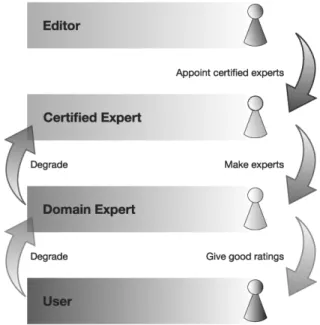
The concept is based on three levels of users: certified experts, domain experts and plain users
(see Figure 3). Certified experts are typically experts in their domain(e.g., university profes-sors or researchers) that are certified either by an editor or by a certain number of other certi-fied experts. Potentially new experts can submit
Fig. 3. Different levels of users and basic mechanisms to grant and retract user statuses. Certified experts can, e.g., make users experts, and by means of poor ratings
users can demote experts.
an application or can be recommended by other users. Usually their application is discussed by a group of experts in the same domain, and they have to pass an “entrance exam”, in which their expertise is to be proved.
Certified experts have the ability to make a plain user a domain expert when the user, for exam-ple, posts a number of high-quality contribu-tions. Plain users can also become domain ex-perts when they have a very large number of positive ratings (see also Figure 3). On the other hand, certified experts or domain experts unable to meet the required standards will have their certification withdrawn.
In an attempt to highlight the community’s pro-fessionalism, domain experts and especially cer-tified experts are encouraged to provide a pub-licly available web-page with personal infor-mation, documentation of their expertise (e.g., a list of publications)and similar data.
3.3. Quality Control
The quality control mechanism is based on blacklisting, certification by experts, and a rat-ing system similar to those known from dis-cussion forums or online auctioning systems. Blacklisting means that the system retains a list of certain words or phrases, for example vulgar expressions, that must not be contained within articles published by users of the community
(see 22; 40]). If an article includes a black-listed expression, it cannot be submitted to the system. Since blacklisting can basically only be applied to all kinds of textual content, it is used for text-based content, annotations, comments, hyperlinks, in discussion forums, etc.
This approach has obvious drawbacks: black-listing the word “sex”, for example, almost auto-matically excludes articles about Freud. There-fore for various kinds of information, such as links to external resources, whitelisting is prob-ably better suited (see 24]). This means that only certain, well-chosen external resources can be accessed, and all other sources are rejected. The second advance to quality control includes the intervention of experts. Every article has to fall into a particular category. Whenever a contribution is published by a plain user or by a domain expert, it has to be approved either by a certified expert or by an editor working in the corresponding category.
Although this technique is certainly rather ex-pensive, it fuels the dialogue between experts and authors. An expert could, for example, suggest to the user that a certain section of the article be changed so that it can be appended to the content. Thus, consensus needs to be reached prior to the publication of a new article, which is, in a way, similar to the review process in scientific publishing.
The third measure is an advanced, credit-based rating system. Credits can be positive, nega-tive or neutral and they can be given for any kind of information including text, images, an-notations and hyperlinks from both editors and users of the community. Credits from differ-ent users have differdiffer-ent importance: a positive credit from a certified expert might be worth a value of 1.2, whereas the credit of a domain ex-pert has a value of 1.1, and the credit of a plain user is 1.0.
The overall rating for each user is calculated in an accumulative manner. Five positive credits
by certified experts and three positive credits by domain experts, for example, result in a total rating of 9:3(5 1:2+ 3 1:1). If users re-ceive a very large number of positive credits, the value of their own credits might be increased. The credit of a plain user A, for instance, is in-creased to 1.05 if A’s total rating exceeds a cer-tain threshold value. Every credit given by A is worth a value of 1.05 from that point onwards. In the case where A’s total rating deteriorates, the value of A’s credits decreases as well. Although this approach is somewhat complex, it represents a “fairer” rating system that takes the users’ commitment into consideration. More-over, it encourages users to contribute valuable content because it potentially makes them more “powerful”.
Ratings have influence on both the users’ ar-ticles and their user level. If plain users, for instance, receive a great number of positive rat-ings they might be promoted to domain experts. If domain experts, on the other hand, receive a lot of negative credits, they might be down-graded to plain user level. Ratings can also trigger certain functions on content (see also section 3.5):
if a user-authored article receives a large number of positive credits, the encyclopae-dia system automatically suggests to an ed-itor to make the article part of the eded-itorial content;
if the number of negative credits for a user-authored article exceeds a certain threshold, it will be automatically removed from the system;
if certified experts or domain experts have a certain number of articles removed due to negative ratings, their certification might be withdrawn;
if editorial content receives too many nega-tive credits, the board of editors is notified and the article has to be reviewed.
3.4. Active Knowledge Brokering
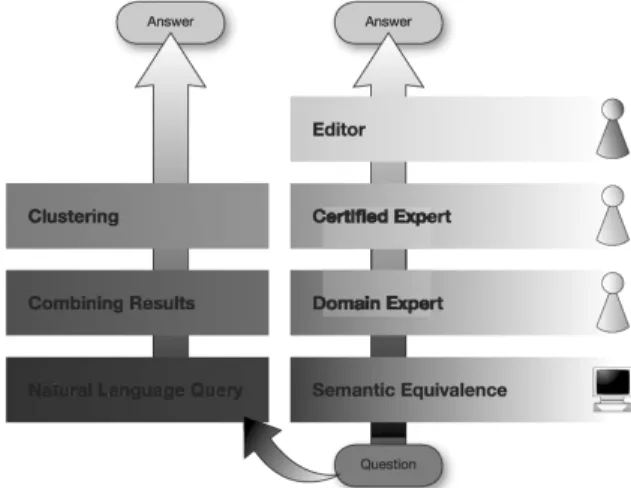
The concept combines multiple technologies such as natural language queries similar to 2] or 17], syntactic, semantic or heuristic anal-ysis of questions, clustering, active document filters, and conventional knowledge brokering as detailed in section 1.5. An overview of the paradigm is given in Figure 4.
Fig. 4. Answer brokering mechanism. When a question is asked the system searches for semantically equivalent previous queries. If none can be found, the question is
passed on to domain experts, certified experts and, finally, to editors.
A user starts by selecting a certain area of in-terest such as “astronomy” and formulates an arbitrary question in natural language, for ex-ample, in plain English. The question triggers a database query in the internal knowledge repos-itories. The results from various sources are combined, clustered and displayed to the user as “articles from the archives”.
However, the user’s question also triggers active documents and answer brokering components. First, an analysis of the question is performed
(see19]). If semantically equivalent questions that have already been answered by human ex-perts are available, the user is asked“Did you mean:::” If this active documents filter fails, i.e., none of the suggestions is satisfactory or none are obtainable, the question is passed on to a human expert. In the case where an ap-propriate answer cannot be provided by domain experts within a certain time, the question is passed on to a certified expert. If an answer still cannot be provided, it is forwarded to an editor. At any point, questions can be rejected as inap-propriate. Moreover, experts and editors have the capability of combining semantically equiv-alent questions that are not recognised by the
system. So if a question is similar to a prior one, it is specified as “equivalent” to an existing question and linked to the corresponding an-swer. Thus, the semantic filter is able to learn. From a technical perspective, active knowl-edge brokering is a generalisation of the active documents approach. With active documents, question-answer pairs are always attached to particular articles or other pieces of information. Active knowledge brokering, on the other hand, is question-centered: questions are largely au-tonomous and are usually not attached to arti-cles. An article or a piece thereof, however, can be part of an answer. Apart from that, an answer to a question can, by means of transclu-sions, lead to a new article.
3.5. Social Aspects
Research has shown that at least two types of users exist in environments where digital con-tent is shared and disseminated: “givers” and “receivers”(see27]). This implies that certain users are willing to update incorrect articles, an-swer other users’ questions, or even collaborate on certain issues. Other users, in contrast to this, will rather receive information than make an effort to reply to questions, etc.
In order to encourage all users to contribute to the community – and in addition to the rat-ing system – these socially disparate charac-ters should be visualised in the environment. A straightforward approach is the use of distinct icons for different types of users and characters. A teacher, for instance, can be depicted as a man or a woman in front of a blackboard. A teacher writing many articles has a pile of notes in the icon, and a professor answering a lot of other users’ questions has a warm smile, for instance.
3.6. Mixed and Split Content
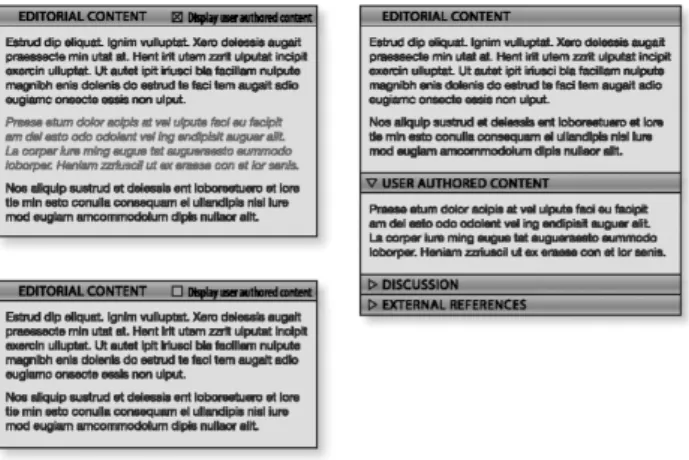
below in an individual area of the window; it can be revealed and hidden by clicking on the triangle symbol. This example also shows two additional sections that are “collapsed”: discus-sions and external resources. Instead of collaps-ing areas in the window, icons can be used to indicate additional content such as annotations or hyperlinks. By clicking on an icon the cor-responding annotation or hyperlink is revealed.
Fig. 5. Mixed and split content modes.(a)Left, top:
mixed mode with user-authored content.(b)Left,
bottom: mixed mode without user-authored content.
(c)Right: split mode with user-authored content
displayed and discussions and external references hidden.
The main benefit of the split content approach is that it is apparent for users which content was published by editors(and therefore is authentic) and which content was added by other users of the system. Moreover, this functionality can be used easily and is straightforward to implement. A more innovative technique for displaying arti-cles is the mixed content mode. When an expert user, for instance, wants to add a paragraph to an editorial article, the entire article is presented in a text editor. The expert can add content includ-ing text, images and video clips at any position in the existing article. The editorial content, however, is protected and cannot be changed. Users viewing the article can choose whether the user-authored content is displayed(see the checkbox in the title bar of Figures 5(a) and
(b)). In Figure 5(a), the piece of text provided by the community is displayed using a different font.
Such approach ensures that the quality of edi-torial content cannot be tampered with, while users of the community can easily add mate-rial at the most appropriate position in the ar-ticle, i.e., the context is preserved. This can
result in a seamless integration of editorial and community-provided content. Readers, on the other hand, can choose to view only the edi-torially approved information(Figure 5(a))or they can also have the data supplemented by the community displayed(Figure 5(b)).
Together with statistical analysis functionality introduced in section 2.7 above, the concept can even be refined: articles that contain a lot of data provided by the community are automat-ically reported to the board of editors. When the article is reviewed by editors they can sim-ply accept it, i.e., the information provided by a user is automatically added to the editorial con-tent and credited to the corresponding user. The user is not only associated with the section in the article, but also gets an extra positive rating or a particular reward.
3.7. Notification and Communication among Users
Notification mechanisms and communication among users are two significant aspects in the community. Notification mechanisms are nec-essary to let users know that one of the articles they authored was certified or that information has been added to an area of interest. In both cases, either “pull” or “push” technology can be employed. Push technology implies active dissemination where the encyclopaedia sends a message, e.g., an e-mail, to the users notifying them of the new information. With the pull tech-nique, the user has to retrieve the corresponding information explicitly from the encyclopaedia. A technology that is very well suited for this kind of information retrieval is RSS (RDF Site Summary, see34]and35; 36]).
3.8. Discussion Forums
Discussion forums based on the paradigm of conventional newsgroups should be available in any situation and at any point in the environ-ment. Users have the possibility to discuss mat-ters related to content in forums and discussions can, in fact, be attached to any kind of informa-tion in the system: to an article, to annotainforma-tions, hyperlinks, images, etc. Although discussions are usually in relation with a particular piece of information, users are also able to have “meta-discussions” in which general strategies, such as reorganisation of an encyclopaedic category or the need for new experts, can be argued. Discussions take place in the system, but are out-of-band rather than directly in the article
(see also Figure 5 (c) where discussions are presented in a separate area). The advantage of this approach is that articles strictly contain content and do not include discussions about content. Thus readers can mainly concentrate on the actual content and still have the option to join a discussion, if they are interested.
4. System Proposal
We propose a web-based system that builds a community around an encyclopaedic body of knowledge consisting of at least one elec-tronic encyclopaedia, several archives of arti-cles from magazines and newspapers, and po-tentially other sources of persistent information of high quality. The target group is a fairly closed user group of people wishing to have simple access to in-depth, high quality informa-tion on a wide range of topics.
The following sub-sections provide a brief over-view of the architecture and the main concepts to be implemented. A first prototype is to be available in December 2005.
4.1. Overview
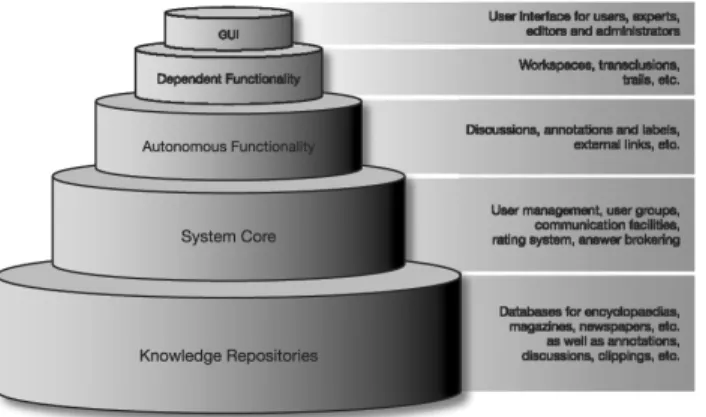
The proposed system is based on several sources of data from potentially heterogeneous architec-tures. The knowledge repositories contain en-tries from encyclopaedias, newspaper articles and similar data. Moreover, the contributions of the community – annotations, complemen-tary content, discussions, etc. – are retained in the databases of the system.
Building on these repositories, the integral com-ponents of the system are implemented. User management, different levels of users, the rating system and adaptation are essential to the envi-ronment(see sections 4.2 and 4.5). Communi-cation facilities and answer brokering(see sec-tion 4.6)are further components that are deeply rooted in the system core.
Basic functionality, such as discussions, annota-tions and links to external resources, builds on the foundations provided by the system core. More complex concepts, such as transclusions or workspaces, build on the basic functionality. The features and functionality offered by the system are presented to editors, experts as well as users in a graphically appealing and easy-to-use, intuitive web-based user interface. An overview of the generic system architecture is given in Figure 6.
Fig. 6. Generic system architecture. The system consists of several knowledge repositories and a system core that encompasses user management, communication, ratings and answer brokering. Building on these foundations, discussion forums and other functionality are realised. Users, experts, editors and administrators interact with
the system in a web-based GUI.
4.2. User Community
The system is based on a user community as introduced in sections 3.2 and 3.3. The com-munity can contribute to the knowledge base, develop the content and work together with the information provided by the system. The sys-tem comprises five levels of users:
administrators that have access to all func-tions and data in the system, mainly for performing maintenance and organisational tasks;
in the system, answer questions, and have full access to discussions; they also have ac-cess to the white lists(see below);
certified experts that can create, modify, remove and certify user-authored content, participate in discussions, answer questions
(see below), promote plain users and certify new experts (together with other certified experts); they have access to white lists;
domain experts that can create new content and modify or remove their own articles, par-ticipate in discussions and answer questions;
and plain users that can create new content and modify or remove their own articles and participate in discussions.
All users can rate other users and their contri-butions.
During a prototype phase, when only a small number of representative users work with the system, the experts in the community are simu-lated with a set of well-educated people in var-ious areas. Each of these experts is responsi-ble for several domains and has premium en-cyclopaedias, specialised databases and similar archives of high quality at hand.
This approach is used to ensure the vividness of the community from the very beginning of the project and to “jump-start” the acquisition of experts and new users.
4.3. Basic Functionality
The basic functionality of the proposed system resembles the one of traditional encyclopae-dias and digital libraries. It provides full-text search with fault tolerant input for all informa-tion stored in the system. In addiinforma-tion to search-ing, articles can be accessed through browsing. The system permits users to attach annotations and labels such as “important” or “for my pro-ject” to any object in the system. For annota-tions and labels different access levels are taken into consideration: they can be private, acces-sible within a certain group of users, or public
(see section 2.1).
Furthermore, users are capable of bookmarking articles and any other information items in the system. Thus, they can make direct references to content in the system.
4.4. Authoring New Content, Linking and Transclusions
Users of the community, especially certified ex-perts and domain exex-perts have the ability to gen-erate new content. This is mainly done by au-thoring new articles, writing annotations, pro-viding links to external resources and partici-pating in discussions.
New content, however, can also be authored by means of transclusions(e.g., 23]). An expert writing an article on the history of tea might, for instance, want to include a paragraph on the Boston tea party. A brief summary that is well-suited can be found in an article about settle-ments on the North American west coast in the 18th century. Instead of copying and pasting the paragraph from this article, the user simply tran-scludes it. Thus, by simply transcluding pieces of information from various articles completely “new” content can be produced.
Although transclusions generally pose a num-ber of difficulties in web-based environments, their implementation can be made easier be-cause it will only be possible to make transclu-sions from the vast number of information items from the internal knowledge repositories of the system. Hence, consistency of transcluded in-formation and potential copyright-related issues can be controlled as well.
An important aspect are links to external re-sources, such as specialised databases. In order to retain a high standard, whitelisting is em-ployed (see Section 3.3). The system has a list of external references(servers)that may be used, and all other resources are automatically blocked. Certified experts and editors, however, have the ability to add new, carefully selected resources to the list.
4.5. Adaptation
The system can adapt to its users. The adapta-tion is based both on a general profile that can be filled out when a user registers with the system, and on ad hoc profiles. Dynamic profiling as described in section 2.5 will not be implemented in the prototype of the system, but rather in a forthcoming version.
the source of information, the types of user-authored articles displayed, etc. vary based on the user’s preferences. Users have the option to disable adaptation in order to get a “default view” that would have been used without any adaptation. This ensures that users still have access to all information stored in the system and that no content is inadvertently filtered by the adaptation component.
4.6. Clustering and Knowledge Maps
When users search for terms in the encyclopae-dia, clustering techniques are employed to com-bine and display the results in a way similar to 3] and 11]. A query for the term “blue sky” might return a number of results from the encyclopaedia, as well as from newspaper articles and other repositories. These results are displayed to the user in clusters such as “atmosphere”, “electromagnetic field”, “pollu-tion” and “space”.
However, clustering is not only utilised in search queries, but also when users view articles. Ev-ery article displayed is complemented with doc-ument clusters that offer a brief overview of pages available on a topic (cf., 1]). This ap-proach facilitates the discovery of information and makes it easier to get an overview of a cer-tain area of interest.
Knowledge maps, as mentioned in section 1.2, are basically a graphic depiction of information clusters. Every article in the system is sup-plemented with a knowledge map on the user’s demand.
4.7. Active Knowledge Brokering
An active knowledge brokering module, as de-scribed in section 3.4, will be included as a fundamental part of the system. The proto-type version will require users to select both a category and a sub-category for their queries, for example, “astronomy” and “solar system”. Subsequently, the user can ask a question in natural language.
The system will search the internal repositories, including the encyclopaedia and the newspaper archive, for matching articles. The results are combined, organised in clusters and presented to the user. Additionally, the system will per-form a syntactic and heuristic analysis on the
question in order to determine if similar ques-tions have been asked before. In case the system is unable to detect appropriate question-answer pairs from previous queries, it will forward the question to human domain experts in the corre-sponding problem domain. If the question is not answered by a domain expert within one day, it is passed on to a certain group of certified ex-perts. If, after two more days, still no answer is provided, the user’s query is forwarded to ed-itors in the respective area. (See also Figure 4.)
4.8. Discussion Forums and Communication
Similar to the “annotate everything” paradigm
(see section 2.1), every piece of information in the system can be discussed. Discussion forums are typically attached to objects in the system including articles, images and links. However, users can also have meta-discussions that do not have to be related to any specific kind of object
(see section 3.7).
The system includes communication facilities outlined in section 3.6: users have the ability to write messages to other users in the system. The messages are displayed immediately if the recipient is currently online (similar to instant messaging)or presented as soon as the user logs on to the system(similar to traditional e-mail).
In both discussion forums and personal commu-nication, it should be particularly easy for users to include content from articles, make refer-ences to objects such as images or annotations, make contributions to a discussion, etc. Among others, transclusions and link consistency are aspects that will have to be considered.
5. Application Areas
5.1. Enhanced Encyclopaedic Environments
The proposed system clearly targets heteroge-neous systems consisting of several data sources such as encyclopaedias and archives of newspa-pers or magazines. It is obvious that especially communities that have the opportunity to de-velop and maintain content can be competitive in comparison to the Wikipedia while ensuring a high standard.
However, not only online encyclopaedias but also DVD-based encyclopaedias can make use of parts of the proposed functionality. Anno-tations, private workspaces, trails, as well as user profiles and adaptation, can be fully imple-mented without the need for a connection to the Internet.
5.2. E-Learning
Many state-of-the-art e-Learning environments make extensive use of encyclopaedic knowl-edge, and students utilise electronic encyclopae-dias when they are doing their homework or learning for exams. Therefore e-Learning en-vironments are particularly well-suited for the functionality introduced above: students can use private and shared workspaces to work to-gether on projects (see section 2.4), they can make information they encounter available to other students, and use annotations to share their insights. When articles from the encyclopaedia are active documents, students can pose ques-tions to documents and get instant answers.
Discussion forums can be employed to exchange views on articles and the information retrieved from the system, while the notification mech-anisms described in section 3.5 keep students informed when a new article or comment are added, or a discussion forum is updated. Lec-turers and teachers can, of course, use the same infrastructure as well. They can publish new documents, make annotations to articles, initi-ate discussions, attach additional content. Thus, in this case, teachers (cf. editors in an ency-clopaedia)and students(domain experts)form a community.
5.3. Corporate Documentation and Knowledge Management
Many companies, including computer busines-ses, the pharmaceutical industry and car manu-facturers offer online support for business cus-tomers and consumers. Their support databases basically constitute encyclopaedic knowledge that can be accessed by a closed user group. With the proposed functionality, especially the community building aspects, these corporate documentation and knowledge management net-works can be greatly enhanced.
A researcher or developer of the company, for instance, publishes the documentation of a com-plex software package. Several users attempt to configure the software, but run into problems on specific computing platforms. They can eas-ily make annotations to the original document, start a discussion on the topic, and attach their configuration files.
The business-business area in which several companies collaborate on a common project can make use of the proposed technology as well. In common projects there is a need to share certain
(encyclopaedic)knowledge and work together on it, whereas other pieces of information must not be unveiled. Hence, the community can make knowledge available that is necessary to complete the project without having to make trade secrets public.
6. Conclusion
This paper introduced several demands that fu-ture systems dealing with encyclopaedic knowl-edge should meet. Annotations should be om-nipresent and documents should be really ac-tive documents. Furthermore, users must have the opportunity to store the information encoun-tered and their comments in a private workspace – and they have to be able to share it with other users in the system. User profiles aimed at adap-tation of individual users, statistical analysis and navigation and tracking technologies based on trails will provide more accurate and more de-tailed search results.
basis for such an environment and appropriate processes for maintaining and ensuring the high quality of the material will have to be rendered. Although the big picture seems clear – involve-ment of users in content developinvolve-ment in its broadest sense – numerous aspects have to be investigated in detail. Research has to be done on concepts such as certification of experts or rating systems, and social aspects and phenom-ena known from the Wikipedia will have to be studied as well. However, more technical top-ics need to be addressed: whitelisting, for in-stance, is not widely used at the moment, so its weaknesses will have to be analysed. Also, link consistency, the use and implementation of transclusions, and new approaches, such as ac-tive knowledge brokering, should be discussed in detail.
In-depth studies on the implementation of links to external sources with techniques such as whitelisting and blacklisting, link consistency and the implications of transclusion in this con-tent will be discussed in an upcoming paper.
7. Acknowledgments
The first author would like to thank Edmund Haselwanter for a very constructive discussion on several topics covered in this paper and Christian G¨utl for his input.
References
1] A9,http://a9.com/.
2] AskJeeves,http://www.askjeeves.com/.
3] Sybase, Inc. A Better Search Engine with Sybase
EAServer and Autonomy?,http://www.sybase. com/content/1034309/ EAS CS v2.pdf,(2005)
Visited February 20th, 2005.
4] Blogger,http://www.blogger.com/.
5] Brockhaus Multimedial,
http://www.brockhaus-multimedial.de/.
6] P. BRUSILOVSKY, Methods and Techniques of
Adap-tive Hypermedia,User Modeling and User-Adapted Interaction, 2-3(1996), pp. 87–129.
7] P. BRUSILOVSKY, Adaptive Hypermedia: From
In-telligent Tutoring Systems to Web-Based Education. In Intelligent Tutoring Systems. Lecture Notes in Computer Science(G. Gauthier et al., eds.),(2000)
pp. 1–7. Springer-Verlag Berlin Heidelberg.
8] G. BUCHANANet al. Integrating Information
Seek-ing and StructurSeek-ing: ExplorSeek-ing the Role of Spatial Hypertext in a Digital Library,Proceedings of the 15th ACM Conference on Hypertext and Hyperme-dia,(2004)Santa Cruz, CA, U.S.A., pp. 225–234.
9] V. BUSH, As We May Think, Atlantic Monthly, 7 (1945), pp. 101–108. See also
http://www.theatlantic.com/unbound/ flashbks/computer/bushf.htm,
Visited February 8th, 2005.
10] Creative Commons,
http://creativecommons.org/.
11] Clusty,http://www.clusty.com/.
12] D. DEROUREet al. Memoir – An Open Distributed
Framework for Enhanced Navigation of Distributed Information,Information Processing and Manage-ment, 1(2001), pp. 53–74. See also
http://eprints.ecs.soton.ac.uk/4240/01/ 2001-4240.pdf.
13] R. FURUTA et al. Hypertext Paths and the World
Wide Web: Experiences with Walden’s Paths, Pro-ceedings of the 8th ACM Conference on Hypertext and Hypermedia, (1997) Southampton, UK, pp.
167–176.
14] Free Software Foundation, Inc. GNU Free
Documentation License, http://www.gnu.org/ copyleft/fdl.html,(2005)Visited February 8th,
2005.
15] R.J. GLUSHKOet al. “Hypertext Engineering”:
Prac-tical Methods for Creating a Compact Disc Ency-clopedia,Proceedings of the ACM Conference on Document Processing Systems, (1988) Santa Fe,
NM, U.S.A., pp. 11–19.
16] Google Answers,
http://answers.google.com/.
17] GuruNet,http://www.gurunet.com/.
18] E. HEINRICH ANDH. MAURER, Active Documents:
Concept, Implementation and Applications, Jour-nal of Universal Computer Science, 12(2000), pp.
1197–1202. See also
http://www.jucs.org/jucs 6 12/active documents concept implementation/.
19] E. HEINRICH et al. Learner-Formulated Questions
in Technology-Supported Learning Applications,
Proceedings of ED-MEDIA‘01, (2001) Tampere,
Finland, pp. 720–725. See also
http://www.iicm.edu/iicm papers/learner formulated questions.pdf.
20] Journal of Universal Computer Science (J.UCS), http://www.jucs.org/.
21] F. KAPPE, Maintaining Link Consistency in
22] H. KROTTMAIER, Enhanced Annotations, Proceed-ings of the International Conference on Society for Information Technology and Teacher Educa-tion (SITE 2003), (2003) pp. 991–993. See also http://dl.aace.org/11854.
23] H. KROTTMAIER AND H. MAURER, Transclusions
in the 21st Century, Journal of Universal Com-puter Science, 12(2001), pp. 1125–1136. See also http://www.jucs.org/jucs 7 12/
transclusions in the 21st/.
24] J. LENNON ANDH. MAURER, Why it is Difficult to
Introduce e-Learning into Schools and Some New Solutions,Journal of Universal Computer Science, 10(2003), pp. 1244–1257. See also
http://www.jucs.org/jucs 9 10/why it is difficult/.
25] B. LEUF AND W. CUNNINGHAM, The Wiki Way. Quick Collaboration on the Web, Addison-Wesley, 2001.
26] C.C. MARSHALL, Annotation: From Paper Books
to Digital Library,Proceedings of the ACM Confer-ence on Digital Libraries,(1997)Philadelpha, PA,
U.S.A., pp. 131–140.
27] C.C. MARSHALL ANDS. BLY, Sharing Encountered
Information: Digital Libraries Get a Social Life,
Proceedings of the 4th ACM/IEEE-CS Joint Con-ference on Digital Libraries,(2004) Tucson, AZ,
U.S.A., pp. 218–227.
28] H. MAURER, Beyond Classical Digital Libraries, Proceedings of the NIT Conference, Global Digi-tal Library Development in the New Millenium,
(2001) Beijing, China, pp. 165–173. See also http://www.iicm.edu/iicm papers/
beyond digital libraries.doc.
29] H. MAURER ANDK. TOCHTERMANN, On a New
Pow-erful Model for Knowledge Management, Journal of Universal Computer Science, 1(2002), pp. 85–
96. See also http://www.jucs.org/jucs 8 1/ on a new powerful/.
30] H. M ¨ULNER, Software f¨ur ein multimediales
Lexikon,(2001)Personal Communication.
31] T.H. NELSON, Literary Machines, Mindful Press,
1981.
32] T.H. NELSON, Generalized Links, Micropayment and Transcopyright,http://www.almaden.ibm. com/almaden/npuc97/1996/tnelson.htm, (1996)Visited May 1st, 2003.
33] K. SHAFERet al. Introduction to Persistent Uniform
Resource Locators, http://purl.oclc.org/ docs/inet96.html,(2005)Visited February 24th,
2005.
34] E. MILLERet al. Resource Description Framework (RDF),http://www.w3.org/RDF/,(2004)
Visited February 3rd, 2005.
35] D. LIBBY, Netscape Communications RSS 0.91
Spec, revision 3, http://my.netscape.com/ publish/formats/rss-spec-0.91.html, (1999)Visited February 3rd, 2005.
36] A. SWARTZ, RDF Site Summary (RSS) 1.0, http://web.resource.org/rss/1.0/, (2001)
Visited February 3rd, 2005.
37] J. RUBART et al. Organizing Shared Enterprise
Workspaces Using Component-Based Cooperative Hypermedia,Proceedings of the Twelfth ACM Con-ference on Hypertext and Hypermedia, (2001)
Aarhus, Denmark, pp. 73–82.
38] W. TREESE, Putting It Together.Open Systems for Collaboration, netWorker, 1(2004), pp. 13–16.
39] F.B. VIEGAS´ et al. Studying cooperation and conflict
between authors with history flow visualizations,
Proceedings of the 2004 Conference on Human Factors in Computing Systems(CHI 2004),(2004)
Vienna, Austria, pp. 575–582.
40] A. WEISS, Ending Spam’s Free Ride,netWorker, 2 (2003), pp. 19–24.
41] Wikipedia. The Free Encyclopedia, http://www.wikipedia.org/.
42] Wikipedia, Wikipedia. The Free Encyclopedia, http://en.wikipedia.org/wiki/Wikipedia,
(2006)Visited July 6th, 2006.
Received:May, 2005
Accepted:April, 2006
Contact addresses:
Josef Kolbitsch Graz University of Technology Steyrergasse 30 8010 Graz, Austria e-mail:[email protected]
Hermann Maurer Institute for Information Systems and Computer Media Graz University of Technology Inffeldgasse 16c 8010 Graz, Austria
e-mail: [email protected]
JOSEFKOLBITSCHis a PhD student at Graz University of Technology. His research interests include electronic encyclopaedias, digital libraries and hypermedia.