Contextualized Question Answering
Luka Brade
ˇ
sko, Lorand Dali, Bla
z Fortuna, Marko Grobelnik,
ˇ
Dunja Mladeni´c, Inna Novalija and Bo
ˇ
stjan Pajntar
Jozef Stefan Institute, Ljubljana, Sloveniaˇ
The paper describes a system which enables accurate and easy-to-use contextualized question answering and it provides document overview functionalities. The possibility of asking natural language questions enables a friendly interaction for the user.The contextualization is achieved by using an ontology. The answers are provided based on a domain specific document collec-tion of choice. The approach consists of several phases as follows: data preparation, data enhancement, data indexing and handling questions. Every module uses state of the art technologies that are shown to work in a complex pipeline to make available question answering on top of a given document repository with the context of ontologies, such as Cyc, ASFA and WordNet. The functioning of the proposed approach is demonstrated on English document collections on Aquatic Sciences and Fisheries — ASFA, using Cyc ontology, ASFA thesaurus as domain specific ontology and WordNet as general ontology. Experimental evaluation has shown that the usage of ontologies increases the number of answers retrieved by about 60%. However, the number of answers that are actually correct increases by only 40% when using ontologies.
Keywords: contextualized information retrieval, ques-tion answering, ontology
1. Introduction
Search applications are very useful and widely used. However, most of them only retrieve doc-uments (or snippets) which match the search query best, without a specific answer or any information related to the context. Our con-tribution is a search application which enables querying in natural language and provides spe-cific answers to the question asked, moreover, domain specific and general context is lever-aged to retrieve facts which are not explicitly stated. The application also provides document overview functionality which enables the user to explore further information in the context of the current answer.
The technology behind is based on Answer-Art[4] technology for question answering and Cyc[7]ontology for providing semantic context to the document collection from a particular do-main of interest.
The approach consists of several phases as fol-lows. In the data preparation phase, we tract the relevant part of Cyc ontology and ex-tend it with any other relevant ontology, either general or domain specific. In this phase, the document collection is pre-processed using An-swerArt technology to obtain subject-predicate-object triplets from the sentences in the domain specific document collection. In the data en-hancement phase, the triplets are enhanced us-ing semantic knowledge obtained from the ex-tended part of Cyc ontology. In thedata index-ing phase, the enhanced triplets are index for efficient search for answers. In the final phase of handling question, the question is transformed based on predefined patterns of questions to en-able efficient search over the indexed triplets and the list of answers is returned.
2. Motivation
When performing search, users are frequently looking for specific answers to questions. More-over, we consider additional facts from the con-text of the answer, and document overview func-tionality as being helpful for the user. We also think that enabling natural language queries makes the system much more user friendly. The proposed approach is based on combining AnswerArt[4]technology for question answer-ing based on triplets and Cyc ontology for pro-viding semantic context to the document collec-tion from a particular domain of interest. More-over, the approach provides answers in semantic context of the domain of interest via including Cyc ontology extended by any other domain specific ontology as needed.
AnswerArt integrates two important function-alities: providing answers to questions and browsing through documents that support the answers. The questions follow a predetermined template, whereas the answers are yielded based on the previously extracted information, in the form of subject–predicate–object triplets. Fur-thermore, the system retrieves the sentences that support these answers, as well as the documents containing the sentences. It integrates three pos-sibilities of further exploring the relevant doc-uments: by analyzing the list of facts extracted from the document, by visualizing the semantic representation of the document and by browsing the document summary.
3. Related Work
Related approaches query structured data stored in ontologies, while AnswerArt derives the an-swers only from unstructured text. TextRun-ner [1]is similar to AnswerArt in the way that it also involves applying structured queries on unstructured text, while the main difference is that AnswerArt also provides a natural language interface to the search. The Calais1 system creates semantic metadata for user submitted documents in the form of named entities, facts and events. AnswerArt named entities and facts represent the starting point and they are further refined by applying co-reference resolution for
named entities, anaphora resolution and seman-tic normalization based on WordNet for facts. This process enables the construction of a se-mantic description of the document in the form of a semantic directed graph where the nodes are the subject and object triplet elements, and the link between them is determined by the predi-cate. Powerset2enables search over Wikipedia
and Freebase, where the search results contain aggregated information from several articles, as well as a list of facts related to people, places and things. The main difference is that Answer-Art describe the answer by a visual representa-tion of the document in the form of a semantic graph and by the document summary, which is automatically extracted based on the document semantic graph.
4. Approach Description
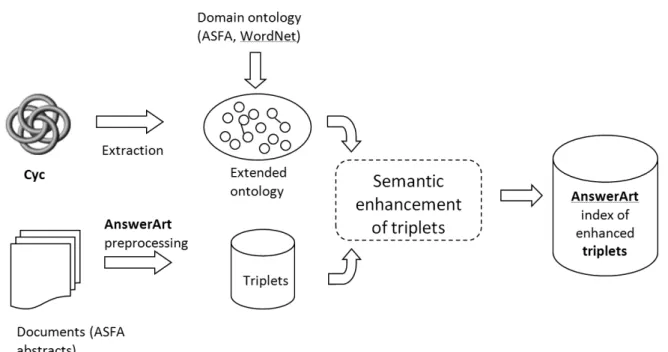
We propose an approach that enables answer-ing question from a desired domain usanswer-ing a col-lection of relevant documents. The approach consists of four phases: data preparation, data enhancement, data indexing and question han-dling. Architecture of the proposed approach is given in Figure 1.
In the data preparation phase, we extract the rel-evant part of Cyc ontology and extend it with any other relevant ontology, either general or domain specific. In our application scenario, we have selected ASFA abstracts for a document collection and extended Cyc by using WordNet and ASFA ontology. The document collection is pre-processed using AnswerArt technology to obtain subject-predicate-object triplets out of the sentences in the document collection. In the data enhancement phase, the triplets are enhanced using semantic knowledge obtained from the extended Cyc ontology. In particular, each part of the triplet is extended by a set of synonyms and direct generalizations obtained from the ontology.
In the data indexing phase, the extended triplets are indexed for efficient search for answers. The search is performed by transforming each ques-tion into a set of semi-triplets — triplets with missing one or two arguments. Search is per-formed as matching of the semi-triplets with the triplets from the index in order to find possible
Figure 1.Architecture of the approach.
values of the missing arguments(answers to the question).
In the final phase, the question is transformed based on predefined patterns of questions to en-able efficient search over the indexed triplets and the list of answers is returned. In the ques-tion handling phase, the quesques-tion is transformed based on predefined patterns of questions to en-able efficient search over the indexed triplets and the list of answers is returned.
5. Underlying Technology
The proposed approach builds on several exist-ing technologies: components of the Answer-Art system for question answering are adjusted for including semantic enhancement of the data using Cyc ontology. It is implemented in a prototype that uses service oriented architec-ture. It consists of module for the triplet ex-traction, which can work over any document repository. In our implementation, we demon-strate it over the ASFA abstracts. Next, there is a module which consolidates Cyc and domain ontologies, which all provide semantic enhance-ments of the triple set. Last, there is AnswerArt module for translating natural language ques-tions into triplet queries and visualization and summarization of the results.
5.1. AnswerArt description
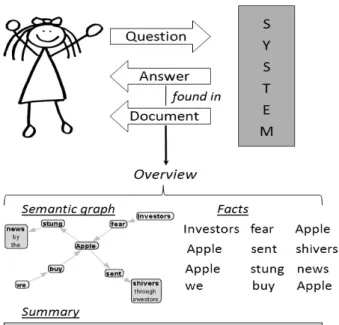
AnswerArt combines question answering, sum-marization and document visualization func-tionalities. The user obtains answers based on the facts previously extracted from text in the form of subject–predicate–object triplets. Moreover, the sentences that support the an-swer, as well as the documents containing these sentences, are also retrieved. The relevant doc-uments can be further explored with the aid of a document overview functionality that consists of a document summary, a semantic represen-tation of the initial document and a list of facts extracted from the document(see Figure 2). The system shows possible answers to the ques-tion, links them to the supporting sentences and corresponding document. The system pro-vides a document overview by retrieving the document semantic graph, the list of subject– predicate–object facts and the automatically gen-erated document summary of variable length interactively set by the user. Extraction of subject–predicate–object facts is a pre-proces-sing step to document collection. Triplets are extracted from each sentence in turn. This means that to extract triplets from a document, the text in that document has to be split into sentences.
Figure 2.Illustration of AnswerArt.
means that several related consecutive tokens are grouped together, based on their tags, result-ing in phrases(noun phrases and verb phrases), also called chunks. Having chunked a sentence, simple rules can be applied to extract triplets from it. An example of such a rule would be: a noun phrase followed by a verb phrase followed by another noun phrase is a triplet.
5.2. Cyc description
Cyc Knowledge Server is a very large, multi-contextual knowledge base and inference en-gine, developed for more than twenty years with a goal to break the “software brittleness bottle-neck” once and for all by constructing a foun-dation of basic “common sense” knowledge — a semantic substratum of terms, rules, and re-lations. This enables a variety of knowledge-intensive products and services. Cyc is in-tended to provide a “deep” layer of understand-ing that can be used by other programs to make them more flexible. Here we have used a part of Cyc functionality that includes the Know-ledge base, Inference Engine and The Natural Language Processing Subsystem, which we
ac-cessed through Cyc Developer Toolsets (CYC
API).
The Cyc knowledge base(KB)is a formalized representation of a vast quantity of fundamen-tal human knowledge: facts, rules of thumb, and heuristics for reasoning about the objects and events of everyday life. The medium of representation is the formal language CycL, de-scribed below. The KB consists of terms — which constitute the vocabulary of CycL — and assertions which relate those terms. These as-sertions include both simple ground asas-sertions and rules.
At the present time, the Cyc KB contains nearly two hundred thousand terms and several dozen hand-entered assertions about/involving each term. New assertions are continually added to the KB by human knowledge enterers and lately also with the help of the machines using various machine learning algorithms.
6. Data Description — ASFA
Aquatic Sciences and Fisheries Abstracts (ASFA) [8] is a database covering the litera-ture on the science, technology, management, and conservation of marine, brackish water, and freshwater resources and environments, includ-ing their socio-economic and legal aspects. More than 5,000 serial publications, books, re-ports, conference proceedings, translations and limited distribution literature are selected for abstracting and indexing in ASFA. Publica-tions in more than 40 languages, with English as primary language, are represented in ASFA database that actually aggregates five databases. We have pre-processed the ASFA documents
using AnswerArt technology. There were
3,100,832 triplets extracted from the data con-taining 347 403 unique terms. Examples of the extracted triplets are the following:
Salmon spawn rivers
Salmon is export product
disease affecting tissues
disease cured antibiotics
symptoms associated disease
weight caught survey
ship deform ice
ship has ballast tanks
fisheries conservation areas
blood developing mechanism
7. Data Enhancement
7.1. Data enhancement with Cyc
The input for this part of the task were the subject–predicate–object triplets extracted from ASFA documents. The triplet source was then connected into the Cyc KB using OpenCYC API. For each from the vast amount of concepts (347,404)in English the Cyc KB was queried to get the corresponding Cyc concept (see the examples below). Furthermore, for each con-cept that Cyc has its English representation we queried it few times to get the related concepts, especially its generalizations. For each of the concepts we got one or more of its generalized meanings and then the Cyc was queried again to get the English presentations of all related concepts.
Out of the 347403 concepts occurring in the extracted triplets, 10310 are covered by Cyc. There are 228266 inferences made by Cyc, which means that one concept has roughly about 20 related concepts extracted from Cyc.
7.2. Data enhancement using WordNet
WordNet is a lexical database of the English language containing about 150 000 words orga-nized into synsets — a set of words which have the same meaning, and also contains an expla-nation, examples, and the part of speech which the words in that synset have. A synset can have semantic relations to other synsets. Two of these relations relevant for our work are the hypernymy relation (more general forms) and the hyponymy relations (more specific). The WordNet database is organized into a hierarchy of hypernyms and hyponyms.
The system uses WordNet to find related terms for each concept extracted from the ASFA ab-stracts. By related term we mean: synonyms (the other words in the synset) and one level of hypernyms. The goal of the related terms is to improve the recall of the search for a given concept, which will be found not only if the user searches for the word as it appeared in the text, but also if he searches for a related term. There were 347404 terms extracted from ASFA, for 27775 of which synonyms could be found in WordNet, and for 20358 hypernyms could be found. For instance, catfish synonyms: mudcat; hypernyms: freshwater fish.
7.3. Data enhancement using ASFA
ASFA thesaurus contains over 9800 concepts, applies to database indexing and provides a set of terms used by indexers to describe the con-tents of publications. These thesaurus terms are listed in the Descriptors field of each record in ASFA database. Each concept might contain the information about hierarchical and affini-tive relations with other thesaurus concepts. 4948 ASFA thesaurus concepts corresponding to 347403 ASFA abstract terms were extracted and elaborated with synonymic and hierarchical relations.
8. Illustrative Example of the System Usage
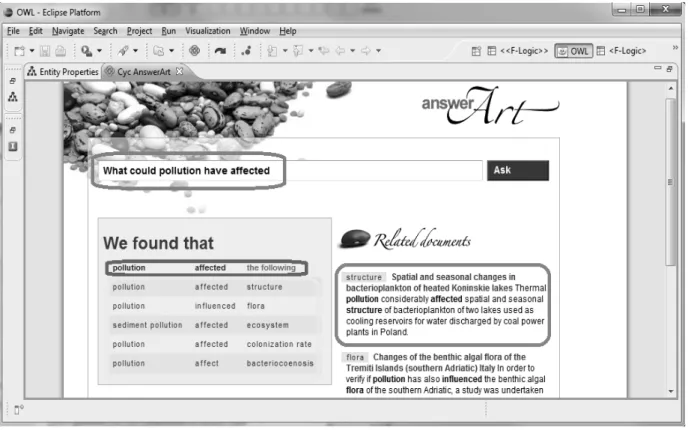
Illustrative example in Figure 3 poses a ques-tion: “What could pollution have affected”. The blue rectangle marks the input field with the question asked.
The red rectangle marks the header of the table of results, showing how the natural language question has been transformed into a triples query. The first word designates the subject, the second verb and the last the object. In our example the subject is “pollution” the verb is “affected” and we are searching for all possible objects: “the following”. In general, it is pos-sible to have missing any single element or any two elements from the triple. It is also possi-ble to have all three elements defined and the question actually checks weather the question is true — or more accurately — if such a claim is found in the document repository. The yel-low rectangle marks the table of results, where each row is a found triple that satisfies the triple query given in the header. The green rectangle marks the first result — excerpt from the actual document that the triple was extracted from. At the top, the title is shown and clicking leads to the detailed view of the specific document.
9. Evaluation
Figure 3.Example of the system usage.
to which the system responded both with and without using inference from ontologies. To each question the system gave a number of an-swers. The correctness or relevance of the given answers was determined according to the judge-ment of the authors.
On average, a question was answered with 8 an-swers out of which on average 3 resulted from using ontologies. Hence the usage of ontolo-gies increases the number of answers retrieved by about 60%. However, the number of an-swers that are actually correct increases by only 40% when using ontologies. This shows that the precision of answers obtained using ontolo-gies is lower and that trying to obtain more answers by inference has a negative effect on the precision. Indeed, the precision of the sys-tem drops from 84.17% to 76.61% when adding answers obtained from ontologies, because the answers using ontologies have the precision of only 63.29%
Although the size of the experiment is too small to base any solid conclusions on it, we can argue that the AnswerArt system cannot find an im-portant number of correct answers unless it uses ontologies. On the negative side however, on-tologies introduce more mistakes and decrease the precision of the system.
10. Discussion
We have presented a search application which enables querying in natural language and pro-vides specific answers to the question asked, moreover, domain specific and general context is leveraged to retrieve facts which are not ex-plicitly stated. The application also provides document overview functionality which enables the user to explore further information in the context of the current answer.
11. Acknowledgments
This work was supported by the Slovenian Re-search Agency and the IST Programme of the European Community under NeOn Lifecycle
Support for Networked Ontologies (
IST-4-027595-IP) and PASCAL2 Network of
Excel-lence(ICT-NoE-2008).
References
[1] M. BANKO, O. ETZIONI, The Tradeoffs Between
Open and Traditional Relation Extraction. InProc. of the ACL,(2008)Columbus, Ohio.
[2] D. BAXTER, B. KLIMT, M. GROBELNIK, D. SCHNEI -DER, M. WITBROCK, D. MLADENIC´, Capturing Doc-ument Semantics for Ontology Generation and Document Summarization. InSemantic knowledge management: integrating ontology management, knowledge discovery, and human language tech-nology, (2009) Berlin, Heidelberg: Springer, pp. 141–154.
[3] CHRISTIANEFELLBAUM, WordNet: An Electronic
Lexical Database. Cambridge, MA: MIT Press, 1998.
[4] L. DALI, D. RUSU, B. FORTUNA, D. MLADENIC´, M. GROBELNIK, Question Answering Based on Seman-tic Graphs. In Proc. of the WWW-2009 Workshop on Semantic Search (SemSearch2009).
[5] GEORGEA. MILLER, WordNet: A Lexical Database
for English.Communications of the ACM, Vol. 38
(1995), No. 11, pp. 39–41.
[6] M. GROBELNIK, J. BRANK, B. FORTUNA, I.
MOZETICˇ, Contextualizing Ontologies with
Onto-Light: A Pragmatic Approach.Informatica Journal, Janauray 2009.
[7] D. B. LENAT, Cyc: A Large-scale Investment in
Knowledge Infrastructure.Comm. of the ACM, Vol. 38, No. 11, November 1995.
[8] E. FAGETTID. W. PRIVETT, J. R. L. SEARS,Aquatic Sciences and Fisheries Thesaurus. Descriptors used in the Aquatic Sciences and Fisheries Information System, Food and Agriculture Organization of the UN, 2009.
Received:June, 2010
Accepted: November, 2010
Contact addresses:
Luka Bradeˇsko Jozef Stefan Instituteˇ
Jamova 39, 1000 Ljubljana Slovenia e-mail:[email protected]
Lorand Dali Joˇzef Stefan Institute Jamova 39, 1000 Ljubljana Slovenia e-mail:[email protected]
Blaz Fortunaˇ
Joˇzef Stefan Institute Jamova 39, 1000 Ljubljana Slovenia e-mail:[email protected]
Marko Grobelnik Joˇzef Stefan Institute Jamova 39, 1000 Ljubljana Slovenia e-mail:[email protected]
Dunja Mladeni´c Joˇzef Stefan Institute Jamova 39, 1000 Ljubljana Slovenia e-mail:[email protected]
Inna Novalija Joˇzef Stefan Institute Jamova 39, 1000 Ljubljana Slovenia e-mail:[email protected]
Boˇstjan Pajntar Joˇzef Stefan Institute Jamova 39, 1000 Ljubljana Slovenia e-mail:[email protected]
LUKABRADESKOˇ is a researcher and a PhD student at Artificial Intel-ligence Laboratory of the Jozef Stefan Institute, working in the area ofˇ
large scale information extraction and ontology building. He has been involved in several European projects including SEKT, NEON and is principal software developer for Cycorp Europe on EU project LarKC. His research interests are in text-mining and reasoning methods. Luka is experienced software engineer and has been working for several years in several software companies in Slovenia, including Hermes Plus, Epi-log, Logina. His specialties are in developing java applications and integrated systems for automatic warehousing and logistics.
LORANDDALIis a computer engineer doing research in the fields of text mining, information retrieval, information visualization, natural language processing and semantic web. Lorand graduated from the Technical University of Cluj Napoca in 2008. Currently he is enrolled in the PhD program at the Jozef Stefan International Postgraduate Schoolˇ
and works at the Artificial Intelligence Laboratory of the Joˇzef Ste-fan Institute. Lorand is developing software for question answering, personalized information retrieval, semantic annotations for text and dynamic user interfaces for data visualization.
BLAˇZFORTUNAis a senior research assistant and a PhD student at Jozefˇ
MARKOGROBELNIKis an expert in analysis of large amounts of complex data for extracting useful knowledge. In particular, the areas of exper-tise comprise: data mining, text mining, information extraction, link analysis, and data visualization as well as more integrative areas such as semantic Web, knowledge management and artificial intelligence. Apart from research on theoretical aspects of unconventional data anal-ysis techniques, he has valuable experience in the field of practical applications and development of business solutions based on the inno-vative technologies. Marko was employed as a researcher first, at the Computer Science Department at the University of Ljubljana and later at the Department of Knowledge Technologies at Jozef Stefan Institute, Ljubljana, Slovenia, the main national research institute for natural sci-ences in the country. His primary focus of research and applications is intelligent data analysis which deals with unconventional scenarios going beyond classical statistical approaches and solving problems in-cluding unstructured or semi structured data. His main achievements are from the field of text-mining(analysis of large amounts of textual data), having leading role on scientific and applicative projects funded by European Commission, having projects with industries such as Mi-crosoft Research, British Telecom, New York Times, Siemens, and organizing several international events on the related topics.
DUNJAMLADENIC´is an expert on study and development of machine learning, data/text mining, semantic technology techniques and their application on real-world problems. She has been associated with the J. Stefan Institute since 1987, first as a student and since 1992 em-ployed as a researcher. She is leading Artificial Intelligence Laboratory of the Jozef Stefan Institute since 2011. She got her MSc and PhDˇ
degrees in Computer Science from the University of Ljubljana in 1995 and 1998 respectively. She was a visiting researcher at School of Computer Science, Carnegie Mellon University, USA in 1996–1997 and in 2000–2001. She has published papers in refereed conferences and journals, served in the program committee of international confer-ences and organized international events in the area of text mining, link analysis and data mining. She is co-editor of several books including “Data Mining and Decision Support: Integration and Collaboration”, Kluwer Academic Publishers 2003, “Semantic Knowledge Manage-ment: Integrating Ontology Management, Knowledge Discovery, and Human Language Technologies” Springer 2008, “Web Mining: from Web to Semantic Web”, Springer 2004, “Semantics, Web and Mining” Springer 2006, “From Web to social Web: discovering and deploy-ing user and content profiles”, Sprdeploy-inger 2007, “Knowledge Discovery Enhanced with Semantic and Social Information”, Springer 2009.
INNANOVALIJAholds a MS degree in intellectual systems of decision taking(Ukraine, 2005)and MA degree in economics(Hungary, 2007). Currently she is working in the area of knowledge technologies and is enrolled in the PhD program at Jozef Stefan International Postgrad-uate School(Slovenia). Her research interests include text mining, ontologies and reasoning, language technologies, economic and busi-ness data analysis. She participated in conferences on data mining & data warehouses and information technology interfaces.
BOSTJANˇ PAJNTARis an expert in complex data visualizations featuring
graph drawing, trend diagrams and semantic landscapes, data mining on text, images and graphs. All of this expertise are usually drawn together to work in different scenarios of semantic Web, information retrieval and artificial intelligence. Boˇstjan is employed in Artificial Intelligence Laboratory at the Jozef Stefan Institute. Earlier, he was employed in aˇ