African Journal of Reproductive Health December 2018; 22 (4):54
ORIGINAL RESEARCH ARTICLE
Sexual Dysfunction in Postpartum Turkish Women:
It’s
Relationship with Depression and Some Risk Factors
DOI: 10.29063/ajrh2018/v22i4.6
Figen Alp Yilmaz
1, Dilek Avci
2*, Yilda Arzu Aba
2, Resmiye Ozdilek
3and Nafiye Dutucu
3Bozok University, Faculty of Health Sciences, Department of Nursing, Yozgat, Turkey1; Bandirma Onyedi Eylul University, Faculty of Health Sciences, Department of Nursing, Balikesir, Turkey2; Kocaeli University, Faculty of Health Sciences, Department of Midwifery, Kocaeli, Turkey3
*For Correspondence: Email: [email protected]; Phone: +90 0266 718 64 00
Abstract
This study aimed to determine the prevalence of sexual dysfunction in postpartum Turkish women, and the relation between sexual dysfunction and depression, and some risk factors. This study was conducted with 530 postpartum women who had given birth during the previous 2-12 months. Data were collected with the Personal Information Form, Index of Female Sexual Function, and Edinburg Postnatal Depression Scale. For the data analysis, descriptive statistics, the Chi-square test, and Pearson correlation analysis were conducted using SPSS version 16. In the study, 74.3% of the postpartum women experienced sexual dysfunction. Sexual dysfunction was more prevalent in women who were high school graduates, whose reported economic status was middle class, who had a history of high-risk pregnancy, and whose menstruations did not recommence. It was also prevalent in women who experienced dyspareunia, who did not use a family planning method, who used withdrawal family planning method, and who experienced postnatal depression. A medium correlation was determined between the sexual dysfunction and postnatal depression. Assessment of the sexual dysfunction prevalence and risk factors of postpartum women enables healthcare professionals to use necessary intervention strategies. (Afr J Reprod Health 2018; 22[4]: 54-63).
Keywords: Depression, Postpartum period, Sexual dysfunction, Turkish women
Résumé
Cette étude visait à déterminer la prévalence de la dysfonction sexuelle chez les femmes turques après l'accouchement et la relation entre la dysfonction sexuelle et la dépression et certains facteurs de risque. Cette étude a été menée auprès de 530 femmes postnatales ayant accouché au cours des 2-12 mois précédents. Les données ont été recueillies à l'aide du formulaire d'informations personnelles, de l'index de la fonction sexuelle chez la femme et de l'échelle de dépression postnatale d'Édimbourg. Pour l'analyse des données, des statistiques descriptives, le test du chi carré et l'analyse de corrélation de Pearson ont été réalisés à l'aide de la version 16 de SPSS. Dans l'étude, 74,3% des femmes en post-partum présentaient un dysfonctionnement sexuel. Le dysfonctionnement sexuel était plus fréquent chez les femmes qui étaient à l'école secondaire. Les diplômés, dont le statut économique déclaré était celui de la classe moyenne, qui avaient des antécédents de grossesse à haut risque et dont les règles ne recommençaient pas. Il était également prévalent chez les femmes atteintes de dyspareunie, n'ayant pas utilisé de méthode de planification familiale, ayant utilisé la méthode de planification familiale de retrait et souffrant de dépression postnatale. Une corrélation moyenne a été déterminée entre le dysfonctionnement sexuel et la dépression postnatale. L'évaluation de la prévalence de la dysfonction sexuelle et des facteurs de risque des femmes en post-partum permet aux professionnels de la santé d'utiliser les stratégies d'intervention nécessaires. (Afr J Reprod Health 2018; 22[4]: 54-63).
Mots-clés: Dépression, période post-partum, dysfonctionnement sexuel, femmes turques
Introduction
Pregnancy and delivery are one of the most significant periods of a women's life1, 2. Postpartum period is the time when spouses adapt
to their parenting roles, resume their sexual activities, but have problems specific to this period. The physiological, psychological, socio-cultural changes that occur during this period affect women‘s sexual health and behaviors1, 3-5
Yilmaz et al. Sexual dysfunction in postpartum Turkish women
African Journal of Reproductive Health December 2018; 22 (4):
55
Reports show that during the postpartum period, women experience problems such as less frequent sexual intercourse, decreased sexual desire, difficulty having orgasm, vaginal dryness, perineal pain, dyspareunia, decreased sexual satisfaction and sexual dysfunction2,6-8.
Sexual dysfunction is characterized by disturbance in sexual desire and in the psychophysiological changes that characterize the sexual response cycle and cause marked distress and interpersonal difficulty9. Female sexual dysfunction is a multidimensional disorder with a prominent impact on overall general well-being10,11. In several studies, it has been indicated that the prevalence of sexual dysfunction in the postpartum period varies between 20% and 76%8,12-15. Postpartum sexual function is affected by changes in anatomy, hormonal milieu, family structure, and husband relationships that accompany childbirth4,6,14. Breastfeeding, vaginal bleeding, caesarean section, perineal trauma and episiotomy can cause sexual dysfunction in women1-3,5,7. In addition, prenatal sexual problems, adaptation to the new role, marital conflicts, sleep disorders, and fatigue negatively affect the sexual life of women and thus lay the groundwork for sexual dysfunction2,12,16.
One of the variables affecting sexual life in the postnatal period is postnatal depression14,17,18. Symptoms of postnatal depression are the most common health issues that require rapid and careful attention during the first year after childbirth. A range of 6-33% of women is reported to experience symptoms of depression during the postnatal period. Several demographic and obstetric factors (maternal age, twin birth, type of delivery, breastfeeding, unintended pregnancy, perinatal complications, etc.) associated with depression in the postpartum period have been identified17-19. In addition, it has been reported that there is a strong mutual relationship between depression and sexual dysfunction, and that sexual dysfunction is more frequent in women with postnatal depression8,20.
Postpartum sexual dysfunction is the serious morbidity and may lead to a variety of physical, mental, social adverse effects on the woman.
However, this problem has received little consideration from both healthcare providers and researchers2,4. There is a gap in the literature related to studies investigating sexual dysfunction and depression among postpartum women14,18, and there is no study on this issue in Turkey. However, the World Health Organization11 highlights that sexual health is an important aspect to be taken into consideration for the improvement of well-being and health of women and should be integrated into primary healthcare services. Therefore, the present study aimed to determine the prevalence of sexual dysfunction in postpartum women, and the relationship between sexual dysfunction, depression and some risk factors.
Methods
Design
This cross-sectional study was conducted between March 2017 and December 2017 in Kocaeli, a province in Turkey.
Sample
The study population comprised postpartum women who had given birth during the previous 2-12 months in Kocaeli University Faculty of Medicine Department of Obstetrics and Gynecology.
The minimum sample size was calculated with the PASS (Power Analysis and Sample Size) 11 Statistical Software (NCSS LLC, Kaysville, Utah, USA). The single report by Acele and Karacam21 showed that 91.3% of postpartum women in Turkey reported sexual dysfunction. On the other hand, in studies carried out worldwide, the rate of sexual dysfunction in the postpartum women ranged from 20% to 76% 8,12,13,15. Therefore, the minimum sample size was calculatedusing the following formula.
n= (zα/2)2 P(1-P) / d2
African Journal of Reproductive Health December 2018; 22 (4):
56
obstetrics clinic register was examined, and the data on how to contact the women who gave birth 2-12 months were obtained. According to the birth records of this hospital, the number of the women in the 2–12 months postpartum period was 1080, and all women were invited to complete the online questionnaire, if they met the following inclusion criteria. The inclusion and exclusion criteria for this study were based on the objectives of the study and the literature review. The inclusion criteria were as follows: aged ≥18 years old (the legal age of consent is 18 years in Turkey), aged ≤40 years old (as they are more likely to experience premenopausal and perimenopausal changes, and their sexual function decreases with age), giving birth 2–12 months ago to a live baby, delivery at week ≥37, having a regular sexual partner, not currently pregnant, not having any obstetric/neonatal complications related to the current birth. The exclusion criteria were as follows: being clinically diagnosed with a physical or psychiatric illness, taking antipsychotic medicine.
A total of 622 responses were received. Of these, 92 responses were excluded; 53 women did not answer all the questions, and 39 did not comply with the inclusion criteria. Reasons for non-compliance were: 8 were pregnant, 14 were >40 years old, 12 had given birth in week 36 or earlier, 5 used antipsychotic medication. Therefore, responses from 530 women were considered for analysis.
Instruments
Data were collected with the Personal Information Form, Index of Female Sexual Function and Edinburgh Postnatal Depression Scale.
Personal Information Form: The form consists of 22 questions on socio-demographic characteristics such as age, partner‘s age, education level, employment status, economic status, length of marriage, and on the obstetric and clinical characteristics such as the history of a physical-psychiatric disease, the presence of obstetric/neonatal complications, high risk pregnancy or not, the type of delivery, breastfeeding status, return of menstruation,
presence of dyspareunia, and family planning method used.
Index of Female Sexual Function (IFSF): The IFSF was developed by Kaplan et al.23 to determine the women‘s sexual functions in the last 4 weeks. The Turkish validity and reliability study of the scale was conducted by Yilmaz and Eryilmaz and its Cronbach‘s alpha value was reported as 0.8224. The five-point Likert-type scale consisted of 9 items and the following 6 subscales: quality of sexual intercourse, lubrication, sexual desire, sexual satisfaction, orgasmic function, and clitoral sensitivity. The responses were rated between 1 (almost never or never) and 5 (almost always or always). Zero points are given to those who had not had sexual intercourse in the last month. The total score was calculated by summing the scores for each subscale. The minimum and maximum possible scores to be obtained from the scale were 5 and 45 respectively. Women with a score of ≤30 are considered to suffer sexual dysfunction24.
The Cronbach alpha reliability coefficient of the scale was calculated as 0.89 in this present study.
Edinburgh Postnatal Depression Scale (EPDS): The scale was developed by Cox and Holden25 to determine the risk of developing postpartum depression in women. The four-point Likert type scale is a self-assessment scale and consists of 10 items. The lowest and highest possible scores to be obtained from the scale were 0 and 30 respectively. The Turkish validity and reliability study of the scale was performed by Engindeniz et al. The cut-off score of the scale was calculated as 12. Individuals with a score of ≥13 were considered at risk for depression26. In this present study, Cronbach alpha reliability coefficient of the scale was calculated as 0.93.
Application
Yilmaz et al. Sexual dysfunction in postpartum Turkish women
African Journal of Reproductive Health December 2018; 22 (4):
57
study, including anonymity and confidentiality of the responses. No credentials were requested; thus, the confidentiality of the responses was protected. Participants were informed that they provided their consent by completing and submitting the online questionnaire and were then directed to the multisession questionnaire. The questionnaire was designed to take approximately 20 minutes to complete. The study website was active between March 2017 and December 2017.
Data analysis
To analyze the data, the SPSS 16.0 software (SPSS, Inc., Chicago, IL, USA) was used. For the analysis of the data, descriptive statistics and the Chi-square test were used. Pearson correlation analysis was used to determine the relationship between sexual dysfunction and postnatal depression because the data showed a normal distribution according to the Kolmogorov– Smirnov test27. The results were assessed at the significance level of p<0.05.
Results
Of the participants, 54.2% were in the 25-34 age group, 42.5% were primary school graduates, 63.4% were unemployed, 58.3% reported their economic status as middle class, and 94.9% were married for 1-5 years. Of the participants‘ spouses, 68.1% were in the age group of 25-34, 43.8% were university graduates and all were employed at a paid job.
The distribution of some variables affecting the sexual life of the participating postpartum women is given in Table 1. Of them, 20.0% had high risk pregnancy, 61.7% underwent caesarean section, and 94.3% breastfed their babies. Sexual life of 80.6% of the participants were adversely affected in the postpartum period, and among the causes were fatigue (65.5%), vaginal dryness (58.5%), insomnia and lack of time (54.5%), not being able to be alone with the husband (49.4%), breast problems (44.2%), and perineal pain (30.6%). Of the participants, 86.4% shared the same bed with their husbands, 82.3% slept in the same room with the baby, 50.2% had
dyspareunia, 73.2% used a family planning method and 54.3% used a condom as the family planning method. In 52.3% of them, menstrual periods returned.
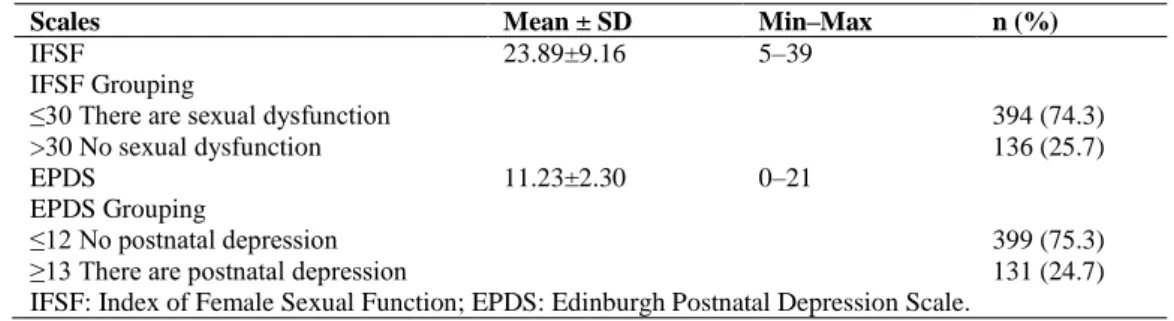
In the study, the mean scores the participants obtained from the Index of Female Sexual Function was 23.89±9.16, and 74.3% of the participants suffered sexual dysfunction. In addition, the mean score they obtained from the Edinburgh Postnatal Depression Scale was 11.23±2.30, and 24.7% of them were at risk for postnatal depression (Table 2).
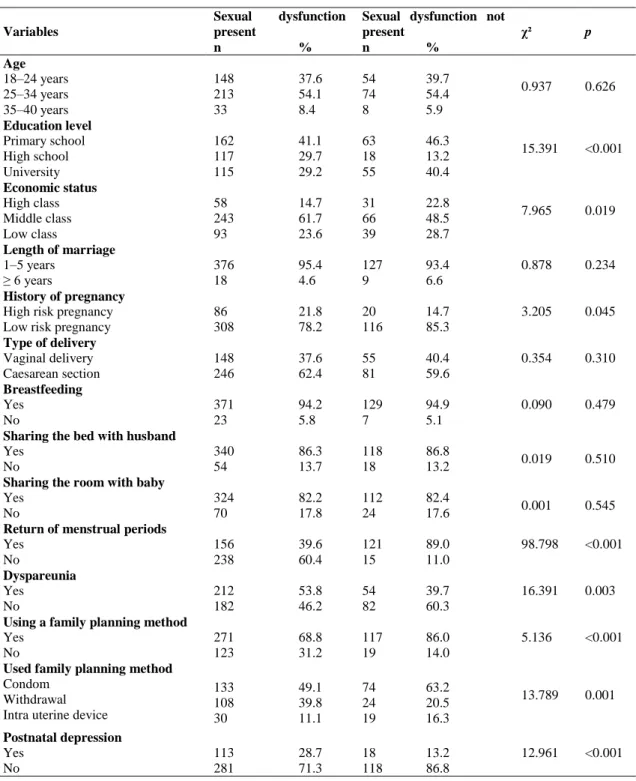
The distribution of sexual dysfunction in the participants according to some characteristics is shown in Table 3. As is seen in the table, the prevalence of sexual dysfunction was found to be statistically significant in women who were high school graduates, who reported their economic status as middle class, who had a history of high risk pregnancy, whose menstruation did not return, who had dyspareunia, who did not use a family planning method, who used withdrawal as a family planning method and who were at-risk for postnatal depression (p<0.05).
Pearson's correlation analysis revealed a moderate negative correlation between Index of Female Sexual Function and Edinburgh Postnatal Depression Scale (r2: -0.601, p<0.01).
Discussion
Yilmaz et al. Sexual dysfunction in postpartum Turkish women
African Journal of Reproductive Health March 2018; 22(1):
58
Table 1: Some variables affecting women's postpartum sexual life in Kocaeli, Turkey
Variables n %
History of pregnancy High risk pregnancy Low risk pregnancy
106 424
20.0 80.0 Type of delivery
Vaginal delivery Caesarean section
203 327
38.3 61.7 Breastfeeding
Yes No
500 30
94.3 5.7 Whether the sexual life was affected during the postpartum period
Yes No
427 103
80.6 19.4 Factors affecting sexual life during the postpartum period*
Fatigue Vaginal dryness Insomnia Lack of time
Not being able to be alone with the husband Breast problems
Perineal pain
347 310 289 289 262 234 162
65.5 58.5 54.5 54.5 49.4 44.2 30.6 Sharing the same bed with the husband
Yes No
458 72
86.4 13.6 Sharing the same room with the baby
Yes No
436 94
82.3 17.7 Return of menstrual periods
Yes No
277 253
52.3 47.7 Dyspareunia
Yes No
266 264
50.2 49.8 Using a family planning method
Yes No
388 142
73.2 26.8 The family planning method used (n=388)
Condom Withdrawal Intra uterine device
207 132 49
53.4 34.0 12.6
*
More than one option was marked.
Table 2: Means and standard deviations for the IFSF, and EPDS
Scales Mean ± SD Min–Max n (%)
IFSF 23.89±9.16 5–39
IFSF Grouping
≤30 There are sexual dysfunction >30 No sexual dysfunction
394 (74.3) 136 (25.7)
EPDS 11.23±2.30 0–21
EPDS Grouping
≤12 No postnatal depression ≥13 There are postnatal depression
Yilmaz et al. Sexual dysfunction in postpartum Turkish women
African Journal of Reproductive Health December 2018; 22 (4):
59
Table 3: Distribution of sexual dysfunction according to some characteristics in postpartum women in Kocaeli, Turkey
Variables
Sexual dysfunction present
Sexual dysfunction not
present χ² p
n % n %
Age 18–24 years 25–34 years 35–40 years 148 213 33 37.6 54.1 8.4 54 74 8 39.7 54.4 5.9
0.937 0.626
Education level Primary school High school University 162 117 115 41.1 29.7 29.2 63 18 55 46.3 13.2 40.4
15.391 <0.001
Economic status High class Middle class Low class 58 243 93 14.7 61.7 23.6 31 66 39 22.8 48.5 28.7
7.965 0.019
Length of marriage 1–5 years
≥ 6 years 376 18
95.4 4.6 127 9 93.4 6.6
0.878 0.234
History of pregnancy High risk pregnancy Low risk pregnancy
86 308 21.8 78.2 20 116 14.7 85.3
3.205 0.045
Type of delivery Vaginal delivery Caesarean section 148 246 37.6 62.4 55 81 40.4 59.6
0.354 0.310
Breastfeeding Yes No 371 23 94.2 5.8 129 7 94.9 5.1
0.090 0.479
Sharing the bed with husband Yes No 340 54 86.3 13.7 118 18 86.8
13.2 0.019 0.510
Sharing the room with baby Yes No 324 70 82.2 17.8 112 24 82.4
17.6 0.001 0.545
Return of menstrual periods Yes No 156 238 39.6 60.4 121 15 89.0 11.0
98.798 <0.001
Dyspareunia Yes No 212 182 53.8 46.2 54 82 39.7 60.3
16.391 0.003
Using a family planning method Yes No 271 123 68.8 31.2 117 19 86.0 14.0
5.136 <0.001
Used family planning method Condom
Withdrawal Intra uterine device
133 108 30 49.1 39.8 11.1 74 24 19 63.2 20.5 16.3
13.789 0.001
Postnatal depression Yes No 113 281 28.7 71.3 18 118 13.2 86.8
12.961 <0.001
hidden by most women, is neglected in clinical practices4,8. However, healthcare professionals play a key role in the prevention, evaluation, and
African Journal of Reproductive Health December 2018; 22 (4):
60
postnatal follow-up to improve women sexual health and quality of life4,28,29.
The analysis of the factors related to sexual dysfunction, the other dimension of the study, revealed that education level affected the prevalence of sexual dysfunction and that sexual dysfunction was more prevalent in high school graduate women. In the literature, there is no consensus on the effect of education level on female sexual dysfunction. While the prevalence of sexual dysfunction decreased as the education level increased in some studies3,30,31, in some studies, the prevalence of sexual dysfunction increased as the education level increased14,32, and in some other studies, no relationship was determined between the education level and sexual dysfunction8,12,13. This may have resulted from the difference in research designs, age groups, social, cultural and economic factors, partners‘ tendency, inadequate or incorrect sex-related knowledge. Thus, more studies should be conducted to explain what this difference stems from.
In the present study, sexual dysfunction was more prevalent in the participants who reported their economic status as middle class. In the literature, findings about the effect of economic status on sexual life vary from one study to another. While some studies indicate that there is no relationship between the economic status and sexual dysfunction13,33, some studies report that low income level is a variable that increases sexual dysfunction3,30,31. Financial difficulties affect the relationship between spouses and thus can cause sexual dysfunction31.
One of the most important variables affecting the prevalence of sexual dysfunction is the history of high-risk pregnancy. Obstetrics complications (antepartum bleeding, fetal conditions, etc.), medication use, limited mobility, fear of harming to the baby, fear of premature birth, psychological burden of having a high risk pregnancy, social myths and lack of knowledge related to high risk pregnancy negatively affect the sexual life of women34,35. Consistent with the literature, sexual dysfunction was more prevalent among women with the history of high risk pregnancy34,36,37. This result suggests that the
sexual problems experienced during pregnancy continue after pregnancy. Therefore, evaluation of women in terms of sexual function both during pregnancy and during the postpartum period gains importance.
In the present study, sexual dysfunction was more prevalent in women whose menstruation did not recommence and who did not use a family planning method. Similarly, Khajehei et al.8
reported that women who did not have regular menstrual periods after birth suffered sexual dysfunction more. This result can be explained by the fact that women whose menstrual periods do not return lack sexual desire and experience sexual dysfunction due to their high prolactin level and their concerns that they can become pregnant again. On the other hand, the family planning method used can affect the sexual life of spouses and if the woman trusts the family planning method they use, then their satisfaction of sexual intercourse increases38. In the present study, it was determined that sexual dysfunction was more common in women using the withdrawal method. The withdrawal method which the most widely used traditional contraceptive method in Turkey is not a medical method and as the partner has to withdraw at the peak point of the sexual intercourse it prevents reaching sexual satisfaction and causes post intercourse tension and for that reason has negative effects on sex life39.
Pregnancy, labor and birth are risk factors for the development of postpartum dyspareunia34. Demage to pelvic muscles during birth, tear and episiotomy, instrumental birth, hormonal changes, vaginal dryness and relationship issues causes dyspareunia and thus sexual dysfunction1,2,4,14. In the present study, sexual dysfunction was more prevalent in women with dyspareunia, which is consistent with the results in the literature3,5,7. Early diagnosis of dyspareunia in the postpartum period may contribute to the improvement of sexual function in women.
Yilmaz et al. Sexual dysfunction in postpartum Turkish women
African Journal of Reproductive Health December 2018; 22 (4):
61
women in the postpartum period experiences depressive symptoms8,18,19. In the present study, 25% of the women were at risk for postnatal depression. Postnatal depression is another risk factor for sexual dysfunction. In the literature, it is stated that symptoms of postnatal depression affect women's sexual functioning negatively and that there is a mutual association between postnatal depression and sexual dysfunction8,14,18,20. In the current study, the sexual dysfunction rate was higher in the participants with postnatal depression, and there was a moderate relation between them, which is consistent with the results in the literature. Mental health is important for maintaining quality of life for women, their families and society18. Therefore, health professionals should routinely screen for signs of antenatal and postnatal depression and assess women‘ sexual function to increase their quality of life.
Study Limitations
The study was conducted in a single department of obstetrics and gynecology in Kocaeli, and the findings may not be generalizable to the entire population of Turkish postpartum women. The participants completed an online questionnaire, therefore, women without access to the computer were not included in the study, which was another limitation of the study. Also, the study was based on self-reported measures with no structured interview. However, as the study was anonymous with no face-to-face contact, the participants were thought to give more honest and reliable answers in cases where sexuality was perceived as taboo and women experienced problems such as mental illnesses, myths or stigma. The other limitation of the study is that factors such as medical condition, mediation use, marital adjustment, domestic violence, cultural factors that may be related to sexual dysfunction were not investigated. Due to its cross-sectional nature, the present study was inadequate to explain the causal relationship between the variables affecting sexual dysfunction, which was another limitation of the
study. Longitudinal studies could provide more insight into the underlying mechanism of the relationships found in this study
.
Ethical Approval
The study protocol was designed in compliance with the principles of the Declaration of Helsinki. Prior to data collection, necessary approvals and permissions were obtained from the Kocaeli University Clinical Research Ethics Committee (Decision date and no. 2017/36) and General Secretariat of the Public Hospitals Union, respectively. Women provided consent by completing and submitting the online questionnaire.
Conclusion
In the current study, 75% of the participants suffered sexual dysfunction in the postpartum period and 25% of them were at risk for postnatal depression. The risk factors identified in the present study indicate that the female sexual dysfunction is a multidimensional problem with physical, emotional and social aspects. In the light of these results, it was concluded that health professionals should holistically evaluate all women in the postpartum period and give training and counseling services to them. Healthcare professionals can assess the sexual and mental problems of women, especially the high-risk groups indicated also in this study, via short screening scales during routine postpartum follow-ups, and they can refer women for early diagnosis and treatment. In addition, to better explain the causal relationship between female sexual dysfunction and affecting factors in the postpartum period and to generalize the results to the community, it is recommended that longitudinal studies with larger samples should be performed.
Conflict of Interest
African Journal of Reproductive Health December 2018; 22 (4):
62
Contribution of Authors
Study conception/design: FAY, DA, YAA, RO, ND; Data collection/analysis: RO, ND, DA; Drafting of manuscript: FAY, DA; Critical revisions for important intellectual content: FAY, DA, YAA; Supervision: DA, FAY.
Funding
This study was supported by Scientific Research Projects Coordination Unit of Bandirma Onyedi Eylul University (Project number: BAP-18-SBF-1009-019).
References
1. Johnson CE. Sexual health during pregnancy and the postpartum. J Sex Med 2011; 8(5): 1267–1284. 2. Yeniel AO and Petri E. Pregnancy, childbirth, and sexual
function: perceptions and facts. Int Urogynecol J 2014; 25(1): 5–14.
3. Bien A, Rzońca E, Palus G and Lenkiewicz E. Factors affecting sexual activity of women after childbirth. Journal of Public Health, Nursing and Medical Rescue 2016; 18(2): 647–55.
4. Leeman LM and Rogers RG. Sex after childbirth: postpartum sexual function. Obstet Gynecol 2012; 119(3): 647–655.
5. McBride H and Kwee J. Sex after baby: women‘s sexual function in the postpartum period. Curr Sex Health Rep 2017; 9(3): 142–149.
6. Abdool Z, Thakar R and Sultan AH. Postpartum female sexual function. Eur J Obstet Gynecol Reprod Biol 2009; 145(2): 133–137.
7. Holanda JBL, Abuchaim ESV, Coca KP and Abrao ACFV. Sexual dysfunction and associated factors reported in the postpartum period. Acta Paul Enferm 2014; 27(6): 573-578.
8. Khajehei M, Doherty M, Tilley PJ and Sauer K. Prevalence and risk factors of sexual dysfunction in postpartum Australian women. J Sex Med 2015; 12(6): 1415–26.
9. American Psychiatric Association. Diagnostic and Statistical Manual of Mental Disorders: DSM–5. American Psychiatric Association, Washington, 2014.
10. McCool ME, Theurich MA and Apfelbacher C. Prevalence and predictors of female sexual dysfunction: a protocol for a systematic review. Syst Rev 2014; 3: 75-80.
11. World Health Organization. Pregnancy, Childbirth,
Postpartum, and Newborn Care: A Guide For Essential Practice. World Health Organization, Geneva, 2015.
12. Hanafy S and El-Esawy F. Female sexual dysfunction during the postpartum period: an Egyptian study. Human Andrology 2015; 5(4): 71–81.
13. Rezaei N, Azadi A, Sayehmiri K and Valizadeh R. Postpartum sexual functioning and its predicting factors among Iranian women. Malays J Med Sci 2017; 24(1): 94–103.
14. Wallwiener S, Müller M, Doster A, Kuon RJ, Plewniok K, Feller S, Wallwiener M, Reck C, Matthies LM and Wallwiener C. Sexual activity and sexual dysfunction of women in the perinatal period: a longitudinal study. Arch Gynecol Obstet 2017; 295(4): 873–883.
15. Vettorazzi J, Marques F, Hentschel H, Ramos JGL, Martins-Costa SH and Badalotti M. Sexuality and the postpartum period: a literature review. Rev HCPA 2012; 32(4): 473–479.
16. Serati M, Salvatore S, Siesto G, Cattoni E, Zanirato M, Khullar V, Cromi A, Ghezzi P and Bolis P. Female sexual function during pregnancy and after childbirth. J Sex Med 2010; 7(8): 2782–90. 17. Chang SR, Chen KH, Ho HN, Lai YH, Lin MI, Lee CN
and Lin WA. Depressive symptoms, pain, and sexual dysfunction over the first year following vaginal or cesarean delivery: a prospective longitudinal study. Int J Nurs Stud 2015; 52(9): 1433–44.
18. Khajehei M and Doherty M. Exploring postnatal depression, sexual dysfunction and relationship dissatisfaction in Australian women. BJM 2017; 25(3): 162–172.
19. Xie R, Lei J, Wang S, Xie H, Walker M and Wen SW. Cesarean section and postpartum depression in a cohort of Chinese women with a high cesarean delivery rate. J Womens Health 2011; 20(12): 1881–6.
20. Atlantis E and Sullivan T. Bidirectional association between depression and sexual dysfunction: a systematic review and meta-analysis. J Sex Med 2012; 9(6): 1497–507.
21. Acele E and Karacam Z. Sexual problems in women during the first postpartum year and related conditions. J Clin Nurs 2012; 21(7-8): 929–937. 22. Rosner B. Fundamentals of Biostatistics. Brooks/Cole,
Boston, 2011.
23. Kaplan SA, Reis RB, Kohn IJ, Ikequchi EF, Laor E, Te AE and Martins AC. Safety and efficacy of sildenafil in postmenopausal women with sexual dysfunction. Urology 1999; 53(3): 481–486. 24. Yilmaz CA and Eryilmaz HY. The validity-reliability
Yilmaz et al. Sexual dysfunction in postpartum Turkish women
African Journal of Reproductive Health December 2018; 22 (4):
63
25. Cox JL and Holden JM. Detection of postnatal
depression: development of the 10-item Edinburgh Postnatal Depression Scale (EPDS). Br J Psychiatry 1987; 150: 782–6.
26. Engindeniz AN, Kuey L and Kultur S. Edinburgh Postpartum Depression Scale Turkish Version Validity and Reliability Study. Psychiatric Association Publications, Ankara, 1996.
27. Field A. Discovering Statistics Using SPSS. Sage Publications, London, 2009.
28. El-Sayed HAE, Ramadan SAS, Ibrahim HA and Moursi HAA. The effect of mode of delivery on postpartum sexual function and sexual quality of life in primiparous women. American Journal of Nursing Science 2017; 6(4): 347-357.
29. Mohammed YF, Hassan HM, Al-Dinary AM and Rashed NS. Sexual function after child birth according to the mode of delivery. AAMJ 2014; 12(4): 264–284. 30. Ghanbarzadeh N, Nadjafi-Semnani M, Ghanbarzadeh
MR, Nadjfai-Semnani A and Nadjfai-Semnani F. Female sexual dysfunction in Iran: study of prevalence and risk factors. Arch Gynecol Obstet 2013; 287(3): 533–9.
31. Singh JC, Tharyan P, Kekre NS, Singh G and
Gopalakrishnan G. Prevalence and risk factors for female sexual dysfunction in women attending a medical clinic in south India. J Postgrad Med 2009; 55(2): 113-20.
32. Fajewonyomi BA, Orji EO and Adeyemo AO. Sexual dysfunction among female patients of reproductive age in a hospital setting in Nigeria. J Health Popul Nutr 2007; 25(1): 101-106.
33. Ege E, Akin B, Yarali BA and Bilgili B. Prevalence and risk factors of female sexual dysfunction among healthy women. TUBAV Science Journal 2010; 3(1): 137-144.
34. Alsibiani SA. Effects of pregnancy on sexual function: findings from a survey of Saudi women. Saudi Med 2014; 35(5): 482–7.
35. Carteiro DMH, Sousa LMR and Caldeira SMA. Clinical indicators of sexual dysfunction in pregnant women: integrative literature review. Rev Bras Enferm 2016; 69(1): 153–161.
36. Malkoc O, Resim S and Bulut B. The effect pregnancy on female sexual functions. J Sex Med 2014; 11: 80. 37. Seven M, Akyuz A and Gungor S. Predictors of sexual
function during pregnancy. J Obstet Gynaecol 2015; 35(7): 691–695.
38. Casey PM, MacLaughlin KL and Faubion SS. Impact of contraception on female sexual function. J Women's Health 2017; 26(3): 207–213.