On Interchange between Drools and Jess
Oana Nicolae, Adrian Giurca and Gerd Wagner Brandenburg University of Technology, Germany E-mail: {nicolae, giurca, G.Wagner}@tu-cottbus.de
Keywords:Drools (aka JBossRules), Jess, RuleML, R2ML, RIF, Rete, ReteOO, business rules, interchange, standardis-ation
Received:March 15, 2008
There is a growing demand for research in order to provide insights into challenges and solutions based on business rules, related to target PSMs (Platform Specific Model in OMG’s MDA terms - Implementation Model). As an answer to these needs, the paper argues on the relevance of business rules target platforms for the actual IT and business context, by emphasising the important role of business rules interchange initiatives. Therefore, the rule-system developers can do their work without any concern about a vendor-specific format, and in particular without any concern about the compatibility between the technologies. The paper provides a description of the business rules translation from a particular object oriented rule-system such as Drools, to another rule-rule-system as Jess coming from the AI area, using R2ML as interchange language. The transformation preserves the semantic equivalence for a given rule set, taking also into account the rules vocabulary.
Povzetek: Prispevk opisuje prenos pravil iz objektnega sistema Drools v AI sistem Jess.
1 Introduction
There is a growing request for business rules technology standardisation from both UML and ontology architects communities. Due to these reasons, business rules aim to express rules in a platform independent syntax.
A number of initiatives on rules interchange have been started. They include the RuleML (2), OMG Production Rules Representation (PRR) (8), RIF (1), and the REW-ERSE I1 Rule Markup Language (R2ML1) (10). We
men-tion here the efforts to establish some standards for express-ing business rules and their vocabularies in natural lan-guage such as OMG’s SBVR (9) and Attempto Controlled English (ACE) (4). SBVR, this human readable format of business rules comes under OMG’s Model Driven Archi-tecture (MDA2) standards and is defined as
Computation-Independent Model (CIM3). CIM is most frequently used
in the context of the Model Driven Architecture (MDA) ap-proach which corresponds the Object Management Group (OMG) vision of Model Driven Engineering (MDE). The Meta-Object Facility (MOF), is the OMG standard for Model Driven Engineering.
The second layer in OMG’s MDA is Platform-Independent Model (PIM)4where rule interchange formats
(i.e. RuleML, RIF, R2ML) try to accomplish their gen-eral purpose: a PSM to PSM business rules migration through the PIM level. The third MDA level is
Platform-1R2ML - http://oxygen.informatik.tu-cottbus.de/
rewerse-i1/?q=node/6
2MDA - Model Driver Architecture is a framework for distinguishing
different abstraction levels defined by the Object Management Group.
3CIM - Computational Independent Model 4PIM - Platform Independent Model
Specific Model (PSM5) containing rule specific languages
together with their specific engines/platforms like: F-Logic (5), JRules(ILOG6), Jess7or Drools8.
The main purpose of an interchanging approach is to provide means for reusing, publication and interchange of rules between different systems and tools. Actually, it also plays an important role in facilitating business-to-customer (B2C) and business-to-business (B2B) interactions over the Internet. Moreover, an interchange approach always sup-poses less transformations than PSM-to-PSM translations.
Our rule interchange work addresses Drools as source platform and Jess as a target platform, using the approach suggested by OMG’s MDA, because these languages are actually in business market interest as popular business logic frameworks, used by Java developers to create com-plex rule-based applications by combining Java platform and business rule technology. Another reason for choos-ing these two rule systems is their efficiency in "pattern" matching, especially to handle updates to its working set of facts, as both Drools and Jess use an algorithm known as the Rete (i.e. Latin for "net") algorithm. Computational complexity per iteration of this algorithm is linear in the size of the fact base.
The main standardisation communities, OMG9 and
W3C10focus their work on providing business rules
spec-ification languages for all MDA layers of models in order
5PSM - Platform Specific Model 6ILog,http://www.ilog.com
7Jess,http://herzberg.ca.sandia.gov/jess/ 8JBossRules,http://labs.jboss.com/jbossrules/ 9OMG - http://www.omg.org/
to obtain rules interchange. Their standards are not sus-tained by most of business rules management system tools, as they implement proprietary rule languages. The reasons for this situation imply the existence of only a few inter-change works in the academia i.e. RIF (1) language still has no well defined guidelines of how to implement the transformations and it also does not specify how to test the correction of the translation.
In this context, EU network of Excelence REWERSE11
developed R2ML as an interchange language for deploy-ing and shardeploy-ing rules between different rule systems and tools (e.g. Object Oriented rule languages, Semantic Web rule languages, Artificial Intelligence rule languages). Ac-tually, R2ML (now at version 0.5) is a mature and ex-perienced enough rule interchange language to provide a concrete interchange format for different rule systems and languages (i.e.http://oxygen.informatik. tu-cottbus.de/rewerse-i1/?q=node/15).
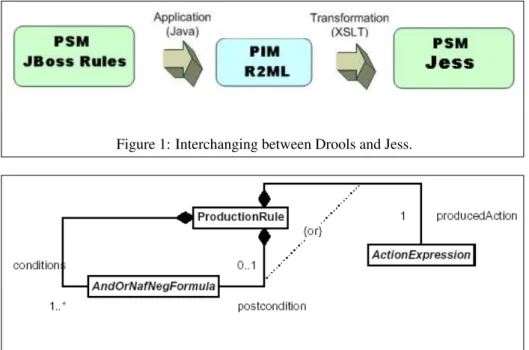
R2ML has a rich syntax, so it can represent business rules from both Drools and Jess languages, providing this way the interchange possibility. As an interchange lan-guage, R2ML addresses the PIM level. The main idea is to use a model transformation language (MTL), or an appli-cation transformation language (ATL) to transform a PIM model into a PSM as in the Figure 1.
Business rules are built following a business model rep-resentation. In many cases, a business model is first repre-sented in a natural language description based on core ontologic concepts like classes and variables (OMG’s MDA -CIM level).
At this stage, we can identify all objects referenced in the rules, and for each object we identify all referenced prop-erties. For each property, we identify all its constraints.
2 Drools to R2ML mapping
In this section we describe the general JBoss business rules transformation into R2ML interchange language. Drools engine project, (now at version 4.0.x) is an open source and standards-based business rule engine and it uses an en-hanced implementation named ReteOO12.
Drools is classified as an Object-Oriented Production Rules engine written entirely in Java language, and more specifically it is a Forward-Chaining rule engine.
A Production Rules System (i.e. PRS) relies on an Infer-ence Engine that is able to scale to a large number of rules and facts. The Inference Engine matches facts and data, against PRs, also called Productions or just Rules, to infer conclusions which result in actions. The Rules are stored in the Production Memory. The facts that the Inference En-gine matches against the rules are stored in the Working Memory.
R2ML is a visual rule markup, XML-based language,
11REWERSE - http://rewerse.net/
12RETE adaptation for an object-oriented language, a descendant of the
well-known RETE algorithm
whose purpose is to capture rules formalised in different languages and to interchange them between rule systems and tools. It provides support for all kind of rules:
– Integrity Rules
– Derivation Rules
– Production Rules
– Reaction Rules
A R2ML production rule has conditions and post-conditions. The conditions and post-conditions of a R2ML production rule are usually interpreted as logical formulae which correspond to a general first order formula: fied formula, existentially quantified or universally quanti-fied (i.e. R2ML uses the concept ofr2ml:QuantifiedFormula
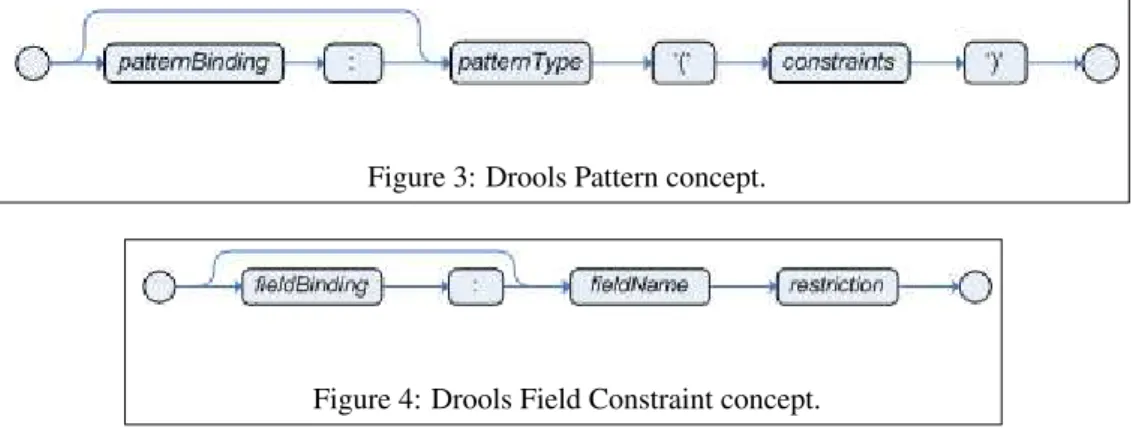
and by default, all R2ML formulae are universally quan-tified). Usually, PRS does not explicitly refer to events, but events can be simulated in a production rule system by externally asserting corresponding facts into the Working Memory. The R2ML production rules metamodel is de-picted in the Figure 2:
The mapping from Drools to R2ML is possible as R2ML supports the representation of the PRs by relying on the OMG’s PRR (8) Specification. Following sections describe general principles of mapping from JBoss rules into R2ML PRs.
2.1 Mapping rules vocabularies
Object oriented rules systems as Drools and ILOG JRules are build on top of Java vocabularies. Drools is designed to use Java beans asfacts. These facts represent the domain of the rules, meaning the rules vocabulary. Java beans objects are defined by users in their applications.
These objects inserted into Working Memory represent the valid facts that rules can access. Facts are the applica-tion data, meanwhile the rules represent the logic layer of the application. This vocabulary is used by rules through the importdeclarations, which are specified inside of the rules file (drlfiles orxmlfiles). For example, a rule from Drools may use one or many Java beans classes in order to describe its own vocabulary. The Java bean classes rep-resent a description of the facts used by the Drools rule engine.
A R2ML rule always refers to a vocabulary which can be R2ML own vocabulary or an imported one (i.e. UML13,
RDF(S)14and OWL15- see lines3.-4.from Section 2.2 i.e.
an example of the importing an OWL external vocabulary for an entire R2ML production rule set). R2ML vocab-ulary is a serialisation of an UML fragment of class dia-grams. Below, we describe the corresponding translation class from a usual Java bean into R2ML elements of the vocabulary namespace with the help of the optionally el-ementr2mlv:Vocabulary i.e. Since almost all names from
13UML - http://www.uml.org
Figure 1: Interchanging between Drools and Jess.
Figure 2: R2ML Production Rules Representation Metamodel.
1.<r2ml:RuleBase
2. xmlns:r2ml=
"http://www.rewerse.net/I1/2006/R2ML"
3. xmlns:dc=
"http://purl.org/dc/elements/1.1/"
4. xmlns:ex=
"http://www.businessrulesforum.com/2007/"
5. xmlns:xsi=
"http://www.w3.org/2001/XMLSchema-instance" 6. xsi:schemaLocation=
"http://www.rewerse.net/I1/2006/R2ML 7. http://oxygen.informatik.tu-cottbus.de/
R2ML/0.5/R2ML.xsd" 8.<r2mlv:Vocabulary>
9. <r2mlv:Class r2mlv:ID="Cheese"> 10. <r2mlv:Attribute r2mlv:ID="type"> 11. <r2mlv:range><r2mlv:Datatype
r2mlv:ID="xs:string"/> 12. </r2mlv:range>
13. </r2mlv:Attribute>
14. <r2mlv:Attribute r2mlv:ID="price"> 15. <r2mlv:range><r2mlv:Datatype
r2mlv:ID="xs:integer"/> 16. </r2mlv:range>
17. </r2mlv:Attribute>
18. <r2mlv:Attribute r2mlv:ID="bestBefore"> 19. <r2mlv:range><r2mlv:Datatype
r2mlv:ID="xs:dateTime"/> 20. </r2mlv:range>
21. </r2mlv:Attribute> 22. </r2mlv:Class> 23.</r2mlv:Vocabulary> 24.</r2mlv:RuleBase>
R2ML rule bases are qualified names (xs:QName), they must have declared the corresponding namespaces (i.e. see above lines 2.-5.). In the same manner, any Java qual-ified class name will be translated into a qualqual-ified name (xs:QName) together with the corresponding names dec-larations.
For example, if we assume the Drools import declaration (i.e. a Java qualified name): org.drools.usecase.Cheese,
this will translate into the following namespace declaration
xmlns:ex="http://www.drools.org/usecase"used in the
qual-ified name (i.e. ex:Cheese), in order to reference the class
name.
2.2 Rule Sets Mapping
All imported Java beans in Drools rule packages form the rules vocabulary. The set of Drools rules is individualized by itspackage namespace, declared at the beginning of the rules file, namespace that can be equal or can differ from Droolsimportdeclarations i.e. The Drools package of rules
package org.drools.rules;
import org.drools.usecase.Cheese; /* set of Drools rules */
finds its correspondent into ther2ml:ProductionRuleSet
ele-ment. It contains three optional attributes:
– r2ml:ruleSetID- is the name of the rule set. The name
of the Java package of classes identifies in an unique way the name of a R2ML ProductionRuleSet (i.e. see line2.from below R2ML code example).
– r2ml:externalVocabulary- represents an URI of an
ex-ternal vocabulary. We used OWL to represent the vo-cabulary of the rule.
– r2ml:externalVocabularyLanguage- refers the language
of the external vocabulary.
1. <r2ml:ProductionRuleSet
2. r2ml:ruleSetID="org.drools.rules" 3. r2ml:externalVocabulary="http://..." 4. r2ml:externalVocabularyLanguage="OWL">
1. rule "<name>" 2. when 3. <LHS> 4. then 5. <RHS> 6. end
// java-like, single line comment # single line comment
/* ...
java-like, multi lines comment ... */
2.3 Rule Mapping
In Drools, a rule consists of the ruleidentifier, the condi-tionspart called LHS (i.e. Left Hand Side) and theactions part called RHS (i.e. Right Hand Side). The general princi-ples of mapping a Drools rule into a R2ML production rule is:
– Every JBoss production rule is translated into a
r2ml:ProductionRule element. An optional element r2ml:Documentationcan contain elements which
com-prise the rule text and also the representation of the rule in a specific rules language.
– A R2ML r2ml:ruleID production rule attribute is
generated using the JBoss <name> value. The
r2ml:ruleIDunique identifies a rule inside a rule set.
– A JBoss rule has a conditions part (i.e. when part) and an action part (i.e. then part). The condition part of a JBoss rule is mapped into the content of
r2ml:conditions role element. The RHS part of a
JBoss rule which contains multiple actions maps into the content ofr2ml:producedActionExprrole element.
– The Drools language syntax also contains the com-ments expressed in Java-like syntax, such as:
When translated into R2ML syntax, they map into the XML<[!CDATA[...]]>construct. For example:
1.<r2ml:Documentation>
2. <r2ml:RuleText r2ml:textFormat="plain"> 3. <[!CDATA[
4. JBoss rule expressed in natural language... 5. ]]>
6. </r2ml:RuleText> 7.</r2ml:Documentation>
In the following lines we describe the mapping of Drools conditions into R2ML appropriate ones.
The LHS (i.e. whenpart) of a JBoss rule consists of patterns(i.e. columns) andevalasConditional Elements (i.e. CE) in order to facilitate the encoding of propositional logic and First Order Logic i.e. FOL. The entire LHS of a Drools rule is in fact a tuple of facts (i.e. a tuple of pat-terns). Each pattern may have zero or more field constraints i.e. the pattern terms (see Figure 4). Theand(i.e.&&) CE is implicit when the JBoss rule condition contains multi-ple patterns. Field constraints compare and assess the field values from the fact object instances. Drools facts from
Working Memory are Java beans objects instances, there-fore these field constraints can be accessed from the "no ar-guments" methods, also called the accessors (i.e. getters).
2.3.1 Mapping Drools patterns without Field Constraints
A Drools pattern without field constraints, will map into the
r2ml:ObjectClassificationAtom. For example, the following
Drools pattern, which corresponds to universally quantified formula from classical logic:∀?c Cheese(?c)is expressed in Drools as following:
$c: Cheese()
This Drools pattern finds its R2ML translation into the below code. As an explanation, we mention that all the R2ML formulae are implicitly universal quantified:
1.<r2ml:ObjectClassificationAtom 2. r2ml:class="Cheese">
3. <r2ml:ObjectVariable r2ml:name="c" 4. r2ml:class="Cheese"/>
5.</r2ml:ObjectClassificationAtom>
Following RuleML, R2ML framework defines the generic concepts of variable. However, R2ML makes a clear distinction betweenobject termsanddata terms.
Typed termsare eitherobject termsstanding forobjects, ordata termsstanding fordata values. The concrete syn-tax of first-order non-Boolean OCL (7) expressions can be directly mapped to R2ML abstract concepts ofObjectTerm andDataTerm, which can be viewed as a predicate-logic-based reconstruction of the standard OCL abstract syntax.
The bounded variable c represents the value of the r2ml:name attribute of the corresponding term
(r2ml:ObjectName and/or r2ml:ObjectVariable) and the
name of the Java bean class (i.e. Cheese) is the value of r2ml:class attribute. The above Drools pattern can
be declared inside rules conditions also without the c
variable, such as:Cheese(), but to be able to refer to the matched facts, usually, the rules conditions use a pattern binding variable such asc(i.e. in Drools terminology we refer to it as afact variableordeclaration).
Any JBoss variables translate into R2ML variables. No-tice that the translation of the Drools variables into R2ML eliminates the$symbol (used in Drools only as a notation convention) from the names of the variables. The JBoss fact variable used in the previous pattern example (i.e.
c:Cheese()) is mapped intor2ml:ObjectVariableusing
the value of r2ml:name="c" property to describe the
vari-able name, which represents an instance of the Cheese
class (see lines3.-4.). The usage of this instance gives us the possibility to call properties and functions ofCheese
class in the actions part of a JBoss rule. The optional
r2ml:classproperty(see line4.from the above example)
spec-ifies the type of the object variable (i.e. Cheese). An
r2ml:ObjectVariableis a variable that can be only
2.4 Mapping Drools patterns with Field
Constraints
In many cases, a JBosspattern(see Figure 3) may contain many field constraints, all of them referring to the same context variable. The Drools field constraints may be of the following possible types (i.e. string, numeric, boolean and date). When separated by the following operators (i.e. enumerated here in their priority order see also Figure 5):
&&, ||and ,(i.e. comma), they form a Drools pattern formula.
A Drools pattern formula translates into R2ML for-mula, using the R2ML simple/imbricated concepts of
r2ml:qf.Disjunction and r2ml:qf.Conjunction (qf stands
for "quantifier free") applied on R2ML atoms, in order to serialize the Drools CE||and&&, respectively.
In the example below, we have two Drools patterns that in classical logic have the following representation, taking into account the operators order from Drools i.e.
∀?c∀?p∃?youngCheese(P erson(?p)∧
like(?p,?youngCheese) ∧ (Cheese(?c)∧
(type(?c,?youngCheese) ∧ price(?c)<10)∨
bestBef ore(?c) < ”27−Oct−2010”))
1.$p:Person($youngCheese:like) 2.$c:Cheese(type == $youngCheese &&
3. price < 10 ||
4. bestBefore < "27-Oct-2010")
TheCheesepattern (see lines2.-4.) has three field con-straints combined with a conjunctive connector (i.e. &&) and a disjunctive connector (i.e.||). We mention that the comma represents by default the conjunctive logic oper-ator. The pattern refers literal constraints used to match the facts (i.e. instances of Cheese class): type (i.e. string constraint), price (i.e. numeric constraint) and
bestBefore(i.e. date type constraint). The valid op-erators that apply for the numeric and date operands are:
==,!=,<,>,<=,>=.
The above Drools pattern translates into the following R2ML formula (i.e. the example below describes only the imbrication of the operators (&&,||) inside the Drools pat-tern):
1.<r2ml:qf.Disjunction> 2. <r2ml:qf.Conjunction> 3. <r2ml:DatatypePredicateAtom>
6. ...
7. </r2ml:DatatypePredicateAtom> 8. <r2ml:DatatypePredicateAtom>
9. ...
10. </r2ml:DatatypePredicateAtom> 11. </r2ml:qf.Conjunction>
12. <r2ml:DatatypePredicateAtom>
14. ...
15. </r2ml:DatatypePredicateAtom> 16.</r2ml:qf.Disjunction>
In the absence of theqf.Disjunctionorqf.Conjunction,
all atoms from the R2ML rule body are implicitly con-nected by conjunction.
First pattern from the Drools example above (see line
1.) contains as field constraint a bound variable, called
declaration. The JBoss variable $youngCheese is bound to the like property, so it can later constrain the type property of the Cheese class. Since the
like property is a data type property (i.e. String), the R2ML mapping is an r2ml:AttributionAtom, while for
an object type property would find its mapping into the
r2ml:ReferencePropertyAtom.
<!--$p:Person($youngCheese:like)--> 1.<r2ml:AttributionAtom
2. r2ml:attribute="ex:Person.like"> 3. <r2ml:subject>
4. <r2ml:ObjectVariable 5. r2ml:name="p" 6. r2ml:class="Person"/> 7. </r2ml:subject> 8. <r2ml:dataValue> 9. <r2ml:DataVariable 10. r2ml:name="youngCheese" 11. r2ml:datatype="xs:string"/> 12. </r2ml:dataValue>
13.</r2ml:AttributionAtom>
The r2ml:AttributionAtom contains ther2ml:subject
el-ement which encloses the object term we refer. This can be expressed, for example, by anr2ml:ObjectVariable
(i.e. lines 4.-6.). The value of the JBoss property is re-ferred by the r2ml:dataValue. In this example, the value
is encoded by the r2ml:DataVariable element (i.e. lines
9.-12.). The youngCheese variable borrows the type of
the youngCheeseproperty. R2ML uses XML Schema Datatypes16 as its default namespace for encoding basic
datatypes. The usage of this set of pre-declared datatypes is not mandatory, the user can specify any other appropri-ate URI and namespace for referring lappropri-ater in the rules its datatypes declaration. The Java/XML type correspondence it is done according to the JAXB17binding style
correspon-dence principle, therefore a Java String value will be trans-lated intoxs:stringqualified name (see line11.).
The relational operations from Drools are serialized into R2ML language using ther2ml:DatatypePredicateAtom
con-struct. Until this version, R2ML had not declared its own built-in constructs, but it allows the use of external ones, such as SWRL18built-ins for representing the
predi-cate type of the relational operations (i.e. swrlb:lessThen).
We also use the construct of r2ml:DatatypePredicateAtom
to serialize the Drools literal field constraints that test equality / inequality of data types properties. When se-rializing object types literal field constraints we use the
r2ml:EqualityAtom to express the concept of equality and
ther2ml:InequalityAtomto express the concept of
inequal-ity (!=).
The following Drools pattern describes a Drools literal String constraint. Drools pattern trans-lates into r2ml:DatatypePredicateAtom using the r2ml:datatypePredicate="swrlb:equal" SWRL
build-in to represent the equality operator and serialises the
type property into the r2ml:AttributeFunctionTerm (see
16XML Schema Part2: Datatypes Second Edition -http://www.
w3.org/TR/xmlschema-2/
17Java Architecture for XML Binding - java.sun.com/
developer/technicalArticles/WebServices/jaxb/
Figure 3: Drools Pattern concept.
Figure 4: Drools Field Constraint concept.
lines 4.-10.). Ther2ml:dataArgumentsattribute comprises
$c:Cheese(type == $youngCheese)
the Drools operands translation into R2ML terms objects or data types, depending on the types of the involved properties. The Drools $youngCheese variable is expressed using the concept ofr2ml:DataVariablei.e.
<!--$c:Cheese(type == $youngCheese)--> 1.<r2ml:DatatypePredicateAtom
2. r2ml:datatypePredicate="swrlb:equal"> 3. <r2ml:dataArguments>
4. <r2ml:AttributeFunctionTerm 5. r2ml:attribute="ex:Cheese.type"> 6. <r2ml:contextArgument>
7. <r2ml:ObjectVariable r2ml:name="c" 8. r2ml:class="ex:Cheese"/>
9. </r2ml:contextArgument> 10. </r2ml:AttributeFunctionTerm>
11. <r2ml:DataVariable r2ml:name="youngCheese" 12. r2ml:datatype="xs:string"/>
13. </r2ml:dataArguments> 14.</r2ml:DatatypePredicateAtom>
The relational operation $c:Cheese(price < 10) is
expressed by the r2ml:DatatypePredicateAtom and the
build-in swrlb:lessThan. The case also involves the r2ml:AttributeFunctionTerm for representing the property price of the Cheese class (i.e. ex:Cheese.price
(see lines4.-10.) and ther2ml:TypedLiteralterm (see lines
11.-12.) for encoding the Java integer value into XML
xs:integer.
<!--$c:Cheese(price < 10)--> 1.<r2ml:DatatypePredicateAtom
2. r2ml:datatypePredicate="swrlb:lessThan"> 3. <r2ml:dataArguments>
4. <r2ml:AttributeFunctionTerm 5. r2ml:attribute="ex:Cheese.price"> 6. <r2ml:contextArgument>
7. <r2ml:ObjectVariable r2ml:name="c" 8. r2ml:class="ex:Cheese"/>
9. </r2ml:contextArgument> 10. </r2ml:AttributeFunctionTerm>
11. <r2ml:TypedLiteral r2ml:lexicalValue="10" 12. r2ml:datatype="xs:integer"/>
13. </r2ml:dataArguments> 14.</r2ml:DatatypePredicateAtom>
The Drools literal date type field constraints are repre-sented into R2ML using XML qualified namexs:dateTime.
The Drools numeric operators work analogous for this type of field constraint, so the serialization into R2ML code is also ther2ml:DatatypePredicateAtomi.e.
<!--$c:Cheese(bestBefore<"27-Oct-2007")--> 1.<r2ml:DatatypePredicateAtom
2. r2ml:datatypePredicate="swrlb:lessThan"> 3. <r2ml:dataArguments>
4. <r2ml:AttributeFunctionTerm 5. r2ml:attribute="bestBefore"> 6. <r2ml:contextArgument>
7. <r2ml:ObjectVariable r2ml:name="c" 8. r2ml:class="Cheese"/>
9. </r2ml:contextArgument> 10. </r2ml:AttributeFunctionTerm> 11. <r2ml:TypedLiteral
12. r2ml:datatype="xs:dateTime" 13. r2ml:lexicalValue="2007-10-27Z"/> 14. </r2ml:dataArguments>
15.</r2ml:DatatypePredicateAtom>
Another meaningful example of Drools field constraints is testing the equality or inequality of a property against the Javanullvalue i.e.
$c:Cheese(buyer == null) $c:Cheese(buyer != null)
The corresponding formula from the classical logic would be:
∀?c∀?t Cheese(?c)∧ ¬buyer(?c,?t)
∀?c∃?t Cheese(?c) ∧ buyer(?c,?t)
Taking into account the above classical logi-cal formula, the R2ML serialization results in the
r2ml:EqualityAtom, having its meaning negated using r2ml:isNegated=true attribute. The child elements for
the r2ml:EqualityAtom are object terms. Our example
involves an r2ml:ReferencePropertyTerm with the attribute r2ml:referenceProperty="ex:Cheese.buyer"and a generated
object term expressed usingr2ml:ObjectVariable with the
generated attribute value r2ml:name="t_24535899" and the r2ml:class="ex:Person"as the type of thebuyerproperty.
The second logic formula involves the existence of a Cheese fact into Working Memory, whose buyer
prop-erty is not null. The R2ML first step in the R2ML serialization is the generation of an object term (i.e. ther2ml:ObjectVariablet_57685642) ofex:Persontype
which is bounded to buyer property. We use the r2ml:ReferencePropertyAtomelement i.e.
<!--$c:Cheese(buyer==null)--> 1.<r2ml:EqualityAtom
2. r2ml:isNegated="true">
3. <r2ml:ReferencePropertyFunctionTerm 4. r2ml:referenceProperty="ex:Cheese.buyer"> 5. <r2ml:contextArgument>
6. <r2ml:ObjectVariable 7. r2ml:name="c"
8. r2ml:class="ex:Cheese"/> 9. </r2ml:contextArgument>
10. </r2ml:ReferencePropertyFunctionTerm> 11. <r2ml:ObjectVariable
12. r2ml:name="t_24535899" 13. r2ml:class="ex:Person"/> 14.</r2ml:EqualityAtom>
<!--$c:Cheese(buyer!=null)--> 1.<r2ml:ReferencePropertyAtom
2. r2ml:referenceProperty="ex:Cheese.buyer"> 3. <r2ml:subject>
4. <r2ml:ObjectVariable
5. r2ml:name="c" r2ml:class="ex:Cheese"/> 6. </r2ml:subject>
7. <r2ml:object>
8. <r2ml:ObjectVariable r2ml:name="t_57685642" 9. r2ml:class="ex:Person"/>
10. </r2ml:object>
11.</r2ml:ReferencePropertyAtom>
//$p:Person()
1.$c:Cheese(buyer == $p, inStock == true)
A Drools pattern containing a formula that implies only field constraints conjunctions, can be split into as many Drools patterns as field constraints it contains i.e.
//$p:Person()
1.$c:Cheese(buyer == $p) 2.$c:Cheese(inStock == true)
There are two possibilities to markup the aboveCheese
patterns (see lines 1.-2.): to use a conjunction of R2ML appropriate atoms or to use ther2ml:ObjectDescriptionAtom
construct.
First option implies the use of the
r2ml:ReferencePropertyAtom in order to markup the
first pattern (see line 1. from Drools example) and a
r2ml:AttributionAtom for the data type boolean field
constraint (see line2.from Drools example) i.e.
<!--$c:Cheese(buyer == $p)--> 1.<r2ml:ReferencePropertyAtom
2. r2ml:referenceProperty="ex:Cheese.buyer"> 3. <r2ml:subject>
4. <r2ml:ObjectVariable 5. r2ml:name="c"
6. r2ml:class="ex:Cheese"/> 7. </r2ml:subject>
8. <r2ml:object> 9. <r2ml:ObjectVariable 10. r2ml:name="p"
Figure 5: Drools constraints inside a pattern.
11. r2ml:class="ex:Person"/> 12. </r2ml:object>
13.</r2ml:ReferencePropertyAtom>
A r2ml:ReferencePropertyAtom associates two object
terms, having different meanings: subject(see lines3.-7.)
andobject(see lines8.-12.). For example, to express the
concept of: "buyer of cheese" we use the code above, where the subject is aCheeseinstance and the object is aPerson
in-stance.
The second solution translates directly the two Cheese
patterns of the rule using ther2ml:ObjectDescriptionAtom.
The referred R2ML serialization is a conjunction of equal-ity constraints i.e. an enumeration ofr2ml:DataSlot(s) or r2ml:ObjectSlot, depending on the type of the involved
properties objects or data, respectively. The attribute
r2ml:class="Cheese"corresponds to the patterns name from
Drools implementation i.e.
1.<r2ml:ObjectDescriptionAtom 2. r2ml:class="Cheese"> 3. <r2ml:subject>
4. <r2ml:ObjectVariable r2ml:name="c"/> 5. </r2ml:subject>
6. <r2ml:ObjectSlot
7. r2ml:referenceProperty="Cheese.buyer"> 8. <r2ml:object>
9. <r2ml:ObjectVariable r2ml:name="p" 10. r2ml:class="Person"/>
11. </r2ml:object> 12. </r2ml:ObjectSlot> 13. <r2ml:DataSlot
14. r2ml:attribute="ex:Cheese.inStoc"> 15. <r2ml:value>
16. <r2ml:DataVariable 17. r2ml:name="true"
18. r2ml:datatype="xs:boolean"/> 19. </r2ml:value>
20. </r2ml:DataSlot>
21.</r2ml:ObjectDescriptionAtom>
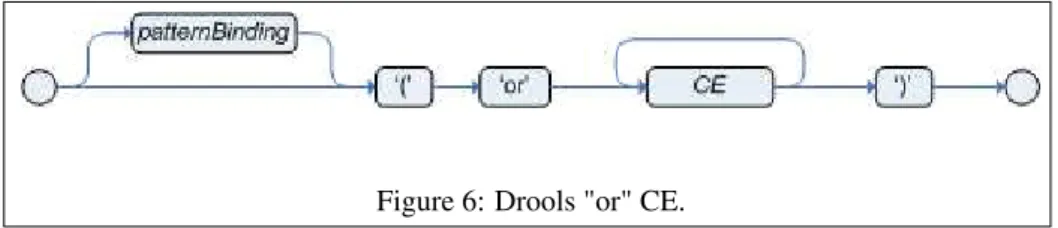
Another CE from the LHS of a Drools rule is the pattern disjunction (|| / or). The Drools disjunction of multi-ple patterns results in multimulti-ple rule generation, called sub-rules, for each possible outcome i.e.
∀?c Cheese(?c) ∧ (type(?c, stilton)∨
type(?c, cheddar))
1.Cheese(type=="stilton") or Cheese(type=="cheddar") 2.Cheese(type=="stilton") || Cheese(type=="cheddar")
In the above examples the DroolsorCE is a shortcut for generating two additional rules. There can be multi-ple activations for a rule, if both sides of the CE are true. The R2ML serialization uses the r2ml:qf.Disjunctionthat
contains each of theCheeseproperties mapped with the
r2ml:AttributionAtom.
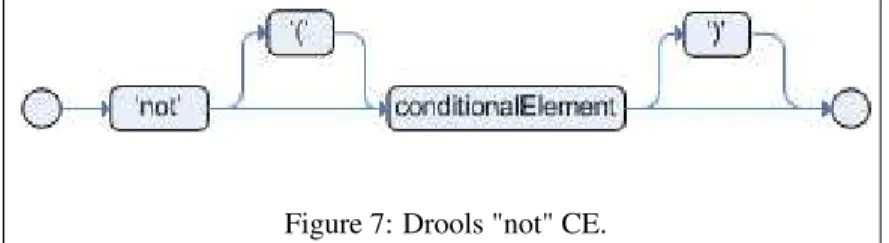
The Drools negation not represents the existential quantifier that checks for the non existence of some facts in Working Memory. Currently, this existential quantifier it is applied only for patterns i.e.∀?c¬Cheese(?c).
not Cheese()
Figure 6: Drools "or" CE.
not have a pattern binding. We still can not serialize the existentially quantifier concept into R2ML language.
But, by applying the negation to the entire formula, we obtain the following expression from the classical logic:
∀?c¬ Cheese(?c). The R2ml serialization of the above formula uses the concept of r2ml:qf.Negation which
em-beds ar2ml:ObjectClassificationAtom.
1. <r2ml:ObjectClassificationAtom r2ml:isNegated="true" 2. r2ml:classID="Car">
3. <r2ml:ObjectVariable r2ml:name="c_974376"/> 4. </r2ml:ObjectClassificationAtom>
not Cheese(type == "stilton")
The above pattern tests if there are notCheesefacts of typestiltonin the Working Memory. In the classical logic would be i.e.
∀?c Cheese(?c) ∧ ¬type(?c, stilton)
. We serialize it using ther2ml:AttributionAtomi.e.
1.<r2ml:AttributionAtom
2. r2ml:attribute="ex:Cheese.type" 3. r2ml:isNegated="true">
4. <r2ml:subject>
5. <r2ml:ObjectVariable r2ml:name="c_6587483" 6. r2ml:class="ex:Cheese"/>
7. </r2ml:subject> 8. <r2ml:dataValue> 9. <r2ml:TypedLiteral
10. r2ml:lexicalValue="stilton" 11. r2ml:datatype="xs:string"/> 12. </r2ml:dataValue>
13.</r2ml:AttributionAtom>
2.4.1 Mapping Drools Actions
Java beans objects/instances are defined by users in their applications. These objects inserted into Working Mem-ory (i.e. WM) represent the valid facts which the rules can access. Facts are the application data, meanwhile the rules represent the logic layer of the application. The term Work-ing Memory Actions is used to describe assertions, retrac-tions and modificaretrac-tions of facts within Working Memory. When discussing about the Drools - R2ML mapping of ac-tions, we are only referring to the JBoss rule actions that find their mapping into R2ML.
R2ML actions are built according with the OMG PRR Specification (8), which stipulates that an ac-tion is either an r2ml:InvokeActionExpression or an r2ml:UpdateStateActionExpr. The R2ML actions are
encoded by the content of r2ml:producedActionExpr role
element i.e.
r2ml:InvokeActionExpression - invokes an operation (by
means of the r2ml:operation attribute) with an ordered,
possible empty list of parameter arguments represented as R2ML terms. In the following example, we map a Java output operation, which has asr2ml:argumentsthe Cheese
instance (i.e.c), previously, supposed to be declared in the JBoss rule condition (see lines4.-5.) and a String argument, that is translated intor2ml:TypedLiteral(see lines6.-8.).
then
System.out.println($c+" out of stock."); end
The R2ML translation:
1.<r2ml:InvokeActionExpression
2. r2ml:operation="System.out.println"> 3. <r2ml:arguments>
4. <r2ml:ObjectVariable r2ml:name="c" 5. r2ml:Class="ex:Cheese"/>
6. <r2ml:TypedLiteral
7. r2ml:lexicalValue=" out of stock" 8. r2ml:datatype="xs:string"/> 9. </r2ml:arguments>
10.</r2ml:InvokeActionExpression>
AssertActionExpr - contains a collection of slots i.e.
property-value pairs (e.g. r2ml:DataSlot/r2ml:ObjectSlot)
in order to represent the data/object type properties of a fact. We use this R2ML action call in order to map the JBossinsert(object)/insertLogical(object)Working
Memory Actions, which has the purpose to insert new memory data.
then
// Offer(cheese, price)
Offer offer = new Offer($cheese,100) insert(offer);
end
The R2ML translation needs an instance of the
Offer class for its r2ml:contextArgument, which
en-code the context of the action call, so we generate an
r2ml:ObjectVariablewith ther2ml:name="offer". We
trans-late the instance of the Cheese class to a r2ml:ObjectSlot
and the direct value 100 as a r2ml:TypedLiteral having
the type of thepriceproperty of theOffer class (i.e.
xs:integer).
1.<r2ml:AssertActionExpr 2. r2ml:class="ex:Offer"> 3. <r2ml:contextArgument> 4. <r2ml:ObjectVariable 5. r2ml:name="offer" 6. r2ml:class="ex:Offer"/> 7. </r2ml:contextArgument> 8. <r2ml:ObjectSlot
9. r2ml:referenceProperty="ex:Offer.cheese"> 10. <r2ml:object>
Figure 7: Drools "not" CE.
13. r2ml:class="ex:Cheese"/> 14. </r2ml:object>
15. </r2ml:ObjectSlot> 16. <r2ml:DataSlot
17. r2ml:attribute="ex:Offer.price"> 18. <r2ml:value>
19. <r2ml:TypedLiteral
20. r2ml:datatype="xs:integer" 21. r2ml:lexicalValue="100"/> 22. </r2ml:value>
23. </r2ml:DataSlot> 24.</r2ml:AssertActionExpr>
RetractActionExpr - deletes an object. Its
r2ml:contextArgument always evaluates to an object
term. We use this R2ML construct to map the JBoss WM Action for removing a previously declared fact (i.e.
c:Cheese()) from the memory i.e.
then
retract($c); end
The R2ML translation is:
1.<r2ml:RetractActionExpr r2ml:class="ex:Cheese"> 2. <r2ml:contextArgument>
3. <r2ml:ObjectVariable 4. r2ml:name="c"
5. r2ml:class="ex:Cheese"/> 6. </r2ml:contextArgument> 7.</r2ml:RetractActionExpr>
UpdateActionExpr - updates a property of a specific
ob-ject term specified by ther2ml:contextArgument. The below
Drools example modifies thetypeproperty of a particular
Cheeseinstance (i.e. c). Theupdate(c)is necessary in order to notify the Drools engine about the changes from WM.
then
$c.setType("cheddar"); update($c);
end
The R2ML translation is:
1.<r2ml:UpdateActionExpr
2. r2ml:property="ex:Cheese.type"> 3. <r2ml:contextArgument>
4. <r2ml:ObjectVariable r2ml:name="c" 5. r2ml:class="ex:Cheese"/>
6. </r2ml:contextArgument> 7. <r2ml:TypedLiteral
8. r2ml:lexicalValue="cheddar" 9. r2ml:datatype="xs:string"/> 10.</r2ml:UpdateActionExpr>
3 R2ML to Jess mapping
In this section we describe how R2ML rules are translated into Jess rule language. In Jess, rules are defined using the
defruleconstruct. They are, in fact written as lists where the head is the special symboldefrule.
Jess provides two main categories of rules: forward-chaining rules and backward-forward-chaining rules. Forward-chaining rules are the most common and used rules in Jess, and our translation will obtain Jess forward-rules. Jess is a forward-chaining reasoning engine, backward-chaining rules being simulated in terms of forward chaining (3).
To translate a R2ML rule into a Jess rule we will use Jess unordered facts. Unordered facts from Jess are alternatives for Java bean instances: objects that have named fields (i.e. properties) in which data appears (although the properties are traditionally called slots (see code example from 3.1)).
Any R2ML rule will translate into a Jess rule which uses unordered facts, because they are nice structured and are better emulating the internal structure of a R2ML rule (which includes the rule vocabulary).
We also use thenew-style, simplified syntax of the Jess language, introduced in version 7.019. We mention that
the Drools language syntax had received and still receives a strong influence from Clips/Jess made and ongoing re-searches.
3.1 Mapping rules vocabulary
Jess business rules vocabulary consists of
deftemplate(s) structures.
A deftemplate describes a fact, in the same way as a Java class describes an object. In particular, a
deftemplateis a Jess concept which includes a name, an optional documentation string, an optional "extends" clause, an optional list of declarations, and a list of zero or more member variables (called slot descriptions) with a type qualifier. Each slot description can optionally include a type qualifier or a default value qualifier.
Using vocabulary classes from R2ML, corresponding Jess deftemplates are generated. The deftemplate20
structure corresponds to the class description from the R2ML vocabulary 2.1 i.e. They can be placed in the same
(deftemplate Cheese
(slot type (type STRING)) (slot price (type INTEGER)) (slot bestBefore (type OBJECT)) )
19Jess 7.0 - http://herzberg.ca.sandia.gov/docs/70/
release_notes.html
20http://herzberg.ca.sandia.gov/docs/71/api/
file as the rules, or in a separate file, which need to be im-ported into the rules file, using theimportkeyword.
3.2 Rule Sets Mapping
The output of the translation from R2ML to Jess is a
.jessbatch file (i.e. a Jess knowledge base). This batch file contains the facts and the rules which represent the in-put data and the logic for the Jess Rete engine, of which the current version is7.0. A Jess rule set is a Jess batch file. The name of this file is obtained from ther2ml:ruleSetID
attribute (see Section 2.2).
3.3 Rule Mapping
– Ther2ml:ruleIDattribute value is used to obtain a Jess
rule ID, which is not allowed to contain spaces.
– In R2ML framework the content of r2ml:conditions
role element which corresponds to an universally quantified formula is translated into the conditions part of a Jess rule i.e. LHS pattern. The LHS of a Jess rule consists of patterns that match facts.
– The content of ar2ml:producedActionExpris markup as
the actions part of a Jess rule i.e. RHS pattern intro-duced by the symbol => , which roughly denotes implication. The actions of a Jess rule are composed only of function calls.
– Jess language supports two kinds of comments: Lisp-style line comments (;) and C-Lisp-style block comments (/*...*/), in order to translate the R2ML comments.
(defrule ruleName (pattern1) (pattern2)
;; ... =>
(function calls))
3.3.1 Mapping r2ml:ObjectClassificationAtom
An R2ML atom corresponds to a Jess pattern. The
r2ml:ObjectClassificatioAtom is used to capture the
in-stanceOf relationship between objects and classes. Any R2ML object classification atom consists from a manda-tory attributer2ml:classwith a (xs:QName) value and an
ob-ject term as an argument.
A positive r2ml:ObjectClassificationAtom (see
Sec-tion 2.3.1) is mapped into a Jess pattern without field constraints i.e. ?fact_variable <- (PatternName{})
where ?fact_variable is the corresponding term (i.e. r2ml:ObjectVariable) and PatternName is the value of r2ml:classattribute i.e.
?c <- (Cheese{})
3.3.2 Mapping R2ML Formulae
Anyr2ml:qf.Conjunction(qf stands fromquantifier free) of
atoms corresponds to a conjunction inside of Jess patterns. It represents an enumeration of Jess field constraints. If conjunctions contain conditions referring to the same con-text, then we translate all the R2ML atoms (i.e. the R2ML formula) into a Jess single pattern with a number of field constraints. Every R2ML atom finds its mapping into the Jess field constraint concept.
Any R2ML variable name is mapped into Jess vari-able identifier by adding the ? symbol as first charac-ter: ?fact_variables and ?field_variables. R2ML
vari-ables are provided in the form of r2ml:ObjectVariable
and r2ml:DataVariable. r2ml:ObjectVariable are variables
that can be only instantiated by objects, meanwhile
r2ml:DataVariable are variables that can be only
instanti-ated by data literals.
Ther2ml:ObjectVariableis mapped into the Jess concept
of?fact_variableusing the value of ther2ml:nameattribute
as the variable name with type xs:NCName. The optional r2ml:classattribute specifies the membership of the object
variable.
The r2ml:DataVariable with attribute
r2ml:typeCategory=’individual’ is mapped into Jess
as ?field_variable, being instantiated only by data literal
types properties.
The r2ml:AttributionAtom captures data
valued properties of objects. Any
r2ml:AttributionAtom maps into a Jess pattern i.e. ?fact_variable<-(PatternName {property ?value}) where ?fact_variable is the content of the child role element r2ml:subject of the involved atom (see Section 2.4 lines
3.-7.), PaternName represents the content of attribute r2ml:class(see Section 2.4 line6.),propertyis the value
of the attribute r2ml:attribute and ?value is the content
of the child role element r2ml:dataValueof the atom (see
Section 2.4 lines 8.-12.). The appropriate translation into Jess language is:
?p <- (Person{} (like ?youngCheese))
The r2ml:DatatypePredicateAtom is designed to capture
built-in predicates. It refers to a user-defined datatype pred-icate by its mandatoryr2ml:datatypePredicateattribute and
consists of a number of data terms as data arguments (the children ofr2ml:dataArgumentsattribute).
Current translation in Jess supports only op-erations which have two arguments. The
r2ml:datatypePredicate, represents qualified names
which express the appropriate build-ins: (e.g. swrlb:equal, swrlb:lessThan, swrlb:lessThanOrEqual, swrlb:greaterThan, swrlb:greaterThanOrEqual), and corresponds to appropriate,
Jess operators used inside the patterns (==,<,<=,>,>=,
!=,<>).
The r2ml:DatatypePredicateAtom code examples from
?c <- (Cheese{type == ?youngCheese && price < 10 ||
bestBefore <= "27/10/2010"})
The r2ml:AttributeFunctionTerm is used by R2ML in
order to express data valued properties of objects. The name of the attribute is revealed through the mandatory r2ml:attribute value. Usually, a R2ML r2ml:AttributeFunctionTerm is contained, as a child
of r2ml:dataArguments construct in R2ML atoms (i.e. r2ml:DatatypePredicateAtom), in order to assign values to
object properties (i.e.type,price,bestBefore).
The Jess translation will always take into consideration, the relation betweenr2ml:AttributeFunctionTermand other
R2ML atoms (see Section 2.4 lines3.-10.).
R2ML data literals i.e. r2ml:TypedLiteral are mapped
into Jess using the values of the r2ml:lexicalValue and r2ml:datatype attributes, into corresponding, Jess valid
types. Internally, all Jess values (symbols, numbers, strings, lists etc) are represented by instances of the class
jess.Value. Its possible values are enumerated by a set of constants defined into thejess.RU(i.e. Rete Utilities) class (i.e. ANY, INTEGER, FLOAT, NUMBER, SYM-BOL, STRING, LEXEME, and OBJECT).
As Jess language does not provide a particular datatype in order to express the XMLxs:dateTimevalue, a possible
translation could be the use of the Jess class: jess.RU (i.e. OBJECT constant). As a consequence, thebestBeforeslot
from thecheesedeftemplate construct has the typeOBJECT
and encapsulates thejava.util.Dateclass.
An R2MLr2ml:ReferencePropertyAtomassociates an
ob-ject term as r2ml:subject with other object term as r2ml:object.
Therefore, the R2ML example of
r2ml:ReferencePropertyAtom(see Section 2.4) will translate
into the following Jess patterns:
?p <- (Person{})
?c <- (Cheese{buyer == ?p && inStock == true})
Ther2ml:EqualityAtomis intended to express equality of
two object terms (i.e. r2ml:ObjectVariable). The
corre-sponding translation into Jess implementation is the sym-bol of == operator. The r2ml:isNegated attribute set to truevalue, involves the use of!=operator.
Ther2ml:InequalityAtomis just a convenience construct
to express the negation of the object terms equality. The corresponding translation into Jess implementation is the symbol of!=operator. Ther2ml:isNegatedattribute set to truevalue, involves the use of==operator.
The Jessnilvalue has an equivalent meaning with the
null value from Java language. Therefore, the corre-sponding mappings from Section 2.4 are the following i.e.
?c <- (Cheese{type == nil}) ?c <- (Cheese{type != nil})
The r2ml:ObjectDescriptionAtom is a convenience
con-struct to describe a set of property-object value pairs and/or
a set of attribute-value pairs which refer to the same object asr2ml:subject.
We translate ther2ml:ObjectDescriptionAtominto a Jess
pattern with field constraints. These constraints refer to the same child role element r2ml:subject and can
be object terms (i.e. r2ml:ObjectVariable) captured in r2ml:ObjectSlots, or data terms (i.e. r2ml:DataVariable)
captured inr2ml:DataSlots.
The R2ML code example from Section 2.4 will translate into:
?p <- (Person{})
?c <- (Cheese{buyer == ?p && inStock == true})
Anyr2ml:qf.Disjunction(qfstands fromquantifier free)
is translated into a disjunctive list of Jess patterns, using the Jess conditional elementor, all bound to the same fact-variable. Any number of patterns can be enclosed in a list withorconditional element as the head.
This structure is a shortcut for generating two or more additional rules. For a rule which contains such disjunction of patterns, there could be multiple activations if multiple sides of theorare true i.e.
(or (Cheese{type=="stilton"}) (Cheese{type=="cheddar"}) )
All R2ML negations i.e. r2ml:qf.Negation, and
here we refer to both r2ml:qf.StrongNegation, and r2ml:qf.NegationAsFailurecollapse in the Jess negation
de-noted by the keyword not, which currently applies only for patterns (see R2ML example from Section 2.4).
not(Cheese{})
Any R2ML atom has an optional, boolean property
r2ml:isNegated which tells if the atom is, or is not
negated. The corresponding Jess translation describes the negated R2ML atom. If the attribute r2ml:isNegated
is missing, this is interpreted in R2ML by the default
r2ml:isNegated="false". The example from Section 2.4
de-scribes anr2ml:AttributionAtomwhich supports a negation
through its propertyr2ml:isNegated="true". The Jess
corre-sponding translation pattern is:
not (Cheese{type == "stilton"})
We mention that a notpattern cannot define any vari-ables that are used in subsequent patterns (since anot pat-tern does not match any facts, it can not be used to define the values of any variables). Also, in our both previous examples anotpattern can not have a pattern binding.
3.4 Mapping R2ML actions into Jess
Function Calls
The possibles actions of a R2ML production rule are defined using OMG’s PRR Proposal (the content of
r2ml:producedActionExpr role element). They are mapped
3.4.1 Mapping r2ml:InvokeActionExpression
An r2ml:InvokeActionExpressionwill map into Jess into a
function call with/without arguments. Notice that?cis a bound variable to the Cheesepattern in the LHS of the rule. The R2ML code example from Section 2.4.1 finds its translation into the following Jess code:
(printout t ?c " out of stock!")
3.4.2 Mapping r2ml:AssertActionExpr
Ther2ml:AssertActionExprassert a new data into Working
Memory. The analogous construct in Jess is theassert
function containing the name of thedeftemplatename and (slot value) pairs. The R2ML code example from Sec-tion 2.4.1 translates into:
(assert(offer (cheese ?c) (price 100)) )
3.4.3 Mapping r2ml:RetractActionExpr
The r2ml:RetractActionExpr deletes an object term from
WM. According with the R2ML code from Section 2.4.1 the corresponding Jess translation is:
(retract (?c))
3.4.4 Mapping r2ml:UpdateActionExpr
The r2ml:UpdateActionExprfrom our R2ML rule example
(see Section 2.4.1) corresponds to the modifyfunction invocation from Jess language, which updates an unordered fact from WM. Notice that ?cis a bound variable to the
scorefield value i.e.
(modify ?c (type cheddar))
4 Limitations of the proposed
interchange
The translation process from PSM to PSM using interme-diate R2ML (as PIM level) demands also the mapping of rules vocabulary. The Drools to R2ML Translator is a Java application that requests access to the Drools vocabulary (Java compiled classes) in order to establish the types of ob-jects and primitives. As R2ML supports Production Rules format(8), the Drools to R2ML translation of rule condi-tions part relies naturally.
Interchange limits appear in the translation of the actions part of a JBoss rule, which may contain any Java valid code: variable declaration, non-declarative structures like
if...thenstructures or cycling structures(i.e. while,
for).
R2ML intends to solve this problem by providing in its future version an<r2ml:OpaqueExpression>with the role to
encapsulate the code which do not find its semantic equiv-alent into R2ML <r2ml:producedActionExpr>role element.
Also Drools tries to emerge its syntax from the OMG pro-posal for PRR, therefore the future design will take much more into consideration the standard actions.
The purpose of R2ML, as PIM level markup language, is to provide PSM to PSM rules translation by sharing a vocabulary model (actually R2ML vocabulary), which can easily be mapped into Jess vocabulary (deftemplate(s) structures) i.e.
VDrools → VR2M L → VJess
Therefore, it makes possible the translation from R2ML to Jess language, as the business rules expressed in R2ML for-mat do not require any conceptual changes in order to be implemented in PSM target platforms (e.g. Jess, F-Logic, RuleML, OCL, SWRL, Drools, Jena21). However, R2ML
is not concerned with the vocabulary interchange issues, therefore this interchange of rules depends of the capabil-ities of a vocabulary interchange format. In this case, we use the R2ML vocabulary but rules may come with differ-ent vocabularies (for example UML, RDF(S) or OWL).
5 Interchange soundness
The soundness of the discussed interchange brought under attention the lack of a well established semantics for both languages (i.e. Drools and Jess). Our solution to establish the interchange soundness is bytesting rules.
Let W0 = {f1, . . . , fm} the initial facts from Drools
Working Memory andR={R1, . . . , Rn}the current rules
set of Drools encapsulating the logic of a specific applica-tion. The inference engine (Drools) will execute the rule setRagainstW0obtainingW ={g1, . . . , gp}.
We encode the logic of the same application using the following set of Jess rules: R0 = {R0
1, . . . , R0n} and as
data the initial set of factsW0
0 = {f10, . . . , fm0 }. Running
the Jess Inference Engine, we obtain a set of final Jess facts i.e.W0 ={g0
1, . . . , g0p}.
We translate the JBoss production rules into Jess imple-mentation via R2ML and we execute those rules based on analogous facts from the Working Memory. The correct-ness of the translation implies the same obtained results regarding the facts from Working Memory.
A translation from Drools to Jess involves:
– a transformation function
T r(Drools,R2M L) : Drools → R2M L
describing the serialisation from Drools to R2ML, where: Drools = (VDroolsxWxR)
– a transformation function
T r(R2M L,Jess) : R2M L → Jess
describing the mapping from R2ML to Jess, where: Jess = (VJessxW0xR0)
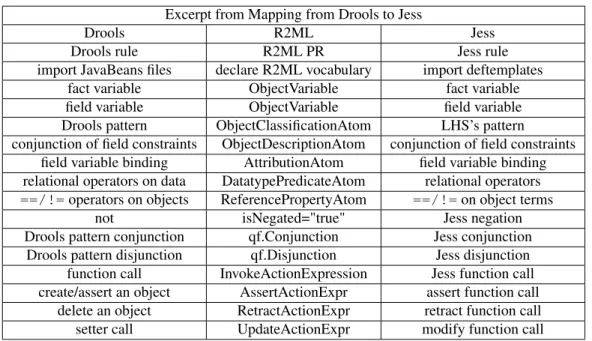
Table 1: Drools to Jess Mapping Rules Excerpt from Mapping from Drools to Jess
Drools R2ML Jess
Drools rule R2ML PR Jess rule
import JavaBeans files declare R2ML vocabulary import deftemplates fact variable ObjectVariable fact variable field variable ObjectVariable field variable Drools pattern ObjectClassificationAtom LHS’s pattern
conjunction of field constraints ObjectDescriptionAtom conjunction of field constraints field variable binding AttributionAtom field variable binding relational operators on data DatatypePredicateAtom relational operators
==/!=operators on objects ReferencePropertyAtom ==/!=on object terms not isNegated="true" Jess negation Drools pattern conjunction qf.Conjunction Jess conjunction
Drools pattern disjunction qf.Disjunction Jess disjunction function call InvokeActionExpression Jess function call create/assert an object AssertActionExpr assert function call
delete an object RetractActionExpr retract function call setter call UpdateActionExpr modify function call
– a translation function T(Drools,Jess) =
T r(Drools,R2M L)(T r(R2M L,Jess))
and results in:
– T(Drools,Jess)(VDrools x W x R) = (VJess x W0
x R0) (i.e. by applying the translation function
T(Drools,Jess) on the W = {g1, . . . , gp} set of
facts, we obtain the following set of facts Wh = {h1, . . . , hp}which is semantically and syntactically
equivalent with the setW0 ={g0
1, . . . , g0p}, obtained
from Jess inference process.
An informal rules translation from Drools to Jess, using R2ML as interchange language is presented in Table1. The reverse translation, from Jess to Drools is also possible, as Jess supports a new richer syntax22 which offers the
capa-bility to represent object types usingdeftemplatestructures. One limitation of this syntax is that it can only be used with unordered facts.
6 Conclusion and future works
The paper provides a description of rule translation from Drools, an Object Oriented rule language, into Jess, an Artificial Intelligence rule language using R2ML as in-terchange format. The results presented in this paper are based on our previous work (6).
Our future works intend to establish a mathematical model of semantic soundness of rule interchange. Also compatibility of the interchange with the work in progress of W3C (i.e. RIF) will be analysed. Further results will be reported in a future work.
22http://herzberg.ca.sandia.gov/docs/71/memory.html
Acknowledgements
We would like to thanks to Edson Tirelli and Kris Verlae-nen from the Drools Team for their helpful comments on our questions as well to Ernest Friedman-Hill, a precious mentor in all issues concerning the Jess language.
References
[1] H. Boley, M. Kifer (2007). RIF Core Design, W3C Working Draft, March 30, 2007http://www.w3. org/TR/rif-core/
[2] H. Boley, S. Tabet and G.Wagner (2001) Design Ra-tionale of RuleML: A Markup Language for Seman-tic Web Rules,In Proc. of Int. SemanSeman-tic Web Working Symposium (SWWS), Stanford University, California, USA.
[3] E.Friedman-Hill (2003),Jess in Action - Rule-Based Systems in Java, Manning Publications Co.
[4] N. E. Fuchs, U. Schwertel, R. Schwitter (1997), Attempto ˚U Englisch als (formale) Spezifikation-ssprache, In: F. Bry, B. Freitag, D. Seipel (eds.), Pro-ceedings of the Twelfth Workshop on Logic Program-ming WLP, Munich.
[5] M. Kifer, G. Lausen and J. Wu, Logical Foun-dations of Object-Oriented and Frame-Based Lan-guages,Journal of ACM, May 1995.
and Distributed Computing (IDC 2007), October, 2007.
[7] OMG (2005).OCL 2.0 Specification, June 06, 2005,
www.omg.org/docs/ptc/05-06-06
[8] OMG (2007). Production Rule Representation Ver. 1.0 , March 5, 2007, http://www.omg.org/ docs/bmi/07-03-05.pdf
[9] OMG (2006).Semantics of Business Vocabulary and Business Rules (SBVR),http://www.omg.org/ docs/dtc/06-03-02.pdf