ERP Software Evaluation
and Comparative Analysis
Kre
ˇ
simir Fertalj and Damir Kalpi´c
Faculty of Electrical Engineering and Computing, University of Zagreb, Croatia
This paper presents the results of an investigation per-formed in 2001 under the title Comparative Analysis of Information Systems Software in Croatia. The focus was set on the comparative analysis of domestic and foreign Enterprise Resource Planning(ERP)software, which is
present in Croatia. The investigation was performed from the standpoint of ERP applicability, regardless of the development methods and information technology. In other words, the evaluation was performed primar-ily from the standpoint of users rather than designers, programmers or other persons engaged in the system development and implementation.
System evaluation was performed in several phases and in multiple steps. A general list of relevant ERP char-acteristics was established first. This initial list was updated in co-operation with ERP suppliers and users. They completed the list by adding the characteristics they regarded as important or accentuated some features of their solutions that had not been mentioned initially. System evaluation was performed at the users’ sites, having insight to real applications. To increase the objectivity and accuracy, the evaluating teams consisted of persons of different profile(independent field experts,
e.g. an accounting expert, IT expert, end-user etc.). In
spite of the attitude taken not to evaluate the concrete basic technology, some estimation of the computing architecture and functionality was performed, when it was found relevant for the estimation of applicability.
Keywords: ERP software, software capability evalua-tion, software comparison.
1. Introduction
ERP system is an integrated information sys-tem to support the business within different organisational parts of an enterprise. Inter-national Data Corporation (IDC) defines the ERP software as support for at least three out of the following four business segments 7]: Accounting, Manufacturing, Material manage-ment/distribution, Human resources manage-ment with payroll.
The term ERP primarily relates to customization and usage of a “ready-made” software pack-age(in further text “ERP package”), and only secondarily relates to software written on pur-pose for a specific customer. The leading global providers are SAP, ORACLE, BAAN, People-Soft and J. D. Edwards. ERP packages are de-signed to be customizable to concrete needs of an organization and to its legacy systems. The customization of ERP modules for a concrete user is performed with special tools and using specific or standard programming languages. Due to already mentioned general ERP char-acteristics, customization and implementation usually require specialised knowledge and sig-nificant resources6]. Practical experience and literature agree that this is the crucial part for success21].
This paper presents the results of an investiga-tion performed in 2001, under the title Compar-ative Analysis of Information Systems Software in Croatia. It received a grant by the Croatian Ministry of Science and Technology.(GRANT No. 00–146). The focus was set on the com-parative analysis of domestic and foreign Enter-prise Resource Planning(ERP)software, which is present in Croatia. The aim was to determine: the actual contents which is being offered within different solutions,
the amount of necessary and sufficient in-vestments,
difficulties and problems connected with im-plementation of ERP solutions,
the position of domestic solutions compared to the foreign ones, opportunities of Croatia in this field.
The results of investigation are supposed to in-form potential and actual ERP customers about the situation on the market, estimated costs of purchase, implementation, further development and maintenance. The ERP suppliers should get the information regarding the desirable charac-teristics of these systems, as seen through users’ eyes. The final purpose is to give the indus-try and administration answers to the following questions:
What can actually be obtained from the so-lutions available on the market?
What are the expected costs?
What development strategies should be cho-sen?
It is understandable that our investigation paid substantial attention to the existing proprietary ERP solutions developed in Croatia. For the international reader, it may be of less interest, except if regarding Croatia as a paradigm for a small, medium-developed country that has re-cently passed through an ugly war and not much better privatisation. Although Croatia is better off than most developing countries of the once called Third world, it is plagued by some com-mon troubles as those countries: weak legal system and moderate corruption. Both these weaknesses surely affect the local ERP market.
2. Method for ERP System Evaluation
ERP systems are large and complex, so their evaluation is also a very complex task. What is more, there are no generally accepted evalu-ation methods. Some widely accepted methods
18]19]relate to the evaluation of the software development within an organisation, or con-centrate on the choice of supplier of services. Some other investigations performed in differ-ent countries were mainly aimed to analyse the market3]7]8]9].
Therefore, for the sake of this investigation, a proprietary method for evaluation and compari-son of ERP systems was defined and elaborated. Essential differences to the known existing pro-cedures are the following:
Definitions of desirable system characteris-tics are updated in co-operation with the sys-tem suppliers and users alike.
Evaluation is performed by having insight into the real-life system, rather than by ap-plying questionnaires.
Independent referees perform the evaluation in co-operation with the staff, well acquainted with the evaluated software. In this way, higher ob-jectivity is achieved than by filling-in question-naires where the suppliers or users “evaluate themselves”. Disadvantage of this approach is the increased time required to evaluate a larger number of systems. Practical experience has shown that the evaluation of a single subsystem may take a couple of hours, while to evaluate a whole system can take a week(4–5 working days).
2.1. Analysis of the Market and Application of ERP Systems
The preparatory phase consists of: Analysis of the world ERP market, Identification of ERP package suppliers, Identification of domestic ERP package pro-ducers,
Identification of the existing ERP customers, Establishing the co-operation with ERP dis-tributors and ERP customers willing to par-ticipate in the evaluation.
Evaluation planning.
2.2. Definition of the Domain of Analysis and the Working Procedure
In parallel with the market analysis and location of ERP applications, the definitions are formu-lated for:
Desirable subsystems and business functions
(ideal ERP system)
System components to be evaluated,
Desirable characteristics for evaluation of single ERP components,
Desirable characteristics and procedures are pre-sented to the suppliers and users of ERP sys-tems. They are encouraged to criticise and they are asked to present their opinion and sugges-tions to complete the initial material. If during the investigation new relevant characteristics are encountered, they can be added and evaluated. In other words, the method can be dynamically adapted and enhanced, with the aim that the outcome be the result of the overall knowledge and experience of all stakeholders. To avoid possible contradictory requirements for change, originating from different suppliers and ERP customers, the investigation team withholds the right to accept or dismiss the suggestions.
2.3. Evaluation Procedure
During the evaluation phase:
Evaluation teams for specific business do-mains are formed,
The evaluation plan is elaborated and up-dated for ERP systems and analysed do-mains,
Analysis of existing ERP installations is per-formed.
Evaluation teams consist of a few experts for each analysed business domain. It is desirable that they are experienced users of software in this field, but they need not be computing ex-perts, because only the user’s aspect is analysed. It is important that they are experts in the busi-ness domain and to increase the evaluation ob-jectivity it is desirable that they originate from different working environments.
The evaluation is performed within an organi-zation with installed ERP. If for some ERP so-lution such evaluation is not possible, the eval-uation can proceed through an insight into the evaluation copy of the software.
The supplier or the customer nominates the “best user”, meaning the person who is most familiar with the system capabilities. This user briefly presents the system capabilities, stress-ing its advantages and features. After preparstress-ing the list of desirable characteristics the evalua-tors ask questions and write down the answers. They give positive marks to those characteris-tics that can be demonstrated on the computer. If, for any reason, it turns out to be impossible,
the evaluation proceeds based upon the avail-able user and/or program documentation. The results and possible additional notes are veri-fied and forwarded to the investigation team for analysis.
2.4. Evaluation of Capabilities
For the purpose of evaluation, to each of the capabilities a range of possible marks is ad-joined. The lowest mark is zero, denoting that the corresponding capability is not present. The highest mark is set depending on the desired granularity of results. For each capability, its respective importance is quantified by a weight. The lowest weight is unit, while the upper limit also depends upon the desired granulation of the analysis results.
The mark for a system is calculated after the formula:
O =Σsi/ mi* fi, for each capabilityi, where:
siis the mark for the capabilityi,miis the
max-imum possible mark for the capabilityi andfi
is the weight of the capabilityi.
In the case when the highest mark for each ca-pability equals 1 and if all the weights are equal to 1, the system evaluation reduces to the sum of capabilities present in the system.
The relative mark for a systemX, in proportion to the ideal system0, is calculated as
RX= OX/ O0* 100
An example for possible marks is: 0 – capability is not present,
1 – partly present, available as option, 2 – capability is present,
3 – additional features present,
4 – especially useful capability or a significant innovation.
We believe that three weight values are suffi-cient:
1 – basic functionality, 2 – advanced functionality, 3 – sophisticated functionality.
Regardless of the ranges and weights applied, the analysis and ranking of results can proceed on the level of single components(subsystems) and on the system level, because the capabilities are grouped around various domains.
2.5. Analysis of Results
In the last phase:
A comparative analysis of the gathered re-sults is performed,
A rank list of ERP solutions is produced, The gathered information is synthesized and conclusions are deduced.
2.6. An Abridged Evaluation Process
The evaluation by direct insight, if applied for a larger number of systems, might request an excessive engagement of human and financial resources and take too much time. Therefore, an abridged approach is also envisaged.
The method can be modified by decreasing the depth of analysis. For the purpose of evaluation, shortened lists of capabilities are checked. Fur-ther simplification evaluates groups of business functions or whole subsystems. Finally, only the existence of groups of functions or subsys-tems can be checked. Naturally, the quality of analysis decreases with simplifications.
3. Results of the Comparative Analysis
3.1. Analysed Systems and Components
The call for co-operation within Croatia was addressed to 14 ERP package suppliers and de-velopers and to 10 ERP customers who had pur-chased an ERP solution or had developed a pro-prietary system. For the purpose of evaluation, the worldwide known ERP packages present in Croatia were selected. Selection of domestic
ERP products was based on the previous know-ledge of the investigation team and completed by references of some IT companies.
The initial response rate to our call for co-operation was 63%, where 38% participated in preliminary phases of investigation, but only a quarter of them agreed to participate in the evaluation process. It is interesting to mention that the initially high percentage(63%)of ERP package suppliers willing to co-operate, signif-icantly dropped during the investigation. At the end, only five systems were analysed: three do-mestic ones, where two of them had previously been awarded for good quality, and the two lead-ing ERP packages on the world market. Some subsystems were not analysed or not analysed in details, partly because they were not imple-mented, but also because of limited investiga-tion resources and lack of time. A comparative analysis was performed for the following ERP packages, listed in alphabetic order:
BAAN, by the BAAN Company, Herndon, VA, USA, at the customer who had been us-ing it for 4 years,
IS in the company LURA GROUP, Croatia, a proprietary solution,
SAP, by the SAP A.G., Waldorf, Germany, at the customer who had been using it for 5 years,
ERP package by the company ENEL d.o.o., Split, Croatia,
SUPER by the company SUPER-KING d.o.o., Zagreb, Croatia, installation at a representa-tive customer.
We were aware of the diversity of modules within commercially available ERP packages and of the diversity in the organization of those ERP subsystems that were developed on pur-pose, for known customers. We defined the desirable capabilities, for the components. The evaluation was completed for the following com-ponents:
General characteristics, Accounting,
Manufacturing monitoring, Projects monitoring, Sales,
Stocks management,
Manufacturing management, Quality control.
For the following components, the evaluation proceeded only partly, i.e. only the existence of components was checked:
Project management, Maintenance management, Human resources with payroll.
Three of the evaluated systems comprised all the components, while the rest contained Ac-counting, Sales, Purchase, Stocks management and Human resources with payroll. All the par-ticipants in the investigation had been informed in advance about the evaluation process and re-ceived the evaluation forms to be better prepared and to have their say regarding the proposed lists of capabilities. Members of the Croatian Ac-countants Association joined the investigation team and helped to create the evaluation forms during the preparatory phase.
Respecting the fact that some values may be a confidential, in our call we proposed that the concrete customer and supplier information be hidden, or revealed only after their written permission. Until the end of the investiga-tion, only a domestic company SUPER-KING alowed revelation of its name. All other partici-pants withheld their permissions. We apologise
to our readers for having the permission to re-veal only one of the analysed systems, while the rest must remain coded. This is partly under-standable, because, as stated before, our investi-gation resources were scarce and, therefore, our concrete findings could even become a subject of litigation.
3.2. Summary of Subsystems Evaluation
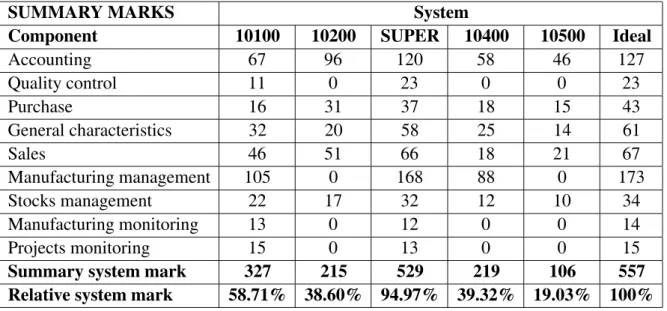
Table 1 and Figure 1 compare the counts of components within subsystems that were eval-uated for capabilities. The last column(Ideal) contains the maximum count of capabilities for each component, representing an ideal system. The last row (Relative system mark) contains the percentage of implemented capabilities in respect to the ideal system.
The systems coded as 10100, SUPER, 10400 have all the components, while for the system 10400 three of them were not evaluated due to objective reasons. Only the systems 10100 and SUPER contain more than half of all desirable capabilities. The system SUPER achieved the best marks and the system 10100 follows. The system 10400 is a complete set of average valu-ed components. The system 10200 achievvalu-ed very good marks for the components it contains. The system 10500 definitely requires a serious redesign.
SUMMARY MARKS System
Component 10100 10200 SUPER 10400 10500 Ideal
Accounting 67 96 120 58 46 127
Quality control 11 0 23 0 0 23
Purchase 16 31 37 18 15 43
General characteristics 32 20 58 25 14 61
Sales 46 51 66 18 21 67
Manufacturing management 105 0 168 88 0 173
Stocks management 22 17 32 12 10 34
Manufacturing monitoring 13 0 12 0 0 14
Projects monitoring 15 0 13 0 0 15
Summary system mark 327 215 529 219 106 557
Relative system mark 58.71% 38.60% 94.97% 39.32% 19.03% 100%
Figure 1. Summary marks of ERP packages.
3.3. Relative Mark Values
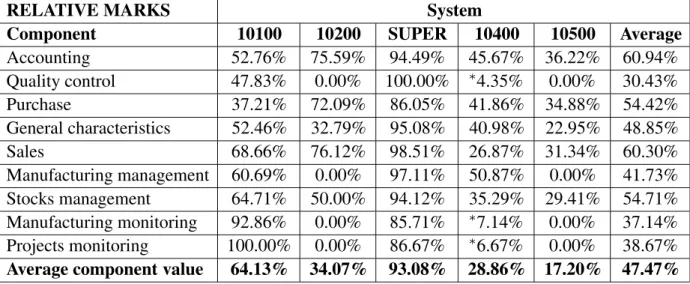
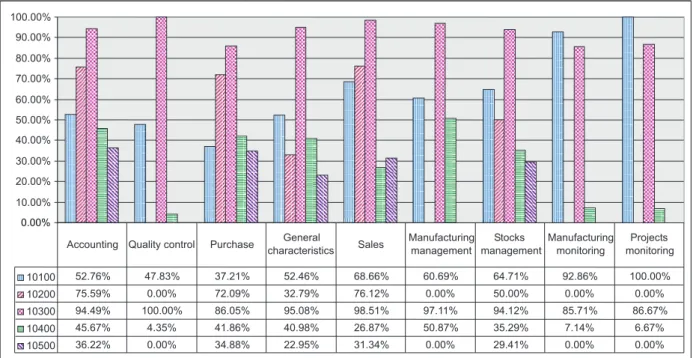
Table 2 and Figure 2 represent the relative pres-ence of capabilities compared to the ideal sys-tem. The last column contains the average value of the examined ERP systems. The last row presents the average components mark.
On average, Accounting and Sales are best sup-ported. Purchase and Stocks management fol-low the suit, but their completeness is only slightly above 50%. General characteristics hardly reach half of the Ideal system. Supports to the Manufacturing and to the Quality control are the weakest points.
RELATIVE MARKS System
Component 10100 10200 SUPER 10400 10500 Average
Accounting 52.76% 75.59% 94.49% 45.67% 36.22% 60.94%
Quality control 47.83% 0.00% 100.00% 4.35% 0.00% 30.43%
Purchase 37.21% 72.09% 86.05% 41.86% 34.88% 54.42%
General characteristics 52.46% 32.79% 95.08% 40.98% 22.95% 48.85%
Sales 68.66% 76.12% 98.51% 26.87% 31.34% 60.30%
Manufacturing management 60.69% 0.00% 97.11% 50.87% 0.00% 41.73%
Stocks management 64.71% 50.00% 94.12% 35.29% 29.41% 54.71%
Manufacturing monitoring 92.86% 0.00% 85.71% 7.14% 0.00% 37.14%
Projects monitoring 100.00% 0.00% 86.67% 6.67% 0.00% 38.67%
Average component value 64.13% 34.07% 93.08% 28.86% 17.20% 47.47%
For the system 10400 only the existence of subsystem was taken into account.
Figure 2. Relative marks of ERP packages.
4. Summary of the Analysis of the Leading Foreign ERP Packages
After a detailed analysis of the ERP packages used in Croatia(SAP and BAAN)and after ac-quiring a partial insight into the software and available documentation for the packages by ORACLE, J. D. Edwards and PeopleSoft and after an additional review of the literature pub-lished worldwide, we came to the following conclusions:
ERP packages are technologically modern, comprehensive and reliable software.
They cover many business domains. They support more than a thousand busi-ness functions or working procedures. They support many variants of business procedures.
They support the operational parts of busi-ness procedures, i.e. everyday transac-tions which generate data.
They are based on modern technologies
(multy-tier client/server architecture, OLE, HTML, SMTP, MAPI, EDI, ALE,...).
Although there are sporadic objections to their reliability, they perform at least so
well as the proprietary customer designed solutions.
ERP packages are sets of interconnected par-tial solutions, rather than integrated solu-tions.
They had initially been developed to sup-port a certain function(e.g. Accounting, Manufacturing)and other modules were added afterwards.
Single modules or subsystems had been developed in different software compa-nies and were acquired by the owner of the “integral” ERP package later. These acquired subsystems are interconnected in different ways(common database, data transfer, and even manual data entry from one module to the other).
Within single subsystems, the variants for some business functions coexist as partial solutions, mostly without any generalisa-tion.
Functional quality and sophistication of im-plemented solutions is mediocre.
Sophisticated functions, like optimiza-tion or simulaoptimiza-tion, are mostly absent and they are substituted by combinations of more complex queries and reporting.
ERP packages are very large and inefficient. The software dwells over huge databases and the program code is huge. For ex-ample, SAP handles 14,000 tables, there are 650 fields to describe a material, and PeopleSoft contains 14,000 predefined screen forms.
An average customer uses only a small fraction of the features available, so the major part of the system is a useless bur-den in application and maintenance. Software was principally designed for ef-ficient transaction processing and simple reporting. Due to the large number of highly normalized tables, more sophisti-cated reporting is resource consuming.
ERP packages are complex and rigid for im-plementation and maintenance.
Implementation and customization require non-standard fourth generation languages and specialised routines for transaction handling.
The systems have been designed as a large set of predefined functions, rather than easily customizable solutions. Accordingly, the customer is sometimes forced to change the organization and business procedures to adapt to the soft-ware.
The system administration requires know-ledge of a large number of parameters and procedures, which are described in manuals of more than thousand pages.
Customization and implementation are timely and complex. They comprise the following activities:
Definition of the customer’s information requirements.
Definition of input and output for the in-formation system.
Identification of those embedded compo-nents, which are useful to the customer. This is usually a small fraction of the
package. Retrieving of the desired data structure and desired function is difficult because of the large number of prede-fined items.
Design and customization of the data-handling screen forms.
Implementation of advanced reporting, because only simple ones are at hand24].
Lack of the basic reporting system can be solved in the following ways:
ERP database is used and only report-ing modules are added. Reportreport-ing slows down the system and assignment of lower priority to reporting can be a remedy. An example isSNAPpackby Information Builders, New York, applied for report-ing from the leadreport-ing ERP packages(SAP, J.D. Edwards and PeopleSoft).
ERP database is copied on another me-dium and the reporting proceeds from there. For example, EMC Corp., Mas-sachusetts, offers a hardware and soft-ware solution calledTime Finder, to cre-ate a copy of the database on a separcre-ate server. It is used for reporting, but also as a backup for the database.
Data from the ERP base are written into a differently structured new database. It is the most common Data Warehousing ap-proach where usually separate hardware is used.
Combination of the above solutions, where some reports are generated by ad-ditional programs from the ERP database and some other come from a separate sys-tem containing the copy. An example is
Crystal Decisions, by Seagate Software, which generates reports from ERP tems and from the Data Warehousing sys-tems.
Regardless which of the above proce-dures is applied, copying of ERP data into spreadsheets (e.g. MS Excel) is most usual.
ERP packages are not a stable basis to de-velop an information system:
It is sometimes enforced with the threat that any support to the existing version will cease otherwise13].
Due to all the considerations enumerated above we find that the mentioned, world renown ERP packages do show some serious disadvantages:
The structure of these systems had not been designed on purpose, it had “hap-pened” through time, as sediments of( ac-quired)subsystems and partial solutions. They are difficult to understand, to im-plement and to maintain6].
They require constant consulting.
They excessively consume the comput-ing resources.
What a customer really gets with an ERP ac-quisition is the contents and structure of the database and a large number of partial solutions to support the operational functions, which may, but need not, comprise the solutions the cus-tomer really needs. The missing functional-ity is repaired with additional components( so-called concepts)like Customer Relations Man-agement (CRM), Supply Chain Management
(SCM), Application Link Enable(ALE), Data Warehousing and Data Mining. To the set of all these partial solutions a preposterous namebest of breed is given. Unfortunately, instead of an integral system, based on a solid concept, add-ons are applied leading to fragmentation, they increase complexity and inefficiency of the in-formation system.
In spite of all the setbacks and much criticism addressed to the famous ERP systems, our informal sources of information, which un-fortunately cannot be properly documented, lead us to a speculation that the market ac-cepts them for the following reasons:
The number of predefined functions is so large that it leaves the potential cus-tomer with the impression that within the package “all has been solved”. However, much effort to reach full functionality and applicability is required.
ERP suppliers impress the potential cus-tomers with the numbers of existing in-stallations and reference lists with most famous world companies.
Significant knowledge and experience has been gathered and embedded during years-long existence of some ERP packages. The customer tries to compensate the lack of own IT personnel by hiring so called “Certified consultants” who in some ca-ses, informally but accountably reported to us, achieve that title regardless of the previous education and after only a short training.
In industrialized countries, the massively “produced”, meaning cheap, semi-quali-fied but highly specialised work force provides the customization of the pack-age fragments.
As the initial investment represents about a third of overall costs, the ERP costs may appear lower than a proprietary develop-ment.
Customers are exhausted by technologi-cal progress in IT and they like to delegate the problem to ERP suppliers.
While integrating islands of computerisa-tion, to avoid internal arguments whose solution should prevail, an ERP package is acquired as a neutral solution.
If you buy the “world’s best” solution, you do not get fired.
Some customers who have dearly paid for their ERP do not dare to admit failure. In some developing countries, big invest-ment may imply big bribe.
in order to succeed has recently been ad-mitted by the World Bank’s President Mr. Wolfensohn.
5. Position of Local Solutions in Respect to the Leading ERP Packages
We found that good proprietary ERP solutions exist in Croatia. According to the results of our investigation 2 out of 3 examined ERP sys-tems are comparable or in some(at least locally appreciated)aspects even better than the world renown packages.
Logically, there are not many local ERP pack-ages on the market, especially having in mind that development of such software takes hun-dreds of person-months, or even person-years. However, there are a few other good Croa-tian packages, which were not evaluated in this study.
General characteristics of these locally pro-duced and favourably evaluated ERP packages: They are offered as complete solutions encompassing complete customer requiments, with prepared screen forms and re-porting systems.
Practically no customization is required for the implementation. Some organizational measures and education of users are the only requirement.
They are compact and homogenous, because they do not consist of acquired and later in-terconnected components.
They are implemented much easier and are much cheaper.
They have a very weak marketing.
They find it very difficult to follow the tech-nical advancements.
6. Opportunities for Improvement
6.1. Situation in Croatia
According to the available data and some previ-ous investigation, the situation can be described in following statements:
The majority of existing information sys-tems are technologically obsolete or do not correspond to the customer’s needs.
After the initial boom, where most of those who had some money bought a renowned ERP, the ERP market has shrunken. It can be attributed to political changes, increased caution and lack of money9].
The Croatian market potential is estimated on 300–400 larger customers and many small and medium size(with 10 or more employ-ees)companies9].
Apart from the above-mentioned exceptions, the main characteristics of most other domes-tic products are:
Incomplete solutions: Most domestic com-panies do not offer an integral solution. Usu-ally they are only partly integrated and cover only certain domains, usually Accounting, Materials handling and Human resources with payroll.
Inadequate solutions: Software developed 10 years ago is obsolete now. Some domes-tic companies, specialised for domains like banking or insurance, tend to widen their activity as outsourcers, regardless of their
(in)competence in new domains.
Main setbacks of acquisition of foreign ERP packages are:
World market prices are too high for local conditions. Very high initial investments are necessary. It would be fair that the foreign vendors adapt their pricing policies to the lo-cal per capita BDP. It might be not applicable for the foreign consultants’ fees, but for the price of licences, it should be feasible. Such policy would reduce the differences in bene-fit of buying an ERP system between highly developed countries on one side and those less developed on the other.
Incompatibility of foreign solutions with lo-cal conditions, resulting in significant cus-tomisation and organizational efforts 20]. A hidden cost caused by higher restructur-ing efforts in less developed world remains, but it would be too much to expect from ERP vendors to cater for that.
compared to the customization costs (60– 70% of the overall costs).
Too long period of implementation for a “ready-made” solution. It may take from one to three years and after 3-4 years, a new development cycle is already due. Some im-plementations extend even longer and/or the required functionality is never achieved. Long-term dependency upon the supplier and expensive consultancy. Fees of 1,200-1,800 USD per day are paid for a consultant, which exceeds a good local monthly salary. Occasional incompetence of (especially some foreign)consultants and instability of suppliers. Poor treatment of customers by the ERP producers derives from the percep-tion that Croatia is a small and unimportant market where third class consultants can be sent. On the contrary, more knowledge is often required in such a country than in a highly organized one.
Cost and Benefit
Depending on the field of their activity, poten-tial customers can count on some usual positive effects of computerization12]:
integration of financial data,
standardization of human resource data, standardization of business processes, standardization of manufacturing processes. In USA, an average investment in a project amounts to 15 million USD, average end-user costs are up to 53.320 USD and return of in-vestment can be expected after 31 months, at the earliest 12]. Additional costs of support after implementation amount to 2,304 USD per user in large organizations and up to 7,870 USD for the small ones15]. It is not always easy to determine whether the investment in computer-ization pays off14]16]22], but there is a gen-eral awareness that a company not investing in its information system would be out of business very soon.
Domestic software is much cheaper. A repre-sentative product can be bought for 2.350 USD per workstation, with one-year guarantee and support. General cost benefit analysis was not
possible, because the necessary data have not been revealed.
It is nearly impossible to estimate in advance some hidden costs like:
educational costs including the adaptation of users to new working ways,
integration and testing, which is difficult to foresee, depending upon the connection with legacy systems,
data conversion often represents an unpleas-ant surprise, due to un-normalized relations or inadequate codification in legacy systems, data analysis becomes costly if the ERP data need to be combined with data from other sources,
protracted engagement of consultants, unexpected efficiency decline as the staff cannot proceed in the usual way.
The cost of owning an enterprise-wide applica-tion goes far beyond an applicaapplica-tion’s purchase price.1]. The largest costs result from imple-mentation efforts. Failed efforts have brought some companies to sue the ERP supplier4].
6.2. Proposal for IS Development Policy
Recommendations to Customers and Users
Potential customers should perform the follow-ing actions:
Estimation whether the intended ERP pur-chase really corresponds to their require-ments5]2].
Market-oriented complex companies who tend to be and stay in some way specific and recognizable and wish to maintain the edge over competition should rely on some proprietary development, at least for support of their highly competitive functions.
Cost benefit analysis, especially the ratio be-tween adaptation of business procedures to software versus the costs of software adap-tation to business processes.
Definition of appropriate metrics for out-sourcers/consultants, where their results should prevail over their physical presence.
An additional criterion to evaluate the outsourcers can derive from independent testing of the staff ability to use the im-plemented solution.
Definition of metrics to evaluate and manage own IT staff, which includes:
education and maximum usage of inter-nal human resources,
awards according to successful imple-mentation,
readiness to changes in staff, in order to substitute overpriced employees,
avoiding of possible blackmails and mis-use after the implementers get acquainted with the weak points of the company, Assurance of acceptability for solutions de-livered from outsourcers, achieved by pre-cise contracts, definition of acceptance tests and major payments only after successful implementation.
Planning of implementation and maintenan-ce, including feasibility studies and risk man-agement.
Establishing of a pilot project or installation to prove the functionality.
Estimation of alternative strategies:
Simultaneous implementation, so called
Big Bangrequires excessive efforts; it of-ten fails and it should be avoided.
Franchise Strategycomprises the instal-lation of independent subsystems with in-tegration only in their common process
(e.g. in Accounting).
Slam-dunk strategy is oriented to some crucial business processes. It is conve-nient for smaller companies that are not ready to invest in comprehensive ERPs. Information system owners who have just com-pleted the implementation cycle or who intend to start a new cycle should perform:
System quality analysis.
Revision of the computerization project. System cost benefit analysis.
Regardless of the customer type, we suggest: Engagement of independent consultants, es-pecially if an impartial quality analysis is required.
Engagement of independent (third party) outsourcers for support and maintenance, if applicable.
Establishing of at least a minimum local IT expertise. Local experience has shown that ERP installations became successful after lo-cal expertise had been gained.
The most important aspect is the proper mo-tivation and high commitment of the top management. Establishing of an informa-tion system cannot be completely purchased nor delegated. It cannot be introduced by brute force, because there are too many pos-sibilities to compromise the project if it is perceived as being against some of the stake-holders’ interests10].
Recommendations to ERP Suppliers and Developers in a Developing Country
In addition to some widely recognized mea-sures 17] suppliers-representatives of foreign ERP solutions should:
In a country with moderate to high corrup-tion, resist the temptation to apply bribery as a shortsighted method, which should back-fire eventually.
Increase the quality of support and customiza-tion instead of pure reselling.
Educate local consultants instead of relying on foreign ones who are expensive and often inept to understand the local conditions.
Include local experts in the development and customization.
Forward users’ remarks to the software pro-ducers to improve the quality and customers’ satisfaction.
Accept that major payment is due after the user-acknowledged functionality has been achieved.
Domestic developers should:
Technically update and complete the exist-ing applications.
Offer application hosting and provide appli-cation services as soon as possible.
Direct themselves towards small and medium size customers.
Direct themselves towards specialized soft-ware, which is not present in major ERPs.
7. Conclusion
The response rate in this investigation left us with an impression that domestic companies are mostly uninterested in improvements, which is rather strange, considering the potential of cur-rent unsatisfactory state of computerization in the country. The suppliers of ERP solutions, who trust their products, accepted the challenge of evaluation and so did the customers who do have some achievements but who are also aware of the deficiencies in their systems.
The leading world-renowned ERP packages are technologically modern, comprehensive and re-liable software. The functional quality and sophistication of the implemented software is however surprisingly mediocre. Customization and implementation of a “ready-made” solution can extend through years, creating a large dis-crepancy between the price of the basic product and the costs of customization. The main reason for high costs is the necessity that, simultane-ously, the software needs to be adapted to the organization and the organization and the busi-ness processes have to be adapted to the ERP package. The weakest point might be the con-sultants who often lack the knowledge about their complex ERP system and, on the other hand, they lack experience in information sys-tems development and do not understand the tar-get system. The presumed, and in ERP systems embedded high level of organization and obe-dience to the rules, cannot always be respected
in developing countries. Potential ERP buyers should count on a dependency upon the supplier and on expensive consultancy for a long time. Reliance upon a pool of own experts might be the best solution in a country with relatively low salaries.
The main characteristics of domestic ERP prod-ucts, with few exceptions, are incompleteness and inadequacy and/or technical obsolence. Best solutions can be found for Accounting, Human resources and Payrolls. Material han-dling is less present. Support for manufactur-ing is lackmanufactur-ing. On the other hand, investigation has detected some cheap local solutions, which could in a fair competition challenge, according to locally appreciated functionality, the world-renowned products.
Regardless whether an information system is bought or developed, computerization should lead to the integration of data and to standard-ization of business processes. The total price for a certain customer can hardly be properly forecasted. Many hidden costs must be taken into account. The largest cost results form pos-sible failure or even worse, protracted efforts in a failed project.
Software development is work intensive. The price of human work in highly developed coun-tries can be up to 10 times higher than in a medium developed country like Croatia. For the latter countries, price performance ratio of their proprietary solutions can be more accept-able than in highly developed countries. World-renowned ERP solutions are aimed for highly organized societies. The assumption that in-troduction of such systems into less developed environments would introduce order and dis-cipline and improve organization, may sound plausible but it is not necessarily true. If the gap is too wide, the failure is granted. Without investment in local expertise, the technology gap only widens. Our suggestion for countries like Croatia is not to expect that wonderful solu-tions can be simply bought. Own effort is indis-pensable and only this can make such countries respected partners on the world market.
function quicker and requires less restructuring. When, with time, the user finds the functionality of such a system unsatisfactory and the deliverer cannot meet the growing requests for enhance-ment, it might be the right time for acquisition of a renown ERP. In such case acceptance should proceed easier and quicker. Which approach is more favourable has to be deliberated on case by case basis.
It is natural that any less developed country tends to become part of the highly developed world. Pure reliance on foreign expertise can make only standing dependency and maintain, or even widen the gap. Illustrative is the exam-ple of the Republic of Korea. It could not make a substantial progress regardless of its successful electronic industry as long as it was dependant on foreign supplies. The better the Korean final products were sold, the more expensive became the imported inputs. When Korea took over the expertise, it became a well-known success story
25].
References
1] Applix Enterprise,Total Cost of Ownership Study
for Enterprise Applications, white paper, Applix. Inc, 2000.
2] R. B. CAMPBELL,ERP: Show me the Money!,
Axis-logic Consulting Inc., 2001,
http://www.axislogic.com/erpstory.htm
3] Ernst & Young and uni Wien,Optimierungsbedarf
von ERP-Software in ¨Osterreich, Ernst & Young Unternehmensberatung Ges.m.b.H und Institut f ¨ur Kreditwirtschaft an der Wirtschaftsuniversit¨at Wien, Vienna, 1999.
4] S. GOODWIN, Software Risk Management Makes
Good Business Sense,
http://www.stickyminds.com/sitewide.asp ?ObjectId=2663&Function=DETAILBROWSE& ObjectType=ART, 2004-07-06.
5] B. HECHT, Choose the right ERP software,
Data-mation, 43(3), pp. 56–58.
6] P. C. HOLLAND, B. LIGHT, A Critical Success
Fac-tors Model for ERP Implementation,IEEE Software, 16(3), pp. 30–36.
7] IDC,The Integrated Enterprise Application (ERP)
Market in Croatia, IDC East Central Europe, Praha, 1998.
8] IDC, Management Summary,1999 Croatian ERP
Market, IDC East Central Europe, Praha, 1999.
9] IDC, The Integrated Enterprise Resource
Man-agement Software Application Market in Croatia, 1999–2004, IDC East Central Europe, Praha, 2000.
10] D. KALPIC´, K. FERTALJ, V. MORNAR, Analysis of
Reasons for Failure of a Major Information System Project, BITWorld 2001 Conference Proceedings, CD-ROM, ISBN 0 905304 36 5, Kamel, Sherif
(ed.). Cairo: The American University in Cairo,
2001, pp. 1–8.
11] D. KALPIC´, M. BARANOVIC´, V. MORNAR, Case
Study Based on a Multi-Period Multi-Criteria Pro-duction Planning Model,European Journal of Oper-ational Research87,(1995), pp. 658–669, Elsevier
Science B. V., Netherlands.
12] C. KOCH,The ABCs of ERP, 2002.
http://www.cio.com/research/erp/edit/ erpbasics.html
13] M. LEVINSON, Let’s Stop Wasting $78 Billion a
Year,CIO Magazine, 15.10.2001.
http://www.cio.com/archive/101501/ wasting.html
14] A. C. MACADA, M. A. MAHMOOD, J. L. BECKER,
Development and Validation of an Instrument to Evaluate the Impact of Information Technology In-vestments: A Cross-Country Analysis, Presented at the IRMA 2000 — Challenges of Information Technology Management in the 21st Century,(May
21–24, 2000)Anchorage, AK, USA, pp. 893–896.
15] METAGROUP, A Platform-Related Cost Analysis
of ERP Applications on-Going Support Costs in the Mid-Tier, MetaGroup Consulting, 11. February 2000.
16] M. A. MAHMOOD, Amerireal Corporation:
Informa-tion Technology and OrganizaInforma-tional Performance”, Presented at theIRMA 2000 — Challenges of Infor-mation Technology Management in the 21st Cen-tury,(May 21–24, 2000)Anchorage, AK, USA, pp.
1037–1038.
17] A.-W. SCHEER, F. HABERMANN, Enterprise resource
planning: making ERP a success,Communications of the ACM, 43(4), pp. 57–61.
18] SEI, Software Capability Evaluation Version 3.0
Method Description CMU/SEI-96-TR-002, Soft-ware Engineering Institute, Carnegie Mellon Uni-versity, Pittsburgh, Pennsylvania, 1996.
19] SEI, Software Capability Evaluation Version 3.0
Implementation Guide for Supplier Selection CMU/SEI-95-TR-012, Software Engineering Insti-tute, Carnegie Mellon University, Pittsburgh, Penn-sylvania, 1996.
20] C. SOH, S. S. KIEN, J. TAY-YAP, Enterprise resource
planning: cultural fits and misfits: Is ERP a univer-sal solution?,Communications of the ACM, 43(4),
pp. 47–51.
21] T. M. SOMERS, K. NELSON, The Impact of Critical
22] C. STEDMAN, What’s Next for ERP?,
Computer-world, 33(1999), pp. 48–49.
23] C. STEDMAN, ERP projects cost more than their
‘measurable’ payback, Computerworld, (Online
News, 03/29/99 06:29 PM).
24] J. ZYGMONT, ERP system performance — rethink
reporting, Datamation IT management Update, 19.5.1999.
25] Invited lecture of a Korean expert on the 18
th
International Conference on Computers & Indus-trial Engineering, ICC&IE’95, Shanghai, China, October 25–27, 1995.
Received:February, 2004
Revised:July, 2004
Accepted:August, 2004
Contact address:
Kresimir Fertaljˇ Faculty of Electrical Engineering and Computing
University of Zagreb Unska 3 10000 Zagreb Croatia Phone:+385 1 6129 918 Fax:+385 1 6129 915 e-mail:[email protected]
Damir Kalpi´c Faculty of Electrical Engineering and Computing
University of Zagreb Unska 3 10000 Zagreb Croatia Phone:+385 1 6129 919 Fax:+385 1 6129 915 e-mail:[email protected]
KRESIMIRˇ FERTALJis an assistant professor at the Department of
Com-puter Science of the Faculty of Electrical Engineering and Computing, University of Zagreb, Croatia. He graduated and received his M.Sc. and Ph.D. degrees in computing from the same institution. Since graduation in 1988, he has been working at the Department of Applied Mathemat-ics, where he currently lectures a couple of undergraduate and post-graduate courses in computing. He also held courses in data modelling, information systems development and fourth generation languages. His professional and scientific interest is in computer-aided software engi-neering and complex information systems. He has defined a propri-etary software development method based on iterative prototyping and, based on it, developed a proprietary source code generator. He ran a few projects supported by the Croatian Ministry of Science and Technology. Currently he is the principal researcher on two such projects, “Improve-ment of Information System Develop“Improve-ment Methods” and “Business Information System Feasibility”. He has authored and co-authored many scientific and professional publications and participated in con-ferences, locally and abroad. Professionally, he participated in a dozen information system projects for business, industry and administration.