Vol. 117 No. 1 (2016) 137–148
urn:nbn:de:hebis:34-2016041950134 ISSN: 2363-6033 (online); 1612-9830 (print) – website: www.jarts.info
Perception of quality in certified organic pineapples
by farmers in Kayunga district, Central Uganda:
Implications for food security
Francis Richard Jumba
∗, Bernhard Freyer
University of Natural Resources and Life Sciences, Vienna, Department of Sustainable Agriculture Systems, Division of Organic Farming, Vienna, Austria
Abstract
In East Africa, Uganda is one of the major producers of organic pineapples for export. These pineapples are mainly produced in central Uganda and have to meet stringent quality standards before they can be allowed on international markets. These quality standards may put considerable strain on farmers and may not be wholly representative of their quality interpretation. The aim of this paper is therefore, to determine the Ugandan organic pineapple farmers’ quality perception, the activities they carry out in order to attain that quality and challenges (production, postharvest & marketing) faced on the same. Qualitative semi-structured interviews were carried out among 28 organic pineapple farmers in Kayunga district, central Uganda. Findings suggest that quality of organic pineapples is mainly perceived in terms of product attributes particularly appearance followed by food security provision. Certification plays a minor role in what farmers describe as organic quality. High production input costs (labour and coffee husks) coupled with a stagnant premium are some of the major challenges faced by farmers in attaining organic quality. The paper argues that currently there are concealed negative food security effects embroiled in these pineapple schemes. It is recommended that the National Organic Agricultural Movement of Uganda (NOGAMU) works with all relevant stakeholders to have the farmer premium price raised and an official organic policy enacted.
Keywords: organic, perception, pineapple, quality, Uganda
1
Introduction
Uganda is one of the leading certified organic produ-cers in Africa (UNEP, 2010) especially for fruits like pineapples (Ananas comosus). Organic pineapple pro-duction in Uganda is mainly driven by the premium markets in Europe (Taylor, 2006) and unlike the
con-∗Corresponding author
University of Natural Resources and Life Sciences, Vienna, Department of Sustainable Agriculture Systems, Division of Organic Farming, Gregor Mendel Strasse 33, 1180 Vienna, Austria Email: [email protected]; Phone:+256 772618506
ventional1 pineapple sector where farmers apply syn-thetic chemicals and mainly supply the local urban mar-kets, organic pineapple farmers utilise natural fertilisers (coffee husks) and don’t spray chemicals. Certified or-ganic pineapples are mainly produced in central Uganda in Kayunga, Masaka and Luwero districts. Of these
1Traditional farming in Uganda can be defined as a farming
sys-tem that has evolved through time, is quite adapted to the local cul-tural conditions and doesn’t utilise synthetic chemicals but still does not meet the requirements of the organic standards and is prone to degradation (Scialabba & Hattam, 2002). So in this study traditional farming methods refer to production methods that do not utilise syn-thetic chemicals but also have few or no ecological intensification pro-cedures.
Published online: May 4, 2016 Open access article licensed under a Creative Commons Attribution 4.0 International License CC BY
three, Kayunga currently produces the most pineapples because of the fertile soils, cheap labour (Muyanja & Turyagyenda, 2006), bimodal rainfall and an altitude of about 1200 m above sea level, that are suitable for apple cultivation (Bolwig, 2012). Certified organic pine-apple production in these areas began as early as 2004 with most farmers seeing it as an opportunity to bene-fit from premium prices in the lucrative organic export markets. However on individual basis, the farmers can-not afford the high certification costs so have been oper-ating under internal control system arrangements (group certification schemes) run by export companies (Hine & Pretty, 2007; Bolwig, 2012). The farmers have an average pineapple plot size of one to five acres (Bolwig, 2012). In most cases, the farmers intercrop the pine-apples with beans for the first two months after which they intercrop with bananas (Musa) and fruit trees like paw paws (Carica papaya). This offers them additional sources of income and food security thus reducing their risks in farming business. Food security in this paper refers to a situation where an individual has access to enough food supplies or income to purchase food and nutritionally adequate diets to enable a healthy and ac-tive life (McCalla, 1999). It comprises three dimensions namely: availability (in terms of production), access (ability to buy it) and utilisation (nutritionally correct diets).
The majority of certified organic pineapples in Uganda are grown for export markets where quality is a major prerequisite for access (Muyanja & Turyagyenda, 2006). Food quality is defined as comprising both phys-ical (product) and process components (Grunert, 1995; Brunsø et al., 2002) . Product attributes of fruits in-clude the physical and physiological components like colour, size and nutritional value (Barrett et al., 2002) whereas the process aspects represent the specific man-ner in which food was produced and are a major basis of differentiation of organic from conventional produce (Trienekens et al., 2012). In Uganda, organic food qual-ity is mainly premised on global north qualqual-ity standards that are the formal institutions or rules (Scott, 1994) de-termining market access for Ugandan pineapples. How-ever, such formal rules may not necessarily be appro-priate for the Ugandan farmers’ socio-economic con-ditions (Taylor, 2006) and have been shown to raise production costs among organic pineapple farmers in Uganda (Bolwig & Odeke, 2007). International or-ganic standards also come with increased certification costs (Barrett et al., 2002) that derail some farmers from engaging in organic pineapple production yet this would have provided them with an opportunity to
im-prove their general livelihood. A recent survey by NOGAMU showed that a large number of the export companies complained of high certification costs and limited supply of products from the small scale farmers as major impediments to doing business (Namuwoza & Tushemerirwe, 2011). According to the same authors, even where group certification had been adopted as a means to curb the high certification costs, it was still costly to organise and manage the farmers. These trends show constraints arising from the international stand-ards requirements.
Since organic standards (Peri, 2006; Lyons et al., 2013) and international market standards (Allaire, 2010) represent how quality in organic products is perceived in the global north, it is prudent to investigate how the Ugandan farmers for whom the standards are intended but live in different socio-economic conditions perceive quality. This can help reveal the extent of the standards congruence with farmers’ perception of quality and also provide a basis of harmonisation of quality standards with farmer needs but in line with the IFOAM organic principles as spelt out by IFOAM (2012). In addition, farmers’ agronomic and post-harvest practices greatly influence the final product quality (Ruben et al., 2005), therefore, investigating their field activities aimed at achieving quality also becomes essential.
Generally very few studies addressing quality percep-tion among farmers have been done before. Moreover, these were carried out in the global north and didn’t focus on the organic sector (Ilbery & Kneafsey, 2000; Kneafsey & Ilbery, 2001; Dimara et al., 2004). To the best of our knowledge, quality perception of organic food among farmers in Africa is an area that has not been explored which reveals a big research gap which this study intends to fill.
This study will thus seek to answer the following questions:
(i) What are the farmers’ perceptions of quality in or-ganic pineapples?
(ii) What are the farmers’ practices aimed at achieving organic pineapple quality based on international or-ganic standards and market requirements?
2
Materials and methods
2.1 The study area and population
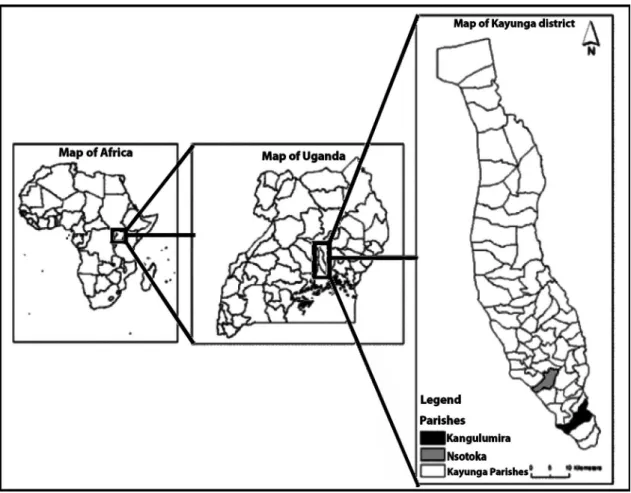
The study was carried out in Kayunga district loca-ted in central Uganda. This area is localoca-ted between 00°4209N and 32°5320E and is approximately 58 km from Kampala, Uganda’s capital city. It has a total area of 1,587.8 km2 and a population of 294,613 inhabitants. Kayunga district alone produces over 31 % of the total Ugandan pineapples (Muyanja & Turyagy-enda, 2006). Pineapple farmers within Kayunga district are mainly located in Kayunga and Kangulumira sub counties (Chongtham et al., 2010).
2.2 Study design: A qualitative approach
This study followed mainly a qualitative approach with some semi-quantitative analysis. This aimed to get deep insights into farmers’ perceptions as seen from their own point of view (Bernard, 1998). Furthermore, we used a mixed methods design that involved both semi-structured interviews and structured observations in order to increase the validity of our research find-ings (Patton, 1999). Semi-structured interviews were
deemed appropriate for this study because they are most ideal if the objective of the research is to seek peoples’ perceptions on certain issues (Mason, 2002). They have also been used before in studies dealing with farmer atti-tudes (Busck, 2002; Burton, 2004). The interviews and observations were done with the help of six research as-sistants during the period August, 2011 to December, 2013. The farmers interviewed were located in Nso-toka and Mataba villages in Kayunga sub county and Kangulumira town in Kangulumira sub county. By the time this study was carried out, there were about 33 organic pineapple farmers operating under two diff er-ent export companies. Thus we purposively selected 28 farmers (out of a population of 33) with the advice of the exporting companies. This was meant to exclude some farmers who were still in the process of conver-sion to organic farming. We also purposively selected 14 men and 14 women farmers to avoid gender bias. The semi-structured interviews lasted for 40 to 60 minutes and were carried out in the local language luganda be-fore being translated to English by a language expert from Makerere University located in Kampala, Uganda. The interviews were then transcribed using F4 program
Fig. 1: Map showing the location of Kayunga district
(Dresing & Pehl, 2012). Structured observations en-tailed observing the farmers routines for pineapple cul-tivation and were carried out on 10 farms in 2 sessions per day. The first session was carried out during the peak period for agronomic operations (6 am–12 pm) while the second session was carried out from 5 pm to 7 pm as this was the time when farmers harvested the pineapples and put them under shade. Key observations from the field were documented.
2.3 Data analysis
Initially the lead researcher analysed the data by carefully reading the transcripts and creating categories (Glaser & Strauss, 1967). This was done with the help of Atlas qualitative data analysis software (ATLAS.ti, 1999).The categorisation entailed grouping of data into distinctive sections that related to a wider analytical concept (Dey, 1993). The categories were then further scrutinized and compared to generate higher-level cat-egories or main themes. Coding validity and reliability was ensured by harmonising the codes created by the lead researcher and those independently formulated by the research assistants (Patton, 1999; O’Connor & Gib-son, 2003). We also carried out follow up discussions in February, 2014 with purposively selected five (key in-formant) farmers to confirm or disconfirm our key find-ings (as described by Corbin & Strauss, 1990; Creswell, 2000; Briz & Ward, 2009). Following this analytical strategy we were able to identify the key attributes used to define quality by the respondents and also contextu-alise why these attributes were pointed out.
3
Results
3.1 Farmers’ production characteristics
The total acreage under certified organic pineapple production in the study area is approximately 30 acres. The majority of organic pineapple farmers in the area have landholdings ranging from 3–5 acres with 1.5 acres under organic pineapple production. In a typical 1 acre plot, farmers plant 12,445 pineapples and intercrop these with bananas. On the boundaries of the plot, they plant paw paws and cassava. The average yield of pine-apples is ≈8660 fruits per acre with over 50 % of the harvest sold out to export companies and export quality rejects retained for home consumption (30 %) or sold to local markets (20 %). Other crops grown for commer-cial purposes in order of importance include paw paws, maize and beans. Because organic pineapple production is labour intensive, farmers usually hire external labour.
3.2 What are the farmers’ perceptions of quality in or-ganic pineapples?
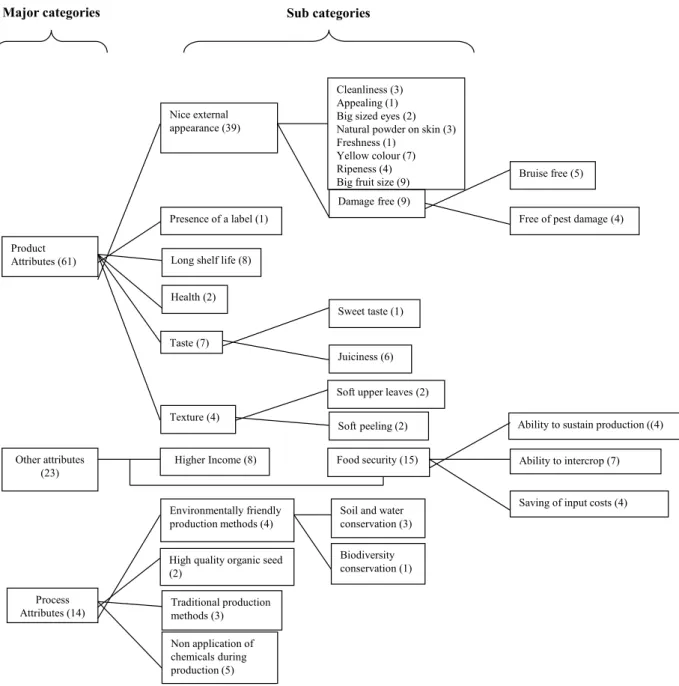
The taxonomy representing the farmers’ food quality perception following Grunert & Grunert (1995); Brunsø
et al. (2002) and Peri (2006) is presented in Fig. 2.
Farmers mainly described quality in organic pineapples in terms of product attributes (61 mentions) followed by food security (15 mentions) and lastly process attributes. The quality descriptions by farmers were classified into major categories and sub categories to enable the iden-tification of key themes relevant to the study objectives (ATLAS.ti, 1999; Thomas, 2003).
3.2.1 Product attributes
Among the product attributes mentioned by the farm-ers, nice external appearance, long shelf life, and taste in that order were the most frequently mentioned items as depicting quality. The presence of a certification la-bel had the least significance in terms of product at-tributes. As concerns appearance, the farmers mainly emphasized big fruit size and absence of damages on fruits as critical indicators of quality. They believed that big pineapples were capable of feeding more fam-ily members compared to the small sized ones. Farmers regarded taste as a key quality element stating that or-ganic pineapples had a better flavour than conventional ones because they are grown under “natural conditions”. Non damaged fruits were viewed as being less prone to rotting and thus possessed better quality.
3.2.2 Process attributes
Among the process attributes, non-application of chemicals2during the production process was perceived as the most crucial indicator of quality in organic apples. For instance one farmer stated: “Organic
pine-apples possess quality because they have been grown without the use of chemical inputs” (Female farmer, 27
years old). Chemicals were seen as poisonous to hu-man beings and the environment. Other process attrib-utes in order of frequency of mention by the farmers included environmental friendly and traditional produc-tion methods. The environmentally friendly methods fo-cused mainly on soil and water conservation practices like mulching with coffee husks. Farmers believed that such practices conserved soil fertility and eventually im-proved the quality of the environment. Traditional farm-ing methods were viewed as organic quality signals be-cause according to the farmers, both traditional and or-ganic production systems didn’t involve the application
Fig. 2: Taxonomy of attributes representing quality perception as mentioned by the pineapple farmers in interviews
The numbers depict the number of mentions attributed to a particular quality attribute
of chemicals and thus would end up with products of the same quality. For instance, they argued that for pest con-trol both systems used cultural methods (e.g. intercrop-ping) whereas for soil fertility enhancement both ap-proaches used organic fertilisers (manure, coffee husks). One farmer stated: “Organic quality is all about
grow-ing good pineapples by traditional means as practiced by our grandparents i.e. without applying chemical fer-tilisers” (Male farmer, 43 years old).
3.2.3 Other attributes
This category includes attributes that neither repre-sent product nor process attributes. These include food
security provision and income. Provision of food secur-ity as a qualsecur-ity characteristic was based on two factors; ability to intercrop with food crops and food produc-tion longevity. With regard to intercropping one farmer stated: “When I farm pineapples organically, I’m able
to get food especially bananas in addition to the pine-apples within the same field” (Male farmer, 37 years
external inputs. They argued that in organic banana-pineapple intercrop systems, food would be produced more cheaply (since locally available inputs would be used) and for a longer time. Chemicals were believed to shorten the soil’s natural fertility. With a reduced span of soil fertility, conventional systems reduced the ability of the plot of land to produce food in the long term. In addition, farmers pointed out that in organic pineapple systems they had to plant banana intercrops at a closer spacing (15 ft instead of the recommended 20 ft) in order to provide more shade for the pineapples. This enabled them to get the smaller ‘export size quality’ pineapples demanded by the companies. With the closer spacing of 15 ft in organic plots, farmers can plant up to 300 ba-nana plants compared to the close to 225 plants in con-ventional plots. However farmers noted that the banana bunches harvested from organic plots were smaller in size compared to those from conventional plots. Be-cause of the smaller size, the farmers fetched a lower price of≈2.68€/bunch compared to≈4.02€/bunch from conventional systems.
Income also played a key role in the farmers’ quality perception as one farmer stated: “To me a quality
pine-apple is one which I can reap high income and profits to cater for my household needs” (Female farmer, 30
years old). This was reinstated by farmer pleas to have the pineapple sale price raised. Conspicuously, farmers didn’t at all describe organic quality in terms of organic certification standards.
3.3 What are the activities farmers carry out to attain quality in organic pineapples?
The majority of farmers singled out proper agronomic and post-harvest practices as the main activities aimed at attaining quality (Table 1).
Firstly, farmers pointed out that to attain quality they had to get good planting material from an organic field and also carry out proper ploughing of the field. The next steps entailed ensuring that the garden is weed free and the application of organic fertilisers. Proper harvest-ing and postharvest practices had to be followed through a number of sequential steps. First of all the pineapple had to be ripe, then it had to be cut and transported carefully to a shade while being careful to avoid dam-age. Indeed field observations confirmed that farmers carefully cut the pineapples and placed them on banana leaves or under a tree to create a cool environment for quality maintenance.
Farmers also emphasized field hygiene at this stage. For example, within the packing shade, any pests or in-sects had to be removed. Finally, the farmers had to sort
and grade the pineapples based on appearance attributes. They would then pack them in boxes of a particular size given to them by the exporting companies. Field ob-servations confirmed farmers packing small sized apples in boxes that would carry a maximum of six pine-apples. These would then be picked up by a truck be-longing to the export company.
3.4 What are the main challenges farmers experience in trying to attain quality?
The main challenges reported by farmers were related to production input issues (Table 2). Notably, although the challenge of weeds was mentioned less frequently than the challenge of profitability, it was mentioned by a greater number of farmers.
Farmers mentioned high costs of inputs particularly coffee husks, labour, protective clothing as their ma-jor hindrances in attaining quality. Labour and organic fertilisers combined accounted for over 70 % of their total production costs. Farmers pointed out that in or-der to produce quality pineapples, one needed three lor-ries of coffee husks worth 1,800,000 Ushs (482€) per acre (0.4 ha) which was quite expensive. Farmers also mentioned that labour costs per manual weeding were now approximately 55€/acre which they deemed ex-pensive. Moreover, a farmer had to weed once every month during the dry season and twice per month dur-ing the rainy season. The farmers also complained of an inadequate premium price which according to them had remained stagnant at≈0.21€ per fruit for over 6 years. This put the farmers in a very difficult situation for business because of the reduced net disposable in-come they now got from organic pineapple cultivation. This was exacerbated by the current increase in living expenses (e.g. school fees). The high cost of living led to some farmers switching to conventional farming which also highlighted the importance of income as a quality attribute. One farmer narrated: “The costs of
growing pineapples are high because of the labourers who charge us a lot and as you know the cost of things has gone up now in Uganda. So the premium price is no longer enough, we beg that it is increased. Actually that is why you see some people have now switched to conventional pineapple growing because the production costs (time and labour) are lower and you can get ready market in Sudan” (Male farmer, 29 years old).
Table 1: Farmers practices aimed at attaining organic quality
Activity mentioned by farmers Number of mentions by farmers
Number of farmers who mentioned attribute
Percentage of farmers who mentioned attribute
Proper agronomic practices in the field 29 27 96 %
Non application of chemicals 20 17 60 %
Proper harvest and postharvest practices 27 25 89 %
Table 2: Main challenges faced by farmers in attaining quality
Challenge Mentions Number of farmers who mentioned item
Percentage of farmers who mentioned attribute
Production input issues (High costs, scarcity) 34 28 100 %
Decreased profitability 26 10 36 %
Weeds 25 24 86 %
Pricking in the field 09 07 25 %
4
Discussion
4.1 What are the farmers’ perceptions of quality in or-ganic pineapples?
Results show that product attributes (specifically ap-pearance, taste, long shelf life) and food security play the most significant role in what is associated with qual-ity by farmers. Prior studies have shown that appear-ance and taste are key quality attributes in fruits (Bar-rett et al., 2010) and food products in general (Grunert, 1995; Grunert et al., 2001, 2004; Grunert, 2005; Peri, 2006). Farmers would prefer nice appearing fruits be-cause this is one of the first basic quality criteria any buyer would demand. Appearance attributes specific-ally colour and size exist in both farmers’ quality per-ceptions and official regulations (Table 3). However, deeper probing and follow up discussions among farm-ers revealed differences in the specifications of what they viewed as quality and what the traders demanded as quality. For instance, the farmers viewed yellow coloured and bigger pineapples as having better qual-ity than the small sized, moderately ripe ones that the company demands from them. Small pineapple size de-mands from the organic export companies in Uganda have been documented by earlier studies. For instance Bolwig & Odeke (2007) as well as Bolwig (2012) re-ported that organic pineapple farmers in central Uganda operating under Biofresh, an organic pineapple export-ing company had to specifically produce small sized pineapples of 1–1.6 kgs as a quality requirement. The farmers under this scheme had to plant the pineapples
produc-Table 3: A comparison of farmers’ quality perception with official quality requirements for organic pineapples
Farmers quality perception attributes Organic standards requirements
Codex Alimentarius standard for pineapples
requirements
Importer requirements/ Export Markets
Non-application of chemicals a a
Health and safety (no contaminants) a a
Environmental friendly production methods X X
Appearance X
High quality organic seed X X
Juiciness X a a
Taste X
Traditional production methods X X X
Texture X X X
Label
Food security provision X X X
Long shelf life X X X
Income X X X
implies that the attribute in question is present in that particular standard/quality requirement.
XImplies that the attribute in question is absent in that particular standard/quality requirement.
aMaximum residue limits specified.
Source: Adapted from Augstburger et al. (2001); FAO & WHO (2011); IFOAM (2012).
tion costs as the major expenditure items from pine-apple revenues. Therefore the current rise in the prices of any of these items will reduce the net disposable in-come available to farmers to purchase food. We argue that despite the claims by Bolwig & Odeke (2007) that there are purely positive food security effects from or-ganic pineapple farming, there are certain hidden nega-tive food security elements within such schemes. In-terestingly, the previous studies done on food security effects of organic pineapple farming (UNCTAD, 2008) followed predominantly qualitative approaches. There-fore, there is still need for more comprehensive infer-ential statistical based studies to quantify the net food security effects of organic pineapple farming. Such ap-proaches would go a long way in accurately determining the real impact of organic pineapple schemes on food security among smallholder farmers. This is now even more paramount given that this study has shown that food security is recognised as a quality attribute among smallholder farmers.
The results further show differences and similarities between farmers’ quality perception and official regula-tory requirements (Table 3). Non application of chemic-als and juiciness represent some of the attributes prom-inent in both official standards and farmers’ perceptions.
Despite non-application of chemicals being a formal re-quirement in organic standards, Ugandan farmers have generally not been applying synthetic chemicals in their gardens overtime (Taylor, 2006). We argue along with Preißel & Reckling (2010) that this is not because they can’t afford them. They just have concern and care for the environment, an assertion supported by the fact that they view non-application of chemicals and other en-vironmentally friendly production methods as quality attributes of organic pineapples. For instance, a study by Sseguya et al. (1999) in central Uganda showed that farmers viewed organic inputs as the most appropriate for crop yield and soil fertility improvement while in-organic inputs were perceived to be harmful. Similar to this, results from a study by Chongtham et al. (2010) showed that Ugandan organic fruit farmers participate in organic fruit production schemes because they deemed them appropriate for the environment.
Other attributes namely food security, long shelf life, traditional production methods and high income (min-imum adequate price to cater for inflation) are con-spicuously absent in all official (formal) quality regula-tions. The absence of food security and income aspects in the official standards has two implications respect-ively: first although food security is considered as one of the elements of the core principles of organic farm-ing (IFOAM, 2012), it’s absence in the organic stand-ards depicts a slight contradiction between the values and actual practice of organic agriculture. Secondly, even if organic produce commands a premium price, there is no set minimum price farmers are supposed to receive for their produce which as a consequence makes them vulnerable to market forces of supply and demand. There have also been reports of farmers not receiving their premium at all (Chongtham et al., 2010) which is contrary to the ethical quality claimed to be in-herent in organic farming (Noe & Alrøe, 2011). The situation is aggravated by the high production input costs especially labour and organic fertilisers which have also been found to hinder organic farming by previ-ous studies in Uganda (Bolwig, 2012) and even in some European countries like Norway (Flaten et al., 2010). Farmers now require 3 lorries of coffee husks (per acre of pineapple plantation) now worth≈482€up from the 381€reported by Chongtham et al. (2010). The costs of manual weeding per acre has gone up from 50€ reported by Preißel & Reckling (2010) to 55€. This shows the increasing hardships and reduced profitability organic pineapple farmers are facing over the years. Ac-cording to the farmers, this has led to some of their col-leagues to abandon the organic pineapple schemes a few seasons after joining them although they still “wished to conserve the environment”. Therefore, overall income aspects need to be strongly mainstreamed in the formal values and practice of organic farming. This is even more prudent given that farmers also view it as a quality signal.
Farmers association of organic pineapple quality with longer shelf life can be explained by the immense diffi -culties smallholder fruit farmers in Uganda face in keep-ing produce fresh for the export market as most can’t af-ford refrigeration facilities (Ndlovu, 2009). A fresh food product that would be able to stay longer in absence of refrigeration facilities would hence symbolise quality.
We have shown how farmers believe that both organic and traditional production systems end up with products of the same quality (section 3.2.2). This is a clear illus-tration of how tradition influences farmers’ quality per-ceptions. Such interpretations are misleading because organic farming is not only about non-application of
chemicals (Scialabba & Hattam, 2002). It is about the fulfilment of all the four organic agriculture principles of Care, Health, Ecology and Fairness in their farm-ing practice (IFOAM, 2009, 2013). Although Preißel & Reckling (2010) note that organic fruit farmers practice traditional production methods to a lesser extent, our re-sults reveal that they still strongly value these traditional farming techniques.
This study has shown for the first time that Ugandan organic farmers do not define quality in terms of organic certification standards yet these standards represent the very rules or norms that govern their day to day organic production practices. Furthermore, the presence of a certification label on the organic pineapple package car-ries minimal significance in terms of what farmers ap-preciate as organic quality. Even in instances where they defined quality in terms of attributes that are part of the official standards (Table 3), they don’t at all relate such attributes to the said standards. Farmers are trained and inspected for compliance to quality attributes inherent in the organic standards and yet they don’t seem to relate organic quality to these standards. They view standards as checklist items/requirements that they simply have to follow (Dimara et al., 2004) in order to access the premium. This highlights the effects of the top down passive mode of training internal control system staff use to train farmers in Uganda (Preißel & Reckling, 2010). Giovannucci & Ponte (2005) have indicated that organic standards are not developed with farmers’ ac-tive participation and as such they end up not fully ap-preciating the rationale behind them. It is a deviation from the original organic movement ideologies where decision making is removed from the farmers for whom the standards are meant (González & Nigh, 2005).
5
Conclusion
as quality. Farmers, therefore, seem not to be prop-erly trained on the relationship between “organic
stand-ards” and “organic quality”. Consistently documented
challenges facing Ugandan organic pineapple farmers’, namely high labour and organic fertiliser costs, have still not been addressed over a six year span. This calls for urgent remedial action from the organic agriculture pro-moters and business beneficiaries particularly exporters in Uganda. Such actions would include more intense promotion of coffee replanting in the area to counter-act the scarcity problem that hikes the husks prices. The National Organic Agriculture Movement of Uganda (NOGAMU) should work hand in hand with its part-ners (donors, exporters, importers, organic agriculture advocators, consumer bodies in Europe) to ensure that farmers’ premium price is increased. NOGAMU should also continue lobbying government for the enactment of an official organic policy. With such a policy or-ganic agriculture will be recognised as a core avenue for sustainable rural development and given financial back-stopping by the government.
Acknowledgement
Thanks to the Austrian Partnership Programme in Higher Education and Research for Development (AP-PEAR) for funding this study.
References
Allaire, G. (2010). Applying economic sociology to un-derstand the meaning of “Quality” in food markets.
Agricultural Economics, 41, 167–180.
ATLAS.ti (1999). Atlas program. ATLAS.ti Sci-entific Software Development GmbH, Berlin,
Ger-many. URL http://www.atlasti.com/index.
html(last accessed: 5 Jan. 2013).
Augstburger, F., Berger, J., Censkowsky, U., Heid, P., Milz, J. & Streit, C. (2001). Organic farming in the tropics and sub tropics: Exemplary description of Pineapples. Grafelfing, Germany.
Barrett, D. M., Beaulieu, J. C. & Shewfelt, R. (2010). Color, flavor, texture, and nutritional quality of fresh-cut fruits and vegetables: desirable levels, instru-mental and sensory measurement, and the effects of processing. Critical Reviews in Food Science and
Nu-trition, 50 (5), 369–389.
Barrett, H. R., Browne, A. W., Harris, P. J. C. & Cadoret, K. (2002). Organic certification and the UK market: organic imports from
develop-ing countries. Food Policy, 27 (4), 301–318. doi: http://dx.doi.org/10.1016/S0306-9192(02)00036-2.
Bernard, H. R. (1998). Handbook of methods in cultural
anthropology. AltaMira Press, Wainut Creek.
Bolwig, S. (2012). Poverty and Gender Effects of Small-holder Organic Contract Farming in Uganda: IFPRI Uganda Strategy Support Program Working Paper. IFPRI, Kampala, Uganda.
Bolwig, S. & Odeke, M. (2007). Household food se-curity effects of certified organic export production in tropical Africa: a gendered analysis. Export promo-tion of organic products from Africa (EPOPA), Ben-nekom, The Netherlands.
Briz, T. & Ward, R. (2009). Consumer awareness of organic products in Spain: An application of multi-nominal logit models. Food Policy, 34 (3), 295–304.
Brunsø, K., Fjord, T. A. & Grunert, K. G. (2002).
Con-sumers’ food choice and quality perception. Aarhus
School of Business, MAPP-Centre for Research on Customer Relations in the Food Sector.
Burton, R. J. (2004). Reconceptualising the ‘beha-vioural approach’ in agricultural studies: a socio-psychological perspective. Journal of Rural Studies, 20 (3), 359–371.
Busck, A. G. (2002). Farmers’ landscape decisions: relationships between farmers’ values and landscape practices. Sociologia Ruralis, 42 (3), 233–249.
Chongtham, I. R., de Neergaard, A. & Pillot, D. (2010). Assessment of the strategies of organic fruit produc-tion and fruit drying in Uganda. Journal of
Agricul-ture and Rural Development in the Tropics and Sub-tropics, 111 (1), 23–34.
Corbin, J. & Strauss, A. (1990). Grounded Theory Re-search: Procedures, Canons and Evaluative Criteria.
Qualitative Sociology, 13 (1), 3–21.
Creswell, J. W. (2000). Qualitative, Quantitative and
Mixed Methods Approaches (3rd ed.). SAGE
Public-ations Inc, Los Angeles.
Dey, I. (1993). Qualitative data analysis. A user-friendly guide for social scientists. Routledge,
Lon-don and New York.
DIVA-GIS (2013). DIVA-GIS Data. URL http:// www.diva-gis.org
Dresing, T. & Pehl, T. (2012). F4
audiotranskrip-tion. URL http://www.audiotranskription.
de/english/contact/about-us (last accessed: 10 Nov. 2012).
Edmeades, S. (2006). Varieties, attributes and marketed surplus of a subsistence crop: bananas in Uganda. Pa-per presented at the International Association of Agri-cultural Economists conference, Gold Coast, Aus-tralia, 12–18th August. pp. 1-16.
FAO & WHO (2011). Codex Standard for pineapples (CODEX STAN 182-1993). Rome.
Flaten, O., Lien, G., Koesling, M. & Løes, A.-K. (2010). Norwegian farmers ceasing certified organic produc-tion: Characteristics and reasons. Journal of En-vironmental Management, 91 (12), 2717–2726. doi:
http://dx.doi.org/10.1016/j.jenvman.2010.07.026.
Giovannucci, D. & Ponte, S. (2005). Standards as a new form of social contract? Sustainability initiatives in the coffee industry. Food Policy, 30 (3), 284–301.
Glaser, B. G. & Strauss, A. L. (1967). The discovery of
grounded theory: Strategies for qualitative research.
Aldine de Gruyter, New Jersey.
González, A. A. & Nigh, R. (2005). Smallholder parti-cipation and certification of organic farm products in Mexico. Journal of Rural Studies, 21 (4), 449–460.
Grunert, K. G. (1995). Food quality: A means-end perspective. Food Quality and Preference,
6 (3), 171–176. doi:http://dx.doi.org/10.1016/ 0950-3293(95)00011-W.
Grunert, K. G. (2005). Food quality and safety: con-sumer perception and demand. European Review of
Agricultural Economics, 32 (3), 369–391.
Grunert, K. G., Bredahl, L. & Brunsø, K. (2004). Con-sumer perception of meat quality and implications for product development in the meat sector–a review.
Meat Science, 66 (2), 259–272.
Grunert, K. G. & Grunert, S. C. (1995). Meas-uring subjective meaning structures by the ladder-ing method: Theoretical considerations and meth-odological problems. International Journal of Research in Marketing, 12 (3), 209–225. doi: http://dx.doi.org/10.1016/0167-8116(95)00022-T.
Grunert, K. G., Lähteenmäki, L., Asger Nielsen, N., Poulsen, J. B., Ueland, O. & Åström, A.
(2001). Consumer perceptions of food products in-volving genetic modification—results from a qual-itative study in four Nordic countries. Food Quality and Preference, 12 (8), 527–542. doi: http://dx.doi.org/10.1016/S0950-3293(01)00049-0.
Hine, R. & Pretty, J. (2007). Capacity Building Study
3: Organic Agriculture and Food Security in East Africa. Promoting production and Trading opportun-ities for Organic Agricultural products in East Africa.
New York and Geneva.
IFOAM (2009). The principles of organic agri-culture. IFOAM - Organics International e.V.
URL
http://www.ifoam.bio/en/organic-landmarks/principles-organic-agriculture
IFOAM (2012). The IFOAM norms for Organic produc-tion and processing: Version 2012. IFOAM, Bonn, Germany. pp. 1–131.
IFOAM (2013). IFOAM Family of standards.
URL http://www.ifoam.org/sites/default/
files/page/files/familyframe_web_1.pdf (last accessed: 1 Jul. 2013).
Ilbery, B. & Kneafsey, M. (2000). Producer con-structions of quality in regional speciality food pro-duction: a case study from south west England.
Journal of Rural Studies, 16 (2), 217–230. doi: http://dx.doi.org/10.1016/S0743-0167(99)00041-8.
Kneafsey, M. & Ilbery, B. (2001). Regional images and the promotion of speciality food and drink in the West Country. Geography, 131–140.
Lyons, K., Palaniappan, G. & Lockie, S. (2013). Or-ganic agriculture governance in the Global South: new opportunities for participation in agricultural de-velopment and livelihood outcomes. In: Halberg, N. & Muller, A. (eds.), Organic Agriculture for
Sustain-able Livelihoods. pp. 132–153, Routledge, London.
Mason, J. (2002). Qualitative Researching (2nd ed.). SAGE Publications, London, Thousand Oaks and New Delhi.
McCalla, A. F. (1999). Prospects for food security in the 21st Century: with special emphasis on Africa.
Agricultural Economics, 20 (2), 95–103.
Namuwoza, C. & Tushemerirwe, H. (2011). Uganda: Country Report. In: Willer, H. & Kilcher, L. (eds.),
The World of Organic Agriculture. Statistics and Emerging Trends 2011. pp. 117–120, IFOAM and
FiBL, Bonn, Frick.
Ndlovu, L. B. (2009). Expert Meeting of LDCs in pre-paration for the 4th United Nations Conference on the Least Developed Countries: UNCTAD.
Noe, E. & Alrøe, H. F. (2011). Quality, coherence and co-operation: A framework for studying the medi-ation of qualities in food networks and collective mar-keting strategies. International Journal of Sociology
of Agriculture and Food, 18 (1), 12–27.
O’Connor, H. & Gibson, N. (2003). A step by step guide to Qualitative Data Analysis. Pimatiziwin: A Journal of Aboriginal and Indigenous Community Health, 1 (1), 63–90.
Patton, M. Q. (1999). Enhancing the quality and credib-ility of qualitative analysis. Health services research, 34 (5 Pt 2), 1189.
Peri, C. (2006). The universe of food quality.
Food Quality and Preference, 17 (1-2), 3–8. URL http://dx.doi.org/10.1016/j.foodqual. 2005.03.002
Preißel, S. & Reckling, M. (2010). Smallholder group certification in Uganda–Analysis of internal control systems in two organic export companies. Journal
of Agriculture and Rural Development in the Tropics and Subtropics, 111 (1), 13–22.
Ruben, R., Saenz, F. & Zúñiga-Arias, G. (2005). Con-tracts or rules: quality surveillance in Costa Rican mango exports. In: Hofstede, G. J., Spaans, L., Schepers, H., Trienekens, J. H. & Beulens, A. J. M. (eds.), Hide or confide? The Dilemma of
Transpar-ency. pp. 51–58, Reed Business Information (Chains
and networks), Sutton.
Scialabba, N. & Hattam, C. (2002). Organic
Agricul-ture, Environment and Food Safety. FAO, Rome.
Scott, W. R. (1994). Institutions and organizations: to-wards a theoretical synthesis. In: Scott, W. R. & Meyer, J. W. (eds.), Institutional environments and
organizations - Structural complexity and individual-ism. pp. 55–80, SAGE, London.
Sseguya, H., Semana, A. & Bekunda, M. (1999). Soil fertility management in the banana-based agriculture of central Uganda: farmers constraints and opinions.
African Crop Science Journal, 7 (4), 559–567.
Taylor, A. (2006). Overview of the Current state of
Or-ganic Agriculture in Kenya, Uganda and United Re-public of Tanzania: Opportunities for Regional Har-monization. UN, New York and Geneva.
Thomas, D. R. (2003). A general inductive approach
for qualitative data analysis. School of Population
Health, University of Auckland, New Zealand.
Trienekens, J. H., Wognum, P. M., Beulens, A. J. M. & van der Vorst, J. G. A. J. (2012). Transpar-ency in complex dynamic food supply chains.
Ad-vanced Engineering Informatics, 26 (1), 55–65. doi:
http://dx.doi.org/10.1016/j.aei.2011.07.007.
UNCTAD (2008). Certified Organic Export Production.
Implications for economic welfare and gender equal-ity among smallholder farmers in tropical Africa.
United Nations, Geneva.