The Journey to the Cloud
for Life Sciences Content
Management
Page
Table of Contents
Executive Summary 2
Industry Forces in Conflict 3
Risk Aversion in Life Sciences: Protecting Vital Intellectual Property 4
Executive Summary
Life sciences organizations—spanning large global companies down to smaller industry players—all face the same burdens of increasing cost pressure, fragmenting value chains, expanding regulatory compliance and exploding content volumes. The need for stronger regulated content management has never been more important to ensure compliance and fast time to market in an increasingly complex and challenging environment. Smaller and mid-size companies certainly have additional cost and resource constraints, but they still need proven industry best practices in this area to maintain compliance of their documents. The task for companies of all sizes is to rationalize their pressing business needs with the available vendor solution options. Given the benefits and rapid growth of cloud- and Software as a Service (SaaS)-based applications in the broader IT industry, is that now a viable option for regulated content management in the life sciences?
To address this question, ORC International conducted a two part analysis into cloud adoption and the business needs of, and solution options for, regulated content
management in the life sciences. In part one of the analysis, ORC found three leading factors forcing pharmaceutical and biotech companies to be somewhat reluctant to fully embrace public cloud solutions.
Life science
industry
forces are in
conflict
• Some factors, like increased cost and
time-to-market pressure, make cloud solutions more
compelling, while other factors, such as industry
fragmentation and globalization, make it less so.
Regulated
content
management
is essential
• Pharmaceutical and biotech companies have a
pervasive need for regulated content
management, and their risk averse nature has
slowed the embrace of cloud as they voraciously
protect their most vital intellectual assets.
Adoption
follows the
path of least
regulation
• When companies have adopted public cloud,
SaaS-based solutions for life sciences content
management, they have traditionally done so in
lesser regulated functions such as sales, marketing
and HR, where information is less risky.
Industry Forces in Conflict
Key ORC Takeaway: Cost pressures, an increasingly fragmented value chain, and expanding global compliance requirements are exerting conflicting influences on cloud adoption.
With an average cost in the range of $1B to $5B to bring a drug to market1, it is not
surprising that pharmaceutical and biotech companies are increasingly looking for ways to keep costs in check while maintaining strict compliance and minimizing business risk. To that end, outsourcing is on the rise; recent research finds 59% of life sciences companies outsourcing late stage clinical trials to Clinical Research Organizations (CROs)2. While reducing cost, it also increases reliance on
3rd party participation in key and sensitive business
processes performed outside of the firewall.
At the same time, there is staggering growth in the amount of content generated in the process of bringing drugs to market. From a documentation standpoint, firms need to plan for, collect, track, secure and maintain a multitude of content across highly regulated, inter-company business processes. A typical clinical trial alone can generate 25,000 documents2; and this is just one of the many
processes in the broader life sciences business operations. Finally, as companies expand into new geographies to maximize product revenue opportunities, their needs may change based on unique regulatory environments of the locales they conduct business in. When it comes to
compliance, there are many different requirements around
clinical information, regulatory submissions and generally introducing and sustaining drugs in those local markets.
1Forbes, August 11, 2013 2 FierceBiotechIT, Jan 27, 2014
“There is a high level of compliance complexity for
life sciences companies operating globally. Public cloud solutions work best for smaller companies that are geographically limited.
It is much harder, and more costly, for organizations to use cloud in one area of the business
while using different solutions in others.”
Program Manager Mid-Market Specialty Pharmaceutical Company
Risk Aversion in Life Sciences: Protecting Vital Intellectual Property
Key ORC Takeaway: Pharmaceutical and biotech companies have a pervasive need for compliant regulated content management and their risk averse nature has slowed the embrace of cloud as they voraciously protect their most vital intellectual assets.
More so than their non-regulated business counterparts, it can be said that content represents the “lifeblood” of the life sciences business. Virtually every major functional area in life sciences has a high dependency on the ability to effectively manage content. Many functions have the need to track-and-trace document-based information from a regulatory standpoint. In other words, they need regulated content management for the key functions and for all parties involved in business processes through the extended value chain. Huge conglomerate or emerging start-up, effective management of regulated content is a basic need.
It is easy to understand the importance of security when considering the types of
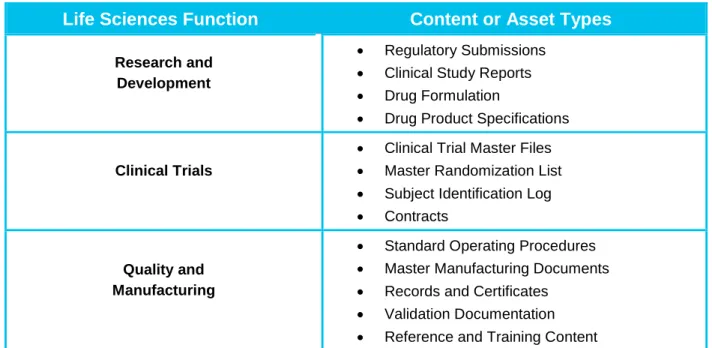
intellectual property and proprietary content life sciences firms produce and manage on a day-to-day basis. Some of the key content categories and assets aligned to the major regulated functions are listed in Table 1. While this list is the most common set,
companies also have their own unique and proprietary assets as well.
Table 1. Sample of “lifeblood” Documents by Function
Life Sciences Function Content or Asset Types
Research and Development
Regulatory Submissions
Clinical Study Reports
Drug Formulation
Drug Product Specifications
Clinical Trials
Clinical Trial Master Files
Master Randomization List
Subject Identification Log
Contracts
Quality and Manufacturing
Standard Operating Procedures
Master Manufacturing Documents
Records and Certificates
Validation Documentation
It is not at all a stretch to call these the most vital intellectual property for life sciences firms and offers a good explanation why many of these organizations are more risk averse when it comes to their IT solution approach.
Regulations require a controlled method of
management over a sponsor’s proprietary information and inspections look for these controlled methods and provide judgment as to sufficiency of controls. Many companies want control over where information is stored and when upgrades take place. That said, as technology options for cloud deployment matures, even the more risk averse firms are investigating alternative deployment options in some of these content areas, but likely not all.
Public Cloud Adoption in Life Sciences
Key ORC Takeaway: Adoption of public cloud, SaaS-based solutions for life sciences content management to date has traditionally occurred in lesser regulated functions such as sales, marketing and HR where information is less risky.
Conducting interviews with implementers and end users of pure SaaS solution provider customers, ORC research findings indicate that most SaaS deployments are for the lesser regulated business processes (CRM, Marketing, HR etc.) for which the material, while sensitive, is nowhere near as critical compared to the more regulated functions. In fact, of the twenty five deployments of SaaS-based life sciences content management analyzed, less than 15% were used for functions beyond sales and marketing. The primary benefit of the deployments center around the collaboration among the internal and external parties and driving efficiency and productivity of document-intensive processes.
Not surprisingly, small and mid-size organizations are the ones who have been the early adopters of cloud offerings, finding the benefits typically associated with public cloud including rapid deployment, accelerated user adoption, and less reliance on internal IT resources. Despite the subscription pricing offered by SaaS providers, however, these
“An issue beyond the regulatory aspect is that companies are not ready
to part with their confidential documents, leaving them in someone else’s hands. They want to
avoid the legal issues altogether. Security is a big
issue for public cloud adoption.” Sr IT Project Manager Cardiovascular Research
customers were mixed regarding the longer-term cost profile. With a considerable initial outlay and recurring costs based on growing volumes and storage, many did not find it dramatically lower cost than on-premise offerings.
Larger organizations interviewed cited a number of concerns and impediments to embracing public cloud offerings including growing content volumes, concerns over file size limitations, the cost and time for migration from existing systems and their ability to integrate with internal applications and
infrastructure.
Finally, many expressed a concern around engaging and managing another vendor
relationship for content management understanding that the content management capability footprint of the SaaS provider may only serve a few functional areas and may not be a holistic solution for them. Running multiple platforms for content management can dampen or even negate the benefits of the cloud deployment.
In Part 2 of ORC International’s research and analysis on cloud adoption for life sciences, ORC will identify the business needs of both large and
mid-size life sciences companies and provide a landscape of two unique classes of current day solution options for regulated content management. We will demonstrate why the journey to the cloud may not necessarily be the binary decision as it has been for other IT solution areas and why regulated content management maturity and solution flexibility might rule the day.
“It is easier for a small company to use a SaaS
solutions with content management for a specific
function, but it would be a huge challenge for a larger
organization because it cannot cover the needs
across the broader business. They would end
up with a dual environment.”
IT Director
Fortune 50 Pharmaceutical Company