SLOA058– November 2000
A Single-Supply Op-Amp Circuit Collection
Bruce Carter Op-Amp Applications, High Performance Linear Products
One of the biggest problems for designers of op-amp circuitry arises when the circuit must be operated from a single supply, rather than ±15 V. This application note provides working circuit examples.
Contents
1 Introduction ... 3
1.1 Split Supply vs Single Supply... 3
1.2 Virtual Ground... 4
1.3 AC-Coupling ... 4
1.4 Combining Op-Amp Stages ... 5
1.5 Selecting Resistor and Capacitor Values ... 5
2 Basic Circuits ... 5 2.1 Gain... 5 2.2 Attenuation ... 6 2.3 Summing ... 9 2.4 Difference Amplifier ... 9 2.5 Simulated Inductor ... 9 2.6 Instrumentation Amplifiers ... 10 3 Filter Circuits ... 12
3.1 Single Pole Circuits... 13
3.1.1 Low Pass Filter Circuits ...13
3.1.2 High Pass Filter Circuits...13
3.1.3 All-Pass Filter ...14 3.2 Double-Pole Circuits ... 15 3.2.1 Sallen-Key...15 3.2.2 Multiple Feedback (MFB)...16 3.2.3 Twin T ...17 3.2.4 Fliege ...20 3.2.5 Akerberg-Mossberg Filter ...22 3.2.6 BiQuad ...24 3.2.7 State Variable...25 4 References... 25
Appendix A – Standard Resistor and Capacitor Values ... 26
Figures 1 Split Supply (L) vs Single Supply (R) Circuits ...3
2 Single-Supply Operation at Vcc/2...4
3 AC-Coupled Gain Stages ...6
4 Traditional Inverting Attenuation With an Op Amp ...6
7 Inverting Summing Circuit ...9
8 Subtracting Circuit...9
9 Simulated Inductor Circuit ...10
10 Basic Instrumentation-Amplifier Circuit ...11
11 Simulated Instrumentation-Amplifier Circuit ...11
12 Instrumentation Circuit With Only Two Op Amps...12
13 Low-Pass Filter Circuits...13
14 High-Pass Filter Circuits...14
15 All-Pass Filter Circuit ...14
16 Sallen-Key Low- and High-Pass Filter Topologies ...16
17 Multiple-Feedback Topologies...17
18 Single Op-Amp Twin-T Filter in Band-Pass Configuration ...18
19 Single Op-Amp Twin-T Filter in Notch Configuration ...18
20 Dual-Op-Amp Twin-T Low-Pass Filter ...19
21 Dual-Op-Amp Twin-T High-Pass Filter ...19
22 Dual-Op-Amp Twin-T Notch Filter ...20
23 Low-Pass Fliege Filter...20
24 High-Pass Fliege Filter ...21
25 Band-Pass Fliege Filter ...21
26 Notch Fliege Filter ...22
27 Akerberg-Mossberg Low-Pass Filter ...22
28 Akerberg-Mossberg High-Pass Filter...23
29 Akerberg-Mossberg Band-Pass Filter...23
30 Akerberg-Mossberg Notch Filter...24
31 Biquad Low-Pass and Band-Pass Filter ...24
32 State-Variable Four-Op-Amp Topology ...25
Tables 1 Normalization Factors ...8
1 Introduction
There have been many excellent collections of op-amp circuits in the past, but all of them focus exclusively on split-supply circuits. Many times, the designer who has to operate a circuit from a single supply does not know how to do the conversion.
Single-supply operation requires a little more care than split-supply circuits. The designer should read and understand this introductory material.
1.1 Split Supply vs Single Supply
All op amps have two power pins. In most cases, they are labeled VCC+ and VCC-, but sometimes they are labeled VCC and GND. This is an attempt on the part of the data sheet author to
categorize the part as a split-supply or single-supply part. However, it does not mean that the op amp has to be operated that way— it may or may not be able to operate from different voltage rails. Consult the data sheet for the op amp, especially the absolute maximum ratings and voltage-swing specifications, before operating at anything other than the recommended power-supply voltage(s).
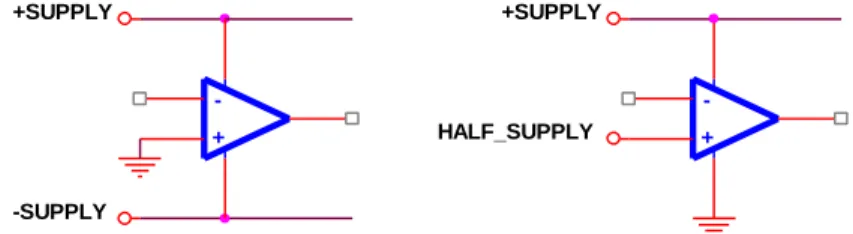
Most analog designers know how to use op amps with a split power supply. As shown in the left half of Figure 1, a split power supply consists of a positive supply and an equal and opposite negative supply. The most common values are ±15 V, but ±12 V and ±5 V are also used. The input and output voltages are referenced to ground, and swing both positive and negative to a limit of VOM±, the maximum peak-output voltage swing.
A single-supply circuit (right side of Figure 1) connects the op-amp power pins to a positive voltage and ground. The positive voltage is connected to VCC+, and ground is connected to V CC-or GND. A virtual ground, halfway between the positive supply voltage and ground, is the reference for the input and output voltages. The voltage swings above and below this virtual ground to the limit of VOM±. Some newer op amps have different high- and low-voltage rails, which are specified in data sheets as VOH andVOL, respectively. It is important to note that there are very few cases when the designer has the liberty to reference the input and output to the virtual ground. In most cases, the input and output will be referenced to system ground, and the designer must use decoupling capacitors to isolate the dc potential of the virtual ground from the input and output (see section 1.3).
-SUPPLY -+ +SUPPLY +SUPPLY HALF_SUPPLY -+
Figure 1. Split Supply (L) vs Single Supply (R) Circuits
A common value for single supplies is 5 V, but voltage rails are getting lower, with 3 V and even lower voltages becoming common. Because of this, single-supply op amps are often rail-to-rail
specifications can degrade close to the rails. Be sure to consult the data sheet for complete specifications on both the inputs and outputs. It is the designer’s obligation to ensure that the voltage rails of the op amp do not degrade the system specifications.
1.2 Virtual Ground
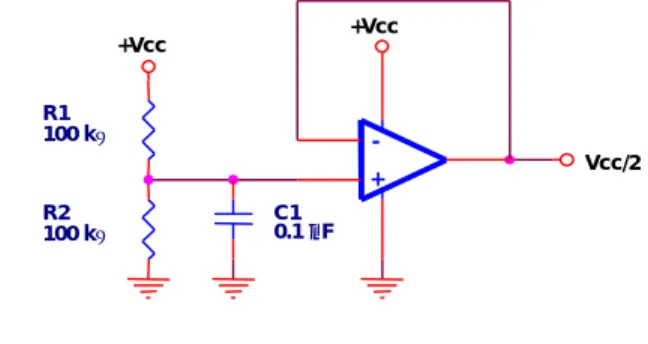
Single-supply operation requires the generation of a virtual ground, usually at a voltage equal to Vcc/2. The circuit in Figure 2 can be used to generate Vcc/2, but its performance deteriorates at low frequencies. R1 100 kΩ +Vcc +Vcc R2 100 kΩ -+ Vcc/2 C1 0.1 µF
Figure 2. Single-Supply Operation at VCC/2
R1 and R2 are equal values, selected with power consumption vs allowable noise in mind. Capacitor C1 forms a low-pass filter to eliminate conducted noise on the voltage rail. Some applications can omit the buffer op amp.
In what follows, there are a few circuits in which a virtual ground has to be introduced with two resistors within the circuit because one virtual ground is not suitable. In these instances, the resistors should be 100 kW or greater; when such a case arises, values are indicated on the schematic.
1.3 AC-Coupling
A virtual ground is at a dc level above system ground; in effect, a small, local-ground system has been created within the op-amp stage. However, there is a potential problem: the input source and output load are probably referenced to system ground, and if the op-amp stage is connected to a source that is referenced to ground instead of virtual ground, there will be an unacceptable dc offset. If this happens, the op amp becomes unable to operate on the input signal, because it must then process signals at and below its input and output rails.
The solution is to ac-couple the signals to and from the op-amp stage. In this way, the input and output devices can be referenced to ground, and the op-amp circuitry can be referenced to a virtual ground.
When more than one op-amp stage is used, interstage decoupling capacitors might become unnecessary if all of the following conditions are met:
• The first stage is referenced to virtual ground.
• There is no gain in either stage. Any dc offset in either stage is multiplied by the gain in both, and probably takes the circuit out of its normal operating range.
If there is any doubt, assemble a prototype including ac-coupling capacitors, then remove them one at a time. Unless the input or output are referenced to virtual ground, there must be an input-decoupling capacitor to decouple the source and an output-decoupling capacitor to decouple the load. A good troubleshooting technique for ac circuits is to terminate the input and output, then check the dc voltage at all op-amp inverting and noninverting inputs and at the op-amp outputs. All dc voltages should be very close to the virtual-ground value. If they are not, decoupling capacitors are mandatory in the previous stage (or something is wrong with the circuit).
1.4 Combining Op-Amp Stages
Combining op-amp stages to save money and board space is possible in some cases, but it often leads to unavoidable interactions between filter response characteristics, offset voltages, noise, and other circuit characteristics. The designer should always begin by prototyping
separate gain, offset, and filter stages, then combine them if possible after each individual circuit function has been verified. Unless otherwise specified, filter circuits included in this document are unity gain.
1.5 Selecting Resistor and Capacitor Values
The designer who is new to analog design often wonders how to select component values. Should resistors be in the 1-Ω decade or the 1-MΩ decade? Resistor values in the 1-kΩ to 100-kΩ range are good for general-purpose applications. High-speed applications usually use resistors in the 100-Ω to 1-kΩ decade, and they consume more power. Portable applications usually use resistors in the 1-MΩ or even 10-MΩ decade, and they are more prone to noise. Basic formulas for selecting resistor and capacitor values for tuned circuits are given in the various figures. For filter applications, resistors should be chosen from 1% E-96 values (see Appendix A). Once the resistor decade range has been selected, choose standard E-12 value capacitors. Some tuned circuits may require E-24 values, but they should be avoided where possible. Capacitors with only 5% tolerance should be avoided in critical tuned circuits— use 1% instead.
2 Basic Circuits
2.1 Gain
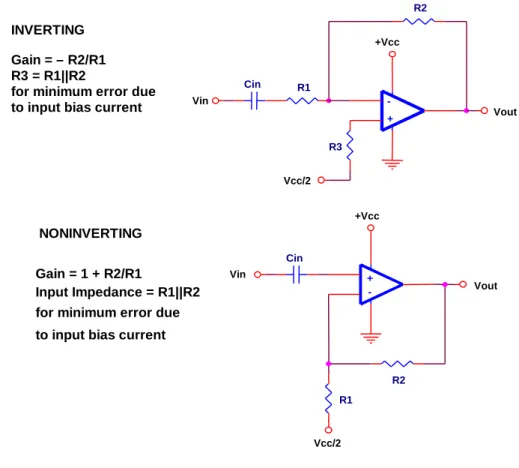
Gain stages come in two basic varieties: inverting and noninverting. The ac-coupled version is shown in Figure 3. For ac circuits, inversion means an ac-phase shift of 180°. These circuits work by taking advantage of the coupling capacitor, CIN, to prevent the circuit from having dc gain. They have ac gain only. If CIN is omitted in a dc system, dc gain must be taken into account.
It is very important not to violate the bandwidth limit of the op amp at the highest frequency seen by the circuit. Practical circuits can include gains of 100 (40 dB), but higher gains could cause the circuit to oscillate unless special care is taken during PC board layout. It is better to cascade
Vout R3 R2 Vcc/2 Gain = – R2/R1 R3 = R1||R2
for minimum error due to input bias current INVERTING R1 +Vcc -+ Vin Cin +Vcc R1 NONINVERTING + -Vin R2 Gain = 1 + R2/R1 Input Impedance = R1||R2 for minimum error due to input bias current
Vout
Vcc/2
Cin
Figure 3. AC-Coupled Gain Stages
2.2 Attenuation
The traditional way of doing inverting attenuation with an op-amp circuit is shown in Figure 4, in
Vout Gain = – R2/R1
R3 = R1||R2
for minimum error due
to input bias current Vin
Vcc/2 R1 R2 +Vcc R3 Cin -+ INVERTING
Figure 4. Traditional Inverting Attenuation With an Op Amp
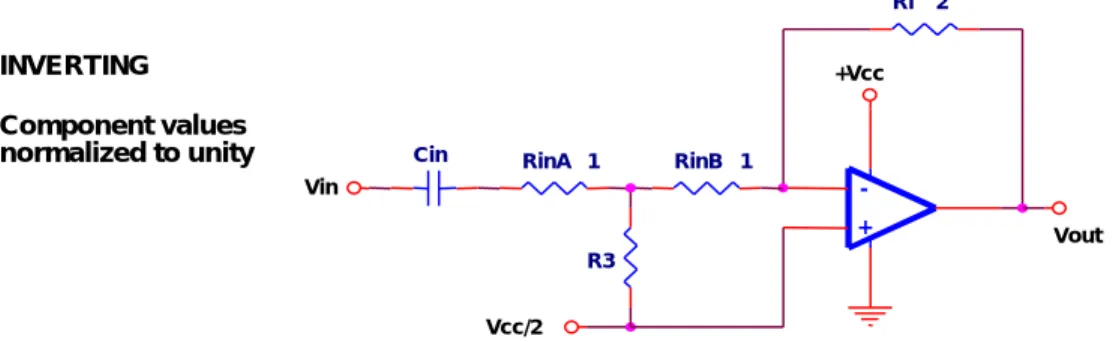
which R2 < R1. This method is not recommended, because many op amps are unstable at gains of less than unity. The correct way to construct an attenuation circuit1 is shown in Figure 5.
1
-+ RinA 1 +Vcc Vin Vcc/2 Component values
normalized to unity RinB 1
Rf 2
Vout INVERTING
R3 Cin
Figure 5. Inverting Attenuation Circuit
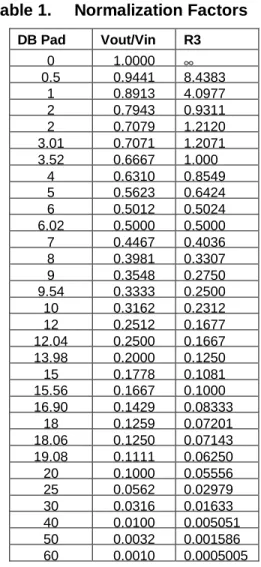
A set of normalized values of the resistor R3 for various levels of attenuation is shown in Table 1. For nontablated attenuation values, the resistance is:
(
O IN)
IN OV
V
V
V
R
2
2
3−
=
To work with normalized values, do the following:
• Select a base-value of resistance, usually between 1 kW and 100 kW for Rf and Rin.
• Divide Rin in two for RinA and RinB.
• Multiply the base value for Rf and Rin by 1 or 2, as shown in Figure 5.
• Look up the normalization factor for R3 in the table below, and multiply it by the base-value of resistance.
For example, if Rf is 20 kΩ, RinA and RinB are each 10 kΩ, and a 3-dB attenuator would use a 12.1-kΩ resistor.
Table 1. Normalization Factors DB Pad Vout/Vin R3 0 1.0000 ∞ 0.5 0.9441 8.4383 1 0.8913 4.0977 2 0.7943 0.9311 2 0.7079 1.2120 3.01 0.7071 1.2071 3.52 0.6667 1.000 4 0.6310 0.8549 5 0.5623 0.6424 6 0.5012 0.5024 6.02 0.5000 0.5000 7 0.4467 0.4036 8 0.3981 0.3307 9 0.3548 0.2750 9.54 0.3333 0.2500 10 0.3162 0.2312 12 0.2512 0.1677 12.04 0.2500 0.1667 13.98 0.2000 0.1250 15 0.1778 0.1081 15.56 0.1667 0.1000 16.90 0.1429 0.08333 18 0.1259 0.07201 18.06 0.1250 0.07143 19.08 0.1111 0.06250 20 0.1000 0.05556 25 0.0562 0.02979 30 0.0316 0.01633 40 0.0100 0.005051 50 0.0032 0.001586 60 0.0010 0.0005005
Noninverting attenuation can be performed with a voltage divider and a noninverting buffer as shown in Figure 6. Vout Vcc/2 R2 Cin Vin Component values normalized to unity NONINVERTING + -+Vcc R1
2.3 Summing
An inverting summing circuit (Figure 7) is the basis of an audio mixer. A single-supply voltage is seldom used for real audio mixers. Designers will often push an op amp up to, and sometimes beyond, its recommended voltage rails to increase dynamic range.
Noninverting summing circuits are possible, but not recommended. The source impedance becomes part of the gain calculation.
R1A
Vin2
-+
Cin2
Vout = – R2(Vin1/R1 + Vin2/R2 + Vin3/R3)
= R1A||R1B||R1C||R2 for minimum error due to input bias current
R3 Vout R1B CIin3 Vin3 INVERTING Vin1 R1C +Vcc R2 Cin1 Vcc/2
Figure 7. Inverting Summing Circuit
2.4 Difference Amplifier
Just as there are summing circuits, there are also subtracting circuits (Figure 8). A common application is to eliminate the vocal track (recorded at equal levels in both channels) from stereo recordings.
For R1 = R3 and R2 = R4: Vout = (R2/R1)(Vin2 – Vin1) R1||R2 = R3||R4
for minimum error due to input bias current
Vcc/2 R2 R1 Cin1 Vin2 Cin2 -+ Vout Vin1 +Vcc R4 R3
Figure 8. Subtracting Circuit
2.5 Simulated Inductor
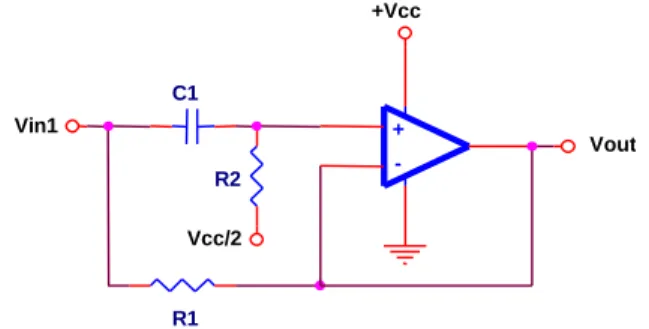
The circuit in Figure 9 reverses the operation of a capacitor, thus making a simulated inductor. An inductor resists any change in its current, so when a dc voltage is applied to an inductance, the current rises slowly, and the voltage falls as the external resistance becomes more
Vout Vin1 L = R1*R2*C1 R2 Vcc/2 C1 +Vcc R1 +
-Figure 9. Simulated Inductor Circuit
An inductor passes low frequencies more readily than high frequencies, the opposite of a
capacitor. An ideal inductor has zero resistance. It passes dc without limitation, but it has infinite impedance at infinite frequency.
If a dc voltage is suddenly applied to the inverting input through resistor R1, the op amp ignores the sudden load because the change is also coupled directly to the noninverting input via C1. The op amp represents high impedance, just as an inductor does.
As C1 charges through R2, the voltage across R2 falls, so the op-amp draws current from the input through R1. This continues as the capacitor charges, and eventually the op-amp has an input and output close to virtual ground (Vcc/2).
When C1 is fully charged, resistor R1 limits the current flow, and this appears as a series resistance within the simulated inductor. This series resistance limits the Q of the inductor. Real inductors generally have much less resistance than the simulated variety.
There are some limitations of a simulated inductor:
• One end of the inductor is connected to virtual ground.
• The simulated inductor cannot be made with high Q, due to the series resistor R1.
• It does not have the same energy storage as a real inductor. The collapse of the magnetic field in a real inductor causes large voltage spikes of opposite polarity. The simulated inductor is limited to the voltage swing of the op amp, so the flyback pulse is limited to the voltage swing.
2.6 Instrumentation Amplifiers
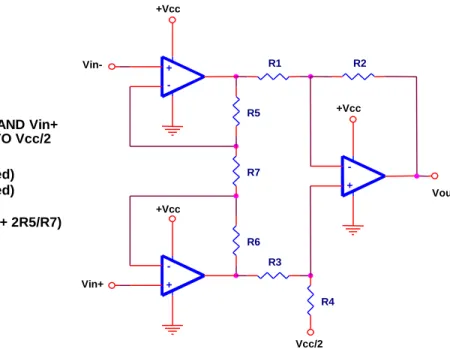
Instrumentation amplifiers are used whenever dc gain is needed on a low-level signal that would be loaded by conventional differential-amplifier topologies. Instrumentation amplifiers take advantage of the high input impedance of noninverting op-amp inputs.
Vin-R5 -+ R6 -+ +Vcc R3 +Vcc R2
ASSUMES Vin- AND Vin+ REFERENCED TO Vcc/2 + -R4 Vout Vin+ R1 Vcc/2 +Vcc R1 = R3 (matched) R2 = R4 (matched) R5 = R6 Gain = R2/R1 (1 + 2R5/R7) R7
Figure 10. Basic Instrumentation-Amplifier Circuit
This circuit, and the other instrumentation amplifier topologies presented here, assume that the inputs are already referenced to half-supply. This is the case with strain gauges that are
operated from Vcc. The basic disadvantage of this circuit is that it requires matched resistors; otherwise, it would suffer from poor CMRR (see for example, Op Amps for Everyone[3]). The circuit in Figure 10 can be simplified by eliminating three resistors, as shown in Figure 11.
Vin+ R2 +Vcc R3 R1 = R3 (matched) R2 = R4 (matched) Gain = R2/R1 -+ Vout +Vcc Vcc/2 +Vcc
Vin-ASSUMES Vin- AND Vin+ REFERENCED TO Vcc/2 -+ R4 + -R1
Here, the gain is easier to calculate, but a disadvantage is that now two resistors must be changed instead of one, and they must be matched resistors. Another disadvantage is that the first stage(s) cannot be used for gain.
An instrumentation amplifier can also be made from two op amps; this is shown in Figure 12.
R4 R2 Vcc/2 R1 = R4 (matched) R2 = R3 (matched) Gain = 1 + R1/R2 Vin+ Vout Vin -+Vcc -+ R3
ASSUMES Vin- AND Vin+ REFERENCED TO Vcc/2
R1
-+
+Vcc
Figure 12. Instrumentation Circuit With Only Two Op Amps
However, this topology is not recommended because the first op amp is operated at less than unity gain, so it may be unstable. Furthermore, the signal from Vin- has more propagation delay than Vin+.
3 Filter Circuits
This section is devoted to op-amp active filters. In many cases, it is necessary to block dc voltage from the virtual ground of the op-amp stage by adding a capacitor to the input of the circuit. This capacitor forms a high-pass filter with the input so, in a sense, all these circuits have a high-pass characteristic. The designer must insure that the input capacitor is at least 100 times the value of the other capacitors in the circuit, so that the high-pass characteristic does not come into play at the frequencies of interest in the circuit. For filter circuits with gain, 1000 times might be better. If the input voltage already contains a Vcc/2 offset, the capacitor can be omitted. These circuits will have a half-supply dc offset at their output. If the circuit is the last stage in the system, an output-coupling capacitor may also be required.
There are trade-offs involved in filter design. The most desirable situation is to implement a filter with a single op amp. Ideally, the filter would be simple to implement, and the designer would have complete control over:
• The filter corner / center frequency
• The gain of the filter circuit
• The Q of band-pass and notch filters, or style of low-pass and high-pass filter (Butterworth, Chebyshev, or Bessell).
Unfortunately, such is not the case— complete control over the filter is seldom possible with a single op amp. If control is possible, it frequently involves complex interactions between passive components, and this means complex mathematical calculations that intimidate many designers. More control usually means more op amps, which may be acceptable in designs that will not be produced in large volumes, or that may be subject to several changes before the design is finalized. If the designer needs to implement a filter with as few components as possible, there will be no choice but to resort to traditional filter-design techniques and perform the necessary calculations.
3.1 Single Pole Circuits
Single-pole circuits are the simplest filter circuits. They have a roll off of 20 dB per decade.
3.1.1 Low Pass Filter Circuits
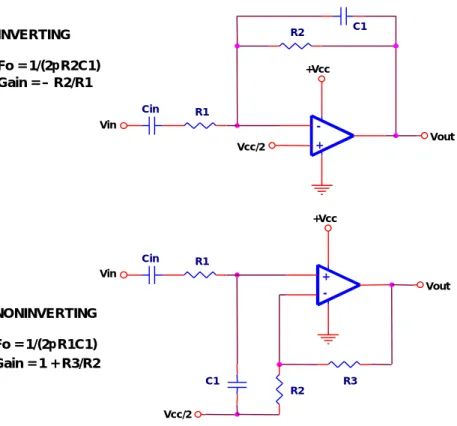
Typical low-pass filter circuits are shown in Figure 13.
Vout Vin R1 Vcc/2 + -NONINVERTING -+ Vin INVERTING Fo = 1/(2pR1C1) Gain = 1 + R3/R2 Cin Cin R3 R2 Vcc/2 C1 C1 R1 Vout +Vcc R2 +Vcc Fo = 1/(2pR2C1) Gain = – R2/R1
Figure 13. Low-Pass Filter Circuits
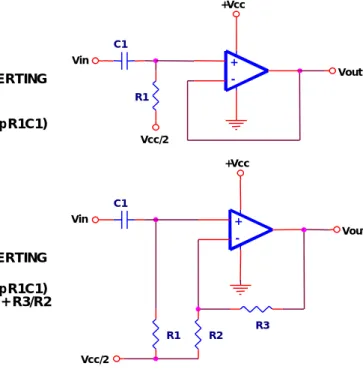
+Vcc Gain = 1 Fo = 1/(2pR1C1) Vin + -C1 Vin NONINVERTING R3 Fo = 1/(2pR1C1) Gain = 1 + R3/R2 Vout C1 NONINVERTING Vout + -Vcc/2 R1 Vcc/2 R1 +Vcc R2
Figure 14. High-Pass Filter Circuits
3.1.3 All-Pass Filter
The all-pass filter passes all frequencies at the same gain. It is used to change the phase of the signal, and it can also be used as a phase-correction circuit. The circuit shown in Figure 15 has a 90° phase shift at F(90). At dc, the phase shift is 0°, and at high frequencies it is 180°.
R1 = R2 = R3 = R F(90) = 1/(2pR*C1) R1 Vcc/2 +Vcc R3 + -C1 Vin1 Vout R2
3.2 Double-Pole Circuits
Double-pole op-amp circuit topologies are sometimes named after their inventor. Several implementations or topologies exist. Some double-pole circuit topologies are available in a low-pass, high-pass, band-pass, and notch configuration. Others are not. Not all topologies and implementations are given here: only the ones that are easy to implement and tune.
Double-pole or second-order filters have a 40-dB-per-decade roll-off.
Commonly the same component(s) adjust the Q for the band-pass and notch versions of the topology, and they change the filter from Butterworth to Chebyshev, etc. for low-pass and high-pass versions of the topology. Be aware that the corner frequency calculation is only valid for the Butterworth versions of the topologies. Chebyshev and Bessell modify it slightly.
When band-pass and notch filter circuits are shown, they are high-Q (single frequency) types. To implement a wider band-pass or notch (band-reject) filter, cascade low-pass and high-pass stages. The pass characteristics should overlap for a band-pass and not overlap for a band-reject filter.
Inverse Chebyshev and Elliptic filters are not shown. These are beyond the scope of a circuit collection note.
Not all filter topologies produce ideal results— the final attenuation in the rejection band, for example, is greater in the multiple-feedback filter configuration than it is in the Sallen-Key filter. These fine points are beyond the scope of an op-amp circuit collection. Consult a textbook on filter design for the merits and drawbacks of each of these topologies. Unless the application is particularly critical, all the circuits shown here should produce acceptable results.
3.2.1 Sallen-Key
The Sallen-Key topology is one of the most widely-known and popular second-order topologies. It is low cost, requiring only a single op amp and four passive components to accomplish the tuning. Tuning is easy, but changing the style of filter from Butterworth to Chebyshev is not. The designer is encouraged to read references [1] and [2] for a detailed description of this topology. The circuits shown are unity gain— changing the gain of a Sallen-Key circuit also changes the filter tuning and the style. It is easiest to implement a Sallen-Key filter as a unity gain
R1 Unity Gain Butterworth R3 = R4 (HIGH) R1 = R2 C1 = 2C2 Fo = √2 / (4pR1C2) C1 R2 C1 +Vcc R1 R4 Vout C2 LOW PASS + -Vin +Vcc R3 HIGH PASS Vin Vout Cin Vcc/2 + -R2 +Vcc C2 Unity Gain Butterworth C1 = C2 R1 = R R = 2R1 Fo = √2 / (4pR1C1)
Figure 16. Sallen-Key Low- and High-Pass Filter Topologies
3.2.2 Multiple Feedback (MFB)
MFB topology is very versatile, low cost, and easy to implement. Unfortunately, calculations are somewhat complex, and certainly beyond the scope of this circuit collection. The designer is encouraged to read reference [1] for a detailed description of the MFB topology. If all that is needed is a unity gain Butterworth, then these circuits will provide a close approximation.
Vcc/2 R1 Vout -+ +Vcc +Vcc C1 Vin Vin Unity Gain Butterworth
Fo = 1/(2πRC) R1 = 0.47R R2 = 2.1R C1 = C2 = C3 = C C1 Cin Vcc/2 Vout R3 +Vcc Vout Unity Gain Butterworth
Fo = 1/(2πRC) R1 = R2 = R/√2 R3 = R/(2√2) C1 = C C2 = 4C HIGH PASS C2 R3 -+ Gain = 2.3 dB Fo = 1/(2.32πRC) R1 = 10R R2 = 0.001R R3 = 100R C1 = 10C C2 = C Vcc/2 C1 Vin BAND PASS R2 R2 -+ Cin R1 C2 R1 C2 LOW PASS R2 C3
Figure 17. Multiple-Feedback Topologies
3.2.3 Twin T
The twin-T topology uses either one or two op amps. It is based on a passive (RC) topology that uses three resistors and three capacitors. Matching these six passive components is critical; fortunately, it is also easy. The entire network can be constructed from a single value of
resistance and a single value of capacitance, running them in parallel to create R3 and C3 in the twin-T schematics shown in Figure. Components from the same batch are likely to have very similar characteristics.
3.2.3.1 Single Op-Amp Implementations Vcc/2 C1 Vin R1 = R2 = R C1 = C2 = C R3 = R/2 C3 = 2C Fo = 1/(2pRC) R2 Vcc/2 Cin R1 R3 -+ R4 C2 R5 Vout C3
Gain controlled by R4 and R5 R4 > 100 * R5
Q hard to control; need mismatched Resistors; also affects gain
BAND PASS
+Vcc
Figure 18. Single Op-Amp Twin-T Filter in Band-Pass Configuration
The bandpass circuit will oscillate if the components are matched too closely. It is best to
de-tune it slightly, by selecting the resistor to virtual ground to be one E-96 1% resistor value off, for instance.
R2
Vout
C3
R4 = R5: HIGH
The only control over Q is by mismatching R3 C2 Vcc/2 +Vcc R1 + -R3 R4 Vin NOTCH Cin R5 C1 C1 = C2 = C C3 = 2C R1 = R2 = R R3 = R/2 Fo = 1/(2pRC) +Vcc
3.2.3.2 Dual-Op-Amp Implementations
Typical dual op-amp implementations are shown in Figures 20 to 22
Vcc/2 -+ Unity Gain R4 < R5/2 Chebyshev R4 = R5/2 Butterworth R4 > R5/2 Bessel R2 R1 = R2 = R C1 = C2 = C R3 = R/2 C3 = 2C Fo = 1/(2pRC) +Vcc C3 Cin R6 Vin R3 LOW PASS -+ C2 +Vcc Vout Vcc/2 C1 R5 R6 = R7: HIGH R4 R1 +Vcc R7
Figure 20. Dual-Op-Amp Twin-T Low-Pass Filter
+Vcc Vout +Vcc C2 Vin Vcc/2 -+ R3 R4 C1 -+ R5 Unity Gain R4 < R5/2 Chebyshev R4 = R5/2 Butterworth R4 > R5/2 Bessel Vcc/2 R2 R1 R1 = R2 = R C1 = C2 = C R3 = R/2 C3 = 2C Fo = 1/(2pRC) HIGH PASS C3
CIN R5 C3 +Vcc R3 R1 = R2 = R C1 = C2 = C R3 = R/2 C3 = 2C Fo = 1/(2pRC) R6 = R7 > 20*R R2 NOTCH R4 R7 -+ Q controlled by ratio of R5 and R4 R4 = 0.05*R5: high Q R4 = 0.5*R5 low: Q Vout R1 R6 -+ +Vcc Vin C2 +Vcc C1 Vcc/2
Figure 22. Dual-Op-Amp Twin-T Notch Filter
3.2.4 Fliege
Fliege is a two-op-amp topology (Figures 23–26), and therefore more expensive than one-op-amp topologies. There is good control over the tuning and the Q and style of filter. The gain is fixed at two for low-pass, high-pass, and band-pass filters, and unity for notch.
R3 Vin Vcc/2 R2 R5 Cin C1 +Vcc Gain fixed at 2 R1 = R/√2 Butterworth R1 > R/√2 Chebyshev R1 < R/√2 Bessel R2 = R3 = R C1 = C2 = C R4 = R5, not critical Fo = 1/(2pRC) C2 -+ LOW PASS R4 +Vcc + - Vout R1
Gain fixed at 2 R1 = R/√2 Butterworth R1 > R/√2 Chebyshev R1 < R/√2 Bessel + -R4 R5 C2 R3 R2 +Vcc Vcc/2 Vin C1 R1 Vcc/2 R2 = R3 = R C1 = C2 = C R4 = R5, not critical Fo = 1/(2pRC) +Vcc -+ Vout HIGH PASS
Figure 24. High-Pass Fliege Filter
Vcc/2 Cin Vin R1 +Vcc BAND PASS + -C1 +Vcc Vout R3 Vcc/2 R2 = R3 = R C1 = C2 = C R4 = R5, not critical Fo = 1/(2pRC) C2 R4 R5 R2 -+ Gain fixed at 2 R1 controls Q low R1 => low Q high R1 => high Q R1 should be > R/5
R5 + -R2 +Vcc R6 Vin C1 R1 Vcc/2 R4 R3 = R4 = R5 = R6 = R C1 = C2 = C Fo = 1/(2pRC) R1 = R2 = R*10/√2 No control over Q Gain fixed at 1 NOTCH C2 Cin R3 -+ Vout +Vcc
Figure 26. Notch Fliege Filter
3.2.5 Akerberg-Mossberg Filter
This is the easiest of the three-op-amp topologies to use (Figures 27–30). It is easy to change the gain, style of low-pass and high-pass filter, and the Q of band-pass and notch filters. The notch filter performance is not as good as that of the twin T notch, but it is less critical.
Vcc/2 R2 R2 = R3 = R4 = R5 = R C1 = C2 = C Fo = 1/(2pRC) R5 R1 Unity Gain: R = R1 Other Gain: R/R1 +Vcc Vout LOW PASS +Vcc Vcc/2 + -Vin +Vcc C2 Cin -+ R4 R6 C1 Vcc/2 R6 = R/√2 Butterworth R6 > R/√2 Chebyshev R6 < R/√2 Bessel -+ R3
+Vcc R2=R3=R4=R5=R C2=C3=C Fo=1/(2pRC) C3 -+ + -Vcc/2 R6 = R/√2 Butterworth R6 > R/√2 Chebyshev R6 < R/√2 Bessel Vcc/2 HIGH PASS C2 Vin +Vcc -+ R5 R1 C1 +Vcc R4 R3 Vcc/2 Unity Gain: C1=C, R1=R Other Gain: R1/R AND C1/C R2 Vout R6 Vcc/2
Figure 28. Akerberg-Mossberg High-Pass Filter
Vcc/2 R1, R6 also control Q
low values, low Q high values, high Q
R5 C2 BAND PASS -+ R6 +Vcc C1 +Vcc R3 Vcc/2 R2 Vout Vin -+ +Vcc + -Cin R1 R2 = R3 = R4 = R5 = R C1 = C2 = C Fo = 1/(2pRC) R4 Unity Gain: R1 = R6 Other Gain: – R6/R1 Vcc/2
+ -Cin NOTCH Vcc/2 R6 R7 -+ Vcc/2 Vcc/2 R3 +Vcc +Vcc R1=R2=R3=R4=R5=R6=R C1 = C2 = C3 = C Fo = 1/(2πRC) Vcc/2 R2 R5 -+ R4 R/2 < R7 < 2 x R R7 controls Q low value, low Q high value, high Q
Vin C2 C1 Vout +Vcc R1 C3
Figure 30. Akerberg-Mossberg Notch Filter
3.2.6 BiQuad
Biquad is a well know topology (Figure 31). It is only available in low-pass and band-pass varieties. The low-pass filter is useful whenever simultaneous normal and inverted outputs are needed.
R3 = R4 unity gain Gain = – R4/R3 R4 also controls Q low value, low Q high value, high Q
V–LPout +Vcc Cin Vcc/2 R6 BAND PASS R4 Unity Gain: R3 = R Other Gain: – R/R3 R1 = R2 = R5 = R
R6 = about R/√2, not critical C1 = C2 = C Fo = 1/(2pRC) Vin VBPout R5 +Vcc R2 -+ +Vcc R4 = R/√2 Butterworth R4 > R/√2 Chebyshev R4 < R/√2 Bessell -+ LOW PASS R1 = R2 = R R5 = R6, not critical R4 = R/√2 C1 = C2 = C Fo = 1/(2pRC) R1 V+LPout R3 C2 C1 -+
3.2.7 State Variable
State variable is a three to four op-amp topology. The fourth op-amp is only required for notch filters. It is also very easy to tune, and it is easy to change the style of lowpass and highpass, and easy to change the Q of the bandpass and notch. Unfortunately, it is not as nice a topology as Akerberg-Mossberg. The same resistor is used for gain and style of filter / Q, limiting control of the filter. There is probably not a lot of reason to use this topology, unless simultaneous lowpass, highpass, bandpass, and notch outputs are required by the application.
R3 Vcc/2 -+ R10 +Vcc NOTCH R8 Vcc/2 R1=R2=R3=R4=R5=R6=R8=R9=R10=R C1 = C2 = C Fo = 1/(2πRC) Vcc/2 -+ R7 BPout HPout LPout R5 R1 Vcc/2 R8, R9 ,R10 and 4th op amp only used for notch R6 LP and HP R7 = R/2 Butterworth R7 > R/2 Chebyshev R7 < R/2 Bessel -+ C2 R4 Unity Gain: R7 = R Other Gain: – R7/R BP and NOTCH R7 high value, high Q R7 low value, low Q
+Vcc Vin +Vcc -+ +Vcc C1 R2 Cin R9
Figure 32. State-Variable Four-Op-Amp Topology
4 References
1. Active Low Pass Filter Design, Texas Instruments Application Report, Literature Number
SLOA049
2. Analysis Of The Sallen-Key Architecture, Texas Instruments Application Report,
Literature Number SLOA024A.
3. Op Amps for Everyone, Ron Mancini (Ed.), Chapter 12, Texas Instruments Literature
Appendix A – Standard Resistor and Capacitor Values
E-12 Resistor / Capacitor Values
1.0, 1.2, 1.5, 1.8, 2.2, 2.7, 3.3, 3.9, 4.7, 5.6, 6.8, and 8.2; multiplied by the decade value.
E-24 Resistor / Capacitor Values
1.0, 1.1, 1.2, 1.3, 1.5, 1.6, 1.8, 2.0, 2.2, 2.4, 2.7, 3.0, 3.3, 3.6, 3.9, 4.3, 4.7, 5.1, 5.6, 6.2, 6.8, 7.5, 8.2, and 9.1; multiplied by the decade value.
E-96 Resistor / Capacitor Values
1.00, 1.02, 1.05, 1.07, 1.10, 1.13, 1.15, 1.18, 1.21, 1.24, 1.27, 1.30, 1.33, 1.37, 1.40, 1.43, 1.47, 1.50, 1.54, 1.58, 1.62, 1.65, 1.69, 1.74, 1.78, 1.82, 1.87, 1.91, 1.96, 2.00, 2.05, 2.10, 2.15, 2.21, 2.26, 2.32, 2.37, 2.43, 2.49, 2.55, 2.61, 2.67, 2.74, 2.80, 2.87, 2.94, 3.01, 3.09, 3.16, 3,24, 3.32, 3.40, 3,48, 3.57, 3.65, 3.74, 3.83, 3.92, 4.02, 4.12, 4.22, 4,32, 4.42, 4,53, 4.64, 4.75, 4.87, 4.99, 5.11, 5.23, 5.36, 5.49, 5.62, 5.76, 5.90, 6.04, 6.19, 6.34, 6.49, 6.65, 6.81, 6.98, 7.15, 7.32, 7.50, 7.68, 7.87, 8.06, 8.25, 8.45, 8.66, 8.87, 9.09, 9.31, 9.53, 9.76; multiplied by the decade value.
Texas Instruments and its subsidiaries (TI) reserve the right to make changes to their products or to discontinue any product or service without notice, and advise customers to obtain the latest version of relevant information to verify, before placing orders, that information being relied on is current and complete. All products are sold subject to the terms and conditions of sale supplied at the time of order acknowledgment, including those pertaining to warranty, patent infringement, and limitation of liability.
TI warrants performance of its semiconductor products to the specifications applicable at the time of sale in accordance with TI’s standard warranty. Testing and other quality control techniques are utilized to the extent TI deems necessary to support this warranty. Specific testing of all parameters of each device is not necessarily performed, except those mandated by government requirements.
Customers are responsible for their applications using TI components.
In order to minimize risks associated with the customer’s applications, adequate design and operating safeguards must be provided by the customer to minimize inherent or procedural hazards.
TI assumes no liability for applications assistance or customer product design. TI does not warrant or represent that any license, either express or implied, is granted under any patent right, copyright, mask work right, or other intellectual property right of TI covering or relating to any combination, machine, or process in which such semiconductor products or services might be or are used. TI’s publication of information regarding any third party’s products or services does not constitute TI’s approval, warranty or endorsement thereof.