1
Step-Down Switching
Regulator
D
ESCRIPTIO
U
The LT1074 is a 5A (LT1076 is rated at 2A) monolithic bipolar switching regulator which requires only a few external parts for normal operation. The power switch, all oscillator and control circuitry, and all current limit com-ponents, are included on the chip. The topology is a classic positive “buck” configuration but several design
innova-U
S
A
PPLICATI
O
■ Buck Converter with Output Voltage Range of 2.5V to 50V
■ Tapped-Inductor Buck Converter with 10A Output at 5V
■ Positive-to-Negative Converter ■ Negative Boost Converter ■ Multiple Output Buck Converter
U
A
PPLICATI
O
TYPICAL
Buck Converter Efficiency
S
FEATURE
■ 5A On-Board Switch (LT1074) ■ 100kHz Switching Frequency ■ Greatly Improved Dynamic Behavior
■ Available in Low Cost 5 and 7-Lead Packages ■ Only 8.5mA Quiescent Current
■ Programmable Current Limit ■ Operates Up to 60V Input ■ Micropower Shutdown Mode
tions allow this device to be used as a positive-to-negative converter, a negative boost converter, and as a flyback converter. The switch output is specified to swing 40V below ground, allowing the LT1074 to drive a tapped-inductor in the buck mode with output currents up to 10A. The LT1074 uses a true analog multiplier in the feedback loop. This makes the device respond nearly instanta-neously to input voltage fluctuations and makes loop gain independent of input voltage. As a result, dynamic behav-ior of the regulator is significantly improved over previous designs.
On-chip pulse by pulse current limiting makes the LT1074 nearly bust-proof for output overloads or shorts. The input voltage range as a buck converter is 8V to 60V, but a self-boot feature allows input voltages as low as 5V in the inverting and boost configurations.
The LT1074 is available in low cost TO-220 or TO-3 packages with frequency pre-set at 100kHz and current limit at 6.5A (LT1076 = 2.6A). A 7-pin TO-220 package is also available which allows current limit to be adjusted down to zero. In addition, full micropower shutdown can be programmed. See Application Note 44 for design details.
A fixed 5V output, 2A version is also available. See LT1076-5.
+ + VSW VIN VC GND FB LT1074 5V 5A C1 500 F R1 2.8k 1% R2 2.21k 1% MBR745* 10V TO 40V C3 200 F R3 2.7k C2 0.01 F µ µ µ L1** 50 H (LT1074) 100 H (LT1076) µ *USE MBR340 FOR LT1076 **COILTRONICS #50-2-52 (LT1074) #100-1-52 (LT1076) LT1074 • TA01
PULSE ENGINEERING, INC. #PE-92114 (LT1074) #PE-92102 (LT1076) HURRICANE #HL-AK147QQ (LT1074) #HL-AG210LL (LT1076) µ 25V
† RIPPLE CURRENT RATING I / 2OUT
† ≥
Basic Positive Buck Converter
OUTPUT LOAD CURRENT (A) 0 EFFICIENCY (%) 60 70 80 90 1 2 3 4 LT1074 • TPC27 5 6 100 50 L = 50 H TYPE 52 CORE DIODE = MBR735 µ V = 5V, V = 15VOUT IN V = 12V, V = 20VOUT IN LT1074
2
A
BSOLUTE
A
W
XI
U
W
W
R
A
TI
U
G
S
PARAMETER CONDITIONS MIN TYP MAX UNITS
Switch “On” Voltage (Note 1) LT1074 ISW = 1A, Tj ≥ 0°C 1.85 V
ISW = 1A, Tj < 0°C 2.1 V
ISW = 5A, Tj ≥ 0°C 2.3 V
ISW = 5A, Tj < 0°C 2.5 V
LT1076 ISW = 0.5A ● 1.2 V
ISW = 2A ● 1.7 V
Tj = 25°C, VIN = 25V, unless otherwise noted.
* Assumes package is soldered to 0.5 IN2 of 1 oz. copper over internal ground
plane or over back side plane.
Y PACKAGE, 7-LEAD TO-220 LT1074: θJC = 2.5°C/W, θJA = 50°C/W LT1076: θJC = 4°C/W, θJA = 50°C/W 7 5 4 3 1 FRONT VIEW 6 2 SHUTDOWN FB GND ILIM VIN VC VSW R PACKAGE 7-LEAD PLASTIC DD FRONT VIEW SHDN VC FB/SENSE GND ILIM VSW VIN 7 6 5 4 3 2 1 LT1076: θJC = 4°C/W, θJA = 30°C/W* LT1076CQ LT1076CR LT1076HVCR LT1074CY LT1074HVCY LT1074IY LT1074HVIY LT1076CY LT1076HVCY LT1074CT LT1074HVCT LT1074IT LT1074HVIT LT1076CT LT1076HVCT LT1076IT LT1074CK LT1074HVCK LT1074MK LT1074HVMK LT1076CK LT1076HVCK LT1076MK LT1076HVMK 1 4 3 2 BOTTOM VIEW
K PACKAGE, 4-LEAD TO-3 METAL CAN VC FB VIN VSW CASE IS GND LT1074: θJC = 2.5°C/W, θJA = 35°C/W LT1076: θJC = 4°C/W, θJA = 35°C/W VIN VSW GND VC FB/SENSE 5 4 3 2 1 Q PACKAGE 5-LEAD PLASTIC DD FRONT VIEW LT1076: θJC = 4°C/W, θJA = 30°C/W* Input Voltage LT1074/ LT1076 ... 45V LT1074HV/76HV... 64V Switch Voltage with Respect to Input Voltage
LT1074/ 76 ... 64V LT1074HV/76HV... 75V Switch Voltage with Respect to Ground Pin (VSW Negative)
LT1074/76 (Note 6) ... 35V LT1074HV/76HV (Note 6) ... 45V Feedback Pin Voltage ... –2V, +10V Shutdown Pin Voltage (Not to Exceed VIN) ... 40V
ILIM Pin Voltage (Forced) ... 5.5V Maximum Operating Ambient Temperature Range
LT1074C/76C, LT1074HVC/76HVC ... 0°C to 70°C LT1074I/76I, LT1074HVI/76HVI ... –40°C to 85°C LT1074M/76M, LT1074HVM/76HVM ... –55°C to 125°C Maximum Operating Junction Temperature Range
LT1074C/76C, LT1074HVC/76HVC ... 0°C to 125°C LT1074I/76I, LT1074HVI/76HVI ... –40°C to 125°C LT1074M/76M, LT1074HVM/76HVM ... – 55°C to 150°C Maximum Storage Temperature ... –65°C to 150°C Lead Temperature (Soldering, 10 sec) ... 300°C
W
U
U
PACKAGE/ORDER I FOR ATIO
ORDER PART NUMBER ORDER PART NUMBER 5 4 3 2 1 V GND FB V VC FRONT VIEW T PACKAGE, 5-LEAD T0-220 LEADS ARE FORMED STANDARD FOR STRAIGHT LEADS, ORDER FLOW 06
IN SW
LT1074: θJC =2.5°C/W, θJA = 50°C/W
LT1076: θJC = 4°C/W, θJA = 50°C/W
3
ELECTRICAL C
HARA TERISTICS
C
Tj = 25°C, VIN = 25V, unless otherwise noted.PARAMETER CONDITIONS MIN TYP MAX UNITS
The ● denotes the specifications which apply over the full operating temperature range.
Note 1: To calculate maximum switch “on” voltage at currents between low and high conditions, a linear interpolation may be used.
Note 2: A feedback pin voltage (VFB) of 2.5V forces the VC pin to its low clamp
level and the switch duty cycle to zero. This approximates the zero load condition where duty cycle approaches zero.
Note 3: Total voltage from VIN pin to ground pin must be ≥ 8V after startup for proper regulation.
Switch “Off” Leakage LT1074 VIN ≤ 25V, VSW = 0 5 300 µA
VIN = VMAX, VSW = 0 (Note 7) 10 500 µA
LT1076 VIN = 25V, VSW = 0 150 µA
VIN = VMAX, VSW = 0 (Note 7) 250 µA
Supply Current (Note 2) VFB = 2.5V, VIN ≤ 40V ● 8.5 11 mA
40V < VIN < 60V ● 9 12 mA
VSHUT = 0.1V (Device Shutdown) (Note 8) ● 140 300 µA
Minimum Supply Voltage Normal Mode ● 7.3 8 V
Startup Mode (Note 3) ● 3.5 4.8 V
Switch Current Limit (Note 4) LT1074 ILIM Open ● 5.5 6.5 8.5 A
RLIM = 10k (Note 5) 4.5 A
RLIM = 7k (Note 5) 3 A
LT1076 ILIM Open ● 2 2.6 3.2 A
RLIM = 10k (Note 5) 1.8 A
RLIM = 7k (Note 5) 1.2 A
Maximum Duty Cycle ● 85 90 %
Switching Frequency 90 100 110 kHz
Tj ≤ 125°C ● 85 120 kHz
Tj > 125°C ● 85 125 kHz
VFB = 0V through 2kΩ (Note 4) 20 kHz
Switching Frequency Line Regulation 8V ≤ VIN ≤ VMAX (Note 7) ● 0.03 0.1 %/V
Error Amplifier Voltage Gain (Note 6) 1V ≤ VC≤ 4V 2000 V/V
Error Amplifier Transconductance 3700 5000 8000 µmho
Error Amplifier Source and Sink Current Source (VFB = 2V) 100 140 225 µA
Sink (VFB = 2.5V) 0.7 1 1.6 mA
Feedback Pin Bias Current VFB = VREF ● 0.5 2 µA
Reference Voltage VC = 2V ● 2.155 2.21 2.265 V
Reference Voltage Tolerance VREF (Nominal) = 2.21V ±0.5 ±1.5 %
All Conditions of Input Voltage, Output ● ±1 ±2.5 % Voltage, Temperature and Load Current
Reference Voltage Line Regulation 8V ≤ VIN≤ VMAX (Note 7) ● 0.005 0.02 %/V
VC Voltage at 0% Duty Cycle 1.5 V
Over Temperature ● – 4 mV/°C
Multiplier Reference Voltage 24 V
Shutdown Pin Current VSH = 5V ● 5 10 20 µA
VSH≤ VTHRESHOLD (≅2.5V) ● 50 µA
Shutdown Thresholds Switch Duty Cycle = 0 ● 2.2 2.45 2.7 V
Fully Shut Down ● 0.1 0.3 0.5 V
Thermal Resistance Junction to Case LT1074 2.5 °C/W
LT1076 4.0 °C/W
Note 4: Switch frequency is internally scaled down when the feedback pin voltage is less than 1.3V to avoid extremely short switch on times. During testing, VFB is adjusted to give a minimum switch on time of 1µs.
Note 5: ILIM≈ (LT1074), ILIM ≈ (LT1076).
Note 6: Switch to input voltage limitation must also be observed. Note 7: VMAX = 40V for the LT1074/76 and 60V for the LT1074HV/76HV. Note 8: Does not include switch leakage.
RLIM – 1k 2k
RLIM – 1k
4
6V REGULATOR AND BIAS + – -POWER SHUTDOWN µ 10 Aµ 320 Aµ + – 2.35V 0.3V CURRENT LIMIT SHUTDOWN 4.5V 10k S + – CURRENT LIMIT COMP C2 15 400 + – C1 R/S LATCH R R Q X Y Z + – A1 ERROR AMP FB V 100kHz OSCILLATOR ANALOG MULTIPLIER XY Z FREQ SHIFT SYNC G1 PULSE WIDTH COMPARATOR 24V (EQUIVALENT) 2.21V SWITCH OUTPUT (V ) 0.04 250 500 INPUT SUPPLY SHUTDOWN* I * 6V TO ALL CIRCUITRY LIM Ω Ω SW Ω Ω VIN C LT1074 • BD01 100 SWITCH OUTPUT (V ) 0.1 Ω SW Ω 3V(p-p) LT1076 LT1074*AVAILABLE ON PACKAGES WITH PIN COUNTS GREATER THAN 5.
W
I
D AGRA
BLOCK
5
W
I
D AGRA
BLOCK
D
ESCRIPTIO
U
A switch cycle in the LT1074 is initiated by the oscillator setting the R/S latch. The pulse that sets the latch also locks out the switch via gate G1. The effective width of this pulse is approximately 700ns, which sets the maximum switch duty cycle to approximately 93% at 100kHz switch-ing frequency. The switch is turned off by comparator C1, which resets the latch. C1 has a sawtooth waveform as one input and the output of an analog multiplier as the other input. The multiplier output is the product of an internal reference voltage, and the output of the error amplifier, A1, divided by the regulator input voltage. In standard buck regulators, this means that the output voltage of A1 required to keep a constant regulated output is indepen-dent of regulator input voltage. This greatly improves line transient response, and makes loop gain independent of input voltage. The error amplifier is a transconductance type with a GM at null of approximately 5000µmho. Slew current going positive is 140µA, while negative slew current is about 1.1mA. This asymmetry helps prevent overshoot on start-up. Overall loop frequency compensa-tion is accomplished with a series RC network from VC to ground.
Switch current is continuously monitored by C2, which resets the R/S latch to turn the switch off if an overcurrent condition occurs. The time required for detection and switch turn off is approximately 600ns. So minimum switch “on” time in current limit is 600ns. Under dead shorted output conditions, switch duty cycle may have to be as low as 2% to maintain control of output current. This would require switch on time of 200ns at 100kHz switch-ing frequency, so frequency is reduced at very low output
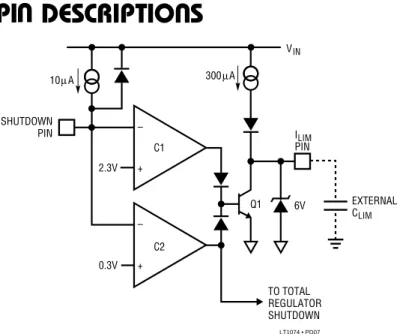
voltages by feeding the FB signal into the oscillator and creating a linear frequency downshift when the FB signal drops below 1.3V. Current trip level is set by the voltage on the ILIM pin which is driven by an internal 320µA current source. When this pin is left open, it self-clamps at about 4.5V and sets current limit at 6.5A for the LT1074 and 2.6A for the LT1076. In the 7-pin package an external resistor can be connected from the ILIM pin to ground to set a lower current limit. A capacitor in parallel with this resistor will soft start the current limit. A slight offset in C2 guarantees that when the ILIM pin is pulled to within 200mV of ground, C2 output will stay high and force switch duty cycle to zero. The “Shutdown” pin is used to force switch duty cycle to zero by pulling the ILIM pin low, or to completely shut down the regulator. Threshold for the former is approximately 2.35V, and for complete shutdown, approximately 0.3V. Total supply current in shutdown is about 150µA. A 10µA pull-up current forces the shutdown pin high when left open. A capacitor can be used to generate delayed start-up. A resistor divider will program “undervoltage lockout” if the divider voltage is set at 2.35V when the input is at the desired trip point.
The switch used in the LT1074 is a Darlington NPN (single NPN for LT1076) driven by a saturated PNP. Special patented circuitry is used to drive the PNP on and off very quickly even from the saturation state. This particular switch arrangement has no “isolation tubs” connected to the switch output, which can therefore swing to 40V below ground.
6
0 –150 CURRENT (mA) 0 50 100 150 200 1 2 3 4 LT1074 • TPC01 –200 –100 5 6 7 8 9 VOLTAGE (V) Ω ≈ –50 V 2VFB≤ SLOPE 400k V ADJUSTED FOR I = 0 AT V = 2V FB C CC
HARA TERISTICS
C
U
W
A
TYPICAL PERFOR
CE
Supply CurrentShutdown Pin Characteristics Shutdown Pin Characteristics ILIM Pin Characteristics
VC Pin Characteristics VC Pin Characteristics Feedback Pin Characteristics
0 –1.5 CURRENT (mA) –0.5 0 0.5 1.0 1.5 2.0 1 2 3 4 LT1074 • TPC02 –2.0 –1.0 5 6 7 8 9 V 2.5V FB≥ VOLTAGE (V) VOLTAGE (V) 10 –40 CURRENT ( A) 20 40 LT1074 • TPC04 30 50 60 70 80 –30 –20 –10 0 10 20 30 40 VIN= 50V
THIS POINT MOVES
IN WITH V DETAILS OF THIS AREA SHOWN IN OTHER GRAPH 0 µ 0 –400 CURRENT ( A) –200 0 1 2 3 4 LT1074 • TPC03 –500 –300 5 6 7 8 9 10 –100 100 200 300 400 500 VOLTAGE (V) µ START OF FREQUENCY SHIFTING VOLTAGE (V) 0 –40 CURRENT ( A) 1.0 2.0 LT1074 • TPC05 1.5 2.5 3.0 3.5 4.0 –35 –30 –25 –20 –15 –10 –5 0 SHUTDOWN THRESHOLD CURRENT FLOWS OUT
OF SHUTDOWN PIN µ = 25 C Tj ° 0.5 –2 –350 CURRENT ( A) –250 –150 0 1 2 LT1074 • TPC06 –400 –300 3 4 5 –200 –100 –50 0 50 100 VOLTAGE (V) –1 5 6 7 8 µ T = 25 Cj ° INPUT VOLTAGE (V) 0 0
INPUT CURRENT (mA)
4 6 10 20 30 60 LT1074 • TPC11 10 40 50 2 8 12 14 16 18 20 V C = 1V
7
C
HARA TERISTICS
C
U
W
A
TYPICAL PERFOR
CE
Reference Voltage vsSupply Current (Shutdown) Temperature Switch “On” Voltage
INPUT VOLTAGE (V) 0 0 INPUT CURRENT ( A) 50 100 150 200 250 300 30 50 60 LT1074 • TPC13 10 20 40 µ JUNCTION TEMPERATURE (°C) –50 2.19 VOLTAGE (V) 2.20 2.21 2.22 2.23 2.24 2.25 –25 0 25 50 LT1074 • TPC14 2.18 2.17 75 100 125 150
Reference Shift with Ripple Switching Frequency vs
Voltage Error Amplifier Phase and GM Temperature
SQUARE WAVE
PEAK-TO-PEAK RIPPLE AT FB PIN (mV) 0
–80
CHANGE IN REFERENCE VOLTAGE (mV) –70
–60 –50 –40 –30 20 20 40 60 80 LT1074 • TPC16 100 120 140 160 180 200 –20 –10 0 10 TRI WAVE JUNCTION TEMPERATURE ( C) –50 80 FREQUENCY (kHz) 95 100 105 110 115 120 –25 0 25 50 LT1074 • TPC18 ° 90 85 75 100 125 150 FREQUENCY (Hz) ( mho) 8k 1k 100k 1M 10M 0 10k TRANSCONDUCTANCE 1k 2k 3k 4k 5k 6k 7k 200 150 100 50 0 –50 PHASE ( ) θ M G –100 –150 –200 µ ° LT1074 • TPC17 0 "ON" VOLTAGE (V) 3.0 2.5 2.0 1.5 1.0 0.5 1 2 3 LT1074 • TPC28 4 5 6 SWITCH CURRENT (A)
T = 25 Cj °
LT1074
LT1076
FEEDBACK PIN VOLTAGE (V) 0 0 SWITCHING FREQUENCY (kHz) 1.0 1.5 3.0 LT1074 • TPC19 0.5 2.0 2.5 20 160 40 60 80 100 120 140 –55°C 25°C 150°C JUNCTION TEMPERATURE ( C) 1 2 3 4 5 6 7 LT1074 • TPC22 ° 8 0 –50 –25 0 25 50 75 100 125 150
OUTPUT CURRENT LIMIT (A)
*MULTIPLY CURRENTS BY 0.4 FOR LT1076 I PIN OPENLIM
R = 10kLIM Ω
R = 5kLIM Ω
8
VIN PIN
The VIN pin is both the supply voltage for internal control circuitry and one end of the high current switch. It is important, especially at low input voltages, that this pin be bypassed with a low ESR, and low inductance capacitor to prevent transient steps or spikes from causing erratic operation. At full switch current of 5A, the switching transients at the regulator input can get very large as shown in Figure 1. Place the input capacitor very close to the regulator and connect it with wide traces to avoid extra inductance. Use radial lead capacitors.
Figure 1. Input Capacitor Ripple
LP = Total inductance in input bypass connections and capacitor.
“Spike” height (dI/dt • LP) is approximately 2V per inch of lead length for LT1074 and 0.8V per inch for LT1076.
“Step” for ESR = 0.05Ω and ISW = 5A is 0.25V. “Ramp” for C = 200µF, TON = 5µs, and ISW = 5A, is 0.12V.
Input current on the VIN Pin in shutdown mode is the sum of actual supply current (≈140µA, with a maximum of 300µA), and switch leakage current. Consult factory for special testing if shutdown mode input current is critical.
GROUND PIN
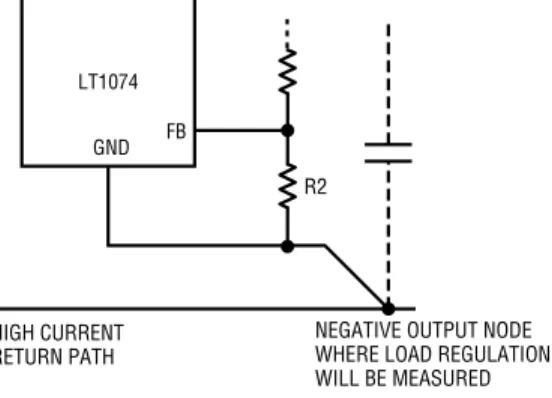
It might seem unusual to describe a ground pin, but in the case of regulators, the ground pin must be connected properly to ensure good load regulation. The internal reference voltage is referenced to the ground pin; so any error in ground pin voltage will be multiplied at the output;
dI dt ( )( )LP ( )( )ISW ESR ( )( )ISW TON C LT1074 • PD01 STEP = RAMP =
D
ESCRIPTIO
U
PI
U
S
R2 LT1074 • PD02 HIGH CURRENT RETURN PATHNEGATIVE OUTPUT NODE WHERE LOAD REGULATION WILL BE MEASURED GND FB
LT1074
∆VOUT =
(
∆VGND)( )
VOUT 2 21.To ensure good load regulation, the ground pin must be connected directly to the proper output node, so that no high currents flow in this path. The output divider resistor should also be connected to this low current connection line as shown in Figure 2.
Figure 2. Proper Ground Pin Connection
FEEDBACK PIN
The feedback pin is the inverting input of an error amplifier which controls the regulator output by adjusting duty cycle. The non-inverting input is internally connected to a trimmed 2.21V reference. Input bias current is typically 0.5µA when the error amplifier is balanced (IOUT = 0). The error amplifier has asymmetrical GM for large input sig-nals to reduce startup overshoot. This makes the amplifier more sensitive to large ripple voltages at the feedback pin. 100mVp-p ripple at the feedback pin will create a 14mV offset in the amplifier, equivalent to a 0.7% output voltage shift. To avoid output errors, output ripple (P-P) should be less than 4% of DC output voltage at the point where the output divider is connected.
See the “Error Amplifier” section for more details.
Frequency Shifting at the Feedback Pin
The error amplifier feedback pin (FB) is used to downshift the oscillator frequency when the regulator output voltage
9
is low. This is done to guarantee that output short circuit current is well controlled even when switch duty cycle must be extremely low. Theoretical switch “on” time for a buck converter in continuous mode is;
t V V V f ON OUT D IN = + •
VD = Catch diode forward voltage ( ≈ 0.5V) f = Switching frequency
At f = 100kHz, tON must drop to 0.2µs when VIN = 25V and the output is shorted (VOUT = 0V). In current limit, the LT1074 can reduce tON to a minimum value of ≈ 0.6µs, much too long to control current correctly for VOUT = 0. To correct this problem, switching frequency is lowered from 100kHz to 20kHz as the FB pin drops from 1.3V to 0.5V. This is accomplished by the circuitry shown in Figure 3.
Figure 3. Frequency Shifting
Q1 is off when the output is regulating (VFB = 2.21V). As the output is pulled down by an overload, VFB will eventu-ally reach 1.3V, turning on Q1. As the output continues to drop, Q1 current increases proportionately and lowers the frequency of the oscillator. Frequency shifting starts when the output is ≈ 60% of normal value, and is down to its minimum value of ≅ 20kHz when the output is ≅ 20% of normal value. The rate at which frequency is shifted is determined by both the internal 3k resistor R3 and the external divider resistors. For this reason, R2 should not be increased to more than 4kΩ, if the LT1074 will be subjected to the simultaneous conditions of high input voltage and output short circuit.
D
ESCRIPTIO
U
PI
U
S
SHUTDOWN PIN
The shutdown pin is used for undervoltage lockout, mi-cropower shutdown, soft start, delayed start, or as a general purpose on/off control of the regulator output. It controls switching action by pulling the ILIM pin low, which forces the switch to a continuous “off” state. Full micropower shutdown is initiated when the shutdown pin drops below 0.3V.
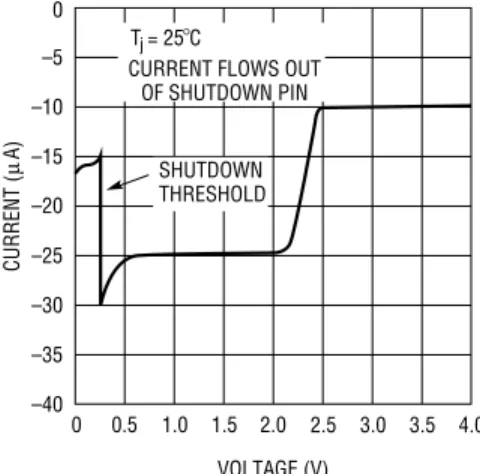
The V/I characteristics of the shutdown pin are shown in Figure 4. For voltages between 2.5V and ≈VIN, a current of 10µA flows out of the shutdown pin. This current increases to ≈25µA as the shutdown pin moves through the 2.35V threshold. The current increases further to ≈ 30µA at the 0.3V threshold, then drops to ≈15µA as the shutdown voltage falls below 0.3V. The 10µA current source is included to pull the shutdown pin to its high or default state when left open. It also provides a convenient pullup for delayed start applications with a capacitor on the shutdown pin.
When activated, the typical collector current of Q1 in Figure 5, is ≈ 2mA. A soft start capacitor on the ILIM pin will delay regulator shutdown in response to C1, by
≈(5V)(CLIM)/2mA. Soft start after full micropower shut-down is ensured by coupling C2 to Q1.
Figure 4. Shutdown Pin Characteristics
VOLTAGE (V) 0 –40 CURRENT ( A) 1.0 2.0 LT1074 • TPC05 1.5 2.5 3.0 3.5 4.0 –35 –30 –25 –20 –15 –10 –5 0 SHUTDOWN THRESHOLD CURRENT FLOWS OUT
OF SHUTDOWN PIN µ = 25 C Tj ° 0.5 + – 2.21V +2V ERROR AMPLIFIER VC FB R2 2.21k R1 VOUT EXTERNAL DIVIDER R3 3k Q1 TO OSCILLATOR LT1074 • PD03
10
D
ESCRIPTIO
U
PI
U
S
– + C1 10 Aµ 300 Aµ – + SHUTDOWN PIN C2 VIN I PIN 6V Q1 TO TOTAL REGULATOR SHUTDOWN 2.3V 0.3V LT1074 • PD07 LIM EXTERNAL CLIMHysteresis in undervoltage lockout may be accomplished by connecting a resistor (R3) from the ILIM pin to the shutdown pin as shown in Figure 7. D1 prevents the shutdown divider from altering current limit.
LT1074 • PD09 R1 R2 R3 V SHUT ILIM IN LT1074 OPTIONAL CURRENT LIMIT RESISTOR D1* *1N4148
Figure 7. Adding Hysteresis
Trip Po V V R R TP int = = . + 2 35 1 1 2
If R3 is added, the lower trip point (VIN descending) will be the same. The upper trip point (VUTP) will be;
V V R R R R V R R UTP = SH 1+ + 1 2 1 3 0 8 1 3 – .
If R1 and R2 are chosen, R3 is given by
R V V R V V R R SH UTP SH 3 0 8 1 1 1 2 =
(
)( )
+ – . –Example: An undervoltage lockout is required such that
the output will not start until VIN = 20V, but will continue to operate until VIN drops to 15V. Let R2 = 2.32k.
R k V V V k R k 1 2 32 15 2 35 2 35 12 5 3 2 35 0 8 12 5 20 2 35 1 12 5 2 32 3 9 =
(
) (
)
= =(
)( )
+ = . – . . . . – . . – . . . . Figure 5. Shutdown CircuitryUndervoltage Lockout
Undervoltage lockout point is set by R1 and R2 in Figure 6. To avoid errors due to the 10µA shutdown pin current, R2 is usually set at 5k, and R1 is found from:
R R V V
V TP SH
SH
1= 2
(
–)
VTP = Desired undervoltage lockout voltage. VSH = Threshold for lockout on the shutdown
pin = 2.45V.
If quiescent supply current is critical, R2 may be increased up to 15kΩ, but the denominator in the formula for R2 should replace VSH with VSH – (10µA)(R2).
LT1074 • PD08 R1 R2 5k V SHUT GND IN LT1074
11
D
ESCRIPTIO
U
PI
U
S
ILIM PIN
The ILIM pin is used to reduce current limit below the preset value of 6.5A. The equivalent circuit for this pin is shown in Figure 8. Q1 R1 8K TO LIMIT CIRCUIT VIN 320 Aµ D1 D3 6V I LIM 4.3V D2 LT1047 • PD12 Figure 8. ILIM Pin Circuit
When ILIM is left open, the voltage at Q1 base clamps at 5V through D2. Internal current limit is determined by the current through Q1. If an external resistor is connected between ILIM and ground, the voltage at Q1 base can be reduced for lower current limit. The resistor will have a voltage across it equal to (320µA) (R), limited to ≈ 5V when clamped by D2. Resistance required for a given current limit is
RLIM = ILIM (2kΩ) + 1kΩ (LT1074) RLIM = ILIM (5.5kΩ) + 1kΩ (LT1076)
As an example, a 3A current limit would require 3A (2k) + 1k = 7kΩ for the LT1074. The accuracy of these formulas is ±25% for 2A ≤ ILIM≤ 5A (LT1074) and 0.7A ≤ ILIM ≤ 1.8A (LT1076), so ILIM should be set at least 25% above the peak switch current required.
Foldback current limiting can be easily implemented by adding a resistor from the output to the ILIM pin as shown in Figure 9. This allows full desired current limit (with or without RLIM) when the output is regulating, but reduces current limit under short circuit conditions. A typical value for RFB is 5kΩ, but this may be adjusted up or down to set the amount of foldback. D2 prevents the output voltage
from forcing current back into the ILIM pin. To calculate a value for RFB, first calculate RLIM, then RFB;
R I 0.44* R R 1 FB = SC L −
(
)( )
Ω(
)
(
Ω)
0 5. * L – k –ISC R inkL*Change 0.44 to 0.16, and 0.5 to 0.18 for LT1076.
Example: ILIM = 4A, ISC = 1.5A, RLIM = (4)(2k) + 1k = 9k
R 15 0 44 9k 0 5 9k 1k 15 FB= −
(
)( )
−(
)
− . . . . Ω VOUT I LIM FB RLIM RFB D2 1N4148 LT1074 • PD13 LT1074Figure 9. Foldback Current Limit
ERROR AMPLIFIER
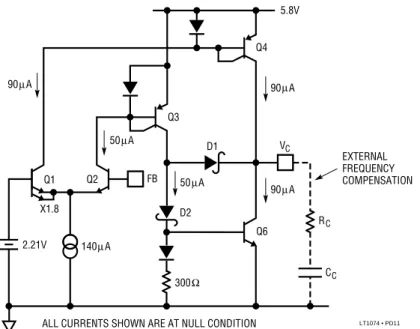
The error amplifier in Figure 10 is a single stage design with added inverters to allow the output to swing above and below the common mode input voltage. One side of the amplifier is tied to a trimmed internal reference voltage of 2.21V. The other input is brought out as the FB (feed-back) pin. This amplifier has a GM (voltage “in” to current “out”) transfer function of ≈5000µmho. Voltage gain is determined by multiplying GM times the total equivalent output loading, consisting of the output resistance of Q4 and Q6 in parallel with the series RC external frequency compensation network. At DC, the external RC is ignored, and with a parallel output impedance for Q4 and Q6 of 400kΩ, voltage gain is ≈ 2000. At frequencies above a few hertz, voltage gain is determined by the external compen-sation, RC and CC.
12
D
ESCRIPTIO
U
PI
U
S
140 Aµ Q1 LT1074 • PD11 Q2 FB V 50 Aµ 90 Aµ Q6 300 C Q4 5.8V CC RC Q3 50 Aµ 2.21V EXTERNAL FREQUENCY COMPENSATION 90 Aµ D1 90 Aµ Ω D2 X1.8ALL CURRENTS SHOWN ARE AT NULL CONDITION
Figure 10. Error Amplifier
The error amplifier has asymmetrical peak output current. Q3 and Q4 current mirrors are unity gain, but the Q6 mirror has a gain of 1.8 at output null and a gain of 8 when the FB pin is high (Q1 current = 0). This results in a maximum positive output current of 140µA and a maximum negative (sink) output current of ≅ 1.1mA. The asymmetry is deliberate — it results in much less regulator output over-shoot during rapid start-up or following the release of an output overload. Amplifier offset is kept low by area scaling Q1 and Q2 at 1.8:1.
Amplifier swing is limited by the internal 5.8V supply for positive outputs and by D1 and D2 when the output goes low. Low clamp voltage is approximately one diode drop (≈ 0.7V – 2mV/°C).
Note that both the FB pin and the VC pin have other internal connections. Refer to the frequency shifting and sychronizing discussions. A G 2 f C at midfrequencies A G R at high frequencies V m C V m C = • • = • π
Phase shift from the FB pin to the VC pin is 90° at mid-frequencies where the external CC is controlling gain, then drops back to 0° (actually 180° since FB is an inverting input) when the reactance of CC is small compared to RC. The low frequency “pole” where the reactance of CC is equal to the output impedance of Q4 and Q6 (rO), is
f 1 r C r k POLE 0 0 = ≈ 2π• • 400 Ω
Although fPOLE varies as much as 3:1 due to rO variations, mid-frequency gain is dependent only on GM, which is specified much tighter on the data sheet. The higher frequency “zero” is determined solely by RC andCC.
f 1 R C ZERO C C = 2π• •
13
U
S
A
PPLICATI
O
TYPICAL
Tapped-Inductor Buck Converter
+ + VSW VIN VC GND FB LT1074HV R1 2.8k R2 2.21k D2 35V 5W C3 200 F 50V R3 1k C2 0.2 F µ µ L1* LT1074 • TA02 D1** D3 1N5819 3 1 VIN C1 4400 F (2 EA 2200 F, 16V) L2 5 Hµ V 5V, 10A C4 390 F 16V µ OUT µ 0.01 Fµ µ + 20V - 35V† †
*PULSE ENGINEERING #PE–65282 **MOTOROLA MBR2030CTL
IF INPUT VOLTAGE IS BELOW 20V,
MAXIMUM OUTPUT CURRENT WILL BE REDUCED. SEE AN44
†
Positive-to-Negative Converter with 5V Output
✝ R3* 2.74k VIN V SW V GND R4 1.82k* C2 1000 F 10V L1 25 H 5A + + D1 MBR745 R1** 5.1k VC C3 0.1 Fµ C4** 0.01 Fµ µ + R2** 10k µ C1 220 F 50V µ * = 1% FILM RESISTORS D1 = MOTOROLA-MBR745 C1 = NICHICON-UPL1C221MRH6 C2 = NICHICON-UPL1A102MRH6 L1 = COILTRONICS-CTX25-5-52 V 4.5V to 40V IN –5V,1A*** + 200 F 10V µ – OPTIONAL FILTER 5 Hµ
LOWER REVERSE VOLTAGE RATING MAY BE USED FOR LOWER INPUT VOLTAGES. LOWER CURRENT RATING IS ALLOWED FOR LOWER OUTPUT CURRENT. SEE AN44.
R1, R2, AND C4 ARE USED FOR LOOP FREQUENCY COMPENSATION WITH LOW INPUT VOLTAGE, BUT R1 AND R2 MUST BE INCLUDED IN THE CALCULATION FOR OUTPUT VOLTAGE DIVIDER VALUES. LOWER CURRENT RATING MAY BE USED FOR LOWER OUTPUT CURRENT. SEE AN44.
R3 = –2.37 (K ) R1 = (R3) (1.86) R2 = (R3) (3.65)
VOUT Ω
MAXIMUM OUTPUT CURRENT OF 1A IS DETERMINED BY MINIMUM INPUT VOLTAGE OF 4.5V. HIGHER MINIMUM INPUT VOLTAGE WILL ALLOW MUCH HIGHER OUTPUT CURRENTS. SEE AN44.
* * * * * LT1074 • TA03 ✝ ✝ ✝ ✝ ✝ LT1074 FB
FOR HIGHER OUTPUT VOLTAGES, INCREASE R1, R2, AND R3 PROPORTIONATELY. FOR INPUT VOLTAGE > 10V, R1, R2, AND C4 CAN BE ELIMINATED, AND COMPENSATION IS DONE TOTALLY ON THE V PIN.C
14
U
S
A
PPLICATI
O
TYPICAL
Negative Boost Converter
+ VSW VIN VC GND FB LT1074 C1 1000 F 25V R1 12.7k R2 2.21k –V –5 TO –15V C3 µ LT1074 • TA04 L1 25 Hµ D1* IN V ** –15VOUT + 100 Fµ 5 Hµ
OPTIONAL OUTPUT FILTER
+ 200 F 15V µ 0.01 Fµ 100pF R3 750Ω C2 1nF + *MBR735
** I (MAX) = 1A-3A DEPENDING ON INPUT VOLTAGE. SEE AN44OUT
U
PACKAGE DESCRIPTIO
Dimensions in inches (milimeters) unless otherwise noted.DD7 0693 0.022 ± 0.005 (0.559 ± 0.127) 0.105 ± 0.008 (2.667 ± 0.203) 0.004+0.008 –0.004
(
0.102+0.203–0.102)
0.050 ± 0.012 (1.270 ± 0.305) 0.059 (1.499) TYP 0.050 ± 0.008 (1.270 ± 0.203) 0.175 ± 0.008 (4.445 ± 0.203) 0.060 (1.524) 0.401 ± 0.015 (10.185 ± 0.381) 15° TYP 0.030 ± 0.008 (0.762 ± 0.203) 0.331+0.012–0.020(
8.407+0.305–0.508)
0.143+0.012–0.020(
3.632+0.305–0.508)
0.050 ± 0.010 (1.270 ± 0.254) DD5 0693 0.022 ± 0.005 (0.559 ± 0.127) 0.105 ± 0.008 (2.667 ± 0.203) 0.004+0.008 –0.004(
0.102+0.203–0.102)
0.050 ± 0.012 (1.270 ± 0.305) 0.059 (1.499) TYP 0.050 ± 0.008 (1.270 ± 0.203) 0.175 ± 0.008 (4.445 ± 0.203) 0.060 (1.524) 0.401 ± 0.015 (10.185 ± 0.381) 15° TYP 0.032 ± 0.008 (0.813 ± 0.203) 0.331+0.012–0.020(
8.407+0.305–0.508)
0.143+0.012–0.020(
3.632+0.305–0.508)
0.067 ± 0.010 (1.702 ± 0.254)15
K Package, 4-Lead TO-3 Metal CanT Package, 5-Lead TO-220
Y Package, 7-Lead Molded TO-220
K4 0592 72° 18° 0.495 – 0.525 (12.57 – 13.34) R 0.470 TP P.C.D. 0.167 – 0.177 (4.24 – 4.49) R TYP 0.151 – 0.161 (3.84 – 4.09) DIA 2 PLC 0.655 – 0.675 (16.64 – 19.05) 1.177 – 1.197 (29.90 – 30.40) 0.038 – 0.043 (0.965 – 1.09) 0.060 – 0.135 (1.524 – 3.429) 0.320 – 0.350 (8.13 – 8.89) 0.420 – 0.480 (10.67 – 12.19) 0.760 – 0.775 (19.30 – 19.69) 0.147 – 0.155 (3.73 – 3.94) DIA 0.390 – 0.410 (9.91 – 10.41) 0.045 – 0.055 (1.14 – 1.40) 0.235 – 0.258 (5.97 – 6.55) 0.026 – 0.036 (0.66 – 0.91) 0.103 – 0.113 (2.62 – 2.87) Y7 0893 0.260 – 0.320 (6.60 – 8.13) 0.045 – 0.055 (1.14 – 1.40) 0.169 – 0.185 (4.29 – 4.70) 0.095 – 0.115 (2.41 – 2.92) 0.155 – 0.195 (3.94 – 4.95) 0.620 (15.75) TYP 0.560 – 0.590 (14.22 – 14.99) 0.016 – 0.022 (0.41 – 0.56) 0.700 – 0.728 (17.78 – 18.49) 0.135 – 0.165 (3.43 – 4.19) 0.152 – 0.202 (3.86 – 5.13) T5 (FORMED) 0993 0.028 – 0.035 (0.711 – 0.889) 0.057 – 0.077 (1.448 – 1.956) 0.139 – 0.153 (3.531 – 3.886) DIA 0.079 – 0.135 (2.007 – 3.429) 0.380 – 0.420 (9.652 – 10.668) 0.560 – 0.650 (14.224 – 16.510) 0.304 – 0.380 (7.722 – 9.652) 0.700 – 0.728 (17.780 – 18.491) 0.035 – 0.055 (0.889 – 1.397) 0.169 – 0.185 (4.293 – 4.699) 0.079 – 0.115 (2.007 – 2.921) 0.149 – 0.230 (3.785 – 5.842) 0.620 ± 0.020 (15.75 ± 0.508) 0.460 – 0.500 (11.68 – 12.70) 0.210 – 0.240 (5.334 – 6.096) 0.055 – 0.090 (1.397 – 2.286) 0.015 – 0.025 (0.381 – 0.635) 0.866 – 0.913 (21.996 – 23.190) 0.970 – 1.050 (24.64 – 26.67)
U
PACKAGE DESCRIPTIO
Dimensions in inches (milimeters) unless otherwise noted.Information furnished by Linear Technology Corporation is believed to be accurate and reliable. However, no responsibility is assumed for its use. Linear Technology Corporation makes no represen-tation that the interconnection of its circuits as described herein will not infringe on existing patent rights.
16
Linear Technology Corporation
LINEAR TECHNOLOGY CORPORATION 1994BA/GP 0494 2K REV B • PRINTED IN USA1630 McCarthy Blvd., Milpitas, CA 95035-7487
(408) 432-1900● FAX: (408) 434-0507●TELEX: 499-3977
TAIWAN
Linear Technology Corporation
Rm. 801, No. 46, Sec. 2 Chung Shan N. Rd. Taipei, Taiwan, R.O.C. Phone: 886-2-521-7575 FAX: 886-2-562-2285
UNITED KINGDOM
Linear Technology (UK) Ltd.
The Coliseum, Riverside Way Camberley, Surrey GU15 3YL United Kingdom
Phone: 44-276-677676 FAX: 44-276-64851
NORTHEAST REGION
Linear Technology Corporation
One Oxford Valley
2300 E. Lincoln Hwy.,Suite 306 Langhorne, PA 19047 Phone: (215) 757-8578 FAX: (215) 757-5631
Linear Technology Corporation
266 Lowell St., Suite B-8 Wilmington, MA 01887 Phone: (508) 658-3881 FAX: (508) 658-2701
U.S. Area Sales Offices
SOUTHEAST REGION
Linear Technology Corporation
17060 Dallas Parkway Suite 208 Dallas, TX 75248 Phone: (214) 733-3071 FAX: (214) 380-5138 CENTRAL REGION
Linear Technology Corporation
Chesapeake Square
229 Mitchell Court, Suite A-25 Addison, IL 60101
Phone: (708) 620-6910 FAX: (708) 620-6977
SOUTHWEST REGION
Linear Technology Corporation
22141 Ventura Blvd. Suite 206 Woodland Hills, CA 91364 Phone: (818) 703-0835 FAX: (818) 703-0517 NORTHWEST REGION
Linear Technology Corporation
782 Sycamore Dr. Milpitas, CA 95035 Phone: (408) 428-2050 FAX: (408) 432-6331
FRANCE
Linear Technology S.A.R.L.
Immeuble "Le Quartz" 58 Chemin de la Justice 92290 Chatenay Malabry France Phone: 33-1-41079555 FAX: 33-1-46314613 GERMANY Linear Techonolgy GmbH Untere Hauptstr. 9 D-85386 Eching Germany Phone: 49-89-3197410 FAX: 49-89-3194821 JAPAN Linear Technology KK 5F YZ Bldg. 4-4-12 Iidabashi, Chiyoda-Ku Tokyo, 102 Japan Phone: 81-3-3237-7891 FAX: 81-3-3237-8010 KOREA
Linear Technology Korea Branch
Namsong Building, #505 Itaewon-Dong 260-199 Yongsan-Ku, Seoul Korea Phone: 82-2-792-1617 FAX: 82-2-792-1619 SINGAPORE
Linear Technology Pte. Ltd.
101 Boon Keng Road #02-15 Kallang Ind. Estates Singapore 1233
Phone: 65-293-5322 FAX: 65-292-0398
World Headquarters
Linear Technology Corporation
1630 McCarthy Blvd. Milpitas, CA 95035-7487 Phone: (408) 432-1900 FAX: (408) 434-0507
0294