VISION-BASED POSITION
ESTIMATION IN MULTIPLE
QUADROTOR SYSTEMS WITH
APPLICATION TO FAULT DETECTION
AND RECONFIGURATION
MASTER THESIS, 2012-2013
SCHOOL OF ENGINEERS, UNIVERSITY OF SEVILLE
Author
Alejandro Suárez Fernández-Miranda
Supervising Teachers
Dr. Guillermo Heredia Benot
2
A strong man doesn't need to read the future, he makes his own. Solid Snake - Metal Gear Solid
4
Table of Content
1. INTRODUCTION ... 10
1.1. Introduction... 10
1.2. General description of the project ... 11
1.3. Related works ... 12
1.3.1. Vision-based position estimation ... 12
1.3.2. Visual tracking algorithms ... 12
1.3.3. FDIR ... 13
1.3.4. Quadrotor dynamic modeling and control ... 13
1.4. Development time estimation ... 14
2. Vision-based position estimation in multiple quadrotor systems ... 17
2.1. Problem description ... 17
2.2. Model of the system ... 19
2.3. Position estimation algorithm ... 21
2.4. Visual tracking algorithm ... 23
2.5. Experimental results ... 25
2.5.1. Software implementation ... 25
2.5.2. Description of the experiments... 27
2.5.3. Analysis of the results ... 28
2.5.3.1. Fixed quadrotor with parallel cameras ... 29
2.5.3.2. Fixed quadrotor with orthogonal camera configuration ... 30
2.5.3.3. Fixed quadrotor with moving cameras ... 31
2.5.3.4. Fixed quadrotor with orthogonal camera configuration and tracking loss 33 2.5.3.5. Z-axis estimation with flying quadrotor and parallel camera configuration ... 34
2.5.3.6. Depth and lateral motion in the XY plane ... 37
2.5.3.7. Quadrotor executing circular and random trajectories ... 39
2.6. Accuracy of the estimation ... 42
2.7. Summary ... 43
2.8. Evolution in the development of the vision-based position estimation system . 44 3. Application of virtual sensor to Fault Detection and Identification ... 47
3.1. Introduction... 47
3.2. Additive positioning sensor fault ... 47
5
3.4. Criterion for virtual sensor rejection ... 50
3.5. Threshold function ... 51
4. Simulation of perturbations in the virtual sensor over quadrotor trajectory control .... 55
4.1. Introduction... 55
4.2. Quadrotor trajectory control ... 56
4.2.1. Dynamic model ... 56
4.2.2. Attitude and height control ... 58
4.2.3. Velocity control ... 59 4.2.4. Trajectory generation ... 59 4.3. Model of perturbations ... 60 4.3.1. Sampling rate ... 60 4.3.2. Delay ... 60 4.3.3. Noise ... 60 4.3.4. Outliers ... 61 4.3.5. Packet loss ... 61 4.4. Simulation results ... 61
4.4.1. Different speeds and delays ... 62
4.4.2. Noise and outliers with fixed delay ... 63
4.4.3. Delay, noise, outliers and packet loss ... 64
5. Conclussions ... 68
6
List of Figures
Figure 1. Estimated percentage of the development time for each of the phases of the project
... 14
Figure 2. Gantt diagram with the evolution of the project ... 15
Figure 3. Two quadrotors with cameras in their base tracking a third quadrotor whose position want to be estimated, represented by the green ball ... 17
Figure 4. Images taken during data acquisition experiments at the same time from both cameras, with two orange balls at the top of a Hummingbird quadrotor ... 18
Figure 5. Relative position vectors between the cameras and the tracked quadrotor ... 19
Figure 6. Pin-hole camera model ... 20
Figure 7. State machine implemented in the modified versión of the CAMShift algorithm ... 25
Figure 8. Orange rubber hat at the top of the Hummingbird quadrotor used as visual marker 28 Figure 9. Camera configuration with parallel optical axes in the Y-axis of the global frame and fixed quadrotor ... 29
Figure 10. Position estimation error in XYZ (blue, green, red) and distance between cameras and quadrotor (magenta, black) for fixed quadrotor and parallel optical axes. Blue marks “*” correspond to instants with tracking loss from one of the cameras ... 30
Figure 11. Orthogonal configuration of the cameras ... 30
Figure 12. Position estimation error in XYZ (blue, green, red) and distance between cameras and quadrotor (magenta, black) for fixed quadrotor and orthogonal configuration of the cameras ... 31
Figure 13. Estimation error and distance with cameras with fixed quadrotor and moving cameras, initially with parallel optical axes and finally with orthogonal configuration ... 32
Figure 14. Evolution of the position estimation error with multiple tracking losses (marked by a “*” character) in one of the cameras ... 32
Figure 15. Orthogonal camera configuration with tracked quadrotor out of the FoV for one of the cameras ... 33
Figure 16. Position estimation error and distance with cameras with long duration tracking loss for one of the cameras (blue and green “*” characters) and both cameras (red “*” characters) ... 34
Figure 17. Number of consecutive frames with tracking loss (blue) and threshold (red) ... 34
Figure 18. Configuration of the cameras and the quadrotor for the Z-axis estimation experiment ... 35
Figure 19. Vicon height measurement (red) and vision-based estimation (blue) ... 36
Figure 20. Position error estimation in XYZ (blue, green, red) and distance between each of the cameras and the tracked quadrotor (magenta, black) ... 36
Figure 21. Configuration of the cameras for the experiment with depth (YE axis) and lateral motion (XE axis) ... 37
Figure 22. X-axis estimation with depth and lateral motion for the quadrotor ... 38
7
Figure 24. Number of consecutive frames with tracking loss with depth and lateral motion for the quadrotor ... 39 Figure 25. Configuration of the cameras with the quadrotor executing circular and random trajectories ... 40 Figure 26. X-axis estimation and real position when the quadrotor is executing circular and random trajectories ... 40 Figure 27. Y-axis estimation and real position when the quadrotor is executing circular and random trajectories ... 41 Figure 28. Number of consecutive frames with tracking loss when the quadrotor is executing circular and random trajectories ... 41 Figure 29. Simulation of GPS data with drift error between t = 20 s and t = 30 s ... 48 Figure 30. Distance between position given by GPS and vision-based estimation with GPS drift error ... 48 Figure 31. GPS simulated data with fixed measurement from t = 110 s ... 49 Figure 32. Distance between vision-based position estimation and GPS with faulty data (black), and threshold (red) ... 50 Figure 33. Number of consecutive frames with tracking loss and threshold for rejecting virtual sensor estimation ... 51 Figure 34. Angle and distance between the camera and the tracked object ... 52 Figure 35. Estimation error and distance with cameras with the cameras changing from parallel to orthogonal configuration ... 52 Figure 36. Distance between GPS simulated data and estimated position and threshold corresponding to Figure 35 ... 53 Figure 37. Two quadrotors with cameras in their base tracking a third quadrotor whose position want to be estimated, represented by the green ball ... 55 Figure 38. Images taken during data acquisition experiments at the same time from both cameras, with two orange balls at the top of a Hummingbird quadrotor ... 56 Figure 39. Reference path and trajectories followed in XY plane with different values of delay in XY position measurement, fixed delay of 100 ms in height measurement and V = 0,5 m·s-1. 62 Figure 40. External estimation of XY position with Gaussian noise, outliers and a reference speed of V = 0,5 m·s-1 ... 64 Figure 41. Trajectories followed by the quadrotor with noise and outliers (blue) and without them (black) ... 64 Figure 42. Quadrotor trajectories with simultaneous application of noise, delay, outliers and packet loss for V = 0,5 m·s-1 (blue) and V = 0,75 m·s-1 (green) ... 65 Figure 43. Reference and real value for height when XY position is affected by noise, delay, outliers and packet loss with a reference speed of V = 0,75 m·s-1 ... 66
8
Acknowledgments
This work was partially funded by the European Commission under the FP7 Integrated Project EC-SAFEMOBIL (FP7-288082) and the CLEAR Project (DPI2011-28937-C02-01) funded by the Ministerio de Ciencia e Innovacion of the Spanish Government.
The author wishes to acknowledge the support received by the CATEC during the experiments carried out in its testbed. Special thanks to Miguel Ángel Trujillo and Jonathan Ruiz from CATEC, and to professors José Ramiro Martínez de Dios and Begoña C. Arrúe Ullés from the University of Seville, for their help.
Finally, the author wants to remark all the help and advice provided by the supervisors Guillermo Heredia Benot and Aníbal Ollero Baturone.
9
Publications
Accepted papers
• Suárez, A., Heredia, G., Ollero, A.: Analysis of Perturbations in Trajectory Control Using Visual Estimation in Multiple Quadrotor Systems. First Iberian Robotics Conference (2013)
Awaiting acceptance papers
• Suárez, A., Heredia, G., Martínez-de-Dios, R., Trujillo, M.A., Ollero, A.: Cooperative Vision-Based Virtual Sensor for MultiUAV Fault Detection. International Conference on Robotics and Automation (2014)
10
1.
INTRODUCTION
1.1.
Introduction
Position estimation is an important issue in many mobile robotics applications, where automatic position or trajectory control is required. This problem can be found in very different scenarios, including both terrestrial and aerial robots, with different specifications in accuracy, reliability, cost, weight, size or computational resources. Two main approaches can be considered: position estimation based on odometry, beacons or any other internal sensors, or using a global positioning system such as GPS or Galileo. Each of these technologies has its advantages and disadvantages. The selection of a specific device will depend on the particular application, namely, the specifications in the operation conditions of the robot. For example, it is well known that GPS sensors only work with satellite visibility, so they cannot operate in indoors, but they are extensively used in fixed-wing UAVs and other outdoor exploration vehicles. Another drawback of these devices is their low accuracy, with position errors around two meters, although centimeter accuracies can be obtained with Differential GPS (DGPS). For small indoor wheeled robots, a simple and low cost solution is to use odomety methods, integrating speed or acceleration information obtained from optical encoders or Inertial Measurement Units (IMU). However, the lack of a position reference will cause a drift error along the time, so the estimation might become useless after a few seconds. In recent years, a great effort to solve the Simultaneous Localization and Mapping (SLAM) problem has been dedicated, making possible its application in real time, although it still carries high computational costs.
The current trend is to integrate multiple sources of information, fusing their data in order to obtain a better estimation for accuracy and reliability. The sensors can be both static at fixed positions or mounted over mobile robots. Multi-robot systems for instance are platforms were these techniques can be implemented naturally. This work is focused in multi-quadrotor systems with a camera mounted in the base of each UAV, so the position of a certain quadrotor will be obtained from the centroid of its projection over the image planes and the position and orientation of the cameras. Moreover, the Kalman filter used as estimator will also provide the velocity of the vehicle.
The external estimation obtained (position, orientation or velocity) can be used for controlling the vehicle. However, some aspects such as estimation errors, delays or estimation availability have to be considered carefully. The effects of new perturbations introduced in the control loop should be analyzed in simulation previous to its application in the real system, so potential accidents causing human or material damages can be avoided.
11
1.2.
General description of the project
The goal of this work is the development of a system for obtaining a position estimation of a quadrotor being visually tracked by two cameras whose position and orientation are known. A simulation study based on data obtained from experiments will be carried for detecting failures on internal sensors, allowing the system reconfiguration to keep the system under control. If the vision-based position estimation provided by the virtual sensor is going to be used in position or trajectory control, it is convenient to study the effects of the associated perturbations (delays, tracking loss, noise, outliers) over the control. Before testing it in real conditions, with the associated risk of accidents and human or material damages, it is preferable to analyze the performance of the controller in simulation. So a simulator of the quadrotor dynamics and its trajectory control system, including the simulation of the identified perturbations, was built.
The position and velocity of the tracked object on the 3D space will be obtained from an Extended Kalman Filter (EKF), taking as input the centroid of the object on every image plane of the cameras, as well as their position and orientation. Two visual tracking algorithms were used in this project: the Tracking-Learning-Detection (TLD), and a modified version of the CAMShift algorithm. However, TLD algorithm was rejected due to high computational costs and its bad results applied to the quadrotor tracking, as it is based on template matching. On the other hand, CAMShift algorithm is a color-based tracking algorithm that uses the HSV color space for extracting color information (Hue component) in a single channel image, simplifying the object identification and making it robust to illumination and appearance changes.
In multi-UAV systems such as formation flight, cooperative surveillance and monitoring or aerial refueling, every robot might carry additional sensors, not for their own control, but for estimating part of the state of other vehicle, for example its position, velocity or orientation. This external estimation can be seen as a virtual sensor, in the sense that it provides a measurement of a certain signal computed from other sensors. In normal conditions, both internal and virtual sensors should provide similar measurements. However, consider a situation with a UAV approaching to an area without satellite visibility, so its GPS sensor is not able to provide position data but the IMU keeps integrating acceleration, increasing error with the time, and then the difference between both sources becomes significant. If a certain threshold is exceeded, the GPS can be considered as faulty, starting a reconfiguration process that handles this situation.
For the external position estimation, a communication network is necessary for the interchange of the information used on its computation (time stamp, position and orientation of the cameras, centroid of the tracked object in the image plane). Although this is beyond the scope of this work, communication delays and packet losses should be taken into account when the virtual sensor is going to be used for controlling the UAV.
A quadrotor simulator with its trajectory control system has been developed for studying the effects of a number of perturbations identified during experiments, including those related to communications. The simulator was implemented as a MATLAB-Simulink block diagram that includes quadrotor dynamics, attitude, position and trajectory controllers, and a way-point
12
generator. Graphical and numerical results are shown in different conditions, highlighting the most important aspects in each case. These results should be used as reference only, as the effects of perturbations over quadrotor performance will depend on the control scheme being used.
Finally, all position estimation experiments were performed hand holding the cameras: they were not mounted in the base of any quadrotor. What is more, both cameras used were connected to the same computer through a five-meter cable, what limited the movements around the tracked UAV. In the next step of the project (not considered here), the cameras will be mounted on the quadrotors, and image processing will be done onboard or in a ground control station. The onboard image acquisition and processing introduces additional problems such as vibrations, weight limitations, or available bandwidth.
1.3.
Related works
The main contribution of this work is the application of the visual position estimation to the Fault Detection and Identification (FDI). However, a number of issues have also been treated, including visual tracking algorithms, quadrotor dynamic modeling and quadrotor control.
1.3.1. Vision-based position estimation
The problem of multi-UAV position estimation in the context of forest fire detection has been treated in [1], estimating motion from multiple planar homographies. Accelerometer, gyroscope and visual sensor measurements are combined in [2] using a non-linear complementary filter for estimating pose and linear velocity in an aerial robot. Simultaneously Localization and Mapping (SLAM) problem has been applied to small UAVs in outdoors, in partially structured environments [3]. Quadrotor control using onboard or ground cameras is described in [4] and [5]. Here both position and orientation measurements are computed from the images provided by a pair of cameras. Homography techniques are combined with a Kalman filter in [6] for obtaining UAV position estimation when building mosaics. Other applications where vision-based position estimation can be employed include formation flight and aerial refueling [7], [8], [9], [10].
1.3.2. Visual tracking algorithms
Visual tracking algorithms with application to position estimation of moving objects have to be fast enough to provide an accurate estimation. As commented earlier, TLD algorithm [11] was tested in the first place due to its ability to adapt to changes in the appearance of the object. However, as this algorithm is based on template matching and the surfaces of the quadrotors
13
are not big enough, most of the time the tracking was lost. On the other hand, the execution time was too high due to the high number of operations involved in the correlations with the template list. Color-based tracking algorithms such as CAMShift [12] present good properties for this purpose, including simplicity, low computation time, invariance to changes in the illumination, rotation and position, or noise rejection. A color marker in contrast with the background has to be disposed in the object to be tracked. The problem of this algorithm appears when an object with similar color is in the image, although it can be solved considering additional features. The basic CAMShift assumes that tracked object is always visible on the image, so it cannot handle tracking losses. Some modifications have been done to CAMShift to make possible tracking recovery when object is temporarily occluded, when it changes its appearance or when similarly colored objects are contained in the scene [13]. A Kalman filter is used in [14] for handling occlusions, while a multidimensional color histogram in combination with motion information solve the problem of distinguishing color.
1.3.3. FDIR
Reliability and fault tolerance has always been an important issue in UAVs [20], where Fault Detection and Identification (FDI) techniques play an important role in the efforts to increase the reliability of the systems. It is even more important when teams of aerial vehicles cooperate closely between them and the environment, as it is the case in formation flight and heterogeneous UAV teams, because collisions between them or between the vehicles and objects of the environment may arise.
In a team of cooperating autonomous vehicles, FDI of individual vehicles in which they use their own sensors for FDI can be regarded as Component Level (CL) FDI. Most CL-FDI applications to UAVs that appear in the literature use model-based methods, which try to diagnose faults using the redundancy of some mathematical description of the system dynamics. Model-based CL-FDI has been applied to unmanned aircraft, either fixed wing UAVs [21] or helicopter UAVs [22][23][24].
The Team Level (TL) FDI exploits the team information for detection of faults. Most published works rely on transmission of the state of the vehicles through the Communications channel for TL-FDI [25]. What has not been thoroughly explored is the use of the sensors onboard the other vehicles of the team for detection of faults in an autonomous vehicle, which requires sensing the state of a vehicle from the other team components.
1.3.4. Quadrotor dynamic modeling and control
Quadrotor modeling and control has been extensively treated in literature. The derivation of the dynamic model is described in detail in [15]. Some control methods applied in simulation and in real conditions can be found here too. PID, LQ and Backstepping controllers have been tested in [16] and [17] over an indoor micro quadrotor. Mathematical modeling and experimental results in quadrotor trajectory generation and control can be found in [18]. Ref.
14
[19] addresses the same problem but the trajectory generation allows the execution of aggressive maneuvers.
1.4.
Development time estimation
The development of this project can be divided into three phases: • Development of the vision-based position estimation system • Development of the quadrotor trajectory control simulator • Documentation (papers, reports, memories)
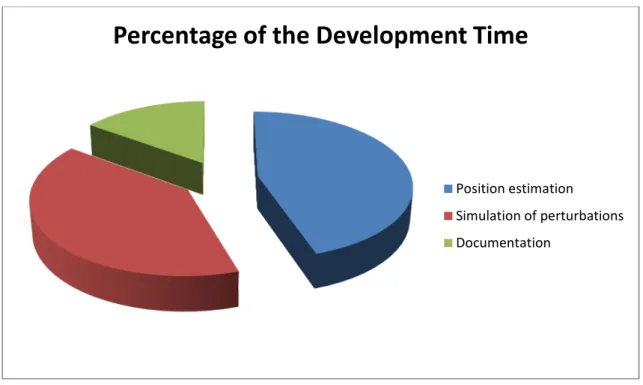
The estimation of the percentage of time dedicated to each of these phases has been represented in Figure 1. The Gantt diagram with the identified tasks and their start date and end date can be seen in Figure 2. The project started in November 2012, with the technical part being finished in June 2013. Since then, two papers have been sent to ROBOT 2013 congress (accepted) and ICRA 2014 (awaiting acceptance), and the project report has been written.
Figure 1. Estimated percentage of the development time for each of the phases of the project
Percentage of the Development Time
Position estimation Simulation of perturbations Documentation
15
17
2.
Vision-based position estimation in multiple quadrotor
systems
2.1.
Problem description
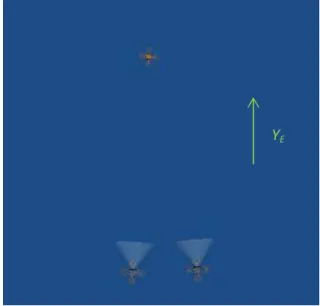
Consider a situation with three quadrotors A, B and C. Two of them, A and B, have cameras mounted in their base with known position and orientation referred to a global frame. Images taken from cameras are sent along with their position and orientation to a ground station. Both cameras will try to stay focused on the third quadrotor, C, so a tracking algorithm will be applied to obtain the centroid of the object on every received image. An external position estimator executed in the ground station will use this data to obtain an estimation of quadrotor C position that can be used for position or trajectory control in the case C does not have this kind of sensors, they are damaged, or they are temporarily unavailable. The situation described above has been shown in Figure 3. Here the cones represent the field of view of the cameras, the orange quadrotor is the one being tracked and the green ball corresponds to its position estimation.
Figure 3. Two quadrotors with cameras in their base tracking a third quadrotor whose position want to be estimated, represented by the green ball
One of the main issues in vision-based position estimation applied to trajectory or position control is the presence of delays in the control loop, which should not be too high to prevent the system of becoming unstable. The following sources of delay can be identified:
• Image acquisition delay
• Image transmission through radio link • Image processing for tracking algorithm • Position estimation and its transmission
The first two are imposed by hardware and available bandwidth. The last one is negligible in comparison with the others. On the other hand, image processing is very dependent on the
18
computation cost required by the tracking algorithm. In this work, the external position estimation system was developed and tested with real data, obtaining position and orientation of cameras and tracked quadrotor from a Vicon Motion Capture System in the CATEC testbed. The visual tracking algorithm used was a modified version of CAMShift algorithm. This color-based tracking algorithm uses Hue channel in the HSV image representation for building a model of the object and detecting it, applying Mean-Shift for computing the centroid of the probability distribution. As this algorithm is based only in color information, a small orange ball was disposed at the top of the tracked quadrotor, in contrast with the blue floor of the testbed. Figure 4 shows two images captured by the cameras during data acquisition phase.
Figure 4. Images taken during data acquisition experiments at the same time from both cameras, with two orange balls at the top of a Hummingbird quadrotor
Although in practical application the external position estimation process will run in real time, here the computations were done off-line in order to make easier the development and debug of this system, so the estimation was carried out in two phases:
1) The data acquisition phase, where images and the measurements of the position and orientation of both cameras and the tracked object were captured along with the time stamp and saved into a file and a directory containing all images.
2) The position estimation phase, corresponding to the execution of the extended Kalman filter that makes use of the captured data to provide an off-line estimation of the quadrotor position at every instant indicated by the time stamp.
As normal cameras do not provide depth information (unless other constraints are considered, such as tracked object size), two or more cameras are needed in order to obtain the position of the quadrotor in the three-dimensional space. Even with one camera, if it changes its position and orientation and the tracked object movement is reduced, the position can be estimated. One of the main advantages of using Kalman filter is its ability to integrate multiple sources of information, in the sense that it will try to provide the best estimation independently on the number of observations available at a certain instant. The results of the experiments presented here were obtained with two cameras, although in some cases the tracked object was occluded or out of the field of view (FoV) for one or both cameras. The
19
extended Kalman filter equations described later were obtained for two cameras, but they can be easily modified to consider an arbitrary number of cameras.
2.2.
Model of the system
The system for the vision-based position estimation of a moving object using two cameras is represented in Figure 5. It is assumed for the cameras to be mounted on the quadrotors, but for clarity, they have not been drawn.
Figure 5. Relative position vectors between the cameras and the tracked quadrotor
The position and orientation of cameras and tracked quadrotor will be referred to fixed frame
{E} = {XE, YE, ZE}. For this problem, PCAM1, PCAM2 and rotation matrixes R E
CAM1 and R E
CAM2 are
known. The following relationships between position vectors are derived: = · +
= · + ( 1 )
The tracking algorithm will provide the centroid of the tracked object. The pin-hole camera model relates the position of the object referred to the camera coordinate system in 3D space with its projection in the image plane. Assuming that the optical axis is X, then:
= ·
;
= ·
( 2 )
where fx and fy are focal length in both axes of the cameras, assumed to be equal for all
20
Figure 6. Pin-hole camera model
It also will be needed a model of camera lens for compensating typical radial and tangential distortion. A calibration process using chessboard pattern or circles pattern is required for obtaining distortion coefficients. There are two ways for compensate this kind of perturbation:
A) Backward compensation: given the centroid of the object in the image plane, the distortion is undone so the ideal projection of the point is obtained. However, it might require numerical approximations if equations are not invertible.
B) Forward compensation: position estimator will obtain an estimation of the object centroid, and is here the model of distortion is applied directly. The drawback of this solution is that distortion equations should be considered when computing jacobian matrix, otherwise a slight error must be accepted.
The distorted point on the image plane is computed as follows: = (1)
(2)! = (1 + "#(1) · $
+ "#(2) · $%+ "#(5) · $') · ()+ *( ( 3 )
Here xn = [x,y]T is the normalized image projection (without distortion), r2 = x2 + y2 and and dx
is the tangential distortion vector:
= 2 · "#(3) · · + "#(4) · ($+ 2 · )
"#(3) · ($+ 2 · ) + 2 · "#(4) · · ! ( 4 )
The vector with the distortion coefficients, kc, as well as the focal length and the principal point of the cameras were obtained with the MATLAB camera calibration toolbox.
yIMn Object Lens Image Plane fy xCAMnObj zCAMn Obj fx xCAMnObj xIMn Object Lens Image Plane yCAMn Obj
21
2.3.
Position estimation algorithm
An Extended Kalman Filter (EKF) was used for the position estimation of the tracked object from its centroid in both images and the position and orientation of the cameras. The “extended” version of the algorithm is used because of the presence of nonlinearities in the rotation matrix and in pin-hole camera model. For EKF application, a nonlinear state space description of the system is considered in the following way:
(-= .((-/0) + 1-/0
2-= 3((-) + 4- ( 5 )
where xk is the state vector, f(·) is the state evolution function, zk is the measurement vector,
h(·) is the output function, and wk and vk are Gaussian noise processes.
State vector will contain position and velocity of the tracked UAV referred to fixed frame {E}, while measurement vector will contain the centroid of the object in both images given by the tracking algorithm in current instant, but also in previous one (this is done for taking into account velocity when updating estimation). These two vectors are then given by:
(-= 56, 6, 6, 86, 86, 869:;
2-= <6, 6, 6, 6, 6/, 6/, 6/, 6/=;
( 6 )
If no other information source can be used, a linear motion model is assumed, so system evolution function will be:
(-= > ? ? ? ? @66 6 86 86 89AB B B B C = > ? ? ? ? ? @6/+ DE · 86/ 6/+ DE · 86/ 6/+ DE · 86/9 86/ 86/ 86/9 A B B B B B C ( 7 )
Here ∆t is the elapsed time between consecutives updates. If acceleration of the tracked quadrotor can be obtained from its internal sensors or computed from orientation, this information would be integrated in the last three terms of the system evolution function:
(-= > ? ? ? ? @66 6 86 86 89AB B B B C = > ? ? ? ? ? @6/+ DE · 86/ 6/+ DE · 86/ 6/+ DE · 86/9 86/ + DE · F6/ 86/ + DE · F6/ 86/9 + DE · F6/9 A B B B B B C ( 8 )
22
On the other hand, it is necessary to relate the measurable variables (centroid of the tracked object on every image plane) with the state variables. This can be done through the equations of the model: G6 6H = > ? ? ? @·$ · ( 6− 6 ) + $ · (6− 6 ) + $J · (6− 6 ) $ · (6− 6 ) + $ · (6− 6 ) + $J · (6− 6 ) ·$J · ( 6− 6 ) + $J · (6− 6 ) + $JJ · (6− 6 ) $· (6− 6 ) + $ · (6− 6 ) + $J · (6− 6 )A B B B C ( 9 )
Here rnij is the ij element of the rotation matrix for the n-th camera. For computing at instant k the centroid of the object at instant k-1, we make use of the following equation:
K6/6/ 6/ L = M6− 86 · ∆E 6− 86· ∆E 6− 869· ∆E O ( 10 )
Then, an equivalent expression to (9) is obtained.
Jacobian matrixes Jf and Jh used in EKF equations can be easily obtaining from these two expressions. However, only the matrix corresponding to the state evolution function is reproduced here due to space limitations:
PQ= > ? ? ? ? @10 0 0 0 0 0 1 0 0 0 0 0 0 1 0 0 0 ∆E 0 0 1 0 0 0 ∆E 0 0 1 0 0 0 ∆E 0 0 1 AB B B B C ( 11 )
Now let consider the general position estimation problem with N cameras. The state vector is the same as defined in (7), however, for practical reasons, the measurement vector will only contain the centroid of the tracked object at instants k and k-1 for one camera each time:
2-)= <6, 6, 6/, 6/=; ( 12 )
The vector znk represents the measurements of camera n-th at iteration k. As the number of
cameras increases, the assumption of simultaneous image acquisition might not be valid, and a model with different image acquisition times is preferred instead. This requires a synchronization process with a global time stamp indicating when the image was taken. Let define the following variables:
• t0: time instant of last estimation update
23
If tmacq is the time stamp of the last image captured, then: ∆E = ES#TU − EV
EV= ES#TU ( 13 )
The rest of computations are the same as described for the case with two cameras.
2.4.
Visual tracking algorithm
Visual tracking applied in the position estimation and control imposes hard restrictions in computational time, in the sense that delays in position measurements affect significantly the performance of the trajectory control, limiting the speed of the vehicle to prevent it of becoming unstable. However, vision-based tracking algorithms must include other properties like:
• Robustness to light conditions • Noise immunity
• Ability to support changes in the orientation of the tracked object
• Low memory requirements, what usually also implies low computation time • Capable to recover from temporal losses (occlusions, object out of FoV) • Support image blurring due to camera motion
• Applicable with moving cameras
It must be taken into account that quadrotors have a small surface, and its projection in the image can be very changing due to its “X” shape. On the other hand, using color markers do not affect the quadrotor control, but they simplify the visual detection task.
In this research, we tested two tracking algorithms: TLD (Tracking-Learning-Detection) and a modified version of CAM-Shift. The first one builds a model of the tracked object while it is on execution, adding a new template to the list when a significant difference between current observation and model is detected. For smooth operation, TLD needs the tracked object to have significant edges and contours since detection is made through a correlation between templates and image patches with different position and scales. This makes its use for quadrotor tracking difficult due to the small surface and uniformity in the quadrotor shape. Experimental results show the following problems in the application of this algorithm:
• Significant error in centroid estimation • Computation time is relatively high • Too many false-positives are found
24
• The bounding box around the object tends to diverge • Tracked object is usually lost when it comes far from camera • Tracked object is lost when background is not uniform
Better results were obtained with a modified version of CAMShift algorithm (Continuously Adaptive Mean-Shift). CAMShift is a color-based tracking algorithm, so a color marker is required to be placed in a visible part of the quadrotor in contrast with the background color. In tests, we put two small orange balls at the top of the quadrotor, while the floor of the testbed was blue. The tracked object (the two orange balls, not the quadrotor) is represented by a histogram of the hue component containing the color distribution of the object. Here the HSV (Hue-Saturation-Value) image representation is used instead of RGB color space. This representation allows the extraction of color information and its treatment as a one-dimensional magnitude, so histogram based techniques can be applied. Saturation (color density) and Value (brightness) are limited in order to reject noise and other perturbations. For every image received, the CAMShift algorithm computes a probability image weighting Hue component of every pixel with the color distribution histogram of the tracked object, so the pixels with color closer to the object will have higher probabilities. Mean-Shift algorithm is then applied to obtain the maximum of the image probability in an iterative process. The process computes the centroid of the probability distribution within a window that will slide in the direction of the maximum until its center converges. Denoting the probability image by
P(x,y), then the centroid of the distribution inside searching window will be given by:
#= WWV
VV ; # =
WV
WVV ( 14 )
where M00, M10 and M01 are zero and first order moments of image probability computed as
follows: WVV= X X (, ) ; WV= X X · (, ) ; WV= X X · (, ) ( 15 )
CAMShift algorithm will return an orientated ellipse around the tracked object, whose dimensions and orientation will be obtained from second order moments.
The basic implementation of CAMShift assumes that there is a nonzero probability in the image at all times. However, if tracked object is temporarily lost from image due to occlusions or because it is out of the field of view, the algorithm must be able to detect tracked object loss and redetect it, so tracking can be reset once object is visible again. This can be seen as a two state machine, as shown in Figure 7:
25
Figure 7. State machine implemented in the modified versión of the CAMShift algorithm
For detecting object lost and for object redetection, a number of criterions can be used: • The zero order moment, as a estimation of the object size
• The size, dimensions or aspect ratio of the bounding box around the object
• One or more templates of the near surrounding of the color marker that include the quadrotor
• A vector of features obtained from SURF, SIFT or similar algorithms
For detection process, the incoming image will be divided into a set of patches, and for every patch, a measurement of the probability for the tracked object to be contained there is computed, and then, the detector will return the position of the most probable patch. If this path is a false positive, it will be rejected by the object loss detector, and a new detection process will begin. Otherwise, CAMShift will use this patch as initial search window.
Experimental results made us conclude:
• CAMShift is about 5-10 times faster than TLD
• Modified version of CAMShift can recover in short time from object lost when this is visible again
• False-positive are rejected by the object loss detector • CAMShift can follow objects further than TLD
• CAMShift requires much less computation resources than TLD
2.5.
Experimental results
This section presents graphical and numerical results of vision-based position estimation using the algorithms explained above. Previously, it is described the software developed specifically for this experiments, as well as the conditions, equipment and personal involved.
2.5.1. Software implementation
Tracking Detecting
Tracked Object Lost
26
Three software modules were developed to support the experiments of vision-based position estimation. These experiments were divided into two phases: the data acquisition phase, and the data analysis phase. Real-time estimation experiments have not been done.
• Data acquisition module: this program was written in C++ for both Ubuntu 12.04 and
Windows 8 Operative Systems using Eclipse Juno IDE and Microsoft Visual Studio Express 2012, respectively. It makes use of Open CV (Open Computer Vision) library, as well as Vicon Data Stream SDK library. The program contains a main loop where images of the two cameras are captured and saved as individual files along with the measurements of the position and orientation of both cameras and the tracked object given by a Vicon Motion Capture System. These measurements are saved in a text file with their corresponding time stamp. Images and measurements are assumed to be captured at the same time for the estimation process, although in practical, these data are obtained sequentially, so there is a slight delay. Previously to the data acquisition loop, the user must specify the resolution of the cameras and the folder name where images and Vicon measurements are stored.
• Tracking and position estimation module: this program was also implemented in C++
for Ubuntu 12.04 and Windows 8, using Open CV and ROS (Robot Operating System) libraries. It was designed to accept data in real time but also data captured by the acquisition program. It has not been tested in real time. Until now, it has only been used for the off-line position estimation. The program contains a main loop with the execution of the tracking algorithm and the extended Kalman filter. It also performs the same functions as the data acquisition program, taking sequentially images from cameras as well as position and orientation measurements from Vicon. The modified version of the CAMShift algorithm returns the centroid of the tracked quadrotor for every image in both cameras. Then, the position estimation is updated with this information and visualized with the rviz application from ROS. It was found that using ROS and Vicon Data Stream libraries simultaneously causes an execution error that was reported by other users. The tracking and position estimation program is not complete jet. The selection of the tracked object is done manually drawing a rectangle around it. The modified CAMShift provides good results taking into account the fast movement of the quadrotor and the blurring of the images in some experiments, but in a number of situations it returns false positives when the tracked object is out of the field of view and there is an object with a similar color within the image. On the other hand, Kalman filter tuning takes too much time when performed with the tracking algorithm. However, the position estimation is computed from the position and orientation measurements and from the centroid of the tracked object on the image plane for both cameras, so images are no longer necessary if the centroids have already been obtained by the tracking algorithm.
• Position estimation module: the position estimation algorithm was implemented in a
MATLAB script in order to make easier and faster the Kalman filter setting. It takes as input the position and orientation measurements of the cameras and the quadrotor
27
(used as ground truth), the time stamp, the centroid of the tracked object given by CAMShift, and a flag indicating for every camera if the tracking is lost in current frame. As output, the estimator provides the position and velocity of the quadrotor in the global coordinate system. In the data acquisition phase, the real position of the quadrotor was also recorded, making possible the computation of the estimation error. This magnitude, distance between tracked quadrotor and cameras, tracking loss flag and other signals are represented graphically for better analysis of the results.
2.5.2. Description of the experiments
The data acquisition experiments were carried out in the CATEC testbed using its Vicon Motion Capture System for obtaining position and orientation of the cameras and the tracked quadrotor. The acquisition program was executed in a workstation provided by CATEC or in a laptop provided by the University of Seville. Two USB cameras Logitech C525 were connected to the computer through five-meter USB cables. This limited the mobility of the cameras during the experiments when following the quadrotor. The cameras were mounted over independent bases whose position was measured by Vicon. The optical axis of the cameras corresponded to the X axis of the base. It is important for the estimation that both axes are parallel. Otherwise an estimation error proportional to the distance between the cameras and the quadrotor is derived.
The tracked object was a Hummingbird quadrotor. Two orange balls or a little rubber hat were disposed at the top of the UAV as visual marker in contrast with the blue floor of the testbed, as shown in Figure 8. The cameras tried to stay focused in this marker. One important aspect referred to the cameras is the autofocus. For data acquisition experiments, two webcams models were used: the Genius eFace 2025 (manually adjustable focus) and the Logitech C525 (autofocus). For applications with moving objects, cameras with fixed focus or manually adjustable are not recommended. On the other hand, the image quality in the case of the Logitech C525 was much better that with the Genius eFace 2025.
28
Figure 8. Orange rubber hat at the top of the Hummingbird quadrotor used as visual marker
The experiments were carried out by three or four persons:
- The pilot of the quadrotor
- The person in charge of the data acquisition program
- Two persons for handing the cameras
At the beginning of each experiment, the coordinator indicates to the pilot and the responsible for the cameras the position and motion pattern to be executed, according to the planning defined previously. Then, the resolution of the images and the name of the folder where Vicon data and acquired images will be saved are specified. Each experiment took between 2 and 5 minutes. The total number of images acquired was around 40,000. The initial set up and the execution of the experiments were carried out in four hours.
2.5.3. Analysis of the results
The position estimation results are presented here in different conditions explained separately. The experiments were designed to consider a wide range of situations and configurations, with different resolution of the cameras. Graphics corresponding to estimation error also represent the distance between each of the cameras and the quadrotor for magnitude comparison. Typically, the estimation error in position is around 0.15 m for a mean distance of 5 m from cameras, although, as it will be seen later, the error will strongly depend on the relative position between cameras and quadrotor. The effect of the tracking loss has been represented with a blue or green character “*” for one of the cameras, and with a red character “*” if tracking is lost for both cameras.
29
2.5.3.1. Fixed quadrotor with parallel cameras
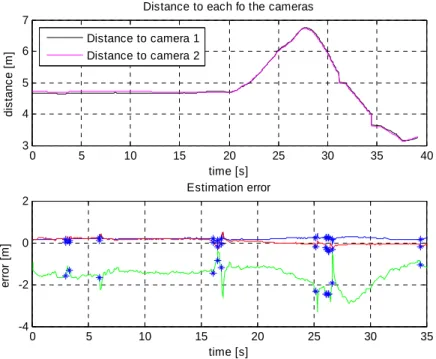
In this experiment, the quadrotor was fixed at the floor. The optical axes of the cameras were in parallel, with a base line around 1,5 meters. The situation is the one described in Figure 9. A resolution of 640x480 was selected. Figure 10 shows the estimation error in XYZ, as well as the distance between each of the cameras and the quadrotor. As seen, the position estimation error in the X and Z axes is around 15 cm, however, it reach the 3 m in the Y axis when the distance from cameras is maximum. In general, the most parallel the optical axes of the cameras are, the higher the error in depth estimation is.
Figure 9. Camera configuration with parallel optical axes in the Y-axis of the global frame and fixed quadrotor
30
Figure 10. Position estimation error in XYZ (blue, green, red) and distance between cameras and quadrotor (magenta, black) for fixed quadrotor and parallel optical axes. Blue marks “*” correspond to instants with
tracking loss from one of the cameras
2.5.3.2. Fixed quadrotor with orthogonal camera configuration
Now the configuration is the one shown in Figure 11. The optical axes of both cameras are orthogonal, corresponding to the best case for the depth estimation. This fact is confirmed by the results shown in Figure 12, where it can be seen that the estimation error has been reduced considerably.
Figure 11. Orthogonal configuration of the cameras
0 5 10 15 20 25 30 35 40 3 4 5 6 7 time [s] d is ta n c e [ m ]
Distance to each fo the cameras
0 5 10 15 20 25 30 35 -4 -2 0 2 time [s] e rr o r [m ] Estimation error Distance to camera 1 Distance to camera 2
31
Figure 12. Position estimation error in XYZ (blue, green, red) and distance between cameras and quadrotor (magenta, black) for fixed quadrotor and orthogonal configuration of the cameras
2.5.3.3. Fixed quadrotor with moving cameras
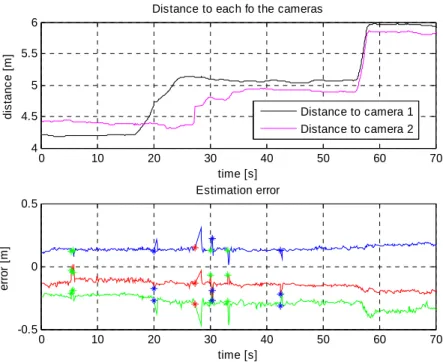
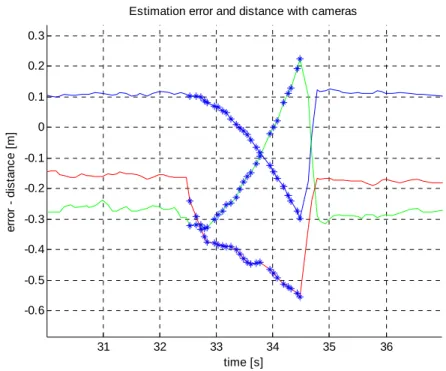
This experiment is a combination of the above two. At the beginning, the cameras are in parallel with a short base line. That is why the estimation error shown in Figure 13 is initially high. Then, the cameras are moved until they reach the orthogonal configuration (in t = 17 s), reducing at the same time the error. Figure 14 represent in more detail the evolution of the estimation error when tracking loss occurs from t = 32.5 s until t = 34.5 s. In two seconds, the estimation error in the Y-axis change in 50 cm due to the integration of the speed in the position estimation. In this case, the estimation is computed using monocular images from a single camera. 0 10 20 30 40 50 60 70 4 4.5 5 5.5 6 time [s] d is ta n c e [ m ]
Distance to each fo the cameras
0 10 20 30 40 50 60 70 -0.5 0 0.5 time [s] e rr o r [m ] Estimation error Distance to camera 1 Distance to camera 2
32
Figure 13. Estimation error and distance with cameras with fixed quadrotor and moving cameras, initially with parallel optical axes and finally with orthogonal configuration
Figure 14. Evolution of the position estimation error with multiple tracking losses (marked by a “*” character) in one of the cameras
0 5 10 15 20 25 30 35 40 45 50 3 4 5 6 time [s] d is ta n c e [ m ]
Distance to each fo the cameras
0 5 10 15 20 25 30 35 40 45 50 -2 -1 0 1 time [s] e rr o r [m ] Estimation error 31 32 33 34 35 36 -0.6 -0.5 -0.4 -0.3 -0.2 -0.1 0 0.1 0.2 0.3 time [s] e rr o r - d is ta n c e [ m ]
33
2.5.3.4. Fixed quadrotor with orthogonal camera configuration and tracking
loss
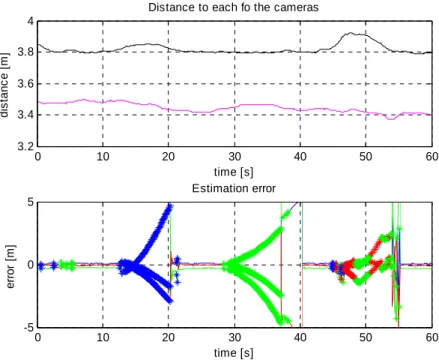
The goal of this experiment is to study the effect of long-term tracking loss from one or both cameras over the position estimation. The quadrotor was in a fixed position with the cameras in an orthogonal configuration, as shown in Figure 15. Here, the quadrotor is out of the Field of View (FoV) for the right camera. The estimation error results have been represented in Figure 16. The green and blue characters “*” represent tracking loss from left or right camera, while red character “*” correspond to tracking loss from both cameras simultaneously. The distance between each of the cameras to the tracked quadrotor has also been plotted in magenta and black. As it can be seen, the error grows rapidly when the vision-based estimation becomes monocular. The error is increased in 1 meter in around 4 seconds.
The number of consecutive frames with tracking loss can be used as a criterion for rejecting the position estimation, defining a maximum threshold. This idea is shown in Figure 17, where it has been represented the number of consecutive frames with tracking loss and a threshold of 15 frames.
34
Figure 16. Position estimation error and distance with cameras with long duration tracking loss for one of the cameras (blue and green “*” characters) and both cameras (red “*” characters)
Figure 17. Number of consecutive frames with tracking loss (blue) and threshold (red)
2.5.3.5. Z-axis estimation with flying quadrotor and parallel camera
configuration
In this experiment the quadrotor height is estimated with the cameras being in the configuration indicated in Figure 18 and a resolution of 1280x720 pixels. The pilot of the quadrotor was asked to perform movements along the Z-axis with two meters amplitude.
0 10 20 30 40 50 60 3.2 3.4 3.6 3.8 4 time [s] d is ta n c e [ m ]
Distance to each fo the cameras
0 10 20 30 40 50 60 -5 0 5 time [s] e rr o r [m ] Estimation error 0 10 20 30 40 50 60 70 0 10 20 30 40 50 60 70 80 90 100 time [s] N u m b e r o f c o n s e c u ti v e f ra m e s w it h t ra c k in g l o s s Threshold
35
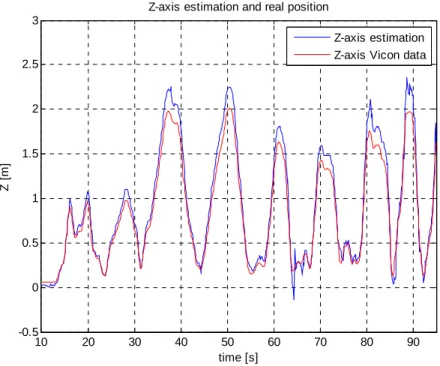
Figure 19 shows the Z-axis measurement given by Vicon (taken as ground truth) and the corresponding estimation obtained from visual tracking. The highest estimation errors are associated with changes in the sign of the height speed. Tracking loss marks are not represented here. The estimation error in depth (corresponding to YE axis in the global frame) is around 0,5 m, as shown in Figure 20, with a mean distance from cameras of 4,5 m.
The model of the system considered for the extended Kalman filter assumes that tracked object moves following a linear trajectory. This is why changes in the direction or in the sign of the movement have associated high errors in estimation. However, integrating acceleration information provided by the inertial sensors (IMU) in the EKF should reduce these errors. In the case of the quadrotors, the acceleration in the XY plane can be approximated from the roll and pitch angles.
Figure 18. Configuration of the cameras and the quadrotor for the Z-axis estimation experiment
36
Figure 19. Vicon height measurement (red) and vision-based estimation (blue)
Figure 20. Position error estimation in XYZ (blue, green, red) and distance between each of the cameras and the tracked quadrotor (magenta, black)
10 20 30 40 50 60 70 80 90 -0.5 0 0.5 1 1.5 2 2.5 3 time [s] Z [ m ]
Z-axis estimation and real position
Z-axis estimation Z-axis Vicon data
10 20 30 40 50 60 70 80 90 3.5 4 4.5 5 time [s] d is ta n c e [ m ]
Distance to each fo the cameras
10 20 30 40 50 60 70 80 90 -2 -1 0 1 2 time [s] e rr o r [m ] Estimation error
37
2.5.3.6. Depth and lateral motion in the XY plane
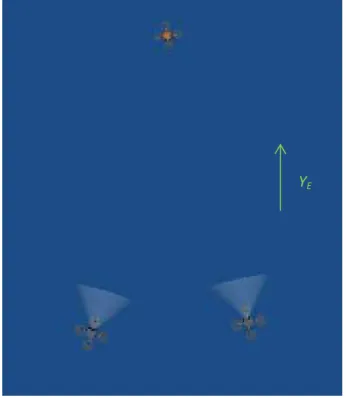
Here the quadrotor will move along the YE (depth) and XE (lateral) axes maintaining a constant height. The configuration of the cameras and the quadrotor is the one represented in Figure 21, with an image resolution of 1280x720 pixels and a mean distance of 5 m between the cameras and the tracked quadrotor. A high resolution in the images implies high acquisition and computation time, and then, the number of estimation updates per second might be insufficient. On the other hand, if the quadrotor speed is too high to be tracked or it is out of the FoV of the cameras for a long time, the position estimation will result useless. Figure 22 and Figure 23 represent the real position of the quadrotor taken from Vicon and the estimated one when the amplitude of the depth motion is about 4 m, and the amplitude in the lateral motion is about 5 m. There are some high amplitude errors in estimation for both X and Y axes due to consecutive tracking losses, as shown in Figure 24. However, once the tracking is recovered, the estimation error is rapidly reduced to normal values around 0,15 m. As mentioned, it is convenient to define a maximum number of consecutive tracking losses, so the vision-based position estimation is rejected if this threshold is exceeded.
Figure 21. Configuration of the cameras for the experiment with depth (YE axis) and lateral motion (XE axis)
YE
38
Figure 22. X-axis estimation with depth and lateral motion for the quadrotor
Figure 23. Y-axis estimation with depth and lateral motion for the quadrotor
0 20 40 60 80 100 120 2 3 4 5 6 7 8 9 10 time [s] X [ m ]
X-axis estimation and real position
Estimation
Vicon data Lateral Motion
Depth Motion 0 20 40 60 80 100 120 8 9 10 11 12 13 14 15 16 17 18 time [s] Y [ m ]
Y-axis estimation and real position Estimation
Vicon data
39
Figure 24. Number of consecutive frames with tracking loss with depth and lateral motion for the quadrotor
2.5.3.7. Quadrotor executing circular and random trajectories
In this experiment the cameras stayed in the fixed positions indicated in Figure 25, changing their orientation to track the quadrotor. The pilot was asked to perform two types of movements with the UAV: circular trajectory with a radius about 3 or 4 m, changing to a random trajectory from t = 80 s. The image resolution was set to 1280x720 pixels. The mean distance between the cameras and the quadrotor was 4 m.
The circular and random trajectories can be considered as the two worst cases for the extended Kalman filter as the model of the systems assumes linear motion. Here, a reduced number of frames with tracking loss may have a considerable influence over the error in the position estimation, as shown in Figure 26 and Figure 27. In the case of the Y-axis estimation (Figure 27), the error increases when the distance to the cameras becomes higher, although this was already expected, as it corresponds to the direction of depth. Finally, Figure 28 shows the consecutive number of frames with tracking loss, what causes the high-amplitude errors in the X and Y position estimation.
0 20 40 60 80 100 120 140 0 5 10 15 20 25 30 35 40 45 time [s] N u m b e r o f c o n s e c u ti v e f ra m e s w it h t ra c k in g l o s s
40
Figure 25. Configuration of the cameras with the quadrotor executing circular and random trajectories
Figure 26. X-axis estimation and real position when the quadrotor is executing circular and random trajectories
0 20 40 60 80 100 120 140 2 3 4 5 6 7 8 time [s] X [ m ]
X-axis estimation and real position Estimation
Vicon data
41
Figure 27. Y-axis estimation and real position when the quadrotor is executing circular and random trajectories
Figure 28. Number of consecutive frames with tracking loss when the quadrotor is executing circular and random trajectories 0 20 40 60 80 100 120 140 8 9 10 11 12 13 14 15 time [s] Y [ m ]
Y-axis estimation and real position
Estimation Vicon data
Circular Trajectory Random Trajectory
0 20 40 60 80 100 120 140 0 10 20 30 40 50 60 70 time [s] N u m b e r o f c o n s e c u ti v e f ra m e s w it h t ra c k in g l o s s
42
2.6.
Accuracy of the estimation
The accuracy of the vision-based position estimation will mainly depend on the number of available cameras without tracking loss, and their relative position between them. As shown previously in some experiments, the best configuration for the cameras is the orthogonal one, while the worst case corresponds to the optical axes being parallel. On the other hand, the image resolution is not so relevant for the accuracy. Moreover, as the estimation is computed from the centroid of the color marker, it is convenient that the projection of this marker has the smallest possible area, so a low resolution is preferable. However, if the color markers have a small area, the tracking algorithm will probably lose it when it moves away from the camera.
Table 1 contains some results obtained from the first two experiments presented above. The image resolution for all cases is 640x480.
Camera configuration
Distance from cameras [m]
Depth axis error [m] Transversal axes
error [m]
Parallel 4.75 1.5 0.15
Parallel 6.75 3 0.3
Orthogonal 4.6 0.25 0.15
Orthogonal 6 0.35 0.3
Table 1. Estimation error in depth axis error (YE) and transversal axes (XE, ZE) for different
configurations and distances
As commented earlier, there will be an offset error in the position estimation associated to an offset in the camera orientation measurement. The estimation error will increase proportionally with the distance between the camera and the tracked object, although it could be partially corrected by a calibration process. On the other hand, a small amplitude noise can be identified in graphical results due to a number of causes including noise in the position and orientation measurements of the cameras, errors in the centroid given by CAMShift or computation delays. However, this noise is negligible in comparison with the offset or the error due to tracking loss.
The visual estimation is rapidly degraded when the tracking is lost from one or both cameras, with an error approximately quadratic with time. Experimental results show that the error increases up to one meter in two seconds of monocular tracking with the quadrotor being in a fixed position.
43
2.7.
Summary
As summary, graphical and numerical results of the vision-based position estimation have been shown in different conditions and configurations. The highlights are as follows:
• The error in the position estimation strongly depends on the angle between the cameras and the tracked object so that the best configuration is the orthogonal one and the worst case corresponds to the cameras being parallel.
• Even in the parallel configuration, there is an offset error in the position estimation due to alignment error between the optical axis of the cameras and the corresponding axis of the base whose orientation is measured. This error will depend on the distance between the cameras and the UAV, but it could be corrected by calibration.
• The tracking loss from one of the cameras makes the estimation error increases up to one meter in around two seconds. The position estimation should be rejected if the number of consecutive losses exceeds a certain threshold.
• The position estimation might be enhanced if the extended Kalman filter integrates information of acceleration from the internal IMU of the UAV being tracked.
It must be taken into account that the EKF provides the estimated position of the color marker, not the estimation of the own UAV. The estimation is computed from the projection of a single pixel of the marker, assuming its centroid on the image. It is desirable for the marker to have a spherical shape so its projection over the image plane is independent from the viewpoint. If this estimation is going to be used for controlling the UAV, replacing its internal position sensors, it is important to consider the sources of delay that will disturb the control. The delay here is defined as the elapsed time since the images are going to be captured until the estimation is received by the quadrotor. The following delays can be identified:
a) Image acquisition delay, depending on the resolution being used and the speed of the sensor, it is equal to the inverse of the number of frames per second. A typical value of 30 ms can be considered for reference.
b) Image transmission delay, affected by the image resolution and compression algorithm (if digital) and available bandwidth.
c) Tracking algorithm delay, in the case of the CAMShift algorithm, it is around 5-10 ms for a 640x480 resolution, although it will depend on the processor speed and the image resolution.
d) Estimation update delay, the computation time for an iteration of the EKF, negligible in comparison with the others.
e) Estimation transmission delay, namely, the elapsed time between the transmission and reception of the position estimation to the UAV through the communication network. It can also be considered negligible, but it might be affected by packet loss.
In practice, the relative velocity between the UAV and the cameras should be limited (otherwise the tracking algorithm would be unable to track the object), and it should
44
convenient that the trajectories followed by the tracked object are as linear as possible so the model of motion considered in the EKF can be applied.
The definition of the variable threshold for the Fault Detection and Identification (FDI) depending on the distance from the furthest camera, allows the automatic rejection of the vision-based position estimation when there is a high number of consecutive frames with tracking loss. In a system with only two cameras, if one of them is unable to track the object, then the estimation will be monocular with the corresponding error integration. However, the variable threshold will increase in the same manner as the estimated distance to the furthest camera.
Execution timesTwo execution times were measured:
- Image acquisition: depending on the image resolution, the data interface (USB, FireWire IEEE 1394) and the USB hub internal to the computer. With the USB cable, the acquisition time for each of the cameras at 640x480 was around 15-20 ms, and it increases to 40-50 ms for 1280x720 pixels.
- Image processing: corresponding to the tracking algorithm. The time consumed by CAMShift with an image resolution of 640x480 pixels is about 5-10 ms.
The time consumed every iteration by the Extended Kalman Filter was not measured, but it is negligible in comparison with these two.
2.8.
Evolution in the development of the vision-based position
estimation system
A first version of the tracking and estimation program was completed in a month (November). It was programmed in C++ with the Visual Studio environment in Windows OS. The tracking algorithm used by the time was the TLD (Tracking-Learning-Detection). For the first tests, the cameras had to be in fixed positions, as position and orientation measurements were not available. The estimation program was executed in real time, with a virtual reality representation of the estimation generated with VTK (Visualization Tool Kit) library.
After a meeting with CATEC, it was decided to change the platform from Windows to Ubuntu. The installation of the 12.04 LTS version along with the Open CV library, the Eclipse Juno IDE and other software used took another month. The Open CV version used in Windows was the 2.4.2, however, the 2.4.3 version was released by the time. Detecting compatibility problems with the latest version cost two weeks.
In the next month (January), the estimation program was adapted to Ubuntu. The first version was written in C, changing to C++ language. Some specific functions, such as timing functions, had to be modified because they are different in Windows and Linux. The CATEC provided a library for accessing the position and orientation measurements of its Vicon Motion Capture System, and then, the data acquisition program was developed. The first experiments were