Asterisk PBX Capacity Evaluation
Lucas R. Costa, Lucas S. N. Nunes, Jacir L. Bordim, Koji Nakano† Department of Computer Science
University of Brasília(UnB), 70910–900, Brasília, Brazil †Department of Information Engineering
Hiroshima University, 1-4-1 Kagamiyama, Higashi-Hirhoshima, 739-8527, Japan e-mail: {lucasrc,saad,bordim}@cic.unb.br, [email protected]
Abstract—A VoIP communication infrastructure may need to serve a substantial number of users with an acceptable voice quality. This paper investigates the suitability of the Asterisk PBX server to provide VoIP communication capabilities with an acceptable Mean Opinion Score (MOS) quality to a large number of users. Theblocking probabilitymetric is used to measure the capacity of the PBX server while MOS is used to assess the quality of the voice calls. Analytical results show the suitability of the Erlang-B model in characterizing the capacity of the Asterisk PBX server considered in this work. Experimental results have shown that the Asterisk PBX can effectively handle more than
160concurrent voice calls with a blocking probability of less than
5% while providing voice calls with average MOS above4.
Index Terms—Performance Analysis, Asterisk, Erlang-B Model, VoIP, VoWiFi.
I. INTRODUCTION
Since its birth, Voice over Internet Protocol (VoIP) gained considerable interest as a feasible alternative to reduce commu-nication costs [1]. The availability of IP phones and softphones have extended the use of VoIP beyond the personal computer. In its simplest form, users are now able to connect their devices to a VoIP provider and establish low-cost calls. As VoIP calls are sensitive to jitter and delay, it is up to the underlining network infrastructure to provide the necessary means to carry voice packets to meet the Quality of Service (QoS) requirements.
While Internet Service Providers have been furnishing their subscribers with VoIP services for some time now, many institutions are attempting to add such capabilities to their own network infrastructure. This is the case at the University of Brasília (UnB) that owns and operates a network infrastructure serving more than fifty thousand users. The motivation comes from the fact that, in general, VoIP capabilities can further improve the availability of voice communication, reaching not only faculty staff and members, but also students and guests. Furthermore, as the institution maintains a large number of wireless access points, over a thousand currently, scattered on its main access and gathering areas, users would be able to place VoIP calls virtually anywhere in the campus. This, in turn, would extend the capability of the institution to provide a free communication channel among its users. However, one of the caveats of such approach is the need of
cost-PBX has been selected. The Asterisk cost-PBX has a number of interesting features: (i) its implementation is based on open source software under the GPL license; (ii) runs on multi-ple operating systems on different platforms; (iii) supports various VoIP protocols and codecs to manage digital and analog traffic on TCP/IP networks [2]; and (iv) incorporates several capabilities of conventional telephone exchanges, such as user authentication, call management (call detail records), monitoring, SMS messaging, voice messages and callback.
There are few studies that investigate the Asterisk PBX performance. However, these studies often assume a limited user population [3] or restrict their attention in specializing and extending the features of the PBX server [4]. Furthermore, tests and experiments to determine the maximum capacity of the Asterisk server are usually based on subjective analysis of the audio channel and its performance with an increasing number of calls [5]. Nonetheless, empirical approaches hinder a projection for the design of the server capacity. This work presents a methodology to evaluate the capacity and the quality of the voice calls provided by the Asterisk PBX server with an increasing workload. More precisely, this work evaluates the capabilities of the Asterisk PBX implementation in supporting a substantial number of users with an acceptable voice quality level. The evaluation and analysis have been conducted at the University of Brasília, which aims to provide VoWiFi (Voice over WiFi) to its users.
The Erlang-B model is widely used in dimensioning the capacity of a Contact Center and could be applied to very the capacity of a VoIP server. In [6], [7], the authors use the Erlang-B model to calculate the packet loss probability. To measure the capacity of the VoIP server, we employ the
blocking probability (BP) [8] and the Mean Opinion Score
(MOS) test [9]. The BP represents the ability of the system in handling the offered traffic load while the MOS is used to assess the quality of the voice calls. These techniques will be used in evaluating the capacity of the Asterisk PBX sever and its suitability to handle a given voice workload. In order to characterize the system workload, the Erlang-B model is employed. Empirical and analytical evaluations are conducted to evaluate both the capacity and the quality of the voice calls provided by the PBX server. In addition, this approach allows verifying the scalability of VoWiFi environ-2015 IEEE International Parallel and Distributed Processing Symposium Workshops
sufficient elements to characterize VoIP traffic on an Asterisk server.
The remainder of the paper is organized as follows. Sec-tion II presents the environment at which the tests and evaluations have been carried out. Section III describes the performance methodology employed in this work to assess the capacity of the Asterisk PBX server. Analytical and empirical results are shown in Section IV. Finally, Section V concludes this work.
II. VOWIFIENVIRONMENT ATUNB
The goal of the VoWiFi project at University of Brasília (UnB) is to provide instruments to its users enjoy the capabil-ities of a commercial PBX service via open-source alternatives. Currently, Wi-Fi access points cover the majority of the com-mon areas within the campuses. The integrated Wi-Fi network at UnB was conceived to provide Internet access to students and faculty staff, although guest users can also benefit from the service. The possibility of enhancing the Wi-Fi infrastructure with VoWiFi capabilities as an alternative to provide telephone services (voice calls) to its users is highly desirable. With this in mind, the UnB VoWiFi project started. However, a number of concerns arise when defining a system that is supposed to provide quality calls to a substantial number of users. While authentication and phone number can be assigned based on the unique IDs that distinguishes students and faculty staff and faculty members, the capacity of the server and its ability to provide a reasonable quality of experience of a VoIP call is not easily obtained.
A. Environment
Figure 1 illustrates the architecture of the VoWiFi environ-ment at UnB. The Asterisk PBX is responsible to provide the necessary means to allow a user with a Session Initiated Protocol (SIP) [10] client to engage in VoIP calls using the UnB Wi-Fi infrastructure. The PBX uses the Lightweight Directory Access Protocol (LDAP) [11] for user authentication and call registration. VoWiFi users can place calls to another VoWiFi user as well as reach landline telephones within the UnB campuses.
Presently, a2.67GHz Intel Xeon CPU with2GB of memory hosts the Asterisk PBX server version1.8.15cert1” with SIP protocol support. The G.711 (μlaw) codec has been used due to its compatibility to the available telephone network. System performance tests are being carried out and this work aims to assess the server capacity necessary to provide VoWiFi capabilities to the UnB users.
B. Call Setup Procedure
The message exchange necessary to setup a call using a SIP-client in the proposed VoWiFi environment with the support of the Asterisk PBX is depicted in Figure 2. The SIP protocol uses a set of messages to establish and terminate calls. These messages are exchanged between the end users. At the start of a call, the SIP Client (i.e., the caller) sends an INVITE
message to the Asterisk server. The server, in turn, forwards
LDAP Server University Telephone Exchange Asterisk Server Wireless Network Smarthphone
Figure 1: Asterisk based VoWiFi Environment at UnB.
SIP Call Generator Asterisk SIP Call Receiver INVITE INVITE 100 180 Ringing 200 OK ACK RTP RTP RTP RTP BYE 200 OK 180 Ringing 200 OK ACK BYE 200 OK
Figure 2: Operation of SIP protocol.
the message to the receiver of the call (i.e., the callee) and sends a message type100back to the caller. Next, the receiver sends a180 Ringingmessage, followed by a200 OKmessage to the Asterisk PBX, which are forwarded to the caller. After correctly receiving the above messages, the caller sends an
ACK packet, which confirms the connection. Note that the Asterisk PBX takes part by forwarding SIP messages back-and-forth between the caller and the callee (depicted in the figure as SIP call generator/receiver, respectively).
Once the SIP session is established, VoIP packets are exchanged via RTP [12] between the caller and the callee. Again, the Asterisk PBX handles all RTP messages. When the communication ends, the call generator disconnects by sending a message typeBYEto the Asterisk PBX, which is forward to the destination of the call. The callee, on receiving the BYE
message returns a message200 OK, tearing up the call. As can be observed in Figure 2, Asterisk PBX serves as a gateway to all SIP messages exchanged between the endpoints as well as it handles all the VoIP messages encapsulated by the RTP protocol.
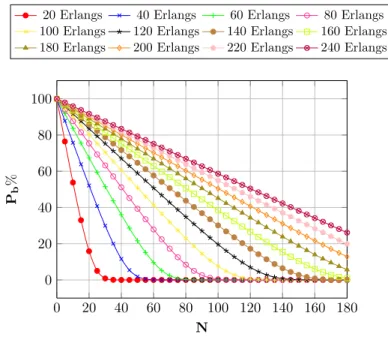
0 20 40 60 80 100 120 140 160 180 0 20 40 60 80 100 N Pb %
20 Erlangs 40 Erlangs 60 Erlangs 80 Erlangs 100 Erlangs 120 Erlangs 140 Erlangs 160 Erlangs 180 Erlangs 200 Erlangs 220 Erlangs 240 Erlangs
Figure 3: Analytical model of Erlang-B with a varying workload.
III. ASTERISKPBX PERFORMANCEANALYSIS The performance analysis requires an intimate knowledge of the system and a careful choice of the methodology, metrics, workloads, and evaluation tools [13]. We begin by establishing a point of reference to serve as the basis to evaluate the behavior of the PBX system. The VoWiFi environment is then used to verify whether the selected metrics are suitable to describe its response. For this latter task, a number of experiments with varying number of parameters are used to stress the Asterisk PBX.
The subsequent sections describe the chosen workload pa-rameters, the analytical model and the proposed evaluation scenario (empirical method).
A. Defining the PBX Workload
To conduct the performance evaluation of a PBX system, one needs to define and characterize its workload, the average arrival rate of the calls, and the average duration of phone calls in the busiest hour. These metrics are used to measure the system performance during the peak hour. The Erlang is a unit of measurement of telephone traffic intensity for a period of one hour [6]. This unit is usually employed to establish the size of a telephony PBX. An Erlang represents a voice channel being used continuously for one hour, as defined in Equation (1).
Erlang= calls/h×duration (minutes)
60minutes (1)
With the workload defined and characterized in Erlangs, it is possible to scale the capacity of Asterisk server according to the demand of simultaneous connections.
B. Analytical Model
When the number of calls in a peak hour is known a priori, the task of defining the necessary elements to cope with the demand resumes to establishing the necessary number of lines, or channels, that will be sufficient to meet such demand. However, in general, the demand by far exceeds the available resources. In addition, the telephone PBX environment has many unpredictable factors that can cause unexpected peak de-mands. Such unpredictable demands may reach the point that exceeds the server capacity. Thus, the challenge in designing a PBX service is to find the least amount of resources that will be necessary to allow the server to deal with the offered load. The characteristics of a PBX server can be determined when the following variables are known:
1) the number N of channels that will be available to users;
2) the PBX demand (A) in Erlangs; 3) the blocking probability (Pb) of the PBX.
The PBX capacity can then be expressed by the numberN of lines, or channels, in terms of a demandAto be met and the congestion probabilityPbone is willing to accept. The analyt-ical model of Erlang-B [6], representing this environment is
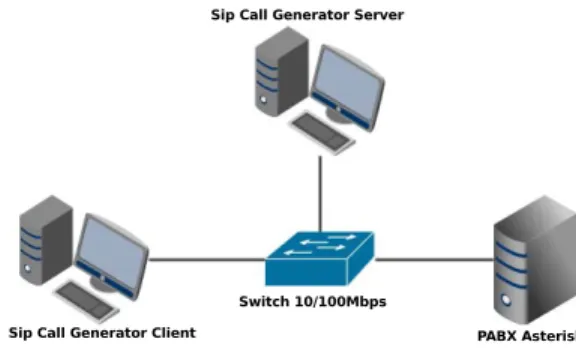
Sip Call Generator Server
Switch 10/100Mbps
PABX Asterisk Sip Call Generator Client
Figure 4: Simulation environment.
Empirical Asterisk PBX Evaluation Steps:
1) The SIP Client (SIP p_C) generates calls with an arrival rate of λ;
2) The SIP Server (SIP p_S) answers the calls;
3) BothSIP p_C andSIP p_Sexchange RTP packets for hseconds;
4) The voice quality and the blocking rate are evaluated and registered.
Figure 5: Asterisk PBX evaluation steps.
shown in Equation (2): Pb= AN N! N i=0 Ai i! , (2)
where A is the offered traffic in Erlangs; N is the number of channels used to carry to offered traffic; andPb is the call blocking probability. Figure 3 shows the results of Equation (2) for different traffic loads in Erlang. As can be observed, the larger the N (number of channels), the lower the blocking probability gets. Also, increasing the workload, results on a higher blocking probability for the same number of channels.
C. Experimental Settings
The experimental settings described in this section aims to determine the maximum capacity of the Asterisk server. In addition to the Asterisk PBX, two machines are used to generate a number of VoIP calls between a SIP call generator server and a SIP client server. The SIPp v3.3 is used for generating SIP traffic [14] and has been installed on an Intel Dual Core2.93GHz processor with2GB of memory. The SIP Call Generator Client and Server machines were connected to the Asterisk PBX server as depicted in Figure 4.
The “VoIPmonitor” tool [15] is used to observe the SIP traffic and assess the quality of the VoIP calls. Assessing the quality of the call is made by measuring voice quality according to the Mean Opinion Score (MOS) test. The MOS
consists of a subjective method of voice quality test [9]. The MOS score ranges from1, representing the worst case, to 5, representing the best case. For the evaluation of the number of Real-time Transport Protocol (RTP) packets, the WireShark traffic analyzer [16] has been used. One may argue that the use of such tools on the PBX server may compromise the tests results. However, the empirical results show that the proposed evaluation scenario does not impose severe demands on the CPU. The empirical method proposed consists of four steps, which are executed for each VoIP call, as detailed in Figure 5. When a VoIP callsucceeds, that is, can be carried out, the voice quality is evaluated. Likewise, the blocking probability (BP) of the calls is recorded for later analysis. The RTP packets are used to obtain the call success rate and voice quality. The call duration (h) was set toh= 120seconds, corresponding to a dialogue between end-points without moments of idleness. The number of calls is defined by its arrival rateλ, with the offered traffic (A), in Erlangs, being expressed by the number of calls times the average duration of these calls.
IV. TESTRESULTS
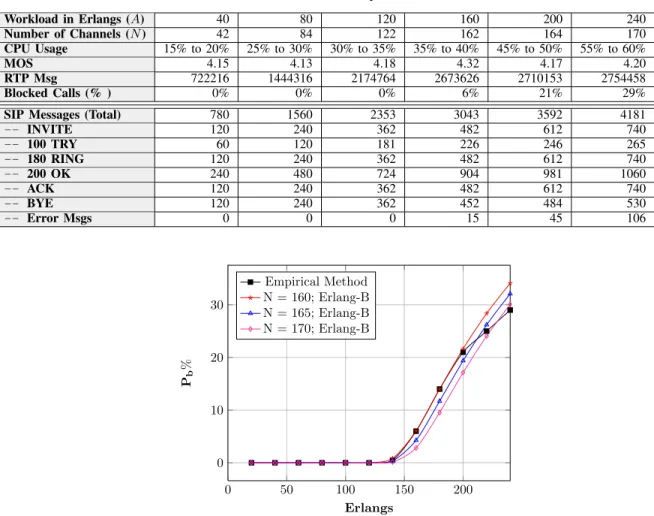
This section presents the results obtained by employing the steps defined in the Asterisk PBX Evaluation Steps (Figure 5). Table I shows the results obtained with the empirical method. The table shows the performance of the Asterisk PBX under different workload (expressed in Erlangs). Each “channel”, denoted asN, supports the communication between two end-users. Hence, a PBX comprising of N channels supports concurrent communication between at most 2N users. The table shows the maximum number of supported channels for different Erlang values in our setting. With a workload of A = 40 Erlangs, the PBX used 42 channels, allowing for 40 concurrent calls. The table line “100 TRY” indicates the number of calls that have been established during the experiment (180seconds for call placement with call duration ofh= 120seconds). For instance, withA= 40, each call of
120seconds demanded the exchange of12036 = (722216/60)
RTP messages on average (i.e., ≈ 100 RTP messages per second). One can confirm that these values are consistent when no call block occurs, which is observed in the interval
40≤A≤120.
The MOS was measured by the VoIPmonitor utility. As can be verified in the table, the MOS values were always above 4, indicating that the obtained voice quality is in the range of “good” to “great”. It is important to note, however, that the VoIPMonitor does not consider dropped calls in the evaluations. That is, the MOS values presented in the table are voice qualities of the completed calls. The CPU demand grew proportionally to the presented workload, except for the case
of A= 240, which rose a little more due to the number of
packets errors. Nevertheless, the CPU usage was always below
60%in the evaluated scenarios. Packet error and the percentage of blocked calls occurred for higher workloads (A ≥ 160). Even in such cases, the PBX was able to maintain the quality of the calls, which is a highly desirable feature. Table I also shows the overall number of SIP messages exchanged during the experiments. The number of SIP messages increases along
Table I: Simulation results (empirical method). Workload in Erlangs (A) 40 80 120 160 200 240 Number of Channels (N) 42 84 122 162 164 170 CPU Usage 15% to 20% 25% to 30% 30% to 35% 35% to 40% 45% to 50% 55% to 60% MOS 4.15 4.13 4.18 4.32 4.17 4.20 RTP Msg 722216 1444316 2174764 2673626 2710153 2754458 Blocked Calls (% ) 0% 0% 0% 6% 21% 29%
SIP Messages (Total) 780 1560 2353 3043 3592 4181
-- INVITE 120 240 362 482 612 740 -- 100 TRY 60 120 181 226 246 265 -- 180 RING 120 240 362 482 612 740 -- 200 OK 240 480 724 904 981 1060 -- ACK 120 240 362 482 612 740 -- BYE 120 240 362 452 484 530 -- Error Msgs 0 0 0 15 45 106 0 50 100 150 200 0 10 20 30 Erlangs Pb % Empirical Method N = 160; Erlang-B N = 165; Erlang-B N = 170; Erlang-B
Figure 6: Comparison of the empirical and analytical results with an increasing workload.
with the workload. As shown in Figure 2, the SIP protocol demands the exchange of 9 messages to establish a call and 4 to tear it down, accounting to a total of 13 SIP messages for each call. Despite of this, SIP messages do not have a major impact on the Asterisk PBX performance. In fact, the RTP messages carry the bulk of the traffic and are responsible for the great part of the CPU demands.
A comparison between the empirical and the analytical model is shown in Figure 6. As can be seen, the empirical results are not bounded by N. Thus, these results allow verifying the value of N that better matches the empirical results. The above results suggest that our environment (as defined in Section II) is able to support approximately 165
calls. Thus, considering a busy hour for the VoWiFi project with about3,000calls (≈50calls per minute), with an average duration of three minutes and noting that the Asterisk server supports up to≈165simultaneous connections, the blocking probability of a call would be ≈ 1.8% by the analytical
model of Erlang-B. Considering the above results, one can see that a single Asterisk PBX is capable to handle a reasonable population with a lower call blocking probability. Figure 7 shows the results when considering a population of callers (that is, users supported by the VoWiFi project). Assuming a population of8,000, the figure shows the blocking probability for varying percentage of callers for different average call duration. With 60% of the population placing simultaneous calls, with an average duration of two minutes less than 5% of the calls are blocked. When the duration of the call is set to2minutes and30seconds, the blocking probability reaches nearly 21%. The blocking probability surpasses 34% of the calls when considering average call duration of 3minutes.
The above results show that the proposed VoWiFi setting would be able to handle a significant number of users. How-ever, taking into consideration the overall population of nearly
50,000 users that UnB aims to provide the service, only a fraction would be able to effectively use it. Among the
0 20 40 60 80 100 0 20 40 60 Population% Pb % 2.0 minutes 2.5 minutes 3.0 minutes
Figure 7: Blocking rate versus teachers and employees of UnB.
alternatives to provide the service to a large number of users is to define effective call policy that would impose limits to the number of calls a user may place. Of course, increasing the number of servers and server capacity are also a possible alternative.
V. FINALCONSIDERATIONS
This paper investigates the suitability of the Asterisk PBX server to provide VoIP communication capabilities with an acceptable MOS quality to a large number of users. To this end, the capacity of the server is evaluated using both analytical and empirical results. The blocking probability metric is used to measure the capacity of the VoIP server while the Mean Opinion Score is used assess the quality of the voice calls. Based on the experimental setting, this paper shows that the analytical model based on the Erlang-B can effectively characterize the capacity of the Asterisk PBX, not only in terms of the number calls being handled by the server but also in terms of the qualify of the voice calls. The model we used in this work proved to be capable to correctly characterize the system workload on the Asterisk PBX. Furthermore, in the evaluated scenario, the experimental results show that the Asterisk PBX using SIP effectively handled more than 160
concurrent voice calls with a blocking probability below5%. REFERENCES
[1] X. Wang, S. Chen, and S. Jajodia, “Tracking anonymous peer-to-peer voip calls on the internet,” in Proceedings of the 12th ACM Conference on Computer and Communications Security, ser. CCS ’05. New York, NY, USA: ACM, 2005, pp. 81–91. [Online]. Available: http://doi.acm.org/10.1145/1102120.1102133
[2] J. M. R. Bryant, L. Madsen,Asterisk: The Definitive Guide. O’Reilly Media, 2013.
[3] M. Alam, S. Bose, M. Rahman, and M. Abdullah Al-Mumin, “Small office pbx using voice over internet protocol (voip),” in The 9th International Conference on Advanced Communication Technology, vol. 3, Feb 2007, pp. 1618–1622.
[4] S. Goel and M. Bhattacharya, “Speech based dialog query system over asterisk pbx server,” in2nd International Conference on Signal Processing Systems, vol. 3, July 2010, pp. V3–752–V3–756. [5] M. Qadeer and A. Imran, “Asterisk voice exchange: An alternative
to conventional epbx,” inInternational Conference on Computer and Electrical Engineering, Dec 2008, pp. 652–656.
[6] I. Angus, “An introduction to erlang b and erlang c,” Telemanagement, July 2001.
[7] T. Misuth and I. Baronak, “Packet loss probability estimation using erlang b model in modern voip networks,” inElectrical and Electronics Engineering (ELECO), 2011 7th International Conference on, Dec 2011, pp. II–259–II–263.
[8] C.-L. Chen, “A new voip call admission control based on blocking probability calculation,” inCommunications and Networking in China, 2009. ChinaCOM 2009. Fourth International Conference on, Aug 2009, pp. 1–6.
[9] ITU-T, “Recommendation p.800, methods for subjective determination of transmission quality,” 1996. [Online]. Available: http://www.itu.int/ rec/T-REC-P.800-199608-I/en
[10] E. S. M. Handley, H. Schulzrinne and J. Rosenberg, “SIP: Session Initiation Protocol,” RFC Editor, RFC 2543, March 1999. [Online]. Available: https://www.ietf.org/rfc/rfc2543.txt
[11] K. Zeilenga, “Lightweight Directory Access Protocol (LDAP): Technical Specification Road Map,” RFC Editor, RFC 4510, June 2006. [Online]. Available: http://tools.ietf.org/html/rfc4510
[12] R. F. H. Schulzrinne, S. Casner and V. Jacobson, “RTP: A Transport Protocol for Real-Time Applications,” RFC Editor, RFC 3550, July 2003. [Online]. Available: http://www.rfc-editor.org/rfc/rfc1654.txt [13] R. Jain,The Art of Computer Systems Performance Analysis: Techniques
for Experimental Design, Measurement, Simulation, and Modeling. Wiley, 1991.
[14] R. Gayraud, “Sipp traffic generator for the sip protocol (http://sipp.sourceforge.net),” 2014. [Online]. Available: http: //sipp.sourceforge.net/
[15] V. Project, “Voipmonitor project (http://www.voipmonitor.org),” 2014. [Online]. Available: http://www.voipmonitor.org/
[16] G. Combs, “Wireshark sniffer (http://www.wireshark.org),” 2014. [Online]. Available: http://www.wireshark.org/
![Figure 1 illustrates the architecture of the VoWiFi environ- environ-ment at UnB. The Asterisk PBX is responsible to provide the necessary means to allow a user with a Session Initiated Protocol (SIP) [10] client to engage in VoIP calls using the UnB Wi-Fi](https://thumb-us.123doks.com/thumbv2/123dok_us/8707999.2357234/2.918.479.832.109.285/illustrates-architecture-asterisk-responsible-necessary-session-initiated-protocol.webp)